Engineering · Manufacturing · Project support
info@hnksglobal.comWhatsApp +86 18836207779 ↗

博客

  • Overhead Shop Crane

    Overhead Shop Crane

    Overhead Shop Crane

    Henan Mine Crane · Workshop Lifting Systems

    Overhead Shop Crane

    Move workpieces between machines, benches and assembly stations with an overhead shop crane arranged around your floor plan. Henan Mine Crane supplies single-girder, suspended and double-girder systems for industrial workshops.

    Specify your lifting load and handling route, then compare usable hook height, workshop coverage, controls and installation scope in a project proposal. New crane configurations are quoted to suit the building and operating cycle.

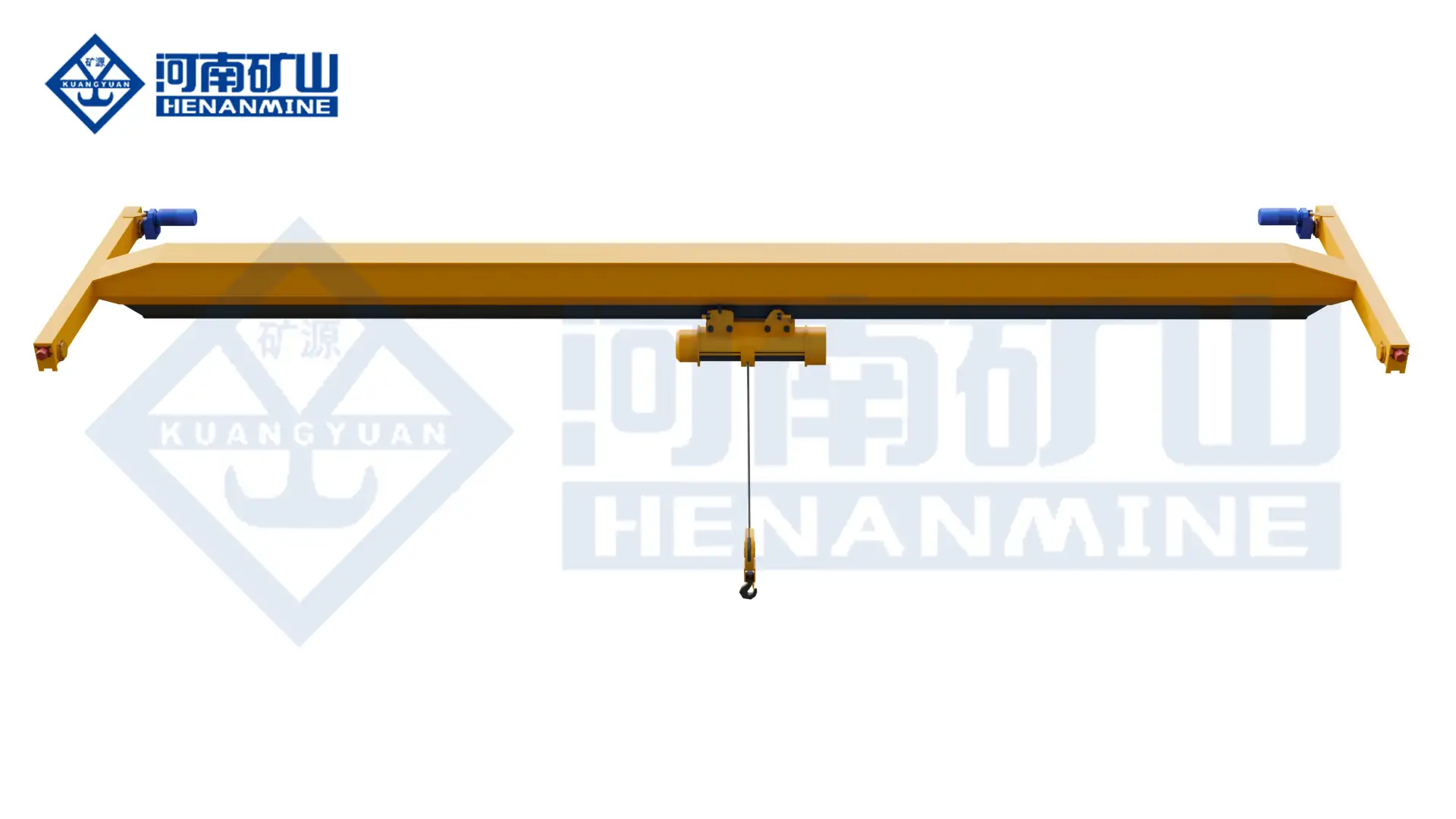
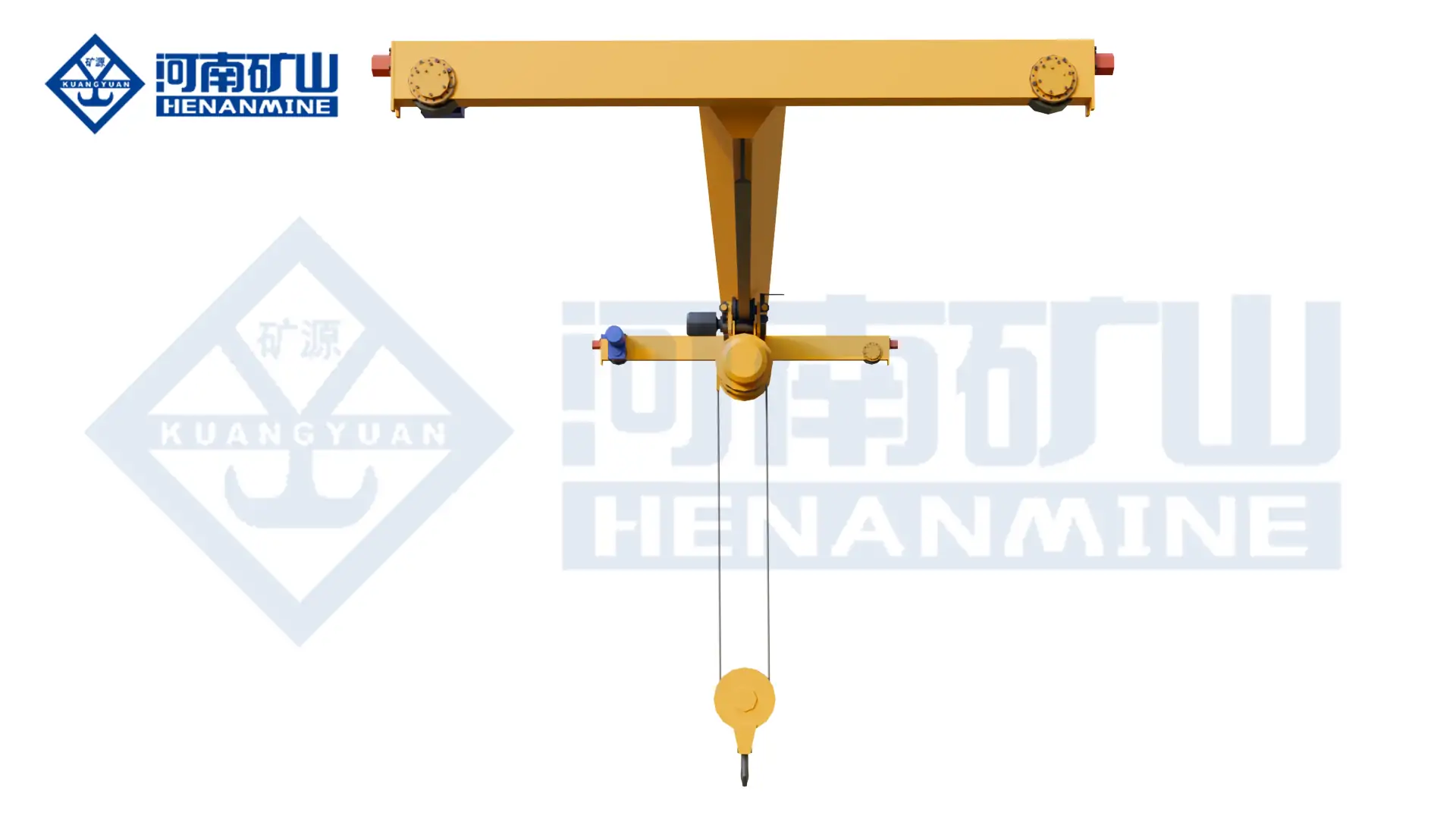
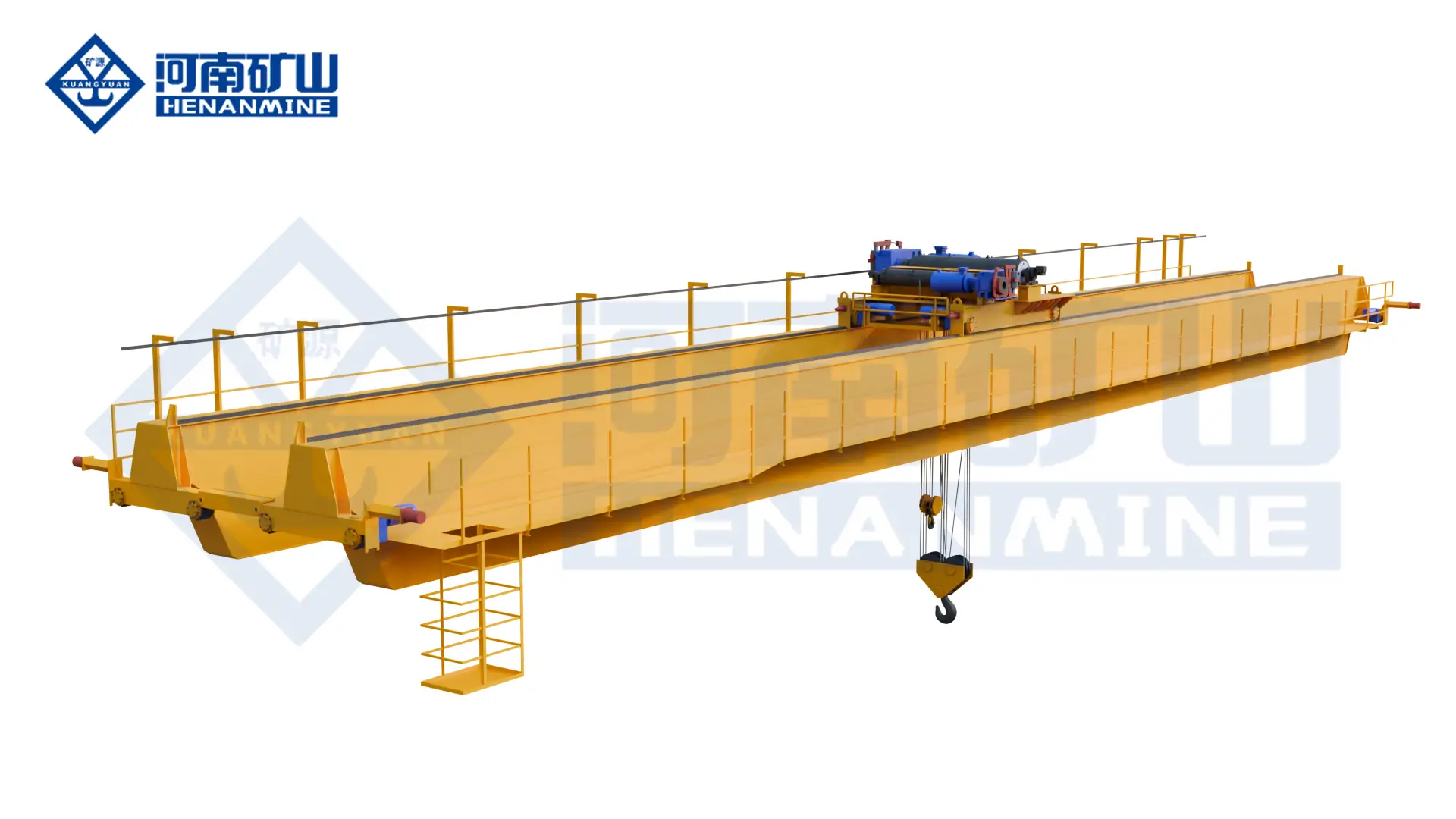
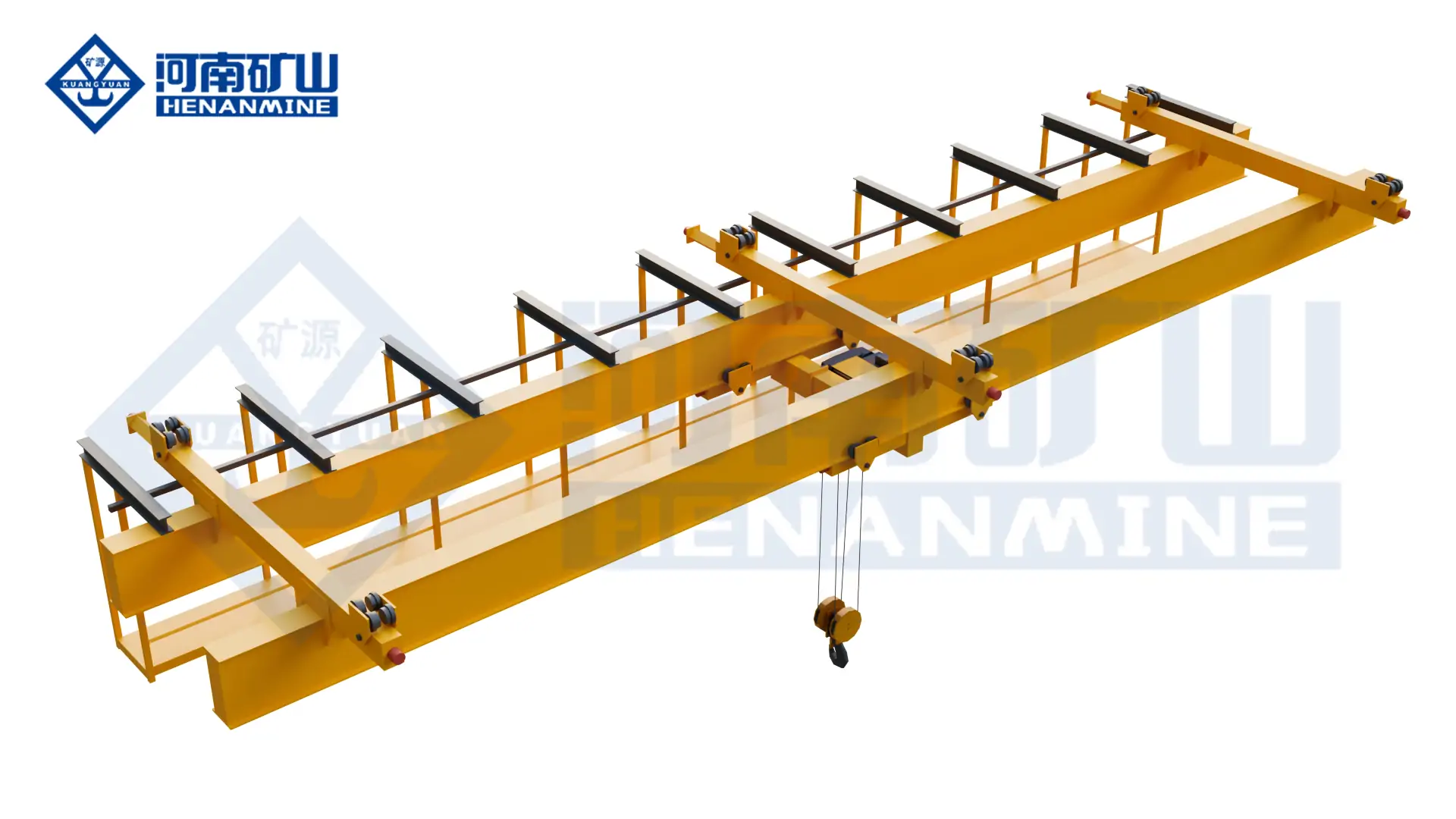
    Single-girder overhead shop crane with an electric hoist from Henan Mine Crane
    Single-girder electric-hoist arrangement. The illustration shows the crane structure; capacity and dimensions are confirmed in the proposal.

    WORKSHOP TASKS

    Machining, Assembly & Repair

    BRIDGE OPTIONS

    Single or Double Girder

    LAYOUT CHECK

    Hook Height & Coverage

    PROJECT SCOPE

    Crane, Runway & Installation

    Overhead Lifting for Industrial Workshops

    An overhead shop crane uses a travelling bridge on elevated runways to serve a workshop bay. The hoist raises the load, trolley travel moves it across the bay, and bridge travel carries it along the shop. Usable coverage depends on hook approaches and obstructions within that area.

    Machine Loading

    Position stock, fixtures and workpieces at machining stations. Check access through machine enclosures and the space needed above the lifted component.

    Fabrication and Assembly

    Move frames and assemblies between workstations. Record load dimensions, lifting points and orientation throughout the handling route.

    Equipment Repair

    Remove motors, gearboxes and machine components. Include the lifting gear and clearance needed to move the component onto a repair bench.

    Selection Considerations

    01 / LOAD

    Load and Lifting Gear

    State the maximum and typical load, dimensions and centre of gravity. Include slings, spreaders or lifting beams when defining the required lifting capacity.

    02 / REACH

    Hook Coverage

    Mark every pickup and placement point on the floor plan. Check the full suspended-load route, including machine guards, racks and maintenance access.

    03 / SPACE

    Building and Services

    Provide a cross-section showing roof members, doors, ducts, lights and other services. Identify possible runway supports and any proposed new columns.

    04 / OPERATION

    Work Cycle and Positioning

    Describe lifts per hour, shifts, travel distances and repeated positioning moves. This helps define crane duty, hoist duty and speed control.

    Single or double girder describes the bridge structure. Top running or underhung describes how the bridge travels on its runways. A hoist travelling below one girder does not automatically make the bridge an underhung crane.

    Overhead Shop Crane Compared with Other Workshop Lifting Configurations

    Start with the handling route and compare the complete installed arrangement. A lower crane equipment price can be offset by additional supporting steelwork, reduced hook coverage or more complex installation.

    Configuration Arrangement Workshop Application What to Check
    Single-Girder Shop Crane One bridge girder with a travelling electric hoist. General machine loading, assembly and maintenance. Check hook height, side approaches, operating duty and runway reactions.
    LX Single-Girder Suspension Crane Bridge end carriages run on the lower flanges of suitable runway beams. Workshops where a suspended runway arrangement fits the available structure. Assess beam flanges, connections, support loads and the complete crane envelope.
    Double-Girder Shop Crane Two bridge girders support the specified hoist or trolley arrangement. Tasks needing a different trolley layout, lifting envelope or equipment arrangement. Compare actual headroom and wheel loads; two girders alone do not establish duty.
    Crane on a Freestanding Runway An overhead bridge served by a fixed, separately engineered support structure. Buildings where existing steelwork cannot accept the proposed crane loads. Allow for columns, bracing and foundations. This is a support option, not a portable crane.
    Gantry Crane Alternative The bridge is carried by travelling legs. Areas where an elevated runway is unsuitable or a different travel arrangement is needed. Compare leg clearance, floor or ground loading and the specified travel path.

    Overhead Shop Crane Technical Specifications

    The following selected sizes use load, span and lifting-height entries from the linked Henan Mine Crane product tables. They provide catalogue references for an initial discussion; the final combination, duty and building interfaces require confirmation in the technical proposal.

    Product Reference Rated Load Runway Centreline Span Listed Lifting Height
    LX Single-Girder Suspension Crane 1 t 3.5 m 6 m
    Single-Girder Bridge Crane 2 t 7.5 m 6 m
    Single-Girder Bridge Crane 5 t 11.5 m 9 m

    Here, t means metric tonne: 1 t = 1,000 kg. State the unit explicitly if your requirement uses US short tons. Listed lifting height does not establish the minimum building height or available hook height.

    For a 5 t lifting requirement, see 5 Ton Overhead Crane. Include the proposed span, highest and lowest hook positions, runway length, duty, power supply and workshop drawing with your enquiry. Other sizes can be discussed against the same information.

    Workshop Headroom, Runways and Hook Coverage
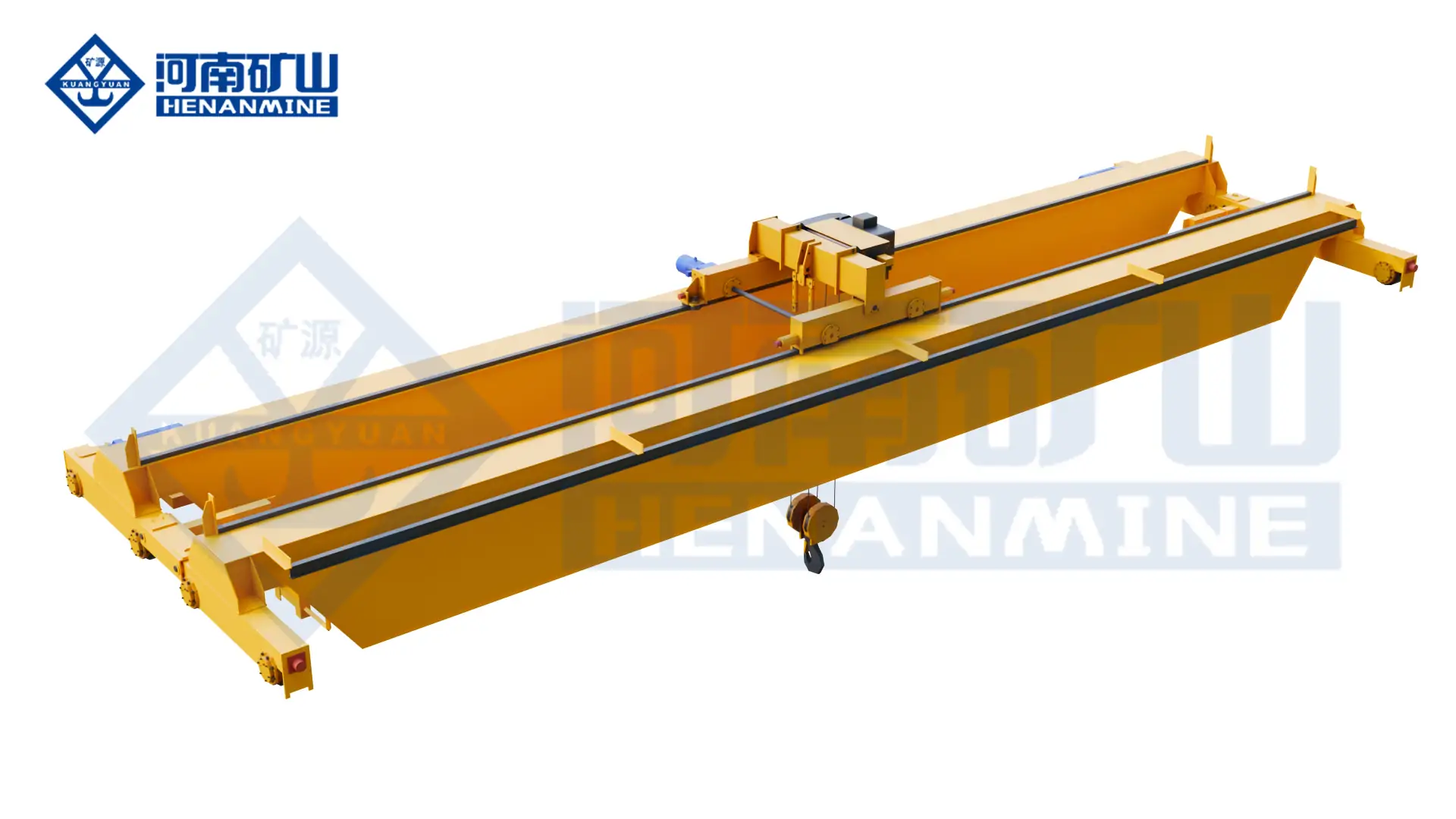
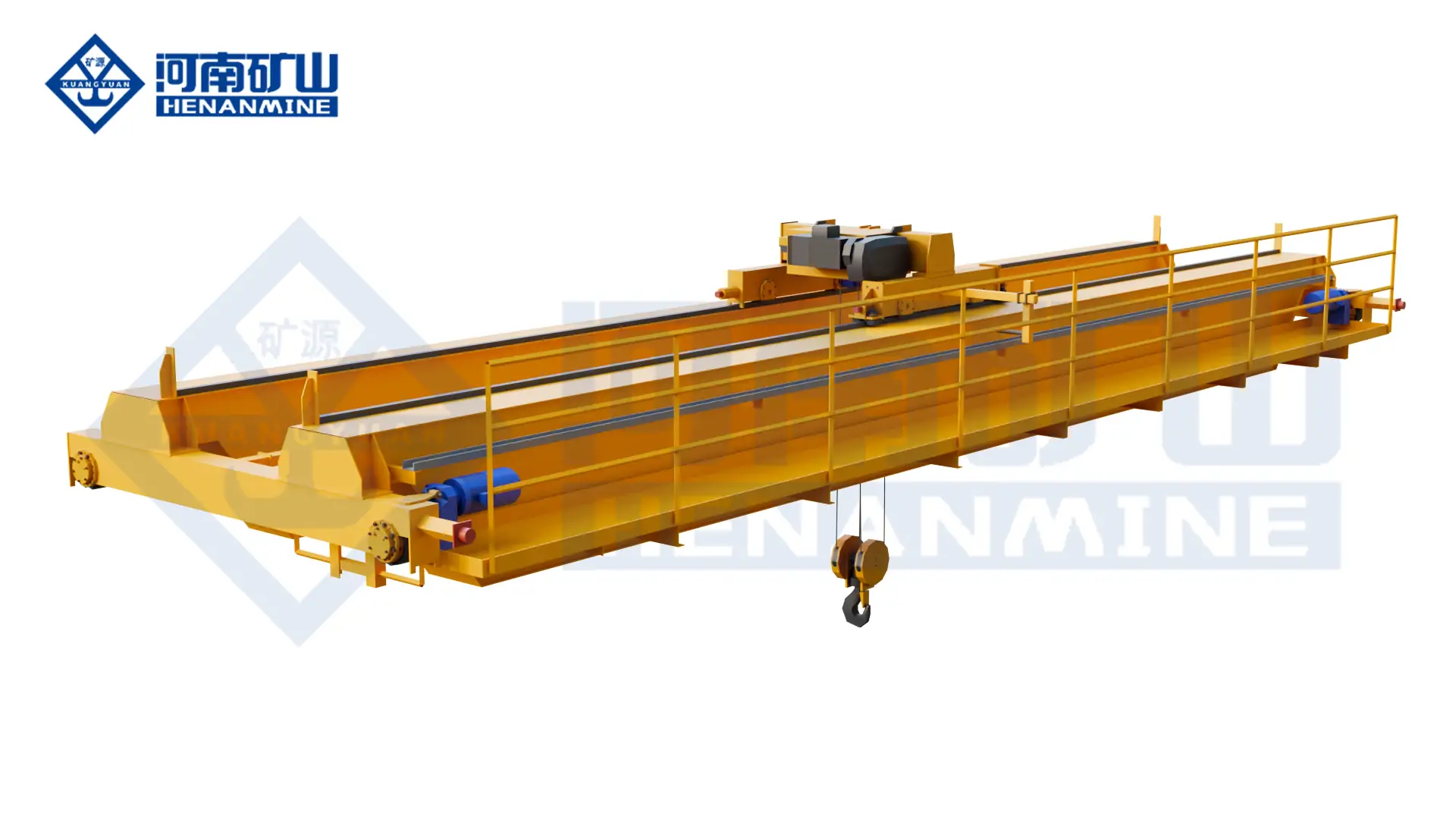
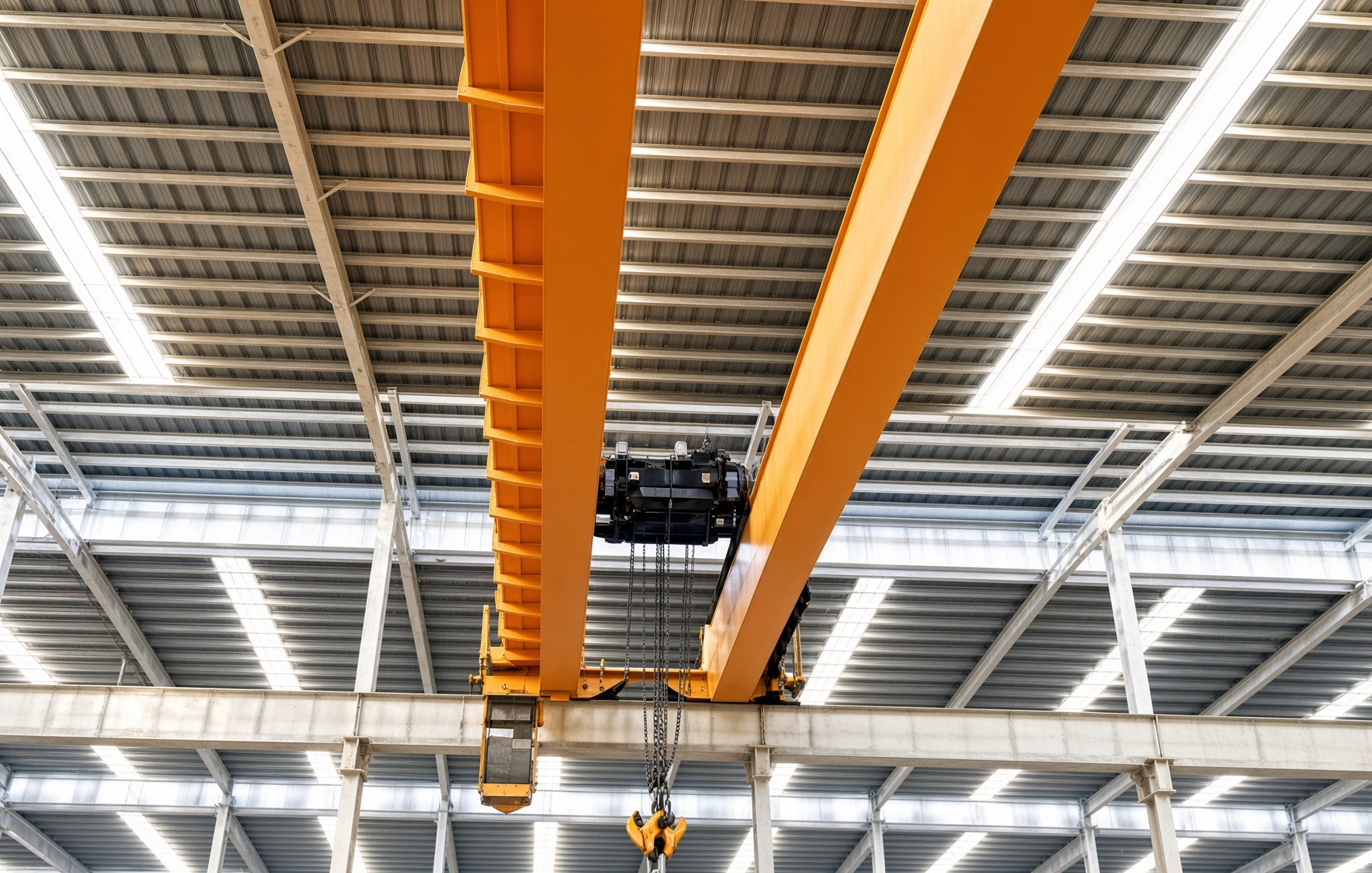
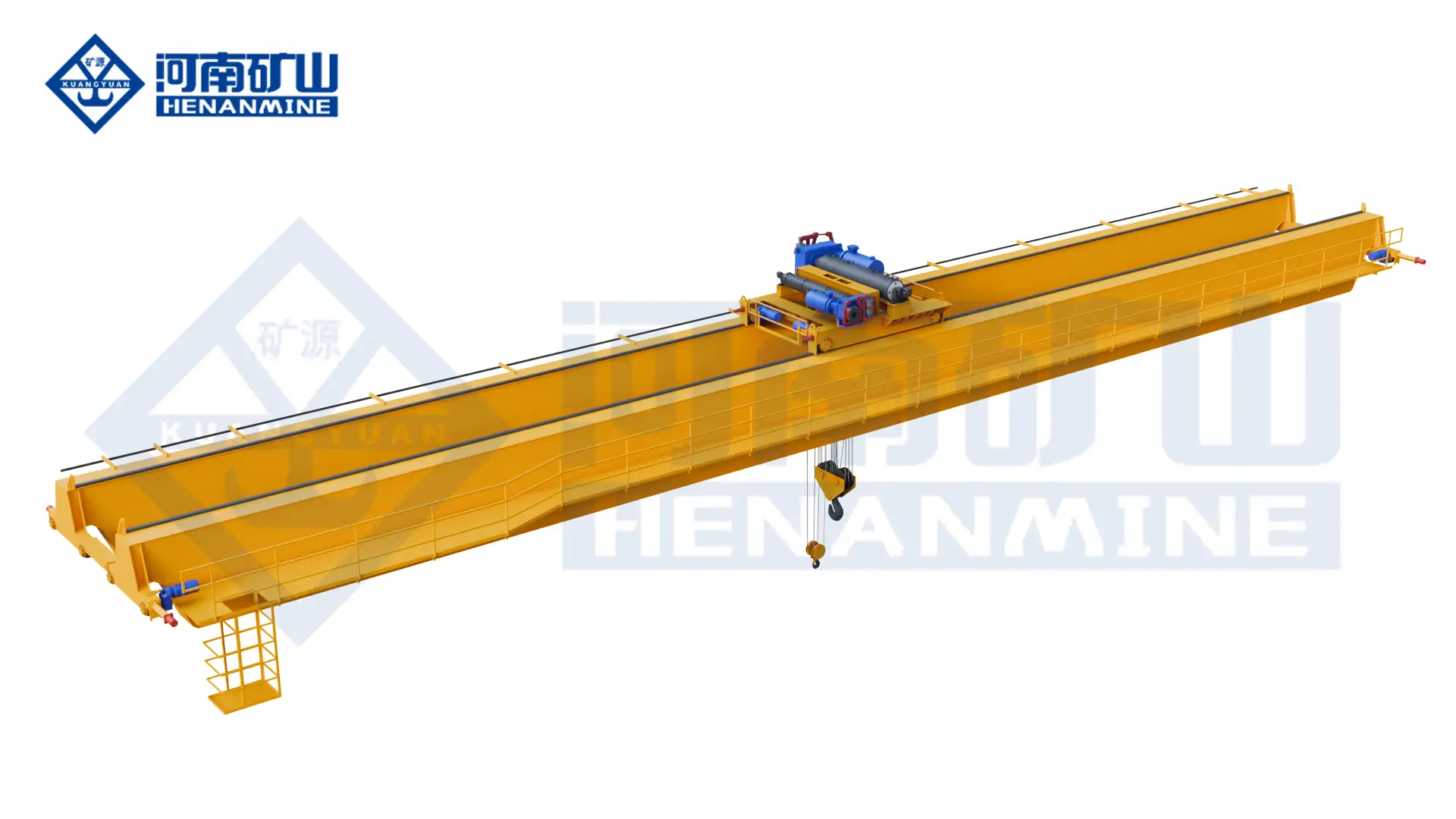
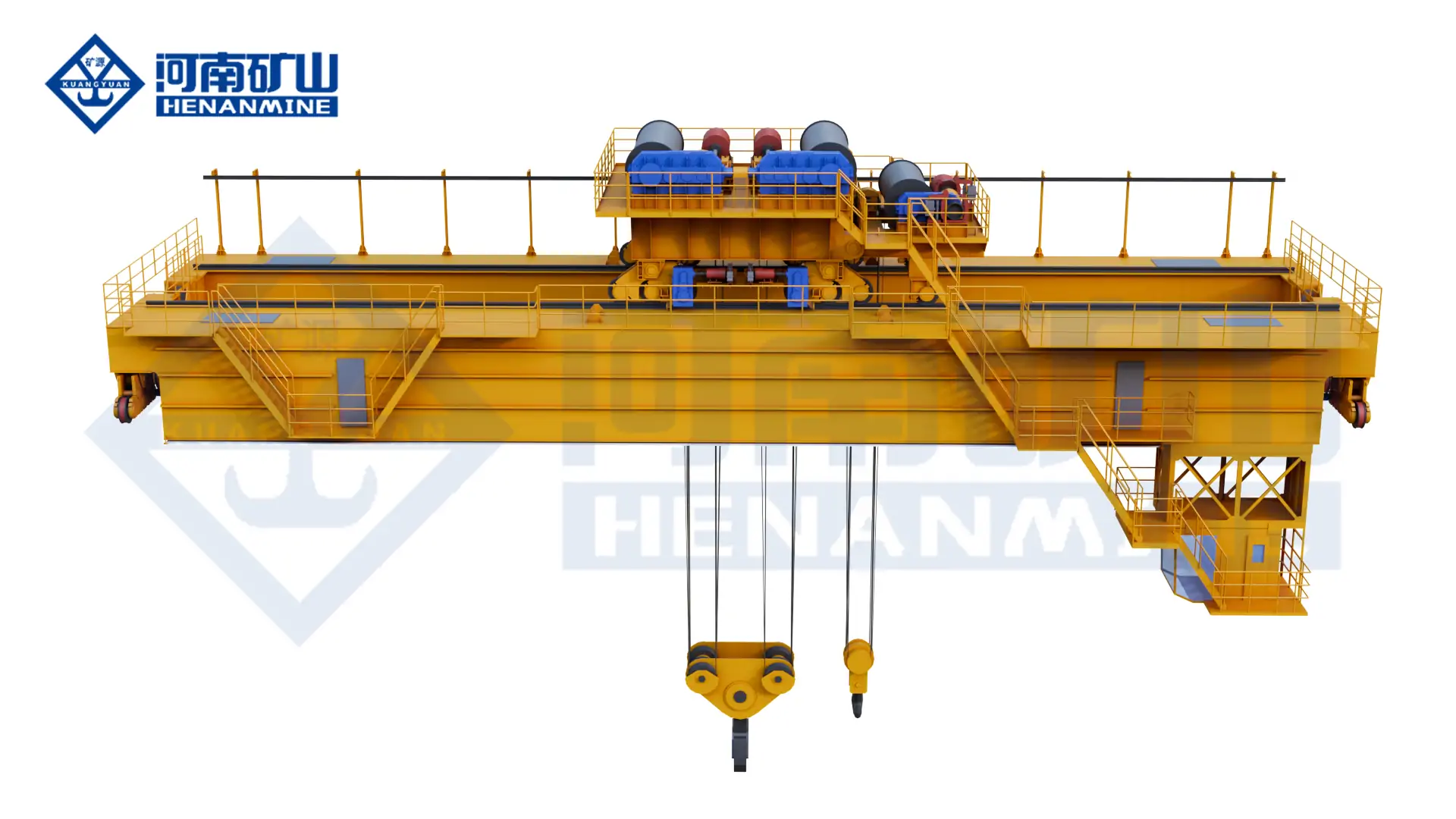
    Double-girder electric-hoist bridge crane arrangement from Henan Mine Crane
    Double-girder electric-hoist arrangement. Compare the proposed crane envelope and highest hook position on the workshop cross-section.

    Headroom and the Lifting Path

    Measure the highest required hook position with the load and lifting gear included. Show the machine or bench height, any required extraction distance, and obstructions above the route. Crane depth, hook-block dimensions and overhead clearances all affect the result.

    Check door panels and tracks in both open and closed positions, together with lights, ducts, sprinklers and other services. A low-headroom hoist and an underhung bridge are different design choices; compare the complete layout.

    Runways and Supporting Structure

    Crane span is measured between runway centrelines, while useful reach also depends on hook approaches. Existing building steelwork needs assessment against the proposed wheel loads, support reactions and operating forces.

    For a freestanding runway, check foundations, floor suitability, bracing and column positions. Keep machine service areas, walkways and vehicle routes accessible.

    Hoist, Travel Controls and Operating Duty

    Hoisting and Placement

    Specify lifting speed and any slow positioning requirement for machine loading. Frequent starts and short moves are part of the duty assessment, even when loads are relatively light.

    Trolley and Bridge Travel

    Match travel speeds to distances and the handling process. Define control behaviour for approaching workstations and stopping a suspended load.

    Pendant or Radio Control

    Choose controls around operator access, visibility and the walking route. Radio control provides operating flexibility; the operator still needs a suitable view of the load and travel path.

    Confirm voltage, frequency, phases and available power for the complete crane, plus the incoming connection and isolation arrangement. An existing workshop outlet does not establish compatibility. For variable-speed options, review the Frequency-Conversion Overhead Crane configuration and specify which motions require speed control.

    Safety and Workshop Environment

    The quotation should identify required safety functions, operating limits and the agreed verification scope for the selected crane. Capacity alone is not a complete safety specification.

    Load and Motion Protection

    Define overload protection, hoisting and travel limits, brakes, emergency stops and electrical protections. Agree how relevant functions are checked at acceptance.

    Workshop Access

    Plan safe inspection access and isolation for maintenance. Where cranes share a runway or operating area, assess separation and collision-prevention requirements.

    Special Environments

    Identify temperature, moisture, corrosion and any hazardous-area classification. Paint processes, combustible dust or hot-material handling may require dedicated equipment and a separate design review.

    For a classified hazardous area, review the Explosion-Proof Overhead Crane range and provide the site classification with the enquiry.

    Manufacturing and Project Documentation
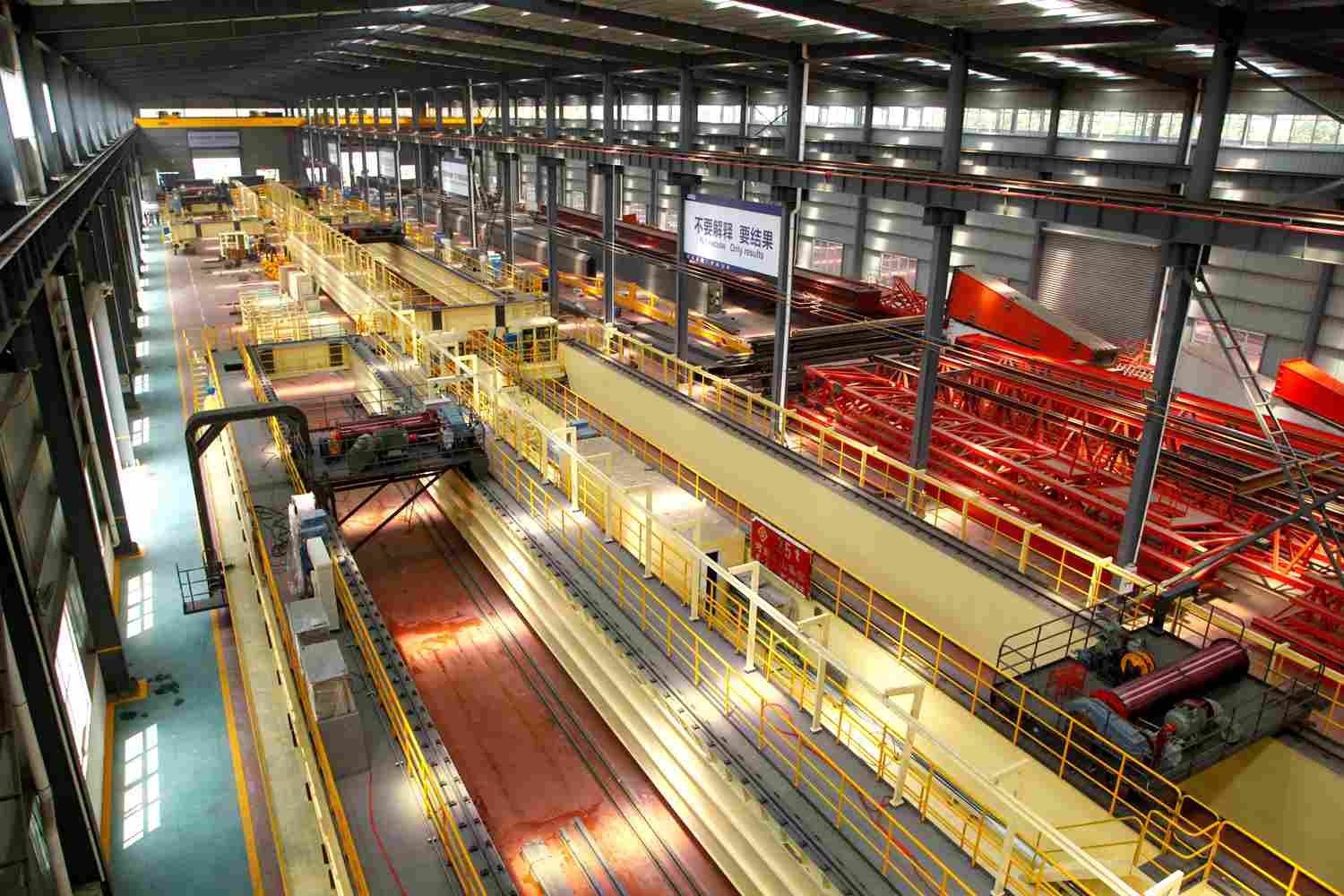
    Crane structure manufacturing workshop shown by Henan Mine Crane
    Manufacturing workshop photograph from the Henan Mine Crane factory display. This is a factory image, not a completed shop-crane installation.

    Henan Mine Crane publishes crane product information and manufacturing workshop photographs in its Factory Scene Display. For your order, agree the drawings and records that identify the supplied equipment and support technical review.

    • General arrangement drawing with hook approaches and crane envelope.
    • Runway interface data, wheel loads and support reactions.
    • Component schedule, electrical drawings and operating manuals.
    • Applicable inspection and test records, supplied against the agreed scope.

    State the project location and required standards or documentation at the quotation stage so their applicability and supply scope can be confirmed.

    Installation, Commissioning and Maintenance

    Plan the Installation Window

    Agree unloading access, assembly space and installation equipment. Identify machines or services affected by the work and coordinate the required workshop shutdown.

    Confirm the Site Interfaces

    Define responsibility for supports, foundations, runway beams, rails, power conductors and incoming electricity. Check the completed runway and electrical interfaces before commissioning.

    Prepare for Operation

    Agree the site inspection, testing, handover and operator familiarisation scope. Plan inspection intervals and replacement access using the supplied manuals and applicable requirements.

    When replacing an existing crane, provide a runway survey and the old crane details. Equal rated capacity does not guarantee compatible wheel loads, dimensions or electrical demand.

    What Determines Overhead Shop Crane Price?

    Overhead shop crane price depends on load capacity, span, lifting height, duty, hoist arrangement and controls. The building can also change the installed cost: a new freestanding runway has a different scope from a crane fitted to verified existing supports.

    When comparing overhead shop cranes for sale, request itemised quotations for the same lifting task and layout. Identify included items and site responsibilities in these three areas:

    Crane Equipment

    Bridge, end carriages, hoist, controls and specified protective functions.

    Runway and Site Work

    Supports, foundations, rails or beams, power supply and installation access.

    Delivery and Handover

    Packing, transport terms, installation, testing, documentation and commissioning.

    Overhead Shop Crane FAQ

    Can an overhead shop crane fit in a small workshop or garage?

    It depends on the load, available hook height, travel area and supporting structure. Provide a plan, cross-section and photographs. An ordinary garage roof or floor must not be assumed suitable. A local lifting task may also justify comparing a jib or gantry arrangement.

    What capacity should I choose for a shop bridge crane?

    Use the heaviest planned lift, including the applicable lifting attachments, together with typical loads and operating frequency. A 1 t, 2 t or 5 t requirement still needs a separate check of span, duty, hook coverage and supporting structure.

    Does an underhung crane give the most lifting height?

    Not automatically. The runway beam, suspension connections, bridge and hoist all affect the highest hook position. Compare dimensioned proposals against the same building cross-section and required lift.

    Can the crane use a freestanding support system?

    A separately engineered runway can support an overhead bridge where suitable. The design must account for columns, bracing, foundations, operating forces and workshop access. Freestanding describes the support arrangement; it does not mean the system can be moved while loaded.

    Can an overhead shop crane run on my existing power supply?

    Provide the voltage, frequency, phases and available power, together with the intended connection location. Compatibility is checked for all crane motions and controls. Do not assume a small rated load means the complete crane can use a standard wall outlet.

    Can one crane serve several machines?

    Yes, where its usable hook coverage and lifting route reach the required stations. Confirm side and end approaches, machine enclosures, load dimensions and operating schedules. Simultaneous work at separate stations may require a different lifting arrangement.

    What should I send to obtain a quotation?

    Send the maximum and typical loads, lifting gear, floor plan, building cross-section, required hook levels, runway length, work cycle, electricity details and project location. Add photographs of doors, services and possible supports, and identify the installation scope you need.

    Request An Overhead Shop Crane Quote

    Send Henan Mine Crane your lifting task and workshop drawing to discuss a suitable overhead shop crane configuration. Include:

    • Load, lifting gear and pickup and placement points.
    • Span, required hook levels, runway length and building cross-section.
    • Work cycle, environment, power supply and project location.
    • Required runway, installation, testing and delivery scope.
    Henan Mine CraneDiscuss your requirements ↗
  • Overhead Gantry Crane

    Overhead Gantry Crane

    Overhead Gantry Crane

    Henan Mine Crane · Industrial Rail-Mounted Gantry Cranes

    Overhead Gantry Crane

    Lift and transfer materials across a workshop or outdoor yard with an industrial overhead gantry crane. A travelling hoist or trolley carries the load beneath the bridge, while supporting legs transfer the crane loads to ground-level rails and their foundations.

    Henan Mine Crane manufactures single-girder, double-girder and semi-gantry configurations for production, storage and equipment handling. Select the arrangement around the load, hook coverage, ground conditions and operating cycle, with the crane and site interfaces defined in the quotation.

    Single-girder gantry crane with supporting legs and electric hoist from Henan Mine Crane
    Single-girder gantry configuration with an overhead electric hoist and supporting legs. Rails and foundations are specified for the installation.

    STRUCTURE

    Bridge, Hoist and Supporting Legs

    TRAVEL ARRANGEMENT

    Industrial Ground-Rail Operation

    CONFIGURATIONS

    Single Girder, Double Girder and Semi-Gantry

    PROJECT DEFINITION

    Load, Coverage, Duty and Site Conditions

    Which Overhead Gantry Crane Arrangement Fits Your Site?

    The term overhead gantry crane is used for different lifting arrangements. The industrial models on this page are gantry cranes with an overhead lifting mechanism and rail travel. A full gantry has supporting legs on both sides; a semi-gantry has legs on one side and an elevated runway on the other.

    An overhead bridge crane travels on two elevated runways, which may be supported by the building or an independent engineered structure. A small portable gantry on castors is another arrangement, with different floor, movement and load requirements.

    Workshops without Elevated Runways

    A full gantry can serve a working bay without relying on the roof structure for crane support. Ground rails, foundations and the moving-leg envelope still require space and engineering review.

    Outdoor Storage and Fabrication

    Serve defined pickup, storage and loading positions along a rail route. Include drainage, vehicle crossings, weather exposure and parking arrangements in the layout.

    Long or Bulky Components

    Check the complete path of beams, machinery and fabricated assemblies. Load orientation, leg clearance and any cantilever reach affect whether the crane can serve each position.

    Overhead Gantry Crane Technical Specifications

    The following reference ranges correspond to the linked Henan Mine Crane configurations. They describe different product arrangements, rather than a single standard machine.

    Configuration Rated Capacity Span Lifting Height
    Single-Girder Electric-Hoist Gantry Crane 1–32 t 6–35 m 4–20 m
    Double-Girder Electric-Hoist Gantry Crane 3–50 t 7.5–35 m 4–30 m
    Single-Girder Semi-Gantry Crane 1–32 t 6–35 m 4–20 m

    These ranges do not establish every possible load, span and lifting-height combination. Confirm the selected combination, crane duty, mechanism duty, wheel loads and dimensions in the project proposal. The unit t denotes a metric tonne.

    Other Specifications to Define

    • Runway length, rail level, required hook approaches and any cantilever working area.
    • Hoisting and travel speeds, positioning needs, lifts per hour and operating shifts.
    • Site voltage, frequency, phases, incoming supply and crane power distribution.
    • Pendant, radio remote or cabin control, with any process functions identified separately.
    • Indoor or outdoor conditions, temperature, dust, corrosion and applicable design requirements.

    Selection Considerations

    01 / LOAD

    Load and Attachment

    Use the maximum payload together with slings, lifting beams or other suspended devices to establish the required capacity. Describe the load shape and centre of gravity as well as its mass.

    02 / WORKING AREA

    Clearance and Coverage

    Mark pickup and placement points on a site plan. Check clear width between the legs, hook approaches, overhead obstructions and the swept path of long loads.

    03 / GROUND INTERFACE

    Rails and Foundations

    Provide existing rail and foundation information where available. The proposed crane reactions and wheel arrangement are needed to assess support suitability and any required civil work.

    04 / OPERATING CONDITIONS

    Duty and Environment

    Describe the handling cycle and exposure conditions. Hoist duty, travel duty, wind-related provisions and environmental protection must match the intended operation.

    Overhead Gantry Crane Compared with Other Crane Configurations

    Start with the support arrangement. A rail-mounted industrial gantry, a bridge crane and a portable workshop gantry place different demands on the site, even when the requested lifting capacity is the same.

    Configuration Support Arrangement Application Fit Main Selection Check
    Single-Girder Full Gantry One bridge girder supported by legs on both sides. Workshop and yard handling where the selected hoist and structure meet the duty. Check leg clearance, hoist headroom and the complete ground-rail footprint.
    Double-Girder Full Gantry Two girders carrying the selected hoist trolley or lifting arrangement. Projects needing a different trolley layout, lifting envelope or structural arrangement. Compare wheel loads, hook height and mechanism duty; two girders alone do not define heavy-duty capability.
    Semi-Gantry Crane Legs and a ground runway on one side; an elevated runway on the other. A work area beside a suitable elevated runway or supporting structure. Both support systems require assessment, together with their alignment and the moving-leg route.
    Overhead Bridge Crane A travelling bridge on two elevated runways. A bay with suitable elevated supports and a need to keep travelling legs out of the floor area. Check runway support capacity, roof clearances and hook approaches.
    Portable Workshop Gantry A separate gantry arrangement commonly supported on castors. Tasks where portability and local floor access are central requirements. Select for the specified floor and movement conditions; load-travel permission is model-specific.

    Leg Clearance, Lifting Height and Cantilever Reach

    The crane must reach the load and place it while keeping the load, hook block and lifting accessories clear of the structure. Check the working envelope on the general arrangement drawing, including the position of the moving legs.

    Layout Item Practical Design Check
    Span and clear leg width Runway centreline spacing does not equal the unobstructed width between the legs. Leg shape and bracing can reduce the passage available for a load or vehicle.
    Lifting height and rigging Allow for the load dimensions and lifting accessories above the placement surface or obstruction. Overall crane height is different from usable hook height.
    Cantilever and hook outreach A girder extension beyond the legs can serve an outside loading position. Trolley end limits reduce usable outreach, and the permitted load at that position must be specified.
    Runway length and end approach The rail route must account for crane end limits, stops, parking space and the operating envelope. Full rail length is not the same as usable hook travel.

    For long material handling, an L-Type Offset Gantry Crane offers a different leg geometry to consider. A Truss Gantry Crane is another structural option; its joints, maintenance access and wind design still require evaluation.

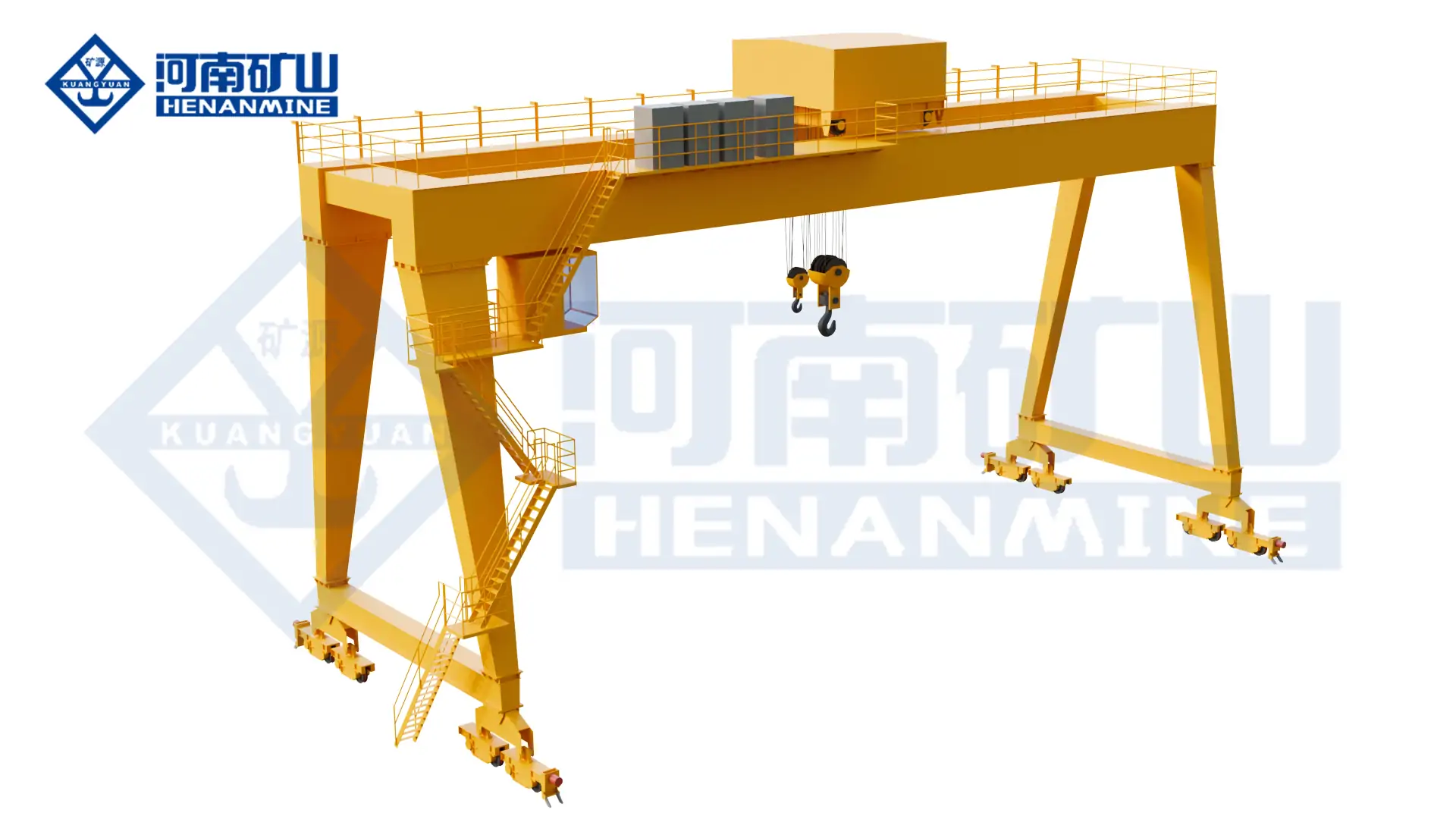
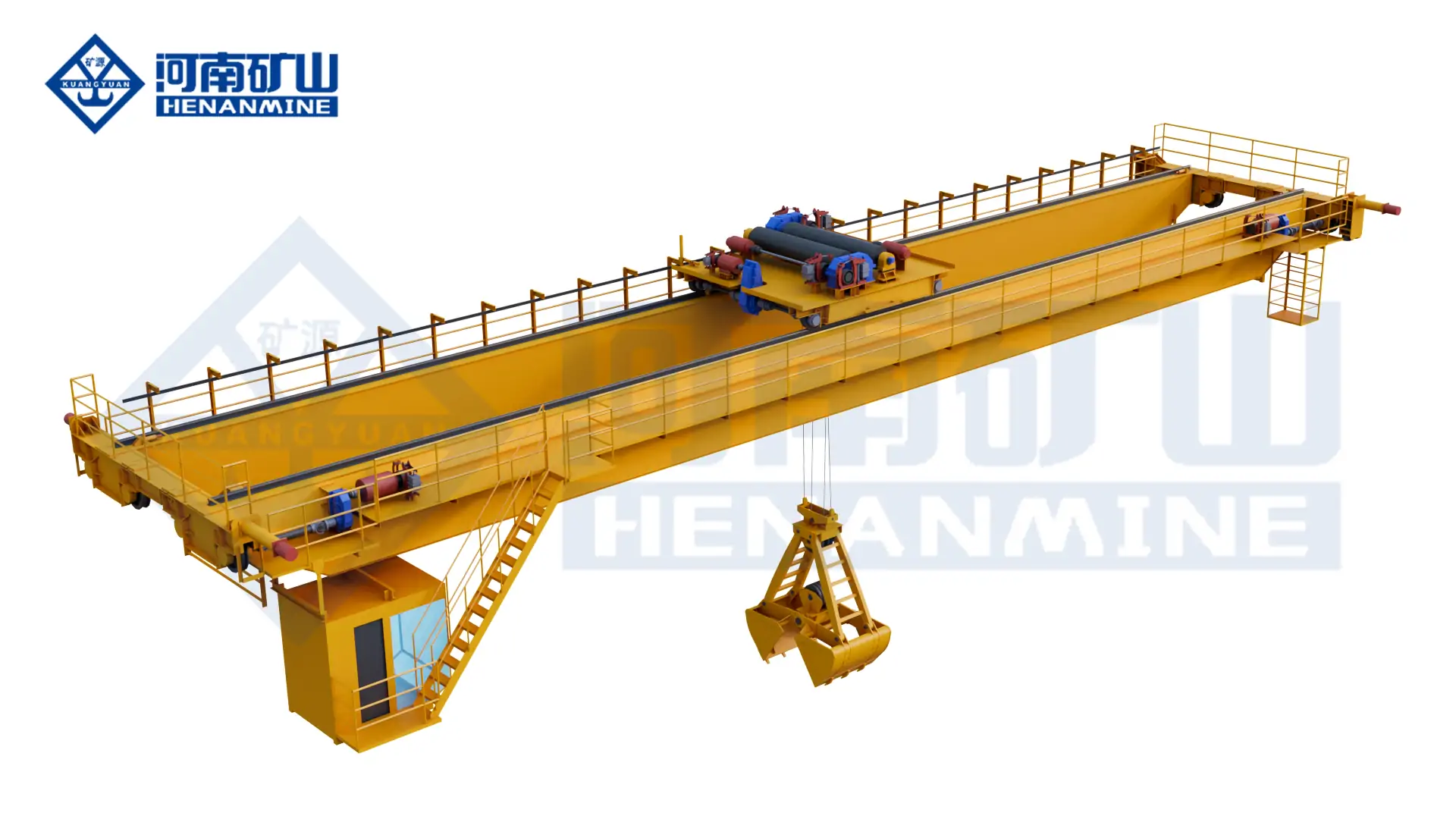
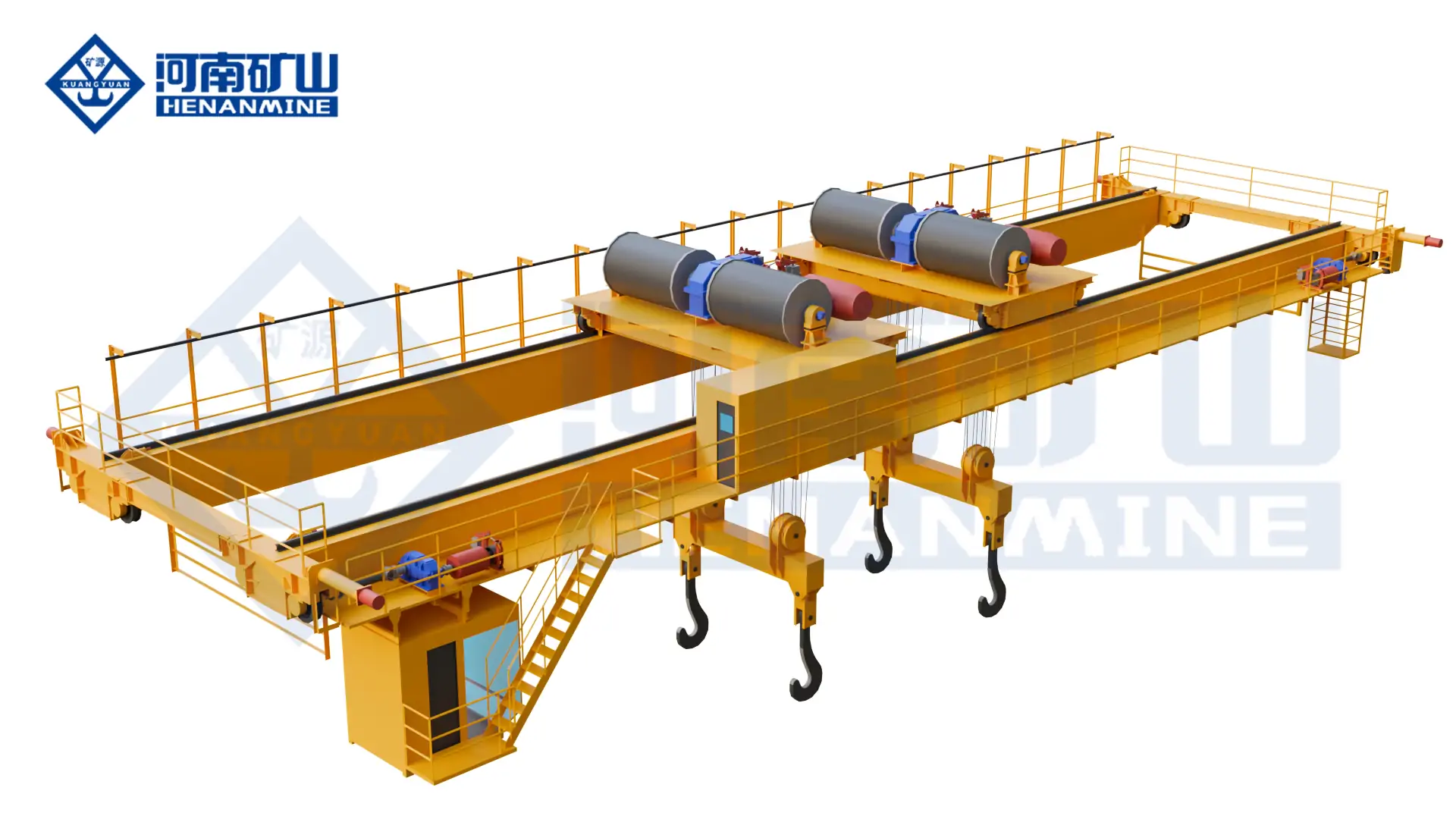
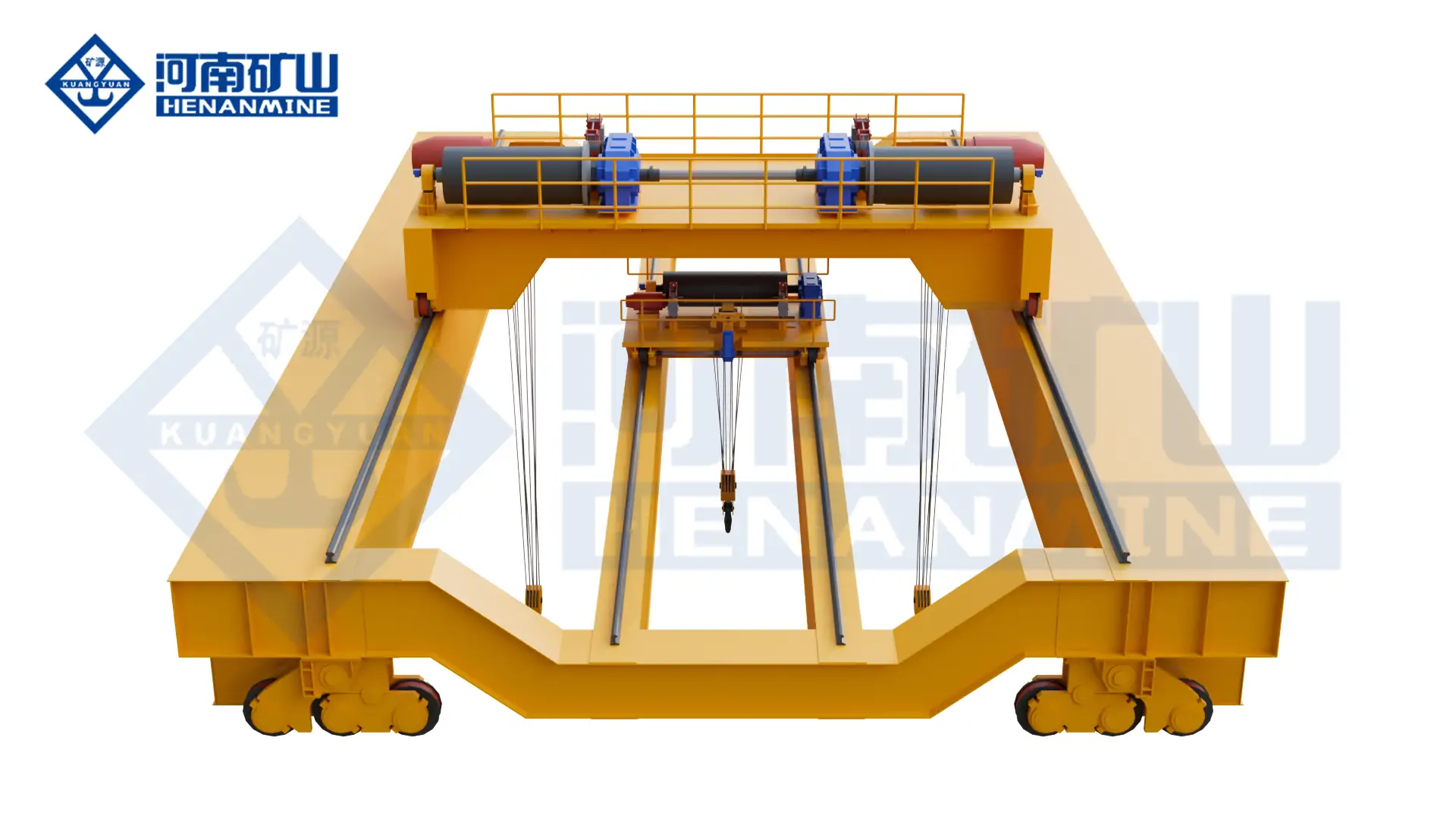
    Double-girder gantry crane structure with main and auxiliary hooks from Henan Mine Crane
    Double-girder gantry illustration. The trolley, hook arrangement and access platforms depend on the selected design.
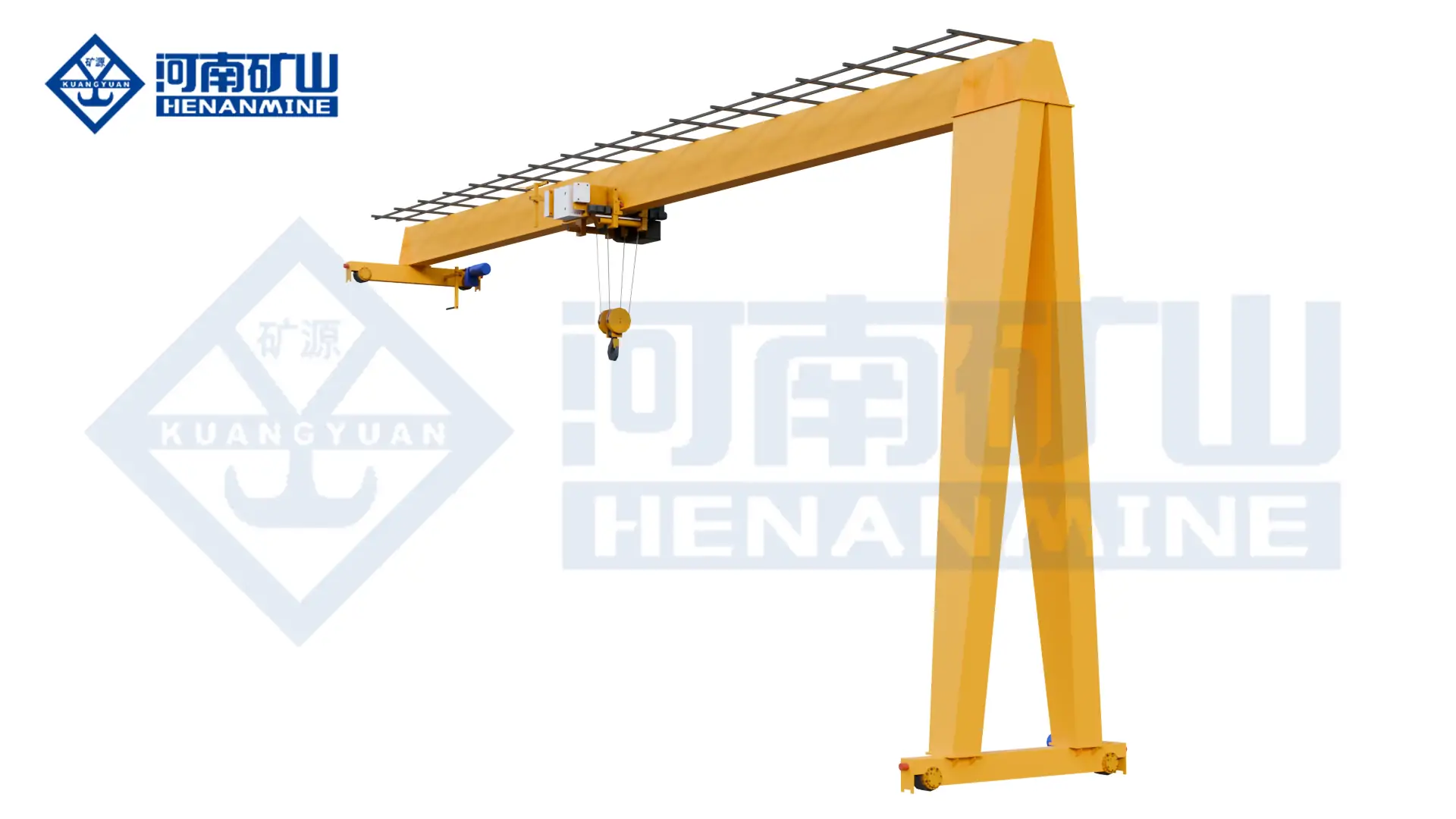
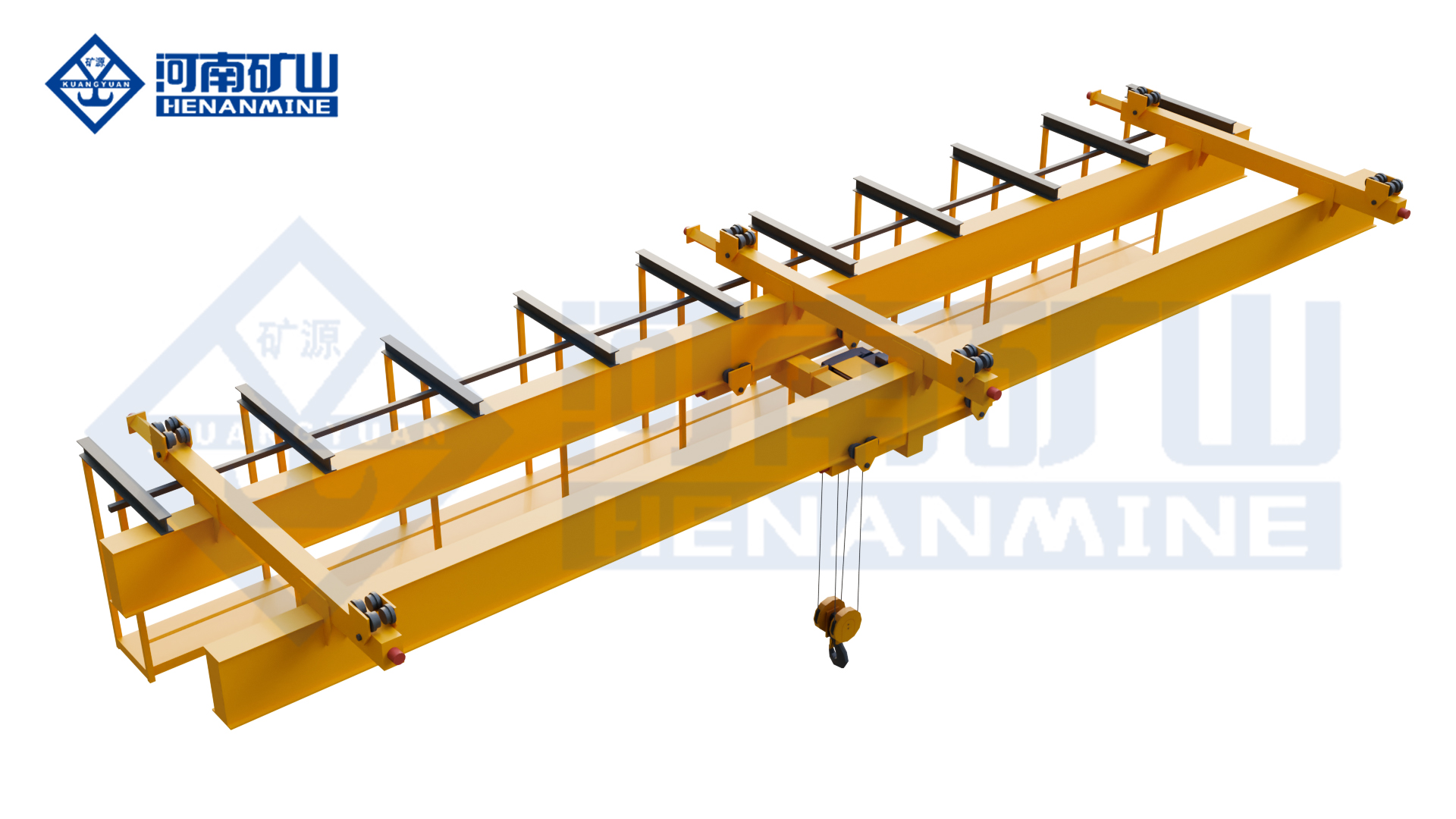
    Single-girder semi-gantry crane with one side supported by legs from Henan Mine Crane
    Semi-gantry illustration: one side runs on a ground rail and the other on an elevated runway. Supporting runways are not shown.

    Hoist, Travel Drives and Operating Duty

    Hoisting and Cross Travel

    The hoist lifts the load, while the travelling hoist or trolley moves it across the girder. Rope travel, hook configuration, braking and speed control must suit both lifting and placement.

    Gantry Long Travel

    The legs and bridge travel together along the ground rails. Wheel geometry, drives, frame alignment and rail condition affect tracking; a large gantry may need additional measures to manage skewing.

    Controls and Attachments

    Choose pendant, radio remote or cabin control around visibility and access. For grab-and-hook handling, confirm attachment mass, material properties and the required operating cycle.

    A production crane used repeatedly near rated load needs a duty assessment based on load spectrum and operating cycles. Specify crane and mechanism classifications under the agreed standard; a capacity figure or a double-girder structure does not establish the required service duty.

    Rails, Foundations and Power Supply

    A ground-supported gantry still requires an engineered support system. Crane self-weight, lifted load, trolley position and operating conditions influence wheel loads and the reactions passed into the rails and foundations.

    • Foundation and rail interface: establish the governing wheel loads, wheel spacing, rail section and connection details. Assess the ground, supporting structure and settlement conditions for the installation.
    • Traffic and drainage: coordinate rails, cable routes, drains and vehicle crossings. Reserve clearance around moving legs and keep the agreed travel envelope available.
    • Power distribution: evaluate cable reel, festoon or conductor arrangements against travel length, obstructions, weather exposure and electrical demand. Define the incoming supply boundary.
    • Existing runways: check geometry, condition, level and support capacity against the proposed crane. Previous use by a crane of similar capacity does not establish compatibility.

    Outdoor Protection and Safety Configuration

    Outdoor use changes the design conditions. The crane specification must address the local environment and distinguish operating conditions from the parked, out-of-service condition.

    Wind and Parking Provisions

    Define the design wind conditions, operating limits, monitoring requirements and parking arrangements. Assess travel brakes, rail clamps and storm anchors as distinct functions with suitable load paths into the supporting structure.

    Load and Motion Protection

    Identify overload protection, hoisting and travel limits, emergency stops, braking and relevant electrical protections. Define control priority and the response to lost commands or interrupted power for the selected design.

    Environment and Access

    Specify rain, dust, temperature and corrosion exposure, including coastal conditions where relevant. Confirm enclosure protection, protective coating requirements and access for inspection and maintenance.

    Wind limits and securing arrangements are specific to the engineered crane and site. Operating and parking procedures must follow the supplied instructions. Any hazardous-area or hot-material duty requires a separate specification review.

    Manufacturing, Documentation and Acceptance

    Crane structures and equipment inside a Henan Mine Crane manufacturing workshop
    Crane manufacturing workshop shown in the Henan Mine Crane factory gallery.

    Henan Mine Crane is the manufacturer of the configurations presented here. Review the manufacturing facilities alongside the selected product details, and agree the documentation and inspection plan for the actual order.

    • General arrangement showing span, hook coverage, clearances and crane dimensions.
    • Wheel loads and interface information for runway and foundation design.
    • Component specifications, electrical drawings and the agreed manufacturing inspection records.
    • Factory and site test scope, acceptance criteria, manuals and maintenance information.

    Identify the applicable standards and destination-specific documents in the contract. Required records should relate to the supplied configuration and the agreed scope.

    Installation and Maintenance

    Installation Planning

    Agree the assembly area, unloading access, temporary lifting equipment and responsibility for civil work. Establish readiness checks for rails, supports and the electrical supply before installation.

    Commissioning

    Confirm the agreed inspections, functional checks and load tests with qualified personnel. Site acceptance should include travel behaviour, specified safety functions and the completed installation interfaces.

    Maintenance and Service

    Provide access to hoists, trolley equipment, wheels, drives and power distribution. Define inspection schedules, spare parts, documentation language, warranty terms and service arrangements in the offer.

    Overhead Gantry Crane Price and Supply Scope

    Overhead gantry crane price depends on capacity, span, lifting height, duty, trolley arrangement, cantilever requirements and the operating environment. Runway construction, power distribution, transport and installation can also change the total project budget.

    When comparing overhead gantry cranes for sale, request quotations against the same drawing and duty. Have the supplier identify the crane equipment, rails, foundations, power supply, inspection, delivery and site work included in the offer.

    Equipment

    Bridge, legs, travel assemblies, lifting system, controls and specified protection.

    Site Interfaces

    Rails, connections, foundations, incoming power and installation responsibilities.

    Project Delivery

    Drawing approval, inspection, packing, shipment, commissioning and service terms.

    Overhead Gantry Crane FAQ

    Is an overhead gantry crane the same as a bridge crane?

    The terms are sometimes mixed in enquiries. A full gantry is supported by legs running at ground level, while a bridge crane runs on two elevated runways. Confirm the support arrangement on the layout drawing.

    Does a self-supporting gantry crane still need foundations?

    A full gantry carries its bridge through its own legs, but the resulting loads still pass into the rails and ground supports. Foundations or other suitable supporting structures must be assessed for the proposed crane.

    Can a 5 ton or 10 ton gantry crane use a single girder?

    These capacities fall within the reference range of the linked single-girder configuration. Suitability still depends on the selected span, lift, duty, hook coverage and site conditions; the exact combination requires confirmation.

    Can the same gantry crane operate indoors and outdoors?

    Only where its design covers the intended conditions. Outdoor use requires assessment of wind, weather exposure, corrosion, drainage and parking arrangements. Moving between indoor and outdoor areas also requires suitable clearances and travel infrastructure.

    Can the crane lift its rated load on the cantilever?

    The permitted load and working reach outside the legs must be stated for the selected design. Do not assume that every cantilever position has the same allowable load as the area within the span.

    Can a gantry crane travel with a suspended load?

    Powered rail-mounted gantries can be engineered for loaded travel within their specified operating limits. Permission and conditions for a portable gantry are model-specific. Follow the manufacturer’s instructions for the actual equipment and site.

    How much does an overhead gantry crane cost, and when can it be delivered?

    Request a quotation against the load, layout, duty and supply scope. Delivery should be confirmed against drawing approval, manufacture, inspection, transport and installation needs. A capacity-only enquiry cannot establish a reliable price or delivery date.

    Request An Overhead Gantry Crane Quote

    Send Henan Mine Crane your load description and site drawing to discuss an industrial gantry crane configuration. Include the following details so the equipment and installation interfaces can be reviewed together:

    • Maximum payload, typical loads, dimensions and lifting attachments
    • Required span, lifting height, runway length and any cantilever working area
    • Ground and runway information, traffic routes and installation space
    • Operating cycles, site environment, power supply and preferred controls
    • Project country, applicable requirements, delivery needs and installation scope
    Henan Mine CraneDiscuss your requirements ↗
  • Overhead Cranes and Hoists

    Overhead Cranes and Hoists

    Overhead Cranes and Hoists

    Henan Mine Crane · Integrated Industrial Lifting Systems

    Overhead Cranes and Hoists

    Henan Mine Crane supplies overhead cranes and electric hoists as coordinated lifting systems for workshops, warehouses, assembly lines, maintenance bays and process facilities. Each system is configured around the suspended load, span, lifting height, operating duty, building clearances and material-handling cycle.

    Available arrangements include single-girder, double-girder, top-running and underhung bridge cranes with wire-rope electric hoists, trolley-mounted hoists or project-specific lifting mechanisms. Supply can include the crane, hoist, controls, electrification, runway interfaces, documentation, delivery and agreed site services.

    Overhead crane and electric wire rope hoist system from Henan Mine Crane
    Electric-hoist bridge crane configured as a complete lifting, travel and control system.

    CRANE STRUCTURE

    Single or Double Girder

    RUNWAY ARRANGEMENT

    Top Running or Underhung

    HOISTING MECHANISM

    Wire Rope, Chain or Winch

    CONTROL OPTIONS

    Pendant · Radio · Cabin · Automation

    Complete Overhead Crane and Hoist Systems

    An overhead crane provides horizontal coverage across and along a working bay. The hoist performs vertical lifting; the trolley or travelling hoist moves across the bridge; the bridge end carriages move the complete crane along parallel runways. Controls, power distribution, brakes and protective devices coordinate these motions.

    A hoist can operate independently on a fixed suspension point or monorail, but it becomes part of an overhead crane when installed on a travelling bridge system. Procurement specifications must therefore define both the lifting mechanism and the structure that carries it.

    Commercial scope: A complete system can cover bridge structure, hoist or trolley, end carriages, controls, electrification and project documentation. Runway steelwork, site power, freight and installation remain separate unless expressly included.

    Overhead Crane vs Hoist: Equipment Functions

    Overhead Crane

    The crane is the complete travelling structure that supports and positions the hoist. Its principal elements include the bridge girder, end carriages, wheels, bridge drives, trolley system, controls and runway interface.

    • Moves loads across the width and length of a bay
    • Transfers wheel loads into elevated or suspended runways
    • Defines span, approaches, coverage and building interfaces

    Hoist

    The hoist is the lifting mechanism. It raises and lowers the load through wire rope or load chain and can be hook-mounted, fixed, push-trolley, geared-trolley or motor-trolley operated.

    • Defines rated load, lifting height, speed and reeving
    • Includes motor, brake, transmission, rope or chain and hook
    • Can serve a crane, monorail or fixed lifting position

    Overhead Crane and Hoist Specifications

    Final ratings and dimensions are developed from the load, operating cycle, building and destination requirements. Approved values are recorded in the technical proposal and general arrangement.

    Specification Engineering Direction Required Project Definition
    Rated Capacity Selected for the crane, hoist and lifting attachment Maximum payload, attachment weight, load spectrum and units
    Crane Span and Travel Matched to runway geometry and required coverage Runway gauge, bay length, support spacing and rail information
    Hoist Lift and Headroom Project-defined hook travel and upper approach Lowest pickup, highest placement, rigging depth and roof clearance
    Working Class Crane and hoist mechanisms rated for the operating cycle Lifts per hour, shifts, loaded cycles, travel and process criticality
    Motion and Control Single speed, dual speed or variable-frequency operation Required speeds, positioning, acceleration and control station
    Electrical Supply Equipment matched to the destination supply Voltage, frequency, phases, earthing and distribution boundary
    Environment General, outdoor, dusty, corrosive, hot or hazardous configuration Temperature, humidity, contaminants, classification and protection

    Industrial Applications

    Manufacturing and Assembly

    Machinery parts, fixtures, dies and assemblies moving between workstations with controlled lifting and positioning.

    Warehousing and Logistics

    Unit loads, stored equipment, loading operations and material transfer above occupied floor routes.

    Maintenance Facilities

    Motors, pumps, machine components and plant equipment removed and positioned during scheduled maintenance.

    Steel Fabrication

    Plate, profiles, welded fabrications and production tooling handled across cutting, welding and assembly areas.

    Power and Process Plants

    Turbines, generators, valves and process equipment requiring planned lifting coverage and maintenance access.

    Special Environments

    Dusty, corrosive, hot, clean or classified areas requiring purpose-selected hoists, controls and protection.

    Selection Considerations

    01 / LOAD

    Payload and Attachment

    Rated capacity includes the load and below-the-hook equipment. Shape, centre of gravity and lifting points affect the handling arrangement.

    02 / COVERAGE

    Hook Envelope

    Span, bridge travel, trolley approaches, lift and obstructions establish usable coverage rather than nominal dimensions alone.

    03 / DUTY

    Load Spectrum and Cycles

    Hoist and crane duty must match operating hours, starts, travel, shifts and the proportion of near-capacity lifts.

    04 / BUILDING

    Runway and Clearances

    Wheel loads, rail level, support spacing, roof height, services and maintenance access govern the physical arrangement.

    05 / MOTION

    Speed and Positioning

    Hoisting speed, travel speed, acceleration, variable-frequency control and process positioning are selected together.

    06 / SCOPE

    Complete Supply Boundary

    Crane, hoist, runway, electrification, freight, installation, commissioning and documentation require allocated responsibility.

    Overhead Cranes and Hoists Compared with Other Lifting Configurations

    Equipment selection is based on required coverage, supporting structure, duty and load movement. A hoist capacity alone does not define the complete crane system.

    Configuration Movement and Support Application Position Critical Selection Inputs
    Single-Girder Crane with Hoist Three-axis movement on elevated top-running runways General workshop, warehouse and maintenance handling Capacity, span, headroom, duty, hook approaches and wheel loads
    Double-Girder Crane with Trolley Hoist Three-axis movement with two-girder bridge and trolley Higher loads, demanding duty or defined lifting envelope Trolley arrangement, access, span, duty and runway reactions
    Underhung Crane with Hoist Bridge travels beneath suspended runway beams Facilities with compatible roof or suspended support structure Runway flange, suspension points, support loads and clearances
    Monorail Electric Hoist Vertical lift with travel along one fixed beam or track Linear production routes or local transfer between fixed points Beam flange, curve radius, switches, lift, duty and power feed
    Gantry Crane with Electric Hoist Leg-supported bridge travelling at floor or ground level Yards or buildings without suitable elevated runway support Ground conditions, rails, foundations, wind and travel clearance

    Overhead Crane and Hoist Configurations

    Single girder overhead crane with electric wire rope hoist

    Single-Girder Electric-Hoist Crane

    One bridge girder carries an under-running wire-rope electric hoist. This arrangement is widely applied to general production, warehousing, assembly and maintenance lifting.

    • Compact general-purpose bridge structure
    • Pendant or radio control with selected speed functions
    • Selection governed by span, headroom, duty and runway capacity
    Double girder overhead crane with trolley-mounted electric hoist

    Double-Girder Electric-Hoist Crane

    Two bridge girders support an electric-hoist trolley. The structure permits alternative hook approaches, platforms and component layouts for demanding operating requirements.

    • Alternative trolley and lifting-envelope arrangements
    • Service access and platforms available by specification
    • Applicable to higher load, span or duty requirements

    Wire Rope Hoist, Chain Hoist or Winch Trolley

    Hoist Type Operating Characteristics Typical Application Position Selection Inputs
    Electric Wire Rope Hoist Rope drum, reeving and powered trolley in a compact lifting unit General single-girder and double-girder bridge cranes Capacity, lift, duty, rope falls, headroom, speed and trolley beam
    Electric Chain Hoist Load chain in a compact hook, fixed or trolley-mounted unit Local lifting, monorails and compatible lighter-duty crane systems Capacity, lift, chain container, duty, trolley and operating environment
    Open-Winch Trolley Separately arranged drum, gearbox, motor, brakes and reeving Heavy-duty, process, high-lift or redundancy-led applications Load spectrum, reeving, speeds, redundancy, access and process control

    Controls, Electrification and Safety Functions

    Control System

    Pendant, radio remote, cabin or automated control is selected for visibility, travel distance, production interfaces and operating responsibility.

    Power Distribution

    Conductor systems, festoon cables and control wiring are coordinated with crane travel, trolley movement and the site connection point.

    Load Protection

    Overload protection, hoisting limits, brakes and emergency stopping functions are specified for the lifting mechanism and application.

    Travel Protection

    Travel limits, end stops, buffers, warnings and anti-collision functions are applied for the runway and operating layout.

    Electrical Protection

    Isolation, short-circuit, phase and motor protection are coordinated with the equipment design and destination power supply.

    Special Environments

    Hazard classification, temperature, dust, corrosion, humidity and outdoor exposure determine component protection and documentation.

    Overhead Crane and Hoist Prices

    Price depends on market, capacity, lift, duty, brand, component scope and sales channel. The following bands summarize current public offers checked on 8 September 2026. They support initial budgeting and do not constitute fixed Henan Mine Crane quotations.

    Equipment Group Indicative Market Band Commercial Basis Scope Limitation
    OEM Electric Chain Hoist US$300–$2,000+ General factory-market equipment Capacity, trolley, lift, duty, controls and freight vary
    OEM Electric Wire Rope Hoist US$500–$5,000+ Single-speed, dual-speed or compact factory-market equipment Capacity, lift, reeving, headroom, trolley and protection vary
    North American Branded Chain Hoist US$3,700–$6,400+ Current 1–2 ton industrial retail examples Trolley, longer lift, special voltage and shipping may add cost
    North American Branded Wire Rope Hoist US$8,300–$20,600+ Current 1–5 ton branded retail examples Lift, speed, trolley, controls, voltage and duty differ
    5 Ton Overhead Crane Kit with Hoist US$28,100–$30,800 Current branded kit listings Main bridge steel, runway, site power or installation may be excluded
    Factory-Supply Overhead Crane US$5,000–$25,000+ General 5 ton single- or double-girder equipment band Runway, freight, import charges and site work commonly excluded

    Factory export offers and regional branded retail prices are not directly interchangeable. A valid comparison uses the same capacity, lift, duty, controls, component scope, delivery term and installation boundary.

    Supply Scope and Commercial Boundary

    Scope Group Typical Content Commercial Definition
    Crane and Hoist Equipment Bridge, end carriages, hoist or trolley, drives, brakes, controls and protective devices Included equipment and technical limits stated in the proposal
    Electrification Crane conductor, festoon, isolator, panels, control wiring and interface cabling Supply termination points and site connections identified
    Runway and Structure Rails, runway beams, columns, brackets, end stops and foundations when included Equipment-only, runway-inclusive or interface-data-only basis stated
    Logistics and Site Services Packing, freight, unloading, erection, commissioning, testing and training Delivery terms, location and responsibility matrix agreed
    Documentation Drawings, component schedules, electrical information, manuals and inspection records Language, format, approval stages and submission schedule stated

    Manufacturing, Inspection and Documentation

    Overhead crane and hoist manufacturing workshop at Henan Mine Crane
    Crane structures and production equipment inside a Henan Mine Crane manufacturing workshop.

    Henan Mine Crane develops the manufacturing package from the approved technical agreement and general arrangement. Crane steelwork, hoisting equipment, travel mechanisms, electrical systems and controls are coordinated as one project configuration.

    • Approved crane envelope, hook approaches and building interfaces
    • Hoist, trolley, travel drive and electrical component schedule
    • Wheel loads, wheel spacing, rail data and supply connection points
    • Agreed inspection activities, functional checks and test records
    • Operating documentation and shipment preparation

    Manufacturing facilities and production scenes are presented in the Henan Mine Crane factory display.

    Installation, Commissioning and Maintenance

    Site Readiness

    Runway geometry, structural suitability, installation access, power supply and assembly space require confirmation before site work.

    Commissioning

    Electrical checks, functional tests, limit settings, motion verification and agreed acceptance activities support formal handover.

    Maintenance Planning

    Rope or chain, hooks, brakes, limits, wheels, drives and electrical equipment require accessible inspection and maintenance provisions.

    Maintenance intervals are established from the supplied manuals, operating duty, environment and applicable site requirements. Critical spares and component replacement clearances should form part of the project plan.

    Information Required for an Overhead Crane and Hoist Quotation

    A complete RFQ enables system selection, layout development and a defined commercial proposal.

    Load and Operation

    • Maximum and typical suspended loads
    • Load dimensions and attachment weight
    • Lifts per hour and operating shifts
    • Required speeds and positioning

    Building and Coverage

    • Runway span and travel length
    • Required lifting height and hook positions
    • Runway and support information
    • Roof, wall and service clearances

    Environment and Scope

    • Temperature, dust, corrosion and hazard data
    • Voltage, frequency and phases
    • Project location and delivery term
    • Runway, freight, installation and testing boundary

    Overhead Cranes and Hoists FAQ

    What is the difference between an overhead crane and a hoist?

    The hoist raises and lowers the load. The overhead crane carries the hoist across a bridge and along runways to provide three-axis lifting coverage within a bay.

    Can an electric hoist operate without an overhead crane?

    An electric hoist can operate from an approved fixed suspension point or trolley on a monorail. The supporting beam, connection, trolley and power system must suit the hoist capacity and duty.

    Which hoist is suitable for an overhead crane?

    Wire-rope electric hoists serve many general bridge-crane applications. Electric chain hoists can suit compatible lighter-duty or local lifting systems, while open-winch trolleys support demanding process, high-lift or redundancy-led requirements.

    How much do overhead cranes and hoists cost?

    Current equipment bands extend from several hundred US dollars for basic OEM electric hoists to more than US$20,000 for branded industrial wire-rope hoists. Five-ton crane kits are currently listed near US$28,100–$30,800, while complete project cost depends on bridge steel, runway, freight and installation.

    Does an overhead crane quotation include the hoist?

    A complete crane-equipment proposal normally identifies the hoist or trolley, but the commercial schedule must state the exact included mechanism. Crane-kit, bridge-only and runway-only offers have different boundaries.

    Can an existing hoist be installed on a new crane?

    Compatibility requires confirmation of hoist condition, capacity, duty, trolley gauge, beam flange, headroom, power supply, controls, wheel loads and applicable project requirements. Nameplate capacity alone is insufficient.

    Does the crane price include runway and installation?

    Runway beams, rails, columns, site wiring, freight, erection and commissioning are included only when stated in the commercial proposal. Each item requires an assigned supply and installation responsibility.

    What information is required for system selection?

    Rated load, attachment weight, span, lift, runway length, operating cycle, control method, power supply, environment, building data, project location and supply scope establish the configuration.

    Request An Overhead Crane and Hoist Quote

    Submit the required capacity, span, lifting height, operating cycle, building information, power supply, environment and project location. Henan Mine Crane will develop an overhead crane and hoist proposal with the applicable configuration, technical data and defined supply scope.

    Henan Mine CraneDiscuss your requirements ↗
  • Overhead Crane Types and Selection Guide

    Overhead Crane Types and Selection Guide

    Overhead Crane Types and Selection Guide

    Henan Mine Crane · Industrial Overhead Lifting Systems

    Overhead Crane Types and Selection Guide

    Compare single-girder, double-girder, top-running, underhung and special-purpose overhead cranes by structure, runway, hoist, duty and application. The correct type is the configuration that fits the load path, building, operating cycle and project supply boundary.

    Henan Mine Crane configures bridge cranes and EOT cranes for workshops, warehouses, steel plants, foundries, bulk handling and automated production. A project proposal defines rated capacity, span, lifting height, working class, speeds, controls, safety functions, documentation and site interfaces.

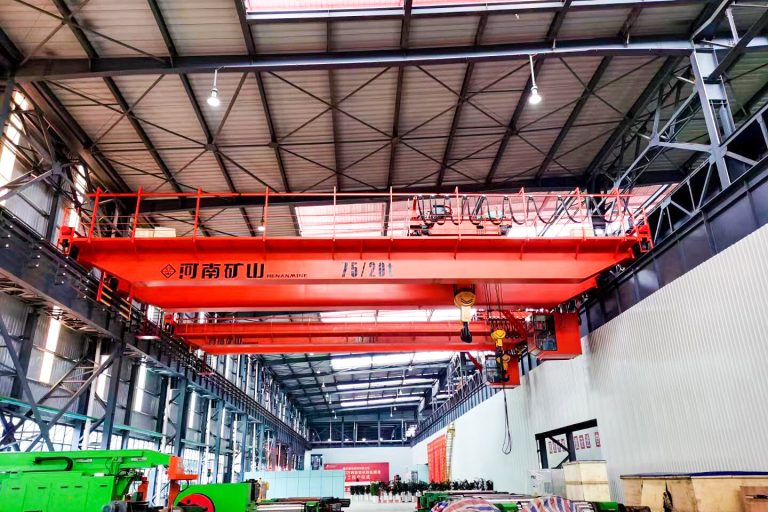
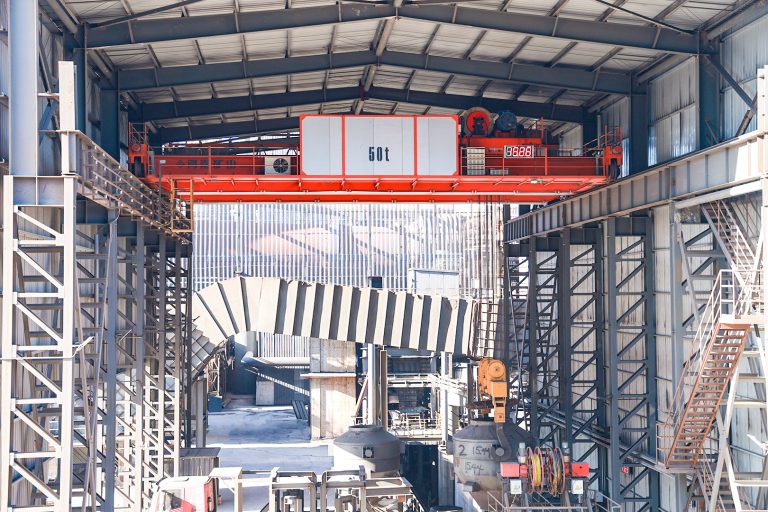
    double girder overhead crane operating in an industrial workshop
    Bridge structure, runway arrangement, lifting mechanism and operating duty must be evaluated as one engineered system.

    PRIMARY STRUCTURE

    Single or Double Girder

    RUNWAY ARRANGEMENT

    Top Running or Underhung

    LIFTING MECHANISM

    Chain, Wire Rope or Winch

    QUOTE BASIS

    Load, Span, Lift, Duty & Scope

    How Overhead Crane Types Are Classified

    An overhead crane is a travelling lifting system in which a bridge moves along two parallel runways and a hoist or trolley moves across the bridge. The terms bridge crane, EOT crane, overhead travelling crane and overhead bridge crane commonly identify the same equipment family. A complete type description requires more than one label.

    Single girder and double girder describe the bridge structure. Top running and underhung describe the connection between the bridge end carriages and runway. Electric chain hoist, wire-rope hoist and open-winch trolley describe the lifting mechanism. Hook, grab, magnet, lifting beam and ladle attachment describe the load-handling function. Working class, environment and automation level complete the equipment definition.

    One system can therefore be a top-running single-girder electric wire-rope-hoist crane, while another can be a top-running double-girder open-winch foundry crane. These descriptions are not competing names; each term defines a different engineering layer.

    Bridge Structure

    Single girder, double girder or a process-specific multi-girder structure defines the load-carrying bridge arrangement.

    Runway Interface

    Top-running or underhung end carriages define how bridge reactions enter the runway and supporting building.

    Lifting Mechanism

    Chain hoist, wire-rope hoist or open-winch trolley determines lifting range, duty, reeving and maintenance requirements.

    Process Function

    Hook, grab, magnet, rotating beam, clamp or ladle devices establish the actual material-handling task and control logic.

    Core Overhead Crane Types

    The following configurations form the primary commercial short list for most industrial projects. Capacity alone does not determine the type. Span, hook height, runway support, operating frequency, load behavior and required positioning accuracy can change the appropriate configuration at the same rated load.

    01 · Single-Girder Overhead Crane

    One bridge girder supports an electric hoist that normally travels on the lower flange or a dedicated track. The arrangement controls self-weight and equipment cost for general workshop, assembly, maintenance and warehouse handling.

    02 · Double-Girder Overhead Crane

    Two bridge girders support a trolley or hoist arrangement. The layout provides a broader structural platform for higher capacity, longer span, demanding duty, improved hook envelope or process equipment.

    03 · Top-Running Overhead Crane

    Bridge wheels travel on rails installed above the runway beams. The arrangement is common across light, medium and heavy industrial service and can use single- or double-girder bridges.

    04 · Underhung Overhead Crane

    Bridge end carriages travel on the lower flanges of suspended runway beams. The arrangement can extend hook coverage toward building sides and avoid runway rails above the support beams.

    05 · Workstation Bridge Crane

    A modular enclosed-track or light-rail bridge serves a defined production cell. Manual, electric or pneumatic motion can support repetitive ergonomic handling at lower capacities and shorter spans.

    06 · Freestanding Bridge Crane System

    Independent columns, runway beams and bracing carry crane loads when the building cannot support a crane or lease conditions restrict building attachment. Foundations and floor interfaces become part of the project.

    Overhead Crane Types Compared

    The comparison below separates structural configuration from runway arrangement and process function. Actual limits depend on the selected product family, span, duty and project standard; the approved technical proposal controls the final configuration.

    Crane Type Bridge / Support Lifting Mechanism Typical Application Critical Procurement Point
    Single Girder One main bridge girder Electric chain or wire-rope hoist General workshop, assembly, maintenance and warehousing Lowest self-weight among conventional powered bridge arrangements; headroom and duty still require confirmation
    Double Girder Two main bridge girders Electric hoist or open-winch trolley Heavy loads, long spans, high duty and process handling Higher structural weight and wheel loads; stronger platform for demanding duty and equipment access
    Underhung Usually single girder below runway beams Chain or wire-rope hoist Compatible buildings, lighter production and extended side approach Suspended beam capacity, connections and roof reactions govern feasibility
    Top Running Single or double girder above runway rails Hoist or trolley selected by load and duty Light through heavy industrial service Runway elevation, rail geometry, wheel loads and maintenance clearance govern fit
    Workstation Modular bridge on enclosed or light track Manual, electric or pneumatic hoist Production cells and ergonomic repetitive handling Shorter span and lower capacity than conventional plant-wide bridge systems
    Freestanding Crane plus independent columns and runway Single- or double-girder bridge Retrofit facilities without suitable building support Foundation, floor, bracing, column spacing and erection access add project scope

    Match Crane Type to Application

    Application matching begins with load behavior and consequence of failure. The table presents common starting configurations, not automatic selections. Final architecture follows the project load case, building, duty and operating environment.

    Application Typical Load Starting Configuration Critical Data
    Machining and maintenance Tools, fixtures, machine parts and service components Single-girder top-running or underhung crane Gross load, hook approach, precise low speed and access above equipment
    Fabrication and assembly Frames, weldments, beams and subassemblies Single- or double-girder top-running crane Load dimensions, turning space, lifting points and production cycle
    Warehouse and logistics Unit loads, coils, plates or palletized products Hook, clamp, magnet or automated overhead crane Storage geometry, inventory logic, positioning and collision zones
    Steel mill and foundry Ladles, billets, coils, plates and hot materials Heavy-duty double-girder process crane Thermal exposure, redundancy, duty, attachment and process safety
    Bulk material handling Ore, coal, slag, biomass, waste or aggregate Double-girder grab crane Bulk density, grab volume, fill factor, cycle time and hopper interface
    Hazardous production Loads handled in classified gas or dust areas Explosion-proof crane matched to area classification Zone, gas or dust group, temperature class and permitted equipment
    Clean production Sensitive components or controlled-process loads Cleanroom or low-contamination overhead crane Cleanliness target, materials, lubrication, particle control and access
    Automated process Repetitive loads within fixed routes and zones Automated overhead crane with position control Cycle logic, accuracy, sensors, interlocks, data interface and recovery mode

    Technical Specification Framework

    The specification should state measurable project data and identify items that remain subject to engineering review. Generic catalogue ranges do not replace an approved general arrangement, load calculation, mechanism data sheet and commercial responsibility matrix.

    Data Group Definition Information Required Procurement Control
    Rated capacity Maximum gross suspended load, including below-hook devices Payload list, attachment weights, lifting points and center of gravity Capacity plate and quotation use one declared unit basis
    Span and runway Runway rail center distance and total bridge travel Surveyed dimensions, rail or beam details, support spacing and alignment condition Nominal building width is not used as crane span
    Lifting height Vertical hook travel and required highest hook position Lowest pickup, highest placement, rigging depth and machinery extraction clearance Headroom is checked on the dimensioned general arrangement
    Working duty Crane and mechanism classification based on use Loads, cycles per hour, travel distances, shifts and annual operating hours Motor thermal rating, brakes, bearings and structures match the load spectrum
    Speeds and control Hoisting, trolley and bridge speeds plus acceleration control Positioning tolerance, pendant, radio, cabin, VFD, anti-sway and automation Operating mode and fallback method are documented
    Power and environment Voltage, phases, frequency, temperature and environmental exposure Dust, humidity, corrosion, outdoor use, hazardous area and process heat Enclosures, materials and protections match the declared conditions
    Runway reactions Maximum and minimum wheel loads, horizontal forces and buffers Building or freestanding support data and load combinations Structural engineer receives approved reaction data before fabrication
    Acceptance Factory checks, site tests and document handover Inspection authority, test loads, witness points, language and certification boundary Contract identifies evidence required for release and commissioning

    Safety, Controls and Environmental Requirements

    Overhead crane safety is defined by the complete application rather than one standard component list. The load, operating duty, control station, travel route, personnel interface, environment and consequence of failure establish the required protective architecture.

    Rated-Load Protection

    The rated capacity includes the payload and every below-hook component. An overload device, upper and lower travel limits, end stops and operating procedures must match the selected crane and destination requirements.

    Hoisting and Braking

    Hoist motors, brakes, rope or chain, drum, sheaves and hooks are selected from the load spectrum and duty. Process or high-consequence service may require additional braking, monitoring or redundancy.

    Bridge and Trolley Travel

    Buffers, travel limits, anti-collision functions, warning devices and controlled acceleration protect the crane route. Shared runways require a defined operating and separation strategy.

    Controls and Positioning

    Pendant, radio, cabin and automated controls are selected for visibility, travel distance and process risk. Variable-frequency drives support smooth acceleration, controlled low speed and repeatable positioning.

    Environmental Protection

    Temperature, dust, moisture, corrosion, washdown and outdoor exposure determine enclosures, materials, coatings, heaters, cooling and component protection. Hazardous areas require a formal classification basis.

    Load Attachment and Process Risk

    Hooks, grabs, magnets, clamps, beams and ladle devices introduce different load-retention and control requirements. Attachment deadweight, geometry, power supply and failure response form part of the crane specification.

    Bridge Structure, Headroom and Runway Compatibility

    A top-running bridge places the crane wheels on rails above the runway beams. The arrangement supports a wide range of capacities and duties, but requires adequate space above the rail and verified runway reactions. Single-girder and double-girder bridges can both be top running.

    An underhung bridge suspends the end carriages from the lower flanges of runway beams. It can improve side approach and avoid floor columns when the building is designed for the suspended loads. Runway flange geometry, lateral restraint, connection forces, roof loading and end clearance require engineering confirmation.

    Hoist position does not define runway type. A hoist commonly runs below the bridge girder on a top-running single-girder crane; the bridge itself remains top running because its wheels operate above the runway rails.

    underhung overhead crane suspended from runway beams
    An underhung bridge travels beneath compatible runway beams; supporting steel and connections form part of the engineering assessment.

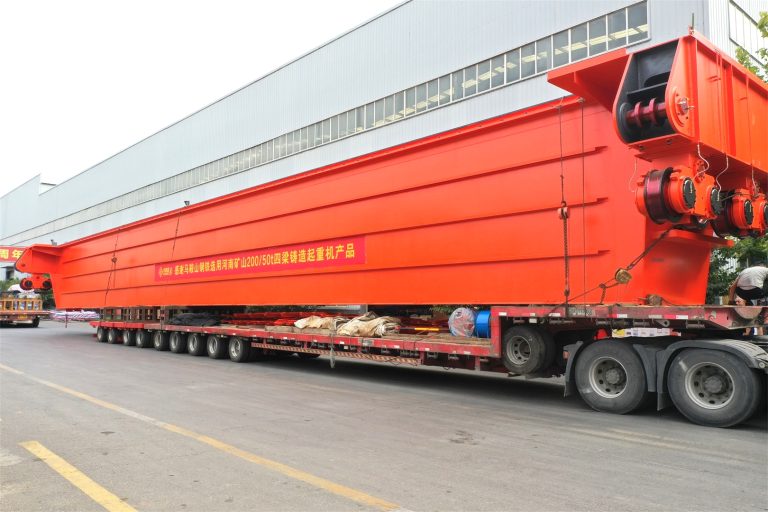
    Project Case: Multi-Type Crane Fleet for Special Steel Production

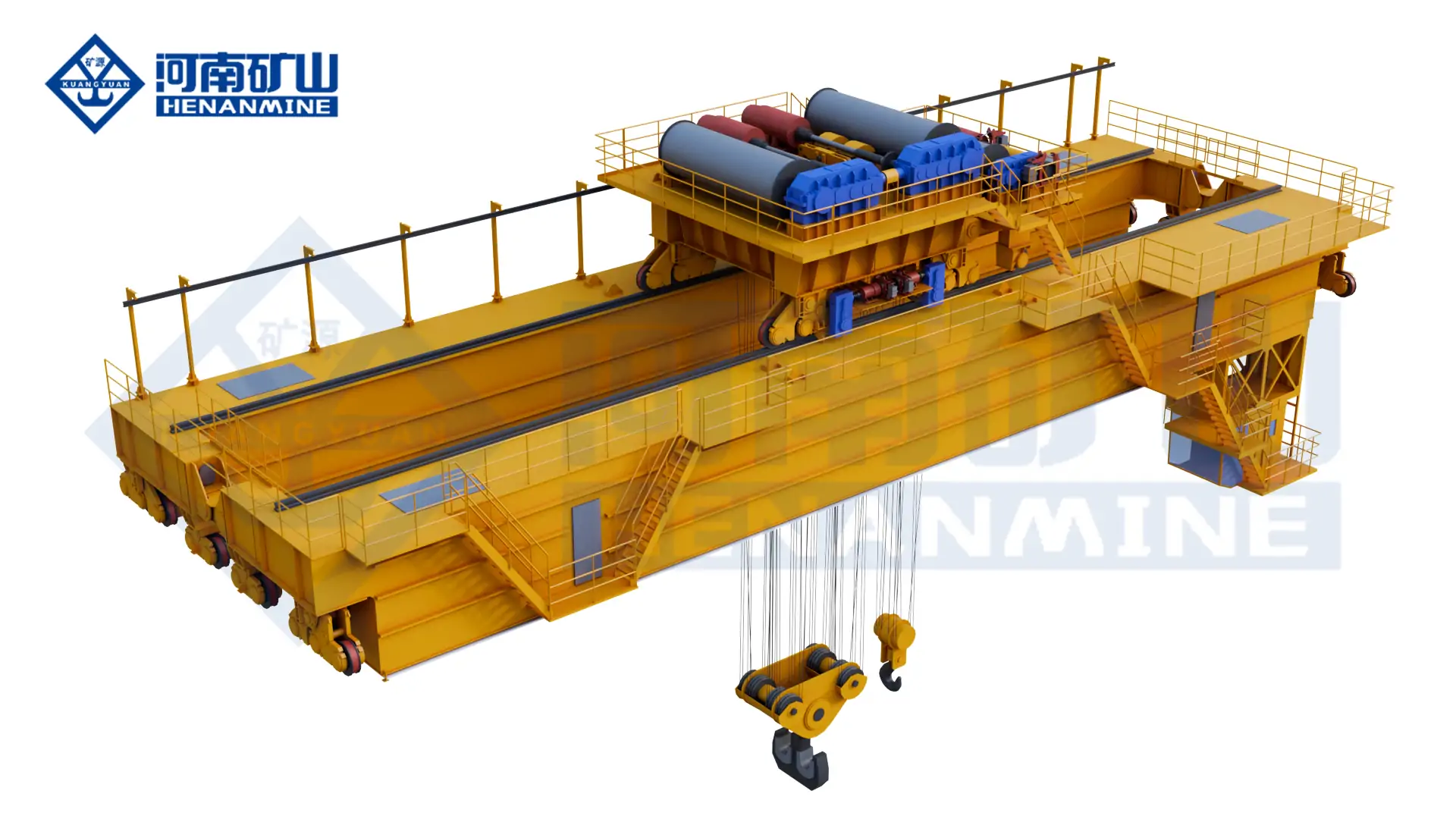
    heavy capacity process crane for a special steel production base
    A special steel base required different crane types for molten-metal handling, steel transfer and auxiliary lifting.

    A 3.2-million-ton premium special steel base required a coordinated fleet rather than one universal overhead crane type. Henan Mine Crane supplied more than 30 core equipment units covering steelmaking, refining, rolling and auxiliary production stages.

    The reported fleet included 200 t foundry cranes, 200/50 t four-girder foundry cranes, 160/63 t cranes, 40+40 t cranes and overhead rotating electromagnetic beam cranes. Foundry cranes addressed molten-metal process loads, rotating electromagnetic beam cranes handled directional steel transfer, and smaller units supported auxiliary lifting.

    The project demonstrates a central selection principle: crane architecture follows the process stage, load attachment, duty and hazard. Common capacity terminology cannot replace a function-by-function handling study.

    View Project Case →

    Engineering Deliverables and Quality Records

    A commercially complete overhead crane package should identify the engineering evidence, manufacturing records and acceptance documents supplied with the equipment. Required deliverables should be agreed before order placement because inspection scope affects schedule, access and price.

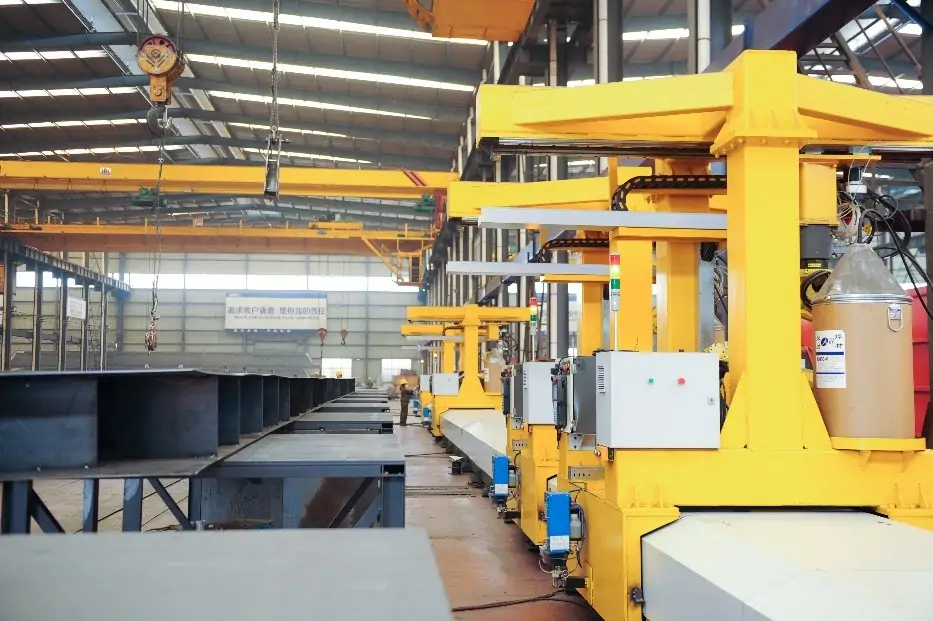
    automated crane girder welding workstation at Henan Mine Crane
    Manufacturing quality is supported by approved drawings, controlled processes, inspections and traceable project records.

    Design Package

    General arrangement, wheel loads, hook approaches, electrical load, component schedule and applicable design basis.

    Structural Evidence

    Material identification, calculation summary, welding procedures, welder qualifications, dimensional inspection and specified NDT.

    Mechanism Records

    Motor, gearbox, brake, drum, rope or chain, wheel, bearing, limit and protective-device data for the selected duty.

    Electrical Documents

    Single-line diagram, schematics, terminal information, I/O schedule, control narrative and configured drive parameters.

    Inspection and Testing

    Inspection plan, witness points, functional checks, brake and limit verification, overload-device setting and specified load tests.

    Handover Package

    Manuals, maintenance schedule, spare-parts list, certificates, commissioning record, training record and final approved drawings.

    Review Henan Mine Crane manufacturing capabilities →

    Installation, Commissioning and Lifecycle Planning

    Runway and Site Readiness

    Survey rail span, elevation, alignment, end clearances and runway capacity. Confirm erection access, incoming power, conductor-system location, production shutdowns and available assembly space before shipment.

    Installation and Alignment

    Bridge sections, end carriages, hoist or trolley, conductor system and controls are installed under approved lifting, bolting, welding, torque, rail-alignment and electrical procedures.

    Commissioning and Acceptance

    Testing progresses from no-load functions and protective devices to brake verification, rated motions, applicable proof loading, control checks, site acceptance and operator-maintenance training.

    Inspection and Maintenance Strategy

    The maintenance plan covers ropes or chains, drums, sheaves, hooks, brakes, wheels, buffers, structures, drives, limits, electrical panels and load attachments. Intervals follow actual duty and environment.

    Overhead Crane Price by Type and Supply Scope

    Overhead crane prices vary widely because the same type name can describe a compact equipment package or a complete installed system. Capacity, span, lifting height, duty, component package, runway steel, electrification, automation, environment, freight and site work must be stated beside every price.

    The September 2026 bands below support preliminary equipment budgeting and are not fixed Henan Mine Crane quotations. Final pricing follows approved project data and a defined commercial boundary.

    Overhead Crane Type Indicative Equipment Band Commercial Basis Main Price Drivers
    Single-girder overhead crane US$3,000–50,000 General equipment-only market band across a broad capacity and span range Hoist package, span, lift, duty, controls, documentation and exclusions
    Double-girder overhead crane US$5,000–150,000 General or custom equipment package across light to heavy capacity Trolley type, capacity, span, duty, maintenance access and wheel loads
    Top-running overhead crane US$3,000–100,000 Single- or double-girder equipment operating on runway rails Bridge architecture, rails, runway scope, power feed and site interfaces
    Underhung overhead crane US$3,500–80,000 Suspended bridge equipment for compatible runway beams Beam geometry, connections, capacity, span, duty and building verification
    Workstation bridge crane US$3,000–45,000 Localized modular bridge system, normally at lower capacity and shorter span Track length, support structure, hoist, manual or powered motion and installation
    Explosion-proof overhead crane US$4,500–50,000+ Equipment matched to a formally defined hazardous-area basis Area classification, protection concept, controls, certification and inspection scope
    Grab or magnetic process crane US$3,000–100,000+ Attachment and control package selected for bulk material or steel handling Material data, attachment, duty, automation, power continuity and process safety
    Foundry or automated process crane Project quotation Engineered process package with application-specific structure, mechanisms and controls Hazard analysis, redundancy, duty, plant integration, testing and documentation

    Low advertised prices may describe a hoist, crane kit or restricted factory package rather than a complete operating system. A normalized comparison separates crane equipment, runway and supports, power supply, packing and freight, erection, commissioning, load testing and third-party inspection.

    Crane Equipment

    Bridge, end carriages, hoist or trolley, drives, controls and the specified crane-mounted protective package.

    Runway and Power

    Rails, beams, columns, bracing, foundations, conductor system and incoming electrical connection when expressly included.

    Delivery

    Export packing, shipment sections, freight, insurance, import handling, unloading and inland transport under the stated trade term.

    Site Completion

    Erection, alignment, electrical connection, commissioning, applicable load testing, inspection and training.

    Information Required for an Overhead Crane Quote

    A complete inquiry allows the crane type, lifting mechanism, runway interface and commercial scope to be evaluated against one operating basis. Preliminary drawings are suitable when assumptions are identified.

    01 · Crane Function

    Handled materials, pickup and placement points, required attachments, process sequence and any load turning, tilting, synchronized lifting or automated operation.

    02 · Maximum Gross Loads

    Maximum and typical payloads plus hooks, beams, grabs, magnets, clamps, slings and every other suspended component for each permitted load case.

    03 · Span and Travel

    Runway rail center distance, total runway length, required bridge travel, side approaches, end approaches and restricted zones along the handling route.

    04 · Lift and Headroom

    Highest hook position, lowest pickup level, load and rigging depth, available roof clearance, runway elevation and required machinery-extraction distance.

    05 · Operating Duty

    Loads per cycle, cycles per hour, shifts, annual operating hours, travel distances, proportion of near-capacity lifts and required availability.

    06 · Building and Runway

    Facility plans and sections, rail or beam details, support spacing, allowable wheel loads, existing-crane data, foundations and erection access.

    07 · Speeds and Controls

    Required hoisting, trolley and bridge speeds; pendant, radio or cabin operation; VFD control, positioning accuracy, anti-sway and process interlocks.

    08 · Power and Environment

    Voltage, phases, frequency, ambient temperature, dust, humidity, corrosion, outdoor exposure, hazardous classification and special process conditions.

    09 · Compliance and Acceptance

    Installation country, governing requirements, inspection authority, documentation language, factory witness points, site testing and certification boundary.

    10 · Commercial Scope

    Delivery address and trade term, packing, freight, runway and electrification boundary, erection, commissioning, local labor, training, spares and schedule.

    Overhead Crane Types FAQ

    What are the main types of overhead cranes?

    The primary structural types are single girder and double girder. Runway arrangements are top running or underhung. Workstation and freestanding systems address localized or independent support needs, while foundry, grab, magnetic, explosion-proof and automated cranes serve special processes.

    Is a bridge crane the same as an EOT crane?

    Bridge crane, overhead bridge crane, overhead travelling crane and EOT crane commonly identify the same travelling-bridge equipment family. A procurement specification should still state girder arrangement, runway type, hoist or trolley, capacity, span, lift and duty.

    What is the difference between single-girder and double-girder cranes?

    Single-girder cranes use one primary bridge girder and commonly support an electric hoist. Double-girder cranes use two primary girders and provide a broader platform for higher capacities, longer spans, demanding duty, process trolleys or improved equipment access.

    What is the difference between top-running and underhung cranes?

    A top-running bridge travels on rails above runway beams. An underhung bridge travels beneath suitable runway beams. The terms describe the bridge-to-runway interface, not the position of the hoist on the bridge girder.

    When is a freestanding bridge crane required?

    A freestanding system is considered when the existing building cannot carry crane loads, reliable structural data is unavailable, attachment is restricted or a separate production bay requires independent support. Columns, bracing and foundations become part of the project.

    Which overhead crane type suits heavy-duty production?

    A double-girder crane with a duty-matched trolley is a common starting point for heavy loads and intensive service. The final choice depends on load spectrum, cycles, span, lift, process hazard, redundancy and maintenance requirements.

    Is a monorail an overhead bridge crane?

    A monorail hoist travels along one fixed beam or track and does not have a moving bridge spanning two parallel runways. It is an overhead lifting system, but it is not a bridge crane in the conventional structural sense.

    Is a gantry crane an overhead crane type?

    A gantry crane uses legs that transfer bridge loads to ground rails, wheels or another ground-supported travel system. It performs similar lifting motions but differs from a building-supported overhead bridge crane.

    How much does an overhead crane cost?

    Broad equipment-only bands begin near US$3,000 for limited light configurations and can exceed US$150,000 for large or complex equipment. Complete installed projects can cost substantially more after runway steel, electrification, freight, erection, testing and special process requirements.

    What information is required for a quotation?

    A formal RFQ should include maximum and typical loads, attachments, span, runway length, lift, building section, operating duty, speeds, controls, power, environment, project location, applicable requirements, delivery address and installation and acceptance scope.

    Request an Overhead Crane Selection Proposal

    Henan Mine Crane prepares project-specific proposals from the maximum gross load, lifting attachments, span, runway length, hook positions, building cross-section, operating cycle, controls, power supply, environment, destination and required supply boundary.

    Henan Mine CraneDiscuss your requirements ↗
  • Overhead Crane Price and Project Cost

    Overhead Crane Price and Project Cost

    Overhead Crane Price and Project Cost

    Henan Mine Crane · Commercial Pricing and Procurement

    Overhead Crane Price and Project Cost

    Indicative overhead crane equipment budgets range from approximately US$5,000 for a standard 5-ton single-girder configuration to US$130,000 or more for heavy double-girder equipment. Capacity, span, lifting height, duty, hoisting mechanism and project scope determine the final price.

    Henan Mine Crane prepares configuration-based commercial proposals covering the crane, optional runway and electrification, delivery, installation support, commissioning and documentation within the agreed supply boundary.

    Henan Mine Crane single girder overhead crane for commercial price evaluation
    A comparable crane price requires the same capacity, span, lift, duty, component level and supply scope.

    BUDGET CURRENCY

    US Dollars

    STARTING BASIS

    Crane Equipment

    SEPARATE COST ITEMS

    Runway · Freight · Site Work

    ORDER VALUE

    Formal Project Quotation

    How Much Does an Overhead Crane Cost?

    For preliminary capital planning, a standard 5-ton single-girder overhead crane commonly falls within an equipment budget of US$5,000–$20,000. A 10-ton single-girder configuration is commonly budgeted at US$10,000–$30,000, while a 10-ton double-girder configuration is commonly budgeted at US$15,000–$40,000.

    These figures represent preliminary equipment budgets rather than installed project totals. Longer spans, greater lifting heights, demanding duty, higher travel speeds, low-headroom arrangements, specified component brands and special environments increase the commercial value.

    Commercial basis: Budget ranges support feasibility studies and initial capital allocation. Purchase approval and supplier comparison require a formal quotation stating the complete technical configuration, delivery term, inclusions, exclusions and validity period.

    Overhead Crane Price by Capacity and Configuration

    The following ranges provide an initial equipment budget for common factory-supply configurations. Final pricing is established from approved crane data and the specified commercial scope.

    Capacity and Configuration Indicative Equipment Budget Typical Commercial Basis Principal Price Variables
    5 Ton Single Girder US$5,000–$20,000 General indoor crane with electric hoist Span, lift, headroom, duty and hoist specification
    10 Ton Single Girder US$10,000–$30,000 General production or warehouse handling Girder design, operating frequency, speed control and components
    10 Ton Double Girder US$15,000–$40,000 Electric-hoist or trolley-based configuration Trolley type, platforms, access, span and working class
    20 Ton Double Girder US$28,000–$60,000 Industrial double-girder crane with trolley Load spectrum, span, mechanism duty and control requirements
    50 Ton Double Girder US$65,000–$130,000+ Heavy-duty bridge and winch-trolley equipment Duty, redundancy, attachment, control, inspection and site interfaces

    Budget ranges exclude runway structures, columns, foundations, international freight, import charges, unloading, erection, site wiring and third-party inspection unless expressly included in the commercial proposal.

    Selection Considerations

    01 / LOAD

    Capacity and Load Characteristics

    Maximum load, normal load, attachment weight, dimensions, centre of gravity and lifting method establish the rated capacity and mechanism demand.

    02 / GEOMETRY

    Span, Lift and Headroom

    Runway gauge, required hook height, building clearances, hook approaches and obstruction zones determine crane dimensions and steel weight.

    03 / DUTY

    Operating Cycle and Speeds

    Lifts per hour, operating hours, load spectrum, travel distance and production criticality determine the required duty and drive specification.

    04 / STRUCTURE

    Girder and Hoisting System

    Single girder, double girder, underhung, electric-hoist and open-winch arrangements have different structural, access and commercial implications.

    05 / SITE

    Building and Runway Conditions

    Existing supports, runway alignment, wheel-load capacity, power supply, erection access and shutdown limitations affect both equipment and site cost.

    06 / OPERATING ENVIRONMENT

    Controls and Special Protection

    Radio control, cabin operation, automation, positioning, explosion protection, corrosion resistance and high-temperature design change the final configuration.

    Overhead Crane Price Compared Across Crane Configurations

    Configuration selection precedes commercial comparison. A lower equipment price does not provide value when the structure, hook coverage, duty or operating environment is unsuitable for the intended service.

    Configuration Relative Equipment Cost Commercial Application Main Cost Drivers
    Single-Girder Electric-Hoist Crane Lower starting level General workshop, warehouse, assembly and maintenance lifting Span, hoist type, headroom, duty and building loads
    Double-Girder Electric-Hoist Crane Moderate Greater structural flexibility with a compact hoisting mechanism Girder weight, hoist arrangement, platforms and access
    Double-Girder Winch-Trolley Crane Higher Heavy loads, intensive duty, wider spans and process handling Mechanism duty, trolley design, access, redundancy and controls
    Underhung Overhead Crane Project-dependent Suspended runway layouts and facilities without conventional floor-supported columns Roof capacity, support spacing, runway complexity and headroom
    Special-Purpose Overhead Crane Engineered quotation Explosion-proof, metallurgical, magnetic, grab, automated or process applications Hazard class, temperature, attachment, automation and safety architecture

    Configuration Has a Direct Effect on Price

    Single girder electric hoist overhead crane price configuration
    Single girder: lower structural mass and a compact electric-hoist arrangement can reduce the starting equipment cost where the application permits.
    Double girder electric hoist overhead crane price configuration
    Double girder: additional structural steel, trolley arrangement, access provisions and higher-duty mechanisms increase the commercial scope.

    What Is Included in the Total Overhead Crane Project Cost?

    The crane purchase price and the installed project cost are different commercial values. A complete budget separates every equipment, logistics and site-work package before supplier proposals are compared.

    01 / CRANE EQUIPMENT

    Bridge and Hoisting System

    Main girder, end carriages, hoist or trolley, drives, brakes, control panel, operator controls and specified safety functions.

    02 / RUNWAY

    Rails and Supporting Structure

    Crane rails, runway beams, columns or brackets, stops, buffers, connections, foundations and structural verification as applicable.

    03 / ELECTRIFICATION

    Power and Site Connection

    Conductor system, festoon, isolator, feeder, grounding, site cabling, protection and connection to the facility electrical supply.

    04 / LOGISTICS

    Packing and Delivery

    Export packing, inland transport, port handling, ocean or land freight, insurance, import duties and delivery to the installation site.

    05 / SITE WORK

    Erection and Commissioning

    Unloading, assembly, access equipment, alignment, electrical work, commissioning, load testing and acceptance support.

    06 / LIFECYCLE

    Documentation and Support

    Drawings, manuals, certificates, training, recommended spare parts, warranty boundary and post-delivery technical support.

    Overhead Crane Price by Supply Scope

    Crane Equipment Only

    Suitable where the facility or local contractor controls runway, delivery, erection and electrical connection.

    Commercial requirement: Interface loads, installation instructions and excluded work must be clearly defined.

    Delivered Equipment Package

    Crane equipment plus agreed electrification, runway items, spare parts, export packing and delivery to the named commercial point.

    Commercial requirement: Incoterm, destination, insurance, customs and unloading responsibility must be stated.

    Installed Project Package

    An expanded scope covering defined site services, erection supervision or installation, commissioning, testing, training and handover.

    Commercial requirement: Local labour, travel, access equipment, permits and acceptance responsibilities must be allocated.

    Principal Factors Affecting Overhead Crane Price

    Price Factor Commercial Effect Required Project Definition
    Rated Capacity Changes structural weight, hoisting mechanism, wheels, drives and runway reactions Maximum load including lifting attachment and operating load spectrum
    Span and Lifting Height Affects girder design, rope length, hook approach, transport dimensions and installation method Runway gauge, hook travel, building height and obstruction drawing
    Duty and Motion Higher duty and speed require upgraded motors, brakes, gearboxes, controls and structural design Starts per hour, operating hours, loaded cycles, travel distance and required speeds
    Component Specification Specified brands, protection levels, monitoring and redundancy change acquisition and replacement cost Approved manufacturer list, electrical standard and maintenance strategy
    Controls and Automation Variable-frequency drives, anti-sway, positioning, PLC integration and remote operation expand the control scope Control stations, positioning tolerance, production interface and network requirements
    Special Environment Explosion-proof, metallurgical, corrosive, dusty or outdoor service requires specialized protection Hazard classification, temperature, contaminants, weather and applicable requirements
    Delivery and Site Scope Freight, runway work, local labour, access equipment, testing and travel can materially change total project cost Destination, Incoterm, site readiness, installation boundary and acceptance plan

    How to Compare Overhead Crane Quotations

    Commercial evaluation is reliable only when each quotation is normalized to the same technical and supply boundary. The comparison schedule should identify every included item, optional item, exclusion and interface responsibility.

    Technical Equality

    Capacity, span, lift, duty, speeds, control, environment, component level and design requirements must match.

    Supply Equality

    Runway, electrification, packing, freight, installation, testing, documentation and spares must be itemized.

    Commercial Equality

    Currency, taxes, Incoterm, payment, delivery, validity, warranty and liquidated-damage conditions require alignment.

    Interface Equality

    Building loads, rail alignment, site power, unloading, erection access and acceptance responsibilities require named ownership.

    Document Equality

    Drawings, calculations, inspection records, manuals, certificates and document language must be defined.

    Lifecycle Equality

    Maintenance access, spare-parts availability, training and technical-support boundaries affect lifecycle value.

    Overhead Crane Budget Examples

    GENERAL WORKSHOP

    5 Ton Single-Girder Crane

    Equipment budget: US$5,000–$20,000

    Low-headroom design, longer span, new runway, delivery and installation are additional project variables.

    PRODUCTION HANDLING

    10 Ton Overhead Crane

    Single girder: US$10,000–$30,000
    Double girder: US$15,000–$40,000

    Duty, hook coverage, building reactions and trolley arrangement determine the appropriate configuration.

    HEAVY INDUSTRIAL SERVICE

    20–50 Ton Double-Girder Crane

    20 ton: US$28,000–$60,000
    50 ton: US$65,000–$130,000+

    Process duty, lifting attachments, redundancy, access platforms and acceptance requirements can dominate total cost.

    Technical and Commercial Controls Before Purchase

    Henan Mine Crane manufacturing facility for overhead crane commercial evaluation
    Manufacturing capability is evaluated together with project-specific drawings, component schedules, inspection records and delivery documentation.

    The purchase contract should connect the commercial value to an approved technical configuration. Henan Mine Crane can define the crane equipment and optional project scope through controlled drawings, schedules and inspection documents.

    • ✓Approved general arrangement and building-interface data before production
    • ✓Named component schedule and controlled substitution procedure
    • ✓Inspection and test plan with records and agreed witness points
    • ✓Packing, marking and transport plan matched to destination conditions
    • ✓Operating manuals, drawings, electrical diagrams and spare-parts schedule

    Production resources are presented on the Henan Mine Crane factory page.

    Information Required for an Overhead Crane Quotation

    A complete RFQ allows capacity, crane geometry, mechanism duty, site interfaces and commercial scope to be priced on the same basis.

    Load Information

    Maximum and normal load, dimensions, attachment, centre of gravity, handling method and synchronized-lifting requirement.

    Crane Geometry

    Capacity, span, lifting height, runway length, hook approaches, building clear height and obstruction drawing.

    Operating Duty

    Lifts per hour, hours per day, load spectrum, travel distance, required speeds and production availability.

    Site and Environment

    Installation country, indoor or outdoor service, temperature, dust, corrosion, hazardous media, power supply and existing runway data.

    Control Requirements

    Pendant, radio remote, cabin or automated operation; speed control, anti-sway, positioning and process interfaces.

    Commercial Scope

    Destination, Incoterm, runway, electrification, installation, commissioning, inspection, documentation, training and spare parts.

    Overhead Crane Price FAQ

    What is the price of a 5 ton overhead crane?

    A general 5-ton single-girder overhead crane can be budgeted at approximately US$5,000–$20,000 for the crane equipment. Span, lift, duty, hoist specification, runway and delivery scope determine the formal price.

    What is the price of a 10 ton overhead crane?

    A preliminary equipment budget is approximately US$10,000–$30,000 for a single-girder configuration and US$15,000–$40,000 for a double-girder configuration. Technical suitability determines the correct structure.

    Does the overhead crane price include the runway?

    Runway beams, rails, columns, brackets, stops and structural verification are separate unless expressly included. The commercial proposal should identify each runway component and the responsible party.

    Does the price include international freight and installation?

    International freight, import charges, unloading, erection, access equipment, site wiring and testing are included only when stated in the quotation. The named Incoterm and installation boundary control the commercial responsibility.

    Why can two cranes with the same capacity have different prices?

    Capacity is only one design input. Span, lifting height, working class, speeds, girder arrangement, hoisting mechanism, component brands, controls, environment and supply scope can differ substantially.

    Is a single-girder crane always less expensive?

    Single-girder equipment generally has a lower starting cost when both structures meet the technical requirement. Double-girder construction may be necessary for capacity, duty, span, hook coverage, trolley design or service access.

    How is an installed overhead crane budget developed?

    The installed budget combines crane equipment, runway and support work, electrification, logistics, unloading, erection, commissioning, load testing, documentation and local project requirements.

    Can an accurate quotation be prepared from a workshop drawing?

    A workshop plan and cross-section establish important geometry. Load data, operating cycle, site environment, power supply, control requirements, destination and supply boundary are also required for a complete proposal.

    How long is an overhead crane quotation valid?

    The validity period is stated in the formal quotation. Steel, components, exchange rates and freight conditions may change after the stated period.

    Request an Overhead Crane Price

    Henan Mine Crane prepares technical and commercial proposals from the required capacity, span, lifting height, duty, building conditions, controls, operating environment and delivery scope.
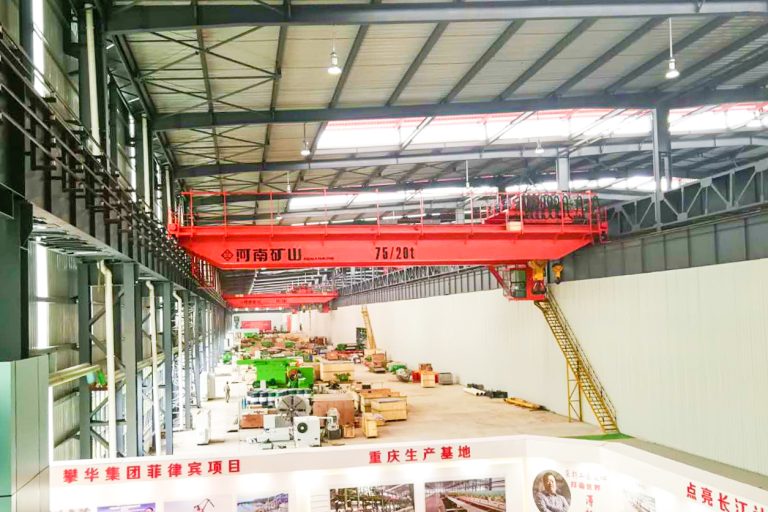
    Henan Mine CraneDiscuss your requirements ↗
  • Overhead Crane for Sale

    Overhead Crane for Sale

    Overhead Crane for Sale

    Henan Mine Crane · Custom Overhead Lifting

    Overhead Crane for Sale

    Find an overhead crane for your workshop, warehouse or production line. Henan Mine Crane manufactures single-girder, double-girder and underhung cranes configured around the lifted load, available space and daily handling cycle.

    Compare crane arrangements, define the equipment and installation scope, and request a project-specific quotation. Your proposal should bring the crane specification, building interfaces, controls and delivery requirements together before an order is placed.

    Single-girder overhead crane with electric hoist from Henan Mine Crane
    Single-girder electric-hoist configuration. Capacity, span, lifting height and equipment scope are confirmed in the quotation.

    CRANE ARRANGEMENT

    Single Girder, Double Girder or Underhung

    RATED CAPACITY

    Selected for the Load and Attachment

    APPLICATION

    Production, Storage and Maintenance

    QUOTATION BASIS

    Technical Specification and Supply Scope

    Overhead Cranes for Industrial Handling

    An overhead bridge crane uses a travelling bridge and hoist or trolley to lift and transfer loads within a defined working bay. It can serve fabrication stations, assembly positions, storage areas and maintenance locations without a floor-mounted travelling crane occupying the same route.

    The appropriate overhead crane for sale depends on what the load must do after it leaves the floor. A maintenance lift, repeated production transfer and controlled placement of an assembly may require different mechanisms, speeds and duties at the same rated capacity.

    Manufacturing and Assembly

    Define the stations to be served, component dimensions and required placement control. Account for machinery and services along the load route.

    Warehousing and Material Transfer

    Check access to storage positions and loading areas. Hook approaches, load length and aisle arrangements determine the usable coverage.

    Maintenance and Equipment Handling

    Specify the heaviest assembly and the lifting height needed to clear equipment. Allow space for lifting beams, slings and component removal.

    Overhead Crane Technical Specifications

    A useful overhead crane quotation identifies the selected values below. Capacity, span and lifting height should be confirmed together with the duty and building layout; a broad catalogue range is not a project specification.

    Specification Information Used to Configure the Crane
    Rated capacity Maximum payload, lifting accessories, load dimensions and centre of gravity; state whether capacity is in metric tonnes or another unit.
    Span and runway Runway centreline spacing, travel length, rail or beam details, and existing or proposed supports.
    Hook height and coverage Highest and lowest required hook levels, side and end approaches, roof clearance and obstructions.
    Operating duty Lifts per hour, operating shifts, travel distances and the share of lifts near rated load.
    Lifting arrangement Electric hoist or winch trolley, single or multiple hooks, and any dedicated load-handling attachment.
    Motion and controls Hoisting, trolley and bridge travel speeds; pendant, radio remote, cabin or specified automation.
    Site environment Indoor or outdoor use, temperature, humidity, dust, corrosion, heat and hazardous-area requirements.
    Electrical supply Site voltage, frequency, phases, earthing and the incoming power connection.
    Supply and acceptance Crane, runway equipment, installation responsibilities, documents and agreed factory and site inspections.

    For a metric 5-ton requirement, see the 5 Ton Overhead Crane page. The weight of suspended lifting accessories must be considered when confirming the required crane capacity.

    Selection Considerations

    01 / HANDLING TASK

    Start with the Lift

    List the heaviest load and normal operating loads. Show the pickup and placement points and identify any rotation, coordinated lifting or special attachment.

    02 / SITE FIT

    Check the Building Interface

    Provide a plan and cross-section. For an existing runway, check the proposed wheel loads, wheel spacing, rail interface and clearances against the supporting structure.

    03 / DUTY

    Define the Work Cycle

    Compare cranes at the duty actually required. Frequent production handling can change the hoist, drives, brakes and maintenance requirements even when capacity is unchanged.

    04 / PROJECT SCOPE

    Agree the Complete Scope

    Identify who supplies runway beams, rails, power distribution, supports and installation. Ask for inclusions and exclusions to be listed with the equipment quotation.

    Overhead Crane Configurations Compared

    Compare overhead cranes for sale against the same load, operating cycle and building drawing. Several arrangements may be feasible; the decision should include equipment cost, support requirements and access for maintenance.

    Crane Configuration Design Arrangement Where to Consider It Quotation Check
    Single-Girder Overhead Crane One bridge girder with the selected travelling hoist. Consider for general workshop lifting where the proposed capacity, duty and hook coverage meet the task. Check hoist headroom, hook approaches and runway reactions.
    Double-Girder Overhead Crane Two bridge girders with the specified trolley or hoist arrangement. Consider when the required lifting envelope, trolley layout or equipment arrangement favours two girders. Compare overall dimensions and mechanism duty; girder count alone does not establish performance.
    Underhung Overhead Crane The bridge travels on the lower flanges of suitable runway beams. Consider where a suspended runway layout fits an engineered supporting structure. Check beam flanges, supports, connections and clearances.
    Double-Trolley Overhead Crane Two lifting units on one bridge. Consider for defined two-point handling or independent lifting duties. Specify each hoist rating, permitted combined load and coordinated operating modes.
    Grab Overhead Crane A lifting system configured around a bulk-material grab. Consider for repeated pickup and discharge of suitable bulk materials. Confirm material density, grab self-weight, discharge geometry and required throughput.
    Explosion-Proof Overhead Crane Equipment configured for a specified hazardous environment. Consider where the site classification requires explosion-protected equipment. Match the design and documentation to the actual gas or dust hazard and applicable requirements.

    Single and double girder describe the bridge structure. Top-running and underhung describe how the bridge runs on its runway. These terms cover different design choices and should both be stated where relevant.

    How the Lifting System Affects the Specification

    Hoist and Trolley Arrangement

    The hoist raises the load and the trolley moves it across the bridge. Hook block dimensions, hoist position and trolley limits affect the actual working envelope. Match the lifting mechanism to the load spectrum and lift height.

    Bridge and Runway Interface

    Bridge travel covers the length of the bay. Wheel arrangement, runway geometry and support reactions affect the building interface, so the crane and runway should be evaluated together.

    Speed and Positioning

    Hoisting speed, cross travel and long travel serve different parts of the cycle. Specify any need for slow placement, controlled acceleration or positioning functions so the proposed controls can be assessed.

    Double-girder electric-hoist overhead crane from Henan Mine Crane
    Double-girder electric-hoist arrangement. Compare the proposed hook height, trolley dimensions and duty.
    Multi-support underhung overhead crane from Henan Mine Crane
    Multi-support underhung arrangement. The supporting structure and load distribution require project-specific assessment.

    Safety and Control Configuration

    Define safety functions and operating modes with the selected crane. The quotation should identify required protections and separately describe additional control or monitoring functions.

    • Load and motion protection: agree overload protection, hoisting and travel limits, brakes, emergency stops and relevant electrical protections, with acceptance checks for the specified functions.
    • Control stations: choose pendant, radio remote or cabin operation around visibility and access. Define control priority and the required response to loss of a command signal.
    • Shared operating areas: assess collision prevention, access controls and operating separation where cranes or equipment share the working bay.
    • Process-specific lifting: magnetic lifting, metallurgical handling and coordinated hoist arrangements require their own load-retention, thermal or fault-response review.

    A crane’s girder arrangement does not define its safety package. Any additional brakes, power-loss provisions, anti-sway controls or monitoring functions must be included explicitly in the agreed design.

    What Should an Overhead Crane Quotation Include?

    An overhead crane price is meaningful only when its scope is clear. Two quotations for the same capacity may cover different equipment, runway interfaces, testing or site work. Request a line-by-line scope before comparing the totals.

    Quotation Line Scope to Agree
    Crane equipment Bridge girders, end carriages, hoist or trolley, hook arrangement, drives and crane-mounted electrical equipment.
    Runway equipment Runway beams, rails or suspended tracks, connections, stops and supporting steelwork, where included.
    Power supply Crane and runway power distribution, cable arrangements and the boundary with the site incoming supply.
    Inspection and documentation Approved drawings, manuals, electrical diagrams, inspection records and the agreed factory and site test scope.
    Delivery and site work Packing, transport, unloading, installation equipment, labour, commissioning and operator familiarisation, as contracted.

    Ask the overhead crane supplier to list exclusions, site responsibilities, currency, delivery terms and quotation validity. Warranty coverage, spare parts and service arrangements should be stated in the offer.

    What Affects Overhead Crane Price?

    Capacity and span influence the structure, while duty, lift height and operating speeds influence the lifting and travel mechanisms. Restricted headroom, multiple hoists, dedicated attachments, environmental protection and automation can change the configuration further.

    A lower equipment price may cover a different hoist, operating duty or supply boundary. Compare the proposed specification and installed project scope, including any runway work and acceptance requirements.

    Load and Structure

    Capacity, span, hook envelope and runway reactions.

    Work Cycle and Controls

    Operating duty, speed control, attachment and process functions.

    Project Scope

    Runway supply, protection, inspection, delivery and installation.

    Manufacturing Review and Order Approval

    Crane structures and equipment inside a Henan Mine Crane manufacturing workshop
    Crane manufacturing workshop shown in the Henan Mine Crane factory gallery.

    Review the Henan Mine Crane manufacturing facilities alongside the product proposal. For your order, agree the records and inspections needed to verify the selected configuration.

    • Approve the general arrangement, hook coverage and building interfaces before manufacture.
    • Confirm component specifications, electrical requirements and any agreed substitutions.
    • Define inspection points, witness arrangements and the required test records.
    • Agree which checks occur at the factory and which require the installed crane on site.

    Applicable standards and conformity documents should be identified for the destination and project. The required records must relate to the supplied crane and its agreed scope.

    Delivery, Installation and After-Sales Support

    Delivery Planning

    Request a schedule tied to drawing approval, component procurement, manufacture, inspection and shipment. Transport time and site readiness should be considered separately from factory completion.

    Installation Readiness

    Confirm runway completion, assembly space, unloading arrangements, power availability and access for installation equipment. Assign responsibility for local lifting equipment and site coordination.

    Service and Spare Parts

    Agree documentation language, operator familiarisation, warranty terms and service scope. Identify maintenance access and recommended spares for the selected hoist, drives, wheels and electrical equipment.

    Overhead Crane Purchase FAQ

    Are these new overhead cranes or used cranes?

    This page covers new overhead cranes manufactured for project requirements. State the required configuration and site conditions when requesting a quotation.

    Are overhead cranes available for immediate delivery?

    Ask about availability for the exact specification. Capacity alone is not enough to establish a match: span, lifting height, duty, power supply and controls must also suit the project. Confirm the delivery date in the offer.

    How much does an overhead crane cost?

    A project quotation is needed because the structure, mechanisms and supply scope vary. Provide capacity, span, lift, duty, building information and site location so the equipment and delivery requirements can be priced together.

    Does the price include runway beams and installation?

    Only if these items are included in the agreed offer. Ask for runway equipment, supporting steelwork, power distribution, installation, commissioning and transport to be listed separately or clearly included.

    Can I buy a crane for an existing workshop?

    Yes, a proposal can be developed for an existing building. Suitability depends on the runway and support assessment, available clearances, hook coverage and electrical supply.

    Can I order a 5 ton or 10 ton overhead crane?

    Include the required capacity in your enquiry together with the load, duty and building dimensions. The selected structure, lifting mechanism and site interfaces must be confirmed for that requirement.

    What should be agreed before placing an order?

    Confirm the technical specification, drawings, inclusions and exclusions, inspection plan, delivery schedule, commercial terms and site responsibilities. Resolve any differences between the enquiry and quotation before acceptance.

    Request An Overhead Crane Quote

    Send Henan Mine Crane your overhead lifting requirement for configuration and quotation review. A building plan, cross-section and load description help define a proposal that matches the site.

    • Required capacity, typical load and lifting attachment
    • Runway span and length, required lifting height and building clearances
    • Operating cycle, environment, power supply and preferred controls
    • Project country, delivery needs, inspection requirements and installation scope
    Henan Mine CraneDiscuss your requirements ↗
  • Forging Crane Systems

    Forging Crane Systems

    Forging Crane Systems

    Henan Mine Crane · Engineered Forge-Shop Lifting Systems

    Forging Crane Systems

    Heavy-duty overhead cranes engineered to lift, transfer, turn and position hot ingots, billets, dies and forged components in open-die forging, press, hammer and heat-treatment facilities.

    Henan Mine Crane configures each forging crane from the maximum gross suspended load, workpiece temperature, press or hammer sequence, turning method, impact and load spectrum, cycle frequency, workshop geometry, required positioning performance and local compliance route. Systems can combine main and auxiliary hoists, powered turning devices, tongs or clamps, heat shielding, variable-frequency drives, cameras and production-line coordination.

    heavy-duty double-girder metallurgical crane platform for a custom forging crane system
    A forging crane is engineered around the actual press-shop load path, including the workpiece, tongs or turning device, hook blocks and every suspended accessory.

    PRIMARY STRUCTURE

    Heavy-Duty Double Girder

    PROCESS LOADS

    Hot Ingots, Dies & Forgings

    HANDLING METHODS

    Hooks, Tongs, Clamps & Turners

    CONTROL OPTIONS

    Cabin, Radio, PLC & Automation

    What Is a Forging Crane?

    A forging crane, also called a forge-shop crane or forging overhead crane, is a process crane built for the thermal, mechanical and production demands of a forging facility. It moves hot or cold stock between furnaces, presses, hammers, manipulators, inspection stations, heat-treatment equipment and storage positions. A specialized system can also rotate or reposition a workpiece during the forging sequence.

    The term covers two substantially different duties. A forge-shop handling crane transfers ingots, dies, tooling and finished forgings between stations. A press-coordinated forging crane participates directly in open-die forging by supporting and turning a heavy workpiece in coordination with the press or manipulator. The second duty normally requires higher working intensity, controlled load buffering, purpose-designed turning equipment and a control philosophy matched to the production sequence.

    A forging crane is not automatically a foundry crane. Foundry or casting cranes are designed for ladles and molten metal; quenching cranes are designed for rapid immersion into a treatment bath. Either may be required elsewhere in the same plant, but each process must be specified separately. Henan Mine Crane develops the forging system from the declared solid-workpiece duty and integrates relevant features from its metallurgical bridge crane and double-girder bridge crane platforms.

    Forging Crane Applications

    Open-Die Forging Press

    Support, rotate and reposition large ingots or forgings through repeated press strokes using approved hooks, tongs or a powered turning device.

    Forging Hammer Bay

    Transfer heated stock, dies and tooling while accounting for shock, vibration, scale and restricted approach around the hammer foundation.

    Furnace Charging and Extraction

    Move ingots or billets to and from heating furnaces with attachment clearance, radiant-heat protection and a controlled pickup orientation.

    Die and Tool Handling

    Change upper and lower dies, anvils, saddles and press tooling with the hook approach, creep speed and maintenance access required by the equipment layout.

    Heat Treatment and Cooling

    Transfer forged parts to normalizing, annealing, cooling or inspection positions; rapid immersion requires a separately defined quenching-crane function.

    Machining and Dispatch

    Move cooled forgings between cleaning, inspection, machining, weighing, storage and shipment when one crane serves the downstream production route.

    Components and Operating Principle

    1. Bridge and end carriages: carry the process trolley and distribute vertical, transverse and longitudinal reactions to the runway.
    2. Main hoist: supports the maximum forging, ingot, die or suspended turning assembly and provides controlled lifting under the declared duty.
    3. Auxiliary hoist: supports turning, tailing, tool handling or secondary positioning when the approved operation requires two lifting points.
    4. Below-hook device: may be a hook rig, tong, clamp, spreader, chain-turning assembly or powered turning unit designed for the workpiece.
    5. Drives and controls: coordinate hoisting, trolley travel, bridge travel, creep speeds, interlocks, monitoring and optional press-line communication.
    6. Thermal and environmental protection: shields structures, ropes, cables, motors, brakes, panels, sensors and the operator station from the declared exposure.
    heavy-duty metallurgical bridge crane machinery arrangement applicable to forge-shop engineering
    Bridge structure, trolley layout, reeving, brakes, ropes and thermal protection are selected as one process system rather than as isolated components.

    Rated-load basis: the crane rating starts with the maximum gross suspended load. This includes the heaviest workpiece, tongs or turning device, spreader, rigging, hook blocks and every other suspended component. The forging mass alone is not the required crane capacity.

    Forging Crane Selection Considerations

    Selection begins with the forging sequence and complete load spectrum. Nominal tonnage alone cannot define the structure, mechanisms, attachment or safety architecture.

    Load Matrix

    Minimum, typical and maximum mass; workpiece dimensions; center-of-gravity range; dies and tooling; attachment mass; single- or dual-point lifting; off-center cases.

    Forging Sequence

    Furnace pickup, press or hammer approach, rotation angle, number of turns, hold time, transfer path, handover to manipulator and downstream placement.

    Temperature and Environment

    Workpiece and furnace temperatures, radiant-heat intensity and duration, ambient range, scale, dust, smoke, oil mist, water spray, vibration and corrosive exposure.

    Duty and Dynamics

    Cycles per hour, starts and reversals, shifts, annual hours, load spectrum, press interaction, permitted shock, required buffering and production consequence of downtime.

    Building and Equipment Interface

    Rail-center span, runway length and elevation, wheel-load limits, headroom, hook approaches, press columns, furnace doors, manipulator envelope and maintenance access.

    Control and Acceptance

    Cabin or radio control, visibility, cameras, creep speed, positioning tolerance, press/MES signals, fallback modes, proof load, representative-workpiece test and documentation.

    high-temperature heavy-duty bridge crane engineering reference for forging crane selection
    The crane envelope must be checked against furnace, press, manipulator, platforms, columns, extraction systems and the full suspended-load turning radius.

    Forging Crane Configurations Compared

    The configuration follows the actual process function. Equipment from adjacent metallurgical duties should not be substituted without a complete engineering review.

    Configuration Suitable Duty Typical Load Handling Engineering Focus Selection Boundary
    Heavy-duty hook forging crane Ingot, die, tooling and forged-part transfer Main hook with approved rigging or spreader Duty, creep speed, heat protection, hook approach and maintenance access Does not provide controlled turning unless a separate system is included
    Main-and-auxiliary hook forging crane Transfer, tailing and planned load rotation Two hooks with approved turning rig or attachment Hook spacing, capacity split, synchronized control, rope fleet angles and permitted load cases The complete turning procedure must be analyzed; two hooks alone do not make every rotation safe
    Tong or clamp forging crane Repeated pickup of defined ingots, billets or forgings Mechanical, hydraulic or powered gripping attachment Grip range, surface contact, hot strength, fail-safe state, scale and attachment mass Requires a controlled workpiece range and representative validation
    Press-coordinated forging crane Direct participation in heavy open-die forging Main hoist plus turning device, tongs or manipulator interface Load buffering, impact limits, rapid reversals, positioning, communication and production availability Requires a joint functional specification with the press and manipulator supplier
    Quenching crane Rapid, controlled immersion of hot workpieces Hook, fixture or basket matched to the bath Fast lowering/lifting, emergency recovery, bath geometry, vapor and splash exposure A heat-treatment crane, not a substitute for press-coordinated forging
    Foundry or casting crane Ladle handling and molten-metal transfer Gantry hook or ladle lifting attachment Molten-metal-specific redundancy, thermal protection and regulatory requirements Required only when molten metal is in scope; it is not the standard crane for solid forgings

    Preliminary Forging Crane Specification Framework

    The values below identify the decisions required for a technical proposal. Final parameters are established after the load cases, process sequence and workshop interfaces are approved.

    Parameter Project Definition Required Input
    Rated lifting capacity Selected from maximum gross suspended load and governing load cases Workpiece, attachment, rigging, hook block and off-center loads
    Main / auxiliary capacity Single hoist, main plus auxiliary, or coordinated multi-hoist arrangement Turning method, capacity split and simultaneous-use cases
    Structure and trolley Double-girder process crane; special multi-girder or dual-trolley layout where justified Capacity, span, wheel loads, headroom, rigidity and access
    Span and lifting height Engineered from rail centers, hook travel and process clearance Workshop section, press/furnace drawings and runway survey
    Working duty Calculated under the selected classification system Load spectrum, cycles, starts, shifts, annual hours and process dynamics
    Hoisting and travel speeds Process, transfer and creep speeds with variable-frequency control as required Cycle time, positioning tolerance, travel distance and load stability
    Thermal design Heat shields, protected components, cooling or relocated equipment Workpiece temperature, radiant flux or distance/time profile and ambient range
    Control system Cabin, radio, local station, semi-automatic or integrated automatic control Visibility, operator location, interfaces, fallback mode and safety zones
    Power and environment Matched to destination voltage, frequency, enclosure and protection requirements Site power, dust, scale, smoke, humidity, altitude and corrosion
    Compliance route One coherent contractual design and inspection basis Destination, local authority, purchaser specification and required certification

    Market envelope: specialized suppliers publicly present dedicated heavy forging cranes in approximately 180–550 t capacities, 24–33 m spans and 17–28 m lifts. Smaller forge-shop handling cranes and larger custom systems also exist. These are market reference ranges, not fixed Henan Mine Crane catalog limits or a substitute for project calculations.

    Hot-Workpiece Handling and Turning Engineering

    Turning a forging creates load cases that may be more demanding than a straight vertical lift. The center of gravity moves, sling or chain angles change, one hook can temporarily carry a larger share, and the workpiece may contact a saddle, manipulator or die. The approved method must define the load path through every stage.

    Main + Auxiliary Hooks

    Define simultaneous-use capacity, hook spacing, permitted angles, speed coordination and the maximum reaction on either hoist.

    Powered Turning Device

    Specify torque, workpiece range, rotation speed, restraint, heat protection, emergency state and attachment-to-crane interface.

    Tongs and Clamps

    Validate grip range, hot material behavior, contact pressure, surface scale, loss-of-power condition and visual confirmation.

    Rigging and Saddles

    Confirm temperature rating, bend radius, edge protection, contact geometry, inspection access and storage away from radiant heat.

    metallurgical material turnover crane platform for controlled hot forging rotation
    A turning system is defined by the workpiece matrix, required rotation, temperature, attachment geometry and the most highly loaded point in the sequence.

    Process control: no operator should have to improvise the turning sequence. The approved lifting plan, control logic, permissible load cases, communication signals and abnormal-condition recovery are established before commissioning and verified with representative loads.

    Heat, Scale, Shock and Environmental Protection

    Thermal Mapping

    Evaluate workpiece temperature, exposure distance, dwell time and radiant paths at the hooks, trolley, girders, cabin, panels and maintenance platforms.

    Protected Hoisting System

    Select ropes, drums, sheaves, bearings, lubrication, brakes and cables for the measured environment and shield them from direct heat and scale.

    Electrical Protection

    Use suitable enclosures, cable routing, cooling or equipment relocation and monitor critical temperatures where the risk assessment requires it.

    Shock and Vibration

    Define permitted process forces, acceleration limits, buffering and structural fatigue cases; the crane must not be used to absorb undefined press or hammer impacts.

    Operator Visibility

    Coordinate cabin position, heat-resistant glazing where specified, cameras, lighting, audio communication and safe radio-control locations.

    Maintainability

    Provide safe access to brakes, ropes, sheaves, drives, panels and attachment points, with guards and shields removable under an isolation procedure.

    heat-protected heavy-duty bridge crane in a high-temperature steel processing environment
    Thermal protection is based on actual exposure at each component. Workpiece temperature alone does not define the temperature experienced by the crane.

    Manual, Semi-Automatic and Integrated Forging Operation

    The control level follows process repeatability, visibility, cycle time, exception rate and the production system’s ability to provide dependable interlocks and workpiece data.

    Control Level Typical Functions Suitable Operating Pattern Definition Required
    Manual control Cabin or radio control, variable speeds, load display, cameras and interlocks Mixed workpieces, frequent exceptions and operator-led rigging Sightlines, control location, communications, exclusion zones and permitted motions
    Semi-automatic Stored positions, automatic travel profiles or assisted turning with operator authorization Repeated stations with controlled workpiece families Coordinates, confirmation logic, permissible sequence and exception recovery
    Press-line integrated Signal exchange with press, manipulator, furnace and safety control systems High-repeatability open-die forging and coordinated production Signal list, ownership, timing, safe states, independent stops and commissioning protocol
    Automatic material flow Task receipt, route control, positioning, status feedback and production-data exchange Controlled transfer between fixed stations with limited human access Plant interface, zone control, workpiece identity, cybersecurity and manual fallback
    Henan Mine Crane automated metallurgical crane platform relevant to integrated forging material flow
    Integrated operation requires an agreed signal matrix, safe-state philosophy, independent emergency functions and a tested manual-recovery procedure.

    Design Basis, Inspection and Acceptance

    The purchase specification identifies one coherent design route. Local statutory requirements at the installation site remain applicable, and standards from different systems are not selectively combined without an approved compliance matrix.

    Possible Design Routes

    A project may use ISO 4301 classification principles with applicable crane standards; EN 13001 with EN 15011 and EN 13155 where applicable; or a North American route using CMAA 70 with applicable ASME B30.2, B30.20 and ASME BTH-1 requirements. The contract states the selected basis and local additions.

    Engineering Deliverables

    General arrangement, load-case schedule, duty calculation, wheel loads, clearance and turning study, attachment data, thermal assessment, electrical drawings, control narrative, interface list, inspection plan and maintenance-access arrangement.

    Manufacturing Inspection

    Material traceability, welding procedures and welder qualification, specified NDT, dimensional checks, machinery alignment, drum and rope inspection, attachment inspection, electrical-panel tests, coating and document review.

    FAT and Site Acceptance

    Functional tests verify motions, brakes, limits, overload protection, control modes, alarms and interfaces. Site testing then covers runway, erection, proof load, representative workpieces, turning sequence, power-loss response, positioning, press coordination, training and handover.

    Acceptance Item Verification Recorded Evidence
    Rated and governing load cases Contractual proof/load test and functional motion checks Test procedure, calibrated instruments and signed results
    Turning and attachment Approved representative workpieces across the declared envelope Workpiece list, sequence, grip/rigging checks and exception record
    Safety and controls Limits, overload, stops, interlocks, communication loss and fallback modes Cause-and-effect record and completed test sheets
    Handover readiness Training, spares, manuals, inspection plan and maintenance access Handover dossier, punch-list closure and acceptance certificate

    Relevant Heavy Metallurgical Crane Experience

    Relevant references are evaluated by capacity, thermal exposure, duty, trolley architecture, process control and commissioning complexity. The following published Henan Mine Crane projects demonstrate adjacent engineering capability; a new forging crane still requires its own process and load-case validation.

    Henan Mine Crane 360 ton four-girder foundry crane heavy metallurgical project

    Ultra-Heavy Metallurgical Reference

    360 t Four-Girder Foundry Crane

    The published Jinsheng’an Group project uses a four-girder, four-rail, dual-trolley arrangement for a 360 t foundry duty, with heavy-capacity structure, thermal protection and redundant hoisting functions.

    The reference is relevant to ultra-heavy structure, trolley coordination and high-temperature engineering. Its molten-metal duty does not define the attachment, motion sequence or safety architecture of a forging crane.

    View 360 t Project Reference

    Henan Mine Crane hot-rolled steel plant specialized bridge crane project

    High-Temperature Production Reference

    Hot-Rolled Steel Plant Bridge Cranes

    Henan Mine Crane publishes a 50–200 t, A6 specialized bridge-crane platform for hot-rolling production, with project-defined heat protection, variable-frequency control and production-system integration.

    This experience is relevant to radiant-heat exposure, continuous steel-plant operation and equipment interfaces. Forging impact, turning and attachment requirements remain separate design inputs.

    View Steel-Plant Reference

    Reference boundary: adjacent metallurgical projects demonstrate relevant structural, mechanism, thermal-protection and control experience. They do not establish the final capacity, duty, turning device, cycle performance, compliance or price of a new forging crane.

    Forging Crane Price and Budget Scope

    A reliable forging crane price requires the maximum gross suspended load, turning method, span, lift, duty, speeds, thermal exposure, controls, runway scope, destination and acceptance requirements. Public listings provide only preliminary market signals because they rarely normalize the process attachment, safety functions or project boundary.

    Public Market Signal Checked in September 2026 Published Position Budget Meaning Commercial Limitation
    25 t double-girder crane marketed for forging; 14 m span and 10 m lift US$42,000 per set A public equipment-level signal for a smaller forging application Attachment, heat duty, runway, freight, erection, tests and local compliance are not normalized
    General double-girder listing with maximum lifting weight above 200 t US$5,000–500,000 per set Shows how capacity-only marketplace ranges become too broad for project budgeting Not a forging-specific quotation and may include placeholder endpoints
    Dedicated heavy forging cranes publicly presented at 180–550 t Price on request Heavy press-shop systems are treated as engineered capital projects Capacity does not reveal trolley layout, turner, duty, thermal design or installation scope
    Henan Mine Crane forging system Project quotation Technical and commercial scope is built from the approved forging process and site data A comparable price requires the RFQ inputs listed below

    Major budget drivers: gross suspended load; main/auxiliary or dual-trolley arrangement; tongs, turner or other below-hook device; span, lift and hook approaches; duty and process dynamics; heat shielding and cooling; braking and redundancy; cabin, cameras and controls; press/MES integration; runway and electrification; export packing, freight, erection, testing, training and local certification.

    The figures above are third-party public market observations, not Henan Mine Crane offers. Marketplace values may be equipment-only figures, placeholders or scopes that exclude essential engineering and site work. Contract comparisons require a line-by-line technical and commercial reconciliation.

    Forging Crane RFQ Information

    A complete enquiry allows the structure, hoists, turning system, thermal protection, runway reactions, controls and commercial scope to be priced on the same basis.

    Workpiece and Attachment Data

    Minimum, typical and maximum mass and dimensions; temperature at pickup; center of gravity; material and surface; dies and tooling; required tongs, clamp, turner, spreader or rigging; drawings and photographs.

    Process and Duty

    Furnace, press, hammer, manipulator and heat-treatment sequence; lifts and turns per hour; shifts; annual hours; load spectrum; required cycle time; permitted process forces and production consequence of downtime.

    Workshop and Runway

    Rail-center span, runway length, rail and elevation; required lift; headroom and approaches; existing wheel-load limits; press, furnace, platform and duct drawings; installation access and site-survey data.

    Controls and Commercial Scope

    Cabin, radio or automatic control; positioning tolerance; press/MES protocol; voltage and frequency; environment; destination; compliance route; Incoterm; runway, electrification, installation, commissioning, testing and documentation scope.

    Fastest route to a comparable proposal: provide a workshop cross-section, equipment layout, workpiece matrix, step-by-step handling sequence and required supply boundary. When existing information is incomplete, the quotation can separate confirmed scope, provisional allowances and exclusions.

    Frequently Asked Questions

    How is forging crane capacity calculated?

    Capacity begins with the maximum workpiece and adds tongs, turning device, spreader, rigging, hook blocks and other suspended equipment. The design then evaluates off-center loads, main/auxiliary load sharing, dynamics and the selected duty classification.

    Is a forging crane the same as a foundry crane?

    No. A forging crane principally handles solid ingots, dies and forgings and may assist rotation at a press. A foundry crane handles ladles and molten metal under a different risk profile and safety architecture.

    When are main and auxiliary hooks required?

    They are considered when the approved process requires tailing, turning, secondary positioning or tool handling. Hook spacing, capacity split, simultaneous loading and the complete rotation sequence must be defined before selection.

    Can a standard overhead crane handle hot forgings?

    Only after a dedicated engineering review. Radiant heat, scale, duty, process dynamics, attachment, visibility and component temperatures can require structural, mechanical, electrical and control measures beyond a general-purpose crane.

    How much does a forging crane cost?

    A public 25 t forging-application listing reviewed in September 2026 showed US$42,000 per set, while dedicated 180–550 t forging cranes were generally price-on-request. Final cost depends on the full process, attachment, thermal design, duty, runway, controls and delivery scope.
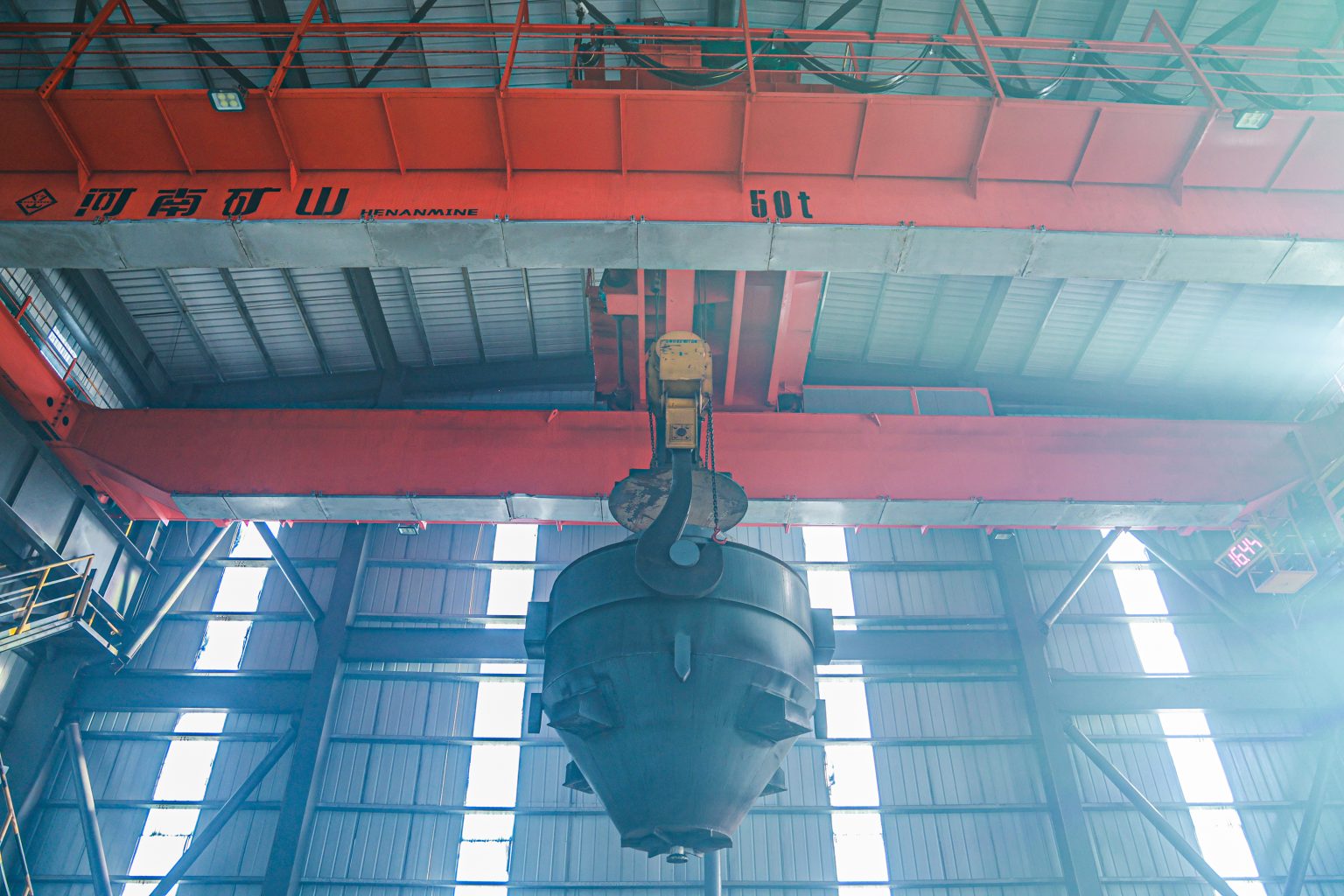
    Can a forging crane coordinate with a hydraulic press?

    Yes, when the crane, press, manipulator and safety systems share an approved functional specification. The signal matrix defines command ownership, permissives, timing, safe states, independent stops and recovery after a fault.

    Can an existing runway be reused?

    Only after the rails, beams, brackets, columns, connections and foundations are checked for condition, alignment, fatigue and the new crane reactions. Heavy process trolleys and special attachments can change wheel loads materially.

    What should be tested before handover?

    Testing covers motions, brakes, limits, overload protection, control modes, attachment functions, representative workpieces, turning sequences, power-loss response, positioning, interfaces, safety zones and manual recovery under agreed criteria.

    Request a Forging Crane Quote

    Submit the workpiece and attachment matrix, temperature, forging sequence, lifts and turns per hour, press, furnace and manipulator drawings, span, lift, runway data, required control level, power supply, destination and supply boundary. Henan Mine Crane will prepare a configuration-based technical and commercial proposal.

    Henan Mine CraneDiscuss your requirements ↗
  • Overhead Bridge Crane

    Overhead Bridge Crane

    Overhead Bridge Crane

    Henan Mine Crane · Workshop and Industrial Lifting

    Overhead Bridge Crane

    An overhead bridge crane moves a suspended load vertically and across a working bay. A hoist or trolley travels along the bridge, while the bridge runs on elevated runways to serve production stations, storage areas and loading positions.

    Henan Mine Crane manufactures single-girder, double-girder and underhung overhead bridge cranes for industrial material handling. Configure the crane around the load, required hook coverage, building structure and operating duty, with the equipment and installation interfaces defined in your quotation.

    Double-girder overhead bridge crane with an electric-hoist trolley from Henan Mine Crane
    Double-girder overhead bridge crane with an electric-hoist trolley. The installation drawing defines the span, hook levels and runway interfaces.

    BRIDGE DESIGN

    Single or Double Girder

    RUNWAY ARRANGEMENT

    Top Running or Underhung

    LIFTING EQUIPMENT

    Hoist or Trolley to Suit the Task

    PROJECT INTERFACES

    Load, Coverage, Structure and Power

    Overhead Bridge Cranes for Workshops and Warehouses

    Overhead crane and bridge crane are common names for this arrangement. Electrically powered travelling models are also called EOT cranes. The practical selection starts with the material flow and the space the hook must reach.

    Connect Production Stations

    Transfer components between fabrication, machining and assembly positions within one crane bay. Include the load orientation and lifting attachment required at each station.

    Serve Storage and Loading Areas

    Reach designated storage lanes and loading positions from above. Check obstructions, vehicle access and the available hook approach at the ends of the runway.

    Handle Maintenance Lifts

    Lift equipment clear of its mounting and move it to a service area. Allow enough hook height for the lifting gear and enough horizontal clearance for the complete component.

    The load path remains within the crane’s defined coverage. Supporting columns, runway steelwork, overhead services and maintenance access still need to be accommodated in the facility layout.

    Overhead Bridge Crane Technical Specifications

    The references below correspond to the linked Henan Mine Crane product tables. They help shortlist an arrangement; the final project specification also defines duty, speed, hook approaches and structural reactions.

    Product Reference Rated Capacity Span Lifting Height
    Single-Girder Bridge Crane: Selected Examples 5 t and 10 t 7.5–28.5 m, listed spans 6, 9, 12, 18, 24 or 30 m
    LH Double-Girder Electric-Hoist Bridge Crane 3–32 t 7.5–31.5 m 6–30 m
    Single-Girder Suspended Bridge Crane 1–10 t 7.5–28.5 m 6–20 m

    All t values here are metric tonnes. If your project uses US short tons, identify that unit in the enquiry. Confirm the complete load, span and lifting-height combination for the selected model; maximum catalogue values are not automatically available together.

    Additional Technical Inputs

    • Maximum and typical cargo weights, load dimensions, centre of gravity and lifting gear.
    • Runway length and elevation, highest and lowest required hook positions, and coverage at each workstation.
    • Lifts per hour, load distribution, operating shifts, travel distances and positioning needs.
    • Supply voltage, frequency and phases; control method; environment and required design standard.
    • Wheel loads, wheel spacing, runway interfaces, access platforms and agreed installation scope.

    Selection Considerations

    01 / LOAD

    Start with the Lifted Load

    Describe the cargo and the slings, lifting beams, grabs or other attachments. Their weights and geometry affect the required rating, hook height and usable payload.

    02 / COVERAGE

    Map the Working Area

    Mark every pickup and placement point on the building plan. Include machine enclosures, doors, stored goods and services that could restrict the load or hook path.

    03 / OPERATION

    Match the Production Duty

    Separate occasional maintenance lifting from repetitive production handling. Load spectrum, operating time and travel distances help determine the crane and mechanism duties.

    04 / INSTALLED SCOPE

    Review the Complete Installation

    Compare the crane with its runway, supporting structure, power supply and service access. A lower equipment price can come with a different building or installation requirement.

    Overhead Bridge Crane Compared with Other Industrial Crane Configurations

    Girder count and runway arrangement are separate choices. A single-girder crane can have a top-running bridge with an under-running hoist; the position of that hoist does not classify the bridge as underhung.

    Configuration Structural Arrangement Selection Trade-Off
    Single-Girder Overhead Bridge Crane One main girder, commonly with a travelling hoist below the beam. A compact arrangement for general handling. Compare hook height, side approaches, duty and total installed cost.
    Double-Girder Overhead Bridge Crane Two main girders carrying the selected trolley and lifting mechanism. Allows different trolley and hook arrangements. Review crane height, runway loading and maintenance access for the proposed layout.
    Underhung Overhead Bridge Crane The bridge travels on the lower flanges of suitable elevated runway beams. Useful where the building supports a suspended runway layout. Flange loading, connections and supporting steelwork require assessment.
    Multi-Support Underhung Bridge Crane A suspended bridge uses multiple runway supports across the working area. Consider for an engineered multi-rail facility. Coordinate support locations, alignment and the distribution of loads.
    Gantry Crane Legs carry the bridge above ground-level runways or a specified travel system. An alternative where elevated runways are unsuitable. Account for leg clearance, travel lanes, ground conditions and foundations.

    For a top-running overhead bridge crane, the end carriages run on rails above the runway beams. Those runways may be carried by building columns or by an independent engineered support structure.

    Hook Coverage, Headroom and Load Clearance

    Span Is Not Hook Coverage

    Span is based on the runway centreline spacing. Side and end approaches, together with any engineered overhang, determine where the hook can travel. Check the resulting working area against the layout.

    Lifting Height Is Not Building Height

    Determine the required highest hook position from the load, lifting gear and obstacle clearance. Then check the complete crane envelope against roof members, lighting, ductwork and maintenance space.

    The Load Needs Clearance Too

    A reachable hook position does not guarantee that a long beam or bulky machine can pass through the same area. Check the suspended load’s dimensions and intended orientation along the full route.

    Single-girder overhead bridge crane with a travelling hoist below the main girder
    Single-girder bridge with an under-running hoist. The hoist position and end clearances influence the working envelope.
    Multi-support double-girder underhung overhead bridge crane with several runway beams
    Multi-support underhung arrangement. Runway support positions and load distribution are coordinated with the building structure.

    For restricted headroom, compare a low-headroom hoist and alternative bridge layouts on the same building cross-section. The useful result is the achievable hook level with the required clearances and access.

    Runway Loads and Building Support

    Runway selection is part of the crane installation. Crane deadweight, trolley position, lifted load and the agreed design load combinations influence the forces transferred to the building or independent supports.

    New Building

    Coordinate the crane drawing with the structural design before fixing runway elevations and column positions. Include power routes, end clearances and access to the lifting and travel equipment.

    Existing Building

    Survey the rails, runway beams, connections and supporting structure. Use the proposed wheel loads, wheel spacing and horizontal reactions for the structural review.

    Replacement Crane

    Compare the actual interfaces of the old and proposed cranes. The same rated capacity can come with different crane weight, wheelbase, loading, hook approaches and electrical demand.

    Define who supplies the runway beams, rails, columns, brackets and foundations. The crane quotation and the building design should use the same approved installation data.

    Hoists, Trolleys and Operating Duty

    Choose the lifting mechanism around the load and work cycle. A double-girder structure does not by itself establish heavy-duty or continuous-service capability; both the crane and its individual mechanisms need suitable classifications.

    Hoist or Trolley Arrangement

    Compare the selected hoist layout, lifting height, hook block, maintenance access and available speeds. The arrangement also affects the hook approaches and structural loads.

    Main, Auxiliary or Dual Hoists

    Identify the task for each hook and any permitted combined operation. Ratings, hook separation, shared loads and control coordination must be defined for multi-hook handling.

    Operating Cycle

    Record the frequency of near-rated lifts, mechanism running time, starts and travel distances. These inputs help distinguish intermittent workshop use from repetitive production service.

    For long components, review the double-trolley electric-hoist bridge crane arrangement. For controlled speed and acceleration, compare the frequency-conversion electric-hoist overhead crane. Specify the required performance for each motion.

    Controls, Power Supply and Motion Performance

    Pendant, Radio or Cabin Control

    Select around operator visibility, walking routes and the handling task. Multiple control stations require a defined selection priority and response to a loss of command signal.

    Power Feed and Distribution

    Confirm site voltage, frequency, phases and the connection point. Distinguish the runway power system from the cable or conductor arrangement supplying the moving hoist or trolley.

    Speed and Positioning

    Specify hoisting, trolley travel and bridge travel separately. Include acceleration, stopping and placement needs; maximum travel speed alone does not define the handling cycle.

    Anti-sway, automatic positioning, load monitoring and production interfaces are functions to specify individually. Agree their operating conditions and acceptance method before they become part of the supply scope.

    Attachments, Special Environments and Safety

    A general workshop hook crane is only one configuration. The material and environment can change the lifting attachment, mechanical design, controls and protection requirements:

    • Grab overhead cranes handle suitable bulk materials. Supply material density, condition, required throughput and discharge height so grab payload and crane duty can be selected together.
    • Explosion-proof overhead cranes require the site’s hazardous-area classification and relevant gas or dust information. Equipment protection and documentation must match that application.
    • Metallurgical bridge cranes address defined hot-material and production duties. Describe the process, temperature exposure and consequences of a lifting interruption.
    • Outdoor or corrosive locations require review of weather exposure, coatings, electrical protection, runway conditions and relevant wind requirements.

    Protection and Safety Functions

    Define overload protection, hoisting and travel limits, braking, emergency stops and electrical protections for the selected crane. Shared runways need an assessment of crane separation and collision prevention. Additional brakes, monitoring or redundancy arrangements depend on the intended duty and risk assessment.

    Manufacturing and Inspection Documentation

    Henan Mine Crane manufacturing workshop showing crane bridge structures and lifting mechanisms
    Crane structures and lifting equipment inside a Henan Mine Crane production workshop.

    Henan Mine Crane manufactures overhead lifting equipment for industrial production and material handling. View the company’s manufacturing workshops for published factory photographs.

    The order documentation should connect the selected crane configuration with the equipment supplied. Agree the following requirements before manufacture:

    • General arrangement drawing showing rated capacity, span, hook limits, crane dimensions and runway interfaces.
    • Hoist, motor, drive and control schedule with electrical diagrams and protection functions.
    • Material and fabrication inspection scope, including specified weld examination and dimensional checks.
    • Factory and site test requirements, acceptance records, manuals and a parts list.

    Define witness points and the records needed at handover. Any required conformity documentation must apply to the ordered equipment and its destination.

    Installation, Commissioning and Maintenance

    Prepare the Installation

    Coordinate delivery with runway readiness, power availability, assembly space and access for lifting equipment. Identify the party responsible for unloading, erection and electrical connections.

    Agree Acceptance

    Define alignment checks, functional tests, protection checks and the applicable load-test scope. Allocate responsibility for test loads, witnessing, records and operator familiarisation.

    Plan Maintenance Access

    Provide safe access and isolation arrangements for hoists, ropes, brakes, wheels and electrical equipment. Follow the supplied manuals and actual duty when setting inspection and lubrication intervals.

    For a production-critical crane, identify essential spares and the space needed to remove components before operation begins. Maintenance access can affect the building layout as well as the crane arrangement.

    Overhead Bridge Crane Price and Supply Scope

    An overhead bridge crane price reflects the load, span, lift, duty, hoist arrangement, controls and supply boundaries. Compare quotations for the same working envelope and operating requirement.

    • Crane equipment: bridge, end carriages, hoist or trolley, controls and agreed protection functions.
    • Runway and power: beams, rails, support steelwork and electrical distribution, as specified.
    • Project services: packing, transport, unloading, installation, commissioning and training scope.
    • Handover requirements: inspection records, manuals, spares, delivery terms and service arrangements.

    When comparing an overhead bridge crane for sale with a hoist or crane kit, check exactly which structures and services are included. Request the selected configuration, exclusions and delivery schedule in the project quotation.

    Request A Bridge Crane Quotation

    Overhead Bridge Crane FAQ

    What is the difference between an overhead crane, bridge crane and EOT crane?

    Overhead crane and bridge crane commonly refer to the same moving-bridge arrangement. EOT means electric overhead travelling and identifies an electrically powered design. The selected bridge, hoist and runway arrangement still need to be specified.

    Should I choose a single-girder or double-girder overhead bridge crane?

    Compare the load, span, highest hook position, duty, runway reactions and installed cost. Double-girder designs allow different trolley arrangements, while a single-girder system may suit general handling. The project layout determines the practical choice.

    Are top-running and underhung cranes different from single- and double-girder cranes?

    Yes. Top running and underhung describe how the bridge travels on its runways. Single and double girder describe the bridge beams. An under-running hoist can be used on a top-running single-girder bridge.

    Can an overhead bridge crane use an existing building?

    It may be possible after the structure and runway are assessed for the proposed crane. Provide building drawings, runway details and condition information. An existing crane’s lifting capacity alone is insufficient to establish compatibility.

    Can the hook reach every part of the crane bay?

    Coverage is limited by side and end approaches, hook height and obstructions. Show each required lifting position on the plan and check both the hook and the suspended load against the proposed crane dimensions.

    Do you offer 5-ton and 10-ton overhead bridge crane configurations?

    The single-girder reference tables include metric 5 t and 10 t examples. Final span, lift, duty and building interfaces need confirmation. Explore the 5 Ton Overhead Crane options or send your full specification for selection.

    What information is needed for an overhead bridge crane quotation?

    Send the required capacity and unit, span, lifting height, runway length, working cycle and power supply. Include load details, the installation country, a building drawing and the required equipment and service scope.

    Request An Overhead Bridge Crane Quote

    Send Henan Mine Crane your load requirement, span, lifting height and operating cycle. Add the building layout, site power supply, installation country and required supply scope so the proposal can address the crane, its working area and its installation interfaces.

    Henan Mine CraneDiscuss your requirements ↗
  • Aircraft Hangar Crane Systems

    Aircraft Hangar Crane Systems

    Aircraft Hangar Crane Systems

    Henan Mine Crane · Aircraft MRO, Engine Handling and Hangar-Wide Maintenance Access

    Aircraft Hangar Crane Systems

    Engineered overhead and underhung crane systems for aircraft maintenance, engine removal and installation, landing-gear service, component replacement, tooling transfer and elevated access across large hangar bays.

    Each aircraft hangar crane is configured around the maintained aircraft fleet, maximum service load, approved lifting interfaces, maintenance sequence, hangar clearances, roof or runway capacity, motion-control requirements and destination compliance framework.

    multi-point suspension crane system arranged for aircraft hangar maintenance
    Large MRO hangars can combine wide-area suspension cranes, service trolleys and synchronized lifting points while preserving aircraft and ground-equipment routes.

    PRIMARY DUTY

    Aircraft Maintenance, Repair and Overhaul

    TYPICAL LOADS

    Engines, Landing Gear, Tooling and Components

    SYSTEM OPTIONS

    Underhung, Bridge, Monorail and Multi-Point

    PROJECT PRIORITIES

    Clear Floor, Low Sway and Aircraft Protection

    What Is an Aircraft Hangar Crane?

    An aircraft hangar crane is an overhead material-handling system designed for maintenance tasks around a complete aircraft. It can lift engines, auxiliary power units, landing gear, flight-control surfaces, cabin modules, maintenance tooling and test equipment, or carry an engineered access platform where the approved maintenance process requires overhead access.

    Hangar work differs from repetitive factory production. Aircraft positions change, several aircraft types may share one bay, mobile stands and docks occupy the floor, tail and wing clearances are restrictive, and the crane may remain lightly loaded for long periods before a critical maintenance lift. Capacity therefore forms only one part of the specification. Coverage, hook approach, low-speed control, collision zoning, component protection, runway reactions and recovery from a control fault are equally important.

    Henan Mine Crane supplies multi-support double-girder underhung cranes, single-girder suspension cranes, double-girder bridge cranes and project-specific multi-hoist systems for new-build and retrofit hangars.

    Aircraft Hangar Crane Applications

    The crane schedule should follow the actual maintenance work package and aircraft fleet. A narrow-body engine-change bay, wide-body heavy-maintenance hangar, military depot, business-jet facility and helicopter maintenance workshop can require different spans, service loads, access arrangements and restricted zones.

    Separate lifting arrangements can be assigned to high-value aircraft components, general tooling and elevated maintenance access so that each duty receives the appropriate control, attachment and inspection regime.

    large-span suspension crane serving an open aircraft maintenance hangar
    Ceiling-supported coverage keeps the hangar floor available for aircraft, docking systems, tugs, stands and maintenance vehicles.

    Engine Removal and Installation

    Controlled vertical movement, accurate lateral positioning and a compatible engine cradle support disconnection, lowering, transfer and reinstallation without uncontrolled sway.

    Landing-Gear Service

    Load control and fine positioning help maintain component orientation during removal, overhaul support, replacement and alignment with approved fixtures.

    Flight-Control and Airframe Parts

    Flaps, rudders, elevators, fairings, doors and structural panels may require long spreaders, protected contact surfaces and several balanced support points.

    Cabin and Interior Modules

    Monorails, light suspension cranes or service hoists can move seats, monuments, galleys, test equipment and maintenance materials along defined routes.

    Maintenance Docks and Tooling

    The crane can reposition calibrated fixtures, engine stands, access-dock sections and maintenance equipment while preserving clear marked routes around the aircraft.

    Overhead Maintenance Access

    A purpose-engineered telescopic platform can provide stable access to upper fuselage, tail and wing areas when platform duty, personnel protection and emergency recovery are included in the system design.

    Aircraft Hangar Crane vs. Aircraft Manufacturing Crane

    Project Factor Aircraft Hangar Crane Aircraft Manufacturing Crane
    Primary Operation Inspection, maintenance, repair, overhaul and component replacement Part fabrication, subassembly, joining and production-line positioning
    Operating Pattern Variable work orders, aircraft types, bay positions and maintenance intervals Defined stations, repeatable load families and production takt
    Typical Equipment Suspension bridges, service trolleys, engine hoists, monorails and teleplatforms Assembly cranes, synchronized multi-hoist systems, process attachments and fixtures
    Layout Priority Flexible coverage around complete aircraft, doors, tails, wings, docks and vehicles Accurate service to fixtures, assembly stations and defined production routes

    Facilities combining final assembly and maintenance can share structural principles, but the load cases, traffic plan, control modes and acceptance tests remain duty-specific. Production applications are covered separately in the aircraft manufacturing crane guide.

    Aircraft Hangar Crane Selection Considerations

    Aircraft Fleet and Work Scope

    Aircraft models, parking positions, maintenance checks, removable components, approved procedures and future fleet changes define the required coverage.

    Rated and Net Hook Load

    The heaviest component, fixture, spreader, sling, powered attachment and credible center-of-gravity position are included in the load schedule.

    Coverage and Hook Approach

    Plan and elevation drawings verify service around the nose, wings, engines and tail, including door pockets, roof trusses, docks and parked equipment.

    Motion Quality

    Low-speed range, acceleration, braking, sway control, travel accuracy and radio-control ergonomics are defined for the most sensitive maintenance task.

    Hangar Structure

    Roof capacity, runway beams, support spacing, deflection, fatigue, connection details, seismic criteria and erection access govern the structural arrangement.

    Maintenance Environment

    Temperature, humidity, washing, coatings, lighting, fire systems, paint or solvent areas and required enclosure protection are documented by bay.

    Aircraft Hangar Crane Configurations Compared

    Configuration Suitable Hangar Duty Operational Value Critical Engineering Check
    Single-Girder Suspension Crane Engine accessories, tooling, cabin modules and general MRO loads Low self-weight, clear floor and efficient coverage below roof steel Roof reactions, hook approach, span and load path
    Multi-Support Double-Girder Underhung Crane Large hangars requiring long spans, broad coverage and higher service loads Load distributed across several support lines with no floor columns Support tolerances, girder deflection and load equalization
    Top-Running Bridge Crane Heavy engine, landing-gear, tooling and facility-maintenance loads Robust lifting platform with defined runway support Column locations, runway elevation, hook approach and wheel loads
    Interlocking Suspension Crane Network Multi-bay MRO with cross-bay transfer of hoists, trolleys or platforms Flexible routing without duplicating every service unit in every bay Bridge alignment, locking logic, transfer interlocks and safe states
    Monorail or Dedicated Service Hoist Repeatable engine route, component shop link or maintenance-equipment transfer Simple controlled route and compact building interface Route geometry, switches, curves, clearance and rescue access
    Synchronized Multi-Hoist System Long or flexible airframe parts, docks and special maintenance fixtures Controlled load sharing, leveling and orientation at several points Point loads, synchronization tolerance, fault response and recovery
    Crane-Mounted Teleplatform Upper-fuselage, wing and tail inspection or repair access Wide elevated access from a movable overhead carrier Personnel-lifting rules, mast stability, collision control and emergency lowering

    Published Multi-Support Hangar Crane Range

    Henan Mine Crane publishes a multi-support double-girder underhung platform for aircraft manufacturing plants and aircraft maintenance hangars. The crane is suspended from several support rails to distribute reactions and preserve an unobstructed floor.

    The ranges below define available product boundaries rather than one standard hangar model. Final ratings, motion speeds, number of supports, clearances and structural reactions are selected from the aircraft maintenance duty and verified building data.

    multi-support double girder underhung crane for a large aircraft hangar
    Several runway support lines can extend coverage across a wide hangar while reducing dependence on floor-mounted crane columns.
    Published Parameter Available Range Hangar Project Input
    Rated Capacity 3–40 t or customized Heaviest component plus all below-the-hook equipment
    Span 10–80 m or customized Bay width, support grid, hangar door and tail clearance
    Lifting Height 6–30 m or customized Aircraft geometry, maintenance stands and required service elevation
    Working Class A3–A5 or customized Load spectrum, starts, travel, shifts and intended service life
    Hoisting Speed 0.5–16 m/min Maintenance cycle and required low-speed positioning range
    Trolley Travel Speed 2–20 m/min Approach zones, sway limits and traffic restrictions
    Crane Travel Speed 5–60 m/min Runway length, zone speeds and stopping distance
    Power Supply 220–690 V, 50/60 Hz Site voltage, earthing, available power and local electrical code
    Published Protection Level IP54 Actual dust, moisture, washing and classified-area requirements

    Engine, Landing-Gear and Multi-Point Handling

    Engine and landing-gear work requires a defined lifting method, not only a hook over the work area. The technical schedule identifies component mass, center of gravity, approved attachment points, fixture deadweight, extraction direction, required orientation and every temporary support state.

    Variable-frequency motions provide controlled acceleration and low-speed adjustment. Load monitoring can identify overload or unequal load share. Where two or more hoists lift one component or fixture, encoder feedback, synchronization limits and a safe fault response keep the points within the permitted relative-height window.

    The aircraft multi-point lifting solution covers hangar maintenance, engine handling, landing-gear work and specialized maintenance tooling.

    extra-long-span suspension crane for aircraft engine and component maintenance
    Fine hoist and travel control support component extraction, transfer and alignment around a parked aircraft.
    Attachment
    Approved fixture, spreader, sling geometry, positive engagement and protected contact surfaces.
    Load Control
    Net hook load, point-load range, overload limit and center-of-gravity envelope.
    Fine Motion
    Defined low speed, acceleration, braking, inching and permissible sway.
    Acceptance
    Representative load, fixture interface, clearance, positioning and recovery tests.

    Service Trolleys, Teleplatforms and Interlocking Crane Networks

    A large MRO facility can use several suspension bridges connected by controlled transfer points. A service trolley or telescopic platform moves along one bridge, the bridges align and lock, and the unit transfers into another bay. This architecture extends maintenance access without assigning a complete duplicate equipment package to every aircraft position.

    Service Trolley

    A hoist trolley supports engines, components and tooling. Capacity, hook approach, power transfer and bridge compatibility are coordinated across every approved route.

    Telescopic Platform

    A rigid telescopic mast can reduce platform sway and reach upper aircraft zones. Rated occupancy, tools, rescue, emergency lowering and personnel-lifting compliance form part of the design basis.

    Bridge Locking and Transfer

    Mechanical alignment, positive locking, position confirmation, motion inhibition and load-state logic prevent transfer until both bridge paths are safely connected.

    Zoned Motion

    Position monitoring can impose slow zones, no-go areas, height limits and defined parking positions around aircraft tails, doors, docks and other cranes.

    Power and Communications

    Busbars, festoons, cable management, radio control and data communications are arranged to avoid snagging and maintain service across transfer interfaces.

    Maintenance and Rescue Access

    Inspection platforms, isolation points, retrieval provisions and manual or powered recovery routes are included for bridges, hoists and personnel-access units.

    Hangar Building, Door and Aircraft-Clearance Integration

    precision aerospace crane integrated with a high-clearance hangar building
    Crane elevation, support points and travel limits are coordinated with the complete hangar section before final structural design.

    Hangar geometry is developed in plan and elevation using the aircraft envelope, towing route, maintenance docks, tail position, wing-tip clearance, hangar doors, roof trusses and all overhead services. The crane must reach the maintenance point without creating a conflict elsewhere in the bay.

    The structural interface schedule states maximum and minimum vertical reactions, transverse and longitudinal forces, buffer loads, simultaneous crane positions, fatigue cycles, support tolerances, runway or roof deflection, seismic actions where applicable, and erection loads. Existing hangars require verified drawings and a condition assessment before support capacity is accepted.

    Lighting, sprinklers, smoke extraction, ventilation ducts, door drives, antennas and maintenance walkways are included in the coordinated model. Isolation access and component-removal routes remain available after the aircraft and docking system occupy the bay.

    Aircraft Protection, Safety Functions and Acceptance

    The control philosophy links each motion to the aircraft protection plan and maintenance method. Safety functions are selected from the risk assessment, destination regulations, crane type and any personnel-lifting duty.

    Protective Functions

    Overload and overtravel protection, emergency stop, motion limits, anti-collision, restricted zones, warning devices, brake supervision where specified and safe electrical isolation.

    Aircraft Surface Protection

    Low-sway travel, padded or approved attachments, controlled approach speed, protected hooks, positive fixture locking and exclusion of loose objects from lifting equipment.

    Factory Acceptance Test

    Mechanisms, controls, alarms, limits, interfaces, simulated faults, load-monitoring functions, synchronized motion and contracted document hold points.

    Site Acceptance Test

    Runway geometry, travel clearances, electrification, rated and proof loads, zone functions, representative routes, accuracy, recovery, training and handover records.

    Maintenance-Task Validation

    Approved fixture engagement, engine or component clearance, low-speed placement, route access and defined abnormal-state recovery are verified with a representative load.

    Lifecycle Records

    Inspection schedules, lifting-accessory records, calibration where required, rope and brake checks, critical spares, software backups, maintenance logs and change control.

    Codes and Standards

    The purchase specification identifies the governing jurisdiction and selected design basis. Applicable references can include ISO 4301-1 for crane classification, ISO 9927-1 for inspections, EN 15011 for bridge and gantry cranes, ASME B30.2 for applicable top-running cranes, ASME B30.17 for applicable underhung cranes and monorails, OSHA 1910.179 for covered United States installations, and IEC 60079 where a formally classified explosive atmosphere exists. Personnel-lifting platforms require a separate compliance and risk-assessment route.

    Wash Areas, Paint Bays and Classified Hangar Zones

    A general maintenance hangar does not automatically require explosion-protected construction. Paint, solvent, fuel-system or battery work may create a classified zone only after the facility’s hazardous-area study defines the substance, zone or division, gas or vapor group, temperature class, ventilation basis and equipment category.

    Where classification is confirmed, motors, brakes, enclosures, controls, cable systems, limit devices and operating procedures are selected for the declared environment. A crane crossing classified and unclassified bays requires clear equipment boundaries and an approved operating philosophy.

    Wash areas and humid coastal hangars can require higher enclosure protection, corrosion-resistant components, compatible coatings, drainage control and a revised inspection schedule. Ambient temperature, altitude and outdoor exposure at the hangar door are included in the equipment data sheet.

    protected double girder bridge crane for a classified aircraft maintenance zone
    Electrical and mechanical protection is selected from the documented hangar environment and governing conformity route.

    Published Aircraft MRO System Reference

    Subang Airport Hangar 3, Malaysia

    A public project announcement dated 6 June 2025 describes an integrated MRO crane package for Hangar 3 at the Subang Airport IVP Complex. The announced supply includes two 500 kg teleplatform units, five suspension crane bridges, two service trolleys rated up to 10 t, crane runways and power-supply lines. Bridge latching mechanisms allow the maintenance units to transfer across bays.

    5 Suspension Bridges
    Overhead coverage distributed across the MRO work area.
    2 Teleplatforms · 500 kg
    Elevated aircraft access carried by the crane network.
    2 Service Trolleys · Up to 10 t
    Component and tooling lifting across approved routes.
    Cross-Bay Transfer
    Bridge locking connects service routes between hangar sections.

    Public industry reference: Subang Airport IVP Complex Hangar 3 project announcement, 2025. The reference illustrates MRO system architecture and is not a Henan Mine Crane delivery record.

    Henan Mine Crane Aerospace Precision-Handling Experience

    Henan Mine Crane aerospace precision handling equipment for a research institute
    Published project imagery shows customized aerospace lifting equipment manufactured for precision component handling.

    24 Equipment Sets for an Aerospace Research Institute

    Henan Mine Crane reports delivering 24 equipment sets to an aerospace research institute, including six lower-rotating girder bridge cranes placed into operation. The published application covers precision transfer of aerospace power components and structural parts.

    The equipment uses PLC and inverter closed-loop vector control, remote, manual and tablet operating modes, and a servo-controlled attachment with extension and rotation. Published performance includes positioning accuracy of ±2 mm and attachment rotation accuracy of ±0.5° for the project configuration.

    The delivery passed acceptance by the Xi’an Institute of Special Equipment Inspection and Testing. This record demonstrates adjacent aerospace precision-handling capability; an aircraft MRO hangar system is engineered from its separate fleet, building and maintenance requirements.

    View Published Aerospace Project →

    Aircraft Hangar Crane Price and Budget Scope

    Public online prices reviewed in 2026 demonstrate the large difference between a bridge kit, a complete freestanding crane and an integrated aircraft-hangar MRO system. A hangar quotation is developed only after the load schedule, coverage, building interface, control functions and contracted services are defined.

    Public Market Reference Published Price Supply Level Scope Boundary
    2 t Bridge Crane Kit US$13,830.51 Gilmore-Kramer online component listing A configurable bridge kit requiring span and running arrangement; not a complete hangar installation
    5 t Crane Kit, 20 ft Span US$22,384–24,322 Starke 2026 price-book configurations Listed kit price varies by festoon, traveling pendant or radio package; runway, erection and hangar integration are separate
    2 t Two-Cell Freestanding Bridge System US$73,487.30 Listed 20 ft × 40 ft-per-cell system Complete commercial configuration; aircraft fixtures, local works and MRO control functions remain separate
    7.5 t Two-Cell Freestanding Bridge System US$94,750.80 Listed 20 ft × 40 ft-per-cell system Fixed retail geometry; aircraft clearances, attachment and acceptance scope are not included
    3 t Three-Cell Freestanding Bridge System US$114,548.05 Listed 30 ft × 90 ft-per-cell system Complete freestanding commercial system; site, freight and aircraft-specific requirements require confirmation
    Aircraft Hangar Underhung or Bridge Crane Project-specific RFQ Engineered crane, runway or roof interface and controls Price follows span, lift, capacity, support structure, duty, destination and installation boundary
    Multi-Bridge, Teleplatform or Synchronized MRO System Project-specific RFQ Integrated hangar process system Requires transfer logic, personnel-access scope, zoning, aircraft interfaces and project acceptance matrix

    Main Cost Drivers

    Coverage and Structure
    Bay dimensions, span, lift, support lines, runway length, headroom and building reinforcement.
    Lifting Equipment
    Capacity, number of hoists, load monitoring, synchronization, attachments and service trolleys.
    MRO Functions
    Interlocking bridges, transfer routes, teleplatforms, restricted zones and aircraft-protection logic.
    Project Services
    Freight, erection, commissioning, load tests, representative-task validation, training and spares.

    Engineering and Procurement Deliverables

    Design Basis

    Aircraft fleet, maintenance tasks, loads, fixtures, duty, environment, standards, operating modes and supply exclusions.

    General Arrangement

    Plan, elevation, aircraft envelope, hook approaches, transfer routes, parking positions, maintenance access and electrification.

    Structural Interface

    Support coordinates, vertical and horizontal reactions, buffers, simultaneous positions, tolerances, deflection and erection loads.

    Control Description

    Speed modes, interlocks, zones, anti-collision, bridge transfer, load monitoring, alarms, communications and recovery logic.

    Inspection and Test Plan

    Manufacturing records, mechanism tests, load tests, safety-function checks, transfer tests, task validation and document hold points.

    Commercial Schedule

    Price, Incoterm, milestones, delivery, site services, acceptance, documentation, training, spares, warranty and exclusions.

    Aircraft Hangar Crane RFQ Data

    RFQ Item Information Required Engineering Use
    Aircraft and Tasks Aircraft types, parking coordinates, maintenance checks and planned lift sequence Coverage, routes, zones and operating modes
    Load Schedule Component masses, dimensions, centers of gravity, lifting points and fixtures Capacity, hoist arrangement and below-the-hook design
    Hangar Drawings Plans, sections, doors, roof steel, columns, docks, services and floor routes Span, lift, hook approach, support layout and collision study
    Structural Data Permitted reactions, support spacing, deflection and existing-building condition Runway, suspension and reinforcement concept
    Performance Duty, motions, speed ranges, synchronization, accuracy and cycle expectations Mechanism class, drives, feedback and controls
    Site Conditions Power, temperature, humidity, altitude, corrosion, dust and hazardous-area classification Electrical and environmental configuration
    Compliance and Supply Destination, governing code, documentation language, Incoterm and site-service scope Conformity route, quotation boundary and project schedule

    A preliminary layout and budget can be prepared from an aircraft envelope, hangar plan, maximum service load and required coverage. A firm quotation requires verified structural interfaces, detailed load cases, agreed controls, destination requirements and a defined installation and acceptance boundary.

    Aircraft Hangar Crane FAQ

    Which crane type is suitable for a large clear-floor hangar?

    A multi-support underhung crane is frequently considered where roof or runway support can carry the required load and floor columns would obstruct aircraft or maintenance traffic. A top-running bridge crane remains practical when dedicated columns and runways are available.

    Can one crane serve several hangar bays?

    Yes. Interlocking suspension bridges can transfer compatible service trolleys or platforms between bays. Bridge alignment, locking, power continuity, transfer interlocks and route clearances must be engineered as one system.

    How is capacity selected for aircraft engine handling?

    Capacity includes the heaviest approved engine or component, cradle, spreader, slings, attachments and applicable dynamic or eccentric load conditions. The maintenance method also defines hook approach, low speed and required orientation.

    Can an aircraft hangar crane carry personnel?

    Only a purpose-engineered personnel-access system should perform that duty. A teleplatform requires its own rated load, fall protection, control hierarchy, collision prevention, emergency lowering, rescue plan and compliance assessment. A standard cargo hook does not establish personnel-lifting suitability.

    Can a crane be installed in an existing aircraft hangar?

    Yes, subject to verified building geometry and structural capacity. Retrofit engineering covers roof or column condition, reactions, reinforcement, access for erection, electrical supply, fire systems and continuing hangar operations.

    Does every hangar require an explosion-proof crane?

    No. Explosion-protected equipment is selected from the formal hazardous-area classification for a specific paint, solvent, fuel or process zone. The general aviation application alone does not determine explosion-protection requirements.

    What determines aircraft hangar crane lead time?

    Engineering approval, structural coordination, customized steelwork, hoists and controls, teleplatform or transfer equipment, conformity documentation, factory testing, ocean freight, site readiness and commissioning all affect the schedule.

    Request an Aircraft Hangar Crane Quote

    Submit the aircraft fleet, maintenance tasks, maximum service load, hangar drawings, required coverage, site power, destination and installation scope for an engineered crane proposal.

    Henan Mine CraneDiscuss your requirements ↗
  • Motorized Gantry Crane

    Motorized Gantry Crane

    Motorized Gantry Crane

    Henan Mine Crane · Powered Gantry Lifting Systems

    Motorized Gantry Crane

    Henan Mine Crane supplies motorized gantry cranes for controlled lifting and material transfer in workshops, fabrication facilities, storage yards and construction sites. Available configurations include rail-mounted single-girder, double-girder and semi-gantry systems engineered for the required load, travel path and operating duty.

    Industrial single-girder motorized gantry crane with electric hoist and powered rail travel
    Industrial electric-hoist gantry arrangement. Capacity, span, lifting height, travel drives and rail interfaces are selected for the project.

    PRIMARY SCOPE

    Industrial Rail-Mounted Gantry

    POWERED MOTIONS

    Hoist · Trolley · Long Travel

    STRUCTURES

    Full or Semi · Single or Double

    QUOTE INPUTS

    Load · Span · Lift · Duty · Site

    Motorized Gantry Crane Design and Operating Principle

    A gantry crane supports the bridge girder on travelling legs instead of two elevated building runways. The hoisting mechanism provides vertical movement, the trolley provides cross travel, and the complete gantry provides longitudinal travel. Electric drives can be specified for all three motions to achieve controlled material transfer across the required working area.

    The same product term may also refer to a powered mobile workshop gantry operating on floor wheels. Mobile and rail-mounted systems have different requirements for floor condition, steering, stability, capacity, span and loaded travel; they should therefore be specified as separate equipment categories.

    Term Used in an Enquiry Possible Meaning Required Quotation Definition
    Motorized gantry crane Usually a gantry with powered long travel; hoist and trolley may also be electric. Power and speed for every axis, travel guidance, control method and operating limits.
    Electric gantry crane May refer only to an electric hoist on a manually moved frame. Whether gantry travel and trolley travel are manual or powered.
    Powered mobile gantry A self-propelled frame on powered floor wheels, sometimes track-guided. Floor specification, steering path, slope, wheel loads and permission to travel under load.
    Rail-mounted gantry crane An industrial gantry travelling on fixed ground-level rails. Rail gauge, travel length, wheel loads, foundations, skew control and outdoor provisions.

    For free-moving workshop operation, the enquiry should specify a trackless motorized mobile gantry and include the floor specification, travel route, gradient, turning requirements and loaded-travel condition. Rail-mounted industrial systems require separate runway and foundation data.

    Motorized Gantry Crane Applications

    Fabrication and Assembly

    Suitable for transferring frames, machinery, plate assemblies and long fabrications between production, inspection and dispatch positions. Hook coverage and travel clearance are configured for the load orientation throughout the handling route.

    Outdoor Storage Yards

    Provides powered coverage for stock rows, loading lanes and transfer points without imposing crane loads on the building structure. Wind protection, drainage, rail alignment and parking restraints are incorporated into the project design.

    Precast and Construction Areas

    Supports the handling of molds, reinforcement cages, precast components and project modules within a defined working corridor. Access conditions, foundation interfaces and changing site restrictions form part of the selection basis.

    Maintenance and Service Bays

    Provides lifting coverage where elevated building runways are unavailable or unsuitable. A semi-gantry arrangement can also serve a dedicated working strip adjacent to an existing support structure.

    Selection Considerations

    01 / LOAD

    Payload and Attachment

    Required load data comprise the maximum and typical suspended loads, dimensions, center of gravity, lifting points and the mass of slings, lifting beams, grabs, magnets or other attachments.

    02 / COVERAGE

    Span, Lift and Hook Reach

    Required layout data comprise pickup and placement positions, clear width between the legs, rail gauge, travel length, lifting height, hook approaches and cantilever outreach.

    03 / MOTION

    Travel, Speed and Positioning

    Motion requirements include operating speeds, travel distances, stopping accuracy, inching, load-swing control and any requirement for synchronized or variable-frequency travel.

    04 / DUTY

    Cycles and Load Spectrum

    Crane and mechanism duty are selected from lifts per hour, operating shifts, load distribution and total travel. Rated capacity alone does not establish the required duty classification.

    05 / SITE

    Rails, Ground and Obstacles

    Site information should identify the layout, ground or foundation conditions, rail data, obstacles and vehicle or pedestrian routes throughout the moving-leg envelope.

    06 / ENVIRONMENT

    Weather and Process Conditions

    Environmental data should identify wind, rain, temperature, dust, humidity, corrosion and any hazardous-area or hot-material classification. Special operating environments require dedicated protection and compliance measures.

    Motorized Gantry Crane Compared with Other Gantry Configurations

    Alternative configurations should be evaluated against the same rated load, hook coverage, operating duty and supply boundary. Initial equipment cost must be considered together with civil work, floor preparation, electrification, hook access and the suitability of the motion system for the required operating cycle.

    Configuration Motion and Support Application Fit Critical Procurement Criteria
    Industrial Single-Girder Motorized Gantry Electric hoist and trolley with powered long travel on two ground rails. General industrial handling where the hoist layout meets the required span, lift and duty. Usable hook height, hoist headroom, wheel loads and long-travel control.
    Industrial Double-Girder Motorized Gantry Powered trolley or winch trolley on two girders; powered ground-rail travel. Projects needing another lifting envelope, mechanism arrangement, capacity or duty. Trolley arrangement, maintenance access, total mass, wheel loads and installed scope.
    Motorized Semi-Gantry One ground-travelling leg and one elevated runway end carriage. A working strip beside a suitable building runway or independent elevated support. Compatibility, alignment and drive coordination between the elevated and ground runways.
    Trackless Motorized Mobile Gantry Powered floor wheels guide a portable frame without fixed crane rails. Indoor routes with smooth, sufficiently level floors and a defined steering envelope. Model-specific floor limits, traction, steering, stability and loaded-travel instructions.
    Manual Portable Gantry The frame is moved manually; the hoist may be manual or electric. Occasional local lifting where travel frequency and required manual force remain within the equipment specification. Loaded travel is permitted only where expressly included in the approved model specification and operating instructions.
    Container RMG or RTG Purpose-built rail- or rubber-tyred container handling with a spreader. Container terminals and intermodal yards, not general workshop hook handling. Container stack geometry, spreader duty, automation and terminal operating system interfaces.

    Motorized Gantry Crane Specifications

    The motorized gantry crane specification is developed from the required lifting capacity, geometry, operating cycle, control functions and site interfaces. The approved technical schedule defines the complete lifting system rather than capacity and span alone.

    Parameter Project Definition
    Rated lifting capacity Maximum suspended load and how below-the-hook attachments are included.
    Structure Single girder, double girder, full gantry, semi-gantry, L-type or another engineered arrangement.
    Span and rail gauge Dimensions defined consistently on the general arrangement drawing.
    Lifting height and headroom Required hook position, available total height and clearance above the load.
    Travel length and cantilevers Runway length, end approaches and hook reach inside or outside the legs.
    Crane and mechanism duty Classification selected from working cycles, load spectrum, travel and service conditions.
    Powered axes and speeds Hoisting, trolley travel and gantry travel speeds, ratios and variable-speed requirements.
    Control method Pendant, radio remote, cab, local service controls or an agreed combination.
    Electrical supply Available voltage, phases, frequency, earthing system and allowable supply route.
    Runway interface Rail profile, wheel loads, wheel spacing, horizontal forces, end stops and foundation responsibility.
    Environment Indoor or outdoor conditions, temperature, wind, precipitation, dust, corrosion and formal area classification.
    Applicable requirements Destination-country law, agreed crane and electrical standards, inspection, testing and documentation requirements.

    Available Motorized Gantry Crane Configurations

    Henan Mine Crane provides single-girder, double-girder electric-hoist and heavy-duty double-girder configurations for different capacities, spans, lifting heights and operating classes. Final model selection is based on the complete combination of load, duty, hook coverage, environment and site interfaces.

    Product Family Capacity Range Span Range Lifting Height Work Class
    European Single-Girder Gantry Crane 1–32 t or customized 6–35 m or customized 4–20 m or customized A3–A5
    Double-Girder Electric-Hoist Gantry Crane 3–50 t or customized 7.5–35 m or customized 4–30 m or customized A3–A5
    MG Double-Girder Gantry Crane 5–500 t or customized 8–40 m or customized 6–30 m or customized A3–A8

    The final technical schedule confirms the selected capacity, span, lifting height, work class, mechanism arrangement, overall dimensions and transport conditions for the project.

    Motorized Gantry Crane Motion System

    VERTICAL AXIS

    Electric Hoisting

    The hoist or winch raises and lowers the load through the specified lifting medium and hook or attachment. Capacity, lift, duty, speed, reeving and braking are selected together.

    CROSS AXIS

    Powered Trolley Travel

    The trolley moves the suspended load across the bridge. End approaches, acceleration and positioning affect usable coverage and load control near the legs and cantilevers.

    LONG AXIS

    Motorized Gantry Travel

    Powered end carriages move the complete structure along rails or an approved floor path. Drive coordination, wheel guidance, braking and skew control are essential system decisions.

    Variable-frequency control can provide smoother acceleration, deceleration and low-speed positioning when included in the specification. It does not remove the need to define braking, travel limits, operator visibility and the permitted load-swing envelope.

    Rails, Foundations and Travel Control

    Runway Geometry

    Rail gauge, straightness, level, elevation difference and end alignment affect wheel contact and skew. Inspection and acceptance criteria should be agreed before crane erection.

    Civil and Structural Interface

    Foundation design requires the selected crane’s wheel loads, wheel spacing and horizontal or exceptional forces. Generic capacity alone is not enough for civil design.

    Drive Coordination

    The long-travel design coordinates driven wheels, brakes, acceleration and feedback or correction as required. The aim is controlled travel without excessive skew or flange forces.

    End and Parking Positions

    Define buffers, end stops, travel limits, service access and the normal parking location. Outdoor systems may require rail clamps, anchors or other wind restraints.

    Power Supply, Controls and Safety Functions

    Define the Electrical Boundary

    Record the site voltage, frequency, phases, earthing arrangement and available fault information. The contract should state who supplies the incoming isolator, feeder, runway electrification, trailing cable management and connections.

    • Cable reel, festoon or conductor system selected for travel length and environment.
    • Pendant, radio control, cab or combined operating stations.
    • Single-speed, two-speed or variable-frequency motion as specified.
    • Required enclosure, heating, cooling or corrosion protection.

    Safety and Protective Functions

    • Overload protection and hoisting upper and lower limits as applicable.
    • Service and holding brakes for the selected mechanisms.
    • Trolley and gantry travel limits, buffers and end stops.
    • Emergency stops, isolating provisions and electrical protections.
    • Audible or visual travel warnings and anti-collision functions where required by the risk assessment.

    Applicable design, electrical, inspection and workplace requirements shall be defined according to the destination country and contract. Where required, the technical proposal can be prepared around specified ISO, FEM, EN, CMAA, ASME or national requirements, subject to confirmation of the exact compliance and documentation scope.

    Outdoor Operation and Wind Protection

    Outdoor motorized gantry cranes require project-specific wind, temperature, rain, dust and corrosion data before structural and electrical configuration. Environmental protection, operating limits and parking restraints are incorporated during the design stage.

    Operating and Out-of-Service Wind

    The project specification defines design wind data, operating limits, monitoring, shutdown actions and the secured out-of-service condition.

    Parking and Restraint

    Travel brakes, rail clamps, storm anchors or other restraints are selected from the design and site. Civil interfaces must be coordinated with the foundation scope.

    Weather and Corrosion

    The protection package may include a specified coating system, weather-rated enclosures, drainage, covers and heaters based on rain, dust, humidity, coastal exposure or process chemicals.

    Motorized Gantry Crane Price

    Motorized gantry crane pricing depends on the travel system, lifting capacity, span, lifting height, work class, control method and operating environment. The following ranges are suitable for preliminary capital budgeting; the final commercial offer is prepared against the confirmed technical specification and delivery scope.
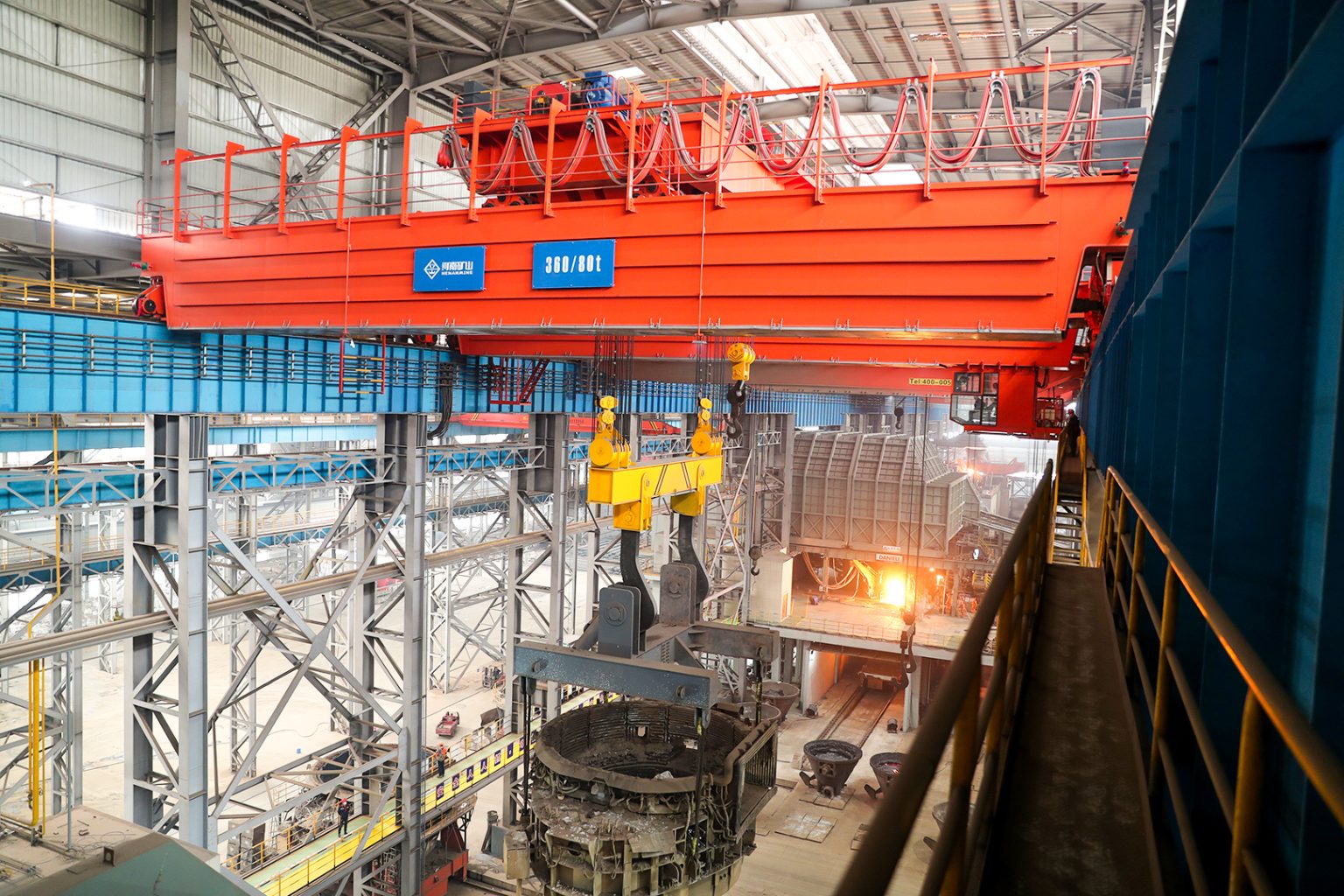
    Configuration Operating Arrangement Indicative Equipment Budget Commercial Scope
    Powered Mobile Workshop Gantry Motor-driven floor wheels for flexible movement within a defined indoor route. From approximately €20,000 Final scope depends on capacity, span, powered motions, steering system, controls and permitted loaded travel.
    Industrial Single-Girder Gantry Crane Powered hoisting, trolley travel and rail-mounted gantry travel for general industrial handling. Approximately $10,000–$50,000 Normally quoted as crane equipment; rails, foundations, incoming power, freight and installation require confirmation.
    Industrial Double-Girder Gantry Crane Double-girder bridge with electric-hoist or winch trolley for higher capacity, duty or lifting-envelope requirements. Approximately $30,000–$90,000 Price varies materially with capacity, span, work class, trolley design, access provisions and outdoor protection.
    Complete Installed System Crane equipment integrated with the agreed runway, power, installation and commissioning scope. Project quotation required Commercial offer to define Incoterm, freight, insurance, duties, unloading, erection, testing, training and spare parts.

    Budget ranges do not represent a fixed selling price. Comparable quotations require identical capacity, span, lift, duty, controls, environmental protection and supply boundaries.

    Total Installed Cost Components

    Crane Equipment

    Bridge, legs, hoist or trolley, travel drives, controls and specified protection.

    Rails and Foundations

    Runway steel, civil work, end stops, anchors, alignment and drainage.

    Electrical Interface

    Incoming feeder, isolator, conductor or cable reel, earthing and site connections.

    Delivery and Site Work

    Packing, freight, insurance, duties, unloading, erection, testing and handover.

    Information Required for an Accurate Quote

    1. Load: maximum and typical payload, attachment mass, dimensions and lifting points.
    2. Geometry: span or clear width, lifting height, travel length, approaches and cantilevers.
    3. Operation: lifts per hour, shifts, travel distances, speeds and positioning needs.
    4. Site: layout, rail or floor information, obstacles, traffic, ground and foundations.
    1. Environment: indoor or outdoor, wind, temperature, rain, dust, corrosion and classifications.
    2. Power: voltage, phases, frequency and preferred supply route and controls.
    3. Destination: country, applicable requirements, documentation and inspection plan.
    4. Commercial scope: Incoterm, freight, rails, erection, commissioning, training and spares.

    Commercial evaluation should be based on a common technical specification and an itemized inclusion schedule. The comparison should cover the complete installed system, operating duty and contractual responsibilities rather than the headline equipment price alone.

    Manufacturing and Project Documentation

    Crane structures and equipment in a Henan Mine Crane manufacturing workshop
    Structural fabrication and crane assembly at a Henan Mine Crane manufacturing facility.

    Henan Mine Crane manufactures the structural assemblies and integrates the hoisting, travel, control and electrical systems in accordance with the approved project specification. The documentation package can include the following records within the agreed supply scope. Henan Mine Crane Manufacturing Facilities.
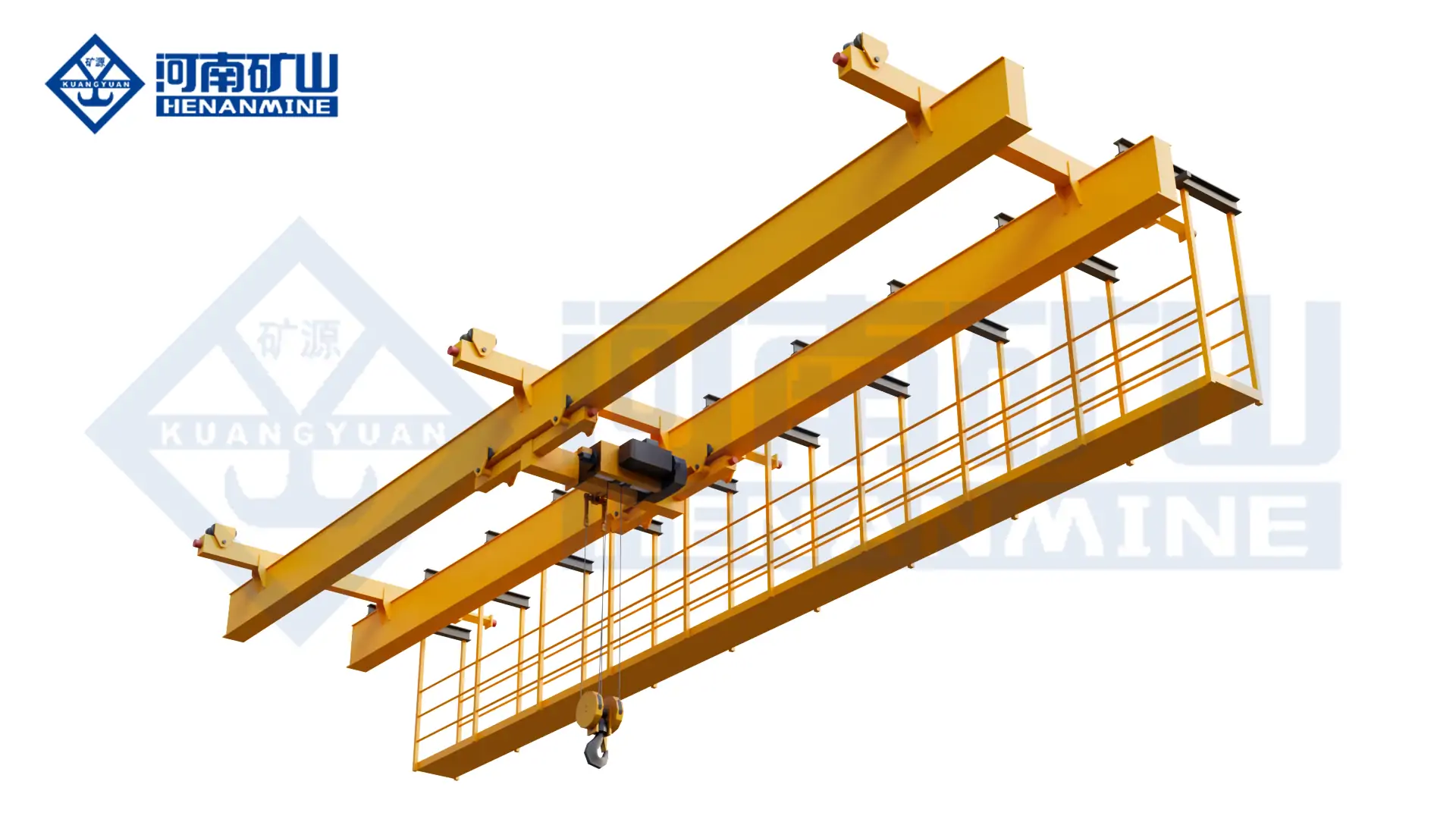
    • General arrangement drawing with dimensions, clearances, hook coverage and service access.
    • Wheel loads, wheel spacing and rail-interface data for civil and structural coordination.
    • Motor and component schedule plus electrical diagrams and control description.
    • Agreed material, welding, inspection, factory test and site acceptance records.
    • Operating, inspection and maintenance manuals with spare-parts identification.

    The contract documentation defines the final technical parameters, component scope, applicable requirements, inspection plan, acceptance criteria and responsibilities for delivery, installation and commissioning.

    Installation, Commissioning and Maintenance

    Site Preparation

    Site preparation includes approved foundations, rails, end stops, power routing, earthing and drainage, together with verification of geometry and installation readiness before equipment delivery.

    Erection and Commissioning

    The installation plan defines unloading and assembly areas, erection equipment, inspection stages, functional checks, applicable load tests, training and handover responsibilities.

    Lifecycle Maintenance

    Safe maintenance access is required for the hoist, trolley, wheels, drives, brakes and electrification. Inspection intervals are established from operating duty, environment, supplied manuals and local requirements.

    Maintenance planning should include rail condition, wheel wear, drive alignment, brake performance, fasteners, wire rope or chain, power-supply wear and outdoor restraint equipment. Record defects and corrective work against the crane’s operating history.

    Motorized Gantry Crane FAQ

    What does “motorized” mean on a gantry crane?

    In most industrial specifications, “motorized” denotes powered gantry long travel; hoisting and trolley travel may also be electrically driven. A complete proposal defines the drive, speed and control method for each motion axis.

    Can a motorized gantry crane move while carrying a load?

    Loaded travel is permitted only where the approved crane design, runway or floor, operating instructions and site procedure support that operating condition. Selection data must define the transported load, hook position, travel route and required loaded-travel cycle.

    Is rail-mounted travel required?

    Industrial gantry cranes commonly operate on fixed rails. Powered mobile workshop gantries can operate on floor wheels, subject to model-specific requirements for floor flatness, slope, traction, steering and stability. The selected travel concept forms part of the approved technical specification.

    Which configuration is appropriate: single-girder or double-girder?

    Configuration selection is based on capacity, span, usable hook height, operating duty, trolley arrangement, maintenance access, wheel loads and total installed cost. Girder quantity alone does not determine crane duty or quality.

    How much does a motorized gantry crane cost?

    A powered mobile workshop gantry may start from approximately €20,000. Industrial rail-mounted single-girder systems may require an equipment budget of approximately $10,000–$50,000, while double-girder systems may range from approximately $30,000–$90,000. Final pricing depends on capacity, span, lifting height, duty, controls, rails, foundations, freight and installation scope.
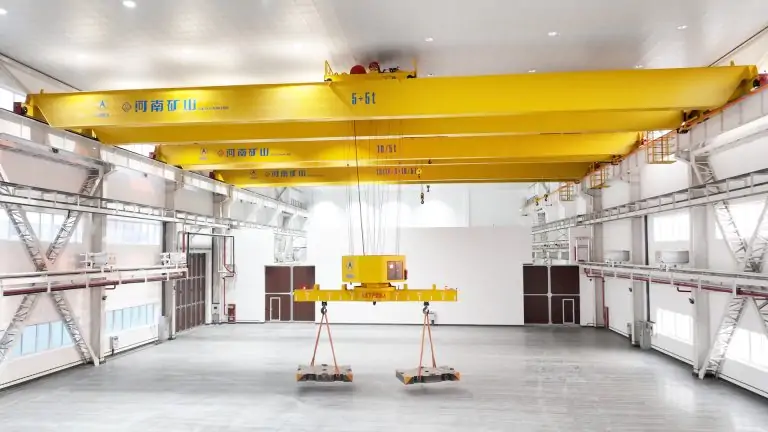
    Can the crane operate outdoors?

    Outdoor operation is available where the approved design incorporates the specified wind, precipitation, temperature, corrosion and parking conditions. The protection package can include weather-rated electrical equipment, protective coatings, wind monitoring and restraint systems.

    What power supply does a motorized gantry crane use?

    The electrical system is configured for the destination supply and the selected motors and controls. Required electrical data include voltage, phases, frequency, earthing arrangement and travel length for definition of the feeder and mobile electrification system.

    Is a motorized gantry crane the same as an overhead bridge crane?

    The two systems use different support arrangements. A full gantry transfers bridge loads through travelling legs to ground-level runways, whereas an overhead crane travels on two elevated runways and preserves floor space without moving legs. Selection depends on building support, foundation work, headroom and site traffic routes.

    Can an existing runway be reused?

    Reuse is assessed after surveying rail geometry, condition and supporting foundations. The proposed crane may have different wheel loads, wheel spacing, horizontal forces or electrical demand from the previous system.

    What information is required for a quotation?

    Quotation data should include the load, span, lifting height, travel length, cantilevers, operating cycle, site drawing, environmental conditions, electrical supply, project location and required freight, rail, installation and commissioning scope.
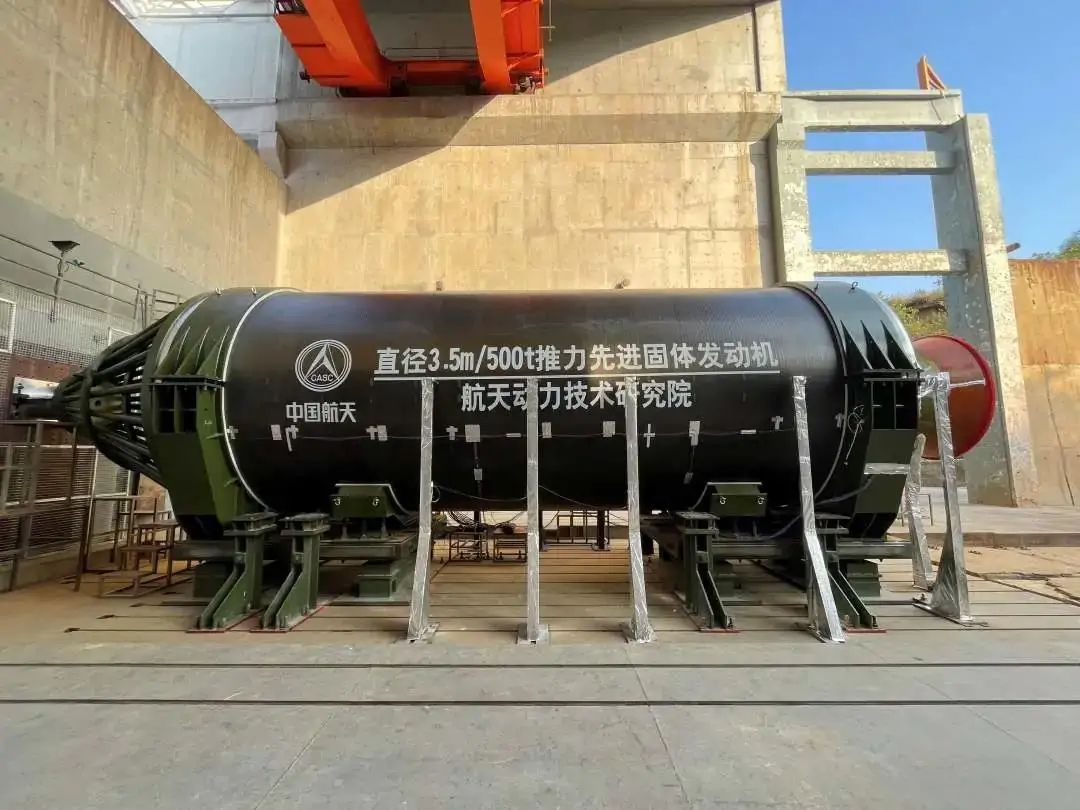
    Request A Motorized Gantry Crane Quote

    Henan Mine Crane prepares project-specific proposals based on the required load, span, lifting height, travel length, operating duty, site layout, environment and electrical supply. The proposal can compare suitable full-gantry, semi-gantry, single-girder and double-girder arrangements and define the powered motion package.
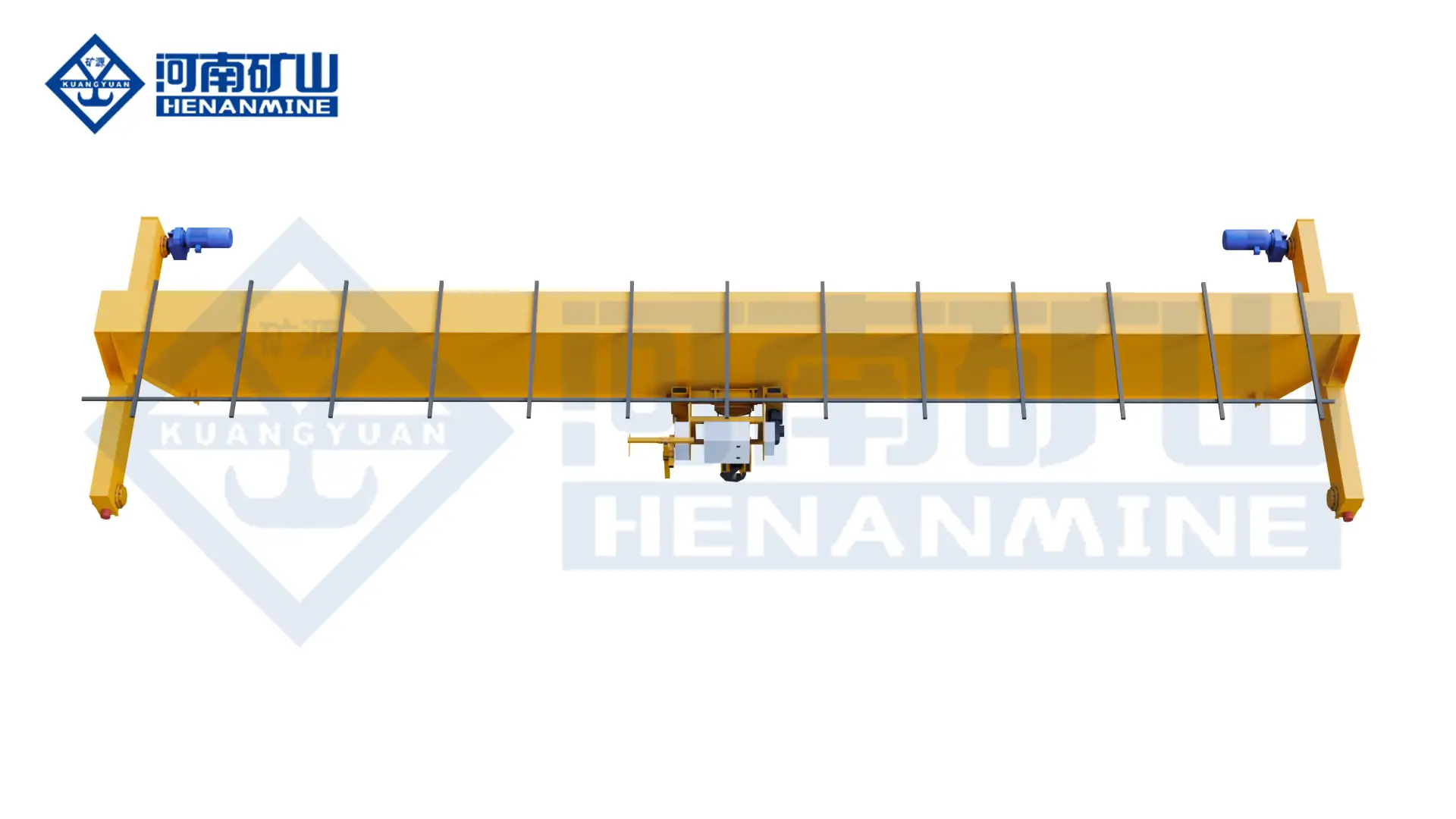
    The requested commercial scope should identify responsibility for rails, foundation interface data, freight, installation, commissioning, operator training and recommended spare parts.

    Henan Mine CraneDiscuss your requirements ↗