Engineering · Manufacturing · Project support
info@hnksglobal.comWhatsApp +86 18836207779 ↗

Blog

  • Multi-Bay Workshop Cranes: Coverage, Transfer and Structural Interfaces

    Multi-Bay Workshop Cranes: Coverage, Transfer and Structural Interfaces

    Technical guide

    Multi-Bay Workshop Cranes: Coverage, Transfer and Structural Interfaces

    Several bays create choices about independent coverage and transfers between working zones. Map the load routes and building supports before comparing crane arrangements, transfer systems and operating boundaries.
    Henan Mine CraneTechnical guide · Updated 2026Crane selection, project scope and operating requirements
    Henan Mine Crane Multi-Point Suspension Crane
    Henan Mine Crane Multi-Point Suspension Crane
    Project planning notes

    Key points for this crane project.

    1. How to Design an Overhead Crane for Multi-Bay
    2. Assess the Workshop Layout Before Crane Design
    3. Determine the Required Overhead Crane Capacity
    Read the technical guide

    How to Design an Overhead Crane for Multi-Bay Workshops

    A multi-span workshop is an industrial plant composed of two or more parallel adjacent production areas, separated by columns and partitions, and unified into a complete production system. It is widely used in heavy manufacturing, shipbuilding, automobile assembly, steel processing and other heavy industry scenes.

    Compared with a single-layer open workshop, the carrying capacity, headroom, structure size, and production functions of each cross-zone are significantly differentiated, and the cross-zone layout is compact, and the production can be operated independently or cooperatively linked.

    The core goal of multi-span crane design

    A set of qualified multi-span bridge crane systems must meet the five design indicators at the same time, taking into account safety, practicality and long-term performance.:

    1. Rated lifting weight: Each crane needs to match the corresponding maximum operating load across the area, reserve a reasonable safety margin, and fully consider additional loads such as spreaders, tooling, and dynamic operating impact.
    2. Operational efficiency: The operation logic of the crane needs to fit the production process, shorten the material handling path, reduce the waiting time of the equipment, and realize the seamless connection of materials in each process without interfering with the normal production rhythm.
    3. Operational safety: Multi-equipment, multi-cross-zone collaborative operation is prone to collisions, path conflicts and other problems. The design stage needs to configure a protection system in advance to avoid various risks of joint operations and optimize maintenance operating conditions.
    4. Expansion compatibility: Adapt to future development needs such as factory capacity upgrading, new equipment, and cross-district expansion. System upgrades can be achieved without large-scale demolition and transformation of existing equipment and structures.

    Overall design process

    The design of multi-span cranes follows a standardized and systematic process: first survey the physical layout of the workshop, clarify the production functions of each span, and then calculate the operating load and work level, and match the adapted crane model and cross-zone transfer plan.

    Then complete the design of the structure, electrical, and control system, complete a full set of safety protection devices, and finally verify the collaborative operation ability of the entire system. All links are interlocking, and the early design decisions directly determine the performance and transformation costs of the later equipment, so rigorous engineering thinking must be adhered to throughout the process.

    Assess the Workshop Layout Before Crane Design

    Cross-zone size and net cross-zone surveying and mapping

    Accurately measure the core parameters of each span: the effective net span between the columns, the total longitudinal length of the track, and the effective net height of the lowest obstacle from the ground to the top. For the renovation and expansion of old factories and workshops, the drawing parameters are often inconsistent with the actual situation on the site, and must be checked point by point to avoid errors in the selection of end beams and track positioning due to millimeter-level errors.

    Among them, the net span of the span is the core parameter, which directly determines the span of the main girder of the crane, and at the same time affects the structural carrying pressure of the track beam and the plant column, which is the key basis for equipment selection and structural verification.

    Positioning of each cross-production function

    Workshops with different functions span regions, and have very different requirements for the tonnage, working level, control accuracy, and operating speed of the crane. Precise division of functions is a prerequisite for customized design.:

    • Cross-zone production and processing: high-frequency hoisting of raw materials and semi-finished products, high operating frequency and large load-bearing movement, need to be adapted to high-level cranes, stable adaptation to continuous operating conditions.
    • Equipment assembly across regions: The core requirements are precise alignment and smooth start and stop. It needs to be equipped with a frequency conversion speed control system to prevent load shaking and protect precision parts from damage.
    • Cross-regional material warehousing: priority is given to ensuring global coverage and rapid transit, with low requirements for high-precision control and high-capacity loads, and a focus on improving operating efficiency.
    • Equipment maintenance and maintenance across regions: flexible operation scenarios and fixed hoisting material specifications require strong crane adaptability, wide operating range, and flexible and convenient operation.
    • Loading and unloading cross-zone: connecting indoor and outdoor operations, it is necessary to adapt to the rapid loading and unloading rhythm, and at the same time have a certain environmental adaptation ability to reduce the waiting time for vehicles to stop.

    Cross-regional material flow combing

    Comprehensively count the complete path of material entry, process transfer, and finished product out of the warehouse, and clarify the direction, frequency, and volume of material flow across regions. Determine whether cross-regional transshipment is a conventional core process or an occasional industry, in order to determine whether it is necessary to configure special programs such as cross-regional collaborative hoisting and docking transshipment platforms.

    Delineate the core hoisting area

    Accurately mark all hoisting points in the workshop, including machine tool loading and unloading area, tooling assembly area, material stacking area, finished product delivery area, etc., to ensure that the hook can reach all operating points directly, and there is no blind spot in the operation. Operation blind spots will force workers to adopt illegal hoisting, manual material movement, etc., greatly increasing safety risks and production losses.

    Demand and frequency of transshipment across regions

    Cross-zone material transfer is the core difficulty of multi-span crane design. For conventional process-based cross-regional transshipment, transshipment channels and collaborative operation intervals must be reserved during the design phase; occasional transshipment can simplify the configuration. At the same time, according to the frequency of daily and hourly transshipment, match the corresponding transshipment plan to avoid overallocation or insufficient capacity.

    Verify the existing structural conditions of the plant

    • Survey of column spacing: The layout of the column of the plant determines the support point and span of the track beam. If the spacing is too large, the specifications of the track beam need to be upgraded to improve the bearing capacity; for old factories with irregular spacing, the track arrangement needs to be optimized to ensure the stable operation of the equipment.
    • Track support structure verification: It is necessary to fully verify the bearing capacity of the steel structure and column of the plant, taking into account the weight of the equipment, the static lifting load and the dynamic impact of start-stop braking. Old factories without the original load-bearing design must not rely on the main body of the factory to bear the load, and an independent support structure must be built.
    • Top clearance and obstacle investigation: Comprehensively investigate roof trusses, pipelines, fire fighting, lighting and other top obstacles, accurately calculate the effective lifting height, and avoid the risk of interference and collision between obstacles and crane main beams and spreaders.
    • Plant height calculation: The effective lifting height is the total floor height of the plant, deducting the height of the track beam, main girder, hoist structure and safety margin. In workshops with limited headroom, low-headroom hoists and lower-hanging cranes can be selected to fine-tune the structure and optimize the working space.
    • Verification of supporting facilities: The layout of the crane shall not block or interfere with the original supporting systems such as fire protection, lighting, ventilation, and electrical. If the pipeline needs to be adjusted, it must be uniformly planned during the design phase to ensure the normal operation of the facilities.

    Determine the Required Overhead Crane Capacity

    Load selection is the core decision-making link of crane design: selection is too small will cause safety hazards and cannot meet production needs; selection is too large to waste procurement costs, increase the load on the building structure, and increase the loss of operation and maintenance. Precise matching and on-demand selection are required.

    Cross-zone static load accounting

    Count the maximum weight of all hoisting materials step by step, including raw materials, semi-finished products, finished products, molds, tooling, large equipment accessories, etc. At the same time, the weight of all lower spreaders must be included, including lifting beams, vacuum suction cups, hanging chains, shackles, wire ropes and other accessories.

    In engineering practice, many load calculations only count the weight of the workpiece and ignore the weight of the spreader, which will cause the actual operating load to exceed the rated parameters of the equipment and lay hidden dangers of overload.

    Dynamic load and operating condition loss

    • Dynamic impact force of start and stop: According to international crane design standards such as FEM, CMAA, ISO, etc., equipment start and stop, braking, and dynamic reclaiming will produce vertical and horizontal impact forces. Dynamic load coefficients need to be superimposed during design to avoid static load selection that cannot be adapted to dynamic operating scenarios.
    • Precise alignment operation requirements: precision assembly and equipment alignment scenarios require long-term hovering of the load and fine-tuning of the position, and the corresponding control mode and load redundancy need to be matched to ensure the stability and accuracy of the operation.
    • Matching the frequency of operations with the level of work: cranes that operate at high frequency and full load in a single day have a great difference in mechanical fatigue loss from cranes that operate sporadically every day. It is necessary to match the corresponding equipment working condition level according to the ISO working level and FEM working system, combined with the hoisting frequency and load utilization rate, rather than just referring to the maximum load.

    Choose the Right Crane Configuration for Multiple Bays

    Rated lifting weight adaptation

    It is the first choice for heavy-duty processing and large-scale assembly.

    Span and lifting height

    The main girder of the double-girder crane has stronger rigidity and less deflection, can be adapted to large-span workshops, and has higher stability in heavy-duty operation; at the same time, the top-mounted trolley structure is used, and the hoist is installed between the double beams. Under the same height conditions, the effective lifting height is far better than that of a single-girder crane.

    Top headroom adaptability

    The single-girder crane hoist hangs down, the structure occupies a larger net height, and the effective lifting height is limited; the double-girder crane has a compact structure layout and a higher headroom utilization rate, which is the best choice for heavy-duty workshops with low headroom.

    Operation and maintenance and service life

    The single-girder crane has a simple structure and low procurement cost, but the maintenance and operation space is small, and the lower flange of the main girder is easily lost due to long-term heavy loads; the double-girder crane is equipped with maintenance walkways, convenient operation and maintenance, high structural strength, strong fatigue resistance, and longer service life throughout the life cycle, which is suitable for continuous industrial production.

    Structural carrying requirements

    The end beam of the upper rail crane walks on the top of the track beam, with direct load transmission and uniform force, which is suitable for high-capacity and high-frequency heavy-duty operations; the lower rail (suspension) crane is suspended at the bottom of the steel beam, and the force mode is special. It is only suitable for light loads and low-level working conditions.

    Headroom utilization efficiency

    Under the same operating conditions, the headroom utilization rate of the upper rail crane is higher and the effective lifting height is greater; the overall suspension of the lower rail equipment is sagging, taking up a lot of effective headroom, and the lifting height is obviously limited.

    Adaptability of existing factories

    For old factories where crane load-bearing conditions are not reserved, lower-rail suspension cranes can be used to install on roof steel beams without strengthening the column foundation; however, the bearing capacity of the roof structure must be verified in advance to eliminate safety hazards. The upper rail system is preferred for the newly built heavy-duty workshop, which has better stability and safety.

    Design Crane Span, Runway Length, and Lifting Height

    Precise selection of crane span

    The span of the crane is the distance between the center lines of the two tracks. The core design principles are: adapt to the effective width of the workshop, cover all hoisting points, and avoid structural obstacles.

    The span design needs to match the net width of the workshop to ensure that the hook can cover the whole area of the workshop through the end distance; at the same time, it is necessary to accurately avoid obstacles such as columns, equipment, and fixed tooling, and fine-tune the span of the main girder according to the location of the obstacles on the site to eliminate operational interference.

    Track length design specification

    1. Longitudinal global coverage: The longitudinal length of the track needs to cover all loading and unloading points and operating stations in the workshop to ensure that the crane can complete all hoisting operations without moving tooling or manual assistance.
    2. Reserved end safety distance: According to industry standards, 500mm-1500mm end safety distance needs to be reserved at both ends of the crane track to adapt to the installation requirements of the end beam structure, buffer, and limit device to avoid equipment rushing to the top and colliding. This distance needs to be included in the total length of the track design.
    3. Docking loading and unloading points: material loading and unloading ports, cross-zone transfer points, and outdoor docking points must be included in the coverage of the track to achieve seamless material transfer and eliminate blind spots in operations.

    Lifting height accounting and optimization

    Effective lifting height is the core parameter to ensure the feasibility of the operation. The accounting needs to include four dimensions to eliminate estimation errors.:

    1. The minimum safety margin for the workpiece to cross obstacles;
    2. The equipment runs at a safe distance from the top.

    If the standard model cannot meet the lifting needs, the effective height can be increased by selecting a low-clearance hoist, a compact main girder structure, and optimizing the layout of the spreader. It is strictly prohibited to reduce the safety margin in violation of regulations.

    Plan Cross-Bay Material Transfer

    Cross-regional material transfer is the core link of multi-cross workshop production. The unreasonable design of the transfer plan will directly form a production bottleneck and drag down the efficiency of the entire production line. It is the top priority in the design stage.

    Definition of cross-zone transfer scenarios

    When the production process requires workpieces to complete roughing, finishing, assembly, heat treatment, warehousing and other processes in different cross-regions in turn, a standardized cross-region transfer plan must be designed to adapt to the needs of normalized material flow.

    Machine-to-machine docking and transfer mode

    The most commonly used cross-zone transfer method is the collaborative docking of two machines: the upstream cross-zone crane transports the materials to the cross-zone boundary transfer area, and the downstream cross-zone crane relays the hoisting to complete the cross-zone transfer of materials. The plan requires that a common operating area be reserved across the boundary of the district, a passage hole be reserved for the partition wall, and a dual-machine anti-collision system be configured to ensure the safety of collaborative operations.

    Design of transfer hole and work area

    For the location of the cross-zone partition wall and column partition, a standardized transfer hole needs to be opened in advance. The size of the hole must be greater than the overall dimensions of the largest workpiece + spreader, and a safe passage margin should be reserved. The opening of the cave entrance needs to be completed in combination with structural verification. It is strictly forbidden to destroy the load-bearing structure of the building. The renovation of the old factory building needs to be strengthened in advance.

    Dual-machine synchronous lifting scheme

    For large-weight workpieces that cannot be carried by a single crane, a dual-machine synchronous lifting mode can be used. The two cranes work together and operate synchronously to increase the overall lifting load.

    In this mode, special equipment that supports synchronous control must be selected, a load sharing monitoring system must be equipped, and special training for operators must be carried out, and it is forbidden to temporarily team up and lift at will.

    Avoid cross-regional transit bottlenecks

    The traffic capacity and operating efficiency of the transfer point need to match the maximum production capacity of the production line to avoid the accumulation and retention of materials at the boundary of the cross-zone. In the design stage, it is necessary to match the corresponding transfer channel and operating mode according to the transfer frequency and workpiece specifications to ensure smooth flow.

    Coordinate Multiple Cranes and Avoid Operational Conflicts

    Synchronous operation of multiple equipment across multiple workshops is extremely prone to path conflicts, equipment collisions, and job interference. Hardware protection + process control must be passed to achieve orderly and coordinated operation of equipment.

    Crane anti-collision protection

    Multi-equipment common rail and adjacent rail operations need to be equipped with intelligent anti-collision systems, relying on laser, ultrasonic, and encoder positioning technology, real-time monitoring of equipment spacing, automatic deceleration, emergency shutdown, and avoidance of collision risks. At the same time, both ends of the equipment need to be equipped with mechanical and electrical dual limit devices to prevent over-stroke operation.

    In the design stage, it is necessary to clarify the minimum safety spacing of the equipment, and reserve a safety margin based on the braking distance and operating speed of the equipment to eliminate the risk of contact under extreme working conditions.

    Multi-machine collaborative control logic

    Multi-equipment common rail operations need to be divided into dedicated intervals, and the priority of operations should be clarified, and simultaneous operations of multiple machines in the same interval are prohibited. The conventional working conditions are independently controlled, and the equipment does not interfere with each other; the synchronous control system is enabled for the dual-machine lifting working conditions to ensure the accurate synchronization of operating parameters.

    The wireless remote control system needs to be equipped with a dedicated identification code to eliminate the risk of cross-device serial control and false control; the wired handle has stronger control stability and is suitable for high-precision and high-safety operation scenarios.

    Standardized control of hoisting path

    For high-frequency conventional hoisting operations, formulate standardized hoisting paths, standardize equipment operation trajectories, and reduce the randomness of operations and the probability of conflicts. Simultaneous construction of multiple equipment is strictly prohibited in overlapping work intervals, and crane operation scheduling is incorporated into the overall production plan to achieve accurate matching of equipment operations and production processes, and reduce waiting time for vacancy.

    Electrical and Control System Design

    Power supply system configuration

    Configure a dedicated power supply circuit according to the total power and peak load of the crane, adapt to the maximum power requirements of equipment lifting, cart, and trolley operation, and be compatible with frequency conversion braking and regenerative power feedback to ensure stable power supply and eliminate voltage fluctuations and overload tripping problems.

    Power supply and transmission system selection

    Three power supply modes are commonly used in industrial workshops, which can be adapted on demand:

    1. Sliding contact line power supply: strong stability, long service life, suitable for high-frequency and long-distance operation, is the mainstream solution for multi-span cranes;
    2. Cable towline power supply: suitable for short-stroke, clean environment workshop, regular wiring and easy maintenance;
    3. Cable reel power supply: suitable for ultra-long travel, outdoor connection scenes, can automatically receive and discharge cables, and has strong adaptability.

    Frequency conversion speed control system

    All series are equipped with a frequency conversion drive system (VFD) as standard, which realizes stepless speed regulation of crane lifting, cart and trolley, smooth start and stop, and no load shaking. It cannot only protect precision workpieces, but also reduce mechanical impact, reduce equipment wear, and extend the service life of the whole machine.

    Control system configuration

    Conventional working conditions use wireless remote control, flexible operation, wide field of vision, suitable for multi-span and wide-range operations; high-precision alignment, high-risk operation scenarios can be used with wired handles for dual control. All remote control equipment comes with unique coding, anti-interference, and fault self-locking functions to prevent misoperation.

    PLC intelligent control system

    It adopts PLC programmable control system, integrates anti-collision, interval protection, overload protection, fault self-inspection, remote diagnosis and other functions, and can realize the automated operation of repetitive processes. At the same time, it supports docking with factory MES, WMS, and ERP systems to realize intelligent material management and equipment operation and maintenance monitoring.

    Safety Design for Multi-Bay Overhead Cranes

    Safety design runs through the whole process of equipment design, installation, operation, operation and maintenance, and is the core guarantee for multi-equipment collaborative operation. It is necessary to build an all-round and integrated safety protection system.

    Core safety protection device

    1. Overload protection: fail-safe fail-safe design, automatically locks the equipment when the system fails to prevent overloading and hoisting;
    2. Emergency stop system: The fuselage and remote control handle are equipped with emergency stop buttons, which can instantly cut off all power and avoid danger in an emergency.;
    3. Multiple limit switches: lifting the upper and lower limits, the travel limits of the cart and the trolley, to prevent the collision accidents of rushing to the top and over-travel.;
    4. Intelligent anti-collision system: necessary for multi-device collaborative operation, automatically avoiding equipment interference;
    5. Sound and light early warning device: Sound and light alarms are automatically triggered when the equipment is running to remind on-site personnel to avoid and adapt to noisy industrial environments.

    Safety maintenance channel design

    In the design stage, a complete maintenance channel, operation and maintenance platform, and ladder walkway are reserved. The double-girder crane is equipped with an on-board maintenance walkway as standard to ensure that operation and maintenance personnel can safely access all components such as hoists, motors, rails, and electrical cabinets, and prevent illegal operations at high altitude.

    Standardized maintenance plan

    According to the working level and running time of the equipment, formulate normalized inspection, regular maintenance, and annual verification plans, clarify the maintenance process, division of responsibilities, and record standards, and ensure the long-term safe and stable operation of the equipment.

    Compliance standard adaptation

    The design, manufacture, installation and acceptance of the complete set of equipment are fully adapted to ISO 4301, FEM 1.001, CMAA 70/74, EN 13001, OSHA 1910.179 and domestic lifting machinery specifications, while meeting the local construction and safety standards of the project location.

    Discuss the crane arrangement for your project.

    Several bays create choices about independent coverage and transfers between working zones. Map the load routes and building supports before comparing crane arrangements, transfer systems and operating boundaries. Share the load, available drawings, working cycle and site conditions with Henan Mine Crane so the required configuration and supply boundary can be discussed.

    Related crane configurations

    Multi-Point Suspension Crane

    View product parameters
    Lifting capacity: 1t – 20tSpan: 10m – 60mWorking class: A3 – A6

    Cover a wide working area with a multi-point suspended crane arrangement. Coordinate runway support positions, load distribution and travel geometry with the building structure.

    Multi Support Double Girder Underhung Crane

    View product parameters
    Lifting capacity: 3 – 40 tSpan: 10 – 80 mLifting height: 6 – 30 m

    Use a multi-support double-girder underhung arrangement for wide-span working areas and large components. The building supports, lifting coverage and load distribution are designed together.

    Updated 2026 · Henan Mine Crane
  • Gantry Cranes on Uneven Sites: Ground Assessment and Travel Requirements

    Gantry Cranes on Uneven Sites: Ground Assessment and Travel Requirements

    Technical guide

    Gantry Cranes on Uneven Sites: Ground Assessment and Travel Requirements

    Uneven ground should be treated as a site engineering issue rather than an assumed equipment capability. Provide the route survey, supporting-surface information and intended movements so a suitable arrangement can be assessed.

    Henan Mine CraneTechnical guide · Updated 2026Crane selection, project scope and operating requirements
    gantry crane design
    gantry crane design
    Project planning notes

    Key points for this crane project.

    1. Assess The Ground Conditions Before Gantry Crane
    2. Design The Gantry Crane Structure For Uneven Ground
    3. Select The Right Wheels and Traveling System
    Read the technical guide

    Assess The Ground Conditions Before Gantry Crane Design

    Site survey is the pre-core process of the design of gantry cranes on uneven ground. The design of all structures, systems, and parameters must rely on real site working condition data to directly determine the site adaptability and operating safety of gantry cranes. Skipping site survey and designing based on experience alone will lead to a serious mismatch between the gantry crane and the working conditions, laying permanent safety hazards. Accurate site survey can be fully carried out from the three dimensions of surface morphology and slope, ground carrying capacity, site obstacles and drainage system, and provide accurate data support for the subsequent customized design of non-standard gantry cranes.

    Surface type and slope

    The construction site covers a variety of surface types such as concrete floor, gravel pavement, soft soil and backfill soil. Among them, loose soil can easily settle and collapse, which is the key focus of the design of gantry cranes on uneven ground. There are widespread natural gradients and local bumps in field sites, which will directly affect the support stability and travel safety of gantry cranes. It is also the core difficulty of Henan Mine Crane manufactured terrain adaptation gantry crane design. Before the design, it is necessary to accurately survey and record the slope parameters, concave and convex points and gap values of the site, and formulate a foundation leveling or equipment adaptive adjustment plan based on the actual terrain to avoid safety hazards such as tilt of the gantry crane fuselage and unilateral force overload from the source.

    Ground bearing capacity

    The ground carrying capacity is the core parameter of the gantry crane design, which directly determines whether the heavy-duty gantry crane can stably carry its own weight, rated lifting weight and dynamic impact load. Most temporary field sites are not reinforced, the bearing capacity of soft soil and backfill soil is weak, and long-term operations are prone to uneven settlement, causing problems such as deformation of the track of the gantry crane, offset of the fuselage, and structural cracking. Before the design, the bearing capacity and settlement coefficient of the site must be calculated through professional geotechnical testing, and the grounding pressure of the gantry crane equipment must be matched. Cushion laying and foundation reinforcement are used for sites with insufficient bearing capacity to ensure that the ground load fully meets the operating needs of gantry cranes on uneven sites.

    Site obstacles and drainage

    Obstacles such as piles, materials, pipelines, foundation pits, etc. on the construction site will limit the travel range of the gantry crane, and the offset trajectory will exacerbate the force deviation of the uneven ground, which directly affects the operating stability of the mobile gantry crane. During the survey phase, the location and size of obstacles need to be fully marked, and the span, travel stroke and outrigger layout of the gantry crane equipment should be reasonably planned to avoid operational interference. At the same time, it is necessary to focus on investigating the stagnant water area of the site, build a supporting drainage system, and discharge the stagnant water in time to avoid the stagnant water softening the soil layer, reducing the bearing capacity of the foundation, and preventing the structure and components of the outdoor gantry crane from being corroded by water vapor.

    Design The Gantry Crane Structure For Uneven Ground

    Based on accurate site survey data, the main structure of the gantry crane needs to be optimized in a targeted manner to break the fixed design limitations of standard gantry crane models. By strengthening the stability of the frame, optimizing the load distribution, and configuring the adjustable support structure, Henan Mine Crane manufactured customized gantry cranes can adapt to the complex force state of uneven ground, and solve the core working conditions such as tilt, deformation, and instability of the gantry crane from the structural level.

    Gantry frame stability

    The gantry frame is the core load-bearing structure of the gantry crane. The rigidity of the standard gantry crane frame is insufficient. Under the influence of the slope and gap of the uneven ground, it is prone to distortion, deformation of the outriggers, and excessive deflection of the main girder. For complex terrain conditions, it is necessary to adopt a high-strength box beam structure, thicken the steel plate of the core components and optimize the welding process to improve the torsional and bending resistance of the terrain-adapted gantry crane. At the same time, a symmetrical load-bearing layout is adopted, node connections are strengthened, and reinforced ribs are added to appropriately reduce the center of gravity of the gantry crane, effectively offset the force deviation caused by the terrain, and ensure that the gantry crane fuselage is stable and free of deformation and violent shaking throughout the process.

    Structural load distribution

    Uneven load distribution caused by uneven ground is the main cause of structural wear, deformation and cracking of gantry cranes. Terrain gaps can easily cause overload of one-sided outriggers and wheels of gantry cranes, and long-term eccentric loads will greatly shorten the service life of gantry cranes. In the design stage, it is necessary to rely on the topographic data of the site, and simulate the force state of the gantry crane parking, travel, hoisting and other working conditions through mechanical simulation, and accurately adjust the structural stiffness and load-bearing ratio. The non-standard gantry crane adopts a flexible adaptation structure to disperse and concentrate the stress, so that the load of the gantry crane is evenly distributed, and sufficient safety margin is reserved to effectively offset the dynamic force deviation caused by the terrain.

    Adjustable support solutions

    The adjustable support structure is a cost-effective adaptation solution for gantry cranes on uneven ground. It can effectively replace the high-cost full-site foundation transformation, quickly adapt to the slope and local drop of the site, and greatly improve the adaptability of gantry cranes to complex sites. At present, the mainstream configuration of gantry cranes is divided into hydraulic adjustable outriggers and mechanical heightening outriggers. The hydraulic outriggers can be adjusted independently, with large adjustment stroke and high leveling accuracy. With a locking device, the operation offset of the gantry crane can be eliminated. The mechanical outrigger has a simple structure and easy maintenance, and is suitable for small gap sites. With a large-size bottom pad, the grounding area can be expanded, the grounding pressure can be reduced, and the soft foundation of the gantry crane can be effectively prevented from settling and subsiding.

    Select The Right Wheels and Traveling System

    The travel system is the core component of the gantry crane in direct contact with the uneven ground. The wheel selection, load distribution, and anti-deviation travel control of the gantry crane directly determine the travel smoothness, stability and service life of the gantry crane. Ordinary standard travel wheels are prone to stagnation, derailment, partial wear, slippage and other problems on uneven ground, and the travel system scheme adapted to gantry cranes on uneven ground needs to be customized in a targeted manner.

    Wheel type and size

    The material, type and size of the wheels of the gantry crane need to be accurately selected according to the working conditions of the site, and adapted to the operating needs of the gantry crane on different uneven ground. Hardened concave-convex and gravel pavement is suitable for high-strength quenched cast steel wheels, which are impact-resistant and wear-resistant, can resist the wear and impact of gravel and raised pavement, and protect the travel structure of gantry cranes. For soft soil, loose sand and gravel, it is better to widen the rubber wheels to increase the grounding area and reduce the grounding pressure to avoid the wheels of the gantry crane from sinking and slipping. Heavy-duty gantry cranes are equipped with large-diameter wide-width wheels to buffer vibration, and light-duty gantry cranes use lightweight adjustable wheels to optimize ground clearance and avoid obstacles.

    Wheel load distribution

    The slope of the ground and the height difference can easily cause uneven force on the wheels of the gantry crane. The working conditions of overloading on one side and floating on one side can cause partial wear of the wheels of the gantry crane, bearing damage, and track deformation. In severe cases, the gantry crane derails and capsizes. In order to solve this problem, the travel system needs to adopt a balanced beam and an articulated bracket structure, so that the wheels can adapt to the ups and downs of the ground and automatically fine-tune the height to ensure that the wheels of all Henan Mine Crane manufactured gantry cranes fit the ground throughout the process and are evenly forced.

    Anti-skew traveling control

    The imbalance of force caused by uneven ground can easily cause the travel deviation of the gantry crane, the skew of the body and the gnawing of the rail, which accelerates the wear of the wheels and rails of the gantry crane, causing the structure of the gantry crane to be distorted and the operating resistance to increase, greatly reducing the service life of the gantry crane equipment. For this working condition, it is necessary to be equipped with a professional anti-deviation travel control system, relying on the PLC intelligent module to monitor the speed and displacement deviation of the gantry crane travel on both sides in real time, and automatically fine-tune the motor speed to achieve accurate correction.

    Improve Stability With Proper Ground and Track Design

    The optimization of the structure of gantry crane equipment is the basis for adapting to uneven ground, and the standardized design of the ground, track and foundation of the site is the core guarantee for the long-term stable operation of gantry cranes. By standardizing ground leveling standards, optimizing track alignment accuracy, and strengthening foundation support structures, terrain defects can be compensated from the level of external working conditions, forming a dual guarantee with the customized design of Henan Mine Crane manufactured gantry crane, and comprehensively improving the safety of uneven ground gantry crane operations.

    Ground leveling requirements

    There is no need for full-field high-precision leveling of uneven ground, but the travel operation area of the gantry crane must be guaranteed to be flat and solid, and the hidden dangers of the operation of the gantry crane must be reduced from the basic level. Before construction, it is necessary to clean up the gravel and debris of the site, fill the pits, compactor and crush the soft soil layer, improve the compactness of the surface, and provide a stable operating base surface for the gantry crane. Strictly control the slope parameters of the site. The local gap needs to be controlled within the adjustable range of gantry crane equipment. Areas with excessive gaps can be leveled with concrete or gravel cushions to avoid the uneven tilt and force of gantry cranes caused by the ups and downs of the terrain.

    Rail and track alignment

    The track flatness and alignment accuracy directly determine the operating stability of the orbital gantry crane. Uneven ground can easily cause track offset, uneven height, and gauge deviation, causing the gantry crane to travel stuck, derailment, and structural deformation. Before the track is laid, the site needs to be leveled and compacted, and the sleepers and cushions need to be laid to disperse the pressure to prevent the track of the gantry crane from settling and deformation. Accurately calibrate the straightness, level and track gauge of the track during laying to ensure the parallel height of the two tracks. The site with a small slope adopts a homeopathic laying method and is equipped with adjustable fixtures.

    Foundation and support design

    For uneven, soft, and easy-to-settle construction sites, customized foundation support design is the key to the long-term stable operation of gantry cranes. The layered rolling process can be used for temporary work sites to lay gravel and ash cushions to enhance the compactness and bearing capacity of the foundation, and to ensure the stability of the temporary operation of the gantry crane. Gantry cranes for long-term heavy-duty operations need to pour reinforced concrete foundations, and calculate the foundation thickness and reinforcement specifications according to the soil bearing capacity to expand the force area. In weak soil areas, pile foundation reinforcement and soil layer replacement processes can be used, and special load-bearing foundations can be added at the force points of the gantry crane legs and the track to eliminate the problem of local overload and settlement.

    Control Load Swing and Dynamic Forces

    Uneven ground will exacerbate the dynamic force fluctuations in the operation of the gantry crane, causing problems such as swing, inertial shock, and structural vibration of the gantry crane, greatly increasing the risk of instability of the gantry crane equipment. By accurately controlling the lifting swing of the gantry crane, optimizing the lifting speed, and adapting to outdoor wind conditions, it can effectively offset the impact of dynamic loads and ensure the safety of gantry cranes in uneven sites under complex terrain.

    Load movement control

    The slight tilt of the fuselage caused by uneven ground can easily cause the lifting center of the gantry crane to shift, and a large swing occurs during operation, which not only affects the lifting accuracy of the gantry crane, but also has the safety risks of lifting collision and fuselage overturning. Therefore, gantry cranes operating in complex terrain need to be equipped with an intelligent sway control control system to monitor the swing angle and swing speed of gantry cranes in real time. The system can accurately control the start and stop rhythm of gantry crane carts and trolleys through PLC, and adopts flexible start and stop mode to compensate for swing inertia, quickly suppress lifting shaking, and effectively improve the lifting stability and operating accuracy of gantry cranes under complex terrain.

    Lifting speed and acceleration

    Conventional high-speed and high-acceleration operating modes are not suitable for uneven ground conditions, which are prone to strong inertial shocks, which exacerbate the vibration of the gantry crane structure, crane swing and component wear. In order to adapt to complex terrain, it is necessary to optimize the driving parameters of gantry crane equipment, reduce the lifting and travel speed under heavy-duty conditions, slow down the start-stop acceleration and deceleration, and adopt a low-speed flexible operating mode to weaken the dynamic impact force. The equipment can be set to multi-speed adjustment, the operator can flexibly switch gears according to the degree of irregularities on the ground, and the low-speed safety mode is enabled for complex terrain, taking into account the operating efficiency and operating safety of the gantry crane.

    Wind and outdoor conditions

    When outdoor gantry cranes are operating on uneven ground, the tilt of the fuselage will be superimposed with the wind load, which greatly increases the risk of overturning of the gantry crane, which is the main safety hazard in the construction of field gantry cranes. When designing, it is necessary to calculate the wind load based on the maximum wind strength level of the operating area, strengthen the wind-resistant rigidity of the main girder and outriggers of the gantry crane, and optimize the structure of the gantry crane fuselage to improve the overall wind resistance. Equipped with intelligent wind speed monitoring equipment, it collects on-site wind data in real time, automatically alarms when the wind speed exceeds the standard, and restricts the heavy-duty operation of the gantry crane to avoid the construction risk of terrain and wind superposition.

    Add Safety Systems For Uneven Ground Operation

    Complex and uneven site working conditions are complex and changeable, and risks cannot be completely avoided by structural optimization and operation control alone. Gantry cranes must be equipped with a full set of dedicated safety protection systems. Through real-time monitoring, intelligent protection, and emergency braking, an all-round safety barrier is built to prevent safety accidents such as tilting, overloading, and crossing boundaries of gantry cranes.

    Tilt and level monitoring

    The inclination and level monitoring system is the core safety guarantee for gantry crane operations on uneven ground. It can dynamically monitor the horizontal state and tilt angle of the fuselage of Henan Mine Crane manufactured gantry crane 24 hours a day, and predict the risk of instability of the gantry crane in advance. The equipment is equipped with a high-precision sensing module, which can accurately capture the tilt changes of the gantry crane fuselage caused by ground settlement and terrain gaps. Once the value exceeds the safety threshold, a sound and light alarm will be triggered immediately. The intelligent model can be linked with a control system to automatically lock the heavy-duty and travel functions of the gantry crane, eliminate safety accidents such as tilting and overturning of the gantry crane from the source, and adapt to dynamically changing complex site working conditions.

    Overload protection

    Uneven ground operations are prone to uneven force, dynamic impact loads exceeding the standard, etc., which can easily cause safety accidents such as structural damage and falling of gantry cranes. Therefore, high-precision overload protection systems for gantry cranes are essential. The equipment is equipped with weight sensing and load monitoring modules, which can collect static lifting weight and dynamic impact load data of gantry cranes in real time, and accurately identify overload conditions. Once the load is detected to exceed the rated standard, the system will immediately cut off the lifting power of the gantry crane, lock the dangerous operation and issue an alarm, effectively avoiding the risk of force fluctuations of the gantry crane caused by the terrain.

    Travel limit and emergency systems

    Irregular site obstacles can easily cause gantry cranes to cross boundaries, collide, and derail, and they need to be equipped with a perfect limit and emergency system to ensure the safety of gantry cranes. The travel end point of the gantry crane is equipped with a dual mechanical and electrical limiting device to accurately limit the travel stroke and prevent cross-border collision failures. At the same time, emergency braking and power-off devices are equipped. When the fuselage of the gantry crane tilts, the travel is stuck, and the hoisting is out of control, it can be stopped with one key to avoid danger. The high-end model comes with a fault self-inspection function, which can investigate anomalies of gantry cranes in real time, give early warning, and adapt to complex and uneven site operations.

    Consider Mobile and Custom Gantry Crane Solutions

    For uneven working conditions with complex terrain, unstable sites, and frequent transitions, standardized transformation cannot meet the needs, and customized mobile gantry cranes are the optimal solution. Through the selection of adaptable models and personalized configuration customization, it can be adapted to all kinds of complex and uneven sites in all directions, and the versatility of gantry crane equipment and the practicality of field construction can be improved.

    Rubber-tired gantry cranes

    Henan Mine Crane manufactured tire-type gantry crane is an ideal model for complex, uneven and soft sites. It does not need to lay a fixed track and relies on rubber tires to walk directly on the ground. The adaptability of the site far exceeds that of traditional rail-type gantry cranes. Widened and thickened rubber tires can increase the grounding area and reduce the grounding specific pressure, effectively avoid the subsidence and slippage of soft soil and gravel sites, and easily adapt to small slopes and uneven terrain. The equipment has strong mobility and flexible transition. With hydraulic leveling legs, it can compensate for ground gaps in real time. It is a high-quality uneven ground gantry crane suitable for temporary construction in the field.

    Adjustable wheel systems

    The adjustable wheel system is the core customized configuration of the gantry crane. The height, angle and spacing of the wheels can be adjusted adaptively according to the terrain of the site, which perfectly solves the problems of easy suspension, uneven force, and stuck travel of the fixed wheels of the gantry crane. The mechanically adjustable wheels rely on manual adjustment, with simple structure and easy maintenance, and are suitable for small light-load gantry cranes and small drop sites. The hydraulically adjustable wheels support automatic and independent adjustment, with higher accuracy and stronger stability. They can cope with complex working conditions with large slopes and high gaps, and greatly improve the versatility of gantry crane site adaptation.

    Custom crane configurations

    Standardized gantry cranes cannot be adapted to differentiated uneven site working conditions. Personalized customization of gantry cranes is the key to ensuring the efficient and safe operation of equipment. The core structure and functional configuration of gantry cranes can be customized according to the actual slope, soil quality, span, lifting weight and other parameters of the construction site. Lengthen the hydraulic parallel adjustment range of the gantry crane for large drop sites, optimize the low-pressure load-bearing travel structure of the gantry crane for soft base surfaces, and strengthen the wind resistance system of the gantry crane for windy outdoor scenes. The precise customized design of gantry cranes can fundamentally solve the problem of uneven site adaptation, balancing operating efficiency and equipment service life.

    Henan Mine Crane

    The core of gantry cranes adapted to uneven ground lies in the integrated customized design of precise survey, structural optimization and a full set of safety configurations. As a professional gantry crane manufacturer, Henan Mine Crane Factory relies on mature non-standard customization experience to optimize equipment structure, travel system and safety protection for complex working conditions such as slope, soft foundation, and uneven sites, and solve problems such as fuselage tilt, derailment instability, and frequent failures from the root cause, greatly improving the operating stability and service life of gantry cranes on uneven ground, and providing highly adaptable and safe hoisting equipment solutions for all kinds of complex field sites.

    Discuss the crane arrangement for your project.

    Uneven ground should be treated as a site engineering issue rather than an assumed equipment capability. Provide the route survey, supporting-surface information and intended movements so a suitable arrangement can be assessed. Share the load, available drawings, working cycle and site conditions with Henan Mine Crane so the required configuration and supply boundary can be discussed.

    Related crane configurations

    Track Switching Overhead Crane

    View product parameters
    Lifting capacity: 1 – 32 tSpan: 3 – 30 mLifting height: 4 – 20 m

    Transfer an electric hoist between connected crane tracks with a track-switching arrangement. Rail alignment, transfer positions and interlocks are coordinated with the building and lifting sequence.

    Updated 2026 · Henan Mine Crane
  • Semi-Gantry or Full Gantry: Compare Factory Support and Traffic Interfaces

    Semi-Gantry or Full Gantry: Compare Factory Support and Traffic Interfaces

    Technical guide

    Semi-Gantry or Full Gantry: Compare Factory Support and Traffic Interfaces

    The choice changes the relationship between the crane, building and floor-level runway. Compare the required coverage and structural work with vehicle access and operating clearances before selecting either configuration.

    Henan Mine CraneTechnical guide · Updated 2026Crane selection, project scope and operating requirements
    Henan Mine Crane Double-Girder Semi-Gantry Crane
    Henan Mine Crane Double-Girder Semi-Gantry Crane
    Project planning notes

    Key points for this crane project.

    1. What Is the Difference Between a Semi-Gantry Crane
    2. When Is a Semi-Gantry Crane the Better Choice?
    3. Semi-Gantry Crane vs Full Gantry Crane
    Read the technical guide

    What Is the Difference Between a Semi-Gantry Crane and a Full Gantry Crane?

    Semi-gantry crane design

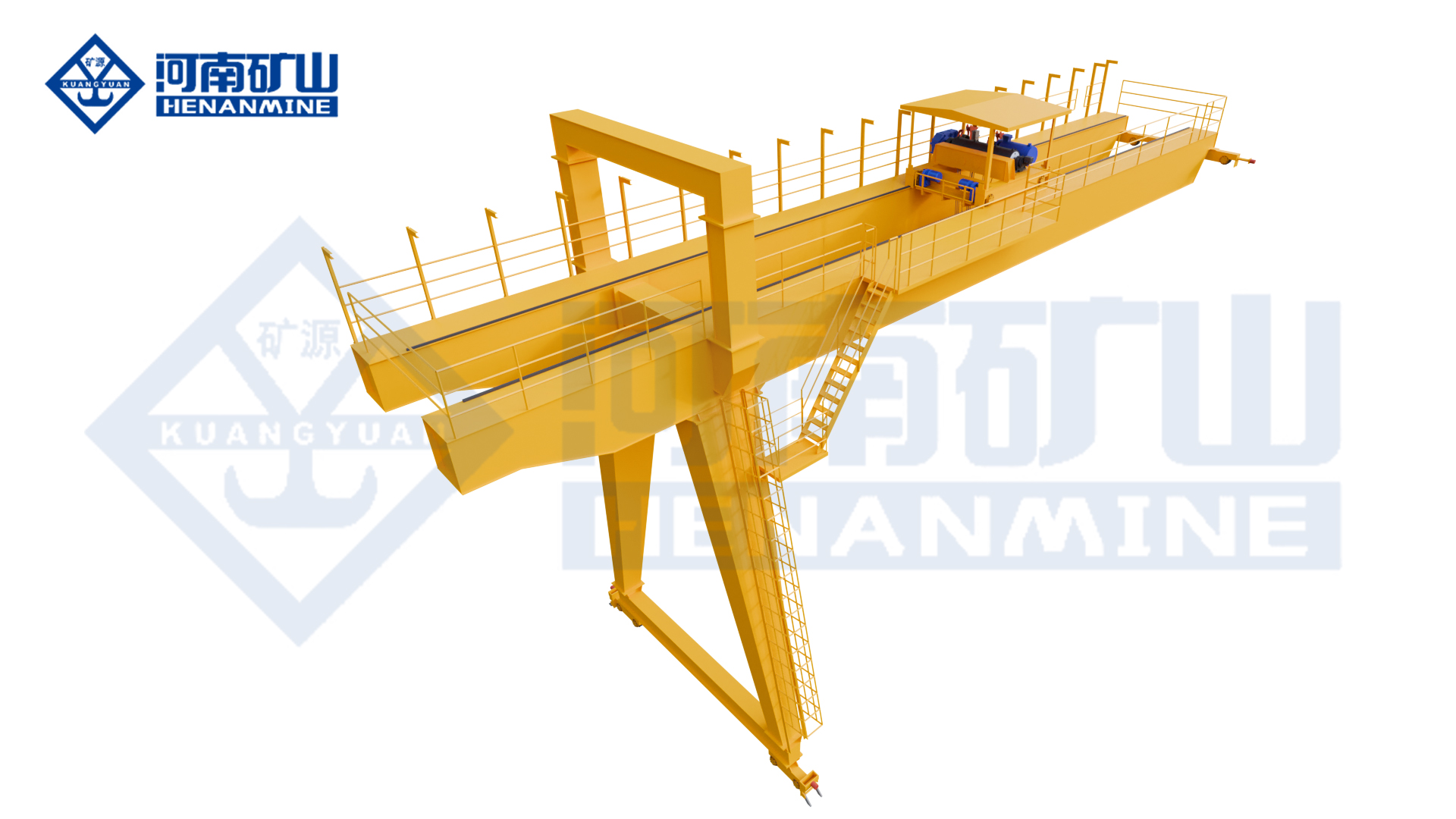
    Henan Crane manufacturing semi-gantry crane crane is a kind of lifting equipment with one side of the outrigger landing and the other side relying on the original building structure of the plant. Independent outriggers are set on one side of the equipment and run along the ground track. The end beam of the cart on the other side is mounted on the high-altitude track of the plant column, ox leg or prefabricated crane beam, and there is no need to build a second track and outriggers on the ground. The complete set of door frame, lifting trolley, lifting mechanism, and electrical control system are integrated, and the electric hoist or hoist lifting mechanism can be configured to adapt to a variety of single-beam and double-beam structures, taking into account the indoor workshop, and also supporting the transition operation scene of semi-indoor and semi-outdoor at the entrance of the plant.

    Key structural differences

    The full gantry crane adopts double-sided landing legs, and both sides require ground tracks and independent concrete foundations. The complete set of equipment is completely self-supporting and does not depend on the bearing capacity of the plant wall or column. It is an independent and complete gantry system. The semi-gantry crane crane has only one side of the landing legs, and the load on the other side is transferred to the steel structure of the building, eliminating the need for one side of the ground rail, legs and corresponding civil foundation. This is the core structural difference between the two, and it also directly determines the area, construction volume, cost and installation cycle. The overall stiffness of the full gantry gantry is higher, and it is not limited by the structure of the plant.

    When Is a Semi-Gantry Crane the Better Choice?

    Limited floor area

    When the ground space of the workshop is tight, the passages are narrow, and the production lines are densely arranged, the advantages of semi-gantry cranes are outstanding. The whole gantry has reserved space for outriggers on both sides, which will take up a lot of ground and squeeze the passage of forklifts and transshipment trucks. The semi-gantry crane has a ground outrigger track on only one side, and the other side is carried by the high-altitude beam of the plant, which can release a large amount of available ground area. It is suitable for narrow and long workshops, wall-mounted stations, and finished and semi-finished products stacked against the wall. The area will not interfere with the assembly line and tooling.

    Existing building support

    If the original columns, cattle legs, and crane beams of the plant have undergone structural verification and the bearing capacity meets the crane load requirements, priority will be given to semi-gantry cranes. It can directly reuse the building structure as a high-altitude carrying track, eliminating the need to build a large steel structure bracket and ground foundation on one side. Many old factories do not want to dismantle the main building on a large scale, and do not want to invest in high civil construction and reinforcement costs. Under such working conditions, gantry cranes can significantly compress the scope of construction and shorten the downtime and transformation cycle. The premise is that professional engineers must complete the construction load test to confirm that the plant structure can withstand the dynamic load caused by crane operation and braking.

    Indoor and outdoor operation

    Crane manufacturing in Henan Province, semi-gantry cranes, cranes support semi-indoor and semi-outdoor mixed operations at the entrances and exits of indoor and factory buildings. Many factories need to hoist the workpiece from the indoor station to the outdoor yard at the gate of the workshop, or transfer it in reverse. One side of the track is arranged on the ground inside the workshop, and the other side of the track is erected on the beam of the workshop at the gate, and the lifting is completed across the inner and outer boundaries. Compared with the full gantry, it does not need to build a complete set of bilateral foundations outdoors, which is suitable for this kind of semi-open transition lifting scene.

    Semi-Gantry Crane vs Full Gantry Crane

    Installation space

    The semi-gantry crane crane has only one side of the ground track, which takes up less space on the ground and is friendly to the workshop passage, especially suitable for wall-mounted stations and narrow and long workshops. However, there must be beams and columns on one side of the building that can erect high-altitude tracks. There are hard requirements for the height of the plant and the position of the beam body, and the carrying capacity of the structure needs to be verified in advance. Ground tracks and foundations are required on both sides of the whole gantry. There is a large demand for reserved space on the ground and higher requirements for the horizontal width of the workshop.

    Improve ability

    Double-beam semi-gantry cranes can be selected for high-capacity, but they are limited by the carrying capacity of the building side structure, and it is not recommended for heavy-duty conditions with high-capacity. The full gantry can achieve large loads of tens or even hundreds of tons, with stable structure, better performance in heavy-duty, frequent impact, and heavy-duty work scenarios, and is suitable for heavy-duty steel components, large-scale equipment, ship segments, etc. Large-weight lifting. When selecting the type, it should be judged comprehensively based on the actual lifting weight and operating intensity to avoid affecting efficiency or safety due to insufficient capacity selection.

    Installation and operating costs

    Civil construction costs are the biggest gap. Henan Mine Crane manufactured semi-gantry cranes are only used for single-sided foundations, and the amount of civil engineering is greatly reduced, the amount of steel is used is less, and the overall procurement + civil construction budget is lower. The installation period is short, and the workshop shutdown construction time is short, which reduces the loss of production line shutdown. However, it is necessary to increase the cost of building structure inspection and beam reinforcement. If the carrying capacity of the original plant is insufficient, the reinforcement cost will rise. The volume of civil engineering projects in the whole gantry has doubled, two tracks and foundations on both sides have been excavated and poured, the amount of steel is greater, and the total investment in pre-procurement, civil construction, and installation is higher.

    Which Industries Use Semi-Gantry Cranes?

    Machinery manufacturing

    Semi-gantry cranes are widely used in general machinery, machine tool processing, and construction machinery parts workshops. Machining workshops usually arrange machining centers, tooling and fixtures against the wall, and castings, forgings, machine tool bases and large tooling need to be frequently hoisted next to the station, and the ground access is already tight. The semi-gantry crane is arranged with one-sided ground rails against the wall, saving ground access and not interfering with the normal operation of the CNC production line. It is suitable for loading, unloading and transshipment of single-piece and small-batch workpieces. The conventional working system of A3-A5 fully matches the intermediate frequency hoisting needs of the machining workshop, which not only ensures the operating efficiency, but also effectively reduces the investment in plant renovation and civil construction.

    Steel manufacturing

    Steel structure processing plants, sheet metal workshops, and profile storage areas often stack long-size materials such as steel plates, pipes, and pipes against the wall. The semi-gantry crane is arranged along the side of the workshop, responsible for the unloading, transfer of steel and the lifting of workpieces in pairs, and releases a large area of ground in the middle of the workshop to the core stations such as cutting and welding, reducing the back and forth intersection of materials and equipment. It does not need to occupy the ground in the middle of the workshop, can take into account the stable lifting of long materials such as steel, and with medium tonnage lifting weight, it is very suitable for the intermediate frequency transfer rhythm of steel structure plants, and it is also convenient for subsequent installation and centralized maintenance.

    Industrial warehousing

    The factory's raw material warehouse and finished product storage workshop are equipped with semi-gantry cranes against the wall, which are mainly used for the stacking and loading of pallets, heavy-duty bins and large finished products. Warehouse access resources are precious, and forklifts and transshipment trucks need to travel frequently between shelves. Semi-gantry cranes manufactured by cranes in Henan Province only retain the arrangement of one-sided ground rails against the wall, leaving the middle area intact for forklift traffic and shelf arrangement to avoid interference between loading and unloading equipment and transportation vehicles. It cannot only complete the stable lifting of large materials, but also maintain high-density storage in warehouses, especially suitable for heavy-duty bins and large-scale finished product loading, unloading and transshipment scenarios.

    What Should Buyers Check Before Choosing a Semi-Gantry Crane?

    Capacity and category of responsibilities

    First confirm the rated lifting weight, and at the same time, the working level (working system) of the crane cannot be ignored. Many customers only look at tonnage, but ignore the number of daily cycles, continuous running time and impact load, which can easily lead to low selection. Working Principle: Working Principle: Working Principle: Working Principle: Working Principle: Working Principle: Working Principle: Working Principle: Working Principle: Working Principle: Working Principle: Working Principle: Working principle Workshop 3/a4. Overloading or choosing a working level that is lower than the requirements of working conditions will accelerate the aging of equipment and bring safety risks. Manufacturers should recommend matching single-beam or double-beam solutions based on the actual number of lifting cycles and the intensity of workshop operations.

    Runway and foundation

    The two rail systems of the semi-gantry crane must be evaluated. The track on the ground side needs to verify the foundation bearing capacity, ground flatness and long-term settlement requirements. For the high-altitude rail beam on the side of the building, the building structure must be verified and the static load must be checked against the dynamic load generated by the braking of the crane cart. If the bearing capacity of the beams and columns of the original plant is insufficient, the reinforcement design needs to be made in advance. The embedding, grounding, and limit installation of foundations and tracks are the key to the safe operation of semi-gantry cranes. Any lack may affect the accuracy and safety of lifting, so the preliminary survey cannot be omitted.

    Span and lifting height

    The span is the distance from the centerline of the ground track to the centerline of the side track of the building, which directly determines the steel selection and overall stiffness of the main girder and outriggers of the gantry. The lifting height needs to consider the lowest and highest positions of the hook, reserve sufficient operating safety distance, and avoid plant pipelines, bridges, and lighting pipelines to prevent interference during lifting. It is also necessary to combine the height of the workpiece and the tooling to confirm whether it is necessary to add a cantilever, and simultaneously check the additional bending moment caused by the cantilever on the side structure of the building to ensure that the whole machine and the plant structure are safe and reliable under dynamic load.

    How to Choose the Right Gantry Crane

    When to choose semi-gantry

    If the following conditions are met, Henan Mine Crane Crane will be preferred to manufacture semi-gantry cranes. The workshop floor is narrow and the space for forklifts and transshipment trucks needs to be reserved. The plant has a qualified and reusable original beam and column structure, which can carry high-altitude tracks. The lifting weight is medium-light to medium-tonnage, and the working system is conventional frequency. The scope of operation is indoors, or semi-indoor and semi-outdoor transfer is required at the entrance of the factory. The budget is limited, and it is hoped that civil construction will be reduced and the installation cycle will be shortened. This kind of project is especially suitable for the renovation of old factories.

    When to choose a full gantry

    In these working conditions, a full gantry crane should be selected. There is no available building support on the site and it needs to be operated in a pure open-air environment. It requires frequent heavy-duty lifting under the high-capacity and heavy-duty work system. The workshop walls and columns cannot be reinforced, and the structural bearing capacity is insufficient. It needs to move freely within the full width of the entire site, and there are no buildings on both sides to set up high-altitude tracks. A complete set of equipment that is completely independent and does not depend on the main structure of the plant is required. The full gantry has self-supporting landing legs on both sides, which can stably carry large loads on open sites without building support, and is suitable for heavy-duty and high-frequency operations.

    Customized crane solutions

    The workshop size, foundation conditions, workpiece specifications, and work shifts of each factory are different, and it is difficult for standardized cranes to be perfectly adapted. Professional crane manufacturers will provide customized solutions based on site survey data, and design main beams, outriggers, rails, lifting mechanisms, electronic controls, limits and various safety protection devices in a targeted manner. Whether it is a semi-gantry crane or a full gantry crane, it can be customized according to your span, lifting height, tonnage, explosion-proof, frequency conversion and other needs. At the same time, it is equipped with civil construction recommendations, structural verification, installation guidance and after-sales maintenance plans to ensure the safe and stable landing of the entire lifting system and long-term reliable operation.

    Henan Mining Crane Factory

    Choosing between a semi-gantry crane and a full-gantry crane requires more than just comparing lifting capacity and purchase price. Your workshop layout, existing building structure, runway conditions, load requirements, and daily operating frequency will all affect the correct solution. A well-matched crane can reduce unnecessary construction costs, improve material handling efficiency and support long-term production needs.

    Whether you need a semi-gantry crane to maximize workshop space or a full-gantry crane for independent heavy lifting, our team can help evaluate your project requirements and recommend suitable configurations. Contact us with your required capabilities, span, lifting height and site conditions to discuss a customized crane solution for your factory.

    Discuss the crane arrangement for your project.

    The choice changes the relationship between the crane, building and floor-level runway. Compare the required coverage and structural work with vehicle access and operating clearances before selecting either configuration. Share the load, available drawings, working cycle and site conditions with Henan Mine Crane so the required configuration and supply boundary can be discussed.

    Related crane configurations

    Double-Girder Semi-Gantry Crane

    View product parameters
    Lifting capacity: 3 – 20 tSpan: 5 – 30 mLifting height: 6 – 18 m

    Cover a workshop edge or yard with a double-girder semi-gantry arrangement. One side uses an elevated runway while the leg-supported side travels on a ground rail, coordinated with site access.

    Single Girder Semi-Gantry Crane

    View product parameters
    Lifting capacity: 1t – 32tSpan: 6m – 35mLifting height: 4m – 20m

    Extend lifting coverage along a workshop or yard with a single-girder semi-gantry. Coordinate the elevated runway, ground-travelling leg and electric-hoist arrangement with the working area.

    Updated 2026 · Henan Mine Crane
  • Overhead Crane Floor Coverage: Check Hook Approaches and Obstructions

    Overhead Crane Floor Coverage: Check Hook Approaches and Obstructions

    Technical guide

    Overhead Crane Floor Coverage: Check Hook Approaches and Obstructions

    A wider span does not by itself guarantee access to every handling point. Plot the actual hook positions, travel limits and obstructions so the useful working area can be checked against the factory layout.

    Henan Mine CraneTechnical guide · Updated 2026Crane selection, project scope and operating requirements
    Henan Mine Crane Grab And Hook Dual Purpose Crane
    Henan Mine Crane Grab And Hook Dual Purpose Crane
    Project planning notes

    Key points for this crane project.

    1. Understand What Determines an Overhead Crane’s
    2. Choose the Right Crane Configuration for Maximum
    3. Extend Coverage Through Better Crane Design and
    Read the technical guide

    Understand What Determines an Overhead Crane’s Coverage Area

    The effective coverage area of a bridge crane refers to the actual operating area where the crane can safely lift, move, and place loads. This range is determined by the mechanical geometry, plant restrictions, structural bearing capacity, operating blind spots, and plane layout.

    Crane span and track length

    The span is the distance between the centerlines of the two tracks, which determines the width of the crane operation. A larger span allows the trolley to cover farther stations laterally, but it is constrained by the width of the plant, the column, the roof and the deflection of the main girder (L/600~L/1000, CMAA/FEM/ISO standard) and cannot be increased infinitely.

    The length of the track controls the longitudinal coverage, and the longer the track, the more stations can be served; the track relies on the plant column or special track beam, and the column arrangement, expansion joints and available net length will limit the track design. Messy column grids and short plant segments will reduce coverage, and sometimes multiple cranes need to be added.

    The size of the plant and the spacing between the columns are the underlying constraints. Safety gaps between the crane installation and the wall, roof, and other equipment must be reserved. The design phase must also consider the future expansion of the plant, seismic and wind loads, and the wheel pressure loads transmitted to the building when the crane is running.

    Trolley stroke and lifting height

    The stroke of the lifting trolley is the distance at which the hoist moves laterally along the main girder. The horizontal movement of the trolley + the longitudinal movement of the main girder along the track together constitute the operating range of the crane's X-Y plane. Affected by the structure of the end beam, the shape of the hoist, and the safety clearance on both sides, the actual available stroke of the trolley is less than the nominal span.

    The limit proximity distance and lifting height of the hook determine the reach range of the end of the track and the vertical operation. Insufficient this parameter will produce a blind spot in the operation or fail to cross the equipment. The nominal parameters of the sample are not equal to the actual available coverage. The evaluation should be combined with the load size and safety clearance to simulate the trajectory of the hook.

    Job blind spots and unreachable areas

    Most of the blind spots appear near the wall, around the plant column, at the end of the track, under the roof beam, maintenance platform, fixed machinery and equipment, overhead pipeline locations, and restricted hoisting passages such as above personnel and above precision equipment. Building obstacles and safety regulations will further compress the actual working space.

    The theoretical coverage range defaults that the hook can be moved to the mechanical limit position; however, the actual hoisting range needs to consider the load swing, safety clearance, operator's field of vision, anti-collision protection zone, and production process. Plane layout verification combined with three-dimensional modeling is the most effective means to quantify and reduce blind spots.

    Choose the Right Crane Configuration for Maximum Coverage

    Single girder bridge crane

    Only one main steel beam is set up, which has a lighter weight and lower procurement costs. Under the premise that the headroom and load conditions of the plant are met, it is widely used in general manufacturing, assembly workshops and warehouses.

    Double girder bridge crane

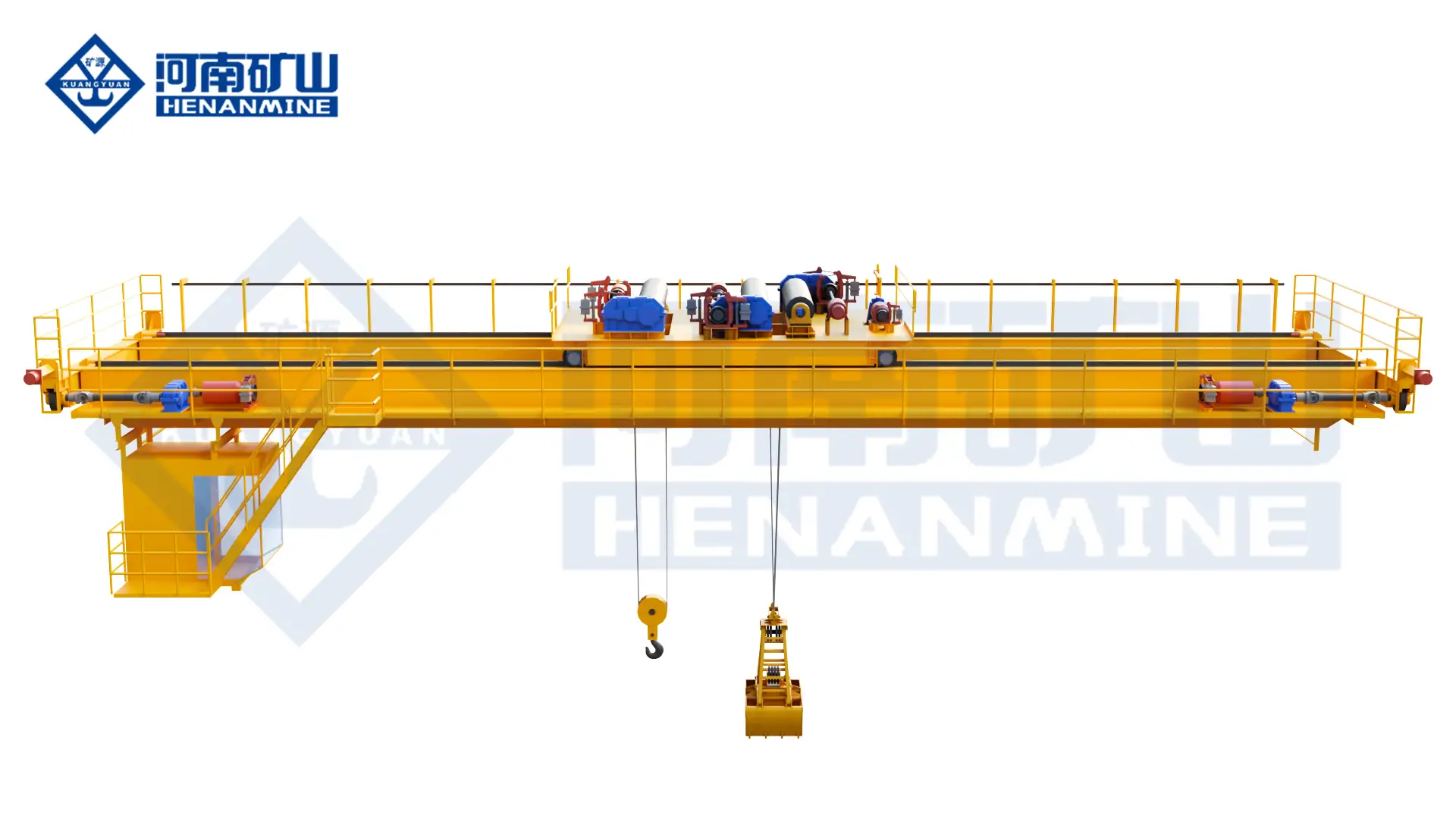
    Equipped with two main beams, the advantages are that the rated load is greater, the span is supported, the lifting height of the hook is better (the hoist can be arranged in the middle of the two main beams), the main girder has higher stiffness and less deflection, and it is also convenient to install maintenance platforms or multiple lifting trolleys. When the load is heavy, the work level is high, the span is large, or the distance and lifting height of the hook are demanding, the double main girder scheme is preferred.

    The selection of the type needs to weigh the initial cost and the long-term use requirements: the single main girder has low cost and fast installation; the double main girder has good performance, heavy-duty and durable, and more flexible operation coverage. The final plan must be determined by comprehensive structural verification, plant headroom, forward production capacity and load conditions.

    Optimize the layout of the main beam and track

    Align the crane track with the main production and material flow routes, so that the crane for high-frequency hoisting operations can travel the shortest distance. Make full use of the existing width and length of the plant to avoid large areas of idle areas.

    Long-span design can reduce the number of rails or cranes, but rigorous structural calculations must be carried out for deflection, natural frequency, and building load, and wheel pressure, track beam bearing capacity, and column force must be verified at the same time.

    Low headroom and customized solutions

    In scenarios where the height of the plant is limited, a low-clearance hoist or a similar monorail scheme can be used to compress the distance from the top surface of the track to the hook. Side-mounted and lower-hanging gourds, optimized end beam structure, and customized main girder size can all improve the proximity of single-sided or double-sided hooks to the limit.

    When the standard crane scheme causes the key station to be in a blind spot, the end beam, split-layer main girder or special spreader can be customized. All customized retrofits must meet structural strength, deflection and safety specifications.

    Henan Mine Crane can provide customized design and manufacturing solutions for low-clearance bridge cranes according to plant headroom, hook height, load requirements and station layout to help enterprises improve the adaptability of hoisting in limited spaces.

    Extend Coverage Through Better Crane Design and Movement

    • Maximize the limit proximity distance of the hooks at both ends: optimize the end beam structure, hoist installation position, buffer and limit switch arrangement, and reduce the redundant gap between the hooks at the limit position of the trolley and the main girder. Improving the proximity performance of the hook ends can eliminate common blind spots at the ends of walls and factories, and there is no need to lengthen the track; both sides of the main girder and both ends of the track need to be evaluated simultaneously.
    • A single main girder is equipped with multiple lifting trolleys (optional as needed): A single main girder can be equipped with two or more trolleys, which can be hoisted independently at different points, and can also be used to lift long pieces and special heavy objects in concert. The design needs to consider the load distribution of the main girder, mechanical/electronic synchronous control, anti-collision and safety interlocking of the trolley. The program expands the scope of effective operations and improves production efficiency, but it will increase equipment complexity and procurement costs.
    • Frequency conversion drive and automatic positioning system (VFD) can make the crane cart, trolley and lifting mechanism start and stop smoothly, accurately locate, and reduce the shaking of the crane. Repeated hoisting conditions can be used with preset positioning, sway control and automatic control. The scheme does not change the physical operating range of the crane, but can achieve accurate and safe blanking, shorten the hoisting cycle, reduce invalid movement, and improve effective operation coverage.

    Plan the Factory Layout Around One Crane

    • Draw production partitions and material flow diagrams: divide the functional areas of raw material reception, processing, assembly, warehousing, and shipment, and mark the high-frequency hoisting points and the material transportation routes between the points. The crane track is arranged to give priority to the highest priority material flow, shorten the driving distance, and reduce the secondary transfer of materials.
    • Clean up obstacles and optimize the hoisting path: investigate machine tools, shelves, columns and overhead pipelines to ensure unobstructed hoisting passages, reduce transit, and avoid hoisting above personnel and high-risk work areas. In most cases, adjusting the layout of the equipment can more effectively expand the coverage of the operation than retrofitting the crane.
    • The layout of the station is adapted to the scope of operation of the hook: the station, loading and unloading point and material temporary storage area are arranged in the area reachable by the hook, and special reclaiming points are set up to improve the safety and efficiency of the operation. In most scenarios, rearranging equipment is more economical than lengthening the track and increasing the span to expand the available coverage.

    Can One Overhead Crane Cover an Entire Factory?

    Applicable scenarios

    • Small and medium-sized production workshops, the overall production process is arranged in a linear manner, the lifting operations of various materials are relatively concentrated, and the production lines are simple and clear.;
    • Most lifting tasks in the workshop can fall within the operating coverage of the continuous track of the crane, without the need to be hoisted across independent work areas.;
    • The frequency of hoisting operations can be controlled, and there is sufficient surplus production capacity in the operation cycle, and the crane will not be in continuous operation at full load for a long time.;
    • The actual load spectrum of the site can be well matched with the selected work level of the crane. Considering the comprehensive input and operation and maintenance costs, the use of a single bridge crane is an economically feasible solution.

    Scenarios that are not enough to meet the needs

    The plant area is huge and the production areas are isolated from each other; the throughput is high, and multiple sets of hoisting operations need to be carried out at the same time; the site has dense obstacles, large differences in load type/lifting height, or the driving distance is too long. Peak operating pressure is high, and a single point of equipment failure will cause the entire line to be discontinued. Such scenarios generally require multiple cranes, or with jib cranes and gantry cranes to assist.

    Program trade-off evaluation method

    Compare the full cost of a high-capacity long-span crane with multiple small cranes: infrastructure renovation, track construction, energy consumption, maintenance, and downtime losses. At the same time, evaluate the redundancy of peak production capacity, equipment redundancy, and the impact of crane failure and shutdown on production. Material flow simulation and whole life cycle cost analysis are the most reliable evaluation methods.

    Common Mistakes When Trying to Increase Crane Coverage

    • Blindly choose a larger span, without reviewing the structure and deflection limits of the plant: the large-span main girder is selected simply to expand the coverage, and the plant column, roof carrying capacity, and main girder deflection standards are not verified in advance, which can easily cause structural safety hazards.
    • Equate the driving distance of the cart track with the actual available coverage of the hook: Mistakenly treat the moving distance of the crane cart along the track as the real operating range of the hook, ignore the blind spots caused by the end beam and safety gaps, and overestimate the actual lifting reachable area.
    • Ignore the proximity distance of the hook, the clearance height of the plant, and fixed obstacles: Only the nominal parameters are paid attention to in the design and selection, and the limit proximity distance of the hook, the clearance of the workshop, and obstacles such as columns, equipment, and pipelines are ignored, causing some stations to be unable to be hoisted.
    • Simply improve the operating speed, without supporting positioning accuracy and anti-sway measures: blindly speed up the operating speed of carts and trolleys, but no anti-sway system and precise positioning device are installed, the lifting shaking is large, and the safety of operation and the accuracy of blanking are reduced.
    • Direct procurement of high-capacity cranes, but the root cause of the problem is actually the unreasonable layout of the workshop: when encountering material handling problems, the high-capacity cranes are directly replaced, and the layout problems such as workshop equipment placement and material movement lines are not investigated first, resulting in unnecessary high investment.
    • It is believed that the hook can physically reach all stations, which means that a single crane can meet the peak production demand: A single crane is selected only based on the hook to reach the station. The demand for hoisting equipment during peak hours has not been evaluated. Under peak working conditions, insufficient production capacity will occur, restricting the entire production line.

    How to Select a Customized Overhead Crane for Your Factory

    • Evaluate on-site working conditions: collect the length, width and basic dimensions of the plant, confirm the load weight and dimensions, count the daily hoisting frequency and material type, and record the workshop environmental conditions, including dust, temperature and humidity, corrosive media, etc., to provide a basic basis for crane selection.
    • Clear coverage goals: sort out all key hoisting points on the production line, determine the required moving distance between the cart and the trolley, mark the current operating blind spots, and clearly define the coverage that the crane needs to achieve.
    • Determine the crane configuration: select the single main girder or double main girder structure, determine the span of the main girder and the total length of the track, select the type of hoist (wire rope hoist / chain hoist, low headroom hoist), and plan the layout of the lifting trolley and the supporting electronic control system.
    • Verify operating conditions: determine the working level of the crane (CMAA A-F level), evaluate environmental factors such as workshop temperature, dust, humidity, etc., and determine whether the environment will affect the life and operating stability of crane parts.
    • Evaluate the complete set of installation projects: comprehensively consider the crane body, track support structure, power supply system, operation control system, various safety protection devices, and the reserved design of later equipment maintenance and maintenance channels.
    • Cooperation with professional crane manufacturers: provide manufacturers with accurate plant drawings and load parameters, require manufacturers to complete on-site layout review, construction and crane structure verification, and issue a complete customized engineering plan.

    Discuss the crane arrangement for your project.

    A wider span does not by itself guarantee access to every handling point. Plot the actual hook positions, travel limits and obstructions so the useful working area can be checked against the factory layout. Share the load, available drawings, working cycle and site conditions with Henan Mine Crane so the required configuration and supply boundary can be discussed.

    Related crane configurations

    Grab And Hook Dual Purpose Crane

    View product parameters
    Lifting capacity: 5 – 16 tSpan: 10.5 – 31.5 mLifting height: 6 – 20 m

    Switch between bulk-material pickup and hook lifting with a grab-and-hook overhead arrangement. Define each load case, the grab type and the changeover procedure for the working area.

    Single-Girder Bridge Crane

    View product parameters
    Lifting capacity: 1–20 tSpan: 7.5–31.5 mLifting height: 6, 9, 12, 18, 24 or 30 m; capacity-dependent

    Use an LDA single-girder bridge and electric hoist for general workshop material handling. Select the lifting capacity, runway geometry and hoist duty around the building and load.

    Updated 2026 · Henan Mine Crane
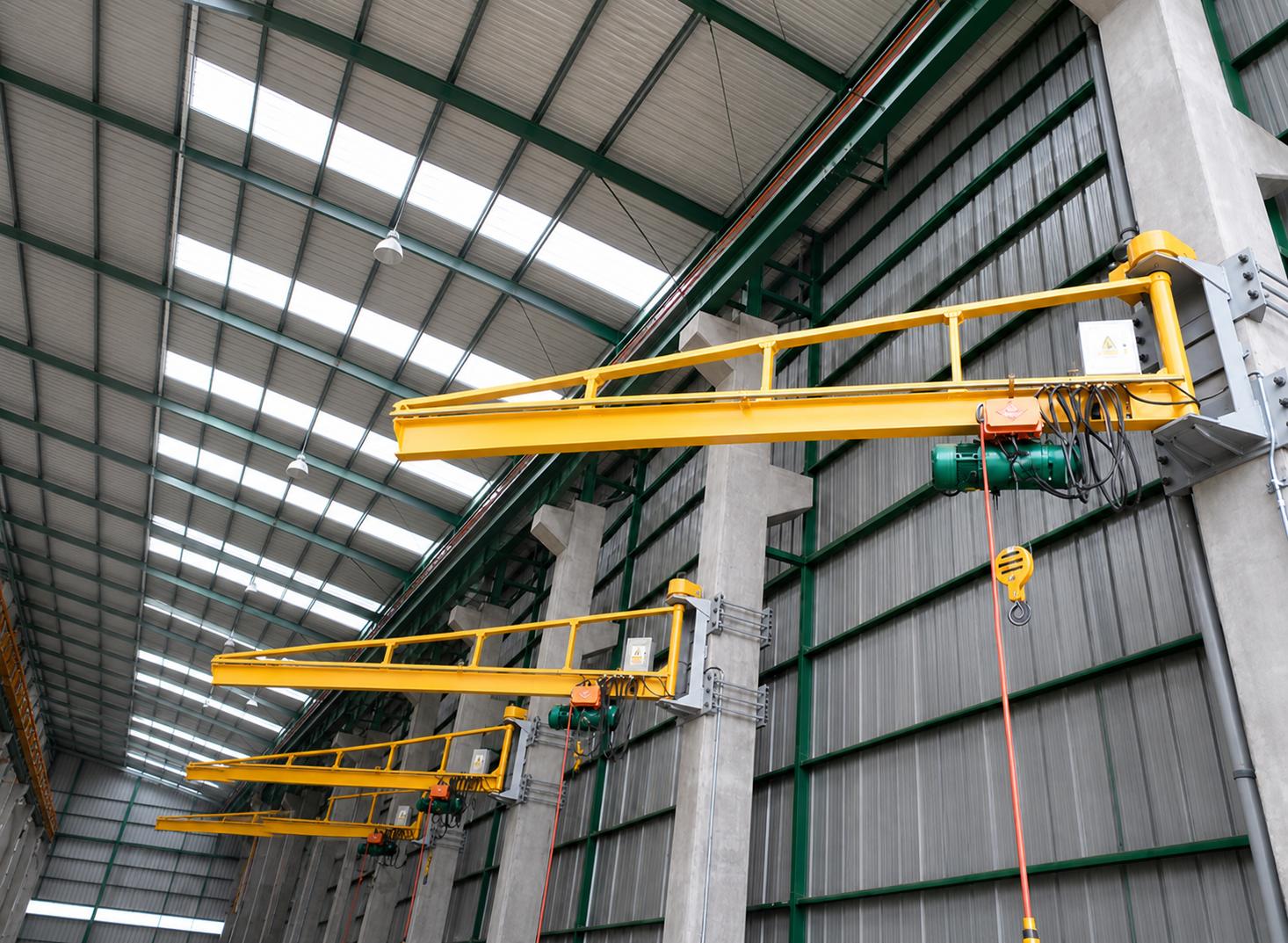
  • Multiple Cranes in One Workshop: Operating Zones and Coordination

    Multiple Cranes in One Workshop: Operating Zones and Coordination

    Technical guide

    Multiple Cranes in One Workshop: Operating Zones and Coordination

    Shared working space creates interactions between crane movements and handling tasks. Define the operating zones, overlapping envelopes and communication requirements before deciding on coordination or collision-prevention functions.

    Henan Mine CraneTechnical guide · Updated 2026Crane selection, project scope and operating requirements
    multiple overhead cranes
    multiple overhead cranes
    Project planning notes

    Key points for this crane project.

    1. Why Multiple Overhead Cranes Need Coordination
    2. How to Plan Crane Layout and Working Zones
    3. How to Coordinate Multiple Overhead Cranes
    Read the technical guide

    Why Multiple Overhead Cranes Need Coordination

    Crane interference risks

    The most prominent hidden danger of Henan Mine Crane manufactured multiple bridge cranes on the same track or in overlapping operating areas is equipment interference. When the trajectories of crane carts and trolleys intersect, the fuselage, spreader, and wire rope are prone to scratches and collisions. Once the collision occurs, it will cause major accidents such as deformation of the main girder, damage to the trolley mechanism, and falling objects. In addition to interference between the main body of the bridge crane, the swing of the crane will also collide with peripheral equipment, columns, and tooling. Many factories only install simple buffers and lack dynamic distance monitoring. When the operator's line of sight is blocked and fatigue operation occurs, the risk of interference will rise sharply.

    Safety and productivity

    Many workshops blindly increase the number of cranes, but on the contrary, they cause congestion in operations, frequent safety accidents, and decreased production beats. In the absence of collaborative rules, multiple cranes rush to operate, operators frequently avoid, hoisting waiting time is prolonged, and the efficiency of material flow is greatly reduced. After standardizing collaborative management, the operation of bridge cranes is partitioned and the movements are orderly, which cannot only avoid safety accidents such as collisions, falling objects, and injuries to personnel, but also reduce equipment downtime and maintenance time. A stable and controllable hoisting process allows the workpiece transfer and assembly processes to be connected more smoothly. Under the premise of ensuring the safety of personnel and equipment, the overall production capacity of the workshop is released, and safety control and production capacity goals are balanced.

    When coordination is needed

    As long as there are two or more bridge cranes in the workshop and there is overlap in the operating area, collaborative operating rules must be formulated. Typical scenarios include the parallel transfer of workpieces by multiple cranes on the same track, the lifting of workpieces across regions, the transfer of materials between two bridge cranes, and multi-station synchronous hoisting operations. Even if the daily division of labor of each crane is independent, when the lifting route is temporarily adjusted during the peak period of the order, there will be intersections in the work area. In addition, temporary working conditions such as plant renovation, entry of large-scale equipment, and equipment overhaul and hoisting also need to enable collaborative control.

    How to Plan Crane Layout and Working Zones

    Define travel paths

    In the pre-planning stage of the workshop, it is necessary to delineate a dedicated cart and trolley operating path for each bridge crane, and determine the direction of material entry and exit and the starting and ending points of workpiece hoisting in combination with the process flow. The main traffic route minimizes crossovers, priority is given to planning independent long-distance passages for large-scale hoisting, and secondary paths are used for short-distance small-scale transshipment. When planning the path, the maximum shape and size of the workpiece should be considered, and the swing space of the crane should be reserved, and the size of the crane body should not only be referred to. After the drawing is completed, combine the simulation operations of the location of the on-site columns, pipelines, and equipment to mark the prohibited areas, form a written path specification, and deliver it to the operator for execution to reduce the uncertainty caused by the temporary diversion of the site.

    Identify shared work zones

    Shared work areas are the core difficulty of multi-machine collaborative control. Most of these areas are workpiece transfer areas, large assembly stations, and raw material loading and unloading points. It is necessary to clearly mark the boundaries of the shared area on the drawings and clarify the entry rules. In principle, only one bridge crane is allowed to operate in the shared area at the same time. For the lifting conditions where two cranes must enter at the same time, a special operation plan is formulated separately to limit the length of operation and the upper limit of load. In daily production, the electronic control system can be used as an electronic fence for the area, and the Henan Mine Crane manufactured bridge crane will automatically trigger an early warning when it enters the shared area, restricting other cranes from entering, and avoiding chaos caused by the simultaneous influx of multiple machines into the shared area.

    Match lifting capacity and hook positions

    The configuration of multiple cranes in the workshop cannot be simple and unified specifications. The rated lifting weight needs to be matched according to the load requirements of each station. Heavy-duty stations are equipped with high-capacity cranes, and small-tonnage models are selected for lightweight transshipment. The installation height and horizontal stroke of the hooks should be matched with each other to prevent the high and low hooks from interfering with each other. In the workpiece lifting scene, the position of the hooks of each bridge crane should ensure that the load is evenly distributed to avoid overload of a single bridge crane. The limit position of the hook is checked synchronously during the design phase.

    Maintain safe clearances

    The safety gap is the basic design index to prevent crane collisions, which is divided into the spacing between the bridge crane body, the spacing between the crane and the fixed building, and the gap between the crane. The conventional static safety distance should be combined with the operating speed of the bridge crane to reserve a margin. The faster the speed, the greater the required safety distance. In addition to static reserved clearance, it is necessary to consider the braking and sliding distance of the cart and the swing amplitude of the hanging object, and cannot only rely on the protection of the structural buffer block. In the layout stage, the safety clearance parameters are written into the design specifications, and the limit devices are set at both ends of the track and at the boundary of the area.

    How to Coordinate Multiple Overhead Cranes

    Set operating priorities

    Establish a clear priority system for crane operations to reduce multi-machine conflicts. Priorities can be divided according to the type of operation, with the highest priority for large-scale lifting and emergency equipment repair and hoisting. The transportation of finished products and the storage of raw materials have the second highest priority. Ordinary tooling has the lowest mobile priority. Priority rules should be written in writing, and operators and ground commanders should learn uniformly. When the operating routes of the two bridge cranes conflict, the low-priority cranes slow down in advance to avoid, and the operations are suspended to wait for the high-priority tasks to be completed. At the same time, an exception approval process is set up, and the priority can be temporarily adjusted under special working conditions, and all priority changes are recorded to avoid communication errors caused by verbal command.

    Coordinate load transfers

    The transfer of workpieces between two bridge cranes is a high-risk collaborative operation and requires standardized operating procedures. Before the operation, the two operators and the ground commander jointly confirm the location of the lifting point, the center of gravity of the workpiece, and the status of the spreader, and plan the transfer path. During the transfer process, keep the workpiece stable, control the lifting and operating speed, and strictly prohibit rapid movement from causing the load to shake. During the handover of the workpieces, one bridge crane slowly carries the load, and the other gradually unloads the force. The force changes of the wire rope are observed throughout the process, and the load is confirmed to be smoothly transitioned before the decoupling is completed.

    Manage simultaneous lifts

    Multi-machine synchronous lifting of large workpieces, load distribution and motion synchronization are the key points of control. Carry out technical exchanges before the operation, calculate the assigned load of each bridge crane, and the carrying capacity of a single crane cannot exceed the safety limit of the rated load, and formulate a test crane plan. During the test hoisting, the workpiece is lifted slightly, the spreader is fixed and the load balance is checked, and after confirming that there is no tilt or slippage problem, it is officially hoisted. The movements of the lifting, cart, and trolley are kept in sync, the speed is uniformly controlled, the attitude of the workpiece is observed in real time, and the work is stopped immediately if the force is abnormal.

    Establish operator communication

    A stable and reliable communication mechanism is the basic guarantee for multiple cranes to work together. The workshop gives priority to the use of standardized gestures and wireless intercom systems, and establishes a fixed command password system to avoid ambiguity in spoken language. Before the operation, the operator and the ground commander confirm the status of the equipment, the operation route and the risk points with each other. During the operation, continuous communication is maintained, and any operator who finds an abnormality can issue a stop command at any time. When the intercom signal is poor and the workshop noise is high, sound and light signals are used to assist communication. Organize communication drills regularly, unify signal standards, prevent misoperation due to signal understanding deviations, and improve the team's collaborative response ability.

    Which Control Systems Help Coordinate Cranes?

    Individual vs. group controls

    Stand-alone control and cluster collaborative control are suitable for different workshop working conditions. The independent control of the stand-alone machine has high flexibility, which is suitable for scenarios where each bridge crane operation is independent of each other and there is very little cross-operation. The operator controls the operation of the machine separately. However, when multiple machines frequently cross-operate, they only rely on stand-alone control and rely entirely on manual judgment, which is high risk. The cluster group control system can centrally monitor the location and operating status of all bridge cranes, and uniformly issue regional authority and action restriction instructions. When selecting projects, a hybrid scheme can be adopted, and the stand-alone mode can be used daily.

    Anti-collision systems

    The anti-collision system is an essential hardware for Henan Mine Crane manufactured multiple bridge cranes to work together. The mainstream solution uses laser, UWB, and radar sensors to collect the distance between the cranes and the obstacles in real time. The system sets up a two-level protection mechanism, a first-level early warning, and a sound and light alarm when the bridge crane is close to a safe distance to remind the operator to slow down. The second cascade of lock protection automatically restricts the cart and trolley from continuing to move in the direction of conflict when the dangerous distance is reached, and only reverse avoidance is allowed. The anti-collision system can be connected to PLC and linked with the regional electronic fence, not just a simple limit, to achieve dynamic distance protection.

    Remote control and visibility

    The remote control is equipped with visual monitoring to effectively solve the problem of blocking the field of view of the workshop. Traditional cab operation is easily obscured by workpieces and columns, and the wireless remote control allows the operator to stand on the ground with a good field of view. At the same time, the bridge crane can be equipped with a high-definition camera, and the central control large-screen can return the hook and crane pictures in real time, and remotely view the location of multiple cranes. When multiple machines work together to lift and transfer workpieces, the command personnel use the video screen to grasp the overall working conditions. The selection of remote control equipment needs to ensure the anti-interference ability of communication, set the automatic shutdown function for signal loss, avoid signal interruption and cause out-of-control, and improve the visibility of operation under complex working conditions.

    PLC-based coordination

    The PLC-based collaborative control system is the core of realizing the intelligent linkage of multiple cranes. The PLC collects the position, speed, load, and limit signals of each crane in real time, and has built-in collaborative logic to determine whether there is a trajectory conflict between each equipment. When the bridge crane enters the preset shared area, the PLC automatically performs the speed limit and interlock shutdown logic, and records all operation logs to facilitate post-mortem traceability. The system can be integrated with anti-collision, remote monitoring, and upper computer management platform, and supports custom job partitions and priority rules. Compared with simple hardware limits, the PLC collaborative scheme is more adaptable, and the logic can be adjusted according to the workshop process, which is suitable for multi-bridge crane cluster projects in large factories.

    How to Ensure Safe Crane Operation

    Prevent crane collisions

    Preventing bridge crane collisions requires a combination of hardware and software, and operator experience cannot be relied on alone. The hardware level is equipped with anti-collision sensors, buffers, and track limits, and the software level relies on PLC to set regional interlocks to restrict multiple machines from entering dangerous areas at the same time. In daily management, regularly check the sensitivity of anti-collision equipment, clean up the dust on the surface of the sensor, and prevent detection failure caused by occlusion. Formulate an inspection list and confirm that the anti-collision system is enabled before each operation. At the same time, the operation process is optimized to reduce unnecessary multi-machine cross-operation, and the operator develops the habit of predicting in advance, decelerating and avoiding as soon as the early warning signal is received, and multi-layer protection reduces the probability of collision accidents.

    Control load swing

    The swing of the crane is a common safety hazard in multi-machine collaborative operation. Excessive swing can easily hit surrounding objects, and it will also change the force of the wire rope, causing unstable load. In operation, low-speed start and slow braking are used to avoid emergency start and stop, and reduce the inertial swing of the hanging object. The high-end bridge crane is equipped with frequency conversion sway control control, which suppresses the shaking of the crane through algorithms, greatly reducing the difficulty of operator operation. When lifting multiple machines, the lifting and operating speed are controlled synchronously to maintain the level of the workpiece and prevent the force on one side from causing a large swing.

    Manage emergency stops

    The emergency stop system is the last safety line of defense. In the collaborative scenario of multiple cranes, it is necessary to distinguish between stand-alone emergency stop and global emergency stop. Each bridge crane is equipped with an independent emergency stop button locally, which can be triggered by the remote control and the cab, which is used to stop the machine in an emergency. At the same time, a global emergency stop is set at the key points of the central control room and the operation site. When there is a major danger such as multi-machine interference and the crane is out of control, multiple bridge cranes are triggered to brake with one key. The system design should ensure that the emergency stop loop is independent, does not depend on the communication network, and is still effective in the fault state.

    Inspect and train operators

    No matter how perfect the equipment system is, it is inseparable from standardized personnel management. Establish a hierarchical inspection system, check the brakes, spreaders, and anti-collision sensors before the shift every day, check the electronic control system every week, and do regular non-destructive testing of the whole machine to record the health status of the equipment. Operators must complete special training, including multi-machine coordination rules, anti-collision system operation, lifting operation procedures, and emergency response methods, and pass the assessment and take the job with a certificate. Regularly organize retraining and on-site simulation exercises, and update accident case studies. At the same time, clarify job responsibilities, operators have the right to refuse risky operations, and build a solid safety bottom line from the personnel management level.

    How to Specify Multiple Overhead Cranes

    Assess loads and workflow

    The first step in the selection of multiple bridge cranes is to comprehensively evaluate the workshop load and production process. Count the average daily lifting load and maximum workpiece weight, analyze the workpiece transfer path and station distribution, and identify high-frequency cross-operation points and lifting operation frequencies. Sort out the fluctuations in the production capacity of the workshop in the morning and evening shifts, evaluate the lifting needs during peak periods, and judge the number and layout plan of Henan Mine Crane manufactured bridge cranes. It is also necessary to consider the expansion plan for the next 3 to 5 years and reserve space for equipment expansion. Based on a complete working condition assessment, divide the stations responsible for each crane, determine the shared working area, avoid excess equipment configuration or insufficient hoisting capacity, and lay the foundation for a complete set of solutions.

    Select capacity, span, and duty class

    Based on the load evaluation results, the rated lifting weight, track span, and working level of each bridge crane are determined. The lifting weight reserves a safety margin, which cannot just match the weight of the workpiece. The span is determined according to the measured size of the track beam of the plant, taking into account the effective coverage of the hook. The working level refers to the GB/T3811 standard, and the A1 to A8 levels are selected according to the daily operating time, lifting frequency, and load fluctuations. The high-frequency heavy-duty assembly workshop adopts the A6 and A7 levels, and the ordinary machining workshop adopts the A5 level. Long-term heavy-duty operation of low-work-level equipment will accelerate the fatigue of metal structures and age in advance.

    Specify rails and power supply

    The track and power supply system are the basis for the stable operation of Henan Mine Crane manufactured multiple bridge cranes, and the working conditions of multiple machines on the same track require higher track strength and installation accuracy. The selection of the track should account for the wheel pressure, match the carrying capacity of the track beam, strictly control the straightness and level of the track, and reduce the operation of the cart. Caton and wear. The power supply scheme can choose sliding contact line or cable power supply. The sliding contact line is suitable for long-track and multi-crane continuous operation scenarios. Do a good job of insulation protection to avoid short circuits caused by dust.

    Define control and safety features

    Clarify a complete set of control and safety configuration lists in the equipment technical agreement. The basic safety configuration includes overload limiter, height limit, stroke limit, and brake. Collaborative related configurations include anti-collision sensing, PLC cluster linkage, electronic area fence, wireless remote control and visual monitoring. At the same time, load monitoring and operation data recording systems are configured, and job data is saved for fault traceability. According to the needs of working conditions, sway control and emergency stop interlocking devices are selected. All safety components are selected from industrial reliable brands, and the factory test items of the equipment are clarified to ensure that all single-machine functions and multi-machine collaborative linkage functions have passed the factory inspection and meet on-site safety specifications.

    Check manufacturer integration capabilities

    The multi-bridge crane project is not just a simple equipment procurement, but also a core test of the manufacturer's system integration capabilities. The procurement phase focuses on whether the manufacturer has experience in multi-machine collaborative program design, PLC cluster program development, and on-site debugging, and whether it can complete the joint adjustment of anti-collision, monitoring, track, and power supply systems. Confirm that the manufacturer can provide one-stop services for site survey, layout planning, installation guidance, personnel training, and after-sales maintenance. Give priority to manufacturers with landing cases of the same type of multi-machine collaborative workshop, to avoid equipment from different suppliers, system incompatible, linkage logic cannot be opened, resulting in collaborative functions cannot be implemented.

    Henan Mine Crane

    Configuring multiple bridge cranes in the same workshop requires comprehensive consideration of lifting weight, track conditions, overlap of operating areas, load distribution, and cooperation between control systems. Henan Mine Crane Factory can provide customized bridge crane solutions according to plant layout, material handling needs and actual working conditions, and configure single-beam or double-beam bridge cranes, wireless remote control and corresponding control systems in combination with different application scenarios to help enterprises rationally plan hoisting equipment and improve the efficiency of material flow in the workshop.

    From pre-project design, crane manufacturing to installation guidance, on-site commissioning and operation training, perfect project support helps to reduce the risk of interference in multi-machine collaborative operation and ensure the long-term stable operation of equipment. Whether it is a new plant or an upgrade of an existing hoisting system, a more suitable equipment configuration can be determined based on the actual lifting weight, span, lifting height, working level and on-site operating conditions, so that the crane system can better adapt to the production process and future development needs.

    Discuss the crane arrangement for your project.

    Shared working space creates interactions between crane movements and handling tasks. Define the operating zones, overlapping envelopes and communication requirements before deciding on coordination or collision-prevention functions. Share the load, available drawings, working cycle and site conditions with Henan Mine Crane so the required configuration and supply boundary can be discussed.

    Related crane configurations

    Single-Girder Bridge Crane

    View product parameters
    Lifting capacity: 1–20 tSpan: 7.5–31.5 mLifting height: 6, 9, 12, 18, 24 or 30 m; capacity-dependent

    Use an LDA single-girder bridge and electric hoist for general workshop material handling. Select the lifting capacity, runway geometry and hoist duty around the building and load.

    LH Electric Hoist Double Girder Crane

    View product parameters
    Lifting capacity: 3, 5, 10, 16, 20 tSpan: 10.5–31.5 mLifting height: 6, 9, 12 or 18 m

    Use an LH double-girder bridge with an electric-hoist trolley for workshop lifting, assembly and maintenance. Match the hoist arrangement to the suspended load, hook travel and available building space.

    Updated 2026 · Henan Mine Crane
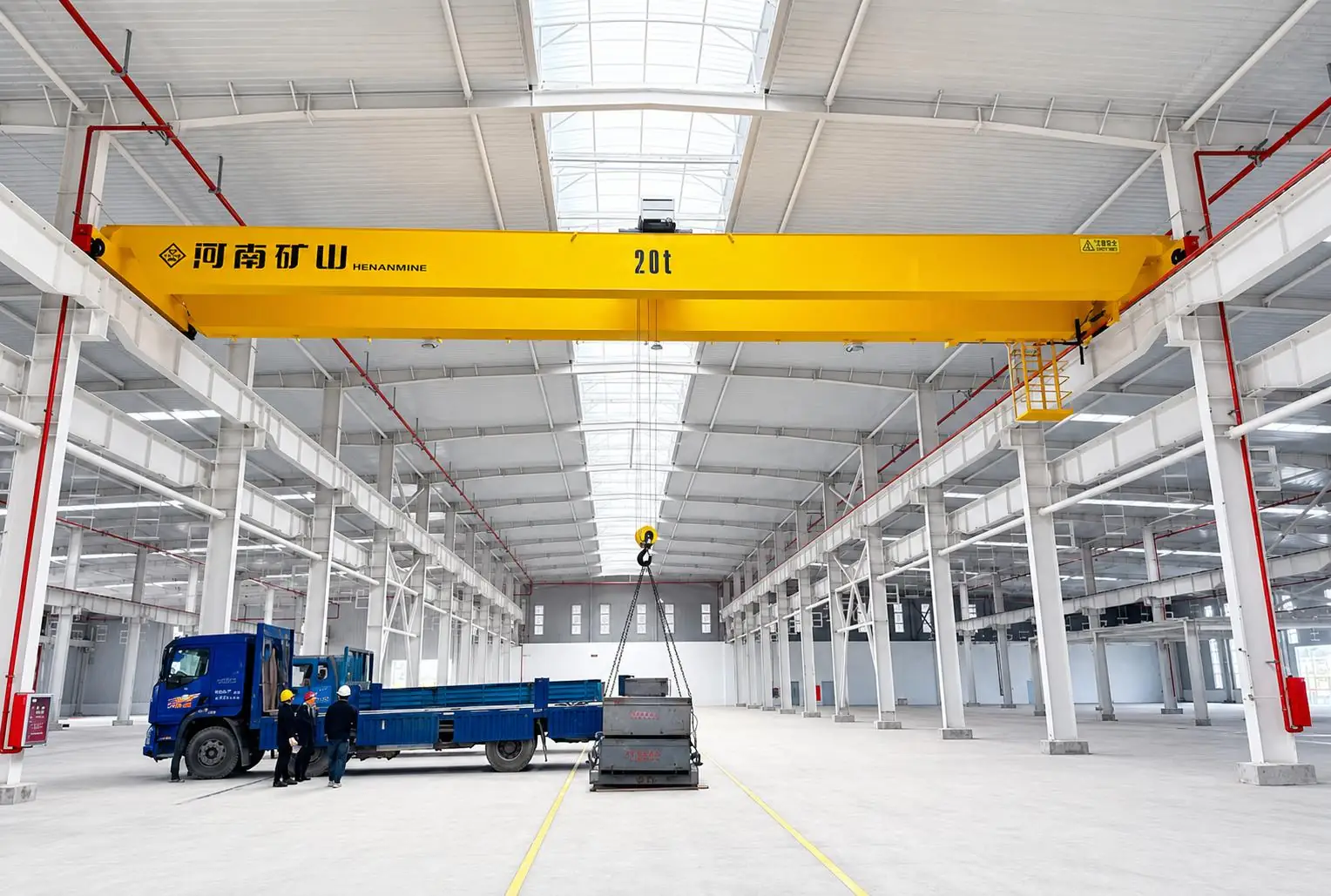
  • Overhead Crane Production-Line Interfaces: Signals and Transfer Positions

    Overhead Crane Production-Line Interfaces: Signals and Transfer Positions

    Technical guide

    Overhead Crane Production-Line Interfaces: Signals and Transfer Positions

    A connected crane needs a clear agreement with the surrounding process equipment. Specify transfer positions, control signals and operating states so normal movements and exception recovery can be planned across the whole line.

    Henan Mine CraneTechnical guide · Updated 2026Crane selection, project scope and operating requirements
    Overhead Crane Automation
    Overhead Crane Automation
    Project planning notes

    Key points for this crane project.

    1. How Do Overhead Cranes Work in Automated Production
    2. How to Integrate an Overhead Crane into an Existing
    3. What Challenges Affect Crane Automation Projects?
    Read the technical guide

    How Do Overhead Cranes Work in Automated Production Lines?

    Crane automation Basics

    The automation of Henan Mine Crane bridge cranes is not just to replace operators with robots, but to upgrade the three sets of mechanisms of carts, trolleys and hoisting, so that the operation of each mechanism can be executed in accordance with preset procedures, combined with the positioning and dispatching system, to realize the automatic operation and collaborative operation of bridge cranes, and gradually transform manual operation into system control. The degree of automation is usually divided into three levels. The first level is remote control. The operator uses a handle or tablet to control in a safe area to reduce personnel risks without changing the operating mode. The second level is the execution of the scheduled procedure.

    System integration

    Integration means turning the bridge crane into part of the production line, not just a usable hoisting tool. The typical practice is to let the upper system uniformly issue tasks, and the bridge crane only performs three actions: picking, transporting, and releasing. After the task instruction arrives, the system plans the path, and the bridge crane reclaims the material, transports it in place, and returns without load to form a complete closed loop. The actual benefit of integration is the synchronization of material flow and information flow. In the past, when the materials were in place depended on manual scheduling, but now they are uniformly arranged by the system. The backlog of WIP has been significantly reduced, and the waiting time at the bottleneck station has been compressed.

    Automation technology

    Supporting the landing of automation are several key technologies. The frequency converter of the bridge crane is combined with a closed-loop encoder to make the three-axis movement speed controllable and the position repeatable. Laser ranging or QR code positioning provides the absolute position reference of the bridge crane. The sway control algorithm suppresses the swing of the bridge crane crane in operation and ensures the accuracy of placement. Safety laser scanners and gratings delineate the work area and isolate personnel from the danger zone. Each technology solves a specific problem. When selecting the type, first look at the requirements of the production line for positioning accuracy and beat. The higher the accuracy requirements, the higher the sensor level, and the cost and implementation difficulty will increase accordingly.

    How to Integrate an Overhead Crane into an Existing Production Line

    Workflow evaluation

    Do a beat analysis before the transformation of the bridge crane, and this step determines the direction of the transformation plan of the bridge crane. Count the loading and unloading time, waiting time, and invalid travel distance of each lifting of the bridge crane, find the bottleneck station, and then see where automation can save time. Without this foundation, no matter how beautifully the plan is made, it is empty. Transformation goals must be quantified. Clarify the target cycle time, target throughput, and target manpower savings, and write the plan as the basis for acceptance, otherwise it is impossible to judge whether the project meets the standards after completion. At the same time, check the existing interface of the production line, the in-place signal of the conveyor line, the alignment point of the station, and the physical state of the bridge crane track, which determine the workload and cost range of the transformation.

    Crane selection

    The selection of bridge cranes revolves around a set of core parameters, such as rated lifting weight, span, lifting height, operating speed, working level and expected frequency of use. Each item directly affects the boundary of the production capacity of the bridge crane after the transformation. It cannot be allocated only according to the current minimum demand, and there must be room for climbing. Three things are reserved for the automation of bridge cranes, sufficient travel and lifting speed margin, communicable frequency conversion and PLC interface, and the hardware foundation for positioning and sway control functions. Many projects wanted to upgrade in the later stage, but found that the bridge crane did not reserve the interface at the beginning, and was forced to replace the whole machine, doubling the cost.

    PLC and control integration

    The controller of the bridge crane must be docked with the production line PLC, and the communication method of the bridge crane control system must be determined first. The common Profinet, ETHERNET/IP, and Profibus fieldbuses have their own applicable scenarios. The selection depends on the existing PLC brand and network architecture of the production line. It is best to be consistent with the production line and reduce the protocol conversion link. The interaction logic of bridge cranes should be clearly defined. The PLC of the production line sends signals for placement, pick-and-place, and release, and the bridge crane is executed in the order of the signals. The two ends are interlocked and mutually recognized, and neither end is ready to operate.

    Conveyor coordination

    The cooperation between the bridge crane and the conveyor line depends on the alignment logic. The three elements of in-place detection, load identification, and release confirmation form an interlocking. The bridge crane will only release the material if it confirms that the station is ready, and the conveyor line will only continue to feed if it confirms that the spreader has left. There will be no empty runs on both sides, and there will be no crashes. In multi-station scenarios, the scheduling priority must also be defined. The bridge crane can only serve one station at a time. The system should prioritize the urgency of the task and the status of the station to avoid path conflicts when multiple tasks are concurrent.

    Sensor integration

    Automation relies on sensors much more than manual operation. The load of the bridge crane is weighed to determine whether it is overloaded and correctly grasped. The position detection covers the dual axles of travel and lifting, anti-collision ranging to avoid collisions, and alignment confirmation to ensure the discharge accuracy of the bridge crane. , Safety protection keeps people away from the work area. These types of sensors form a complete perception layer. Key signals must be redundant and self-checked. The important sensor adopts a dual-channel design, coupled with a fault self-test, to ensure that a single sensor can trigger a safe shutdown when it fails, rather than malfunction. The sensor calibration and calibration of bridge cranes also directly affect the positioning accuracy and cycle time, and should be included in the daily maintenance plan.

    What Challenges Affect Crane Automation Projects?

    Building and runway restrictions

    Plant conditions are often the biggest variable in bridge crane automation projects. The headroom height determines the lifting and spreader transformation space, the straightness and wear of the track directly affect the positioning accuracy of the bridge crane, and the foundation bearing and column spacing constrain the span and load. Do a check of the status quo of the bridge crane plant before the transformation, which can avoid rework where the equipment is in place and the track is found to be unqualified. The difference in construction investment between the new factory building and the renovation of the old factory building is obvious. We can take into account the track accuracy and automation interface at the design stage.

    System compatibility

    Compatibility with old equipment is the most common obstacle to the transformation of bridge cranes. The electrical system of the bridge crane that left the factory in the early years was aging, incompatible with the new bus and the upper system, and direct docking often failed. At this time, it is necessary to judge which way to go, the whole machine control cabinet is transformed, or the whole machine is replaced. The judgment is based on the remaining equipment life, mechanical status and control upgrade space of the bridge crane. The mechanical condition is good, but the electrical aging is only good, and the transformation of the control cabinet is cost-effective. The equipment itself has reached the end of its life, but the transformation is not cost-effective, and the whole machine should be replaced.

    Production downtime

    The risk of shutdown is one of the most worried issues for the owners of bridge crane renovation projects. The commissioning, trial operation and acceptance of bridge cranes during the transformation period all require a shutdown window, which directly conflicts with the tasks in production. If it is not handled well, a transformation may interrupt several weeks of continuous production. The countermeasure is to be implemented in stages. First debug the stand-alone machine and adjust the movement of the bridge crane itself. You are welcome to join us. The final cut is fully automatic to verify the beat and stability. Every step is completed in the window to minimize the impact of the shutdown. Continuous production lines can also use night or weekend windows, or arrange the transition of alternate work plans.

    Safe and reliable

    The automation system of Henan Mine Crane bridge cranes must meet safety standards and risk assessment requirements. There is no shortage of safety devices such as limit, anti-collision, emergency stop, and area protection, and the requirements for bridge crane automation scenarios are more stringent. The system has no human adaptability, and safety redundancy directly determines the risk level of the bridge crane. The reliability requirements are also higher than manual operation. During automated operation, a fault location error may cause the entire line to shut down. Therefore, fault diagnosis, redundancy design and maintainability must be considered in advance. The operating rate is the real result of the automated transformation of bridge cranes, not just the ability to run automatically.

    How to Plan Crane Automation Costs and Implementation

    Project cost factors

    The cost of bridge crane automation transformation is not a fixed number, it depends on the scope of bridge crane transformation, the status of equipment and the complexity of the production line. The cost structure usually includes hardware (frequency converter, sensor, control cabinet), software (scheduling logic and upper system), engineering design, on-site commissioning, and personnel training. The cost level is most affected by two factors, one is the scope of transformation, whether it is the transformation of the whole machine or the addition of automation modules. The second is the electrical condition of the existing bridge crane. When estimating, it is recommended to quote separately according to the four pieces of hardware, engineering, commissioning, and training, and then superimpose the emergency budget.

    Installation and commissioning

    The implementation cycle of the bridge crane is divided into five stages, including plan design, factory commissioning, on-site installation, online trial operation, and formal acceptance. Each stage must have a clear acceptance node for bridge cranes, rather than waiting for all of them to be completed before seeing the results. Factory debugging is easy to be underestimated, but the value is very high. Simulate the on-site working conditions of the bridge crane in the factory, and adjust the action, positioning accuracy, and safety interlocking of the bridge crane itself in place, which can greatly compress the on-site commissioning time and shutdown window. After the site is connected, it will be accepted one by one according to the positioning accuracy, cycle time, and safety interlock function, and all of them will be put into operation only if they meet the standards.

    Long-term maintenance

    The maintenance of automation equipment is different from that of traditional bridge cranes. The sensors and encoders of bridge cranes need to be calibrated regularly, the control cabinet should pay attention to heat dissipation, and the communication stability should be inspected. These tasks may seem trivial, but they are essential for the long-term stable operation of bridge cranes. Predictive maintenance is the direction. Monitor temperature, vibration, motor current and other parameters through operating data, give early warning before a failure occurs, and turn unplanned downtime into planned maintenance. The supply of spare parts and service response of bridge cranes should also be discussed clearly when purchasing. The long-term cost of ownership should be included in the total cost, rather than just staring at the purchase price.

    How to Choose an Overhead Crane Manufacturer for Automation Projects

    Engineering ability

    When choosing a bridge crane manufacturer, it depends not only on the product model of the bridge crane, but on the program ability. Almost all bridge crane automation projects have customized requirements. Whether non-standard design and feasibility simulation can be done for specific working conditions is more important than whether there are ready-made products. The method of investigation is to see if the other party has an engineering design team that integrates mechanical, electrical, and software, rather than just doing mechanical matching. Verify the opponent's level with specific working conditions. Throw out a scene of a large-span, heavy-duty or high-speed bridge crane, and see the depth of the plan given by the other party, whether it applies the standard plan, or is really designed around your production line, you can judge in a few words.

    Control system integration

    The control ability is the core of the bridge crane automation project, and it is also where the supplier gap is opened. Investigate whether the other party has independently mastered the PLC and drive programming of the bridge crane, rather than just purchasing a third-party control box to install it. Autonomous control means that subsequent changes to procedures, functions, and troubleshooting are all in your own hands, and you are not subject to others. Openness is also critical. For bridge crane control to be able to interface with MES and third-party PLCs in the production line, suppliers should keep the agreement open, rather than binding their own private agreements. The risk of binding the agreement is that any changes in the later stage must pass through the supplier, and the cost and time are uncontrollable.

    Testing and technical support

    Factory test data is hard evidence to judge the strength of suppliers. The full-load, full-speed, and precisely positioned bridge crane test report can visually reflect the true performance of bridge crane equipment, rather than relying only on the promotional parameters on the product information. Suppliers are required to provide complete test records as the basis for acceptance. After-sales service is the basis for long-term cooperation. The response speed of on-site commissioning, the ability of remote support, the degree of localization of spare parts, and the terms of the maintenance agreement determine the level of guarantee after the bridge crane equipment is put into operation. Once the bridge crane is shut down, it affects the entire production line.

    Henan Mine Crane

    Henan Mining Factory provides customized bridge cranes, gantry cranes and material handling solutions for demanding industrial applications. From upgrading capabilities and span to working conditions, operating mechanisms and automation requirements, each project can be customized according to specific production needs. With integrated R&D, engineering design, manufacturing and service capabilities, we help customers choose lifting equipment that is suitable for their facility layout, material handling work flow and long-term operational goals.

    Whether you are upgrading an existing workshop, expanding a production line, or planning a new industrial facility, our team can work with you to define the correct crane configuration for your project. Share your required lifting capacity, span, lifting height, working environment and operating requirements, discuss customized solutions with Henan Mining Cranes, and plan your project from planning to implementation

    Discuss the crane arrangement for your project.

    A connected crane needs a clear agreement with the surrounding process equipment. Specify transfer positions, control signals and operating states so normal movements and exception recovery can be planned across the whole line. Share the load, available drawings, working cycle and site conditions with Henan Mine Crane so the required configuration and supply boundary can be discussed.

    Related crane configurations

    Modular Electric Hoist Overhead Crane

    View product parameters
    Lifting capacity: 1 – 32 tSpan: 7.5 – 31.5 mLifting height: 6–30 m

    Use a modular electric-hoist overhead crane for production, assembly and maintenance lifting. Select the hoist arrangement, hook coverage and movement control for the workshop and operating cycle.

    Intelligent Grab Overhead Crane

    View product parameters
    Lifting capacity: 5 – 50 tSpan: 10.5 – 31.5 mLifting height: 6 – 30 m

    Handle bulk materials with a grab overhead crane configured for the material and working cycle. Select the grab volume, lifting arrangement and operating sequence from pickup and discharge conditions.

    Updated 2026 · Henan Mine Crane

  • Bridge Crane Capacity Selection: Payload, Attachments and Working Duty

    Bridge Crane Capacity Selection: Payload, Attachments and Working Duty

    Technical guide

    Bridge Crane Capacity Selection: Payload, Attachments and Working Duty

    Capacity selection starts with the complete suspended load and the way it will be handled. Provide the attachment weights, load geometry and operating cycle before comparing model-specific crane proposals.

    Henan Mine CraneTechnical guide · Updated 2026Crane selection, project scope and operating requirements
    Bridge Crane Capacity Selection: Payload, Attachments and Working Duty
    Henan Mine Crane lifting equipment
    Project planning notes

    Key points for this crane project.

    1. What Is Bridge Crane Lifting Capacity?
    2. Key Factors to Consider When Choosing Bridge Crane
    3. Understanding Capacity Safety Margins
    Read the technical guide

    What Is Bridge Crane Lifting Capacity?

    The rated lifting capacity is the hard upper limit for safe operation of the equipment, and overloading is strictly prohibited. Overloading is easy to cause deformation of the main girder, structural damage, heavy falling and other major safety accidents, regular bridge cranes are equipped with overload protection devices, from the hardware to prevent the risk of overloading.

    Key Factors to Consider When Choosing Bridge Crane Capacity

    Want to accurately select the crane tonnage, cannot only refer to the weight of the goods lifted at a single time, you need to integrate the plant conditions, operational needs, long-term development of more than ten core factors, matching the full range of equipment parameters, taking into account the safety, practicality and economy.

    Maximum Load Weight

    The basis for selection is to account for the total lifting weight, not just the weight of the material. The total load needs to include the weight of the goods, spreaders, slings, beams, clamps, suction cups and all other work equipment under the hook.

    Service Classification

    The frequency of crane use and the intensity of operation directly determine the effective load carrying capacity. The Crane Manufacturers Association of America (CMAA) divides the equipment operation level into six grades from A to F. The A grade is for standby intermittent operation, and the A grade is for standby intermittent operation:

    Class A is a standby intermittent operation, Class F is a continuous heavy-duty high-intensity operation. Long-term high-frequency, full-load operation conditions, must be matched with higher specifications of the equipment design, even if the maximum weight of the goods is fixed, but also need to raise the rated tonnage, to protect the service life of the equipment and operational stability.

    Track Span

    Span refers to the center distance between the two sides of the running track, which is the key index affecting the force of the main girder. Under the same tonnage, the larger the span, the higher the bending stress and deformation load of the main girder, and the effective bearing performance of the equipment will be reduced. Large-span workshops usually need to use double girder overhead travelling crane or directly lift the rated tonnage of the equipment in order to meet the requirements of safe operation.

    Lifting Height and Plant Headroom

    The effective lifting height of the workshop and the top headroom size directly constrain the hoist selection and the whole machine structure program. Low plants need to match the low headroom with a special hoist, if the site headroom is not enough, the payload performance of conventional lifting equipment will be greatly limited, need to adapt to adjust the tonnage and structure of the equipment to meet the site installation and operational requirements.

    Operation Speed and Positioning Accuracy

    For the need for rapid lifting, accurate alignment of the production line conditions, the crane lifting, trolley, trolley running faster, the dynamic inertia is greater, the machine structural strength and load performance requirements are higher. High-speed, high-precision operation scenarios, the need to match a higher margin of the tonnage configuration, to avoid fatigue damage caused by long-term dynamic load equipment.

    On-site Operating Environment

    Indoor and outdoor work, high and low temperature extreme environment, humidity, corrosion, dust, explosion-proof factory and other working conditions, will affect the crane material performance and load stability. Outdoor equipment to withstand wind loads, corrosive environment will accelerate the aging of components, this type of scenario equipment need to do anticorrosion, explosion-proof transformation, some working conditions also need to be appropriate downward adjustment of the rated load utilization, selection of models need to reserve sufficient tonnage margin.

    Load Characteristics and Lifting Methods

    In the face of eccentric lifting, center of gravity shift, load shaking, fragile, high temperature and other special working conditions, lifting operations will produce additional torque and dynamic stress, significantly increasing the operational risk. At the same time, all kinds of special spreaders and tools will take up the rated load, further reducing the effective lifting capacity. Therefore, special load scenarios must be appropriate to increase the tonnage reserve to ensure operational safety and equipment stability.

    Future Expansion and Growth

    Equipment selection needs to be pre-judged in advance of the next 3-5 years of production capacity upgrades, goods weight increase, production line iteration and other development needs, reasonable reserve tonnage margin. Moderately enlarging the bearing reserve can effectively avoid the equipment overload and machine elimination and replacement problems caused by the later capacity enhancement, and significantly save the comprehensive costs brought by the secondary procurement, equipment transformation and production downtime, and realize the long-term equipment adaptation.

    Bridge Crane Capacity Selection: Payload, Attachments and Working Duty
    Lifting equipment and application context

    Understanding Capacity Safety Margins

    Many users tend to confuse the two core concepts: design safety factor and operational safety margin, which is one of the main reasons for tonnage selection errors.

    • Design safety factor: the structural safety margin preset for the equipment factory, is a hard design guarantee. The safety coefficient of the whole machine is 3:1, the core components are 2:1-3:1, and the perishable parts such as wire ropes and spreaders are 4:1-5:1, which is used to offset the aging, impact and fluctuation of the working conditions of the equipment, and overloading is strictly prohibited.

    How to Calculate the Required Bridge Crane Capacity

    Professional tonnage calculations do not require complex formulas and follow standardized steps to accurately calculate the appropriate tonnage for most industrial plant conditions.

    Identify the Maximum Load Weight Accurately calculate the maximum net weight of the material to be lifted in a single operation in the workshop, and then fully add up the weight of all accessories such as spreaders, work tools, ropes, clamps, etc. under the hook, and then integrate them to arrive at the total basic load.

    Account for Load Characteristics Comprehensively investigate the lifting conditions at the site, focusing on checking whether there are special operating scenarios such as center of gravity shift, eccentric lifting, load swaying, high temperature, fragile, etc. For non-routine loading conditions, additional safety margins are required to effectively offset the safety hazards caused by eccentric torque and dynamic impact loads, so as to build up a solid operational safety bottom line.

    Incorporate Duty Cycle

    Combining the average daily lifting frequency, single operation duration, load utilization rate and other core indicators, the corresponding CMAA operation level is accurately determined. For the severe working conditions of high-frequency heavy load and continuous uninterrupted operation, even if the peak load value of the equipment is on the low side, it is still necessary to upgrade the equipment configuration and strengthen the structural strength and anti-fatigue performance of the whole machine, so as to ensure the long-term stability and low-fault operation of the equipment.

    Evaluate Structural and Operational Factors

    Comprehensive verification of the site track span, effective lifting height, equipment running speed, operating environment, plant load bearing and other key parameters, to comprehensively verify the suitability of the equipment. For large span, low headroom and heavy load conditions, the model can be flexibly optimized, such as replacing single girder models with double girder models and moderately increasing the rated tonnage, which can effectively make up for the performance degradation brought about by the limitation of working conditions.

    Reserve Capacity for the Future

    Combined with the enterprise's future capacity upgrading, goods weight increase, production line expansion, process iteration and other long-term development planning, scientific reserve tonnage margin. By reserving equipment redundancy in advance, you can effectively avoid the problems of insufficient equipment carrying capacity, elimination and replacement of the whole machine triggered by the later increase of production capacity, and significantly reduce the comprehensive cost of the second procurement of equipment and the downtime of the transformation.

    Professional Calibration and Compliance Certification

    Organize and summarize a full set of field conditions parameters, and submit them to professional crane manufacturers for special calibration.

    Bridge Crane Capacity Selection: Payload, Attachments and Working Duty
    Crane arrangement for technical discussion

    Common Bridge Crane Capacity Ratings

    Industry crane tonnage for the standardized gradient design, while the single girder, double girder models adaptable tonnage and the scene of significant differences, selection can be directly referred to the following common standards.

    Conventional Tonnage Gradient

    For oversized and heavy-duty working conditions, we can also provide 100-ton customized models, which are comprehensively adapted to all kinds of industrial scenarios.

    Single Girder Overhead Cranes (Light to Medium Duty)

    With light structure, convenient installation and outstanding cost performance, this model is suitable for small-span workshops, light load and low-frequency operation scenarios, and is widely used in light factories, maintenance workshops and regular light manufacturing conditions, and is the preferred equipment for light and medium-sized lifting scenarios.

    Double Girder Overhead Crane (Medium and Heavy Duty)

    Double girder overhead travelling crane has high structural strength, wide range of spans, greater effective lifting height and excellent fatigue resistance for heavy loads. It is designed for high-frequency operation, large spans, high loads and heavy-duty lifting in demanding industrial scenarios.

    Industry-Specific Capacity Recommendations

    The load characteristics, operation frequency and working conditions of different industries are very different, corresponding to the mature standardized selection scheme, which can be directly adapted to the industry's general production needs.

    • Priority is given to single girder overhead travelling crane, which is cost-effective, easy to operate and maintain, and fully adapted to the normalized light-load lifting and loading of small parts, jigs and fixtures, and finished products.
    • Single or double girder overhead travelling crane can be selected according to the workshop span and operation frequency, suitable for high-frequency lifting and loading of medium-sized materials such as mechanical parts, steel plates, body components, etc., taking into account the operational efficiency and operational stability.
    • It is equipped with high-strength double girder overhead travelling crane as standard, with strong load bearing capacity and excellent fatigue resistance, which can be stably adapted to heavy load and high frequency lifting and loading scenarios such as castings, steel structures and heavy machinery and equipment.
    • Adoption of high-temperature-resistant, heavy-duty customized double girder cranes can be effectively adapted to the high temperature, dusty, continuous full-load operation of steel mills in harsh working conditions, equipment durability and safety is stronger.
    • Customized large-span heavy-duty double girder overhead travelling crane with strong structural rigidity and large lifting span is specially adapted to the lifting and assembling of oversized components such as ship hull modules, large power generating sets and heavy-duty complete sets of equipment.
    • The equipment is mainly used for standby and overhaul work, with low daily utilization rate, but with strict requirements on stability and reliability, specially adapted to the overhaul and hoisting work of the core equipment of the plant such as steam turbine and transformer.
    • It can be equipped with explosion-proof, clean and precise positioning control system, which is perfectly suited for aerospace and other precision manufacturing, high-risk and clean special operating environments, taking into account the accuracy and safety of operations.

    Signs Your Current Bridge Crane Capacity Is Inadequate

    Rated lifting capacity is the core parameter, but relying on the tonnage alone cannot guarantee the adaptability of the equipment, you need to synchronize the verification of the following supporting parameters, to avoid the equipment cannot be used normally after arrival.

    • Structural and dimensional parameters: covering the rail span, effective lifting height, plant top clearance, total rail length, roof beam load-bearing limits and other core data, all dimensions and load-bearing parameters need to be verified on-site to ensure that the site conditions are accurately matched.
    • Operational performance parameters: including hoist configuration type, hoisting and trolley speed, frequency control mode, precise positioning accuracy and other core indicators, which need to be accurately matched with the production line's operational rhythm and efficiency requirements to meet the needs of normalized production.
    • Environment and installation parameters: Combined with indoor and outdoor operating scenes, temperature and humidity conditions, corrosion and dust, explosion-proof anti-static and other special needs, the approved equipment protection level, anti-corrosion standards, explosion-proof configurations, fully adapted to the complex field operating environment.
    • Long-term use of parameters: comprehensive consideration of the ease of maintenance of the equipment, universal adaptability of accessories, the performance of the whole machine energy consumption and the expansion of space for later upgrades, from the source to control the whole life cycle of the equipment operation and maintenance costs, to enhance the long-term use of cost-effective.

    How a Crane Manufacturer Can Help Determine the Right Capacity

    The core value of the regular crane manufacturers, not only the production and sale of equipment, but also to provide a full set of selection solutions to adapt to the working conditions, from the source to avoid selection errors.

    On-site Survey and Condition Diagnosis

    Professional manufacturers will arrange senior technical engineers to visit the field survey, accurate measurement of the plant track span, effective headroom, track specifications, roof beams and columns load-bearing, site power conditions and other core data.

    All-round investigation of plant structure, installation space, site environment and other hidden constraints, accurate mapping of all kinds of selection of hidden dangers, from the source to eliminate parameter matching inconsistency, equipment cannot be installed, production restrictions and other issues, to provide accurate selection of real and reliable on-site data support.

    Accurate Load Accounting

    Combined with the actual lifting scene on site, engineers accurately account for the maximum net weight of materials, the total weight of spreaders, slings, clamps, jigs, suction cups and other accessories one by one, so as to accurately calculate the total basic load.

    At the same time, the engineers also assess the distribution of the center of gravity of the load, the existence of eccentric lifting, load shaking, dynamic impact and other characteristics, combined with the differentiated lifting methods, scientifically calculate the appropriate safety load and the standard safety margin, to completely avoid the problems of small tonnage and insufficient safety redundancy caused by selecting the model based on the weight of the material alone.

    Precise Matching of Operating Levels

    Relying on the core working condition data such as average daily lifting frequency, single operation duration, annual operation load, and normal load utilization rate, the corresponding CMAA A-F operation level is accurately determined.

    For different operating intensities such as intermittent standby, regular light load, high-frequency heavy load, continuous full load, etc., matching the corresponding structural strength, wear-resistant and anti-fatigue grade of the equipment fuselage and core parts, eliminating the problems of premature structural decay and frequent failures caused by the high-intensity operation of low-specification equipment, and guaranteeing that the equipment is suitable for the long-term operating intensities.

    Structural Mechanics Simulation Analysis

    Relying on the professional finite element mechanical analysis system, the manufacturer simulates the stress state of the main girder, end beams and lifting mechanism under different track spans, rated loads, start-stop impacts, off-load shaking and other complex working conditions, and accurately calculates the core data of the structural deformation, stress peaks, fatigue loss, and so on.

    Through data simulation, we optimize the tonnage and model configuration of the equipment, and strengthen the weak structure, so as to ensure the overall structural safety and stable operation of the equipment at the design level, and to adapt to all kinds of harsh working conditions.

    Safety Margin and Long-term Planning

    The selection process not only matches the current production conditions, but also combines with the enterprise's 3-5 years of production capacity upgrading, goods weight increase, production line expansion, process iteration and other long-term development plans, to scientifically reserve a reasonable safety margin and equipment expansion space.

    Not only to avoid the safety hazards caused by the current tonnage shortage, but also to eliminate the waste of premature equipment elimination and replacement, balancing the safety of the current operation and long-term use of the economy, to achieve the equipment once selected, long-term fit.

    Customized Configuration and Parts Selection

    At the same time, according to the dust, moisture, corrosion, explosion-proof and other special environments, supporting the exclusive safety protection devices, anti-corrosion coatings, explosion-proof electrical accessories, a full range of optimization of the overall performance of the equipment, suitable for all kinds of special, complex operating scenarios.

    Compliance Testing and Certification

    After the equipment production is completed, we strictly follow the domestic national standards and OSHA, ASME, CMAA international industry standards to carry out a full set of load testing and performance verification such as static load, dynamic load, overload protection, limit protection, etc., to complete the factory acceptance of standardized equipment.

    Life Cycle Cost Optimization

    The manufacturer combines the parameters of equipment of different tonnages and models, and compares the initial procurement cost, daily energy consumption and loss, regular maintenance cost, parts replacement cost, downtime loss and other full-cycle costs.

    Discuss the crane arrangement for your project.

    Capacity selection starts with the complete suspended load and the way it will be handled. Provide the attachment weights, load geometry and operating cycle before comparing model-specific crane proposals. Share the load, available drawings, working cycle and site conditions with Henan Mine Crane so the required configuration and supply boundary can be discussed.

    Related crane configurations

    Single-Girder Bridge Crane

    View product parameters
    Lifting capacity: 1–20 tSpan: 7.5–31.5 mLifting height: 6, 9, 12, 18, 24 or 30 m; capacity-dependent

    Use an LDA single-girder bridge and electric hoist for general workshop material handling. Select the lifting capacity, runway geometry and hoist duty around the building and load.

    LH Electric Hoist Double Girder Crane

    View product parameters
    Lifting capacity: 3, 5, 10, 16, 20 tSpan: 10.5–31.5 mLifting height: 6, 9, 12 or 18 m

    Use an LH double-girder bridge with an electric-hoist trolley for workshop lifting, assembly and maintenance. Match the hoist arrangement to the suspended load, hook travel and available building space.

    Updated 2026 · Henan Mine Crane

  • Jib Crane Selection: Reach, Rotation and Supporting Structure

    Jib Crane Selection: Reach, Rotation and Supporting Structure

    Technical guide

    Jib Crane Selection: Reach, Rotation and Supporting Structure

    A jib crane must serve the required local working area within its support constraints. Mark pick-up points, lifting height and rotation clearance, then compare foundation or building connections for the proposed arrangement.

    Henan Mine CraneTechnical guide · Updated 2026Crane selection, project scope and operating requirements
    jib crane manufacturer
    jib crane manufacturer
    Project planning notes

    Key points for this crane project.

    1. Understand Different Types of Jib Cranes
    2. Key Factors to Consider When Choosing a Jib Crane
    3. How to Select the Right Jib Crane Design
    Read the technical guide

    Understand Different Types of Jib Cranes

    Henan Mine Crane manufactured jib crane can be divided into four core types according to the installation mode, structure form and usage scene. the space conditions, operation requirements and usage frequency of different models of jib crane are significantly different. Accurately distinguishing the characteristics of various types of equipment is the first step in scientific selection, and it is also the key to avoid selection errors and improve equipment utilization.

    Floor mounted jib crane

    floor type jib crane is the most widely used type of industrial jib crane in industrial scenes. it adopts the fixed installation of ground column, does not need to rely on auxiliary structures such as walls and roofs, and has strong independent load-bearing and stability. The overall structure of the equipment is solid, strong carrying capacity, excellent anti-overturning performance, the working radius can be customized according to the needs, suitable for high-capacity, high frequency, high-intensity lifting operations. The floor-mounted jib crane is not limited by the wall structure and can be deployed in the open area of the workshop, the open-air operation area of the factory, the assembly station of large equipment and other scenes.

    Wall mounted jib crane

    The wall-mounted jib crane relies on the load-bearing wall of the factory building and the steel structure column to complete the fixed installation without occupying the ground space, and is perfectly suitable for the operation scene of narrow workshop site, dense ground equipment and no redundant installation area. Henan Mine Crane manufactured wall mounted jib crane has compact structure, light weight and convenient installation. the boom can fit the wall surface and rotate. the operation scope is concentrated in the front area of the wall. it is mainly suitable for lifting operations of medium and small tonnage and fixed narrow and long working stations, such as material supply at the side of the production line, wall surface equipment maintenance, narrow area parts transfer, etc.

    Portable jib crane

    Portable jib crane is the most flexible light lifting equipment, the bottom is equipped with mobile rollers, no fixed installation, according to the needs of the operation of the free transfer station, switching work area. portable jib crane has an overall lightweight design, simple operation and convenient handling. it can be used on the ground without professional installation and construction. it is mainly suitable for temporary lifting scenes with small tonnage, low frequency and multi-station switching, such as temporary equipment maintenance in workshops, temporary transfer of small materials, temporary lifting operations on construction sites, handling of scattered goods in warehouses, etc. Compared with the fixed jib crane, the mobile model adaptation scene is more flexible, can be multi-regional reuse, greatly reduce the cost of enterprise equipment procurement, suitable for small and medium-sized enterprises with non-fixed working conditions, scattered operating points, temporary lifting demand.

    Articulating jib crane

    Articulating jib crane is also called crank jib crane. It adopts double-section foldable boom design, which breaks through the operation limitation of traditional single-arm jib crane. It can bypass obstacles such as equipment, walls and workpieces and complete fine lifting in dead angle area. This type of jib crane has flexible rotation, adjustable angle and precise operation, and can adapt to complex working conditions, dense obstacles and working areas that ordinary cranes cannot cover, such as dense equipment workshops, narrow assembly spaces, mold maintenance stations and other scenes. Its core advantages are no dead angle, accurate positioning and adaptation to complex working conditions. It is mostly used for fine operations such as high-precision assembly, precision equipment maintenance and complex space material handling.

    Key Factors to Consider When Choosing a Jib Crane

    After understanding the classification of jib cranes, if you want to accurately select the equipment suitable for your own working conditions, you need to consider comprehensively the core factors such as your own operation requirements, site conditions, and use intensity. The following 5 major core selection elements, covering key dimensions such as equipment performance, adaptation scenarios, service life, and operational safety, are the core basis of how to choose a jib crane.

    Lifting capacity

    Rated lifting weight is the primary core parameter of Henan Mine Crane jib crane selection, which directly determines whether the equipment can meet the operation requirements, and is also the key to prevent overload safety accidents. When selecting an enterprise, it is necessary to accurately count the maximum load weight of daily operations and the tonnage of conventional hoisting materials. It is strictly prohibited to select according to conventional loads.

    At the same time, it is necessary to distinguish the rated load and the limit load, strictly follow the equipment marking parameters, prevent overload operation, and ensure the safety of operation and the service life of the equipment from the equipment performance level.

    Working radius and coverage area

    The working radius and coverage determine the effective working area of the jib crane, and the core is determined by the length and rotation angle of the boom. Before selection, it is necessary to accurately measure the horizontal distance and vertical coverage of the operation area, and define the distance between the farthest hoisting point and the installation base point, so as to determine the customized length of the boom. At the same time, it is necessary to confirm the rotation range of the equipment. The conventional jib crane can realize 180, 270 and 360 rotation, the floor type supports 360 full-angle rotation, and the wall-mounted type supports 180/270 rotation.

    If the boom is too short to cover the entire operating area, it will result in limited operations and low equipment utilization. The boom is too long will cause waste of resources, while reducing the lifting stability. Accurate matching of the working radius can maximize the performance of the equipment, achieve full coverage, no dead angle operation, and improve the overall hoisting efficiency.

    Installation environment

    The spatial layout, installation conditions and environmental conditions of the installation site directly determine the installation type and material configuration of the jib crane. The first is the space conditions, the site is open, no wall support, give priority to the floor type jib crane. The ground is narrow, the wall bearing standard, suitable for wall-mounted jib crane. Station is not fixed, need to move frequently, choose mobile jib crane.

    Followed by environmental conditions, indoor conventional dry environment, the use of standard material equipment can be. Outdoor open air, damp, dust, corrosion, high temperature and other special environment, need to customize anti-corrosion, dustproof, waterproof, high temperature resistant special model, to avoid environmental erosion caused by equipment corrosion, circuit failure, structural damage. At the same time, it is necessary to confirm the load-bearing strength of the installation floor and wall to ensure the firm installation and stable operation of the equipment.

    Operation frequency

    Operation frequency determines the operation mode selection of the equipment, which is divided into manual operation and electric operation. The manual jib crane has simple structure, low cost and convenient maintenance. It is suitable for low-frequency, intermittent and light lifting operations, such as daily scattered maintenance and occasional material transfer. It is simple to operate without professional training and has extremely low operation and maintenance costs.

    Henan Mine Crane electric jib crane is equipped with electric rotating and electric lifting systems, with labor-saving operation, efficient operation and stable start and stop. It is suitable for high-frequency, continuous, high-intensity assembly line operations, batch material transfer, heavy equipment assembly and other scenes. Enterprises need to match the corresponding operation mode according to their daily average operation time, lifting times and operation continuity, taking into account the operation efficiency and cost budget.

    Duty cycle and durability

    The working level and equipment durability determine the service life and long-term operation stability of the jib crane, and the core adapts to the working load of different strength. industrial jib crane is divided into three working levels: light, medium and heavy. light equipment is suitable for low-frequency and short-term and long-term operations to meet the conventional scattered hoisting needs of small and medium-sized enterprises. Medium-sized equipment is suitable for daily continuous operation and medium-load assembly line working conditions. The heavy equipment adopts thick steel, strengthened transmission structure and high-quality core accessories, which are suitable for high-strength working conditions of 24-hour intermittent continuous operation and high-capacity high-frequency lifting.

    How to Select the Right Jib Crane Design

    After clarifying the core selection parameters, it is necessary to complete the customized design and selection of equipment in combination with the working conditions, and optimize the scheme from the three dimensions of installation mode, rotation mode and supporting equipment, so that the jib crane can be fully adapted to the enterprise's exclusive operation scenario to achieve efficient, safe and low-cost operation.

    Determine mounting method

    The installation method is the basis of equipment design and is directly adapted to site conditions and operational requirements. Floor type installation independent load-bearing, strong stability, suitable for open field and high-capacity operation. Wall-mounted installation covers zero area and is suitable for narrow workshops and side operations of assembly lines. Mobile installation is flexible and portable, suitable for multi-station temporary operation. Enterprises need to combine the workshop layout, available space, fixed operating points, to determine the optimal installation method, without blindly pursuing high-end models, the design of the adaptation site is the optimal solution.

    Choose manual or electric Rotation

    The rotation mode directly affects the operation efficiency and labor cost. Manual rotation relies on manpower to push the boom to rotate, no power consumption, low failure rate, low cost, suitable for light, low frequency, small range of operations. The electric rotation is driven by a motor, with stable rotation, accurate positioning, labor saving and high efficiency, and can be adapted to high-frequency, large-scale and high-precision hoisting operations. Electric rotation is preferred for mass production and long-term continuous operation of assembly line. Manual rotation can be selected for temporary maintenance and scattered light operation to accurately match the operation efficiency requirements.

    Consider hoist compatibility

    As the core lifting equipment of jib crane, the adaptability of hoist directly determines the stability and safety of hoisting. When selecting the type, it is necessary to match the corresponding electric hoist, manual hoist, explosion-proof hoist and other supporting equipment according to the equipment tonnage, operation height and operation mode. Conventional indoor working conditions can be matched with standard electric hoist. Wet, dusty, flammable and explosive special working conditions, need to match the explosion-proof, anti-corrosion special hoist. Small tonnage light duty operation can be matched with manual hoist. At the same time, it is necessary to ensure that the hoist stroke, lifting speed, load-bearing parameters are perfectly matched with the Henan Mine Crane jib crane body to avoid failures and potential safety hazards caused by incompatible supporting equipment.

    Safety Considerations for Jib Crane Selection

    Safety is the core criterion for the selection and use of jib cranes. In addition to adapting to working conditions, it is also necessary to focus on the safety of equipment structure, protection configuration, and later operation and maintenance conditions to avoid all risks of lifting operations.

    Load stability and structural strength

    The structural strength and load stability of the equipment are the basis for safe operation. When selecting the type, priority should be given to industrial jib crane with thickened national standard steel and integrated welding process to ensure that the structure of the core load-bearing parts such as boom, column and base is stable and free from hidden dangers of deformation and cracking. At the same time, the maximum lifting weight and working radius shall be combined to confirm the overturning resistance and deformation resistance of the equipment, eliminate the thin-walled inferior steel equipment, avoid structural instability and lifting deviation during heavy-duty operation, and ensure the stability and safety of the whole operation.

    Safety features and protection systems

    A high-quality jib crane must be equipped with a complete safety protection system, the core of which includes overload protection, limit protection, emergency stop device, buffer device, anti-decoupling device, etc. Overload protection can automatically identify the overload state, timely power shutdown, to eliminate the risk of overload operation. The upper and lower limit device can avoid over-travel operation of the hoist and collision damage of the equipment. The emergency stop device can stop quickly in case of sudden failure to avoid safety accidents. Special conditions can also be customized explosion-proof, dustproof, early warning alarm and other exclusive protection functions, all-round protection of the safe operation of the equipment.

    Regular inspection and maintenance requirements

    When selecting the type, the convenience of later operation and maintenance of the equipment should be taken into account, and the jib crane model with simple structure, universal accessories and simple maintenance should be preferred. At the same time, it is necessary to clarify the requirements for daily inspection and regular maintenance of the equipment, and check whether the wire rope, hook, limiting device, motor and transmission structure are normal. Regularly add lubricating oil to the lubrication parts, tighten the connecting bolts, detect the circuit system, and check the hidden dangers of the structure. Standardized operation and maintenance can effectively extend the service life of equipment, reduce the probability of failure, and ensure long-term safe and stable operation.

    Henan Mine Crane

    The selection of jib cranes suitable for working conditions is not simply concerned with tonnage and price, but a comprehensive selection process combining operation requirements, site conditions, frequency of use and safety standards. Enterprises need to first clarify their own lifting weight, working radius, installation environment and working intensity, and then accurately match the floor-mounted, wall-mounted, mobile and folding 4 categories of jib crane. At the same time, they need to optimize the equipment design scheme and complete the safety protection system, taking into account the working efficiency, operation safety and long-term operation and maintenance costs.

    As a professional jib crane manufacturer, Henan Mine Crane Factory has a mature research and development, production, customization, installation and operation system, which can provide exclusive industrial jib crane customization scheme for different industries and different working conditions to accurately solve various material handling problems. We can rely on professional selection experience, avoid the misunderstanding of selection, and select the lifting equipment with the highest cost performance and the strongest adaptability, so as to protect the safe production and efficient operation of enterprises.

    Discuss the crane arrangement for your project.

    A jib crane must serve the required local working area within its support constraints. Mark pick-up points, lifting height and rotation clearance, then compare foundation or building connections for the proposed arrangement. Share the load, available drawings, working cycle and site conditions with Henan Mine Crane so the required configuration and supply boundary can be discussed.

    Related crane configurations

    Explore crane product families and technical parameters ↗

    Updated 2026 · Henan Mine Crane

  • Gantry Crane Selection: Start with the Site and Required Coverage

    Gantry Crane Selection: Start with the Site and Required Coverage

    Technical guide

    Gantry Crane Selection: Start with the Site and Required Coverage

    The supporting surface and handling route help determine which gantry concept is practical. Define the load, working envelope and travel requirements before developing capacity and configuration details.

    Henan Mine CraneTechnical guide · Updated 2026Crane selection, project scope and operating requirements
    Henan Mine Crane overhead crane inside a workshop bay
    Henan Mine Crane overhead crane inside a workshop bay
    Project planning notes

    Key points for this crane project.

    1. How to choose the right gantry crane: a complete
    2. Indoor use vs outdoor use
    3. Load characteristics
    Read the technical guide

    How to choose the right gantry crane: a complete guide for industrial buyers

    Gantry cranes are the core material handling equipment in factories, ports and other scenarios, and they are relied upon for the transfer of heavy parts, container stacking and other operations. The right equipment for the right conditions can ensure smooth operations and avoid material backlogs and schedule delays.

    Indoor use vs outdoor use

    The use of the scene is the basis for selection, indoor and outdoor work on the gantry crane requirements are significantly different. Outdoor need to face the wind, rain, extreme temperature and humidity and other natural environmental tests.

    Open area (such as ports, yards) wind load will affect the stability of the equipment, need to strengthen the wind design to prevent swaying and tipping; rain, snow, ultraviolet rays are easy to corrode the structure and electrical components, outdoor equipment protection level needs to be higher.

    Indoor environmental stability, combined with plant height, column spacing and other space constraints to determine the span and lifting height. Electrical protection, indoor can be adjusted according to the standard of dust, humidity, outdoor need to use waterproof, dustproof, low temperature resistant electrical components, to protect the normal operation of bad weather.

    Load characteristics

    Load is the core basis for selection of gantry cranes, and its type, weight and size directly determine the core parameters of the equipment. Conventional handling load weight needs to be based on the actual maximum load, not empirical estimation, which is the key to determine the rated lifting capacity.

    Load size is also critical, such as handling large plates, long steel components, need to match the spreader adaptability and operating radius, to avoid exceeding the effective operating range of the equipment.

    Long, irregular or eccentric loads are prone to center of gravity shift, affecting the stability and force balance of the equipment. If such loads are handled frequently, additional stabilizers and adapted spreaders are required to ensure operational safety.

    Working frequency and working cycle

    The working frequency of the gantry crane directly affects the loss and life of the equipment. Light load conditions, short operating time, low load frequency, the structural strength of the equipment and components of low wear resistance requirements.

    Heavy-duty working conditions, the need for long continuous operation, frequent start and stop, equipment component wear and tear intensity. If you choose light load level equipment, it is prone to premature failure of components and frequent failures.

    Work frequency is also associated with maintenance costs, heavy-duty equipment requires more frequent maintenance, replacement of wear parts. Procurement selection needs to plan ahead for this part of the long-term investment, to avoid only focusing on the initial procurement costs and ignore the subsequent maintenance pressure.

    Henan Mine Crane crane rail-mounted container gantry crane

    Single girder gantry crane vs double girder gantry crane

    The core difference between single girder and double girder gantry cranes is in the structural design, which directly determines its load capacity and applicable scenarios. Single girder main girder is a single steel girder, simple structure, light weight, low cost, suitable for small and medium-sized lifting capacity, low operating frequency scenes, such as small and medium-sized factories, material handling, warehouse loading and unloading.

    The double girder main girder consists of two steel beams, which has a more stable structure and stronger carrying capacity, and is suitable for large lifting capacity and high working level operation, such as harbor and heavy machinery factory heavy load handling. However, it weighs more, occupies more space, and costs more for procurement and subsequent installation and maintenance.

    In terms of maintenance, single girder structure is simple, troubleshooting and parts replacement are convenient, and maintenance cost is low; double girder structure is complex, with many parts, and maintenance of lifting and traveling mechanism requires professional technology, which takes longer time and costs more. Purchasers need to combine their own load demand and budget to weigh the choice.

    Full Gantry Crane vs Semi-Gantry Crane

    Full gantry cranes are equipped with outriggers on both sides, relying on the ground track support, the operating range is not limited by the space on both sides, suitable for open yards, large workshops and other open spaces, the advantage of strong stability, a large operating radius, and all-round handling of materials.

    Semi-portal cranes are equipped with outriggers on one side only, and the other side runs on the track relying on the columns or walls of the plant, which is suitable for the space-restricted scenarios such as obstacles on one side of the workshop and insufficient width of the site, and it can fully utilize the existing site without large-scale reconstruction.

    Selection needs to be combined with the site layout and the scope of operation: the site is open without obvious obstacles, the need for a wide range of operations, choose the full gantry; site restrictions, choose the semi-gantry is more suitable, but also saves site costs.

    The MGB semi-gantry crane manufactured by Henan Mine Crane

    Rail-mounted gantry crane (RMG) vs. tire-mounted gantry crane (RTG)

    The core difference between rail-mounted (RMG) and tire-mounted (RTG) gantry cranes is in the way they travel, which directly determines operational flexibility. The rail type runs along a fixed track with a fixed route, which is suitable for scenes where the operation site is stable and does not require frequent position adjustments, such as fixed yard areas in harbors, and special corridors for production lines in factories.

    Rail type has stable operation, strong load bearing, high precision, controllable energy consumption and maintenance cost, but lack of flexibility, difficult to adjust the operation range after the track is laid, and high cost of subsequent site modification.

    Tire type does not need a fixed track, can be moved freely, high flexibility, suitable for multi-area handling, temporary work site and other scenes. However, its carrying capacity is slightly lower, the stability of operation is greatly affected by the level of the ground, tire wear and tear, maintenance costs are relatively high.

    Lifting capacity

    Lifting capacity is the core technical parameters of the gantry crane, selection needs to be clear about the relationship between the rated lifting capacity and the actual workload, the actual operation cannot be long-term full-load operation, need to reserve a safety margin.

    At the same time, we need to consider the future expansion of production capacity, reserve load capacity in advance to avoid short-term repeated purchases.

    Do not blindly pursue high rated lifting capacity, otherwise it will increase the procurement cost, improve the site infrastructure requirements, resulting in waste of resources. Need to combine the current load and future planning, reasonable determination of lifting capacity parameters.

    Span and lifting height

    The span and lifting height should be determined in conjunction with the site layout and operational requirements. Span is the distance between the legs at both ends of the main girder, which should be adapted to the width of the site, the width of the material stacking and the operating radius.

    Lifting height is the limit distance between the top and bottom of the hook, which needs to consider the height of material stacking, working platform and the structure of the equipment itself.

    Selection requires on-site measurement of the site dimensions, combined with the operational scenarios to accurately determine the parameters. Too big or too small parameters will affect the efficiency.

    Working level (A5-A8)

    Gantry crane working level (A5-A8) is divided according to the working frequency and load duration rate, which directly reflects the operational strength and durability. The higher the level, the stronger the structural strength, wear resistance, etc., suitable for long-time high-intensity operation.

    Grade A5 is suitable for intermittent light to medium operations in small factories; Grade A6-A7 is suitable for continuous operations of medium to high intensity such as harbor loading and unloading and production lines in machinery factories; Grade A8 is suitable for frequent operations of high intensity such as steel ladle transfer in steel mills.

    Hoisting, trolley and large vehicle running speeds

    Lifting, trolley and large vehicle running speed are directly related to operational efficiency and safety.

    Selection should be combined with the load characteristics and operational requirements, balancing speed and safety.

    The MN Multi-Function Gantry Crane manufactured by Henan Mine Crane

    Environment and special working conditions

    Environmental factors have a great impact on the life of the gantry crane and operational safety, and different working conditions need to match the corresponding protective capacity in order to ensure the stable operation of the equipment.

    Outdoor operations need to focus on the wind load, open, high-altitude scenes need to strengthen the wind-resistant design and equipped with windproof devices; extreme temperature environments, the need to use electrical components and oils suitable for high and low temperatures, to prevent component failure.

    Seaside, chemical plants and other corrosive scenes, need to use stainless steel, weathering steel and other corrosion-resistant materials, and anti-corrosion coating on the surface of the equipment to slow down the corrosion of components.

    High dust, high humidity environment need to strengthen the equipment sealing protection, selection of high protection level components and increase the frequency of cleaning and maintenance; flammable and explosive environments need to use explosion-proof equipment, explosion-proof standards to prevent safety accidents.

    Discuss the crane arrangement for your project.

    The supporting surface and handling route help determine which gantry concept is practical. Define the load, working envelope and travel requirements before developing capacity and configuration details. Share the load, available drawings, working cycle and site conditions with Henan Mine Crane so the required configuration and supply boundary can be discussed.

    Related crane configurations

    Explore crane product families and technical parameters ↗

    Updated 2026 · Henan Mine Crane

  • Gantry Cranes for Material Handling: Compare the Complete Work Cycle

    Gantry Cranes for Material Handling: Compare the Complete Work Cycle

    Technical guide

    Gantry Cranes for Material Handling: Compare the Complete Work Cycle

    Different handling tasks can require different movements even at the same nominal load. Map pick-up, travel and set-down operations to compare the proposed crane arrangement with the actual material flow.

    Henan Mine CraneTechnical guide · Updated 2026Crane selection, project scope and operating requirements
    Henan Mine Crane overhead crane inside a workshop bay
    Henan Mine Crane overhead crane inside a workshop bay
    Project planning notes

    Key points for this crane project.

    1. Define Your Material Handling Requirements
    2. Determine the Required Gantry Crane Capacity and
    3. Choose the Right Gantry Crane Configuration
    Read the technical guide

    Define Your Material Handling Requirements

    The first step in the selection of gantry cranes is not to look at the equipment parameters, but to accurately sort out the requirements of their own handling conditions. All equipment parameters, model configuration, and function customization must revolve around the actual material handling scenario. The vague definition of requirements is the primary cause of selection errors. Only by accurately targeting the core requirements can the problems of poor equipment adaptability and mismatched production capacity be avoided from the root cause.

    Load type and maximum weight

    First of all, it is necessary to clarify the types of materials to be transported daily, including solid finished products, steel profiles, containers, sand and gravel materials, precision equipment, heavy molds, etc. The shape, center of gravity, and hoisting methods of different materials vary greatly, which directly affects the structural design and accessory selection of gantry cranes. For example, precision equipment handling requires a smooth and non-shaking lifting configuration, bulk material handling needs to be equipped with special grapple, suction cups and other auxiliary aids, and heavy steel handling requires higher load-bearing rigidity of the main girder.

    At the same time, the maximum lifting weight must be approved, and a reasonable safety margin must be reserved. Many enterprises only select the type according to the weight of conventional materials, ignoring the occasional heavy-duty material hoisting requirements, which leads to overload operation of the equipment in the later stage, deformation of the main girder, and motor burning, greatly shortening the service life of the equipment.

    Lifting frequency and workflow

    The hoisting frequency directly determines the working level and working condition adaptability of Henan Mine Crane manufactured gantry cranes, which is the core basis for distinguishing light, medium and heavy work equipment. If it is intermittent light-duty handling in the workshop, the number of hoisting times per day is small and the intermittent time is long, you can choose a lightweight conventional model. If it is supporting the factory assembly line, high-frequency turnover in warehousing, continuous loading and unloading at the port, hundreds of hoisting times a day, and continuous operation for a long time, a special model for heavy-duty work must be selected.

    In addition, it is necessary to sort out the complete operating process, clarify the whole process of lifting, translation, landing, and stacking of materials, and determine whether special operating modes such as fixed-point hoisting, reciprocating handling, and cross-regional transportation are required, so as to provide a basis for the subsequent span, travel speed, and control mode selection, so as to ensure that the equipment is perfectly adapted to the rhythm of the production line and improve the overall operating efficiency.

    Material movement requirements

    The material movement requirements of different scenes vary significantly. Some scenes only need to be hoisted vertically, some need to move horizontally, vertically, and horizontally simultaneously, and some scenes need to be accurately aligned and fine-tuned. Positioning. For example, mold installation and equipment maintenance scenarios require high-precision fine-tuning and movement. The storage and stacking scene requires a wide range of covered movement. At the same time, it is necessary to clarify the distance, height, and positioning accuracy requirements of the material movement, whether it needs to move smoothly at a uniform speed, and whether it needs a low-speed fretting function. These requirements directly determine the travel mechanism, speed regulation system, and limit device configuration of Henan Mine Crane manufactured crane to ensure accurate, efficient, and collision-free material handling, and adapt to the needs of refined operations.

    Determine the Required Gantry Crane Capacity and Dimensions

    After clarifying the basic handling requirements, the core parameters of the equipment need to be accurately approved, including core hard indicators such as lifting capacity, span, lifting height, and operating area size. The deviation of the parameters will directly lead to the inability of the equipment to be installed, insufficient operating range, and waste of space. It is the most critical quantitative link in the selection process.

    Lifting capacity

    The lifting capacity of the gantry crane is the rated lifting weight, which is the most core parameter of the equipment. The unit is tons (t), and the common specifications cover the full range of 1t-200t. The core principle of selection is to select the type reasonably according to the actual working conditions, and reserve certain safety surplus parameters in advance, not only to avoid safety accidents caused by overloading of small-tonnage equipment, but also to prevent waste of costs caused by idle high-capacity equipment.

    Light-load intermittent operation scenarios (workshop small-piece handling, equipment maintenance), optional 1t-10t light gantry crane. Medium-load conventional operation scenarios (steel processing, storage and material turnover), suitable for 10t-50t medium-sized gantry cranes. For heavy-duty continuous operation scenarios (heavy-duty manufacturing, port loading and unloading, hoisting of large components), heavy-duty gantry cranes above 50t are required. At the same time, combined with the weight of the material, the weight of the hoisting aids, and the loss of eccentric hoisting, the rated load is comprehensively approved to ensure the safety and redundancy of the operation.

    Span and lifting height

    The span refers to the distance between the centers of the outriggers on both sides of the gantry crane, which determines the horizontal operation coverage of the equipment, and strictly matches the width of the site, the width of the material stacking, and the size of the operation channel. If the span selection is too small, it will lead to incomplete job coverage, and if it is too large, it will increase the weight of the equipment and the procurement cost, and it will also reduce the operating stability of the equipment. Lifting height refers to the vertical distance from the lowest position of the hook to the highest lifting position. When selecting the type, you cannot only refer to the height of the material itself.

    Working area and clearance

    It is necessary to comprehensively survey the on-site operating area, including the available space on the ground, the travel passage of the equipment, the safe distance on both sides, the height of the top clearance, and the size of the track installation area. During the operation of the gantry crane, the outriggers, main beams, and travel mechanisms need to maintain a standard safe net distance from obstacles such as plant columns, walls, equipment, and pipelines to eliminate hidden dangers of operating collisions.

    Choose the Right Gantry Crane Configuration

    Gantry cranes have a variety of structural configurations, and the applicable scenarios, operating flexibility, load-bearing capacity, and cost performance of different configurations vary greatly. Choosing the appropriate structure based on its own working conditions and site conditions can greatly improve the practicality of equipment and reduce operation and maintenance costs. It is the core link of accurate selection.

    Fixed vs. mobile gantry cranes

    Fixed gantry cranes need to be fixed and installed on embedded tracks or concrete foundations. The whole machine has strong stability, high load-bearing upper limit, and high operating accuracy. It is suitable for scenarios where the work area is fixed, there is no need for frequent displacement, and long-term continuous operation, such as fixed production line hoisting, fixed-point stacking of large warehouses, and construction of fixed work areas on construction sites. It is the mainstream choice for industrial heavy-duty scenarios. The mobile gantry crane is equipped with rubber travel wheels, no embedded track is required, and the whole machine can be shifted manually or electrically. It is flexible in deployment, easy to install, and can operate across sites.

    Single-girder vs. double-girder gantry cranes

    Henan Mine Crane manufactured single-girder gantry crane has a simple structure, light weight, low cost, low energy consumption, and convenient operation and maintenance. It is mainly suitable for 1t-32t medium and light load operations, indoor and outdoor scenes with medium operating frequency and simple working conditions, such as small workshops, warehousing, and light material handling. It is extremely cost-effective and is a common choice for small and medium-sized enterprises. The double-beam gantry crane adopts a double-main girder structure, which has stronger rigidity, greater load-bearing capacity, smoother operation, and excellent fatigue resistance. It can be adapted to high-capacity loads above 32t, supports high-frequency, long-term, and high-intensity continuous operation, and has a wider range of lifting heights and spans.

    Full gantry vs. semi-gantry configurations

    The full gantry crane adopts a double-sided symmetrical outrigger structure. The whole machine has balanced force, excellent stability, and comprehensive operation coverage. It is not limited by the side conditions of the site. It can independently complete the material handling of the whole area, and is suitable for all kinds of open outdoor venues, large factories, and operating scenarios without wall support. It has the strongest versatility. The semi-gantry crane is an asymmetric structure with one-sided legs and one-sided support on the wall/column of the plant. The biggest advantage is to save site space and adapt to indoor and outdoor scenes where the site is narrow, there is a building structure on one side, and the passage is limited, such as the workshop side work area and the material stacking area against the wall.

    Consider the Operating Environment and Duty Cycle

    The operating environment and working system are the key hidden factors that affect the service life, operating stability and maintenance costs of gantry cranes. Most enterprise selection only focuses on parameters and structure, ignoring environmental adaptability, which leads to corrosion, aging, and frequent failures of equipment in the short term, greatly shortening the service life. Therefore, it is necessary to customize the adaptation plan in combination with the on-site environment.

    Indoor vs. outdoor applications

    The indoor operating environment is relatively stable, free of wind, rain, sand, exposure, rain and snow erosion. Gantry cranes with conventional anti-corrosion configuration and electronic control by ordinary motors can be selected. They are mainly lightweight, cost-effective, and low-noise operation, and are suitable for workshops, factories, indoor storage and other scenarios. Outdoor operations need to face wind and rain, exposure, rain and snow, and changes in temperature difference between day and night, and special outdoor adaptation treatment must be done. The whole equipment needs to be coated with outdoor anticorrosive coating, and the motors, electronic controls, and electrical accessories need to be specially designed for rain, dust, and sun protection. At the same time, they are equipped with windproof anchoring devices, track stops, and lightning protection devices to prevent equipment sliding in windy weather, electrical short circuits, structural corrosion, etc., and are suitable for outdoor scenes such as construction sites, ports, and open-air yards.

    Lifting frequency and duty requirements

    The working system of lifting equipment (A1-A8 level) corresponds to different lifting frequencies and load continuity rates, which directly determines the durability and service life of the equipment. The A1-A3 light-level work system is suitable for low-frequency, intermittent, and short-term operations, and is suitable for equipment maintenance and scattered hoisting. The A4-A6 intermediate work system is suitable for daily normalization and intermediate frequency continuous operation, and is the mainstream selection for general industrial scenarios. The A7-A8 heavy-duty work system is suitable for ports, heavy-duty assembly lines, and high-frequency continuous operation scenarios at full load. When selecting models, it is strictly forbidden to replace heavy-duty equipment with light-duty equipment. Long-term high-frequency and heavy-duty operation will cause fatigue deformation of the main girder, overheating and burning of the motor, and accelerated wear of the reducer, greatly increasing the probability of failure and operation and maintenance costs.

    Temperature, wind, dust, and corrosive conditions

    Special and harsh working conditions need to be specially customized and adapted. High-temperature motors and electronic controls need to be selected for high-temperature environments, and heat dissipation devices are equipped to avoid high-temperature equipment downtime. The low-temperature and cold environment requires the use of low-temperature antifreeze steel and antifreeze lubricating grease to prevent the structure from cracking and the accessories from getting stuck. In dusty and gravel scenes, the electrical system, travel mechanism, and transmission components need to be fully enclosed and dust-proof to prevent dust from entering the interior of the equipment and causing caton, short circuit, and wear. In chemical industry, coastal salt spray, and humid corrosive environments, heavy anticorrosive spraying, galvanized anti-rust treatment, and corrosion-resistant accessories are selected to enhance the corrosion resistance of the equipment and extend the service life of the equipment.

    Select the Right Hoist and Crane Controls

    The lifting hoist mechanism and control system are the core execution components of Henan Mine Crane manufactured gantry crane, which directly determine the operating accuracy, smooth operation, ease of operation and safety of the equipment. High-quality accessories matching and control solutions can greatly improve operating efficiency, reduce operating difficulty, and reduce safety issues caused by human operation errors.

    Hoist type and lifting speed

    Commonly used hoist mechanisms are divided into two categories: electric hoists and standard hoists. The electric hoist has a compact structure, light weight and energy saving, and stable start and stop. It is suitable for 1t-32t medium and light gantry cranes with moderate lifting speed and is suitable for smooth hoisting of conventional materials. The heavy-duty hoist has strong load-bearing capacity, sufficient power, and good overload resistance. It is suitable for heavy-duty gantry cranes above 50t, which can meet the needs of stable lifting of high-capacity heavy objects and continuous heavy-duty operation. The lifting speed can be customized according to the needs of the operation, and the standard uniform lifting speed is selected for conventional material handling.

    Trolley and crane travel requirements

    It is necessary to combine the translation needs of material handling to determine the speed and accuracy of the trolley travel horizontally and the whole machine travel vertically. Under normal working conditions, fixed-speed travel can be used to meet the needs. For refined operation scenarios such as assembly line matching, precise stacking, and equipment alignment, it is recommended to be equipped with a frequency conversion travel system to achieve smooth start-stop and stepless speed regulation to eliminate material shaking and offset caused by start-stop inertia. At the same time, according to the coverage of the operation, the travel stroke and track length are determined, and the adapted travel wheels, transmission mechanisms, and limit cushioning devices are selected to ensure the smooth operation of the equipment throughout the process, with precise limits and cushioning in place to avoid collision and impact damage to equipment and materials.

    Pendant, remote, or cabin control

    At present, the mainstream control methods of gantry cranes are divided into three types, which are adapted to different operating scenarios. The handheld button box is simple to operate, low cost, and fits close-range conventional operations. It is the basic configuration of small and medium-sized gantry cranes. The wireless remote control control is flexible and the wireless circuit is bound. The operator can stay away from the hazardous area of the operation and observe the hoisting status from multiple angles. The safety is higher, and it is suitable for most indoor and outdoor general scenes. The cab has a wide field of vision and comfortable operation. It is equipped with professional control handles and instruments.

    What to Check Before Ordering a Gantry Crane

    After completing the selection of models, parameters, and configurations, the final verification before ordering is the last level to avoid procurement errors and ensure the adaptation of equipment on the ground. Most companies have problems such as equipment cannot be installed, working conditions are not matched, and there is no after-sales guarantee after purchasing. They all ignore the preliminary verification link. The following six core points must be confirmed one by one.

    Applicable safety standards

    Gantry cranes are special equipment. The production, manufacturing, installation and acceptance must strictly follow national and industry safety standards. Before ordering, it is necessary to confirm that the manufacturer's products comply with the current lifting machinery safety specifications, and are equipped with a full set of safety protection devices such as overload limit, height limit, stroke limit, buffer, windproof device, and emergency brake.

    Site conditions and installation requirements

    Accurately survey the ground bearing capacity, basic construction conditions, track installation conditions, power supply conditions, site clearance size, and surrounding obstacle distribution of the installation site in advance. Confirm in advance whether it is necessary to do concrete foundations, embedded tracks, retrofit power supply lines, and clean up obstacles, and clarify the installation and construction conditions, construction period, and site adaptability. At the same time, confirm the equipment installation process, commissioning standards, and entry conditions with the manufacturer, and prepare the site in advance to avoid problems such as inability to install, rework, and delay production after the equipment arrives, saving time and transformation costs.

    Future material handling needs

    The purchase of gantry cranes cannot only meet the current operating needs. It needs to be combined with the company's capacity expansion, material upgrading, and site expansion planning in the next 1-5 years to reserve equipment upgrade margin. If there are needs for material weight gain, expansion of operation range, increase in hoisting frequency, and new operation scenarios in the future, tonnage, span, and height margins can be appropriately reserved during the selection process to support later functional upgrades and parameter adjustments. Predicting the long-term demand in advance can effectively avoid the problem of insufficient equipment production capacity and secondary procurement and replacement in the short term, significantly reduce the input cost of enterprise equipment, and improve the long-term cost performance of equipment.

    Henan Mine Crane

    The selection of gantry cranes is not a simple parameter matching, but a combined systematic engineering.

    As a professional large-scale crane manufacturer, Henan Mine Crane Factory has a full range of customized gantry crane production capacity, which can provide standardized and customized one-stop material handling solutions for all scenarios such as indoor and outdoor, light and heavy loads, special corrosion, high and low temperature, and high-frequency operations.

    Discuss the crane arrangement for your project.

    Different handling tasks can require different movements even at the same nominal load. Map pick-up, travel and set-down operations to compare the proposed crane arrangement with the actual material flow. Share the load, available drawings, working cycle and site conditions with Henan Mine Crane so the required configuration and supply boundary can be discussed.

    Related crane configurations

    Explore crane product families and technical parameters ↗

    Updated 2026 · Henan Mine Crane