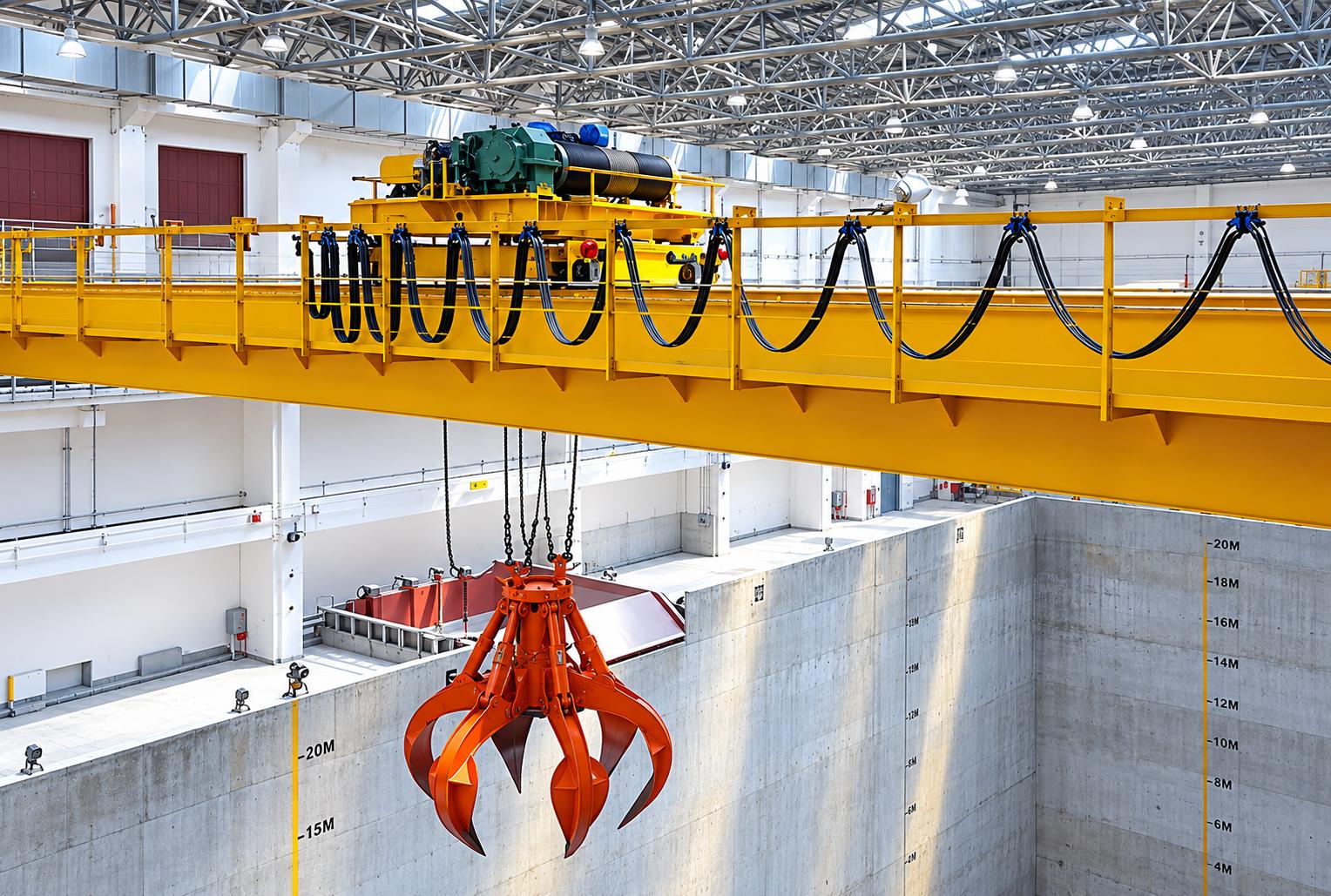
Large-scale manufacturing workshops use multiple bridge cranes to share a single-span track, which can meet the material transfer needs of different processes such as heavy-duty assembly, steel structure processing, and mold handling, and improve equipment utilization and production convergence efficiency.However, as the number of cranes increases, problems such as intersecting operating routes, mutual interference of hoisting objects, and improper cooperation between multiple machines will also arise, affecting the safety of on-site operations and the rhythm of production.A reasonable collaborative plan must not only consider the layout and working area of the crane, but also combine the control system, safety protection, operation process and equipment parameters for overall planning to ensure the orderly operation of multiple equipment in the same workshop.
Why Multiple Overhead Cranes Need Coordination
Crane interference risks
The most prominent hidden danger of Henan Mine Crane manufactured multiple bridge cranes on the same track or in overlapping operating areas is equipment interference.When the trajectories of crane carts and trolleys intersect, the fuselage, spreader, and wire rope are prone to scratches and collisions. Once the collision occurs, it will cause major accidents such as deformation of the main beam, damage to the trolley mechanism, and falling objects.In addition to interference between the main body of the bridge crane, the swing of the crane will also collide with peripheral equipment, columns, and tooling.Many factories only install simple buffers and lack dynamic distance monitoring. When the operator’s line of sight is blocked and fatigue operation occurs, the risk of interference will rise sharply.Establish a collaborative management mechanism in advance, which can dynamically restrict the crane from entering the conflict area and reduce the probability of equipment interference from the source.
Safety and productivity
Many workshops blindly increase the number of cranes, but on the contrary, they cause congestion in operations, frequent safety accidents, and decreased production beats.In the absence of collaborative rules, multiple cranes rush to operate, operators frequently avoid, hoisting waiting time is prolonged, and the efficiency of material flow is greatly reduced.After standardizing collaborative management, the operation of bridge cranes is partitioned and the movements are orderly, which can not only avoid safety accidents such as collisions, falling objects, and injuries to personnel, but also reduce equipment downtime and maintenance time.A stable and controllable hoisting process allows the workpiece transfer and assembly processes to be connected more smoothly. Under the premise of ensuring the safety of personnel and equipment, the overall production capacity of the workshop is released, and safety control and production capacity goals are balanced.
When coordination is needed
As long as there are two or more bridge cranes in the workshop and there is overlap in the operating area, collaborative operating rules must be formulated.Typical scenarios include the parallel transfer of workpieces by multiple cranes on the same track, the lifting of workpieces across regions, the transfer of materials between two bridge cranes, and multi-station synchronous hoisting operations.Even if the daily division of labor of each crane is independent, when the lifting route is temporarily adjusted during the peak period of the order, there will be intersections in the work area.In addition, temporary working conditions such as plant renovation, entry of large-scale equipment, and equipment overhaul and hoisting also need to enable collaborative control.Enterprises cannot only attach importance to collaboration in lifting operations, and normalized operations must also be included in the collaborative management system.
How to Plan Crane Layout and Working Zones
Define travel paths
In the pre-planning stage of the workshop, it is necessary to delineate a dedicated cart and trolley operating path for each bridge crane, and determine the direction of material entry and exit and the starting and ending points of workpiece hoisting in combination with the process flow.The main traffic route minimizes crossovers, priority is given to planning independent long-distance passages for large-scale hoisting, and secondary paths are used for short-distance small-scale transshipment.When planning the path, the maximum shape and size of the workpiece should be considered, and the swing space of the crane should be reserved, and the size of the crane body should not only be referred to.After the drawing is completed, combine the simulation operations of the location of the on-site columns, pipelines, and equipment to mark the prohibited areas, form a written path specification, and deliver it to the operator for execution to reduce the uncertainty caused by the temporary diversion of the site.
Identify shared work zones
Shared work areas are the core difficulty of multi-machine collaborative control. Most of these areas are workpiece transfer areas, large assembly stations, and raw material loading and unloading points.It is necessary to clearly mark the boundaries of the shared area on the drawings and clarify the entry rules. In principle, only one bridge crane is allowed to operate in the shared area at the same time.For the lifting conditions where two cranes must enter at the same time, a special operation plan is formulated separately to limit the length of operation and the upper limit of load.In daily production, the electronic control system can be used as an electronic fence for the area, and the Henan Mine Crane manufactured bridge crane will automatically trigger an early warning when it enters the shared area, restricting other cranes from entering, and avoiding chaos caused by the simultaneous influx of multiple machines into the shared area.
Match lifting capacity and hook positions
The configuration of multiple cranes in the workshop cannot be simple and unified specifications. The rated lifting weight needs to be matched according to the load requirements of each station. Heavy-duty stations are equipped with large-tonnage cranes, and small-tonnage models are selected for lightweight transshipment.The installation height and horizontal stroke of the hooks should be matched with each other to prevent the high and low hooks from interfering with each other.In the workpiece lifting scene, the position of the hooks of each bridge crane should ensure that the load is evenly distributed to avoid overload of a single bridge crane.The limit position of the hook is checked synchronously during the design phase. When multiple cranes approach, sufficient clearance is reserved between the hook and the wire rope to prevent the spreader from winding and scratching, and to take into account the needs of different hoisting processes.
Maintain safe clearances
The safety gap is the basic design index to prevent crane collisions, which is divided into the spacing between the bridge crane body, the spacing between the crane and the fixed building, and the gap between the crane.The conventional static safety distance should be combined with the operating speed of the bridge crane to reserve a margin. The faster the speed, the greater the required safety distance.In addition to static reserved clearance, it is necessary to consider the braking and sliding distance of the cart and the swing amplitude of the hanging object, and cannot only rely on the protection of the structural buffer block.In the layout stage, the safety clearance parameters are written into the design specifications, and the limit devices are set at both ends of the track and at the boundary of the area.When equipment is retrofitted and tooling is added in the later stage, the safety gap must be reviewed to prevent new objects on the site from compressing the working space.
How to Coordinate Multiple Overhead Cranes
Set operating priorities
Establish a clear priority system for crane operations to reduce multi-machine conflicts.Priorities can be divided according to the type of operation, with the highest priority for large-scale lifting and emergency equipment repair and hoisting.The transportation of finished products and the storage of raw materials have the second highest priority.Ordinary tooling has the lowest mobile priority.Priority rules should be written in writing, and operators and ground commanders should learn uniformly.When the operating routes of the two bridge cranes conflict, the low-priority cranes slow down in advance to avoid, and the operations are suspended to wait for the high-priority tasks to be completed.At the same time, an exception approval process is set up, and the priority can be temporarily adjusted under special working conditions, and all priority changes are recorded to avoid communication errors caused by verbal command.
Coordinate load transfers
The transfer of workpieces between two bridge cranes is a high-risk collaborative operation and requires standardized operating procedures.Before the operation, the two operators and the ground commander jointly confirm the location of the lifting point, the center of gravity of the workpiece, and the status of the spreader, and plan the transfer path.During the transfer process, keep the workpiece stable, control the lifting and operating speed, and strictly prohibit rapid movement from causing the load to shake.During the handover of the workpieces, one bridge crane slowly carries the load, and the other gradually unloads the force. The force changes of the wire rope are observed throughout the process, and the load is confirmed to be smoothly transitioned before the decoupling is completed.The command password is unified throughout the process, and multiple people are prohibited from issuing operation instructions at the same time. After each step of the action is confirmed to be correct, the next step can be continued.
Manage simultaneous lifts
Multi-machine synchronous lifting of large workpieces, load distribution and motion synchronization are the key points of control.Carry out technical exchanges before the operation, calculate the assigned load of each bridge crane, and the carrying capacity of a single crane cannot exceed the safety limit of the rated load, and formulate a test crane plan.During the test hoisting, the workpiece is lifted slightly, the spreader is fixed and the load balance is checked, and after confirming that there is no tilt or slippage problem, it is officially hoisted.The movements of the lifting, cart, and trolley are kept in sync, the speed is uniformly controlled, the attitude of the workpiece is observed in real time, and the work is stopped immediately if the force is abnormal.Synchronous hoisting operations require on-site supervision by a full-time commander-in-chief, and re-record after the operation is completed to optimize the subsequent hoisting operation plan.
Establish operator communication
A stable and reliable communication mechanism is the basic guarantee for multiple cranes to work together.The workshop gives priority to the use of standardized gestures and wireless intercom systems, and establishes a fixed command password system to avoid ambiguity in spoken language.Before the operation, the operator and the ground commander confirm the status of the equipment, the operation route and the risk points with each other.During the operation, continuous communication is maintained, and any operator who finds an abnormality can issue a stop command at any time.When the intercom signal is poor and the workshop noise is high, sound and light signals are used to assist communication.Organize communication drills regularly, unify signal standards, prevent misoperation due to signal understanding deviations, and improve the team’s collaborative response ability.
Which Control Systems Help Coordinate Cranes?
Individual vs. group controls
Stand-alone control and cluster collaborative control are suitable for different workshop working conditions.The independent control of the stand-alone machine has high flexibility, which is suitable for scenarios where each bridge crane operation is independent of each other and there is very little cross-operation. The operator controls the operation of the machine separately.However, when multiple machines frequently cross-operate, they only rely on stand-alone control and rely entirely on manual judgment, which is high risk.The cluster group control system can centrally monitor the location and operating status of all bridge cranes, and uniformly issue regional authority and action restriction instructions.When selecting projects, a hybrid scheme can be adopted, and the stand-alone mode can be used daily. When entering a shared area and lifting operations, it can be switched to a cluster collaborative mode, taking into account operational flexibility and overall operational safety control.
Anti-collision systems
The anti-collision system is an essential hardware for Henan Mine Crane manufactured multiple bridge cranes to work together. The mainstream solution uses laser, UWB, and radar sensors to collect the distance between the cranes and the obstacles in real time.The system sets up a two-level protection mechanism, a first-level early warning, and a sound and light alarm when the bridge crane is close to a safe distance to remind the operator to slow down.The second cascade of lock protection automatically restricts the cart and trolley from continuing to move in the direction of conflict when the dangerous distance is reached, and only reverse avoidance is allowed.The anti-collision system can be connected to PLC and linked with the regional electronic fence, not just a simple limit, to achieve dynamic distance protection.In harsh workshop environments such as dust and high temperature, industrial-grade sensing equipment should be selected to ensure long-term stable operation.
Remote control and visibility
The remote control is equipped with visual monitoring to effectively solve the problem of blocking the field of view of the workshop.Traditional cab operation is easily obscured by workpieces and columns, and the wireless remote control allows the operator to stand on the ground with a good field of view.At the same time, the bridge crane can be equipped with a high-definition camera, and the central control large-screen can return the hook and crane pictures in real time, and remotely view the location of multiple cranes.When multiple machines work together to lift and transfer workpieces, the command personnel use the video screen to grasp the overall working conditions.The selection of remote control equipment needs to ensure the anti-interference ability of communication, set the automatic shutdown function for signal loss, avoid signal interruption and cause out-of-control, and improve the visibility of operation under complex working conditions.
PLC-based coordination
The PLC-based collaborative control system is the core of realizing the intelligent linkage of multiple cranes.The PLC collects the position, speed, load, and limit signals of each crane in real time, and has built-in collaborative logic to determine whether there is a trajectory conflict between each equipment.When the bridge crane enters the preset shared area, the PLC automatically performs the speed limit and interlock shutdown logic, and records all operation logs to facilitate post-mortem traceability.The system can be integrated with anti-collision, remote monitoring, and upper computer management platform, and supports custom job partitions and priority rules.Compared with simple hardware limits, the PLC collaborative scheme is more adaptable, and the logic can be adjusted according to the workshop process, which is suitable for multi-bridge crane cluster projects in large factories.
How to Ensure Safe Crane Operation
Prevent crane collisions
Preventing bridge crane collisions requires a combination of hardware and software, and operator experience cannot be relied on alone.The hardware level is equipped with anti-collision sensors, buffers, and track limits, and the software level relies on PLC to set regional interlocks to restrict multiple machines from entering dangerous areas at the same time.In daily management, regularly check the sensitivity of anti-collision equipment, clean up the dust on the surface of the sensor, and prevent detection failure caused by occlusion.Formulate an inspection list and confirm that the anti-collision system is enabled before each operation.At the same time, the operation process is optimized to reduce unnecessary multi-machine cross-operation, and the operator develops the habit of predicting in advance, decelerating and avoiding as soon as the early warning signal is received, and multi-layer protection reduces the probability of collision accidents.
Control load swing
The swing of the crane is a common safety hazard in multi-machine collaborative operation. Excessive swing can easily hit surrounding objects, and it will also change the force of the wire rope, causing unstable load.In operation, low-speed start and slow braking are used to avoid emergency start and stop, and reduce the inertial swing of the hanging object.The high-end bridge crane is equipped with frequency conversion anti-swing control, which suppresses the shaking of the crane through algorithms, greatly reducing the difficulty of operator operation.When lifting multiple machines, the lifting and operating speed are controlled synchronously to maintain the level of the workpiece and prevent the force on one side from causing a large swing.The operator has to wait for the crane to stabilize before continuing to move. It is forbidden to quickly transfer the workpiece with a pendulum to reduce the risk of secondary life.
Manage emergency stops
The emergency stop system is the last safety line of defense. In the collaborative scenario of multiple cranes, it is necessary to distinguish between stand-alone emergency stop and global emergency stop.Each bridge crane is equipped with an independent emergency stop button locally, which can be triggered by the remote control and the cab, which is used to stop the machine in an emergency.At the same time, a global emergency stop is set at the key points of the central control room and the operation site. When there is a major danger such as multi-machine interference and the crane is out of control, multiple bridge cranes are triggered to brake with one key.The system design should ensure that the emergency stop loop is independent, does not depend on the communication network, and is still effective in the fault state.Regular emergency stop drills are carried out to test the braking response effect, so that operators can be familiar with the emergency stop trigger conditions in different scenarios.
Inspect and train operators
No matter how perfect the equipment system is, it is inseparable from standardized personnel management.Establish a hierarchical inspection system, check the brakes, spreaders, and anti-collision sensors before the shift every day, check the electronic control system every week, and do regular non-destructive testing of the whole machine to record the health status of the equipment.Operators must complete special training, including multi-machine coordination rules, anti-collision system operation, lifting operation procedures, and emergency response methods, and pass the assessment and take the job with a certificate.Regularly organize retraining and on-site simulation exercises, and update accident case studies.At the same time, clarify job responsibilities, operators have the right to refuse risky operations, and build a solid safety bottom line from the personnel management level.
How to Specify Multiple Overhead Cranes
Assess loads and workflow
The first step in the selection of multiple bridge cranes is to comprehensively evaluate the workshop load and production process.Count the average daily lifting load and maximum workpiece weight, analyze the workpiece transfer path and station distribution, and identify high-frequency cross-operation points and lifting operation frequencies.Sort out the fluctuations in the production capacity of the workshop in the morning and evening shifts, evaluate the lifting needs during peak periods, and judge the number and layout plan of Henan Mine Crane manufactured bridge cranes.It is also necessary to consider the expansion plan for the next 3 to 5 years and reserve space for equipment expansion.Based on a complete working condition assessment, divide the stations responsible for each crane, determine the shared working area, avoid excess equipment configuration or insufficient hoisting capacity, and lay the foundation for a complete set of solutions.
Select capacity, span, and duty class
Based on the load evaluation results, the rated lifting weight, track span, and working level of each bridge crane are determined.The lifting weight reserves a safety margin, which cannot just match the weight of the workpiece.The span is determined according to the measured size of the track beam of the plant, taking into account the effective coverage of the hook.The working level refers to the GB/T3811 standard, and the A1 to A8 levels are selected according to the daily operating time, lifting frequency, and load fluctuations.The high-frequency heavy-duty assembly workshop adopts the A6 and A7 levels, and the ordinary machining workshop adopts the A5 level.Long-term heavy-duty operation of low-work-level equipment will accelerate the fatigue of metal structures and age in advance. The selection stage cannot simply reduce the work level to compress costs.
Specify rails and power supply
The track and power supply system are the basis for the stable operation of Henan Mine Crane manufactured multiple bridge cranes, and the working conditions of multiple machines on the same track require higher track strength and installation accuracy.The selection of the track should account for the wheel pressure, match the carrying capacity of the track beam, strictly control the straightness and level of the track, and reduce the operation of the cart. Caton and wear.The power supply scheme can choose sliding contact line or cable power supply. The sliding contact line is suitable for long-track and multi-crane continuous operation scenarios. Do a good job of insulation protection to avoid short circuits caused by dust.The total electrical load is calculated during the design to ensure the stability of the power supply when multiple bridge cranes are operating at the same time, overload and leakage protection are set up, and track settlement and power supply line aging are regularly detected.
Define control and safety features
Clarify a complete set of control and safety configuration lists in the equipment technical agreement.The basic safety configuration includes overload limiter, height limit, stroke limit, and brake.Collaborative related configurations include anti-collision sensing, PLC cluster linkage, electronic area fence, wireless remote control and visual monitoring.At the same time, load monitoring and operation data recording systems are configured, and job data is saved for fault traceability.According to the needs of working conditions, anti-swing and emergency stop interlocking devices are selected.All safety components are selected from industrial reliable brands, and the factory test items of the equipment are clarified to ensure that all single-machine functions and multi-machine collaborative linkage functions have passed the factory inspection and meet on-site safety specifications.
Check manufacturer integration capabilities
The multi-bridge crane project is not just a simple equipment procurement, but also a core test of the manufacturer’s system integration capabilities.The procurement phase focuses on whether the manufacturer has experience in multi-machine collaborative program design, PLC cluster program development, and on-site debugging, and whether it can complete the joint adjustment of anti-collision, monitoring, track, and power supply systems.Confirm that the manufacturer can provide one-stop services for site survey, layout planning, installation guidance, personnel training, and after-sales maintenance.Give priority to manufacturers with landing cases of the same type of multi-machine collaborative workshop, to avoid equipment from different suppliers, system incompatible, linkage logic cannot be opened, resulting in collaborative functions cannot be implemented.
Henan Mine Crane Factory Custom
Configuring multiple bridge cranes in the same workshop requires comprehensive consideration of lifting weight, track conditions, overlap of operating areas, load distribution, and cooperation between control systems.Henan Mine Crane Factory can provide customized bridge crane solutions according to plant layout, material handling needs and actual working conditions, and configure single-beam or double-beam bridge cranes, wireless remote control and corresponding control systems in combination with different application scenarios to help enterprises rationally plan hoisting equipment and improve the efficiency of material flow in the workshop.
From pre-project design, crane manufacturing to installation guidance, on-site commissioning and operation training, perfect project support helps to reduce the risk of interference in multi-machine collaborative operation and ensure the long-term stable operation of equipment.Whether it is a new plant or an upgrade of an existing hoisting system, a more suitable equipment configuration can be determined based on the actual lifting weight, span, lifting height, working level and on-site operating conditions, so that the crane system can better adapt to the production process and future development needs.