
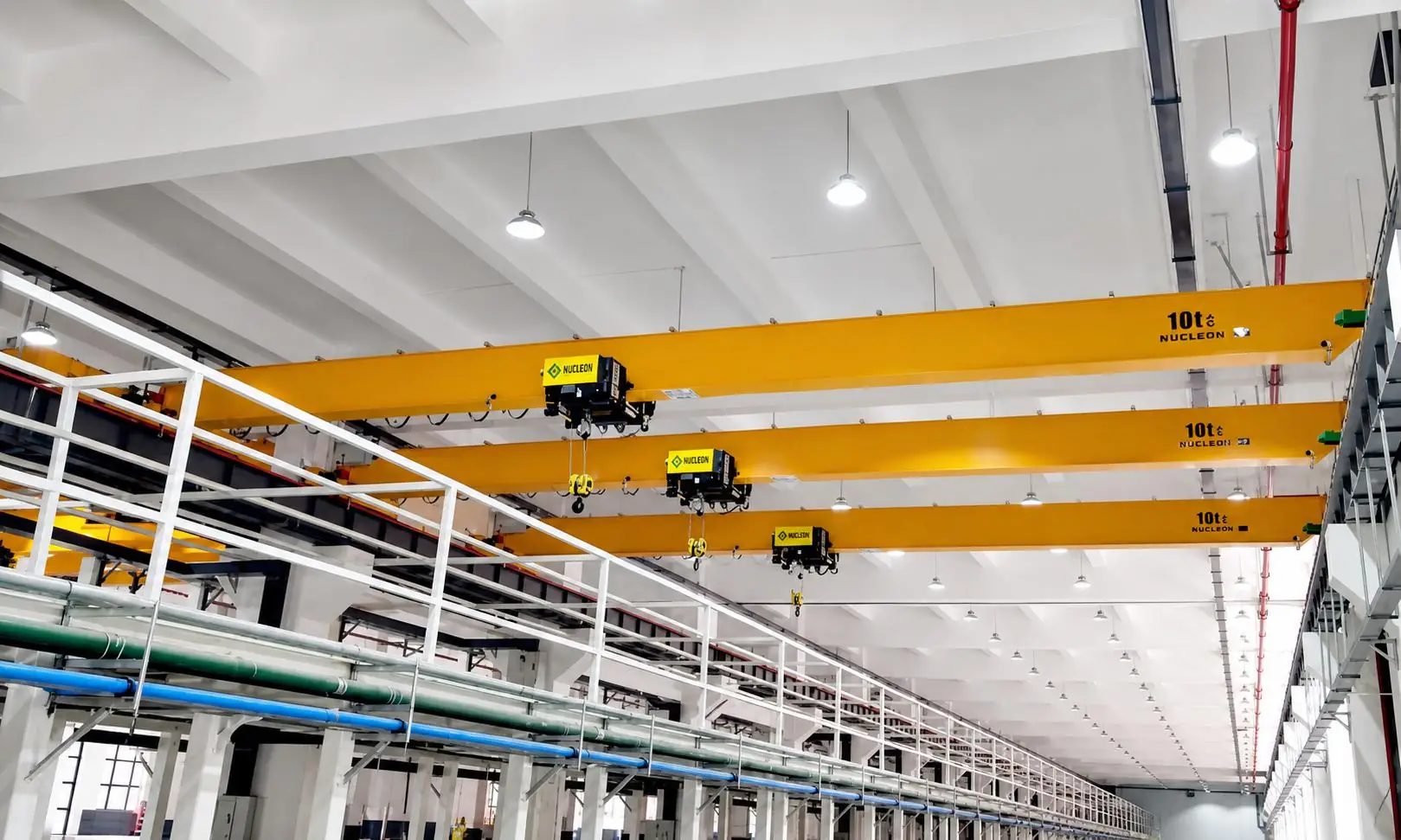
For manufacturing enterprises and warehousing and processing workshops, bridge cranes are the core equipment for material handling and workpiece hoisting.Many factories have such demands: can only one bridge crane be used to cover as many ground areas of the plant as possible, and the procurement, infrastructure and maintenance costs of multiple cranes can be reduced.
The theoretical coverage of the crane is not equal to the actual hoisting area.To maximize the operating coverage area through a single bridge crane, it is necessary to comprehensively consider the geometric parameters, structure selection, plant layout, electronic control and safety structure.This article analyzes the key factors affecting the coverage, shares the selection and layout optimization plans, and introduces the applicable conditions and common misunderstandings of single-vehicle driving.
Understand What Determines an Overhead Crane’s Coverage Area
The effective coverage area of a bridge crane refers to the actual operating area where the crane can safely lift, move, and place loads.This range is determined by the mechanical geometry, plant restrictions, structural bearing capacity, operating blind spots, and plane layout.
Crane span and track length
The span is the distance between the centerlines of the two tracks, which determines the width of the crane operation.A larger span allows the trolley to cover farther stations laterally, but it is constrained by the width of the plant, the column, the roof and the deflection of the main beam (L/600~L/1000, CMAA/FEM/ISO standard) and cannot be increased infinitely.
The length of the track controls the longitudinal coverage, and the longer the track, the more stations can be served; the track relies on the plant column or special track beam, and the column arrangement, expansion joints and available net length will limit the track design.Messy column grids and short plant segments will reduce coverage, and sometimes multiple cranes need to be added.
The size of the plant and the spacing between the columns are the underlying constraints.Safety gaps between the crane installation and the wall, roof, and other equipment must be reserved. The design phase must also consider the future expansion of the plant, seismic and wind loads, and the wheel pressure loads transmitted to the building when the crane is running.
Trolley stroke and lifting height
The stroke of the lifting trolley is the distance at which the hoist moves laterally along the main beam.The horizontal movement of the trolley + the longitudinal movement of the main beam along the track together constitute the operating range of the crane’s X-Y plane.Affected by the structure of the end beam, the shape of the hoist, and the safety clearance on both sides, the actual available stroke of the trolley is less than the nominal span.
The limit proximity distance and lifting height of the hook determine the reach range of the end of the track and the vertical operation.Insufficient this parameter will produce a blind spot in the operation or fail to cross the equipment.The nominal parameters of the sample are not equal to the actual available coverage. The evaluation should be combined with the load size and safety clearance to simulate the trajectory of the hook.
Job blind spots and unreachable areas
Most of the blind spots appear near the wall, around the plant column, at the end of the track, under the roof beam, maintenance platform, fixed machinery and equipment, overhead pipeline locations, and restricted hoisting passages such as above personnel and above precision equipment.Building obstacles and safety regulations will further compress the actual working space.
The theoretical coverage range defaults that the hook can be moved to the mechanical limit position; however, the actual hoisting range needs to consider the load swing, safety clearance, operator’s field of vision, anti-collision protection zone, and production process.Plane layout verification combined with three-dimensional modeling is the most effective means to quantify and reduce blind spots.
Choose the Right Crane Configuration for Maximum Coverage
Single girder bridge crane VS Double girder bridge crane
Single girder bridge crane
Only one main steel beam is set up, which has a lighter weight and lower procurement costs. Most plans occupy a smaller headroom height of the plant, which is suitable for small and medium-sized tonnage (according to the span and work level, the maximum is generally 20~30 tons) and medium-span working conditions.Under the premise that the headroom and load conditions of the plant are met, it is widely used in general manufacturing, assembly workshops and warehouses.
Double girder bridge crane
Equipped with two main beams, the advantages are that the rated load is greater, the span is supported, the lifting height of the hook is better (the hoist can be arranged in the middle of the two main beams), the main beam has higher stiffness and less deflection, and it is also convenient to install maintenance platforms or multiple lifting trolleys.When the load is heavy, the work level is high, the span is large, or the distance and lifting height of the hook are demanding, the double main beam scheme is preferred.
The selection of the type needs to weigh the initial cost and the long-term use requirements: the single main beam has low cost and fast installation; the double main beam has good performance, heavy-duty and durable, and more flexible operation coverage.The final plan must be determined by comprehensive structural verification, plant headroom, forward production capacity and load conditions.
Optimize the layout of the main beam and track
Align the crane track with the main production and material flow routes, so that the crane for high-frequency hoisting operations can travel the shortest distance.Make full use of the existing width and length of the plant to avoid large areas of idle areas.
Long-span design can reduce the number of rails or cranes, but rigorous structural calculations must be carried out for deflection, natural frequency, and building load, and wheel pressure, track beam bearing capacity, and column force must be verified at the same time.
Low headroom and customized solutions
In scenarios where the height of the plant is limited, a low-clearance hoist or a similar monorail scheme can be used to compress the distance from the top surface of the track to the hook.Side-mounted and lower-hanging gourds, optimized end beam structure, and customized main beam size can all improve the proximity of single-sided or double-sided hooks to the limit.
When the standard crane scheme causes the key station to be in a blind spot, the end beam, split-layer main beam or special spreader can be customized.All customized retrofits must meet structural strength, deflection and safety specifications.
Henan Mine Crane can provide customized design and manufacturing solutions for low-clearance bridge cranes according to plant headroom, hook height, load requirements and station layout to help enterprises improve the adaptability of hoisting in limited spaces.
Extend Coverage Through Better Crane Design and Movement
- Maximize the limit proximity distance of the hooks at both ends: optimize the end beam structure, hoist installation position, buffer and limit switch arrangement, and reduce the redundant gap between the hooks at the limit position of the trolley and the main beam.Improving the proximity performance of the hook ends can eliminate common blind spots at the ends of walls and factories, and there is no need to lengthen the track; both sides of the main beam and both ends of the track need to be evaluated simultaneously.
- A single main beam is equipped with multiple lifting trolleys (optional as needed): A single main beam can be equipped with two or more trolleys, which can be hoisted independently at different points, and can also be used to lift long pieces and special heavy objects in concert.The design needs to consider the load distribution of the main beam, mechanical/electronic synchronous control, anti-collision and safety interlocking of the trolley.The program expands the scope of effective operations and improves production efficiency, but it will increase equipment complexity and procurement costs.
- Frequency conversion drive and automatic positioning system (VFD) can make the crane cart, trolley and lifting mechanism start and stop smoothly, accurately locate, and reduce the shaking of the crane.Repeated hoisting conditions can be used with preset positioning, anti-swing and automatic control.The scheme does not change the physical operating range of the crane, but can achieve accurate and safe blanking, shorten the hoisting cycle, reduce invalid movement, and improve effective operation coverage.
Plan the Factory Layout Around One Crane
- Draw production partitions and material flow diagrams: divide the functional areas of raw material reception, processing, assembly, warehousing, and shipment, and mark the high-frequency hoisting points and the material transportation routes between the points.The crane track is arranged to give priority to the highest priority material flow, shorten the driving distance, and reduce the secondary transfer of materials.
- Clean up obstacles and optimize the hoisting path: investigate machine tools, shelves, columns and overhead pipelines to ensure unobstructed hoisting passages, reduce transit, and avoid hoisting above personnel and high-risk work areas.In most cases, adjusting the layout of the equipment can more effectively expand the coverage of the operation than retrofitting the crane.
- The layout of the station is adapted to the scope of operation of the hook: the station, loading and unloading point and material temporary storage area are arranged in the area reachable by the hook, and special reclaiming points are set up to improve the safety and efficiency of the operation.In most scenarios, rearranging equipment is more economical than lengthening the track and increasing the span to expand the available coverage.
Can One Overhead Crane Cover an Entire Factory?
Applicable scenarios
- Small and medium-sized production workshops, the overall production process is arranged in a linear manner, the lifting operations of various materials are relatively concentrated, and the production lines are simple and clear.;
- Most lifting tasks in the workshop can fall within the operating coverage of the continuous track of the crane, without the need to be hoisted across independent work areas.;
- The frequency of hoisting operations can be controlled, and there is sufficient surplus production capacity in the operation cycle, and the crane will not be in continuous operation at full load for a long time.;
- The actual load spectrum of the site can be well matched with the selected work level of the crane. Considering the comprehensive input and operation and maintenance costs, the use of a single bridge crane is an economically feasible solution.
Scenarios that are not enough to meet the needs
The plant area is huge and the production areas are isolated from each other; the throughput is high, and multiple sets of hoisting operations need to be carried out at the same time; the site has dense obstacles, large differences in load type/lifting height, or the driving distance is too long.Peak operating pressure is high, and a single point of equipment failure will cause the entire line to be discontinued. Such scenarios generally require multiple cranes, or with jib cranes and gantry cranes to assist.
Program trade-off evaluation method
Compare the full cost of a large-tonnage long-span crane with multiple small cranes: infrastructure renovation, track construction, energy consumption, maintenance, and downtime losses.At the same time, evaluate the redundancy of peak production capacity, equipment redundancy, and the impact of crane failure and shutdown on production.Material flow simulation and whole life cycle cost analysis are the most reliable evaluation methods.
Common Mistakes When Trying to Increase Crane Coverage
- Blindly choose a larger span, without reviewing the structure and deflection limits of the plant: the large-span main beam is selected simply to expand the coverage, and the plant column, roof carrying capacity, and main beam deflection standards are not verified in advance, which can easily cause structural safety hazards.
- Equate the driving distance of the cart track with the actual available coverage of the hook: Mistakenly treat the moving distance of the crane cart along the track as the real operating range of the hook, ignore the blind spots caused by the end beam and safety gaps, and overestimate the actual lifting reachable area.
- Ignore the proximity distance of the hook, the clearance height of the plant, and fixed obstacles: Only the nominal parameters are paid attention to in the design and selection, and the limit proximity distance of the hook, the clearance of the workshop, and obstacles such as columns, equipment, and pipelines are ignored, causing some stations to be unable to be hoisted.
- Simply improve the operating speed, without supporting positioning accuracy and anti-sway measures: blindly speed up the operating speed of carts and trolleys, but no anti-sway system and precise positioning device are installed, the lifting shaking is large, and the safety of operation and the accuracy of blanking are reduced.
- Direct procurement of large-tonnage cranes, but the root cause of the problem is actually the unreasonable layout of the workshop: when encountering material handling problems, the large-tonnage cranes are directly replaced, and the layout problems such as workshop equipment placement and material movement lines are not investigated first, resulting in unnecessary high investment.
- It is believed that the hook can physically reach all stations, which means that a single crane can meet the peak production demand: A single crane is selected only based on the hook to reach the station. The demand for hoisting equipment during peak hours has not been evaluated. Under peak working conditions, insufficient production capacity will occur, restricting the entire production line.
How to Select a Customized Overhead Crane for Your Factory
- Evaluate on-site working conditions: collect the length, width and basic dimensions of the plant, confirm the load weight and dimensions, count the daily hoisting frequency and material type, and record the workshop environmental conditions, including dust, temperature and humidity, corrosive media, etc., to provide a basic basis for crane selection.
- Clear coverage goals: sort out all key hoisting points on the production line, determine the required moving distance between the cart and the trolley, mark the current operating blind spots, and clearly define the coverage that the crane needs to achieve.
- Determine the crane configuration: select the single main beam or double main beam structure, determine the span of the main beam and the total length of the track, select the type of hoist (wire rope hoist / chain hoist, low headroom hoist), and plan the layout of the lifting trolley and the supporting electronic control system.
- Verify operating conditions: determine the working level of the crane (CMAA A-F level), evaluate environmental factors such as workshop temperature, dust, humidity, etc., and determine whether the environment will affect the life and operating stability of crane parts.
- Evaluate the complete set of installation projects: comprehensively consider the crane body, track support structure, power supply system, operation control system, various safety protection devices, and the reserved design of later equipment maintenance and maintenance channels.
- Cooperation with professional crane manufacturers: provide manufacturers with accurate plant drawings and load parameters, require manufacturers to complete on-site layout review, construction and crane structure verification, and issue a complete customized engineering plan.
Conclusion
The coverage of bridge crane operations is determined by the span, track length, hook geometry parameters, plant conditions, blind spots and workshop layout.The key to maximizing the effective operating area lies in the crane’s adaptation to the flow direction of materials, reducing obstacles, optimizing the proximity performance of the hook and the electronic control system, and ensuring the safety of structure and operation.
The optimal solution usually requires simultaneous optimization of the workshop layout, rather than simply replacing the crane hardware.In the early stage of the project, professional lifting engineers are invited to design based on on-site measured data to create a crane solution that takes into account operating capacity, efficiency, cost and reliability.