Engineering · Manufacturing · Project support
info@hnksglobal.comWhatsApp +86 18836207779 ↗

Blog

  • Gantry Crane Incident Prevention: Site Layout and Operating Controls

    Gantry Crane Incident Prevention: Site Layout and Operating Controls

    Technical guide

    Gantry Crane Incident Prevention: Site Layout and Operating Controls

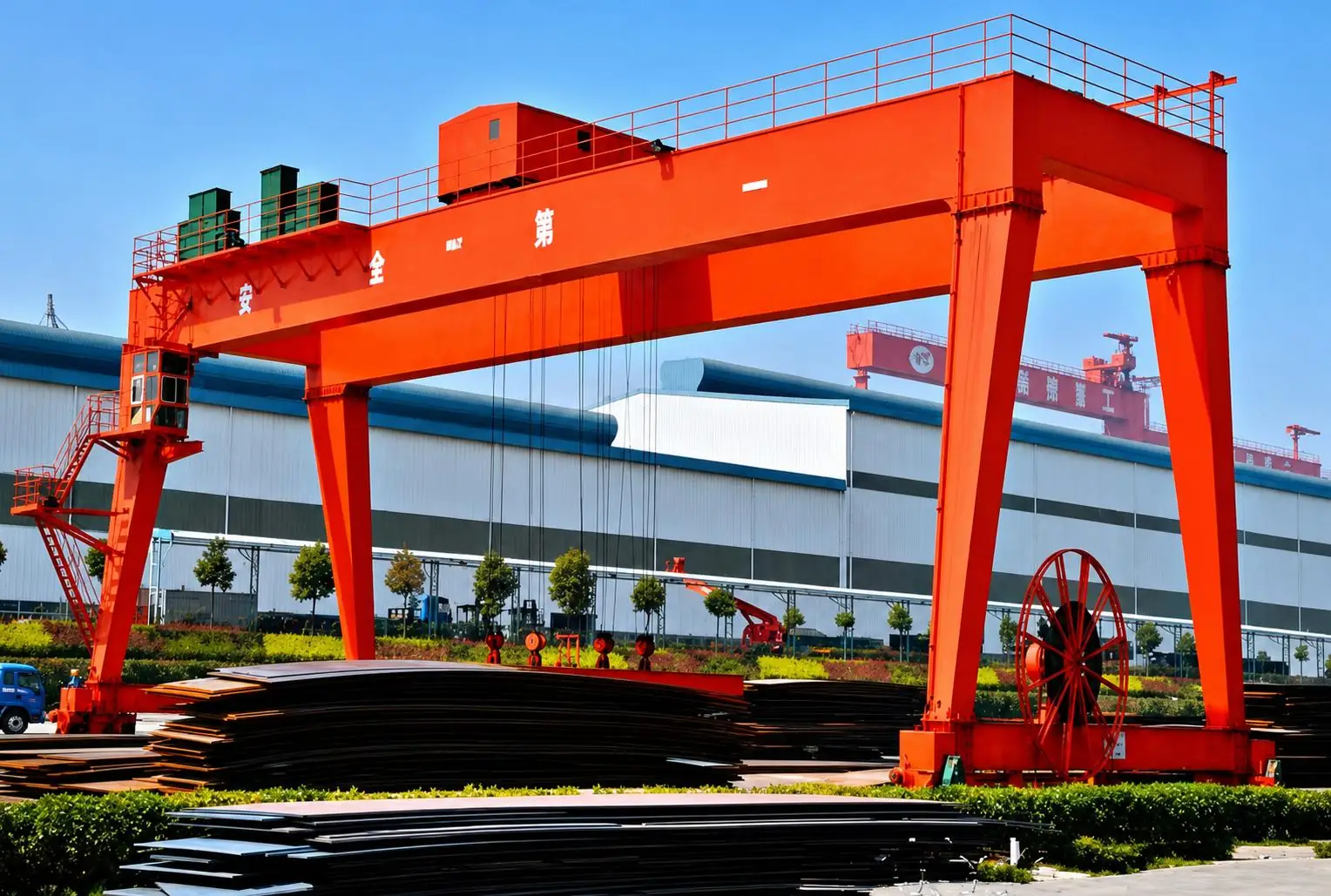
    Risk control should address the particular crane, lifting task and site conditions. Review working zones, support conditions and operating responsibilities using the equipment documentation and the project's approved procedures.
    Henan Mine CraneTechnical guide · Updated 2026Crane selection, project scope and operating requirements
    gantry crane accidents
    gantry crane accidents
    Project planning notes

    Key points for this crane project.

    1. Overloading and Dropped Load Accidents
    2. Gantry Crane Collisions
    3. Gantry Crane Tipping and Structural Failures
    Read the technical guide

    Overloading and Dropped Load Accidents

    Exceeding rated capacity

    Henan Mine Crane manufactured gantry crane overload operation and load fall are the most common safety accidents, and they are also the main causes of deformation and fracture of the lifting structure and casualties on the site. The rated lifting weight of each industrial gantry crane manufactured by Henan Mine Crane is strictly designed according to the carrying limit of core accessories such as the main girder structure, wire rope, hoist, etc., which is a hard standard for its safe and stable operation. In order to catch up with the construction period, many construction sites are overloaded with luck and violations. The weight of the material is estimated only empirically, ignoring the superimposed effects of wind loads and dynamic impact loads.

    Improper load rigging

    The irregular layout of the lifting rigging of the gantry crane is an easily overlooked cause of the falling object accident of the gantry crane, and the safety hazards run through the entire lifting operation process of the gantry crane. Common illegal operations on the site include the use of worn and broken wires, aging and damaged wire ropes and hoisting slings, the mixing of different specifications of spreader accessories, the offset of the center of gravity of the gantry crane hoisting, the angle between the rigging forces is too large, and sharp heavy-duty materials are not protected against cutting and other issues. This kind of hidden danger will not immediately cause equipment failure, but in the dynamic operation process of gantry crane lifting, horizontal translation, and fixed-point blanking, it can easily cause rigging to fall off and fracture, heavy objects to slip off and offset, greatly increasing the risk of high-altitude hoisting and falling objects.

    Gantry Crane Collisions

    Collisions with structures

    Structural collision accidents of gantry cranes mostly occur in industrial construction scenarios where the site is narrow, multiple gantry cranes cross-operate, and the line of sight of the operation is limited. They are mainly divided into three categories: gantry crane cart travel collision, trolley running sideways collision, and lifting heavy objects swinging collision. During the operation process, the gantry crane in operation can easily hit the plant column, the end limit of the track, the high-altitude pipeline and the surrounding stacking materials, and the swinging lifting heavy objects will also indirectly hit the surrounding machinery and equipment and building structures. Short-term minor collisions will damage the buffer device and travel transmission structure of the gantry crane.

    Collisions with personnel

    Man-machine collision of gantry cranes is a high-incidence safety accident with a very high fatality and injury rate, and it is also a key difficulty in on-site safety control of industrial gantry cranes. The flow of personnel on the construction site is complicated, and some construction personnel have weak safety awareness. There are violations such as crossing the equipment operation track, staying in the blind area of gantry crane operation, and following the lifting of heavy objects. At the same time, the gantry crane operators are inattentive in their operations, the surrounding environment is not observed in place, or the construction at night, the haze, sand and dust weather are blocked from sight, making it difficult to find the surrounding operators in time.

    Anti-collision systems

    To effectively avoid gantry crane collision safety accidents, it is necessary to rely on the three-in-one gantry crane safety prevention and control plan of intelligent equipment protection, construction site control, and collaborative personnel dispatching. Industrial gantry cranes can be equipped with intelligent anti-collision systems such as infrared sensing and laser ranging, and sound and light early warning and forced shutdown protection are automatically triggered when the equipment is close to obstacles or on-site personnel. The site needs to clean up debris on both sides of the gantry crane track in time, divide the independent hoisting operation area and the personnel passage area, set up eye-catching safety warning signs, and strictly prohibit unrelated personnel from entering the blind area of the gantry crane operation.

    Causes of load swing

    Heavy object swing of gantry cranes is a high-frequency dynamic safety hazard. Uncontrolled load swing can easily cause personnel squeezing and heavy object falling accidents. The risk incentives are mainly divided into three categories: operation, environment, and equipment. Equipment operators start and stop abruptly, change direction at high speed, and uneven translation speed will directly break the force balance of lifting heavy objects; open-air gantry crane operations encounter severe weather such as gusts of wind and side winds, and natural airflow will continue to push heavy objects off the preset lifting trajectory. At the same time, equipment failures such as loose wire ropes, stuck pulleys, and insufficient track flatness of gantry cranes will cause uneven lifting force, forming continuous heavy object swing, and greatly increasing the safety risks of industrial hoisting operations.

    Personnel in danger zones

    The core risk of safety accidents caused by the swing of heavy objects of gantry cranes lies in the illegal detention of on-site personnel in the dangerous operating area of gantry cranes. The swing coverage of heavy objects of gantry cranes, the operating radius of equipment, and the area directly below the hoisting are all restricted areas for high-risk operations, but there are often personnel on the construction site who are lucky enough to cross the gantry crane operation area, and violations such as unreasonable standing positions of command personnel and close-range leaning operations of personnel when the materials are in alignment are very common. Once the suspended lifting heavy objects swing out of control, the on-site personnel cannot quickly avoid them, and safety injuries such as impact, squeezing, and smashing can easily occur.

    Safe load control

    Precise control of the swing of heavy objects in Henan Mine Crane manufactured gantry cranes to avoid the risk of personnel squeezing requires a combination of standardized operation, operation area control and intelligent lifting equipment assistance. Equipment operators need to start and stop smoothly and at a uniform speed, change direction slowly, eliminate illegal operations such as emergency stop, rapid rotation, and high-speed translation, and predict the trajectory of the operation in advance to weaken the swing of heavy objects. The hazardous operation area of gantry cranes is strictly delineated on site, and personnel are prohibited from entering the swing radius of heavy objects and the blind area of equipment operation, and the material alignment operation is maintained at a safe distance.

    Gantry Crane Tipping and Structural Failures

    Unstable ground conditions

    The unstable foundation and track foundation are the core hardware hidden dangers of gantry crane overturning and structural failure, which have a great impact on the safety of outdoor operations of large-span gantry cranes and mobile gantry cranes. Uneven soft and hard foundation of the work site, track settlement deformation, excessive flatness, or temporary work ground is not hardened, the backfill soil is not compacted, and the foundation is soaked in water on rainy days, will cause the overall force of the gantry crane to be unbalanced. When the equipment walks to an unstable ground area, the force of the equipment's outriggers is uneven, the fuselage is tilted, and the hoisting partial load and dynamic load are superimposed, which can easily cause the equipment to roll over and overturn, and it will also cause irreversible structural damage such as distortion of the main girder and cracking of the welds.

    Wind and environmental forces

    Gantry cranes operating in the open air are highly susceptible to environmental factors such as wind, climate, acid-base corrosion, etc., which can cause structural failure and overturning accidents. The horizontal thrust generated by strong winds and gusts of wind will break the balance of force on the equipment, causing the equipment to slip and heavy objects to fall. Most construction site gantry crane overturning accidents are caused by illegal hoisting operations under Category 6 high winds. In addition, rainwater erosion will soften the foundation of the gantry crane operation and corrode the operating track. Coastal salt spray and industrial dust will corrode the steel structure and fastening accessories of the gantry crane, resulting in a decrease in component strength and loose bolts.

    Structural inspection and maintenance

    Normalized structural inspection and professional maintenance of gantry cranes are the key means to avoid accidents of overturning and structural failure of gantry cranes. Before daily operations, it is necessary to check the compactness of the foundation of the gantry crane and the flatness of the track, calibrate the operating parameters of the equipment track regularly, and repair the hidden areas of settlement, loosening, and water accumulation in time. Strictly implement the wind operation standards of gantry cranes, equipped with professional wind speed detectors, stop immediately in windy weather and lock the windproof anchoring device. Regularly carry out non-destructive testing of the core structures of the main girder, outriggers, welds, connecting bolts, etc. of the gantry crane, timely rust removal and corrosion, replacement of damaged parts, and special investigations before and after bad weather, resolutely prevent equipment from carrying out sick operations.

    Mechanical and Electrical Failures

    Brake and hoist failures

    The failure of the gantry crane brake system and the hoist lifting system is a high-incidence mechanical hazard, which can easily cause vicious gantry crane safety accidents such as sliding hooks and falling objects. Problems such as brake pad wear, brake spring fatigue, oil leakage from the oil cylinder, and excessive brake clearance of the gantry crane brake system can lead to insufficient braking force and brake failure, causing heavy lifting objects to fall. At the same time, equipment wire rope broken wire rust, pulley caton, reel deformation, insufficient lubrication of the gearbox and other failures will directly lead to lifting power failure and wire rope fracture. Most mechanical failures of gantry cranes originate from the lack of daily maintenance, and minor hidden dangers accumulate for a long time, and eventually evolve into major lifting safety accidents.

    Limit switch malfunctions

    The limit switch is an indispensable core safety protection device for gantry cranes. It is mainly used to limit the operating limit position of gantry cranes and eliminate the safety risks caused by over-range operations. High-frequency mechanical vibration, dust accumulation, rainwater erosion and line aging problems on the construction site are likely to cause equipment limit switches to stall, fail, signal failure, and equipment over-range failure without warning or automatic shutdown. The operator fails to investigate the limit failure of the gantry crane in a timely manner, and the continuous over-range operation will cause the safety hazards of the chain gantry crane such as the hook rushing to the top, the trolley hitting the end, the track derailing, and the wire rope breaking.

    Electrical system failures

    The failure of the electrical system of the gantry crane is sudden and uncontrollable, which seriously threatens the stability of the operation of the whole machine and the safety of on-site personnel. Dust, humidity, high temperature and continuous mechanical vibration on the construction site can easily cause electrical failures such as aging and damage of equipment cables, short circuit of lines, loose terminal blocks, and failure of contactors. If the fault is light, it will lead to sudden equipment shutdown and failure of operating instructions, and if it is heavy, it will cause dangerous conditions such as equipment malfunction, heavy objects out of control, and electrical fire. At the same time, the gantry crane has poor electrical grounding and insufficient protection, which will cause the risk of leakage and directly threaten the personal safety of the operators.

    Common Human Errors That Cause Gantry Crane Accidents

    Operator mistakes

    In the operation of gantry cranes on construction sites, operators often experience violations such as overloading and partial-load hoisting based on experience, ignoring the rated load parameters of the equipment, irregular start-stop operation, and forced alignment at high speed. Some personnel are inattentive in their operations, ignoring the hidden dangers of the surrounding environment, forcibly operating with illness after the equipment alarms, and operating lifting equipment in violation of regulations in bad weather and at night. The fault tolerance rate of human error of gantry cranes is extremely low, which is the top priority of safety control on construction sites.

    Poor communication

    Henan Mine Crane manufactured gantry crane hoisting belongs to the collaborative operation of multiple people. Accurate and smooth personnel communication is the basis for safe operation. Omissions in communication can easily induce safety accidents of gantry cranes. Problems such as substandard command gestures, chaotic walkie-talkie channels, and vague hoisting instructions often occur at construction sites. When multiple people cooperate with the operation, the work is unknown and the information is out of sync. Command personnel are improperly positioned and their sight is blocked. It is easy to issue incorrect operation instructions. Under noisy working conditions, the transmission of instructions is biased, and short-term communication errors can cause serious safety consequences such as misalignment of heavy equipment, equipment collisions, and injuries to personnel.

    Inadequate training

    Insufficient job training and lack of professional competence of operators are the root causes of frequent man-made accidents of gantry cranes. In order to reduce costs, some enterprises allow undocumented and inexperienced personnel to operate gantry cranes. Such personnel have not systematically learned the parameters of gantry crane equipment, standardized operating procedures, and on-site hidden danger identification knowledge. Based on simple experience, they cannot accurately judge the risks of various hoisting operations, and the ability to deal with equipment failures is weak. At the same time, the lack of normalization of safety training for gantry cranes, the experiential operation of old operators and the dilution of safety awareness have normalized the illegal operation of equipment, and various safety hazards have continued to accumulate.

    How to Prevent Gantry Crane Accidents

    Daily inspections

    The daily inspection of Henan Mine Crane manufactured gantry cranes is the primary line of defense for investigating hidden dangers in equipment and preventing safety accidents of gantry cranes. Before daily operations, operators need to comprehensively inspect the core components of the gantry crane brake system, winch, wire rope, etc., test the sensitivity of the gantry crane limit device, overload warning, and anti-collision equipment, and investigate the operating safety status of electrical circuits and foundation tracks. After the operation is over, clean the equipment in time, record the hidden dangers of the operation of the gantry crane, report the operating status of the equipment, stop and report for repair immediately if a fault is found, resolutely eliminate the sick operation of the gantry crane, and avoid all kinds of hoisting safety risks from the source.

    Regular maintenance

    Regular maintenance of normalized gantry cranes is the core measure to stabilize equipment performance, eliminate mechanical and electrical failures, and extend the service life of gantry cranes. According to the equipment model, frequency of use, and construction conditions, enterprises need to formulate monthly, quarterly, and annual hierarchical maintenance plans, regularly fill the transmission parts of gantry cranes with special lubricants, and replace worn, aging, and rusted vulnerable parts in time. At the same time, tighten the equipment connection bolts, overhaul the electrical circuits, remove rust and corrosion from the steel structure, calibrate the track accuracy, establish a complete maintenance file, and realize the standardized maintenance of the whole life cycle of lifting equipment.

    Safety devices

    Equipping and standardizing the use of safety protection devices for gantry cranes is a hard guarantee to avoid sudden equipment accidents. Standard industrial gantry cranes need to be equipped with overload limiters, high and low limiters, emergency stop buttons, windproof anchoring devices, sound and light early warning systems and other safety accessories as standard. Open-air gantry cranes are equipped with wind speed monitoring, dust-proof and rain-proof protection facilities, and multi-equipment cross-operation scenarios supporting equipment intelligent anti-collision and intelligent sway control systems. Enterprises need to regularly verify the operating accuracy of the protective equipment, and it is strictly forbidden to shield or dismantle the safety equipment privately to ensure the effective operation of the gantry crane's multiple safety protections throughout the process.

    Clear operating procedures

    Standardized gantry crane operating procedures are the core management basis for standardizing personnel operating behavior, eliminating human error, and reducing the safety accident rate of gantry cranes. Enterprises need to combine their own gantry crane equipment parameters, construction site working conditions and industry safety standards to formulate refined and landing full-process hoisting operation specifications, clarify equipment start-stop, translation, alignment, blanking and other operation details, and clarify various hazardous operation scenarios and prohibited operation regulations. Strictly implement the licensed induction system for gantry cranes, submit safety technology before operation, eliminate overloading, emergency stops and turns, illegal and risky operations, etc., and standardize and standardize the whole process of hoisting operations.

    Emergency response plans

    A sound emergency response plan can effectively reduce casualties and property losses after accidents. Enterprises need to formulate special emergency response plans for various high-incidence accidents such as falling objects, capsizing, collisions, and mechanical and electrical failures, and clarify standardized processes for command and dispatch, personnel evacuation, and equipment rescue. Organize regular emergency drills for all staff to enhance the operator's fault handling and emergency risk avoidance capabilities, and equip the scene with first aid, windproof, and emergency materials, and quickly start the plan after the accident to control the spread of risks and reduce accident losses.

    Henan Mine Crane

    Most safety accidents of gantry cranes are caused by hidden equipment hazards, environmental impacts, operating errors and management omissions. A good job of full-cycle safety control can effectively avoid risks. As a professional crane manufacturer, Henan Mine Crane Factory is deeply engaged in optimizing the safety performance of equipment, from the core structure, safety configuration to stable quality, and at the same time adapts to various complex working conditions to create high-adaptability and high-safety gantry cranes to help enterprises reduce the risk of failures and accidents from the source of equipment, and ensure the safe, efficient and stable operation of hoisting operations.

    Discuss the crane arrangement for your project.

    Risk control should address the particular crane, lifting task and site conditions. Review working zones, support conditions and operating responsibilities using the equipment documentation and the project's approved procedures. Share the load, available drawings, working cycle and site conditions with Henan Mine Crane so the required configuration and supply boundary can be discussed.

    Related crane configurations

    Explore crane product families and technical parameters ↗

    Updated 2026 · Henan Mine Crane
  • Upper Rotating Magnetic Overhead Crane

    Upper Rotating Magnetic Overhead Crane

    Overhead Cranes / Henan Mine Crane

    Upper Rotating Magnetic Overhead Crane

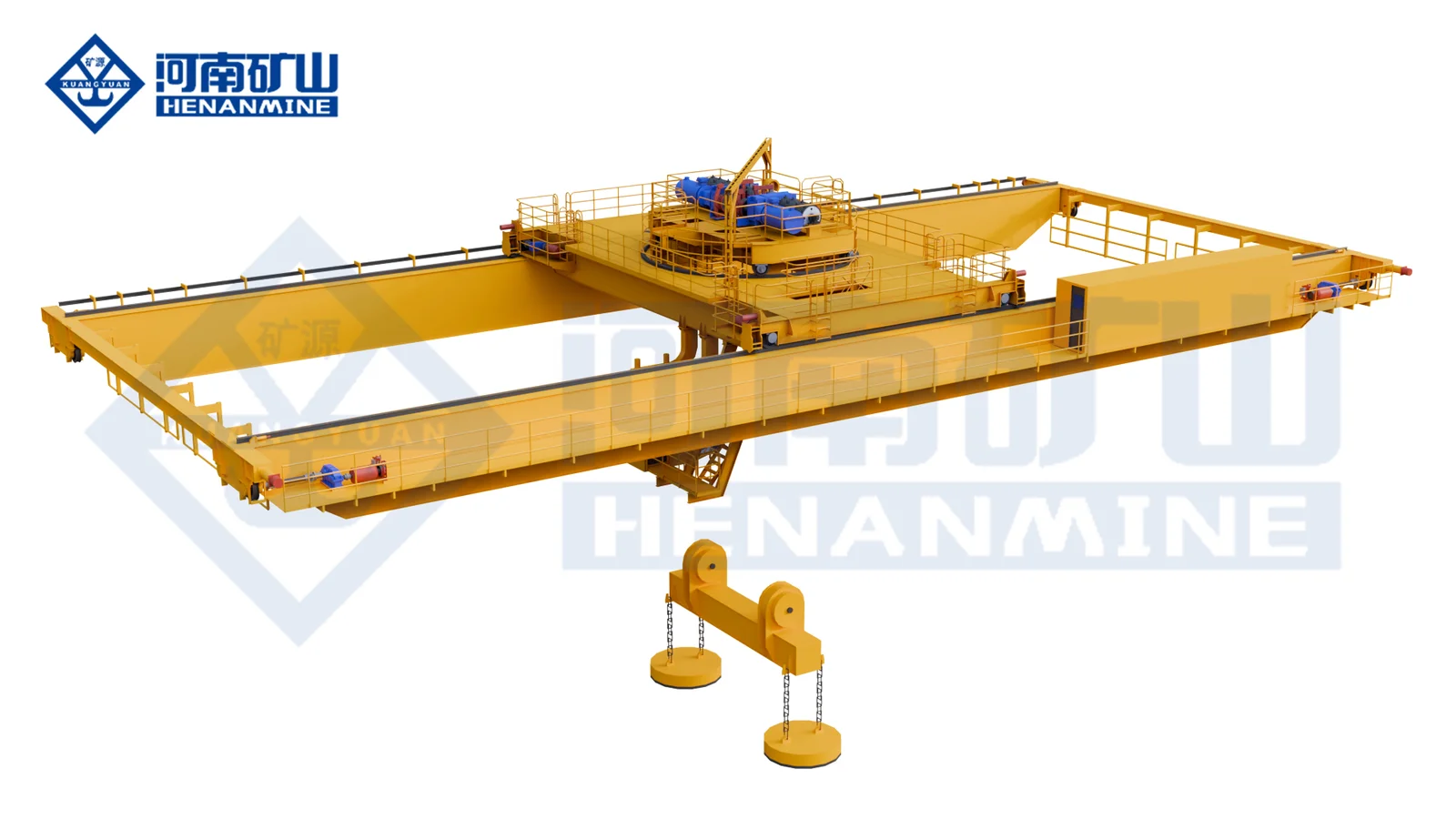
    A rotating magnetic beam for positioning long steel products. Magnet arrangement, material temperature and power-loss protection require a matched specification.

    Lifting capacity5+5–25+25 t
    Listed spans25–34 m
    Working classA6–A7
    Technical specifications

    Define the total suspended load, duty and site conditions for your project.

    Technical specifications

    Check the load.
    Plan the configuration.

    Parameters and equipment options are matched to the application and confirmed in the technical proposal.

    Discuss your configuration

    Rated capacity includes the hanging beam and lifting appliances. Confirm the allowable net steel payload for the complete arrangement.

    Paired rated lifting capacity5+5–25+25 t, including the hanging beam and lifting appliances
    Listed spans25–34 m
    Maximum lifting height10–16 m for the listed arrangements
    Working classA6–A7
    Hoisting speed12.4–16 m/min
    Trolley travel speed39–48 m/min
    Crane travel speed85.2–107 m/min
    Hanging beam rotation speed1.36–1.85 r/min
    Crane power, excluding lifting appliances50.2–243.5 kW
    Recommended railP43, QU80 or QU100, according to the arrangement
    Power supply380 V, 50 Hz, three-phase AC

    Final parameters, dimensions, wheel loads and supply scope follow the approved project specification.

    Application & operation

    Matched to the handling task.

    Overhead Cranes

    Workshop lifting, production lines and specialist steel handling.

    Match the process

    Define the material, handling method, load cycle and operating conditions to select the lifting arrangement.

    Selection considerations

    Start with your operating conditions.

    01

    Load & lifting method

    Specify the material, dimensions, weight, centre of gravity and lifting attachment. Include the attachment weight in the suspended load.

    02

    Site & available space

    Confirm span, lifting height, travel coverage, headroom and obstructions. Share runway or building drawings when available.

    03

    Duty & environment

    State operating hours, lifts per hour, travel distances, temperatures, control requirements and the site power supply.

    Configuration comparison

    Compare related lifting arrangements.

    Crane arrangementHandling configuration
    Upper Rotating Magnetic Overhead CraneA rotating magnetic beam for positioning long steel products. Magnet arrangement, material temperature and power-loss protection require a matched specification.
    Electromagnetic Hanging Beam CraneA hanging-beam arrangement for steel plates, sections, coils and billets. The beam and magnets are matched to product length and stacking orientation.
    Electromagnetic Overhead CraneA magnetic lifting arrangement for ferromagnetic steel products. Select the magnet for material shape, contact area, temperature and handling cycle.
    Slab Handling CraneA configuration for moving and stacking steel slabs. Slab dimensions, temperature, lifting attachment and production cycle determine the equipment.

    Operating protection & lifecycle support

    Plan beyond the equipment.

    01

    Operating protection

    Confirm the required overload protection, travel limits, brakes, emergency controls and any process-specific interlocks in the technical specification.

    02

    Installation & commissioning

    Agree the runway interface, assembly, electrical connections, inspection and commissioning responsibilities before delivery.

    03

    Maintenance & spares

    Define inspection access, maintenance documentation, wear parts and the support scope for the complete crane and lifting attachment.

    Questions before the order

    Clarify the details
    that shape the crane.

    What information is needed for a quotation?+

    Provide the lifting task, maximum suspended load, span, lifting height, duty cycle, working environment, control mode and site power supply. A bay layout and material photos help define the configuration.

    Can the crane fit an existing building?+

    The existing runway, structural capacity, available headroom and clearances must be checked against the proposed crane dimensions and wheel loads.

    Does the proposal include installation?+

    Specify the destination and the installation support you need. Equipment supply, shipping, erection, commissioning and operator training should be defined separately in the proposal.

    Related equipment

    Explore the alternatives.

    Let’s discuss your project

    The right crane starts
    with your lifting task.

    Share your load, span, lifting height and operating conditions.

    info@hnksglobal.com
  • Cleanroom vs General-Purpose Cranes: Define the Environmental Requirements

    Cleanroom vs General-Purpose Cranes: Define the Environmental Requirements

    Technical guide

    Cleanroom vs General-Purpose Cranes: Define the Environmental Requirements

    A cleanroom lifting project needs the required environment and handling process specified clearly. Compare material, component and maintenance requirements against the facility brief rather than assuming a standard crane can be adapted without review.

    Henan Mine CraneTechnical guide · Updated 2026Crane selection, project scope and operating requirements
    overhead crane for cleanroom applications
    overhead crane for cleanroom applications
    Project planning notes

    Key points for this crane project.

    1. Main Application Scenarios for the Two Types of
    2. Core Operational Requirements for High-End Material
    3. Detailed Analysis of Two Crane Models
    Read the technical guide

    Main Application Scenarios for the Two Types of Cranes

    The boundaries between cleanroom cranes and standard cranes are very clear; the production environments, material properties, and operational standards they are suited for differ fundamentally. The core criterion for selection is the project’s production cleanliness grade.

    Semiconductor and Precision Electronics Production Scenarios

    The handling of semiconductor wafers, precision electronic components, and high-end production equipment requires zero tolerance for environmental particulates, impurities, or oil contamination. Even minute dust particles or vibrations can render precision components unusable, directly resulting in significant economic losses.

    In such scenarios, cleanroom Overhead Cranes must be used.

    Power Battery and Advanced Materials Production Facilities

    Production workshops for lithium battery anode and cathode materials, battery cells and modules, and new energy storage materials are classified as controlled clean environments. Powdered materials are highly prone to absorbing impurities; oil leaks from equipment and metal dust generated during operation can directly affect material purity and product yield rates.

    Cleanroom Cranes are specifically designed for these operating conditions. From structural sealing and lubrication methods to surface treatment, they eliminate the generation of contaminants, making them suitable for the production and handling processes of high-end new energy materials.

    Pharmaceutical and Medical Device Production Scenarios

    The transfer of pharmaceutical raw materials, medical consumables, and sterile production equipment must strictly adhere to pharmaceutical clean production standards. The open structure and exposed lubrication components of ordinary industrial cranes are highly prone to generating contaminants and do not meet the hygiene standards for pharmaceutical production.

    Specialized cleanroom cranes are compatible with pharmaceutical cleanrooms of various grades, maintaining a stable workshop environment throughout the process and mitigating the risk of external contamination.

    Precision Optics and Laboratory Material Handling

    Fragile, high-precision materials such as optical lenses, precision laboratory instruments, and testing equipment not only require a clean environment but also demand extremely stable equipment operation. Even slight vibrations or shaking can cause displacement or damage to precision components.

    Precision handling cranes designed for these scenarios combine dust-free and dust-proof features with low-speed, smooth operation, meeting the specialized high-precision requirements of laboratories and precision optical workshops.

    General-purpose factories and traditional processing workshops

    Traditional industrial settings such as mechanical processing, steel structure manufacturing, and mold production do not have strict particulate matter control requirements. Materials handled are primarily steel, castings, and tooling/molds, with the core requirements being stable load-bearing capacity and durability.

    For these routine lifting operations, standard Overhead Cranes fully meet production needs. These Cranes offer better cost-effectiveness and are well-suited for high-frequency, heavy-load operations in conventional industrial settings.

    Conventional Warehouses and Standardized Production Lines

    The handling and lifting of general warehouse materials and common industrial components do not require stringent cleanliness standards. The focus is on improving handling efficiency and ensuring basic equipment safety; the design standards of standard industrial Cranes are sufficient for these basic operating conditions.

    Core Operational Requirements for High-End Material Handling

    Lifting requirements in high-end cleanrooms differ significantly from traditional industrial lifting. The core focus is no longer simply load-bearing capacity, but rather environmental adaptability and material protection capabilities.

    Extremely Low Contamination Risk Control

    The core challenge in high-end manufacturing is external contamination. During operation, standard cranes can generate metal dust, lubricant mist, and wear debris from components. These microscopic contaminants can directly contaminate precision materials, high-purity materials, and sterile production environments.

    Cranes designed for high-end applications must be comprehensively optimized in terms of structure, components, and lubrication methods to eliminate the generation of various contaminants at the source and maintain a stable cleanroom classification.

    Smooth, Vibration-Free Operation Throughout

    Precision materials and large precision equipment are highly sensitive to vibration and impact. Jerky starts and stops, body swaying, and tracking deviations can all cause misalignment of internal precision structures and damage to materials, resulting in product scrap.

    High-end operating conditions require Cranes to start and stop smoothly, operate at a constant speed, and achieve precise positioning, minimizing mechanical vibration to the greatest extent possible to accommodate high-precision handling operations.

    Dedicated Component Design for Cleanroom Compatibility

    Conventional cranes typically feature open-structure motors, gearboxes, and wire ropes, which are prone to dust accumulation and oil leakage. Cleanroom-specific cranes employ fully enclosed drive systems, dust-proof sealed components, and oil-free lubrication materials, with all exposed parts treated to resist dust and contamination.

    High-Precision Positioning Capability

    Processes such as equipment positioning, material docking, and precision fixture assembly require cranes to possess precise alignment capabilities. Even the slightest positional deviation can affect the assembly precision of the entire production line—a core requirement that standard cranes cannot meet.

    Low-Interference Operation and Maintenance Design

    Downtime costs in cleanrooms are extremely high. Frequent equipment inspections and maintenance not only impact production capacity but also introduce external contaminants. Cranes designed for high-end applications feature durable structures, low failure rates, and simple daily maintenance, ensuring minimal disruption to production processes.

    Adapted to On-Site Production Environments

    Cleanroom classifications vary across industries, as do production workflows and equipment layouts. High-quality lifting equipment must align with the cleanroom class, production processes, and spatial layout, seamlessly integrating into the existing production system.

    overhead crane for cleanroom applications
    overhead crane for cleanroom applications

    Detailed Analysis of Two Crane Models

    Many buyers struggle to distinguish the core differences between these two equipment types, primarily due to a lack of understanding regarding their design objectives: one is specifically engineered for clean, precision applications, while the other is suited for conventional industrial heavy-load scenarios.

    What Is a Cleanroom Crane?

    A cleanroom crane is specialized lifting equipment designed for controlled dust-free workshops and clean production areas, and it is the core model of clean environment cranes. Its design priorities differ entirely from those of ordinary equipment; rather than focusing on maximum load capacity, it prioritizes dust-free operation, contamination prevention, smooth movement, and low vibration.

    The entire unit features a fully enclosed structure, special dust-proof coatings, and a leak-free lubrication system. Components are meticulously selected to ensure that no dust, oil residue, or debris is generated during operation, making it suitable for high-grade cleanrooms in industries such as semiconductors, pharmaceuticals, and new energy.

    What is a standard crane?

    Standard industrial cranes are general-purpose lifting equipment for traditional factory settings, emphasizing heavy-duty capacity, structural durability, and cost-effectiveness. These units feature an open structure with exposed drive components and lubrication systems, allowing for normal mechanical wear and the generation of trace amounts of dust.

    Suitable for industrial environments without cleanliness requirements, this equipment is characterized by simple construction, easy maintenance, and low procurement costs, making it the mainstream lifting solution for traditional manufacturing and warehousing facilities.

    Scenarios Where Cleanroom Cranes Are the Preferred Choice

    Cleanroom cranes are required whenever production areas have specific cleanliness grade requirements, the materials being handled are high-value, or production processes have zero tolerance for contamination.

    This is particularly true in industries such as precision electronics, biopharmaceuticals, and high-purity new materials, where even minute contamination or vibrations can trigger batch-wide quality issues; dedicated cleanroom equipment is the fundamental guarantee for production stability.

    Scenarios Where Standard Cranes Are Sufficient

    For applications such as conventional machining, heavy steel structure handling, warehouse material handling, and general equipment installation/dismantling—where there are no dust-free or precision handling requirements—standard cranes can meet production needs while effectively controlling equipment procurement costs.

    Special Mixed-Use Scenarios

    In certain semi-clean workshops, pre-treatment processes, and non-core clean areas, a full set of high-grade cleanroom cranes is not required. Modified industrial cranes can be selected; by upgrading dust-proof coatings, sealed components, and smooth control systems, they can adapt to semi-clean environments at a lower cost.

    Core Technical Parameters to Verify During Procurement

    The parameter selection logic for these two types of cranes is entirely different. For high-end cleanroom applications, it is not sufficient to simply verify standard parameters; it is essential to focus on specialized indicators such as cleanroom compatibility and operational quality.

    Cleanroom Compatibility Grade

    First, clearly define the nature of the work area: is it a high-grade controlled cleanroom, a semi-clean production area, or a standard industrial zone? Different cleanliness grades require entirely different standards for dust protection, sealing, and contamination prevention, which directly determine the crane model selection.

    Rated Lifting Capacity

    Select the model based on the actual weight of materials, production equipment, and containers, allowing for a reasonable safety margin. Cleanroom cranes are typically suited for handling precision, lightweight materials, whereas standard cranes are designed for heavy-duty lifting; load capacity must be matched to actual operating conditions.

    Equipment Span

    The span must precisely match the width of the workshop or factory building and the production line layout to ensure full coverage of the work area without any lifting blind spots, while avoiding space waste and operational instability caused by excessive span.

    Effective Lifting Height

    Determined by combining equipment installation height, material transfer paths, and workshop clear height, this ensures sufficient space for lifting precision equipment and transferring materials at elevated heights, while preventing operational interference.

    Smooth Operation Performance

    Prioritize verifying the smoothness of hoisting, trolley travel, and overall machine operation. High-quality cleanroom Cranes feature soft start/stop and shock-free operation, effectively reducing body sway and mechanical vibration to protect precision materials.

    Surface Finishing and Material Treatment

    Cleanroom cranes feature a matte, dust-resistant topcoat and a smooth, corrosion-resistant surface that resists dust accumulation, facilitates cleaning, and prevents flaking or debris shedding. Conventional cranes prioritize rust prevention and load-bearing capacity, with surface treatments that do not require dust or stain resistance.

    Lubrication and Sealing Design

    Cleanroom models feature a fully enclosed lubrication system and leak-proof sealing structures, ensuring grease does not spill and that no dust is released from component wear. Standard Cranes use open lubrication systems, which cannot prevent oil leaks or the release of wear dust.

    Control Methods

    Cleanrooms typically use wireless remote control and precise electronic control modes, offering fine-tuned operation and accurate positioning to accommodate precision tasks. For standard applications, joystick control is sufficient to meet basic lifting requirements.

    Ease of Maintenance

    Maintenance in cleanroom areas must be completed quickly to minimize environmental disruption. Cleanroom Cranes feature an optimized component layout with centralized maintenance points, enabling rapid repairs and replacements to reduce downtime.

    overhead crane for cleanroom applications
    overhead crane for cleanroom applications

    Core Differences Between Cleanroom Cranes and Standard Cranes

    While the two types of equipment appear structurally similar, they differ significantly in core design, application scenarios, and value—key factors that must be clearly understood when selecting equipment for high-end projects.

    Differences in Environmental Adaptability

    Cleanroom cranes are specifically designed for controlled environments that are dust-free, sterile, and low in particulate matter, enabling long-term, stable operation in various high-grade cleanrooms. Standard cranes are only suitable for ventilated, open conventional industrial facilities and cannot operate within cleanroom areas.

    Differences in Contamination Control Levels

    Cleanroom models implement comprehensive contamination control across components, lubrication, coatings, and structure, ensuring zero dust, zero oil residue, and zero debris throughout the entire process. Standard cranes lack contamination control design; mechanical wear and grease leakage during operation generate contaminants.

    Differences in Structure and Component Craftsmanship

    Cleanroom cranes utilize precision-sealed components, specialized dust-proof coatings, and low-wear core parts, featuring meticulous craftsmanship and stringent material standards. Standard cranes prioritize structural strength and heavy-load capacity, with component manufacturing standards better suited to conventional industrial needs.

    Differences in Operational Quality

    Cleanroom models feature more precise electronic control systems, ensuring smooth starts and stops, minimal vibration, and high positioning accuracy—ideal for handling precision materials. Standard Cranes exhibit significant operational inertia and noticeable sway, making them unsuitable for high-precision, high-protection material handling requirements.

    Differences in Purchase Costs

    Due to precision manufacturing, specialized components, and dust-free design, cleanroom cranes carry a higher purchase price than standard industrial cranes. Standard models feature simple structures and mature manufacturing processes, offering a clear cost-effectiveness advantage.

    Differences in Lifecycle Value

    In cleanroom environments, high-cost cleanroom cranes eliminate the risks of material contamination and product scrap, thereby reducing production losses. While standard cranes are lower in price, they are prone to quality incidents, resulting in higher overall costs over the long term.

    How to Select a Reliable Crane Supplier

    The customization requirements for cleanroom lifting equipment are far higher than those for standard cranes. Many manufacturers lack design experience in cleanroom environments, making it highly likely that equipment will fail to meet compatibility standards.

    Verify the Manufacturer’s Design Experience in Cleanroom Environments

    Many manufacturers specialize only in standard industrial cranes and are unfamiliar with the dust-proof, contamination-proof, and low-vibration design standards required for cleanrooms. Prioritize manufacturers with deep expertise in cleanroom environments for the semiconductor, pharmaceutical, and new energy industries to ensure equipment compatibility.

    Review Completed Projects in Similar Fields

    Focus on the manufacturer’s completed projects in precision manufacturing, biopharmaceuticals, and new energy materials. Authentic project experience is the best testament to equipment quality and adaptability.

    Assess Professional Engineering Customization Capabilities

    High-quality manufacturers can optimize equipment structure, sealing methods, and electrical control systems on a one-to-one basis according to the cleanroom class, material characteristics, and production line layout, creating customized solutions tailored to project requirements.

    Verify Complete Set of Technical Documentation

    Reputable manufacturers provide a full set of documentation, including assembly drawings, surface treatment specifications, operating parameter manuals, sealing structure descriptions, and maintenance guidelines, to meet the acceptance and operational standards of high-end projects.

    Confirm Selection Criteria for Core Components

    Motors, gearboxes, brakes, seals, cables, and lubricants for cleanroom cranes all have specific standards. Each component selection must be verified individually to prevent the use of generic substitutes.

    Clarify Equipment Testing and Commissioning Standards

    Before leaving the factory, cleanroom equipment must undergo stability testing, dust-proof sealing inspections, precision alignment adjustments, and no-load and full-load trial runs to ensure it can immediately adapt to clean production conditions upon arrival at the site.

    Verify After-Sales and Spare Parts Support Capabilities

    High-end clean production lines cannot tolerate prolonged downtime. Manufacturers must provide rapid after-sales response, dedicated spare parts inventory, and dust-free maintenance services to minimize losses from production interruptions.

    Common Misconceptions in Procurement and Selection

    Many equipment compatibility issues in high-end projects stem from cognitive biases during the selection phase. Seemingly minor errors can directly impact product yield rates and production stability.

    Using price as the sole selection criterion and substituting standard Overhead Cranes for cleanroom-grade equipment to cut costs ultimately leads to serious issues such as material contamination and batch scrapping.

    Assuming all Overhead Cranes perform identically and ignoring the specific requirements of cleanroom environments—such as dust prevention, contamination control, and low vibration—results in equipment that cannot be put into service upon arrival.

    Failing to clarify the specific cleanliness grade of the workshop and selecting equipment blindly leads to a mismatch between equipment standards and on-site conditions.

    Ignoring hidden risks such as equipment leaks, dust generation, and contamination during operation and maintenance, while focusing solely on basic lifting functions.

    Over-specifying equipment—purchasing high-grade cleanroom Cranes for standard semi-clean environments—results in wasted equipment costs.

    Selecting under-specced equipment for high-precision, high-cleanliness processes creates potential quality hazards.

    Choosing manufacturers with no experience in cleanroom projects leads to equipment designs that fail to meet high-end production standards.

    Equipment parameters do not align with production line workflow design, resulting in low operational efficiency and poor adaptability.

    Frequently Asked Questions

    What is the core difference between cleanroom cranes and standard cranes?

    The core difference lies in their design objectives. Cleanroom cranes prioritize dust-free operation, contamination prevention, low vibration, and high precision, making them suitable for high-end cleanroom and precision applications; standard cranes prioritize heavy-duty capacity and durability, making them suitable for conventional industrial lifting tasks, without cleanroom protection features.

    Does all high-end material handling require cleanroom cranes?

    Only materials that are contamination-sensitive, precision-sensitive, fragile, or high-value require cleanroom equipment. For general high-end heavy-duty equipment or precision handling without cleanroom requirements, modified industrial cranes can be used.

    Are cleanroom cranes always more expensive?

    Dedicated dust-proof sealing processes, precision electronic controls, high-quality components, and refined production workflows all increase equipment costs. However, the production stability and quality assurance they provide are irreplaceable by standard equipment.

    Which industries must use cleanroom-grade Cranes?

    Industries such as semiconductors, precision electronics, biopharmaceuticals, power batteries, high-purity new materials, and precision optical laboratories must use cleanroom Cranes to ensure production environment integrity and material quality.

    Can standard cranes be retrofitted for cleanroom environments?

    Only semi-clean or low-demand environments can undergo simple dust-proof retrofits. High-grade cleanrooms cannot be retrofitted as substitutes; factory-customized cleanroom-specific cranes must be selected.

    The workshop’s cleanroom class, maximum material weight, required span and lifting height, workshop layout drawings, and production process requirements—to enable the manufacturer to provide a precise customized solution.

    How do you determine whether a project requires a complete set of cleanroom equipment or modified industrial equipment?

    This determination is based on the facility’s official cleanliness grade, material contamination sensitivity, and production process standards. High-grade cleanrooms and core precision processes require a complete set of cleanroom equipment, while auxiliary processes may use modified models.

    Summary

    There is no absolute superiority between cleanroom cranes and standard cranes; the distinction lies solely in their suitability for specific operating conditions. In traditional heavy-duty industrial settings, standard cranes offer better value for money; in high-end cleanroom and precision material handling scenarios, cleanroom cranes are the core equipment for ensuring product quality and stable production.

    When selecting equipment, one should not focus solely on price and load capacity parameters, but rather make a comprehensive assessment that considers the workshop’s cleanliness grade, material properties, production processes, and long-term production plans. Overspecifying equipment leads to wasted costs, while underspecifying it can result in serious production risks.

    Henan Mine Crane specializes in the R&D and customization of cleanroom lifting equipment. With extensive experience in implementing high-end projects in the semiconductor, pharmaceutical, and new energy sectors, we can tailor high-end material handling Crane solutions to meet specific cleanroom requirements, complete with comprehensive technical documentation and long-term after-sales support.

    If you are unsure whether your project requires a cleanroom crane or a standard crane, please provide details on material types, load requirements, workshop cleanliness standards, and site drawings. Our engineering team will then provide you with a precise selection proposal.

    Discuss the crane arrangement for your project.

    A cleanroom lifting project needs the required environment and handling process specified clearly. Compare material, component and maintenance requirements against the facility brief rather than assuming a standard crane can be adapted without review. Share the load, available drawings, working cycle and site conditions with Henan Mine Crane so the required configuration and supply boundary can be discussed.

    Related crane configurations

    Grab And Hook Dual Purpose Crane

    View product parameters
    Lifting capacity: 5 – 16 tSpan: 10.5 – 31.5 mLifting height: 6 – 20 m

    Switch between bulk-material pickup and hook lifting with a grab-and-hook overhead arrangement. Define each load case, the grab type and the changeover procedure for the working area.

    Updated 2026 · Henan Mine Crane

  • Outdoor Stockyard Gantry Cranes: Coverage, Traffic and Environmental Inputs

    Outdoor Stockyard Gantry Cranes: Coverage, Traffic and Environmental Inputs

    Technical guide

    Outdoor Stockyard Gantry Cranes: Coverage, Traffic and Environmental Inputs

    A stockyard crane needs to serve storage and dispatch while fitting site traffic routes. Define the material, lifting attachment, working area and exposure conditions before comparing gantry configurations.

    Henan Mine CraneTechnical guide · Updated 2026Crane selection, project scope and operating requirements
    Henan Mine Crane overhead crane inside a workshop bay
    Henan Mine Crane overhead crane inside a workshop bay
    Project planning notes

    Key points for this crane project.

    1. What Is an Outdoor Gantry Crane?
    2. Common Applications of Gantry Cranes in Outdoor
    3. Key Factors When Choosing the Best Gantry Crane for
    Read the technical guide

    What Is an Outdoor Gantry Crane?

    Outdoor gantry crane is a ground-supported open-air lifting equipment. It does not need to rely on the building structure of the factory building. It relies on its own outriggers to land firmly. It can stand across the outdoor work area to complete the three-dimensional handling of heavy materials. It is an efficient lifting equipment exclusive to the outdoor yard.

    Its core structure is simple and precise, and the five core components work together to complete the operation.:

    • main girder: The core load-bearing beam spans the operating area and carries all the loads of the trolley, lifting mechanism and cargo. It is divided into two mainstream structures, single beam and double beam.
    • Support legs: vertical steel structure brackets, connecting the main girder and the ground travel mechanism, are the basis for the independent operation of the equipment and ensure the stability of the operation of the whole machine.
    • Lifting mechanism: it consists of electric hoist, wire rope reel, hook and other components. It is responsible for the vertical lifting of goods and is the core power component.
    • Trolley operating mechanism: A travel trolley mounted on the top of the main girder can drive the goods to move laterally along the main girder, covering the horizontal working area.
    • Cart operating mechanism: A travel device installed at the bottom of the outriggers drives the entire crane to move vertically along the ground track or the ground to expand the vertical operating range.

    Relying on the linkage operation of the three dimensions, the gantry crane can realize vertical lifting, horizontal translation, and vertical travel of cargo, covering the outdoor yard operation area in all directions, and accurately completing the loading, unloading, transshipment, and stacking of various heavy materials.

    The core difference between gantry cranes and bridge cranes

    It is easy for many users to confuse gantry cranes with bridge cranes. The operating principles of the two are similar, but the structural support, installation scenarios, and applicable environments are greatly different. They are the core distinguishing points of the selection. The specific comparison is as follows:

    Contrast dimensionGantry craneBridge crane
    Support structureIndependent outrigger support on the ground, no need for building supportRelying on the track system of the plant building, the supporting building structure is required
    Installation adaptabilityDesigned for outdoor scenes, open-air installation without pressureOnly suitable for indoor use, relying on closed plant structure
    Core application scenariosOutdoor yard, port terminal, open-air construction site, steel material yardIndoor workshop, factory production line, closed processing site
    Environmental adaptabilityWeather-resistant, corrosion-resistant, and suitable for complex outdoor working conditionsOnly suitable for indoor constant temperature, dry, no exposure to rain and rain environment

    In summary, gantry cranes are the only suitable professional equipment for outdoor and open-air material handling scenarios. There is no need to transform the factory building, the infrastructure cost is lower, and the scene adaptability is stronger.

    Common Applications of Gantry Cranes in Outdoor Stockyards

    With its strong outdoor adaptability and heavy-duty operation capabilities, gantry cranes are widely used in various outdoor heavy-duty material handling scenarios, covering many industries such as industry, logistics, infrastructure, and shipbuilding.

    Steel and metal raw material yard

    The heavy weight, miscellaneous types and dense stacking of materials in the steel yard are the core application scenarios of gantry cranes. The equipment can accurately handle all kinds of heavy metal materials, including steel coils, steel plates, steel pipes, I-beams, channel steel and other profiles, and is suitable for the whole process of steel storage, transportation, loading and unloading.

    With special spreaders (C-type spreaders, magnetic cranes, balance beams, etc.), steel deformation and surface wear can be effectively avoided, labor and forklift operations can be greatly replaced, and yard regularity and operating efficiency can be improved. It is the core standard equipment of steel processing and warehousing enterprises.

    Container and logistics terminal

    In container terminals and large logistics hubs, gantry cranes undertake the core container loading, unloading, stacking, and transshipment work. The equipment can efficiently complete the cargo transfer between containers and trucks, ships, and depots, increase the density of container stacking through standardized operations, maximize the use of yard space, and solve the pain points of traditional logistics depots with large footprint, low storage capacity, and slow turnover.

    At present, the modern intelligent terminal has realized the automated operation of gantry cranes, connected to the terminal operation and maintenance system, and completed unmanned, high-frequency and high-precision container handling operations.

    Material handling on construction sites

    The working conditions of the infrastructure construction site are complex and the operating area is dynamically changing. With the advantages of mobility and adaptability, the gantry crane is perfectly adapted to the construction scene. It is mainly used for handling materials such as precast concrete components, steel structure frames, large machinery parts, and heavy construction equipment.

    The equipment can flexibly adjust the operating position according to the construction progress, and the installation and disassembly are convenient, and it is suitable for all kinds of large-scale infrastructure projects, road and bridge projects, and assembled building construction scenarios.

    Shipyard and port operations

    The shipyard has the industry's top heavy-duty operation requirements. The weight of materials such as hull segments, ship main engines, and deck equipment can reach hundreds of tons, and the carrying capacity, stability, and accuracy of lifting equipment are extremely demanding. Heavy-duty gantry cranes (gantry cranes) are the core equipment of shipyards, which can complete the hoisting, splicing, and transshipment of ultra-large components.

    At the same time, port bulk cargo and heavy equipment loading and unloading operations also rely on heavy-duty gantry cranes to complete all-weather, high-intensity outdoor heavy-duty operations.

    Key Factors When Choosing the Best Gantry Crane for Outdoor Use

    Selection is the core link that determines the operating efficiency, service life, and safety of equipment. Enterprises need to combine their own working conditions to accurately match the four dimensions of load, span, model, and operating parameters to avoid selection errors.

    Determine the rated lifting load

    lifting capacity is the first core parameter of selection. Insufficient load will cause safety hazards, while excess load will cause equipment to be idle and costs to be wasted. According to the operating load, it can be divided into three categories:

    When selecting the type, it is necessary to focus on the three indicators of rated lifting weight, maximum cargo weight, and safety factor. When calculating the load, it is necessary to include the weight of spreaders, beams and other accessories.

    Adapt to span and work site size

    The shape parameters of the crane directly determine the coverage of the operation, and it needs to be fully adapted to the layout of the yard, the material stacking method, and the operation movement line to avoid blind spots in the operation. The core parameters include:

    • Span: Refers to the distance between the centers of the tracks on both sides, which needs to match the maximum working width of the yard, taking into account the material stacking and vehicle passage space, and eliminating the problem of restricted operations.
    • Lifting height: For the maximum vertical lifting stroke of the hook, it is necessary to meet the height requirements of material stacking and vehicle loading and unloading, and reserve sufficient safe avoidance distance to ensure the safety of operations.
    • Track operation length: Determine the vertical operation coverage of the crane, it is necessary to completely cover the core operation area of the yard, and reserve a safety buffer zone at both ends of the track.

    Before selecting the type, it is recommended to survey the site on the spot, and customize the exclusive size parameters based on the layout of the yard, the height of the material stacking, and the operation movement line to ensure full coverage of the equipment operation, no dead ends, and no redundant waste of performance.

    Optimal adaptation model

    The mainstream outdoor gantry cranes on the market are divided into four major models. The structure, performance, and adaptation scenarios of different models are significantly different, and the working conditions need to be accurately matched.:

    Single beam gantry crane

    Using a single main girder structure, the structure is simple, the cost is low, and the maintenance is convenient. It mainly focuses on light and medium-load operations. The core advantages are high cost performance, convenient installation, and low late operation and maintenance costs.

    Double girder gantry crane

    The symmetrical structure of the double main girder has stronger bearing capacity, higher stability, greater lifting height and longer service life. It mainly focuses on heavy-duty and high-frequency operations.

    Rail gantry crane (RMG)

    Relying on fixed track operation, it has extremely high positioning accuracy, stable operating efficiency, supports automated control, and focuses on standardized and high-turnover operations. It is mainly used in container depots, large-scale logistics hubs, and standardized storage parks. It is suitable for large-scale, intelligent, and high-frequency batch material transfer operations. It is the core standard equipment of intelligent terminals.

    Tire gantry crane (RTG)

    It uses rubber tires to walk without laying a fixed track, can move freely and flexibly, and has strong adaptability to the site. It is suitable for outdoor scenes where the operating area is not fixed and the operating points need to be switched frequently. It is mostly used for temporary container transshipment and material handling in scattered depots. There is less investment in infrastructure and full operating flexibility.

    Outdoor Gantry Crane Features for Harsh Environments

    Outdoor harsh environments such as wind, rain, exposure, dust, corrosion, and strong winds require much higher weather resistance, safety, and stability of cranes than indoor equipment. Special outdoor configuration is the key to the long-term operation of the equipment.

    All-weather weather protection design

    • Anticorrosive steel structure: high-grade weather-resistant steel is used, and it is equipped with hot-dip galvanized and multi-layer anticorrosive coating technology for corrosion scenarios such as seaside and chemical industry to eliminate rust, aging, and structural deformation.
    • Waterproof electrical system: electrical components such as motors, control cabinets, junction boxes, etc. adopt IP55/IP65 advanced waterproof and dustproof protection levels to prevent rain and dust intrusion and avoid circuit failures.
    • Wind-resistant and stable design: equipped with special windproof rail clamps and anchoring devices, the structure has been verified by wind load, which can withstand strong winds and weather, prevent equipment from slipping and overturning, and adapt to open-air windy conditions.

    A full set of intelligent security protection system

    Outdoor heavy-duty operations have complex working conditions and high safety risks. A full set of intelligent safety protection systems can avoid hidden dangers in operations in all directions and ensure the safety of personnel, goods and equipment. The core configuration functions are as follows:

    • Overload protection device: real-time dynamic monitoring of heavy loads, once the rated load is exceeded, the equipment will automatically be powered off and shut down immediately, and equipment damage and safety accidents caused by overload operations will be eliminated from the source.
    • Emergency stop system: The whole machine is equipped with an emergency stop button in the whole area. When encountering emergencies such as sudden failures and personnel hazards, the power of the equipment can be cut off with one key, and the equipment can be stopped quickly to avoid risks and minimize operating risks.
    • Stroke limit switch: accurately control the limit operating stroke of the hook lifting and travel of the whole machine, effectively eliminate equipment collisions, structural deformation, damage to accessories and other problems caused by over-range operation, and ensure the safety of the operation boundary.
    • Anti-collision device: adapted to multi-device collaborative operation scenarios, real-time identification of equipment spacing through intelligent sensing, automatic deceleration, limit, and shutdown operations, effectively avoiding equipment collision failures and secondary safety hazards.

    Intelligent electronic control and operating system

    • Wind speed monitoring system: monitor the wind speed of the outdoor environment in real time 24 hours a day. When the wind speed exceeds the safe operating threshold, the system automatically alarms and locks the equipment, prohibits illegal operations, and effectively protects against the risk of overturning and slippage caused by strong winds.
    • The modern outdoor gantry crane is equipped with an intelligent electronic control system, which is upgraded from multiple dimensions of control accuracy, operation convenience, and operation stability, and is fully adapted to the needs of efficient and safe intelligent yard operations. The core configuration advantages are as follows:
    • Frequency conversion drive system (VFD): To achieve smooth start and stop of equipment and stepless speed regulation, to eliminate job shocks and material shaking, and to accurately control the operating speed, not only to protect the integrity of equipment and goods, but also to effectively reduce energy consumption.
    • Remote control + ground operation dual control mode: compatible with wireless remote control and ground operation, operators can avoid blind spots in the operation, stay away from high-risk operation areas, and improve the construction safety factor in all directions.
    • PLC intelligent automation system: supports custom preset operating processes, can realize standardized semi-automatic and fully automatic operations, and is suitable for large-scale, normalized and efficient operation scenarios of smart depots.
    • Real-time intelligent monitoring system: continuously monitor core data such as equipment load, temperature, vibration, and operating status 24 hours a day, accurately predict potential failures, and realize early investigation of hidden dangers.

    The complete set of intelligent electronic control system can effectively reduce the intensity of manual operation, avoid human operation errors, and greatly improve the accuracy and operating efficiency of material hoisting. At the same time, it reduces equipment loss and extends the service life of the whole machine, helping enterprises to achieve efficient, stable and low-cost normalized outdoor lifting operations.

    Gantry Crane Specifications Buyers Should Compare

    When comparing the quotations and plans of various manufacturers, it is important not to only look at the total price. It is necessary to check the parameters one by one and the specifications one by one, so as to effectively avoid the procurement pitfalls such as low-price allocation, false parameter bids, and shrinking configuration. The following is a checklist of the core parameters necessary for procurement acceptance:

    Mechanical core parameters

    During the procurement verification phase, it is necessary to focus on checking a number of core mechanical parameters, including the rated lifting weight, the span of the whole machine, the maximum lifting height, the working level of the equipment, the operating work system, the effective travel length of the track and the weight of the whole machine.

    Among them, the rated lifting weight determines the upper limit of carrying capacity, the span and lifting height determine the coverage of the operation, and the working level and working system are adapted to the needs of outdoor high-frequency heavy-duty operations. Accurate verification of various parameters can ensure that the performance of the equipment fits the on-site working conditions, and effectively avoid problems such as restricted operations, equipment overload and wasted performance.

    Electrical core parameters

    The verification of electrical parameters covers the rated power of the motors of various institutions, the control method, the adaptation voltage of the equipment, the electrical protection level, the frequency conversion speed regulation configuration and the brake system specifications. The full set of electrical configuration needs to match the power supply conditions of the factory area to ensure that the whole machine has stable control, accurate response, and insulation protection up to standard, and fully meets the safe electricity consumption specifications for complex outdoor working conditions.

    Structural process parameters

    During the procurement phase, it is necessary to strictly verify the main steel specifications, anti-corrosion process system, coating thickness standards, equipment design specifications and welding process parameters, and review the complete factory quality inspection report and certificate of conformity one by one to ensure that the whole machine has solid structural strength, excellent outdoor corrosion and weather resistance, and all technical indicators are strictly in line with industry standards and safety specifications.

    Common Mistakes When Buying an Outdoor Gantry Crane

    Most companies are prone to falling into low-cost misunderstandings when purchasing, which leads to frequent failures in the later stage, soaring operation and maintenance costs, and security risks. The four high-frequency misunderstandings must be avoided:

    Ignore cost performance

    Low-cost equipment generally has problems such as thin steel materials, poor-quality accessories, rudimentary technology, and lack of safety configuration. Short-term procurement costs are low, but long-term problems such as high failure rate, frequent downtime, high maintenance costs, and short service life will occur. The comprehensive operating cost far exceeds that of high-quality equipment, and there are great safety risks. Procurement needs to focus on the whole life cycle cost, rather than a single purchase price.

    Ignore the on-site working conditions and environment

    The temperature, wind, humidity, dust, and degree of corrosion in different regions vary greatly. Seaside docks need to strengthen anti-corrosion and windproof configurations; industrial and mining dust scenes need to strengthen dust-proof seals; low-temperature areas need to be adapted to cold-resistant steel and lubricants. Ignoring the customization of working conditions will lead to rapid aging of equipment and frequent failures.

    Improper selection of lifting tonnage

    Small tonnage selection will lead to long-term overload operation of equipment, resulting in structural deformation, wear and tear of accessories, and sudden loss of life, which can easily cause safety accidents; excessive tonnage selection will cause equipment to be idle, energy consumption is too high, and funds are wasted. It is strictly forbidden to select the type according to the average load, and it must be accurately configured according to the maximum load + safety margin.

    Ignore after-sales supporting services

    Gantry cranes are large-scale industrial equipment, and lifetime operation and maintenance, parts replacement, and fault repair are essential. Some small manufacturers do not have a perfect after-sales system, and accessories are difficult to find and no one repairs after equipment failure, and the loss of long-term downtime far exceeds the equipment price difference. Be sure to verify the manufacturer's technical support, parts supply, and on-site service capabilities before purchasing.

    How to Choose a Reliable Gantry Crane Manufacturer

    High-quality equipment comes from reliable manufacturers. After the selection is over, the strength of the manufacturer is the core of ensuring the quality, after-sales and service life of the equipment. It can be assessed from four dimensions.:

    Manufacturing strength

    Inspect the manufacturer's production plant, CNC processing equipment, welding technology, and quality inspection system, and confirm that the manufacturer has an independent design, production, processing, and testing team, with the ability to mass produce and customize large-scale gantry cranes, and eliminate OEM and small workshop manufacturers.

    Customized design ability

    High-quality manufacturers can provide one-stop services for free site survey, working condition analysis, personalized program customization, drawing design, and installation guidance. Non-standard equipment can be customized for special sites and special working conditions, rather than forcibly applying standard models.

    Perfect after-sales system

    Reliable manufacturers provide a full set of services such as equipment commissioning, operator training, regular maintenance, lifetime parts supply, and 24-hour technical support. They have the ability to quickly repair on-site and minimize equipment downtime.

    Discuss the crane arrangement for your project.

    A stockyard crane needs to serve storage and dispatch while fitting site traffic routes. Define the material, lifting attachment, working area and exposure conditions before comparing gantry configurations. Share the load, available drawings, working cycle and site conditions with Henan Mine Crane so the required configuration and supply boundary can be discussed.

    Related crane configurations

    Explore crane product families and technical parameters ↗

    Updated 2026 · Henan Mine Crane
  • Manufacturing Facility Crane Systems: Match Lifting to Production

    Manufacturing Facility Crane Systems: Match Lifting to Production

    Technical guide

    Manufacturing Facility Crane Systems: Match Lifting to Production

    The best starting point is the material's movement through the factory. Map machining, assembly and storage handovers so crane coverage, duty and control requirements can be checked against the production sequence.

    Henan Mine CraneTechnical guide · Updated 2026Crane selection, project scope and operating requirements
    Manufacturing Facility Crane Systems: Match Lifting to Production
    Henan Mine Crane lifting equipment
    Project planning notes

    Key points for this crane project.

    1. Why the Right Overhead Crane Matters for
    2. Assessing Your Manufacturing Requirements
    3. Understanding Types of Crane Systems
    Read the technical guide

    Why the Right Overhead Crane Matters for Manufacturing

    Core Benefits of Overhead Cranes in Production

    Compared with forklifts and stacker trucks, overhead cranes have become the preferred equipment for manufacturing workshops due to their suspended structure, which has significant core benefits. It does not take up floor space, can maximize the use of plant area, easy to plan production lines and storage areas, especially suitable for high-density production workshop.

    At the same time, the overhead crane can realize three-dimensional flexible movement, not only can transfer heavy workpieces, but also accurately docking assembly stations, suitable for machinery, automotive, hardware, logistics and other industries, easy to carry heavy, bulky, shaped materials, to make up for the shortcomings of the operation of manual and small equipment.

    Special Considerations for Existing Factories

    Old factory crane selection, and the logic of the new plant is different, do not blindly pursue high matching, the core principle is to adapt to the existing plant structure, do not force the transformation to accommodate the equipment. Old plant load bearing, floor height, spacing are fixed parameters, rash installation of large-span, high-load models, very easy to cause safety hazards, high cost of rectification later, but also cause a long period of downtime.

    Assessing Your Manufacturing Requirements

    The first step in choosing a crane is to comprehensively sort out your own manufacturing requirements and accurately approve the parameters to avoid blind purchasing.

    Load Capacity

    Load capacity is the core parameter of the crane, must accurately account for the maximum weight of materials handled by the workshop daily, as a benchmark for selection. When selecting cranes, you can't just choose the model according to the average weight, but must reserve a safety margin to cover the heaviest load in all production scenarios, so as to prevent safety accidents caused by overloading operations.

    Lift Height

    Lift height refers to the vertical distance of the hook from the lowest point on the ground to the highest working point, which needs to be determined by combining with the height of the workshop, the height of material stacking and the demand of assembly work.

    For example, if there are high-level shelves and high-station assembly operations in the workshop, it is necessary to choose the equipment with larger lifting height; if it is only ground transfer and simple assembly, the conventional lifting height can meet the demand. When calculating, it is necessary to reserve sufficient margin to avoid the inability to complete normal lifting operations due to insufficient height.

    Span & Reach

    Span and work radius determine the coverage of the crane. Span refers to the lateral distance between the two ends of the crane's main girder, that is, the width of the workshop that can be covered by the equipment; work radius refers to the maximum extension distance of the trolley and the hook from the main girder or column, which determines the lateral coverage of the equipment.

    Frequency of Use

    The frequency of use of the equipment directly determines the configuration level of the crane, which is divided into two kinds of heavy-duty working conditions and light-duty working conditions.

    If it is a 24-hour continuous operation, high-frequency transit production line, you need to use thickened steel, high-power motors, high-strength parts of the heavy crane;

    if it is occasional use, low-frequency operation of the workshop, choose a light, economical equipment can be used to meet the needs of the use, but also control the cost of the initial investment.

    Application Type

    Different production scenarios, there are differences in the type of crane. Mechanical assembly workshop needs accurate positioning, smooth operation of the equipment;

    heavy-duty processing workshop needs a large load, high strength cranes; warehousing and logistics areas need to cover a wide range of models, high transit efficiency;

    small processing stations are suitable for local lifting equipment. Clearly their own application scenarios, in order to target selection, so that cranes are better integrated into the production process, play a maximum role.

    Understanding Types of Crane Systems

    Overhead Bridge Cranes (Single/Double Girder)

    Overhead bridge cranes are commonly used in workshops, and are divided into single girder and double girder models, which are suspended from the top of the plant and run on rails.

    The double girder model has stronger load bearing and more stable operation, with a load capacity of up to a hundred tons and precise positioning, suitable for heavy manufacturing, automobile production and other large load and high-precision indoor work.

    Gantry/Goliath Cranes

    Gantry cranes, also known as gantry cranes, are similar in structure to overhead cranes, but the difference is that they do not rely on the top of the plant for load bearing, but rely on the bottom outriggers to support the legs, which move along the ground track, and belong to independent lifting equipment.

    These models do not need to rely on the structure of the plant, installation flexibility, and outstanding load-bearing capacity, a very wide range of operations.

    Jib Cranes

    The Jib Crane is a compact localized lifting equipment with a 360° rotating boom, which is mainly used for small fixed point operations. It is small in size, can be installed on columns or wall-mounted, does not take up space, easy to control, suitable for loading and unloading of machine tools, small workstations, maintenance rooms and other small scenes, to make up for the blind spot of large cranes.

    Ensure Your Crane Fits Your Work Environment

    Crane operating environment, directly affecting the service life of the equipment, operational stability and safety, the selection must be combined with site conditions, environmental factors, to do a good job of all-round adaptation, to avoid early loss of equipment, failures occur frequently.

    Indoor vs. Outdoor

    Indoor and outdoor crane configuration requirements differ significantly.

    Space & Layout Constraints

    Before installation, it is necessary to make a field survey, measure the size of the workshop, the location of obstacles, avoid production lines and passages, and ensure the smooth running of the route. For workshops with small space, wall-mounted and compact cranes are preferred; workstation cranes need to be delineated in advance to fit the production requirements without wasting space.

    Structural Support Requirements

    Various types of cranes have different load-bearing requirements: overhead cranes need to meet the load-bearing standards at the top of the plant, and be reinforced if necessary; gantry and independent light cranes do not need to rely on the plant, but only need to be leveled and reinforced foundations; jib cranes need to be installed in accordance with the way to reinforce the columns or walls, to ensure that the operation of the stable.

    Compatibility with Operational Flow

    The crane's running route and operating rhythm must be perfectly compatible with the production line and warehousing process, and must not interfere with normal production. Equipment running track to avoid the core production line, employee access, fire facilities, reserve sufficient space for maintenance, so that the material transfer seamless assembly line, storage area, to enhance the efficiency of the flow.

    Safety, Compliance & Maintenance Essentials

    Global Safety Standards

    The equipment should be tested by load test, equipped with limit, overload protection, emergency braking and other safety devices, to eliminate safety accidents, strictly prohibit the procurement of unqualified three-no products, and strictly abide by the safety bottom line.

    Operator Training & Controls

    Crane control system should be simple and easy to understand, in line with the artificial design, according to the level of workers to choose manual control or electric remote control mode. Enterprises must provide professional training for operators, and only after passing the examination can they be put on duty, so that workers can master the operation process, emergency treatment methods, and safety precautions.

    Maintenance & Reliability

    Regular maintenance and overhaul is the key to extend the life of cranes and ensure stable operation. It is recommended to formulate a regular maintenance plan, regularly check the motor, wire rope, hook, rail, circuit and other core components, and timely replacement of worn parts. When choosing, give priority to models with universal parts and easy maintenance, and ensure sufficient supply of after-sales parts.

    Cost Factors and Return on Investment (ROI)

    Crane procurement cannot only look at the price of the first period, to account for the full life cycle costs, avoid the low price trap, to maximize long-term returns.

    Total Cost of Ownership (TCO)

    Total Cost of Ownership (TCO) is not only the purchase price of the equipment, but also includes installation, plant renovation, wiring, later operation and maintenance, accessories, electricity and other costs, the selection of the whole accounting, cannot ignore the hidden costs.

    ROI Calculation for Existing Factories

    Older factories accounting returns, focus on three points: one is to choose simple installation, no need to change the plant model, reduce production stoppages and transformation costs; the second is to choose efficient and accurate equipment to improve productivity; the third is to choose the modular model can be upgraded, to avoid repeated purchases.

    In summary, the old factory crane selection, the need for comprehensive cost, efficiency, scalability, overall accounting in order to maximize returns.

    Choosing the Right Supplier and Customization Options

    High-quality suppliers, crane quality and after-sales protection, selecting the supplier, not just look at the offer, to examine the strength of the full range, choose reliable, professional, after-sales protection of the manufacturer.

    • look at the performance and durability of the equipment. Cranes produced by formal manufacturers, the use of high-quality steel and branded accessories, exquisite craftsmanship, after strict quality control, equipment stability, long life, with qualified qualification certificates, reject poor quality labeled products.
    • diversified solutions. Strength manufacturers can provide standardized, modular, customized models, both to meet the regular working conditions, but also to undertake special scenarios customized needs, suitable for all types of manufacturing plants lifting needs.
    • professional design and development capabilities. Manufacturers have independent engineering design, manufacturing team, according to customer conditions, tailored lifting program, accurate matching parameters, to solve complex selection problems.
    • provide a full life cycle services. From the preliminary program design, manufacturing, to on-site installation and commissioning, later operation and maintenance, parts supply, repair and maintenance, to provide one-stop service, full follow-up, to solve the customer's worries.
    • has a wealth of industry cases. With many years of experience in the production of industrial cranes, there are a large number of manufacturing plants, heavy industry, logistics and warehousing applications, good reputation, high market acceptance, especially in the field of EOT cranes and other professional equipment, there are mature project experience.

    FAQ

    1. What is the best overhead crane for a small manufacturing workspace?

    For a small manufacturing workspace, the best overhead crane is a jib crane or a light crane (LCS).

    1. How do I calculate the right load capacity for my factory crane?

    Single girder cranes are suitable for light loads, double girder cranes and gantry cranes are suitable for large loads, eliminating overloading.

    1. What's the difference between jib cranes and light crane systems?

    Jib cranes focus on fixed-point rotary operation, covering a circular area, suitable for single-station loading and unloading; light crane can move linearly along the track, covering a square area, suitable for long-distance transfer of assembly line, the two operating range and form of significant differences.

    1. Can I install an overhead crane in an existing building with limited support?

    Can I install an overhead crane in an existing building with limited support? These two types of equipment do not need to plant the top of the load-bearing, only need to reinforce the ground foundation, without remodeling the plant, the installation is fast, will not delay production.

    Discuss the crane arrangement for your project.

    The best starting point is the material's movement through the factory. Map machining, assembly and storage handovers so crane coverage, duty and control requirements can be checked against the production sequence. Share the load, available drawings, working cycle and site conditions with Henan Mine Crane so the required configuration and supply boundary can be discussed.

    Related crane configurations

    Single-Girder Bridge Crane

    View product parameters
    Lifting capacity: 1–20 tSpan: 7.5–31.5 mLifting height: 6, 9, 12, 18, 24 or 30 m; capacity-dependent

    Use an LDA single-girder bridge and electric hoist for general workshop material handling. Select the lifting capacity, runway geometry and hoist duty around the building and load.

    LH Electric Hoist Double Girder Crane

    View product parameters
    Lifting capacity: 3, 5, 10, 16, 20 tSpan: 10.5–31.5 mLifting height: 6, 9, 12 or 18 m

    Use an LH double-girder bridge with an electric-hoist trolley for workshop lifting, assembly and maintenance. Match the hoist arrangement to the suspended load, hook travel and available building space.

    Updated 2026 · Henan Mine Crane

  • Crane Projects for Azerbaijan: Define Industrial Lifting and Site Scope

    Crane Projects for Azerbaijan: Define Industrial Lifting and Site Scope

    Technical guide

    Crane Projects for Azerbaijan: Define Industrial Lifting and Site Scope

    An export proposal needs the actual load and facility information, not just a destination name. Provide the handling task, building or ground interfaces and installation requirements so the equipment and delivery responsibilities can be coordinated.

    Henan Mine CraneTechnical guide · Updated 2026Crane selection, project scope and operating requirements
    Crane Projects for Azerbaijan: Define Industrial Lifting and Site Scope
    Henan Mine Crane lifting equipment
    Project planning notes

    Key points for this crane project.

    1. Why Azerbaijan Industries Need Reliable Crane
    2. Bridge Crane for Azerbaijan project
    3. Gantry Cranes for Outdoor Projects in Azerbaijan
    Read the technical guide

    Why Azerbaijan Industries Need Reliable Crane Systems

    Azerbaijans economic core relies on the oil and gas industry, and is making every effort to promote industrial diversification. Infrastructure reconstruction, port expansion, industrial manufacturing, ship repair and other fields are developing rapidly. The heavy handling, equipment hoisting and material transfer of various engineering projects are highly dependent on stable, safe and durable lifting systems. Once the crane fails, it will not only cause delays and production capacity stagnation, but also may cause safety accidents and environmental risks. Therefore, high-reliability lifting equipment is just needed for the development of Azerbaijans industry, rather than optional configuration.

    Oil and gas industry

    The oil and gas industry has long been the cornerstone of Azerbaijan’s economy. Operations along the Caspian coast—ranging from offshore platform construction and pipeline laying to refinery maintenance and equipment module lifting—involve complex working conditions, heavy loads, and harsh environments, placing extremely stringent demands on crane performance. Tracked cranes, truck cranes, specialized offshore cranes, and heavy-duty bridge cranes are widely employed in platform construction and routine operations. The stability of this equipment is directly linked to the production continuity and operational safety of oil and gas projects, effectively mitigating issues such as shutdowns caused by equipment failures, environmental pollution, and risks to personnel safety.

    A surge in infrastructure projects

    Leveraging financial support from the oil and gas sector, the development of the new energy industry, and reconstruction projects in liberated regions such as Karabakh, Azerbaijan’s infrastructure sector has maintained robust, rapid growth. In urban construction, healthcare and wellness facilities, municipal projects, and steelstructure building works, tower cranes, gantry cranes, and truckmounted cranes are essential for erecting steel frameworks, transporting building materials, and carrying out civil engineering tasks. Highpower lifting equipment, specifically designed to withstand outdoor working conditions, has become a critical enabler for accelerating infrastructure development.

    Port Logistics Upgrade

    Azerbaijan is vigorously advancing the expansion of the Baku International Sea Port and the Alat Port, as well as the development of the Alat Free Economic Zone, deepening its presence along the Middle Corridor trade route and striving to establish itself as a pivotal logistics hub for Eurasia. In port operations—covering container handling, bulkcargo transshipment, and yard warehousing—the demand for heavyduty railmounted gantry cranes and portspecific gantry cranes has surged. Efficient and reliable lifting equipment directly boosts port cargo throughput, helping Azerbaijan consolidate its pivotal role in crossborder trade.

    Industrial diversification

    To reduce its reliance on a singleindustry oilandgas economy, Azerbaijan is vigorously developing nonoil and gas sectors, including industrial parks, steel structure fabrication, ship repair and construction, and light manufacturing. In various types of factory workshops, shipyards, and processing lines, overhead cranes, lightduty gantry cranes, and electric hoists are essential for routine material handling, equipment assembly, and workpiece transfer, driving a sustained increase in market demand for compact, highefficiency lifting equipment.

    Reliability of Lifting Equipment

    Azerbaijan’s unique geographical and climatic conditions, coupled with its industrial landscape, place stringent demands on the quality, performance, and adaptability of lifting equipment. High-quality, reliable lifting systems deliver multiple core benefits to projects:

    • Safety and Risk Mitigation: Lifting equipment is designed to handle heavy loads, and in environments such as offshore oil and gas platforms, ports, and large-scale infrastructure construction sites, equipment failures can easily result in personnel injuries or fatalities, equipment damage, and environmental disasters. Equipped with overload protection, an intelligent control system, and built to meet FEM industry standards, this highquality crane minimizes safety risks and is ideally suited for Azerbaijan’s highhazard industrial environments.
    • Enhancing production efficiency: Oil and gas refining, port cargo handling, and assembly-line manufacturing are all continuous operations; a single crane failure can bring the entire production line or project to a standstill. Highly stable, lowfailurerate lifting equipment ensures high equipment availability, aligns closely with project schedules, and helps enterprises enhance their operational competitiveness.
    • Custom-designed lifting equipment featuring corrosion protection, temperature control, and windresistance as well as seismicresistant capabilities can operate continuously and reliably in complex outdoor, coastal, and industrial environments.
    • Reduced total lifecycle operating costs: High-quality cranes feature low failure rates, lower maintenance expenses, and a longer service life, eliminating the need for frequent emergency repairs and component replacements, thereby delivering significantly better value over their entire lifecycle compared to standard equipment. At present, Azerbaijan has put into service, on a large scale, Europeanstandard, highquality bridge and gantry cranes, primarily because of their lower longterm operation and maintenance costs.
    • Empowering the national economic strategy: A stable material-handling equipment system serves as a foundational pillar for Azerbaijan’s industrial diversification, the development of its logistics hub, and the attraction of foreign investment. It helps the country achieve its export targets, deliver large-scale infrastructure and industrial projects, and foster steady growth in its non-oilandgas sectors.

    Bridge Crane for Azerbaijan project

    The bridge crane (EOT crane) is the most commonly used indoor lifting equipment in Azerbaijans workshops, processing plants, oil refineries and shipyards.

    Mainstream bridge crane models and applicable scenarios

    • It is divided into two types: manual and electric.
    • It is mainly used for metallurgical casting, heavy-duty processing of steel structures, forging of oil and gas equipment, and heavy-duty handling of large-scale factory buildings. It can provide cab control and intelligent frequency conversion control models according to the industry standard of FEM of Turkish Arnikon brand. It has been successfully applied to Baku Polad Texno metallurgical project.
    • Special customized bridge crane: for Azerbaijan oil and gas, chemical high-risk scenes, can be customized explosion-proof, high temperature, anti-corrosion special bridge crane, suitable for flammable, explosive, high temperature and high corrosion operating environment, to meet the local special industrial safety standards.

    Market pattern of mainstream crane suppliers in Azerbaijan

    At present, the Azerbaijani lifting equipment market is mainly divided into international import brands and local service providers, among which Chinese manufacturers occupy a dominant position in the market with high cost performance and strong customization capabilities:

    They have supplied goods in batches for many contractors and industrial parks in Baku, with complete shipping and installation guidance services.

    Turkish manufacturers: with Arnikon as the core, the main FEM standard double beam casting crane, deep into the local metallurgical industry market.

    Local service provider: represented by Baku Heavy Crane LLC, mainly engaged in truck crane, tower crane leasing and project supporting services, while undertaking large-scale project crane installation and operation, familiar with local SOCAR oil and gas projects, shipyard infrastructure standards.

    Project Procurement Core Considerations

    The equipment can be customized according to the plant size, operating conditions span, lifting height, working grade (A3-A5 and above); equipment in line with ISO, CE, FEM international standards, adapt to the local import acceptance requirements;

    Procurement can choose factory direct sales, regional agents, local contractors to cooperate in three modes, equipment mainly through the Black Sea, Caspian Sea shipping delivery.

    Gantry Cranes for Outdoor Projects in Azerbaijan

    For Azerbaijan port yards, outdoor processing yards, infrastructure sites, shipyards and other outdoor scenes without plant shelter, gantry cranes have become the core lifting equipment by virtue of the advantages of not relying on building structures and adapting to open-air operations. Our customized European-style gantry crane is specially adapted to the harsh working conditions of sandstorm, salt spray and large temperature difference along the Caspian Sea coast, and has landed in batches in key projects such as Baku and Alat ports.

    Classic gantry crane case of landing Azerbaijan

    The equipment is equipped with IP54 protection, multi-layer anti-corrosion coating, windproof track clamp and storm anchoring device, which is suitable for coastal outdoor working conditions and is mainly used for hoisting and storage of large steel structures and equipment modules.

    Mainstream gantry crane models and adaptation scenarios

    Model TypeApplicationsKey Advantages
    Single-Girder Gantry CraneSmall- to medium-sized outdoor storage yards, engineering maintenance, and light-duty material handlingHigh cost-effectiveness, lightweight design, and easy installation
    Double-girder Rail-mounted Gantry CranesHeavy-duty steel structure fabrication, large-scale industrial storage yardsHigh load-bearing capacity, excellent stability, suitable for continuous heavy-load operations
    Rail-Mounted Port Gantry Cranes (RMG)Ararat Port, Container Terminals, Logistics HubsStable operation, high operational efficiency, suitable for high-frequency cargo handling
    Tire-Mounted Mobile Gantry CraneFor Temporary Outdoor Construction Sites Without Fixed RailsFlexible Mobility and Adaptability to Various Work Sites
    Giant Shipbuilding Gantry CranesLifting of Large Hull Modules at the Baku ShipyardExtra-Heavy Loads, Extra-Long Spans, Suitable for Heavy-Duty Shipbuilding Projects

    Core Advantages of Gantry Cranes Adapted to Projects in Azerbaijan

    The gantry crane is adapted to the normal operation of the whole outdoor area, and does not need to be disassembled and displaced many times, helping the yard and the construction site to improve the overall operation efficiency. It can be customized according to the local environment along the Caspian Sea to achieve windproof, earthquake resistance, dust prevention, salt spray erosion resistance, and adapt to the local complex climate conditions.

    The frequency conversion drive control is accurate, the equipment runs smoothly, effectively reduces the swing problem of hanging objects, reduces the probability of material damage, and reduces the probability of safety accidents. Long-term operation and maintenance costs are better than mobile crane rental solutions, more economical, suitable for Azerbaijan port expansion, infrastructure repair, heavy equipment manufacturing and other key industry projects.

    Electric Hoist and Light Lifting Equipment

    Electric hoist, cantilever crane, portable gantry crane and other light lifting equipment, is the core of heavy crane supporting equipment, widely used in Azerbaijan workshop maintenance, small assembly, storage transfer, light outdoor lifting scene, market demand is large, high reuse rate.

    Main electric hoist model

    It is suitable for different operation requirements of light and heavy duty. It is standard equipment for small and medium-sized industrial projects in Azerbaijan.

    Mainstream Light Lifting Equipment and Its Application

    • Cantilever crane: wall-mounted, fixed and mobile full coverage, with a working radius of 180-360, suitable for fixed-point hoisting, equipment assembly and precision machining scenes.
    • Monorail crane, manual lifting equipment: suitable for assembly line repetitive light handling, power-off emergency operation, to meet the diversified lightweight lifting needs.

    Crane Selection Guide for Azerbaijan Project

    Purchasing cranes directly from regular Chinese manufacturers is the best choice for Azerbaijans industrial projects to reduce costs, increase efficiency and customize adaptation. Compared with local procurement and European and American imports, it has multiple advantages in price, customization and service. At the same time, it only needs to control the core details to avoid procurement risks.

    Advantage of Chinese factory direct sales

    • Strong customization capability: one-to-one customization of span, lifting height, protection level, control mode, explosion-proof and anti-corrosion configuration can be made according to Azerbaijans temperature and climate, sandstorm and salt spray environment, operating conditions and site size, which is perfectly suitable for various non-standard projects.
    • Efficient technical communication: directly connect with factory R & D engineers, accurately connect with technical parameters, process standards and acceptance requirements, avoid information deviation of middlemen, and ensure that equipment meets project requirements.
    • The delivery cycle is controllable: it has its own large-scale production base, perfect parts supply chain, no middlemen to arrange orders, and can flexibly adjust the production schedule according to the project duration to ensure the timely delivery of equipment.
    • Complete product system: covering all categories from light hoists, small and medium-sized cranes to heavy-duty gantry cranes and special port cranes, one-stop equipment for the project.

    Procurement Core Considerations

    Strictly benchmarking international ISO, CE and FEM standards to ensure that the equipment meets the requirements of Azerbaijans import acceptance. Plan the logistics process of shipping, customs clearance and local transportation in advance to control the delivery cycle;

    Docking the after-sales plan in advance to confirm the installation and debugging, maintenance and spare parts supply channels; SGS and BV can be arranged for third-party testing before leaving the factory to ensure the quality of the equipment. Comprehensive accounting of equipment unit price, logistics, installation, operation and maintenance costs, to control the whole life cycle cost performance.

    Azerbaijan Exclusive Crane Condition Customization

    Temperature and humidity adaptation customization

    The high temperature scene is equipped with H-class insulated motor, high temperature resistant cable, heat dissipation system and equipment sunscreen coating. The low-temperature scene is equipped with cold-resistant steel, low-temperature lubricating grease and electric control cabinet heating device.

    Anti-corrosion and dustproof customization

    The coastal project adopts ISO C4/C5 grade multi-layer anti-corrosion coating, hot galvanized structure and stainless steel fasteners. The wind-sand area is equipped with fully sealed hoist, dust-proof electric control cabinet and filter ventilation system to prevent sand, dust and salt spray from corroding the core components of the equipment.

    Windproof and Seismic Safety Customization

    Outdoor equipment comes standard with windproof track clamps, storm anchoring devices and wind speed monitoring systems. According to Azerbaijans seismic standards, structural support and connection nodes are optimized to improve the seismic stability of equipment. Explosion-proof electrical systems can be customized for high-risk oil and gas scenes to adapt to flammable and explosive working environments.

    Working condition and intelligent customization

    High-frequency operation ports and factories upgrade FEM to A5-A6 high working grade. The whole system comes standard with VFD frequency conversion speed regulation, anti-sway and overload protection system. Support wireless remote control, cab control, remote monitoring, adapt to modern intelligent operation requirements.

    Discuss the crane arrangement for your project.

    An export proposal needs the actual load and facility information, not just a destination name. Provide the handling task, building or ground interfaces and installation requirements so the equipment and delivery responsibilities can be coordinated. Share the load, available drawings, working cycle and site conditions with Henan Mine Crane so the required configuration and supply boundary can be discussed.

    Related crane configurations

    Single-Girder Bridge Crane

    View product parameters
    Lifting capacity: 1–20 tSpan: 7.5–31.5 mLifting height: 6, 9, 12, 18, 24 or 30 m; capacity-dependent

    Use an LDA single-girder bridge and electric hoist for general workshop material handling. Select the lifting capacity, runway geometry and hoist duty around the building and load.

    LH Electric Hoist Double Girder Crane

    View product parameters
    Lifting capacity: 3, 5, 10, 16, 20 tSpan: 10.5–31.5 mLifting height: 6, 9, 12 or 18 m

    Use an LH double-girder bridge with an electric-hoist trolley for workshop lifting, assembly and maintenance. Match the hoist arrangement to the suspended load, hook travel and available building space.

    Updated 2026 · Henan Mine Crane

  • Crane Procurement for Austria: Specification and Document Responsibilities

    Crane Procurement for Austria: Specification and Document Responsibilities

    Technical guide

    Crane Procurement for Austria: Specification and Document Responsibilities

    A project enquiry should set out the lifting requirements and the documents expected for the destination. Compare the equipment arrangement and supplier scope, and verify the project-specific installation and acceptance obligations.

    Henan Mine CraneTechnical guide · Updated 2026Crane selection, project scope and operating requirements
    Crane Procurement for Austria: Specification and Document Responsibilities
    Henan Mine Crane lifting equipment
    Project planning notes

    Key points for this crane project.

    1. Industrial Crane Solutions for Austrian Companies
    2. Core partners in traditional Austrian industrial
    3. Crane Applications in Austria’s Key Industries
    Read the technical guide

    Industrial Crane Solutions for Austrian Companies

    Austrian industrial crane market has formed a two-tier supply system of local leading enterprises + international famous brands, covering all categories of overhead cranes, portal cranes, special cranes, forestry cranes and port container cranes.

    At the same time, it provides full life cycle services from scheme design, equipment production, installation and commissioning to maintenance and upgrading, which is suitable for Austria's industrial scene.

    Local brands, the core local crane service providers in Austria, have been deeply involved in the Austrian market for many years. They are familiar with local working conditions and regulations and standards, and specialize in refined customization and rapid localization services.

    Core partners in traditional Austrian industrial projects.

    • Voith Crane (Traun, Upper Austria): With more than 70 years of local Austrian manufacturing experience, Voith Crane focuses on customized cranes for metallurgy, energy, paper, wood and automotive industries. From scheme planning, implementation to post-maintenance, Voith Crane provides full-process exclusive services to adapt to high-load and high-precision industrial production scenarios.
    • Kuhn Austria: integrating well-known brand equipment such as Palfiger, focusing on complete lifting system solutions, providing industry-specific selection, forklift leasing, customized body modification, spare parts supply services, and adapting to diversified project needs.

    International famous crane brands based in Austria rely on mature technology and global system to set up localized service outlets in Austria, focusing on standardized and intelligent lifting equipment, adapting to large-scale industrial assembly lines and high-end precision manufacturing scenarios.

    • ABUS Austria: Introducing German original indoor overhead crane series, localization team responsible for sales, installation, maintenance, equipment upgrade, products cover overhead crane, monorail system, swing crane, light gantry crane, electric hoist, complete accessories, efficient service response.

    Crane Applications in Austria’s Key Industries

    Austrian industry to export-oriented high-end manufacturing as the core, iron and steel metallurgy, automobile manufacturing, forest paper, infrastructure engineering, recycling, chemical energy and other pillar industries, the crane load capacity, operation accuracy, environmental adaptability, automation level requirements are different, bridge crane and gantry crane with strong adaptability, become the main equipment in various industries.

    Steel and Mechanical Engineering

    Forestry IndustryAustria has voestalpine and other well-known steel enterprises, steel plate, steel coil, heavy machinery components handling, casting, production line transfer is the core demand. The industry generally uses high-capacity double-beam overhead cranes and special process cranes for steel coils, which can adapt to high temperature, dust and high frequency continuous operation conditions.

    Automotive and High-End Intelligent Manufacturing

    Austria is a European production base for automobile chassis, engine and vehicle electronic core components, and the production line has extremely high requirements for lifting accuracy, stability and safety. The workshop mainly uses light precision bridge crane, station swing crane and monorail crane system for assembly and transfer of body components, engine assembly and precision parts. It is equipped with frequency conversion speed regulation and sway control technology to realize millimeter precise positioning and meet the operation requirements of automatic assembly line.

    Infrastructure and Geotechnical Engineering

    Forestry industry Forestry and paper making are traditional dominant industries in Austria. There are significant differences in working conditions among field forest farm, sawmill and paper workshop. Outdoor forest farms and timber storage yards are equipped with vehicle-borne forestry cranes and heavy-duty portal cranes, which are suitable for log loading and unloading and batch handling; paper workshops adopt anti-corrosion bridge craft cranes, focusing on paper roll transfer and pulp raw material hoisting. Benchmark projects such as Laojixing Paper Mill are equipped with customized lifting equipment to adapt to wet and heavy-duty operating environment.

    Infrastructure and Geotechnical Engineering

    Austria has a large number of tunnels, bridges and municipal infrastructure projects, represented by Brenner Base Tunnel. Large-span portal cranes and mobile gantry cranes are widely used to handle materials on site, hoist large components and shift infrastructure equipment. Equipment does not need to rely on building structures, and deployment is flexible to adapt to outdoor complex construction scenarios.

    Recycling and Solid Waste Treatment

    Recycling and solid waste treatment Austria has developed environmental protection industry. Solid waste recycling, wood recycling and metal waste treatment scenarios are generally used. Grab bridge cranes, heavy duty gantry cranes and special recycling cranes can adapt to intermittent high-intensity operations and dust pollution conditions, and efficiently complete waste sorting, batch transfer and stacking operations.

    General Manufacturing

    The general manufacturing and chemical industries are equipped with explosion-proof bridge cranes and explosion-proof hoist lifting systems to meet the safety operating standards for high-risk flammable and explosive scenarios; the hydropower and new energy industries use high-reliability customized cranes to adapt to complex outdoor working conditions; Light industry industries such as food processing and electronics manufacturing mainly rely on light clean bridge cranes and workstation lifting equipment to ensure clean and precise operations in the workshop.

    Overhead Cranes vs. Gantry Cranes

    Overhead cranes and gantry cranes are the two most widely used crane types in Austrian industrial projects. Neither is inherently superior to the other; rather, they are suited for significantly different core applications. Companies should select the appropriate model based on their operational environment, site conditions, load requirements, and budget. Additionally, hybrid models such as semi-gantry cranes can be chosen to accommodate special operating conditions.

    Differences in Core Structure and Operating Conditions

    Key ParametersOverhead Crane (Indoor)Gantry Crane
    Support MethodAssembled using factory building columns, roof tracks, or freestanding columns, with no ground-level support structureEquipped with its own outriggers, it moves along ground tracks or rollers and supports itself autonomously without requiring a building structure.
    Suitable LocationsIndoor enclosed environments such as industrial plants, workshops, and warehousesOutdoor open environments such as storage yards, construction sites, docks, and non-load-bearing industrial buildings
    Space UtilizationDoes not occupy floor space, maximizing the available working area in the factoryThe outriggers and tracks occupy some floor space, resulting in slightly lower site utilization
    Load and Operating ConditionsSuitable for medium-to-heavy loads, high-frequency, continuous assembly line operationsSuitable for light-to-heavy loads and intermittent operations; offers greater weather resistance for outdoor use

    Model adaptation scene accurate positioning

    • Priority is given to portal cranes: outdoor storage yards, infrastructure sites, workshops without load-bearing structures, projects requiring flexible relocation of equipment, intermittent lifting operations, such as timber storage yards, port material areas, municipal construction sites.
    • Semi-portal crane is preferred for special scenarios: one side relies on the workshop track, one side ground support leg, taking into account the advantages of indoor and outdoor operation, and adapting to small and medium-sized industrial projects with limited site and mixed working conditions.

    Customized Crane Design for Austrian Workshops

    Bridge crane core parameters

    Equipment working conditions cover FEM 1Am-3m, ISO M4-M6, standard frequency conversion speed regulation, wireless remote control, sway control, intelligent load monitoring system.

    EU Compliance and Crane Documentation for Austria

    Austria implements dual control of EU general standards + strict national regulations on lifting equipment.

    EU-level compliance requirements

    At the same time, EN 13001 crane general design standard, EN 15011 bridge gantry crane special standard, electrical system in accordance with EN IEC 60204 – 32 safety specifications.

    Mandatory requirements in Austria

    The equipment shall be re-tested after relocation, overhaul and transformation.

    Required Compliance Documents for Projects

    China regular export manufacturers can assist customers with complete sets of documents in the whole process to ensure the smooth landing and production of equipment.

    How to Select the Right Crane for an Austrian Facility

    Cost advantage

    The factory direct supply mode eliminates the premium of agents and dealers, greatly reduces the cost of enterprise equipment procurement and upgrading, and adapts to large-scale projects with controllable budget.

    Full-dimensional customization capabilities

    It supports structure optimization, accessory selection and function upgrading, solves niche operation scenarios that standard equipment cannot adapt to, and conforms to personalized production requirements of local enterprises.

    Efficient delivery

    Relying on large-scale production lines, the production cycle of conventional gantry cranes is only 6 – 16 weeks, which is much faster than the customized delivery cycle of European and American brands. It can quickly respond to the needs of Austrian enterprises for equipment renewal, project expansion and urgent construction period to ensure the smooth progress of the project.

    Intelligent upgrade

    The export models come standard with frequency conversion speed regulation, wireless remote control, sway control, and overload protection systems. They can be equipped with remote monitoring, data traceability, intelligent linkage, and automated operation functions. They are intelligently configured against international brands such as Konecranes to help Austrian companies achieve lifting operations. Digitalization, efficiency, and security upgrades.

    After-sales system mature

    Head China export manufacturers are equipped with exclusive European service team to provide installation guidance, commissioning training, lifelong technical consultation and spare parts supply services. Spare parts are cheap and fast to supply, so as to solve the pain points of difficult maintenance and high cost of overseas equipment and realize long-term guarantee for the whole life cycle.

    Discuss the crane arrangement for your project.

    A project enquiry should set out the lifting requirements and the documents expected for the destination. Compare the equipment arrangement and supplier scope, and verify the project-specific installation and acceptance obligations. Share the load, available drawings, working cycle and site conditions with Henan Mine Crane so the required configuration and supply boundary can be discussed.

    Related crane configurations

    Single-Girder Bridge Crane

    View product parameters
    Lifting capacity: 1–20 tSpan: 7.5–31.5 mLifting height: 6, 9, 12, 18, 24 or 30 m; capacity-dependent

    Use an LDA single-girder bridge and electric hoist for general workshop material handling. Select the lifting capacity, runway geometry and hoist duty around the building and load.

    LH Electric Hoist Double Girder Crane

    View product parameters
    Lifting capacity: 3, 5, 10, 16, 20 tSpan: 10.5–31.5 mLifting height: 6, 9, 12 or 18 m

    Use an LH double-girder bridge with an electric-hoist trolley for workshop lifting, assembly and maintenance. Match the hoist arrangement to the suspended load, hook travel and available building space.

    Updated 2026 · Henan Mine Crane

  • Crane Sourcing for Australia: Site Interfaces and Handover Requirements

    Crane Sourcing for Australia: Site Interfaces and Handover Requirements

    Technical guide

    Crane Sourcing for Australia: Site Interfaces and Handover Requirements

    Destination requirements need to be established for the actual project and equipment. Provide the load, operating conditions and required documents so supplier proposals can be assessed alongside installation, acceptance and support responsibilities.

    Henan Mine CraneTechnical guide · Updated 2026Crane selection, project scope and operating requirements
    Crane Sourcing for Australia: Site Interfaces and Handover Requirements
    Henan Mine Crane lifting equipment
    Project planning notes

    Key points for this crane project.

    1. Why Australia Needs Reliable Crane Suppliers
    2. Why Choose a Chinese Overhead & Gantry Crane
    3. Types of Cranes Available for Australian Customers
    Read the technical guide

    Why Australia Needs Reliable Crane Suppliers

    The Australian crane market just needs to be clear: mining high-intensity operations, extreme natural conditions, strict WHS safety regulations, equipment highly dependent on imports.

    Mining high-strength hoisting just needed

    The mining areas of Western Australia, Queensland and Northern Territory are remote, hot and dusty, with lagging equipment maintenance and high downtime costs. Mining area construction, equipment installation, maintenance and material handling all rely on high dust-proof, anti-corrosion, high-level stable cranes.

    Rapid growth of infrastructure market

    Roads, railways, ports, high-rise buildings, new energy projects continue to land, driving the whole category of lifting equipment demand.

    Bad local working condition

    Australias coastal salt spray, inland drought and high temperature, hurricane weather, standard cranes easy to rust, failure, loss of fast. Professional manufacturers can customize anti-corrosion, dustproof, high temperature resistant, high frequency operation models, suitable for Australian wild and remote sites.

    High import dependence

    Australias domestic production capacity is insufficient, equipment is highly dependent on imports, often facing delays in delivery, spare parts shortage. Australian companies pay more attention to equipment stability, low downtime and localized after-sales protection, rather than simply low prices.

    Project Cost

    Lifting equipment failure will cause delays, waste of labor, capacity stagnation. Reliable equipment and professional operation and maintenance can guarantee the construction progress, improve the safety level and reduce the comprehensive operating cost.

    Why Choose a Chinese Overhead & Gantry Crane Manufacturer?

    More and more Australian enterprises choose Chinese bridge and gantry cranes. The core advantages are high cost performance, deep customization, fast delivery, international quality and mature export services. The comprehensive cost of ownership is better than that of European, American and Japanese brands.

    High cost performance

    The core performance, carrying capacity and operation intensity of the equipment are fully adapted to high-strength conditions such as Australian mining and infrastructure, and are highly cost-effective for large-scale engineering projects and batch equipment procurement.

    Deep customization

    Support full-parameter personalized customization, and can flexibly adjust the equipment span, lifting height, rated load and working level according to the working conditions in Australia. In view of the special environment such as salt spray along the coast of Australia, high-temperature sand and dust in the inland, and outdoor operations, the dust-proof, anti-corrosion and high-temperature protection structure can be specially upgraded to perfectly adapt to various non-standard operation scenarios such as mining areas, ports, outdoor storage yards, prefabricated factory areas, etc.

    Full category coverage

    The product matrix fully covers light workshop equipment to heavy industrial special models, and is suitable for all scene lifting requirements. The production and delivery cycle of conventional equipment is only 30-60 days. It can provide a complete set of supporting equipment such as crane, electrical control system, hoisting mechanism and steel structure main body in one stop, greatly simplifying the procurement process and improving the project landing efficiency.

    International Quality Certification

    The equipment of high-quality manufacturers has passed many international authoritative certifications such as ISO, CE and FEM, and comes standard with high-end functions such as frequency conversion speed regulation, intelligent anti-sway, overload protection, remote operation and maintenance monitoring, etc.

    Export service system is mature

    With many years of export experience in the Australian market and stable overseas channels and local cooperative service system, it can provide standardized English technical information, ex-factory quality inspection and commissioning, on-site installation guidance, cross-border parts supply and remote technical support. No middleman docking, efficient communication, rapid response, all-round protection of equipment landing and long-term stable operation.

    Types of Cranes Available for Australian Customers

    • It is flexible in mobility and perfectly suitable for the daily maintenance and hoisting scenes of narrow urban construction sites, field operation sites and workshops.
    • Crawler crane: chassis stability is outstanding, terrain adaptability is extremely strong, can adapt to soft rugged ground, focus on large-scale infrastructure, bridge engineering, wind power projects, mining construction and other high-capacity heavy lifting operations.
    • Tower Crane: Designed for the construction of high-rise residential buildings, commercial complexes and large buildings in core Australian cities such as Sydney, Melbourne and Brisbane, with large operating radius and high lifting height, suitable for medium and long-term urban infrastructure projects.
    • Bridge crane: It provides two mainstream styles of single beam and double beam, with complete tonnage coverage. It is widely used in indoor hoisting operations in industrial workshops and mineral processing plants, and supports customization of exclusive dust-proof and anti-corrosion working conditions.
    • Gantry crane: including track fixed type, rubber tire type and portable type, which is suitable for outdoor high-frequency hoisting scenes such as outdoor storage yard, prefabricated component factory area, port wharf and mining area.
    • Swing boom/wall-mounted crane: lightweight fixed-point hoisting equipment, support multi-angle rotation, adapt to light and repetitive hoisting operations such as production line assembly and steel structure processing, with high efficiency, energy saving and high cost performance.
    • Port cranes: covers special equipment such as shore bridges, port mobile cranes, bulk cargo gantry cranes, marine cranes, etc., and is suitable for special maritime operations such as cargo handling, ship maintenance, and offshore platforms in major Australian ports.
    • Special crane: it can provide customized models such as explosion-proof, high temperature resistant, floating crane on water, monorail crane, etc., which can be accurately adapted to special working conditions such as new energy, oil and gas engineering, water treatment, precision manufacturing, etc.

    Key Features of High-Quality Chinese Cranes

    Our high-quality bridge and gantry cranes are optimized in structure and process, and can be adapted to extreme working conditions such as high temperature, sand and dust, salt spray and so on in Australia. They are the first choice for high-quality hoisting equipment for Australian industrial and mining, infrastructure and port projects.

    • High-strength structural design: the whole machine adopts high-quality national standard steel, with precision non-destructive welding process and multi-layer anti-corrosion coating system, with excellent high temperature resistance, dust resistance, salt spray resistance, anti-aging performance, can be long-term stable operation in Australia inland mining areas, coastal ports and other harsh operating environment.
    • Intelligent electronic control system: equipped with variable frequency speed regulation drive, intelligent anti-sway system and PLC integrated control system to achieve smooth start and stop, accurate positioning and efficient operation; Standard Internet of Things remote monitoring module supports real-time diagnosis and predictive maintenance of equipment, greatly reducing the risk of failure and shutdown.
    • Multiple safety protection: the whole machine comes standard with a complete set of safety devices such as overload protection, travel limit, emergency braking, equipment anti-collision, etc. to build a full-dimensional safety protection system, which fully matches Australias WHS occupational health and safety control standards and avoids potential hoisting safety hazards from the source.
    • Flexible customization adaptation: supports personalized customization of tonnage, span, lifting height, working level and protection scheme, and can be modified according to customers on-site working conditions, perfectly adapting to various standardized and non-standardized industrial and engineering hoisting scenes.
    • Lower full-cycle cost: all equipment factory through the third-party authoritative inspection and acceptance, the overall structure is stable, wear-resistant and resistant, the service life of conventional working conditions can reach more than 20 years.

    Australian Crane Compliance Standard (AS/NZS)

    All imported lifting equipment must complete the adaptation, transformation and verification of localized AS/NZS standards before it can be legally put into operation.

    • AS/NZS 1418: Australian crane design and manufacturing core standards, standardize equipment structure design, safety configuration, structural stability and factory full set of inspection process.
    • AS/NZS 2550: equipment life cycle operation and maintenance standards, overall planning of equipment daily use, regular inspection, maintenance, annual inspection and operation and maintenance ledger filing management.

    The imported crane shall be equipped with a full set of English technical drawings, load test report and material qualification certificate, complete on-site re-inspection and equipment filing, and carry out regular overhaul evaluation of the whole machine according to the standards.

    Equipment must be specifically adapted to AS/NZS standard before it can pass local acceptance and be legally put into operation.

    Industries Served in Australia

    • Mining resources: It is specially customized for high temperature, sand and dust conditions in remote mining areas in Australia. It is fully suitable for core operations such as infrastructure construction, heavy equipment installation, shutdown maintenance and material transfer in mining areas, effectively reducing downtime losses in mining areas.
    • Infrastructure construction: full coverage of full tonnage equipment, which can meet all kinds of lifting needs of urban high-rise buildings, road and bridge projects, modular buildings, large-scale public works, etc., and adapt to long-term and short-term construction projects.
    • Port logistics: suitable for Australias major ports, freight yard high-frequency operation scenarios, support container handling, bulk cargo transshipment, ship maintenance and other heavy-duty, efficient continuous lifting operations.
    • Heavy manufacturing: suitable for steel structure processing, mechanical assembly, workshop assembly line precision hoisting, stable positioning, fine operation, effectively improve the factory production and processing efficiency and operation standardization.
    • New energy and public utilities: It can serve special scenarios such as wind power construction, power transmission engineering, power station construction, oil and gas equipment operation and maintenance, and support the needs of high-capacity, high difficulty and high safety lifting operations.
    • Subdivision of industrial scenarios: covering warehousing logistics, rail transit maintenance, water treatment engineering, data center construction and other lightweight, fine lifting scenarios, to adapt to all kinds of niche non-standard construction needs.

    How to Choose the Right Crane for Your Project

    • Clarify the core operating parameters: accurately calculate the rated load, maximum lifting height, operating radius and operating level of the equipment to ensure that the equipment performance matches the requirements of hoisting conditions.
    • Survey the working environment of the site: comprehensively evaluate the characteristics of the work site, focusing on typical Australian environmental factors such as high temperature, sand and dust, salt spray corrosion and ground flatness, and finalize the suitable protection configuration.
    • Matching equipment models as required: combined with the selection of project construction cycle, mobile cranes are preferred for short-term temporary hoisting, and fixed hoisting equipment such as bridge type and portal type are selected for long-term fixed operation.
    • Co-ordination of full-cycle costs: abandon a single procurement cost consideration, comprehensive assessment of equipment procurement, transportation, maintenance, energy consumption, downtime and other full-life cycle costs.
    • Select high-quality cooperative manufacturers: give priority to the original manufacturers who deeply cultivate the Australian market, have rich local project cases, complete qualifications and perfect after-sales system.
    • Formulate a special plan in advance: for high-capacity, high-difficulty and complex hoisting projects, plan the construction plan in advance, complete the risk assessment and safety plan, and avoid construction hidden dangers.

    Why Buy Directly from a Chinese Crane Manufacturer?

    Compared with the procurement of local distributors in Australia, direct docking with the original Chinese crane procurement is the most cost-effective selection for large and medium-sized infrastructure, mining and industrial projects in Australia. It can effectively compress the procurement cost, realize the precise working condition customization, the whole process of controllable delivery, and completely avoid the common problems such as middleman price increase, scheme adaptation deviation, after-sales lag and so on.

    Core Advantages

    Relying on sufficient production capacity and mature scheduling system, one-stop procurement of all types of equipment can be realized, with stable and controllable delivery cycle. With a dedicated Chinese-English bilingual docking team, the whole process of production, quality inspection and delivery can be synchronized in real time, thus greatly improving the efficiency and accuracy of cross-border procurement.

    Core Considerations

    Before purchasing, be sure to check the Australian AS/NZS standard adaptation capability of the manufacturers equipment, and confirm that a full set of compliance English technical drawings, load reports, material certificates and testing documents can be provided to ensure smooth customs clearance and entry acceptance of the equipment. Coordinate shipping, customs clearance, GST declaration and Australian inland logistics transportation in advance, reasonably plan the delivery period, and avoid problems such as logistics delay and customs clearance obstruction.

    Clarify the original quality assurance cycle, cross-border parts supply channels, remote technical support and on-site after-sales response mechanism to ensure that the equipment later operation and maintenance worry-free. All equipment must complete SGS, BV, TUV and other third-party authoritative inspection and acceptance before leaving the factory, and strictly control the quality of the equipment.

    At the same time, refine the terms of the procurement contract, clarify the delivery standards, liability for breach of contract, after-sales rights and responsibilities, and comprehensively avoid cross-border procurement risks.

    Suitable for Project

    The direct mining mode is highly suitable for all kinds of Australian high-quality engineering projects, covering large and medium-sized bridge and gantry crane projects that need to be customized with high-capacity and large span; large industrial and mining projects and park infrastructure projects that need to purchase multi-category lifting equipment in bulk;

    Equipment long-term high-frequency operation, the need for continuous operation and maintenance and spare parts replenishment of the mining area, port resident projects, the pursuit of cost-effective, high-quality equipment and one-stop customized services, strict control of the whole life cycle cost of Australian local engineering, manufacturing enterprises technical transformation projects.

    Discuss the crane arrangement for your project.

    Destination requirements need to be established for the actual project and equipment. Provide the load, operating conditions and required documents so supplier proposals can be assessed alongside installation, acceptance and support responsibilities. Share the load, available drawings, working cycle and site conditions with Henan Mine Crane so the required configuration and supply boundary can be discussed.

    Related crane configurations

    Single-Girder Bridge Crane

    View product parameters
    Lifting capacity: 1–20 tSpan: 7.5–31.5 mLifting height: 6, 9, 12, 18, 24 or 30 m; capacity-dependent

    Use an LDA single-girder bridge and electric hoist for general workshop material handling. Select the lifting capacity, runway geometry and hoist duty around the building and load.

    LH Electric Hoist Double Girder Crane

    View product parameters
    Lifting capacity: 3, 5, 10, 16, 20 tSpan: 10.5–31.5 mLifting height: 6, 9, 12 or 18 m

    Use an LH double-girder bridge with an electric-hoist trolley for workshop lifting, assembly and maintenance. Match the hoist arrangement to the suspended load, hook travel and available building space.

    Updated 2026 · Henan Mine Crane

  • Custom Crane Projects for Georgia: Load Routes and Facility Constraints

    Custom Crane Projects for Georgia: Load Routes and Facility Constraints

    Technical guide

    Custom Crane Projects for Georgia: Load Routes and Facility Constraints

    Customisation should solve an identified site or process requirement. Show the handling sequence, load geometry and available support so the supplier can develop a proposal that explains both equipment changes and installation interfaces.

    Henan Mine CraneTechnical guide · Updated 2026Crane selection, project scope and operating requirements
    Chinese Cranes for Georgia
    Chinese Cranes for Georgia
    Project planning notes

    Key points for this crane project.

    1. Why Georgia is a potential market for crane exports
    2. Mainstream crane category suitable for export
    3. Recommended models for different buyers
    Read the technical guide

    Why Georgia is a potential market for crane exports

    Strategic location drives logistics demand

    Georgia, which connects Asia, the South Caucasus, the Black Sea and Europe, is a key node in the intermediate corridor. Transit trade and local logistics synchronous growth, the construction of logistics park, warehousing, multimodal transport station, directly drive the demand for logistics lifting equipment.

    Centralized release of construction equipment demand for capital construction projects

    At present, there are several large-scale infrastructure projects in the local area: upgrading of east-west expressway, Kvesheti-Kobi north-south corridor including tunnel and bridge project, Tbilisi Ring Road, Natakhtari-Zhinvali new highway, as well as a large number of bridge and tunnel supporting projects. These projects will generate a large number of mobile cranes, gantry cranes, bridge erecting machines and construction hoisting equipment procurement needs, and the financial support of ADB and the World Bank also makes the project landing more secure.

    Port expansion brings long-term incremental opportunities

    The Anaklia Deepwater Port has officially entered the construction phase in 2026, with breakwater and dredging works progressing, and is expected to welcome the first cargo ship in 2029. The project adopts the landlord model, the port infrastructure is owned by the state, and the terminal operators are recruited from the world. China enterprises can participate in the equipment supply link. The planned capacity of Phase I will be increased with the cargo volume of the middle corridor, followed by Phase II expansion, and the upgrading of the existing wave season and Batumi Port will be superimposed. In the future, the equipment demand for quay crane, yard gantry crane, front crane, wharf tractor and other equipment will be generated for the sixth time.

    China-Georgia Free Trade Agreement Brings Tariff Advantages

    The China-Georgia Free Trade Agreement, which came into force in 2018, is the first free trade agreement signed by China in Eurasia. In addition to mature customized production capacity and fast delivery cycle in China, China-made lifting equipment has obvious differentiation advantages in price and flexibility compared with European brands.

    Mainstream crane category suitable for export

    Overhead crane

    Bridge crane is the export category with the widest adaptability. Georgia's manufacturing workshop, steel structure factory, warehouse, machinery processing plant, maintenance workshop, hydropower plant and prefabricated component factory can basically be used. Different scenarios correspond to different configurations: single-beam bridge crane is enough for ordinary production workshop, double-beam bridge crane is selected for heavy industrial workshop, electric hoist bridge crane for warehouse replenishment, low clearance style is selected for workshop with limited floor height, heavy working grade for steel structure and machinery factory, and special model for maintenance of hydropower plant. Common pain points for local buyers are also clear: limited workshop space, insufficient floor height, budget control, simple installation, and follow-up spare parts. The bridge crane made in China can just match these needs.

    Portal crane

    Gantry crane is suitable for outdoor scene without workshop crane beam, and can be used without relying on building structure and with its own supporting legs. Gantry cranes are suitable for local building materials yard, steel structure yard, railway material yard, port rear yard, container repair area and precast concrete component factory. In terms of specific type selection, single-beam gantry crane is used for ordinary outdoor stock yard, double-beam gantry crane is used for loading and unloading heavy goods, RMG rail-mounted gantry crane can be selected for railway intermodal storage yard, semi-gantry crane is used for semi-outdoor scene of small workshop, bridge girder erection machine or engineering gantry crane is used for road and bridge construction, and rubber-tyred gantry crane is selected for precast yard requiring frequent transfer.

    Mobile cranes and truck cranes

    Mobile equipment such as truck cranes and all-ground cranes have strong adaptability, can be used in road construction, bridge construction, municipal engineering, equipment maintenance and building construction, and are convenient to transfer, so that the mobile equipment is very suitable for engineering contractors and equipment leasing companies. Georgia's east-west road upgrading, north-south corridor tunnel and bridge works, and local municipal projects all require a large number of mobile lifting equipment. Different scenarios correspond to different models: conventional truck crane is selected for road construction, all-terrain crane or crawler crane is used for bridge project, cross-country crane is selected for Urban area construction, truck crane is selected for pipeline installation, general truck crane is used for equipment maintenance, and multi-purpose crane is the most cost-effective for leasing business.

    Tower crane

    Tower crane is mainly corresponding to housing and commercial real estate projects, high-rise residential buildings, commercial buildings, hotels, urban complexes, and long-term construction sites, all need tower cranes. There is a steady demand for tower cranes for urban renewal, real estate development and public building projects in cities such as Tbilisi. Type selection, high-rise residential use rotary tower crane, urban commercial projects choose flat tower crane, small construction site with movable arm tower crane, medium-sized construction projects from the lift tower crane, long-term site with fixed tower crane. The pain points of local customers are limited construction space in Urban area, high lifting height requirements, long construction period, guidance for installation and dismantling, and stable supply of spare parts.

    Port Cranes and Container Handling Equipment

    Port equipment belongs to the category of high long-term value but long sales cycle, which follows the pace of port expansion in Georgia. The promotion of the construction of Anaklia Port, the upgrading of existing ports, as well as the landing of inland dry ports and multimodal transport stations will drive the demand for relevant equipment. Specifically speaking, STS quay crane is used for container terminal, RTG rubber-tyred gantry crane is used for storage yard, RMG rail-mounted gantry crane is used for railway connecting storage yard, container front crane is used for inland storage yard, empty container stacker is used for empty container storage yard, wharf tractor is used for horizontal transfer of wharf, and portal grab crane is used for bulk cargo terminal.

    Jib crane and small and light lifting equipment

    Small and light equipment such as jib crane, electric hoist, monorail crane and station crane, with small volume, convenient transportation and simple installation, belong to the export category with very low threshold. Maintenance workshops, small factories, warehouses, machinery repair shops, logistics sites, production line stations, can be used. Rotary jib crane shall be selected for station hoisting, chain electric hoist for small warehouse, monorail crane for fixed-path transfer, wall-type rotary jib crane for mechanical maintenance, station crane for production line, and manual or electric hoist for light load operation. This kind of equipment is corresponding to the small budget customers, the demand is simple: fast delivery, installation is simple, cheap, broken easy to repair. The light and small lifting equipment made in China has sufficient production capacity, low price and fast delivery, which is very suitable for batch export and is also suitable for entry into the local market.

    Chinese Cranes for Georgia
    Chinese Cranes for Georgia

    Recommended models for different buyers

    Buyer Type in GeorgiaRecommended Crane Type
    Manufacturing FactoryOverhead Crane
    Steel Structure WorkshopDouble Girder Overhead Crane
    Warehousing & Logistics CenterElectric Hoist Crane / Jib Crane
    Road Construction ContractorTruck Crane / Mobile Crane
    Bridge Engineering CompanyGantry Crane / Crawler Crane / Launching Gantry
    Port Terminal OperatorSTS Crane / RTG / RMG
    Inland Container DepotReach Stacker / RMG / Gantry Crane
    Real Estate DeveloperTower Crane

    China crane vs European crane in Georgia

    FactorChinese CranesEuropean Cranes
    Purchase CostMore competitive pricingHigher price point
    CustomizationHighly flexible on span, capacity, heightStandard configurations, longer custom lead time
    Delivery TimeShorter for standard modelsLonger lead time for most models
    Product RangeWide range from hoists to port cranesFocus on mid-to-high end systems
    Spare PartsBulk supply with initial order, cost-effectiveExpensive spare parts, longer delivery
    Brand RecognitionGrowing recognitionStrong established brand reputation
    Automation LevelCustomizable for basic & mid-level automationPremium advanced automation systems
    CertificationCE/ISO available, meets project requirementsFull EU certification acceptance

    Instead of deliberately positioning China equipment as "cheap," the more accurate positioning is: for Georgian buyers who value price, customization flexibility, delivery speed and practical after-sales service, China lifting equipment is a highly balanced choice.

    Note to buyer

    The first is to clarify the purpose and scenario of the equipment. First, make clear whether it is for factory, construction, port, logistics or maintenance, indoor or outdoor, whether steel, container, concrete, machinery or bulk cargo is hoisted, and whether it is fixed installation or mobile transfer. The direction is wrong, and cheap equipment is useless.

    Then the parameters and the job level. Rated lifting weight, maximum load, daily working hours, lifting frequency, working level and future capacity expansion demand shall be calculated clearly in advance. Georgia is not an EU country, but many international EPC projects will require CE, ISO, EN standards, and government projects or foreign-funded projects may have additional document requirements. Be sure to confirm clearly with the owner, general contractor or local supervision before buying, so as to avoid customs clearance or acceptance problems.

    Logistics and installation should also be planned in advance. Large equipment shall be transported by container or bulk cargo, whether unloading at destination port and inland transfer route can be taken, and how to arrange installation team, commissioning engineer and operation training.

    Export Georgia Fit Ranking

    1st Overhead Crane

    The adaptation scenario is the widest, and it can be used in factories, warehouses, industrial workshops, maintenance stations and energy projects. With a large demand base, convenient transportation than large-scale port equipment, flexible customization and outstanding cost performance, customers from all walks of life can be covered, and it is the most reliable category exported to Georgia.

    2nd Gantry Crane

    Suitable for outdoor storage yard, infrastructure material yard, steel plant, logistics park, prefabrication yard. Without relying on the crane beam of the factory building, the demand for infrastructure construction is obviously pulled, and the customer group and bridge crane are differentiated, which is also a category with stable local demand.

    3rd Mobile Crane/Truck Crane

    Corresponding to infrastructure, roads, bridges, municipal, rental market. With strong liquidity, engineering contractors and lessees are the main customers, following the local infrastructure cycle, there are many project opportunities.

    4th jib crane and electric hoist

    Light and small equipment, low investment, fast delivery, simple installation, suitable for small buyers and scattered orders. It can be used as a lightweight product entering the market, and is also suitable for matching with large-scale equipment for supporting supply.

    5th Port and Container Handling Equipment

    It has large long-term potential and high value of single project, which is deeply bound with the expansion of local logistics ports. The disadvantage is that the sales cycle is long, bidding is required, complete technical scheme is required, installation after-sales guarantee is provided, and the comprehensive ability of suppliers is required.

    FAQ

    Are China cranes suitable for the Georgian market?

    The price of lifting equipment made in China is competitive, with complete categories, customization support and mature export experience. Corresponding models can be found in different scenarios to meet the needs of most projects in Georgia. With the help of the China-Georgia Free Trade Agreement, most lifting equipment can also enjoy zero tariff treatment, further improving the cost performance.

    Which type of crane is best suited for the Georgian market?

    Overhead cranes and gantry cranes are preferred for industrial customers; truck cranes and tower cranes are preferred for infrastructure construction projects; RTG, RMG, front cranes and other container equipment can be considered for port and logistics projects.

    Which industries in Georgia require lifting equipment?

    Construction, logistics and warehousing, ports and docks, manufacturing, steel structure processing, road and bridge construction, energy and hydropower, equipment maintenance and other industries have stable demand. With the progress of intermediate corridors and infrastructure projects, the growth of logistics and construction equipment will be more obvious.

    Is the China overhead crane suitable for the Georgian plant?

    The lifting capacity, span, lifting height and working level of bridge crane can be customized according to requirements, which can meet the indoor lifting requirements of various factories, warehouses and workshops in Georgia.

    Are gantry cranes suitable for outdoor scenarios in Georgia?

    Gantry crane does not need crane beam of factory building, has strong outdoor adaptability, can customize wind-proof and anti-corrosion configuration, and is very suitable for outdoor operation scenes such as storage yard, prefabrication yard and logistics park.

    What documents are required to import cranes from China to Georgia?

    The certificate of origin is a necessary document to enjoy the zero tariff of the China-Georgia Free Trade Agreement.

    China or European cranes for Georgian buyers?

    China cranes are more suitable for projects that value cost performance, customization flexibility and delivery speed; projects with sufficient budget and rigid requirements for brands and high-end automation.

    Epilogue

    In general, Georgia is a very pragmatic potential market, infrastructure, logistics, ports, manufacturing, real estate sectors have stable demand for lifting equipment. For China crane manufacturers, bridge crane, portal crane, mobile crane and light and small equipment are the easiest categories to cut into at present, and port container equipment belongs to high-value track worthy of long-term layout.

    Discuss the crane arrangement for your project.

    Customisation should solve an identified site or process requirement. Show the handling sequence, load geometry and available support so the supplier can develop a proposal that explains both equipment changes and installation interfaces. Share the load, available drawings, working cycle and site conditions with Henan Mine Crane so the required configuration and supply boundary can be discussed.

    Related crane configurations

    Explore crane product families and technical parameters ↗

    Updated 2026 · Henan Mine Crane
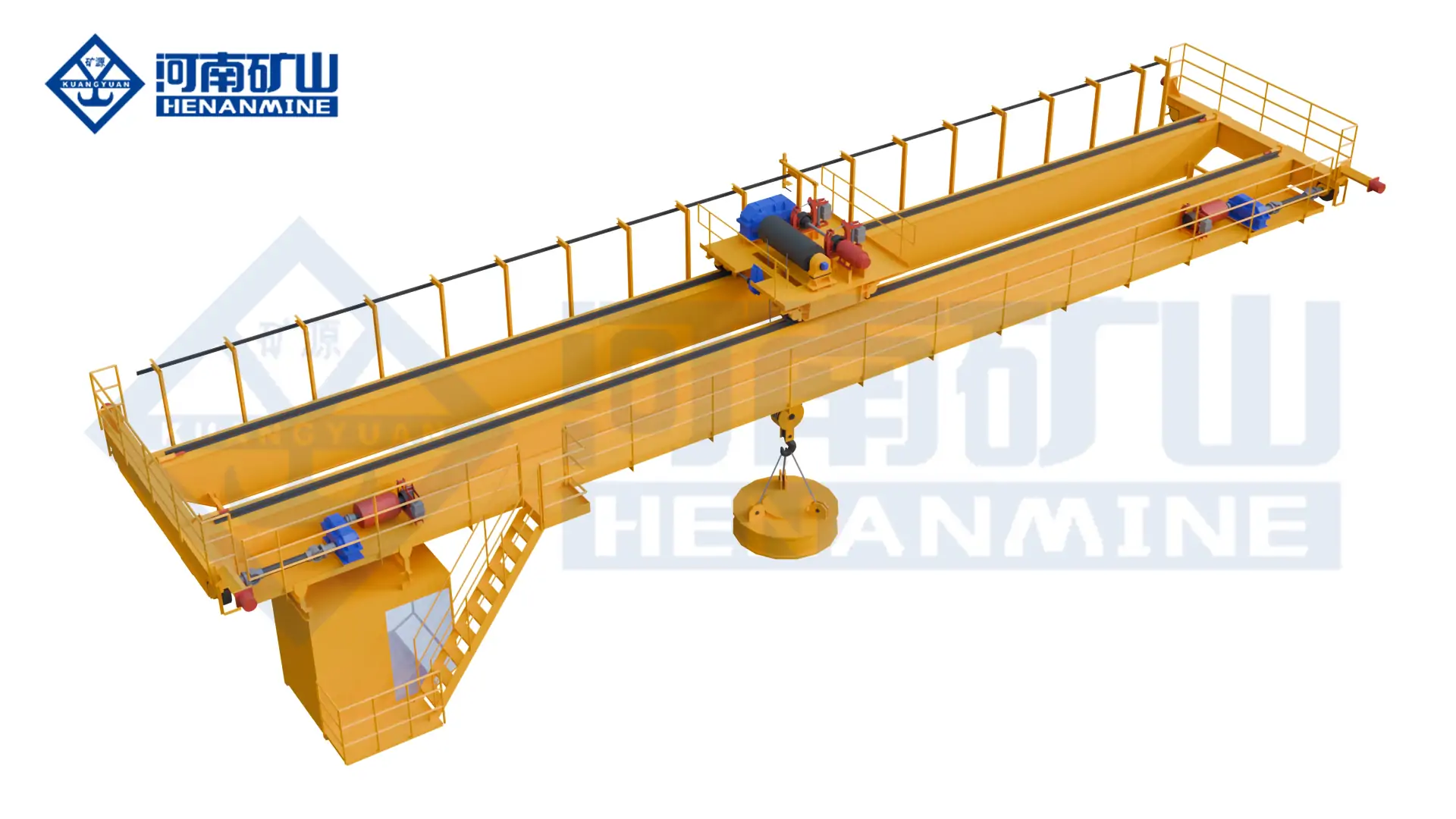
  • RMG Cranes for European Projects: Conformity Documents and Project Scope

    RMG Cranes for European Projects: Conformity Documents and Project Scope

    Technical guide

    RMG Cranes for European Projects: Conformity Documents and Project Scope

    Required conformity documentation must match the equipment, destination and contractual roles. Establish those requirements with the responsible project team and compare them alongside the RMG configuration and installation scope.

    Henan Mine CraneTechnical guide · Updated 2026Crane selection, project scope and operating requirements
    Henan Mine Crane Rail-Mounted Gantry (RMG)
    Henan Mine Crane Rail-Mounted Gantry (RMG)
    Project planning notes

    Key points for this crane project.

    1. Establish a common technical brief
    2. Compare the proposed equipment and engineering
    3. Define the boundary of supply
    Read the technical guide

    Establish a common technical brief

    Required conformity documentation must match the equipment, destination and contractual roles. Establish those requirements with the responsible project team and compare them alongside the RMG configuration and installation scope.

    Set out cargo flows, stacking or transfer positions and the available quay or yard layout. Identify which dimensions and operating conditions are confirmed and which still need a survey or engineering review. Each supplier should respond to this same information so differences in the proposed equipment can be understood.

    Compare the proposed equipment and engineering documents

    Request the configuration-specific dimensional drawing, lifting arrangement, working duty and support information. Ask the supplier to identify the assumptions behind the proposal and the interfaces that depend on the building, civil works or connected process equipment.

    A general brochure or a familiar manufacturer name does not replace this project review. Confirm that the documents describe the arrangement actually being quoted and that open technical items have a named owner.

    Define the boundary of supply

    Separate crane equipment from the supporting works, power supply, installation resources and site acceptance activities. Record what is included, excluded or provisional in each offer. Compare delivery and documentation on the same destination and responsibility basis.

    Where a local contractor or distributor coordinates part of the work, identify the handover between that party and the equipment manufacturer. Resolve gaps before the order is placed.

    Agree acceptance, maintenance and support responsibilities

    Set out the required inspection and acceptance records and the responsibilities for resolving findings. Clarify commissioning support, operator handover, maintenance documentation and the spare-parts information included with the equipment.

    Evaluate service commitments using the proposed contractual scope and the resources relevant to the destination site. Ask how technical queries and replacement-part identification will be handled after delivery.

    Compare the complete commercial offer

    Review the technical arrangement and project scope alongside the commercial terms. List optional equipment, provisional items and assumptions separately so an apparently lower offer is not compared with a more complete supply package.

    Use the agreed project brief, resolved technical queries and final responsibility list as the basis for purchasing. Keep manufacturer comparisons tied to documented proposals rather than unsupported league tables or general claims about price and quality.

    Discuss the crane arrangement for your project.

    Required conformity documentation must match the equipment, destination and contractual roles. Establish those requirements with the responsible project team and compare them alongside the RMG configuration and installation scope. Share the load, available drawings, working cycle and site conditions with Henan Mine Crane so the required configuration and supply boundary can be discussed.

    Related crane configurations

    Rail-Mounted Gantry (RMG)

    View product parameters
    Lifting capacity: 35 t, 40.5 t, 50 tSpan: 18 – 35 mLifting height: 12.3 – 21 m

    Use an RMG for container transfer along a fixed rail layout. Select the lifting arrangement, yard coverage and positioning controls from the container flow and stacking requirements.

    Rail-Mounted Container Gantry Crane

    View product parameters
    Lifting capacity: 35 t, 40.5 t, 50 tSpan: 18 – 35 mLifting height: 12.3 – 21 m

    Handle containers along a fixed yard runway with a rail-mounted container gantry crane. Coordinate the spreader, stacking geometry, rail layout and transfer positions around the terminal operation.

    Updated 2026 · Henan Mine Crane