Electromagnetic vs Grab Cranes for Steel Handling: Material Comes First
The suitable attachment depends on the material's form and handling condition. Compare magnetic lifting and grabbing against the actual stock, transfer sequence and release requirements before selecting the complete crane arrangement.
Key points for this crane project.
- What Is an Electromagnetic Crane?
- What Is a Grab Crane?
- Electromagnetic Crane vs. Grab Crane: Key
What Is an Electromagnetic Crane?
An electromagnetic crane is similar to an overhead or gantry crane but uses a circular electromagnet in the place of a hook or bucket. When the electromagnet is energized, the force when the magnetic fields when energized is intense enough to grip the steel directly and move the load without the need for slings, chains or rigging.
Electromagnetic cranes are used in all steel mills, scrapyards, shipbuilding and auto plants, and especially where coils, plates or fairly clean ferrous scrap are passing from one operation to another very rapidly. Almost all large industrial units have a battery-backed, power-off holding system so that the magnet maintains its hold when the power is shut off – an essential safety feature where the lifting operation is taking place above people.
What Is a Grab Crane?
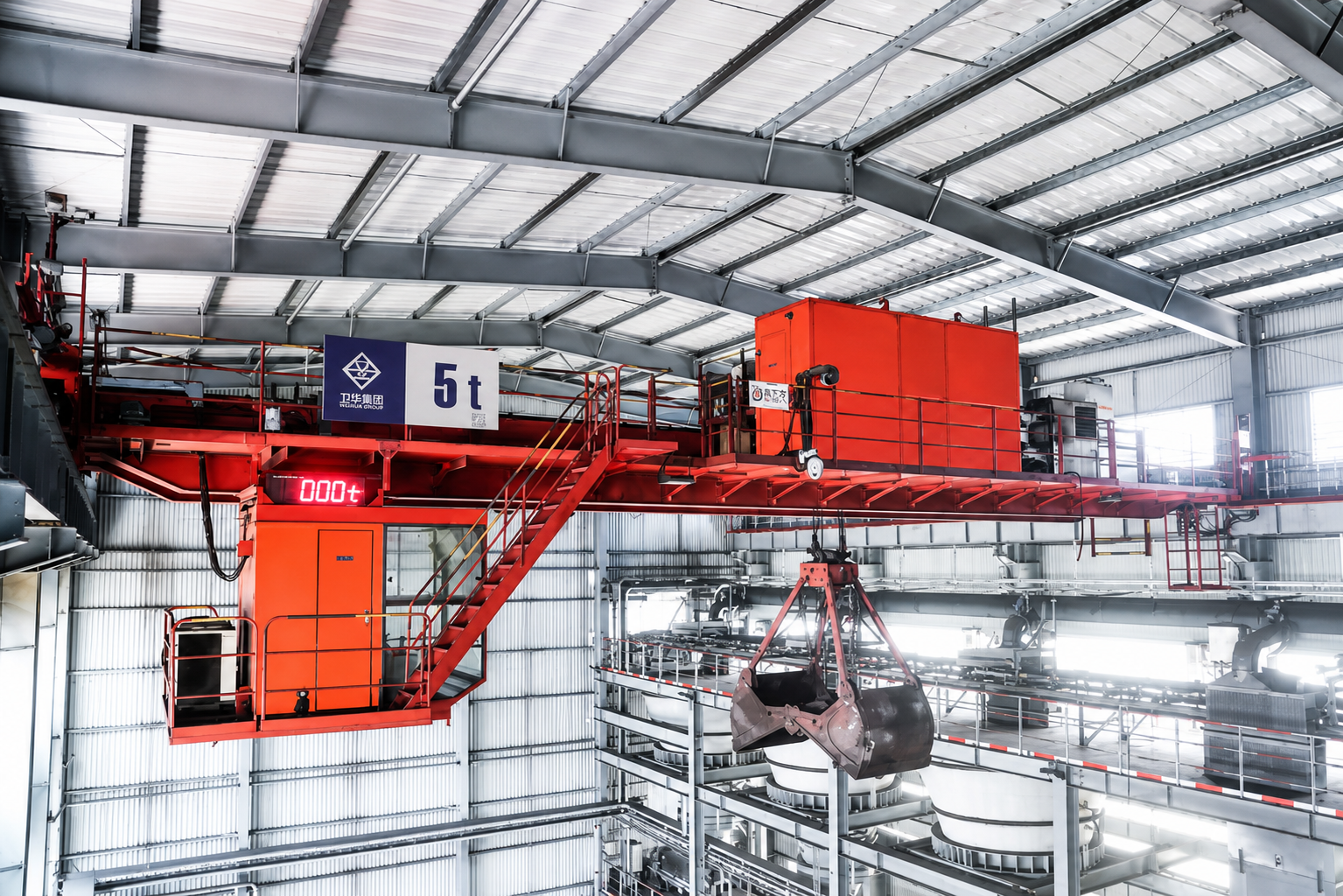
A grab crane is actually an overhead or gantry crane with a clamshell grab suspended underneath it instead of a magnet or a hook. The jaws of the grab open and close (normally by a hydraulic cylinder) to physically clamp around the general or irregular shape.
Since the grab crane does not magnetize and clamp, it has the advantage of being able to empty non-magnetic materials like iron ore, coke, limestone, slag, non-ferrous metals, mixed and bundled scrap. Therefore, it is the standard piece of equipment in the raw material yard and any bay where loads cannot be expected to be purely clean, magnetic steel.
Electromagnetic Crane vs. Grab Crane: Key Differences at a Glance
| Factor | Electromagnetic Crane | Grab Crane |
|---|---|---|
| Material compatibility | Ferrous materials only (steel, iron) | Ferrous and non-ferrous, mixed and irregular materials |
| Weather resilience | Best suited to controlled, indoor environments | Handles rain, snow, dust, and temperature extremes reliably |
| Automation level | High — no manual rigging or slinging needed | Moderate — hydraulic grabs are automated, but the load itself is more variable |
| Versatility | Limited to whichever magnet is configured for the load | High — one grab can handle diverse material streams |
| Power draw / operating cost | Higher continuous power consumption | Primarily hydraulic; different cost profile |
| Component wear | Fewer, more expensive electrical component replacements | More frequent, lower-cost mechanical component replacements |
| Typical service life | 20–30 years with proper maintenance | 20–30 years with proper maintenance |
Where Electromagnetic Cranes Win in a Steel Mill
Coil, plate, and billet handling
The magnetic lifting tool can be used to lift the coil, which can save the tedious and low-speed procedure of manually aligning the C hook with the inner hole of the coil. Magnetic adsorption and unloading release can be completed instantaneously, which is also the core reason why electromagnetic cranes and special coil cranes are widely used in rolling workshops and finishing span areas.
Hot billet transfer
The temperature of billet produced by continuous casting process can reach 800 DEG C or more. Magnetic lifting tools do not have the structure of physically clamping workpieces, which can greatly reduce the probability of collision damage on the surface of high temperature steel that is still in the forming stage. Compared with mechanical grab, it has very prominent advantages in this working condition.
High-volume, single-material operations
The operation time saved by a single lifting will continue to accumulate in the frequent lifting day after day, and the overall operation efficiency will be significantly improved.
Foundry and scrap-return handling
Cast iron ingot, steel ball, pig iron block and clean machining steel scrap and other materials, are suitable for magnetic lifting operations. With good adaptability and operation advantages, electromagnetic crane has become the standard lifting equipment for foundry workshop and scrap recovery section.
Where Grab Cranes Win in a Steel Mill
Raw materials yards
Iron ore, coke, raw coal, limestone and other burden raw materials need to be transported into the smelting furnace after storage, and these materials cannot be hoisted by magnetic equipment. Therefore, clamshell and hydraulic grab crane are the only practical equipment selection for raw material storage yard operation.
Cold or coated billets
After the billet is cooled or coated, the adsorption and clamping force of electromagnetic crane will be greatly attenuated, and the lifting stability will be greatly reduced. For cooled billets and coated billets stored at normal temperature and transferred in storage yard, mechanical clamp is the preferred scheme with higher safety and more stable operation.
Mixed and non-ferrous scrap
For scrap mixed with iron and nonferrous metals, bundled scrap and irregular scrap, mechanical grab operation adaptability is better. Mechanical grab relies on physical wrapping to clamp materials, which is different from magnetic adsorption principle, and can effectively solve the problem that mixed and irregular wastes cannot be hoisted stably.
Outdoor and exposed installations
Mechanical grab lifting system has excellent environmental adaptability, can withstand rain, snow, dust, high and low temperature and other complex outdoor conditions, stable performance is not easy to damage, waste dump, port, open yard and other unshielded operation area standard equipment. However, in such complex open-air environment, the operation performance and reliability of magnetic lifting equipment are difficult to be effectively guaranteed.
Cost and Lifecycle Comparison
There is no absolute cost advantage between the two types of lifting equipment. The overall cost of ownership mainly depends on the frequency of equipment operation and the type of materials handled. The cost differences are as follows:
- Initial investment cost: grab crane early procurement investment is lower, equipment configuration flexibility is strong, can adapt to a variety of complex conditions quickly adjust the configuration scheme.
- Operation cost: electromagnetic crane needs to be continuously energized to maintain magnetic lifting force, and the whole process continues to consume electricity; grab crane mainly relies on hydraulic system to complete the operation, and the energy consumption operation mode is significantly different from electromagnetic equipment.
- Maintenance cost and mode: electromagnetic lifting system fault maintenance frequency is lower, but the single maintenance cost is higher, the core maintenance items are concentrated in the coil, power components replacement and other high-priced accessories. The grab lifting system has more mechanical loss parts, higher daily maintenance and repair frequency, but the single maintenance cost is low, and the overall maintenance threshold is lower.
- Equipment service life: Under the premise of standardized maintenance, the service life of two types of equipment can reach 20 to 30 years. Therefore, the core consideration for equipment selection is not basic durability, but the long-term benefits brought by labor cost savings and improved work cycle efficiency.
Safety Considerations
Both types of equipment are suitable for heavy industrial operation scenarios with high load and high-capacity, but there are obvious differences in their safe operation characteristics:
- Electromagnetic crane relies on continuous power supply to produce adsorption force to fix the load, so it must be equipped with a power failure and load maintenance system with standby energy storage device. This configuration is the standard configuration of industrial-grade equipment and is a must in equipment selection and procurement. It cannot be omitted.
- At the same time, the electromagnetic crane does not need manual auxiliary hanging hangers, which greatly reduces the frequency of operation of workers under lifting materials and dangerous areas, and effectively avoids the safety risks of manual hanging operations.
- Grab crane relies on mechanical clamping force to fix materials, without relying on continuous power supply to stably carry loads, and power failure safety is better. However, it is necessary to regularly check the wear of the grab jaws to avoid potential safety hazards such as insufficient clamping force and material falling due to component wear.
How to Choose: A Decision Framework by Mill Zone
Most steel mills will not configure a single type of crane for the whole plant, but according to the material characteristics and operating environment of each cross-workshop, the crane model is targeted to maximize adaptability and operating efficiency. The specific selection standards for each area are as follows:
- Raw material storage yard: grab crane shall be selected. Non-ferrous metals and bulk materials loading and unloading operations, rely on mechanical clamping structure to complete, grab crane can perfectly adapt to this kind of materials grab, transfer needs.
- Scrap storage yard: grab crane shall be selected. The material category in this area is complicated, and the versatility of multi-material adaptation of grab crane is more important than the operation frequency advantage of electromagnetic crane, which can meet the flexible loading and unloading of various scrap steel.
- Melting workshop/foundry workshop: electromagnetic crane shall be selected. The materials in this area are mainly homogeneous ferrous metals. The electromagnetic crane can realize high-frequency sub-cycle operation, greatly improve the melting feeding efficiency and meet the continuous production requirements.
- Continuous casting billet operation area: electromagnetic crane shall be selected. It can absorb high temperature billet stably, effectively avoid the damage caused by clamping equipment to the surface of high temperature steel, and ensure the forming quality of billet.
- Billet storage area: grab crane or mechanical clamping crane shall be selected. The magnetic adsorption performance of normal temperature steel and coated steel is greatly attenuated, the clamping stability of electromagnetic crane is insufficient, and the mechanical gripping equipment is more reliable.
- Rolling finishing span: electromagnetic crane is selected. Electromagnetic crane is the best choice for the repetitive transfer of steel coils and plates because of its speed and safety.
- Outdoor storage and open space: grab crane is selected. The equipment has stronger weather resistance, can adapt to extreme outdoor environments such as high and low temperature, wind and rain, and the operation stability is not affected by climate temperature fluctuations.
- Pre-selection requirements: before determining the crane model, it is necessary to accurately verify the exclusive operation parameters of the single-span workshop, including single lifting weight, single shift lifting times, ambient temperature range, operation span, etc. Crane type and load class must be customized according to single-span operation parameters, rather than applying uniform standards for the whole plant.
Duty Class and Capacity Notes for Steel Mills
Crane load class and model is equally important, directly determines the service life of equipment and production stability, the operation area level specifications are as follows:
- This area is not suitable for conventional electromagnetic, grab accessories, need special ladle, casting crane operation.
Common error warning: improper load class selection is a high-frequency problem of steel plant equipment configuration. Ordinary "heavy duty" cranes that are only suitable for intermittent operations cannot withstand high-frequency continuous operations in areas such as scrap yards, and are prone to excessive wear and tear of equipment, frequent failures, and greatly shortened service life.
Discuss the crane arrangement for your project.
The suitable attachment depends on the material's form and handling condition. Compare magnetic lifting and grabbing against the actual stock, transfer sequence and release requirements before selecting the complete crane arrangement. Share the load, available drawings, working cycle and site conditions with Henan Mine Crane so the required configuration and supply boundary can be discussed.
Related crane configurations
Electromagnetic Overhead Crane
View product parametersLift ferromagnetic steel with a matched electromagnetic lifting arrangement. Product shape, contact area, temperature and handling frequency determine the magnet and crane configuration.
Electromagnetic Hanging Beam Crane
View product parametersSupport long steel products with an electromagnetic hanging beam. Beam length, magnet spacing and lifting points are configured around product geometry, orientation and stacking requirements.
Updated 2026 · Henan Mine Crane