Engineering · Manufacturing · Project support
info@hnksglobal.comWhatsApp +86 18836207779 ↗

Blog

  • Carbon Product Handling Cranes: Grip, Stacking and Process Conditions

    Carbon Product Handling Cranes: Grip, Stacking and Process Conditions

    Technical guide

    Carbon Product Handling Cranes: Grip, Stacking and Process Conditions

    Carbon products need a lifting arrangement matched to their geometry and handling condition. Provide the product information, contact requirements and transfer sequence so the attachment and crane functions can be assessed together.
    Henan Mine CraneTechnical guide · Updated 2026Crane selection, project scope and operating requirements
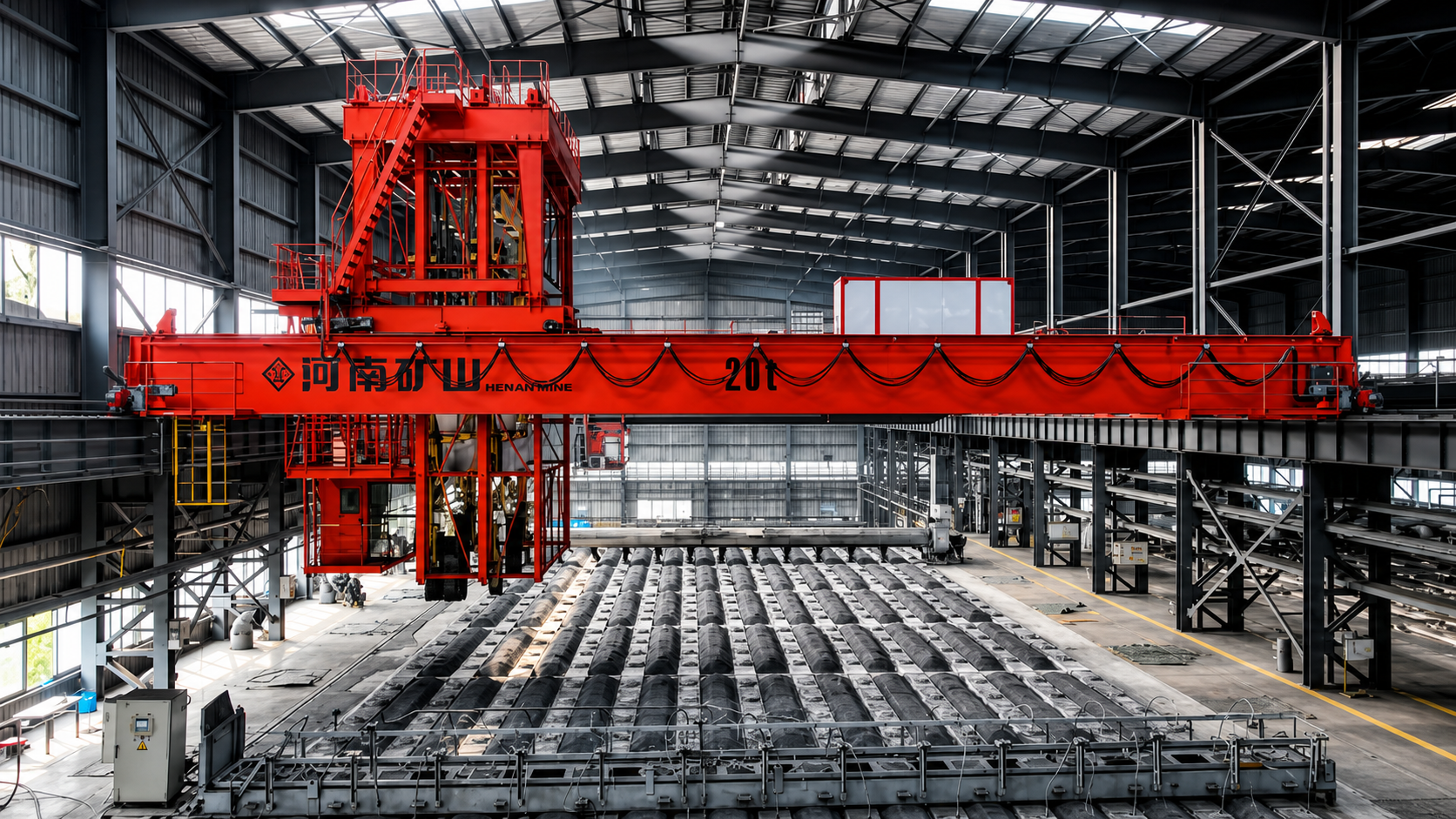
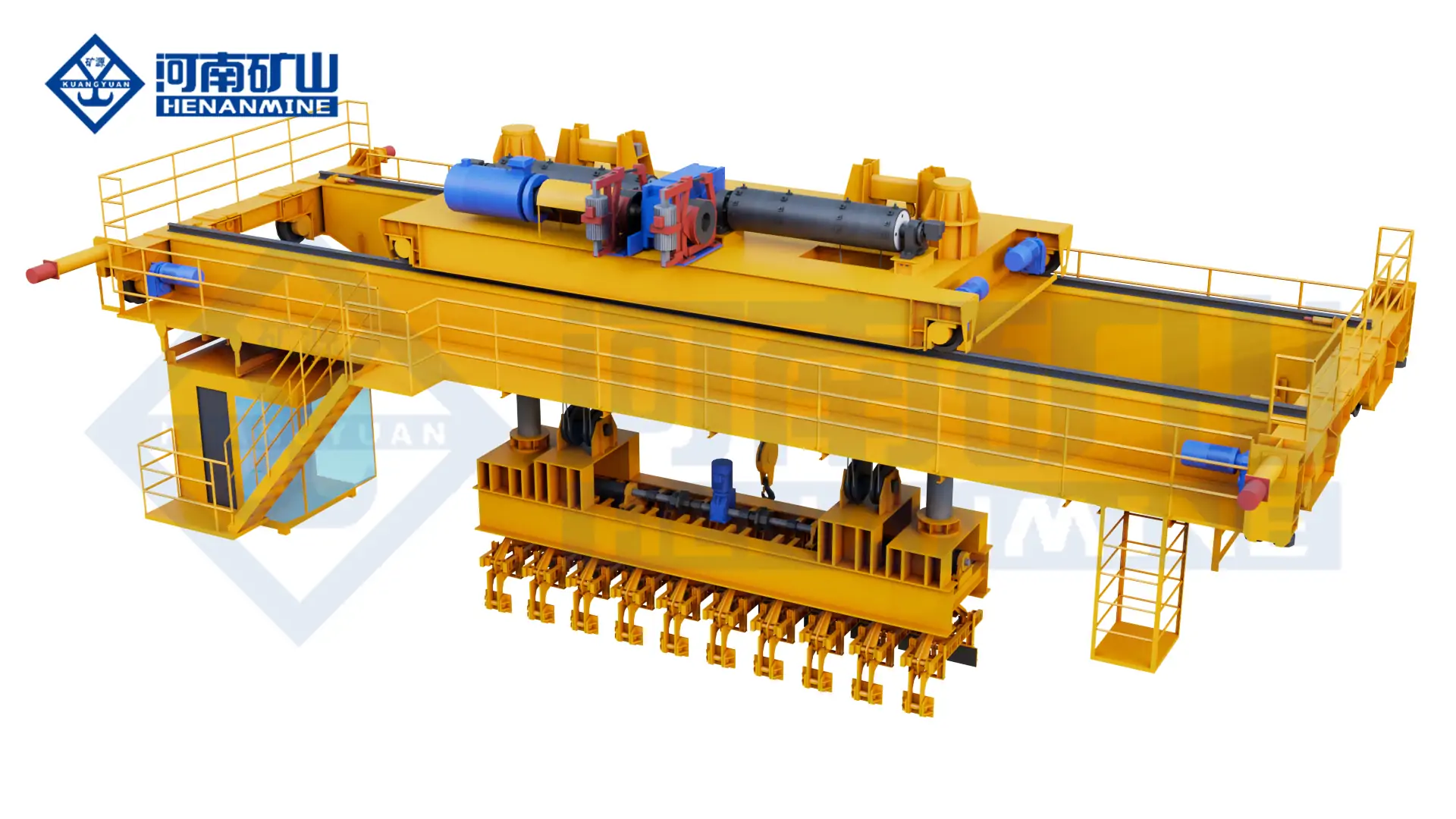
    Henan Mine Crane Anode Carbon Block Stacking Crane
    Henan Mine Crane Anode Carbon Block Stacking Crane
    Project planning notes

    Key points for this crane project.

    1. Understanding Carbon Product Handling Requirements
    2. Key Factors to Consider When Choosing a Dedicated
    3. Selecting the Right Crane Type for Carbon Product
    Read the technical guide

    Understanding Carbon Product Handling Requirements

    Various types of industrial carbon products in the handling, cutting, stacking process, will expose multiple safety hazards, but also the core basis for the selection of special cranes:

    • Dust Hazard and Explosion Risk: Carbon products operations will produce a large amount of fine dust, suspended in the air is very easy to be inhaled by the human body, stimulate the respiratory tract, skin and eye mucous membranes; when the concentration of dust reaches a critical value, sparks, high temperatures can lead to dust explosions and fires, is the core of the carbon plant's safety hazards.
    • Risk of static electricity accumulation and ignition: Most carbon products have conductive properties, and the friction between materials and equipment during transportation will quickly accumulate static electricity, which, if not released in time, will not only cause static breakdown of the equipment and electrocution of the personnel, but will also ignite the suspended carbon dust and lead to safety accidents.
    • Risk of material adsorption and pollution: Activated carbon and other porous carbon materials have strong adsorption properties, and it is very easy to adsorb moisture, chemical vapors, and impurity pollutants in the air, which leads to a decrease in the purity of the material, product obsolescence, and even produces a secondary chemical reaction, which leads to an unknown safety hazard.
    • Chemical reaction risk: Carbon products are strictly prohibited from contacting with strong oxidizing agents, open flames, and high temperature heat sources. In the environment of high temperature, high corrosion, and mixed impurities, abnormal reactions are likely to occur, exacerbating the safety risks.

    On-site Standardized Handling and Storage Norms

    In order to reduce the risk from the source, the carbon products factory needs to strictly follow the industry norms and material safety data sheet (SDS) requirements, the implementation of standardized operations:

    • In terms of storage, carbon products should be stored in dry, clean and pollution-free closed areas, using ton bags, iron drums, sealed cartons and other sealed containers, away from open flames, high-temperature equipment, direct sunlight and strong oxidizers, bulk materials need to be well fenced off for storage, and regular inspection of contamination and sedimentation problems.
    • The operation should be mechanized and closed to reduce manual contact; dry dust sweeping is strictly prohibited, and precise dust-absorbing equipment should be used; all equipment should be grounded throughout the whole process, and air testing and special approvals should be implemented for limited space operations.

    The special properties of carbon products determine that ordinary cranes cannot meet the operational requirements.

    Key Factors to Consider When Choosing a Dedicated Crane

    Matching Load Capacity and Material Characteristics

    It is necessary to accurately account for the maximum weight, external dimensions and center of gravity of carbon product tonnage bags, material drums and equipment, as well as to consider the frequency of full-load lifting. Selection is strictly prohibited “small horse-drawn cart” triggering equipment overload failure, and there is no need for excessive overload caused by cost waste. At the same time, it is necessary to match the corresponding lifting appliance in advance with the shape of the material to ensure the stability of lifting.

    CMAA Working Level

    Work level is the core indicator of crane selection, the industry common CMAA A-F class division standard, based on the daily operating hours, the number of lifts per hour, the average load ratio, the operating distance classified levels. Carbon products factories are mostly continuous, high-frequency operations, mostly suitable for D-F heavy grade, extra-heavy grade work level; if the misuse of A-B light equipment, will lead to rapid wear and tear of the equipment, frequent failures, and planted potential safety hazards.

    Adaptation of Space Parameters

    Combined with the plant span, effective lifting height, top clearance and site obstacle layout, the span, operation mode and structure form of the crane are accurately determined. At the same time, according to the load bearing conditions of the plant, single girder, double girder, top mounted, bottom mounted and other suitable models are reasonably selected to ensure that the equipment is installed in accordance with the rules and operates smoothly without interference.

    Operational Performance and Control Mode

    According to the demand of production efficiency, reasonable configuration of lifting, trolley, trolley running speed, with frequency conversion speed control system (VFD), to realize smooth starting and stopping, accurate alignment, to avoid high-speed starting and stopping caused by material shaking, dust flying.

    The control mode can be handheld button, wireless remote control, cab control, etc., to meet the needs of different operating scenarios.

    Environmental Adaptability

    Carbon products production plants are generally characterized by high dust concentration, slightly corrosive media, temperature and humidity fluctuations and other working conditions. Cranes adapted to the working conditions must be dustproof, explosion-proof, corrosion-resistant, high and low temperature resistance, and all electrical components must be sealed and protected to meet the Class II dust and explosion-proof high-risk environment requirements.

    Structural Installation and System Integration

    Equipment selection before the field survey of the plant load-bearing structure, verify the crane rail, bracket installation conditions, while taking into account the installation period and later equipment expansion and transformation needs. Ensure that the lifting equipment can be seamlessly linked with the plant's conveyor equipment, dust removal systems, automated production lines, perfectly adapted to the overall production process.

    Full Life Cycle Operation and Maintenance Benefits

    Crane selection cannot only focus on the initial procurement costs, but also need to comprehensively consider the later operation and maintenance, parts replacement, energy consumption, downtime losses and other life cycle costs. High-quality carbon products crane, although the initial investment is high, but the failure rate is low, easy operation and maintenance, longer service life, long-term comprehensive cost-effective advantage.

    Budget and Customization Needs

    Combined with the overall project budget, a reasonable balance between the standardized configuration of equipment and personalized customization needs.

    Selecting the Right Crane Type for Carbon Product Handling

    Explosion-Proof Overhead Bridge Cranes

    This model is the preferred equipment for indoor production, packaging and storage of carbon products. Equipped with Class II Zone 1 / Zone 2, Group F exclusive explosion-proof motor, brake and control system, NEMA 9 dustproof and explosion-proof sealed cabinet, equipped with bronze, stainless steel and other non-sparking parts.

    Explosion-Proof Gantry Cranes

    Gantry Cranes mainly applicable to outdoor yards, loading and unloading areas, and operation scenes without the top support structure of the plant. Inheriting the explosion-proof, anti-static, non-sparking core advantages of the overhead travelling crane, it has a flexible layout, strong adaptability to the site, and can be linked with the dust removal system of the plant, perfectly adapted to the outdoor carbon material stacking, transshipment and loading operations. When selecting the model, you need to focus on considering the ground bearing capacity and outdoor wind-resistant design.

    Explosion-Proof Jib Cranes or Workstation

    They are small workstation lifting equipment, suitable for feeding port, unloading station, mixing workshop, equipment maintenance and other local work areas. Compact structure, small footprint, easy to ground the machine, dustproof sealing, can realize a small range of high-frequency precision lifting, to solve the carbon material handling needs of the local workstation, to avoid the waste of a wide range of equipment resources.

    Explosion-proof Monorail and Customized Equipment

    Adapted to the assembly line linear conveying conditions, explosion-proof monorail cranes can be accurately docked with pneumatic conveying, closed feeding system, seamless linkage, highly adaptable to automated continuous production process.

    For shaped material structure and complex special conditions, manufacturers can be used to customize the lifting program, such as Henan Mining to provide customized solutions to accurately match the individual operational needs, to solve the problem of non-standard lifting.

    Choosing the Appropriate Lifting Attachments

    Attachment is a core component that directly contacts carbon materials, its material, structure and performance directly determine the safety of operation and material integrity, the selection needs to strictly follow the ASME B30.20, OSHA, ATEX/IECEEx standards.

    Four core principles for selection of attachments

    • Non-sparking material principle: all parts in contact with materials must be made of bronze, brass, austenitic stainless steel and other non-ferrous metals, and ordinary carbon steel is strictly prohibited to avoid impact, friction and sparks.
    • Continuous anti-static principle: the attachment needs to form a complete conductive path with the crane body, with grounding straps, conductive slings, continuous release of static electricity, to eliminate the accumulation of static electricity.
    • Dustproof and easy to clean principle: Priority is given to the use of smooth closed structure, to eliminate hollowing out, dust accumulation dead ends, reduce carbon dust adhesion, easy to daily cleaning, to avoid the accumulation of dust triggered by the risk.
    • The principle of high safety redundancy: the safety factor of the attachment is not less than 5:1, suitable for high-frequency heavy-duty, dusty and corrosive conditions, and at the same time, it has formal explosion-proof and dust-proof certificates.

    Recommended Lifting Attachments

    • Non-sparking hooks and lower pulley sets: made of solid bronze, bronze-plated stainless steel, they are the standard components of explosion-proof cranes, eliminating impact sparks from the source, and are suitable for all kinds of basic lifting scenarios.
    • Conductive slings and explosion-proof rigging: bronze-plated chain, stainless steel wire rope, conductive synthetic fiber slings, taking into account the flexibility, conductivity and non-sparking characteristics, suitable for carbon products, ton bags, soft bags of material lifting.
    • Special spreader for tonnage bag: Multi-point closed tonnage bag lifting frame can smoothly lift up carbon products and big bag materials, avoiding bag tearing and dust leakage during lifting, realizing dust-free lifting.
    • Customized lifting beams and explosion-proof vacuum spreaders: Spark-free lifting beams can be customized for irregular materials and large-scale work equipment; explosion-proof vacuum spreaders can be used for special dust-free work requirements to minimize dust disturbance.

    Attachment System Compliance Requirements

    It is strictly prohibited to replace the explosion-proof attachments with ordinary attachments or mix them with the explosion-proof mainframe. Attachment protection is missing or level mismatch, will break the whole machine explosion-proof protection closed loop, resulting in sparks, static electricity, dust leakage and other hidden dangers, very easy to cause explosions, equipment failure, material contamination, resulting in the failure of the whole machine explosion-proof system.

    Essential Safety Features for Carbon Handling Cranes

    Carbon dust high-risk environment, crane safety configuration needs to focus on “eliminate ignition sources, control dust risk, avoid equipment failure” three core, build a full range of protection systems, fully adapted to Class II Group F dust explosion-proof scenarios standard.

    Complete Explosion-proof Electrical System

    The whole machine motor, brake, limit switch, control line, junction box are Class II 1 zone / 2 zone explosion-proof configuration, using NEMA 9 dustproof and explosion-proof sealing structure, which can prevent dust from entering the electrical cavity to avoid internal arc, high temperature leakage, and at the same time, strictly control the surface temperature of the equipment, which is lower than the ignition point of the carbon dioxide dust.

    Full-dimensional Electrostatic Grounding System

    Equipment to build the whole machine full-dimensional electrostatic grounding system, through the crane body, running track, lifting appliances and materials of the complete conductive path, real-time channeling and release of static electricity accumulated in the course of the operation, a complete solution to the problem of static buildup of carbon materials, and effectively avoid static-induced ignition of dust safety risks.

    Professional Dust Protection Structure

    The whole machine adopts closed sealing protection design, the surface of the equipment is smooth and flat, no dust accumulation dead corner, with dustproof sealing rubber strips and positive pressure blowing structure, which can effectively prevent carbon dust from invading into the internal equipment. At the same time, the equipment is easy to clean and maintain, which can avoid all kinds of safety hazards caused by dust accumulation and overheating.

    Enhanced Safety Protection Devices

    The equipment is equipped with multiple safety protection devices, such as overload protection, high and low level limit, travel limit, anti-collision, emergency stop, failure brake, etc. With intelligent sound and light alarm system, it can realize real-time warning of malfunctions and emergency stop of abnormality, which can effectively prevent illegal operation, equipment collision and other safety accidents, and guarantee the safety of operation in all aspects.

    Standardized Certification and Operation Management System

    At the same time, it is necessary to establish a perfect operator, operation and maintenance personnel special training system, standardized high-risk working conditions operation process, from the equipment and personnel to build a solid safety management system.

    Automation and Smart Technology Considerations

    Intelligent automation technology can effectively reduce the frequency of personnel entering the high-risk work area, reduce the risk of manual exposure, while improving the accuracy and stability of the operation, which is the core direction of the modernization and upgrading of carbon plant safety.

    Core Application Value

    Through intelligent transformation, it can reduce the risk of dust inhalation and electrostatic injury by reducing manual close operation; precisely control the lifting trajectory to reduce the dust caused by material shaking; and realize real-time monitoring of equipment status to pre-judge failures in advance and avoid the risk of equipment failure in high-risk environments.

    Intelligent Configuration for High-risk Environments

    • Explosion-proof wireless remote control system: Intrinsically safe explosion-proof remote control equipment, the operator can be controlled from a distance, away from high-risk work areas, to protect personal safety.
    • Laser positioning and intelligent anti-collision system: Relying on laser and ultrasonic sensors to realize accurate positioning, automatically identify peripheral equipment and building structures, and actively avoid collision to ensure operational stability.
    • Real-time Load Monitoring System: Equipped with intelligent weighing sensors, it displays the lifting weight in real time and automatically triggers overload alarm and limit protection to prevent overloading.
    • IoT predictive maintenance system: real-time collection of equipment operation data through temperature, vibration, and current sensors, cloud analysis of equipment status, advance prediction of wear and tear, failure problems, and preventive maintenance.
    • Environmental linkage monitoring system: docking plant dust, temperature monitoring equipment, when the environmental parameters exceed the standard, automatic alarm and suspension of lifting operations, to avoid the risk of explosion.
    • Semi-automatic programmed operation mode: for repetitive lifting processes, a fixed running track can be set to realize one-key start-stop and automatic alignment to improve operational efficiency and standardization.

    Cautions

    After the completion of intelligent upgrading and transformation of equipment, the qualification of the whole machine for high-risk environment shall be re-verified, and it is strictly prohibited to modify the structure and control system of the equipment privately, so as to prevent the failure of explosion-proof performance, nullification of the qualification, and other potential safety hazards.

    Evaluating Crane Reliability and Maintenance Requirements

    Carbon dust working conditions wear and tear, high risk, equipment reliability directly determines the plant safety and production continuity, scientific assessment and operation and maintenance system is the key to long-term stable operation of equipment.

    Equipment Reliability Core Assessment Criteria

    1. match the actual working conditions strictly according to the CMAA working level standard, for the special environment of carbon dust corrosion and high loss, it is necessary to appropriately raise the working level of the equipment and take the way of reducing the amount of use, to offset the loss of the equipment caused by the bad working conditions, and to ensure the stability of the operation.
    2. comprehensively verify the integrity and completeness of the explosion-proof components, dust-proof sealing structure and electrostatic grounding system of the whole machine, and strictly verify the third-party authoritative certification and special test reports to ensure that the equipment complies with the standards.
    3. Prioritize the selection of equipment with redundant component design, perfect wear-resistant and corrosion-resistant configuration, and excellent MTBF, and at the same time, combine with the manufacturer's carbon products industry similar landing cases to comprehensively assess the suitability of the equipment for the working conditions and operational reliability.

    Carbon Dust Environment Exclusive Operation and Maintenance Specifications

    • Classified inspection system: daily pre-shift inspection of equipment appearance, grounding status, and dust accumulation; weekly and monthly functional tests to verify the performance of limit, brake, and remote control systems; annual load test, electrical explosion-proof test, and grounding resistance test to complete a comprehensive compliance verification.
    • Explosion-proof special operation and maintenance: Regularly check the sealing rubber strips, dust and explosion-proof performance of the box, test the wear and tear of non-sparking parts, verify the value of grounding resistance, and prevent private modification of the structure of the equipment to destroy the explosion-proof level.
    • Dust special cleaning and maintenance: the use of dust-free cleaning equipment to regularly clean the dust accumulated on the surface of the equipment, and timely replacement of aging seals, filtering components, to avoid the accumulation of dust erosion of equipment components.
    • Digital operation and maintenance management: Relying on the intelligent system to record inspection, repair and maintenance data, realize the traceability of the whole life cycle of the equipment, implement predictive maintenance, and reduce sudden downtime failures.

    Full Life Cycle Cost Optimization Strategy

    In high-risk environments, low-quality and low-priced equipment will bring high operation and maintenance costs, downtime losses and security risks. Priority is given to high-quality, highly reliable special cranes, the initial investment is slightly higher, but can significantly reduce the frequency of maintenance, parts replacement costs and safety losses, to maximize the cost-effectiveness of the whole life cycle.

    Discuss the crane arrangement for your project.

    Carbon products need a lifting arrangement matched to their geometry and handling condition. Provide the product information, contact requirements and transfer sequence so the attachment and crane functions can be assessed together. Share the load, available drawings, working cycle and site conditions with Henan Mine Crane so the required configuration and supply boundary can be discussed.

    Related crane configurations

    Anode Carbon Block Stacking Crane

    View product parameters
    Lifting capacity: 10 – 30 tSpan: 13.5-40 mLifting height: 6 – 20 m

    Handle and stack anode carbon blocks with a crane configured around block geometry, gripping method and storage layout. Define the transfer sequence and automation interfaces before selection.

    Galvanizing Process Overhead Crane

    View product parameters
    Lifting capacity: 5 – 32 tSpan: 10.5 – 31.5 mLifting height: 6 – 24 m

    Transfer suspended workpieces through a galvanizing process with a crane matched to the line. Coordinate lifting points, corrosive exposure, tank geometry and the required handling sequence.

    Updated 2026 · Henan Mine Crane
  • Dedicated Production Cranes: Specify Repeated Tasks and Equipment Interfaces

    Dedicated Production Cranes: Specify Repeated Tasks and Equipment Interfaces

    Technical guide

    Dedicated Production Cranes: Specify Repeated Tasks and Equipment Interfaces

    A dedicated crane should be designed around a defined process cycle. Establish load presentation, movement sequence and handover conditions before selecting automation functions and agreeing responsibility for the surrounding equipment.

    Henan Mine CraneTechnical guide · Updated 2026Crane selection, project scope and operating requirements
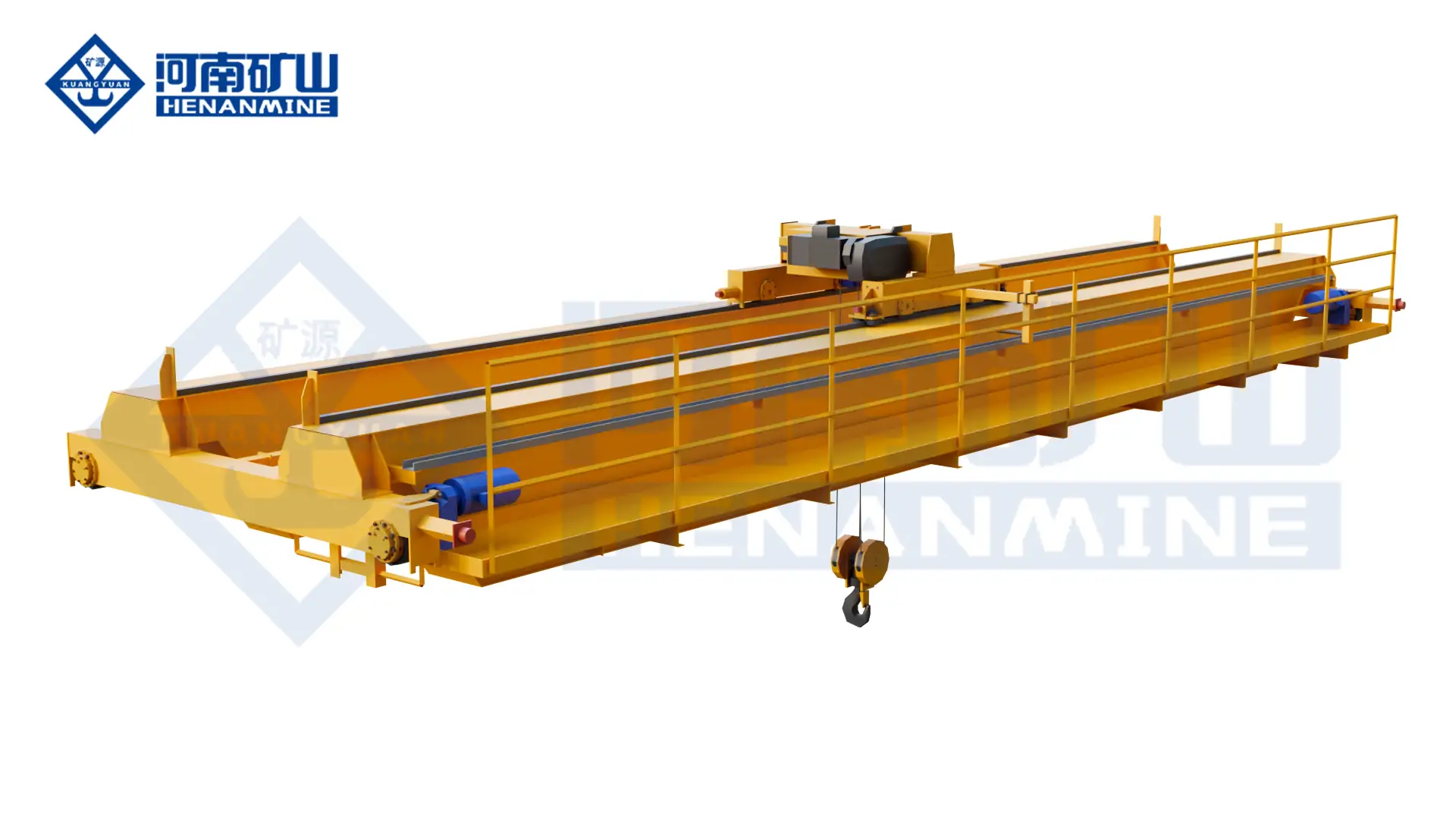
    Henan Mine Crane Modular Electric Hoist Overhead Crane
    Henan Mine Crane Modular Electric Hoist Overhead Crane
    Project planning notes

    Key points for this crane project.

    1. What Is a Dedicated Crane for Automated Production?
    2. Why Standard Cranes Fail in Automated Lines
    3. Step 1: Define Load, Duty Cycle & FEM/CMAA Class
    Read the technical guide

    What Is a Dedicated Crane for Automated Production?

    A dedicated crane for automated production is a crane system engineered for one specific application a fixed load range, a defined duty cycle, and a known production sequence rather than a general-purpose lifting tool. It integrates directly with PLC logic, sensors, and often a warehouse or manufacturing execution system (WMS/MES) to execute repeatable lift-transport-place cycles with minimal or no operator input.

    It matters because automated production lines are only as fast and reliable as their slowest material-handling link. A crane sized and controlled correctly removes that bottleneck; one selected like a generic hoist becomes the line's weakest point.

    Why Standard Cranes Fail in Automated Lines

    Off-the-shelf cranes are built for flexibility across applications, not for the repeatability automated lines demand. Three failure points show up repeatedly:

    • Duty cycle mismatch. A crane rated for occasional lifts (FEM Class A/B) breaks down fast under continuous automated cycling (FEM Class D/E).
    • No control interface. Standard hoists often lack the encoder feedback, VFD compatibility, or I/O architecture needed for PLC-driven positioning.
    • Insufficient positioning accuracy. Manual cranes tolerate inches of error; automated cells often need millimeter-level repeatability to hand off to a robot or fixture.

    Each of these gaps forces costly retrofits or production stoppages after installation. Crane projects in older factories often run smoothly at commissioning but encounter problems three to five years later when the crane becomes overloaded daily or stations become unreachable, ultimately requiring a costly second crane purchase.

    Step 1: Define Load, Duty Cycle & FEM/CMAA Class

    1. Maximum load weight, including the heaviest lifting attachment or fixture.
    2. Lift frequencycycles per hour, and hours of operation per day.
    3. Duty classFEM (European) or CMAA (North American) classification, which rates cranes from light/intermittent duty up to continuous heavy-duty cycling.

    Crane systems built for Industry 4.0 facilities maintain FEM Class D duty cycles while using high-strength steel to reduce weight. If your automated line runs near-continuous cycles, specifying anything below Class D/E duty rating guarantees premature bearing, motor, and structural wear.

    Why this matters for automation specifically: automated cranes run far more cycles per shift than manually operated ones, because there's no operator fatigue limiting throughput. Undersizing the duty class is the single most common reason automated crane installations fail early.

    Step 2: Match Crane Type to Layout

    Crane geometry must fit your floor plan, structural support, and production flow before automation features even enter the conversation.

    Crane TypeBest Fit for Automation
    Bridge/Overhead CraneLong-span lines needing full-bay coverage
    Gantry CraneFacilities without runway support, indoor/outdoor
    Monorail CraneLinear, repetitive assembly-line moves
    Stacker/Multi-Axis CraneAutomated storage, retrieval, precision placement
    Jib/Workstation CraneLocalized, repetitive station-level lifts

    Monorail cranes typically move in a straight line, with the trolley and hoist mounted on an I-beam, making them ideal for production and assembly line applications that can be custom configured for automated assembly line requirements. For multi-directional, high-precision handling, some manufacturers offer automated bridge crane systems designed to emulate 5-axis stacker cranes, enabling precise, multi-directional motion for heavy-duty load handling.

    If load capacity exceeds light-to-medium duty, or the application requires long-span coverage, outdoor use, or precision hoisting beyond the system's capability, a gantry or overhead crane is the more appropriate choice.

    Step 3: Set Positioning Accuracy & Repeatability Targets

    1. Manual-assisted crane: applicable to conventional auxiliary lifting scenarios, positioning tolerance control in ±5-10cm, can meet the needs of ordinary precision, non-precision lifting operations.
    2. Semi-automatic crane: equipped with basic encoder position feedback device, positioning accuracy of ±1-3cm, can be adapted to medium precision standardized, repetitive lifting operation scenarios.
    3. Fully-automatic crane: equipped with closed-loop servo control system and professional load sway control compensation algorithms, with sub-centimeter to millimeter-level ultra-high repetitive positioning accuracy, to meet the requirements of robots, fixtures and fixtures for accurate docking and other high-precision automation operations.

    Anti-sway and skew correction are standard functions for automated cranes: skew correction guarantees straight-line accuracy and trajectory stability, anti-sway control suppresses load swing, improves operational safety and positioning accuracy, and with multi-axis linkage control, multi-dimensional synchronous operation of the equipment can be realized to adapt to complex lifting conditions.

    Match the accuracy spec to the downstream process a crane feeding a robotic weld cell needs tighter repeatability than one simply staging pallets for a forklift.

    Step 4: Plan Automation Tier & Controls Integration

    Automated cranes typically fall into two categories. Semi-automatic cranes retain greater manual control but include features that assist the operator, while fully automatic cranes can execute repetitive or complex tasks with only operator setup required.

    Before selecting a tier, define the controls stack:

    • PLC and VFD integrationPLCs handle logic and inputs, while VFDs manage motor speed control, and together they form the backbone of crane automation integration.
    • HMI modernizationgives a single interface for drive configurations and dynamic crane feedback to both production and maintenance teams.
    • AGV/robotics handoffincreasingly common in Industry 4.0 lines, where cranes stop being lone devices and become smart points that interact with robotics, AGVs, and ERP systems.

    Don't select automation tier based on budget alone a fully automated crane bolted onto a facility with no PLC infrastructure or network backbone will underperform regardless of crane quality.

    Step 5: Build In Safety Systems for Unmanned Operation

    Removing the operator from the lift cycle raises the bar on built-in safety, not lowers it. Core systems to specify:

    • Personnel and obstacle collision avoidance system: real-time detection of personnel and equipment obstacles in the crane's running path through sensors to realize active obstacle avoidance and eliminate collision safety accidents.
    • Redundant braking and emergency stopping logic: Redundant braking mechanism and emergency stopping program are configured for heavy-duty and high-altitude lifting conditions, which greatly improves operational safety and fault tolerance under extreme working conditions.
    • Zone automation control: For high-risk processes such as electroplating, pickling, etc., the crane is restricted from ineffective operation through zone control, which reduces the exposure range of high-risk operations and effectively reduces operational safety risks.
    • Software no-fly/restricted area control: Relying on the software program to lock the equipment prohibited, restricted areas, and with the structure of the interlocking mechanism of double protection, to prevent violations of cross-area operation.

    Eliminating human error and removing people from dangerous environments makes workplaces both safer and more efficient but only if the automation layer itself includes redundancy. Look for vendors who build in obstacle detection and synchronized multi-axis movement as standard, not optional, features.

    Step 6: Evaluate Vendors & Custom Engineering Capability

    Not every crane manufacturer can deliver true automation engineering. Use this checklist when comparing vendors:

    • Self-developed control adaptability: the internal engineering team can be compatible with Rockwell, Siemens and existing SCADA platforms, support customized system integration, abandon the universal automation suite, to ensure that the equipment and the existing production system is stable linkage, highly compatible.
    • Empowerment of simulation and digital twin technology: Before equipment production and manufacturing, relying on the digital twin model to carry out sway control control, operation path simulation simulation, in advance to check the design defects and operation of the hidden problems, effectively avoiding the later construction rework problems, and significantly reduce the cost of rectification and transformation.
    • Factory Acceptance Test (FAT) validation mechanism: Before the project is officially put into use, a prototype proof-of-concept test is completed based on the real bridge crane equipment to comprehensively verify the equipment performance, control logic and operation stability, to avoid the risk of on-site commissioning in advance, and to ensure the efficient and smooth landing of the on-site commissioning work.
    • On-site technical support and hands-on training services: After the automated crane is put into use, it is necessary to provide supporting human-machine interface (HMI) hands-on training and rapid troubleshooting on-site services, rather than only providing remote parts sales services, to ensure that all-round equipment for daily stable operation and maintenance, and rapid disposal of faults.
    • Modular scalable design, adaptable capacity upgrade: crane main girder, end beam, trolley, hoisting mechanism and other core components support step-by-step upgrades and individual replacement, without the need to dismantle the entire machine. Iterative expansion on demand, phased investment, effectively reducing the pressure of the initial investment, to protect the long-term value of the equipment.

    Henan Mine Crane has extensive experience delivering customized lifting solutions for manufacturing, logistics, steel processing, and intelligent factory applications.

    Get in touch with our team for technical consultation, project evaluation, and customized crane recommendations.

    Calculating ROI and Total Cost of Ownership

    Don't evaluate an automated crane purchase on price tag alone. When evaluating investment, factor in labor savings, safety improvements, and throughput gains, not just equipment price and account for hidden ROI such as avoided structural rework and production downtime.

    • The one-time fixed asset investment of the project mainly includes the procurement of main equipment for automated cranes, the development and integration of intelligent control system packages, on-site wiring installation, equipment commissioning and acceptance and delivery of a full set of engineering costs, covering the hardware, software and construction service costs required for the project landing.
    • By eliminating the manual operation positions in each production shift, streamlining the on-site manpower configuration, completely getting rid of the dependence on manual guarding, continuously reducing the operating costs such as manpower salary, scheduling management, personnel training, etc., and realizing the long-term savings in production operation and maintenance costs.
    • After the completion of the system automation transformation, the manual duty operation positions in each production team can be eliminated, significantly reducing the manpower allocation of front-line operators, effectively reducing long-term scheduling, labor payroll, personnel management and other ongoing operating costs, and realizing the optimization of the manpower structure and the long-term reduction of production costs.
    • Reserving expansion capacity in advance to avoid transformation costs: Reserving track expansion interface and power redundancy capacity in advance of the project can effectively avoid the high rework and rectification costs incurred in the later transformation.

    Most facilities that plan for expandability from day one report lower five-year costs than those that "buy big once" oversizing without modularity increases both upfront cost and installation risk.

    Common Mistakes When Specifying Automated Cranes

    • Equipment selection is based only on the current operating load of the approved parameters, without taking into account the later capacity enhancement, workpiece specifications expansion of the working conditions of the changes in the amount of load redundancy is not reserved, do not meet the needs of long-term production iteration.
    • No special approval of equipment working system and working condition level is carried out, and the equipment is in automated continuous cycle running state for a long time, which is very easy to produce mechanical fatigue, leading to premature failure of the equipment, higher failure rate and other problems.
    • The automation control system is retrofitted at a later stage, and the integration and integration planning is not completed at the initial design stage of the project, resulting in shortcomings in the overall adaptability, compatibility and stability of the system.
    • After the substantial reduction of on-site manual supervision, there is no supporting optimization and upgrading of the safety protection system, which seriously underestimates the safety system configuration standards and protection needs under the working conditions of low manual guarding and automated operation.

    Discuss the crane arrangement for your project.

    A dedicated crane should be designed around a defined process cycle. Establish load presentation, movement sequence and handover conditions before selecting automation functions and agreeing responsibility for the surrounding equipment. Share the load, available drawings, working cycle and site conditions with Henan Mine Crane so the required configuration and supply boundary can be discussed.

    Related crane configurations

    Modular Electric Hoist Overhead Crane

    View product parameters
    Lifting capacity: 1 – 32 tSpan: 7.5 – 31.5 mLifting height: 6–30 m

    Use a modular electric-hoist overhead crane for production, assembly and maintenance lifting. Select the hoist arrangement, hook coverage and movement control for the workshop and operating cycle.

    Intelligent Grab Overhead Crane

    View product parameters
    Lifting capacity: 5 – 50 tSpan: 10.5 – 31.5 mLifting height: 6 – 30 m

    Handle bulk materials with a grab overhead crane configured for the material and working cycle. Select the grab volume, lifting arrangement and operating sequence from pickup and discharge conditions.

    Updated 2026 · Henan Mine Crane

  • Urban Rail Transit Cranes: Component Handling and Workshop Coverage

    Urban Rail Transit Cranes: Component Handling and Workshop Coverage

    Technical guide

    Urban Rail Transit Cranes: Component Handling and Workshop Coverage

    Urban rail work includes different lifting tasks during construction and maintenance. Define the components, lifting points and working positions so the crane arrangement can be assessed against the particular facility or project stage.

    Henan Mine CraneTechnical guide · Updated 2026Crane selection, project scope and operating requirements
    Henan Mine Crane Rail-Mounted Container Gantry Crane
    Henan Mine Crane Rail-Mounted Container Gantry Crane
    Project planning notes

    Key points for this crane project.

    1. Understanding Crane Applications in Urban Rail
    2. Key Factors to Consider When Choosing a Crane for
    3. Selecting the Right Crane Type for Urban Rail
    Read the technical guide

    Understanding Crane Applications in Urban Rail Transit Projects

    Construction applications

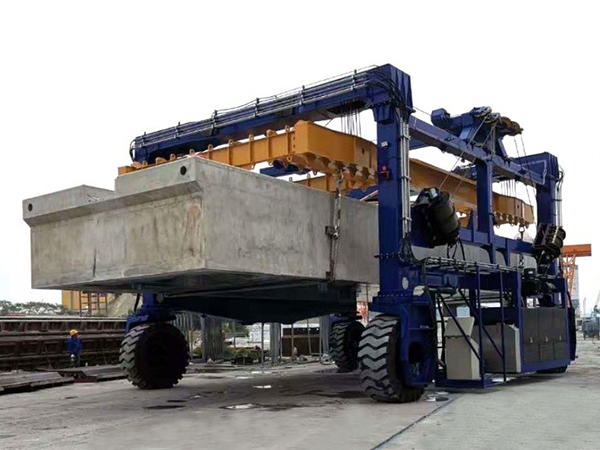
    In the construction stage of urban rail transit engineering, Henan Mine Crane manufactured crane is the core main equipment of the whole process construction, covering the whole scene operation such as main construction, component installation, station construction, etc. Core hoisting tasks include accurate hoisting and positioning of precast concrete segments, large steel structural members, station main modules, track box girders, platform equipment and other heavy materials. Whether it is underground tunnel excavation supporting construction, subway station main body construction, elevated track bridge pavement, rail transit supporting infrastructure construction, cranes are responsible for key heavy load transfer and installation work.

    Different from outdoor infrastructure projects, urban rail transit construction is mostly located in the core area of Urban area, with dense surrounding buildings, complex traffic flow and greatly reduced construction space. This requires the construction crane not only to meet the heavy lifting capacity, but also to have good site adaptability, to be able to operate stably in a narrow and low-regularity construction area, to ensure that all kinds of large components are in place quickly, accurately and safely, and to support the overall construction progress steadily.

    Maintenance applications

    After the rail transit project is completed and opened to traffic, the normal operation and maintenance is the core work to ensure the safe and stable operation of the line, and the crane is also indispensable in the operation and maintenance scenario. In daily maintenance operations, the crane is mainly responsible for the disassembly, transfer and installation of track heavy components, power supply catenary equipment, signal equipment and maintenance tools, covering various operation and maintenance scenarios such as track replacement, equipment maintenance, fault repair and component upgrading.

    Most of the operation and maintenance operations of urban rail transit are time-limited construction that does not affect the normal operation, mostly concentrated in the night window period, with tight operation time, high standard and low fault tolerance rate. The special maintenance crane has the advantages of flexible mobility, stable start-stop and accurate positioning. It can quickly complete equipment disassembly, component replacement and fault disposal, efficiently cooperate with daily inspection, regular overhaul and emergency repair, minimize the downtime of operation and maintenance, and ensure the all-weather stable operation of rail transit lines.

    Site requirements

    Urban rail transit operation scenarios are divided into three core types: underground tunnel, elevated track and depot/maintenance workshop. The operation environment of different scenarios is very different, which directly determines the selection standard and performance requirements of cranes. The underground tunnel operation space is closed, the floor height is limited, the ventilation conditions are limited, the light is insufficient, and the surrounding pipelines are dense and the construction passage is narrow. Henan Mine Crane manufactured crane has extremely high requirements on the shape, operation flexibility, explosion-proof performance and accuracy. It is necessary to adapt to the operation in a narrow confined space to avoid equipment collision, component deviation and other problems.

    Elevated track operation is in the high-altitude open-air environment, greatly affected by wind, rain, snow, temperature difference and other weather conditions, and the operation area is suspended without shelter, which has strict requirements on wind resistance, operation stability and safety protection performance of cranes. The depot and maintenance workshop are indoor fixed operation scenarios, with regular site and stable space, mainly focusing on continuous operation capability of equipment, precise controllability and span and lifting height parameters suitable for workshop layout. Environmental differences under different working conditions are the basic conditions that must be given priority in crane selection, which directly determines whether the equipment can adapt to the site and stabilize the operation.

    Key Factors to Consider When Choosing a Crane for Urban Rail Transit

    Load capacity

    Rated load is the core basic parameter of rail transit crane selection, which directly determines whether the equipment can complete the core lifting task. Before type selection, it is necessary to comprehensively count the dead weight, fixture weight, additional load and other data of all lifting components of the project, accurately calculate the maximum lifting demand, and eliminate the misunderstanding of type selection based on experience. For ultra-heavy components such as subway segments, bridge steel structures, station heavy equipment, etc., it is necessary to match cranes with corresponding heavy load levels to ensure sufficient lifting bearing capacity.

    In addition, the type selection shall take into account the full-cycle requirements of the project, not only adapt to the current construction load, but also consider the potential heavy load requirements of later transformation, equipment replacement and operation and maintenance overhaul, so as to avoid insufficient performance and repeated procurement of equipment in a short period of time and reduce the comprehensive investment of the project.

    Working conditions

    The core characteristics of urban rail transit construction are complex working conditions and limited site, which are also the key to distinguish them from ordinary lifting operations. The construction site in Urban area is generally narrow and low in regularity. The surrounding area is close to residential areas, municipal roads and existing buildings. The working space is severely squeezed, and large conventional cranes cannot enter or operate. At the same time, high-density Urban area construction has strict control requirements on equipment noise, dust and operation scope, and equipment shall be adapted to fine construction standards.

    Underground operation has the problems of height limit, width limit and poor airtight ventilation. Compact, lightweight and low-noise special lifting equipment shall be selected to avoid equipment size exceeding the standard and unable to adapt to tunnel and station foundation pit space. High altitude work needs to cope with strong wind, high altitude temperature difference, rain and snow weather interference, equipment needs to have excellent environmental adaptability and anti-interference ability.

    Lifting precision

    Rail transit engineering requires extremely high installation accuracy of components. Small deviations in rail splicing, steel structure docking and equipment installation may affect the overall engineering quality and later operation safety. Therefore, the hoisting accuracy of cranes is the core assessment index. Compared with the extensive hoisting of ordinary infrastructure, the installation of rail transit components requires millimeter positioning accuracy to ensure accurate alignment of prefabricated components, rail equipment and power supply devices and conform to engineering construction specifications.

    Load swing, fuselage shaking and operation deviation in hoisting process will lead to component positioning deviation, rework, component damage and time delay. The high-quality rail transit crane is equipped with stable transmission system and control system, which can effectively suppress load swing, realize stable start and stop, precise fine adjustment, greatly improve the qualified rate of component installation, and ensure the construction accuracy and construction quality of the project.

    Safety features

    Urban rail transit construction personnel are dense, equipment is expensive, and working conditions are complex. Once a lifting safety accident occurs, it will cause serious casualties, property losses and time delays. Therefore, the safety protection function of equipment is the hard core index of type selection. Qualified rail transit cranes must be equipped with multiple safety protection devices, of which overload protection and emergency braking system are the basic configurations, which can stop quickly when the load exceeds the standard, abnormal operation and sudden failure, so as to eliminate overload operation and sudden accidents.

    Modern high-end rail transit cranes are also equipped with intelligent monitoring system, anti-collision warning system, wind speed monitoring system and attitude sensing system, which can monitor the operation status of equipment, operating environment parameters and surrounding obstacles in real time. The system can predict risks in advance, actively warn and automatically limit, comprehensively avoid potential safety hazards caused by human operation errors, environmental interference and equipment failures, realize safe and controllable operation flow, and adapt to the construction requirements of high safety standards of rail transit.

    Selecting the Right Crane Type for Urban Rail Transit Applications

    Overhead cranes

    Henan Mine Crane manufactured bridge crane is the core special equipment of urban rail transit depot, maintenance workshop and equipment storage workshop, focusing on indoor standardization, high precision and high frequency operation scenarios. This kind of crane runs on the fixed track of the workshop, with regular operation scope, stable operation, accurate positioning and low failure rate, which is perfectly suitable for the normal operation of equipment maintenance, locomotive maintenance, component storage and parts transfer in the rail transit workshop.

    Compared with other models, bridge crane indoor operation stability is very strong, no outdoor environmental interference, can achieve high-frequency, long-term continuous operation, can accurately complete locomotive parts disassembly, heavy equipment alignment, precision parts transfer and other high-precision work. At the same time, the equipment has low operation noise, convenient operation and simple maintenance, and is suitable for the closed operation environment of the workshop. It is an indispensable core lifting equipment in the rail transit operation and maintenance system.

    Gantry cranes

    Henan Mine Crane manufactured gantry crane is widely used in rail transit outdoor construction site, prefabricated component storage yard, tunnel wellhead operation area, is the main type of civil construction stage. The equipment does not need to rely on the factory building structure, the ground track can support the whole machine operation, the site adaptability is very strong, and it can flexibly cover large outdoor operation areas such as station foundation pit, track construction site, component prefabricated yard, etc.

    Gantry crane has excellent heavy load performance, which can adapt to the hoisting, transfer and stacking of heavy components such as concrete segments, large steel structures and track box girders, and can meet the requirements of high strength, heavy load and wide range of operations in the civil construction stage of rail transit. The equipment has stable structure, strong wind resistance and high operation efficiency, which can adapt to outdoor complex weather conditions, greatly improve the transfer and installation efficiency of components on the construction site, and ensure the advancement of civil construction period.

    Portal cranes

    Henan Mine Crane manufactured portal crane is mainly used in heavy load and large-scale operation scenarios of large-scale rail transit infrastructure projects, and is suitable for large-scale engineering projects such as elevated rail construction, large-scale station construction, rail transit hub infrastructure construction, etc. This model has the core advantages of super high lifting height, super large working radius and heavy load stability, and can complete the lifting operation of super heavy steel structure, large bridge component and integral station module.

    In the open large-scale construction site, the portal crane can realize 360° large-range rotary operation, with wide operation coverage area, strong lifting capacity and stable operation, which can adapt to the overall hoisting construction of large-scale infrastructure of rail transit, effectively solve the problems of low hoisting efficiency and poor splicing accuracy of large-scale components, and greatly improve the construction efficiency and overall construction quality of large-scale infrastructure projects.

    Rail maintenance cranes

    Rail maintenance crane is a customized special equipment for rail transit. It is specially designed for rail inspection, fault repair, daily maintenance and line reconstruction scenarios. It has the core characteristics of flexibility, rapid deployment and adaptation to rail driving. Different from traditional lifting equipment, this model can travel directly on the operation track without additional construction of the operation foundation, and can quickly reach the fault point and operation area.

    The equipment is small in size, flexible in operation, stable in start-up and shutdown, perfectly suitable for short-term maintenance window at night, and can efficiently complete refined operations such as track component replacement, catenary equipment maintenance, faulty component removal and installation, line cleaning, etc. At the same time, the equipment has strong adaptability, which can take into account the maintenance requirements of subway, urban rail transit, light rail and other rail transit lines. It is the core special equipment to ensure the normal and safe operation of the line.

    How to Select Crane Specifications for Different Rail Transit Projects

    Lifting capacity

    lifting capacity matching is the primary core of rail transit crane selection, and the core principle is "accurate adaptation, sufficient allowance, and elimination of waste". Before type selection, it is necessary to comprehensively sort out the lifting requirements of the whole process of the project, calculate the maximum single component weight, tooling weight and additional operation load, and determine the rated lifting capacity in combination with the safety factor of more than 1.2 times. For heavy load scenarios such as tunnel segments and bridge steel structures, high-capacity portal cranes and portal cranes are selected. For maintenance and light component transfer scenarios, small and medium-sized tonnage special maintenance cranes and overhead cranes can be selected.

    It is necessary to strictly avoid two major mistakes in type selection: one is that the tonnage is too small, the equipment is operated at full load and overload for a long time, the failure is frequent, and the safety hazard is extremely large, which cannot meet the continuous operation demand. Second, tonnage surplus, equipment procurement costs, operation and maintenance costs increased significantly, equipment utilization rate is low, resulting in waste of funds and resources. Precisely matching load requirements is key to balancing project safety, efficiency and cost.

    Span and lifting height

    Crane span and lifting height directly determine the scope of equipment operation coverage, which should strictly conform to the actual space parameters of construction site, station and workshop. For underground tunnel and foundation pit construction scenarios, compact equipment with small span and low lifting height shall be selected according to tunnel height, foundation pit depth and operation width, so as to avoid equipment size exceeding the standard and unable to enter the site for operation. For elevated construction and outdoor prefabricated yard scenarios, large-span and high-lift models shall be matched to cover a large range of operation areas and meet the hoisting requirements of high-altitude components.

    For indoor scenarios such as depot and maintenance workshop, the span and lifting height shall be determined in combination with workshop column spacing, workshop floor height and equipment layout, so as to ensure that there is no dead angle in operation, cover all maintenance stations, and avoid space waste caused by equipment size redundancy. At the same time, construction allowance shall be reserved to meet the operation requirements of site reconstruction and equipment upgrading in the later stage, so as to ensure the long-term adaptability of equipment.

    Working duty class

    The working level represents the operation frequency, continuous operation ability and durability of the crane, which directly determines the service life and adaptation scenario of the equipment. It is a key parameter that is easily ignored in the selection of rail transit. Rail transit projects are divided into two scenarios: high-frequency continuous operation and low-frequency intermittent operation: 24-hour shift operation of equipment in civil construction stage, extremely high frequency and large load fluctuation, so it is necessary to select high-level crane to adapt to high-intensity continuous operation to avoid fatigue damage of equipment.

    Maintenance workshop and daily maintenance scenarios are intermittent operations with low operation frequency and stable load. Equipment suitable for medium and low working levels can be selected to balance cost and use demand. Accurate matching of working level can effectively improve equipment durability, reduce long-term loss, reduce failure probability, prolong overall service life of equipment, and avoid problems such as premature aging and frequent maintenance caused by insufficient working level.

    Control system

    At present, rail transit cranes are mainly divided into manual control, wireless remote control, intelligent automatic control three types of control mode, adapt to different operation scenarios and precision requirements. Manual operation is suitable for simple, low frequency, large margin extensive lifting operation, flexible operation, low cost, suitable for ordinary material transfer. Wireless remote control distance, easy to operate, allows operators to stay away from high-risk areas, adapt to high-altitude, underground, narrow dangerous conditions, greatly improve the safety of operations.

    Intelligent control system is the first choice for high-end rail transit projects. It is equipped with precise positioning, automatic sway control, intelligent speed regulation, one-button alignment and other functions, which can realize high-precision and automatic lifting operation, perfectly adapt to high-standard scenarios such as precision equipment installation and accurate alignment of large-scale components. The control system shall be reasonably matched according to the construction accuracy, safety level and operation efficiency requirements of the project, taking into account the convenience of operation, operation safety and construction accuracy.

    Advanced Features That Improve Urban Rail Transit Crane Performance

    Smart monitoring

    Intelligent monitoring system is the core upgrade configuration of modern rail transit crane, and it is also the key to realize long-term safe operation of equipment. The system can collect equipment operation data in real time 24 hours a day, covering core parameters such as lifting load, running speed, equipment attitude, motor temperature, fault code, operating environment wind speed, etc., realizing visual tracking of the whole process of equipment status.

    Relying on big data monitoring and algorithm analysis, the system can realize predictive maintenance, predict potential faults such as wear and tear of equipment parts, aging of lines and performance attenuation in advance, push maintenance reminders in advance, and completely change the passive mode of traditional "maintenance after failure". Effectively reduce unplanned downtime, improve equipment attendance, reduce construction delay and safety risks caused by sudden failures, and adapt to the stringent requirements of continuous construction and normal operation and maintenance of rail transit.

    Anti-sway technology

    sway control technology is the core function to solve the problem of high-precision lifting of rail transit. In the process of narrow urban working conditions, aerial operation and start-stop speed change, the hoisting components are easy to swing, which not only affects the positioning accuracy, but also collides with the surrounding structures and causes safety accidents, which is a common pain point in rail transit construction.

    Henan Mine Crane manufactured crane equipped with intelligent sway control system can suppress load swing in real time through dynamic algorithm, automatically offset the swing deviation caused by start and stop, speed change and wind force, and control the swing amplitude of components in a very small range. Greatly improve component installation and positioning accuracy, reduce alignment adjustment time, avoid component collision damage and construction rework problems, effectively improve hoisting stability and operation efficiency under complex working conditions, and meet rail transit precision construction standards.

    Automated operation

    Automatic intelligent operation is the development trend of rail transit lifting equipment, which is specially built for complex, high-risk, high-precision and high-frequency operation scenarios. The equipment is equipped with intelligent control system, precise positioning system and remote control module, which can realize automatic operation functions such as remote control, automatic alignment, intelligent speed regulation, fixed-point start-stop, etc. without manual close operation.

    In complex scenarios such as underground confined space, high-altitude high-risk area and unattended maintenance at night, automatic operation mode can completely avoid safety risks of manual operation and solve problems such as insufficient manual operation precision, fatigue operation and limited vision. At the same time, the automatic operation process is standardized and the efficiency is stable, which can greatly shorten the operation time, improve the standardization degree of construction, and meet the development requirements of intelligent construction and intelligent operation and maintenance of modern rail transit.

    Common Mistakes When Selecting Cranes for Urban Rail Transit Projects

    Choosing by price only

    Most rail transit project selection errors are price-only theory, one-sided pursuit of low-cost procurement, ignoring equipment adaptability, performance quality and safety standards. Low-cost cranes mostly use inferior accessories, simplify the process, and delete safety configurations, which seems to reduce the initial purchase cost, but there are many problems such as poor performance, poor stability, lack of safety protection, and high failure rate.

    From the perspective of the whole life cycle cost of the project, the operation and maintenance cost, maintenance frequency and failure shutdown loss of low-cost non-standard equipment are much higher than those of high-quality equipment. Frequent equipment failures will lead to delay in construction period, construction rework and safety accidents, which will not only greatly increase the comprehensive operation cost, but also affect the project acceptance and project reputation, and ultimately lose more than gain. Rail transit projects belong to high-standard and high-safety projects, and procurement costs must not be reduced at the expense of performance and safety.

    Ignoring long-term service

    Many purchasers only pay attention to the current performance parameters of the equipment when selecting models, ignoring the manufacturer's long-term after-sales and accessory support capabilities, which is a key misunderstanding affecting the long-term use of the equipment. The service life of rail transit cranes is as long as 10-20 years. Long-term high-frequency operation requires continuous after-sales support such as parts replacement, equipment maintenance, technical upgrading and fault repair.

    If the manufacturer has no perfect after-sales system, no sufficient spare parts reserve, no professional technical team, no timely maintenance when the equipment fails in the later stage, and the spare parts procurement cycle is long, it will lead to long-term downtime of the equipment and seriously affect the construction and operation progress. At the same time, lack of technical support cannot meet the needs of later project transformation and equipment upgrading, greatly shortening the service life of equipment and reducing the return on investment of equipment.

    Using standard solutions

    The working conditions of urban rail transit projects are very different. The construction space, load demand, operation environment and operation and maintenance standards of different cities, different lines and different stations are different. It is difficult for general standardized cranes to accurately adapt to all scenarios. If standard equipment scheme is directly applied, problems such as inconsistent equipment size, insufficient performance redundancy, lack of function and poor adaptability are easy to occur.

    For example, the subway construction site in Laocheng District is narrow and strict, and standard high-capacity equipment cannot enter the site. Special tunnel and elevated conditions require customized sway control, explosion-proof and wind-resistant configurations. Rail transit projects need customized solutions based on site conditions. Through targeted structural optimization, function installation and parameter adjustment, the equipment can fully meet the specific needs of the project and maximize the performance and value of the equipment.

    How to Choose a Reliable Crane Manufacturer for Urban Rail Transit

    Project experience

    Rail transit lifting equipment is highly professional, and the industry project experience of the manufacturer is the primary consideration standard for selection cooperation. High-quality manufacturers shall have rich landing experience in similar projects such as subway, elevated rail transit, rail transit maintenance station, etc., and be familiar with rail transit construction standards, working condition pain points, acceptance specifications and safety requirements.

    Before cooperation, it is necessary to focus on verifying the manufacturers 'past rail transit project cases, project landing scale and equipment operation reputation, and give priority to professional manufacturers who have served large-scale rail transit infrastructure projects and long-term deep cultivation in rail transit fields. Mature project experience can ensure that manufacturers can quickly and accurately match equipment solutions, avoid working condition adaptation loopholes, ensure that equipment fully conforms to industry standards and project requirements, and reduce selection risks from the source.

    Engineering capability

    Strong engineering R & D and customized manufacturing capabilities are the core competitiveness of high-quality rail transit crane manufacturers. The differentiated working conditions of rail transit projects determine that general equipment cannot meet the needs of high-end projects, and manufacturers must have the engineering capabilities of independent research and development, personalized customization, structure optimization and function upgrading.

    Henan Mine Crane

    Crane selection is the core and key work of urban rail transit project construction and operation, which directly determines the construction safety, operation efficiency, project quality and long-term economic benefit of the project. Rail transit operating conditions are complex, standards are strict, fault tolerance rate is low, so the selection work cannot be based on experience, blindly following the trend or simply comparing prices. It is necessary to comprehensively combine multiple factors such as project application scenarios, site operating conditions, load requirements, precision standards, long-term use planning, etc., scientifically screen equipment types, accurately match equipment parameters, and optimize intelligent safety configuration.

    The customized Henan Mine Crane Factory crane can effectively solve the industry pain points of limited construction space, insufficient precision, high safety risk and high operation and maintenance cost of urban rail transit, assist rail transit projects to realize safe construction, efficient promotion and long-term operation and maintenance, and lay a solid foundation for high-quality construction and stable operation of urban rail transit infrastructure.

    Discuss the crane arrangement for your project.

    Urban rail work includes different lifting tasks during construction and maintenance. Define the components, lifting points and working positions so the crane arrangement can be assessed against the particular facility or project stage. Share the load, available drawings, working cycle and site conditions with Henan Mine Crane so the required configuration and supply boundary can be discussed.

    Related crane configurations

    Rail-Mounted Container Gantry Crane

    View product parameters
    Lifting capacity: 35 t, 40.5 t, 50 tSpan: 18 – 35 mLifting height: 12.3 – 21 m

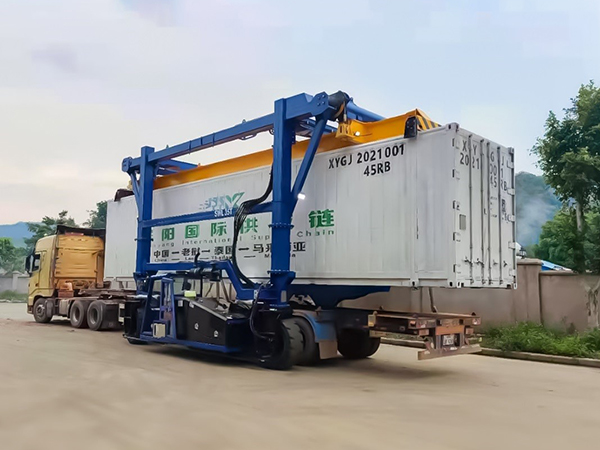
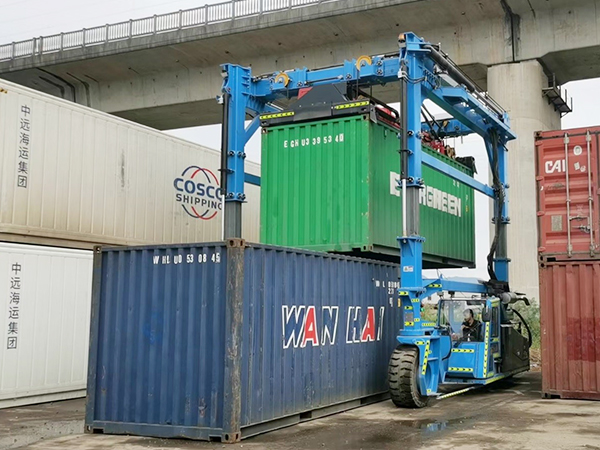
    Handle containers along a fixed yard runway with a rail-mounted container gantry crane. Coordinate the spreader, stacking geometry, rail layout and transfer positions around the terminal operation.

    Rail-Mounted Gantry (RMG)

    View product parameters
    Lifting capacity: 35 t, 40.5 t, 50 tSpan: 18 – 35 mLifting height: 12.3 – 21 m

    Use an RMG for container transfer along a fixed rail layout. Select the lifting arrangement, yard coverage and positioning controls from the container flow and stacking requirements.

    Updated 2026 · Henan Mine Crane

  • Outdoor Heavy-Duty Cranes: Site Exposure and Supporting-Route Inputs

    Outdoor Heavy-Duty Cranes: Site Exposure and Supporting-Route Inputs

    Technical guide

    Outdoor Heavy-Duty Cranes: Site Exposure and Supporting-Route Inputs

    Heavy outdoor lifting needs the load, site and operating environment considered together. Provide the handling envelope, ground or runway information and exposure conditions before comparing crane configurations.

    Henan Mine CraneTechnical guide · Updated 2026Crane selection, project scope and operating requirements
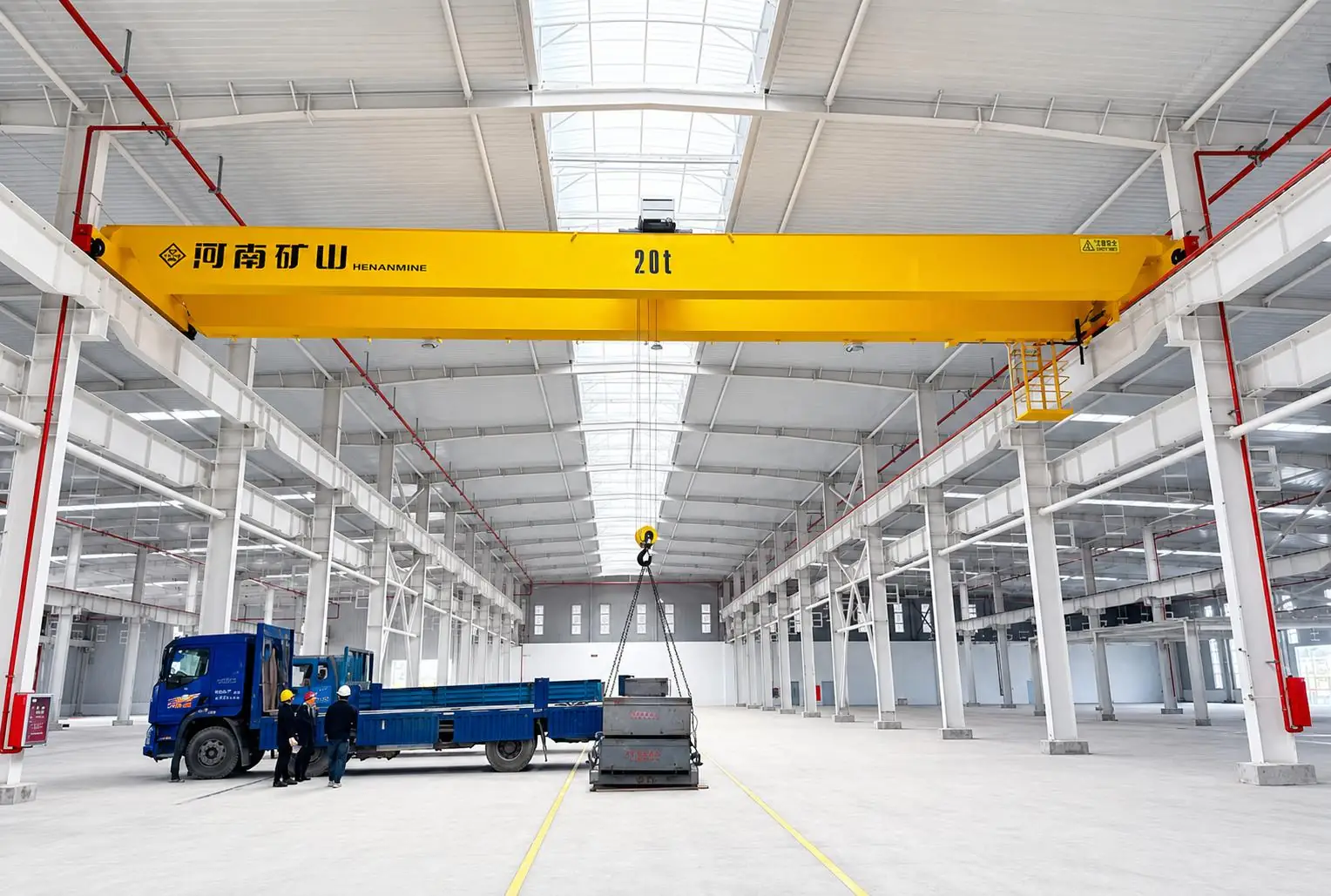
    Henan Mine Crane overhead crane inside a workshop bay
    Henan Mine Crane overhead crane inside a workshop bay
    Project planning notes

    Key points for this crane project.

    1. What Makes Outdoor Heavy-Duty Crane Selection
    2. Define Your Load and Lift Profile
    3. Match the Crane to the Right Duty Class
    Read the technical guide

    What Makes Outdoor Heavy-Duty Crane Selection Different

    Indoor cranes operate in a controlled environment with no wind, minimal corrosion exposure, and a fixed building structure to support the runway. Outdoor heavy-duty applications remove all of those advantages. The crane itself must provide structural stability, weather resistance, and safety systems that an indoor crane simply doesn't need.

    Industry bodies including the Crane Manufacturers Association of America (CMAA), ASME, and OSHA stress that proper selection starts with an engineering-driven evaluation of load requirements, duty cycle, operating environment, and site constraints not simply matching a price point to a tonnage figure.

    Each of these settings adds its own combination of wind exposure, corrosive elements, and ground conditions that shape which crane type will actually hold up.

    Define Your Load and Lift Profile

    Before comparing crane types, quantify exactly what you need to lift.

    • The maximum load capacity of the equipment is based on the single maximum lifting load as an accounting standard, not with reference to the average load. Equipment selection and operation planning should be based on the peak load judgment, to eliminate overloading operations, to prevent equipment damage and safety accidents.
    • Below the hook of the lifting beam, slings, lifting beams and other supporting lifting gear, self-weight should be included in the effective lifting load.
    • Before operation, according to the lifting height, hook stroke, check the site safety headroom, material stacking height, check all kinds of obstacles, to avoid space interference in the process of operation, to protect the safe and smooth lifting operations.
    • Lifting equipment span, for the equipment support structure between the horizontal working distance to be covered, is the key parameter of equipment selection, site planning, station layout, need to combine with the site operating conditions accurately determined.
    • Frequency of lifting operations need to count the total number of cycles in a single shift, and at the same time verify the concentration of peak load and duration, so as to match the load of equipment, pre-judgment of loss, and rational planning of operations and maintenance work.

    A simple "top 10 lifts" table listing weight, pick point, travel path, and frequency for your most common lifts aligns engineering, safety, and operations before you start evaluating vendors. Don't size the entire system around a rare peak load; a crane built to handle a once-a-year outlier lift is usually overspecified and overpriced for daily use.

    Match the Crane to the Right Duty Class

    Duty class is one of the most commonly overlooked factors in crane selection and one of the leading causes of premature equipment failure when ignored. CMAA assigns duty classes from A through F, ranging from light, occasional use up to continuous, severe-impact service.

    • Class A-B: Light duty class, suitable for low frequency, intermittent auxiliary lifting operations with light loads and shorter duration of use. The equipment has limited fatigue resistance and heavy load reserve capacity, and is not suitable for outdoor high-intensity, large load and continuous heavy load regular production operations.
    • Class C: Medium regular operation level, suitable for standardized, cyclical daily lifting operations. It can stably withstand regular loads to meet the workshop's normalized lifting needs, but it does not support long-time continuous operation, cannot withstand high-frequency impact loads, and is only suitable for small and medium-intensity intermittent work conditions.
    • Class D: Heavy duty grade, suitable for high frequency, high intensity industrial lifting conditions. Frequent starting and stopping, continuous cyclic operation, excellent impact resistance and fatigue resistance, suitable for processing plants, steel mills and other conventional heavy-duty production scenarios.
    • Grade E-F: Ultra-high severe operation grade, supporting all-weather full-load continuous operation. With strong structural strength and durability, it can withstand harsh working conditions such as high loads, strong impacts and corrosion, and is suitable for extreme working environments such as heavy industry, ports and ocean engineering.

    Most outdoor heavy-duty applications shipyards, precast yards, steel processing fall into Class D or E. Underspecifying duty class doesn't just shorten component life; it directly increases downtime and safety risk under sustained outdoor stress.

    Choose the Right Crane Type for Outdoor Use

    Different crane configurations suit different outdoor scenarios. Here's how the main types compare for heavy-duty outdoor work.

    Gantry Cranes

    Gantry cranes are supported by freestanding legs rather than a building runway, which makes them the default choice for outdoor yards, construction sites, and facilities without structural support. They can be track-mounted for repeated linear movement or caster-mounted for portability. Heavy-duty industrial gantry systems can reach lifting capacities up into the hundreds of tons, with truss-girder designs offering reduced wind resistance compared to solid box girders.

    Overhead Cranes

    Bridge cranes travel along runway beams and are typically used indoors, but outdoor-rated versions exist for facilities with exposed runway structures. Double-girder configurations handle heavier loads and wider spans than single-girder systems, making them suitable for steel production, shipbuilding, and large-scale manufacturing where a permanent structure is available.

    Mobile Cranes (Rough Terrain, All-Terrain, Crawler)

    For temporary or multi-site work, mobile cranes offer flexibility a fixed system can't match.

    • Rough Terrain Crane: Equipped with heavy-duty single axle and rough terrain tires, it adapts to outdoor construction sites with limited space and uneven ground, and has excellent site mobility, but it is limited to the internal work of the construction site and is not allowed to drive on the road.
    • All Terrain Crane: Combining cross-country passability and legal road driving ability, it can adapt to complex construction site conditions, and can also quickly transfer between various project sites by itself, with higher cross-site operational efficiency and wider scope of application.
    • Crawler crane: Crawler traveling structure, large grounding area, good adhesion, excellent stability of the whole machine, can be in the soft, muddy, poor bearing capacity of the complex ground operation, mostly used for large-scale infrastructure, bridges and large-scale lifting projects.

    Jib and Davit Cranes

    Jib cranes provide rotational lifting (180°-360°) for localized, repetitive tasks and typically top out around a few tons not a fit for heavy-duty work, but useful as a supplement to a larger system. Davits are lightweight, portable, and well suited to light-duty outdoor lifting such as watercraft or equipment handling.

    Engineer for Wind Load

    Wind is one of the biggest structural threats to outdoor cranes, capable of causing lateral thrust, overturning risk, or track derailment. Heavy-duty outdoor cranes should be engineered against recognized wind standards such as ASCE 7, Eurocode 1, or FEM, with wind-area type and gust speeds factored into the structural design.

    1. Automatic rail clamp: It can automatically lock the crane rail position under windy conditions, firmly fixing the position of the equipment, eliminating the problem of equipment slipping and shifting, and greatly improving the stability of the equipment for windy operation.
    2. Truss main girder structure: adopting permeable lattice truss design, it can realize smooth airflow penetration, and compared with solid box main girder, it can effectively reduce the lateral wind load, and reduce the interference of wind on the operation of the equipment and lateral thrust.
    3. Reinforced end beams and anchoring structure: The crane end beams and anchoring base are reinforced to improve the overall rigidity and overturning resistance of the equipment, which is suitable for open and unobstructed high wind operation sites.

    OSHA 1910.179 requires outdoor storage bridges to include both wind indicators and automatic rail clamps a baseline safety requirement, not an optional upgrade.

    Plan for Corrosion and Weather Exposure

    Rain, salt spray, humidity, and UV exposure all accelerate wear on outdoor crane structures and components. Corrosion protection should be matched to your site's environment using the ISO 12944 corrosion category system (C3-C5), with coastal and industrial sites generally requiring the higher end of that range.

    1. Hot dip galvanizing process: through the formation of a stable zinc layer protective structure, the equipment provides long-lasting rust and corrosion resistance, especially for coastal, high humidity and other corrosion-prone harsh operating environments, and can effectively slow down the corrosion and aging of the metal structure.
    2. Epoxy primer + polyurethane topcoat system: double-layer composite coating process, both excellent weather resistance and anti-corrosion performance, able to withstand outdoor sun, rain, temperature changes and other environmental erosion, long-term protection of the equipment substrate structure.
    3. Powder coating process: the formation of the coating is uniform and dense, high hardness, with good anti-scratch and anti-corrosion properties, taking into account the protection of equipment and the appearance of cleanliness, applicable to the value and durability of the equipment requirements of the scene.
    4. IP protection grade electrical box: adopting fully sealed structure design, it can effectively prevent water vapor and dust from intruding into the interior of the equipment, comprehensively protect the motor, control components and wiring system, and guarantee the stable and safe operation of the electrical equipment.

    Sites with extreme temperature swings should also confirm hydraulic fluids and lubricants are rated for the local range, and that any cold-weather options (cab heaters, enclosure warmers) are available if needed.

    Account for Site and Ground Conditions

    Ground stability has a direct impact on which crane types are viable.

    • Selection of site ground conditions: soft, uneven construction ground is more suitable for crawler cranes or gantry cranes equipped with reinforced rails, compared with wheeled mobile cranes, this type of equipment ground stability is stronger, can effectively avoid subsidence, rollover and other safety hazards.
    • Operating space constraints selection: for the site is small, dense layout of the construction plant, you need to choose a smaller footprint models, or equipped with adjustable boom crane, flexible adaptation to the narrow operating space, to avoid the problem of space interference.
    • Transportation and access conditions verification: need to verify the access conditions of the crane and parts in advance, to confirm the ease of transfer of equipment; large mobile lifting equipment need to plan the transportation route in advance, and apply for special access permits, to ensure that the equipment is smoothly into the field in place.

    Skipping a ground assessment is one of the most common reasons outdoor crane installations run into stability problems after the fact.

    Compare Total Cost of Ownership, Not Just Purchase Price

    Crane pricing varies enormously by type, capacity, and environmental rating:

    • Small gantry cranes: suitable for outdoor light lifting operations, equipment procurement costs are low, the starting price of only a few thousand U.S. dollars, cost-effective, suitable for lightweight, simple construction scenarios.
    • Medium-sized industrial gantry and overhead cranes: to meet the needs of conventional industrial heavy-duty operations, equipment configuration and performance standards, equipment configuration and performance standards are higher, the cost of hundreds of thousands of dollars in general, is the mainstream lifting equipment in industrial plants.
    • Large shipyard-class and special mobile cranes: designed for large-scale engineering, shipbuilding and other demanding working conditions, equipment performance is tough, complex processes, the cost can reach millions of dollars level, suitable for high-capacity of special lifting operations.
    • Working conditions corresponding to the cost of equipment: lifting equipment, the higher the working conditions of the higher level, the need for supporting the motor, brake, gear box and other core components of higher performance standards, the overall cost of manufacturing equipment with the increase.
    • Anti-corrosion and weathering upgraded configuration: Coastal special anticorrosion protection configuration of the equipment invested in the early stage is higher, but can effectively resist humidity, salt spray and other harsh environments corrosion, significantly reducing the later operation and maintenance costs, and extend the service life of the equipment.
    • Maintenance and Inspection Cycle: According to OSHA code, the wire rope, hooks and structural components of the lifting equipment need to be regularly tested and inspected, and the lifting equipment that has been idle for a long period of time needs to implement a more stringent inspection and maintenance program before resuming work.
    • Procurement and Rental Selection: Short-term, single lifting projects are more suitable for equipment rental mode; for long-term, high-frequency heavy lifting operations, the overall economy of the procurement of equipment is better.

    Discuss the crane arrangement for your project.

    Heavy outdoor lifting needs the load, site and operating environment considered together. Provide the handling envelope, ground or runway information and exposure conditions before comparing crane configurations. Share the load, available drawings, working cycle and site conditions with Henan Mine Crane so the required configuration and supply boundary can be discussed.

    Related crane configurations

    Explore crane product families and technical parameters ↗

    Updated 2026 · Henan Mine Crane

  • Straddle Carrier Manufacturer Review: Yard Fit, Controls and Service

    Straddle Carrier Manufacturer Review: Yard Fit, Controls and Service

    Technical guide

    Straddle Carrier Manufacturer Review: Yard Fit, Controls and Service

    A manufacturer comparison should use the same container-handling brief. Assess the carrier's proposed working envelope, operating arrangement, documentation and site support so technical and commercial differences are clear.

    Henan Mine CraneTechnical guide · Updated 2026Crane selection, project scope and operating requirements
    Container Straddle Carrier by Henan Mine Crane
    Container Straddle Carrier by Henan Mine Crane
    Project planning notes

    Key points for this crane project.

    1. Mainstream application scenarios of cross-traffic
    2. The core demand of straddle car in port and
    3. Types of straddle car equipment suitable for
    Read the technical guide

    Mainstream application scenarios of cross-traffic container trucks

    The flexible trackless operation characteristics of straddle car make it suitable for a variety of container operation scenes, whether it is a large seaport terminal, or inland small logistics yard, can play a practical value. There are obvious differences in equipment configuration, stacking capacity and power type for different scenarios.

    Large Container Terminal

    The main coastal container terminal has a complex operation chain, and needs to frequently complete the container transfer work between the shore bridge and the yard, and between the yard and the truck channel. Cross-traffic vehicles can replace part of the rail equipment to fill the operational gap of flexible transfer.

    The high frequency of operation and the shift operation of the equipment in this type of scenario require higher durability, continuous operation capability and braking stability of the port straddle carrier.

    Port Logistics Yard

    Independent port yards are mainly responsible for temporary stacking of containers, organizing and categorizing, and temporary storage of turnover. The layout is flexible and there is no fixed operation track or assembly line constraints.

    The trans-carrier can freely adjust the operation route to complete the basic work of container stacking, shifting, sorting, etc., which is suitable for the dynamic operation demand of the yard, and is the core equipment for the lightweight operation of the yard.

    Inland Multimodal Transportation Terminal

    The inland container distribution center connecting railroads and highways has messy working conditions, irregular container entry and exit frequency, and limited space for site reconstruction.

    The trackless transporter, which does not require civil engineering transformation, can quickly adapt to the changing operational layout and meet the demand for scattered and high-frequency container transshipment under multimodal transportation scenarios.

    Automated and Semi-Automated Terminal Projects

    In the intelligent terminal renovation project, automated straddle car is the core supporting equipment of unmanned yard. It can be docked to the terminal intelligent control system to complete autonomous travel, precise alignment, automatic stacking and other operations.

    This type of project requires manufacturers to have intelligent equipment development, system debugging, program adaptation capabilities, ordinary general equipment manufacturers cannot meet the demand for customized intelligent transformation.

    High Throughput Independent Yard

    Some small and medium-sized yards do not rely on RTG, RMG and other large-scale rail equipment, relying entirely on cross-traffic vehicles to complete all container operations. The operational pressure of the yard is concentrated and the equipment utilization rate is extremely high.

    These scenarios require highly adaptable and durable specialized straddle carriers to ensure all-weather stable operation of the yards and avoid equipment failures that may lead to operational stagnation.

    The core demand of straddle car in port and logistics yards

    The core demand of yard operation is stable, flexible and low-cost operation. As a high-frequency equipment, the procurement standard of straddle car needs to be adapted to the actual working conditions of the site instead of simply benchmarking the parameters of the equipment.

    Stable on-site operation rhythm

    The cargo turnover rhythm of the container yard is not fixed, and the equipment is required to operate continuously and uninterruptedly during the peak period. Equipment start and stop smoothly, no lag, in order to protect the rapid flow of containers, shorten the vehicle and cargo detention time.

    All-weather operation stability

    Most of the yards implement shift system operation, and the cross-traffic trucks are in the state of high-frequency starting and stopping, repeated traveling, and weight lifting and lowering for a long period of time. The durability of the core components of the equipment and the anti-fatigue performance of the whole machine directly determine the overall operational stability of the yard.

    Site operation flexibility

    The container placement position, operation channel and transfer route of the conventional yard will be adjusted with the change of cargo flow. The transporter needs to have good steering performance and mobility to adapt to the logic of changing yard operations.

    No need to rely on the characteristics of the fixed track, can maximize the release of yard space, suitable for all kinds of non-standard site layout.

    Safe and smooth lifting performance

    Containers have a large self-weight, and shaking and deflection during lifting will bring about cargo damage and safety hazards. The equipment needs to have good anti-shaking effect, precise braking ability and wide operation vision.

    Perfect safety protection design can effectively reduce the risk of manual operation errors.

    Low Failure, Easy Maintenance Equipment Attributes

    The time cost of yard equipment downtime is extremely high, and equipment with frequent breakdowns and difficult-to-purchase spare parts will continue to increase the operational burden. The structure of the equipment needs to be designed for easy daily maintenance, and the core parts have the characteristics of universal and easy procurement.

    Suitable for late automation upgrade

    Many traditional yards are mainly manual operation, but there are plans for intelligent upgrading in the future. The transporter with automation interface can be upgraded to remote control, semi-automatic or fully automatic function without replacing the whole machine.

    Container Straddle Carrier by Henan Mine Crane
    Container Straddle Carrier by Henan Mine Crane

    Types of straddle car equipment suitable for different yards

    There are many types of yard straddle car on the market, and different models have different stacking capacity, traveling speed, and operational positioning, so the selection of the type is based on the need to meet the capacity requirements of the site.

    Standard Container Handling Vehicle

    It is suitable for daily transfer and single or double stacking operation in conventional small and medium-sized yards. With mature structure and low failure rate, it is suitable for the basic operation needs of most traditional terminals and logistics yards.

    With outstanding cost performance, it is suitable for regular projects with stable work flow and no need for high-intensity stacking.

    High-stacking type transporter

    Designed for yards with limited land resources and the need to increase storage density, it supports multi-layer container stacking operation. It can greatly enhance the container storage capacity per unit site and improve the utilization rate of yard space.

    It is the preferred model for urban core yards and harbor areas where land is scarce.

    Specialized transshipment truck for yard

    The main high-speed travel, fast alignment function, specially used for long-distance container transfer between quay front and yard, yard and freight channel. The equipment travels faster and has higher alignment efficiency.

    It can effectively shorten the turnover time of containers, which is suitable for the high-flow and fast-paced port operation scenarios.

    Automated/semi-automated trans-shipment vehicle

    Equipped with intelligent control system, autonomous navigation module and accurate positioning system, it can realize unmanned or less manned operation. It is suitable for the upgrade project of smart port and smart yard, which can reduce the dependence on labor and unify the operation standard.

    Automated transporter manufacturers need to have integrated hardware and software research and development capabilities, not ordinary equipment manufacturers can produce.

    Customized cross-truck solutions

    Customized models for non-standard sites, special operating processes, and extreme environmental conditions. Manufacturers can adjust the equipment span, height, power and control system according to the width of the yard channel, the direction of cargo flow, wind and temperature environment, special container specifications.

    Core technical parameters that must be confirmed for procurement

    The parameters of the transporter directly determine whether the equipment is suitable for the working conditions of the yard, and if the parameters are not matched correctly, there will be problems such as insufficient stacking of containers, inaccessible channels, and substandard efficiency, which need to be checked one by one during the purchasing stage.

    Rated load

    According to the yard mainstream container specifications, spreader weight, whether the need for heavy-duty operations to determine the load standard. It is necessary to cover the maximum weight of fully loaded containers and reserve a reasonable margin to avoid long-term full-load operation and loss of equipment.

    Stacking height

    Directly affect the storage density of the yard. The cost and structural design of double, triple and multi-layer stacking equipment varies greatly, which needs to be combined with the storage planning of the yard and the site area to determine the appropriate height.

    Equipment Span and Clearance

    The span of the equipment needs to match the width of standard containers, and at the same time match the layout of the yard access. The clearance needs to meet the operational safety distance, to avoid collision with the box, fence and peripheral equipment in the process of travel.

    Traveling speed

    Equipment empty, heavy travel speed, determines the efficiency of container transfer. Long-distance transit scenes give priority to high-speed models, narrow and dense yard can be adapted to conventional speed, to ensure operational safety.

    Lifting speed

    Box lifting speed directly affects the length of a single operation cycle. Too slow lifting speed will drag down the overall turnover efficiency, too fast is easy to cause the box shaking, need to balance the speed and stability.

    Wheel configuration and steering system

    Multi-wheel set, multi-angle steering design can enhance the flexibility of the equipment site, suitable for narrow aisles, right-angle turns, dense yard operations. The accuracy of the steering system directly affects the alignment efficiency and operational safety.

    Power type

    Currently, the mainstream is divided into three types: diesel, electric and hybrid. The diesel type is suitable for non-electricity supporting, high-intensity continuous operation scenarios; the electric motor type has lower energy consumption and less noise, and is suitable for yards with strict environmental control; the hybrid power combines the advantages of range and energy saving.

    Control System

    Manual cab control, remote control, semi-automatic and full-automatic control can be selected according to project requirements. Newly built smart yards can be directly equipped with automation systems, and traditional yards can be reserved for upgrading interfaces.

    Full set of safety protection system

    Must be equipped with anti-collision sensing, emergency braking, load monitoring, speed limit control, panoramic vision assistance and other safety features. All-round avoidance of equipment collision, overloading, speeding brought about by safety accidents.

    Environmental suitability parameters

    Coastal yards need to focus on verifying the equipment's anti-corrosion, anti-salt spray and wind resistance; inland dusty yards need to confirm the equipment's dustproof sealing design; high temperature and low temperature areas need to be matched with the appropriate power and hydraulic systems.

    Container Straddle Carrier by Henan Mine Crane
    Container Straddle Carrier by Henan Mine Crane

    Professional transporter manufacturers screening criteria

    The suppliers of straddle carrier on the market are uneven, traders do not have R & D production capacity, equipment suitability and after-sales service cannot be guaranteed, screening manufacturers can focus on the following dimensions.

    Verify the entity's R&D production capacity

    High-quality manufacturers must have a full set of production capacity for independent design, structural research and development, machine welding, assembly and commissioning. Can independently optimize the structure of the equipment according to the working conditions, rather than simply assembling common parts.

    Avoid trading businesses that only do resale distribution in order to guarantee the quality of equipment and customization capabilities.

    Verification of similar yard landing cases

    Focus on checking the manufacturer's real landing projects in container terminals, inland yards, and multimodal transportation terminals. Mature project experience represents the manufacturer's familiarity with the operating logic and pain points of various yards.

    Manufacturers with rich overseas project experience are more suitable for port operation standards in different regions of the world.

    Evaluate professional engineering adaptability

    Reliable manufacturers will not directly promote fixed models, but will take the initiative to match the yard drawings, cargo flow planning, stacking targets, and site dimensions. Combined with the on-site working conditions, they will give exclusive selection plan and optimize the equipment parameters to meet the needs of the site.

    Verification of a full set of formal technical data

    Regular manufacturers can provide a full set of information such as equipment assembly drawings, performance parameter statements, electrical schematic diagrams, control logic descriptions, list of core accessories, etc., to meet the needs of project acceptance, filing, and later maintenance.

    Confirm the brand and quality of core parts

    Core accessories such as engine, motor, reducer, brake, PLC control system, spreader, tires, steering components, etc. determine the stability and service life of the equipment. When purchasing, you need to clarify the brand, specification and warranty standard of the parts.

    Strict factory inspection system

    Before the equipment leaves the factory, it needs to complete a number of tests, such as assembly verification, no-load test run, heavy load test, steering debugging, full-function testing, etc., and keep complete testing records to eliminate potential equipment failures from the source.

    Clear commissioning and personnel training services

    Confirm the service scope of the manufacturer in advance, including factory commissioning, on-site installation and docking, machine commissioning, operator training, operation and maintenance guidance, etc., so as to ensure that the equipment can be quickly put into operation after entering the site.

    Verification of global after-sales service and spare parts guarantee

    The core demand of overseas landfill projects is fast after-sales response and spare parts supply. Manufacturers need to have an overseas after-sales team, spare parts inventory, and remote technical support capabilities to minimize equipment downtime.

    Comprehensive assessment of the whole life cycle value

    Low-priced equipment is often characterized by shrinking parts, simplified processes, high energy consumption, and no room for upgrading. Procurement should be based on a comprehensive judgment of equipment cost, energy cost, maintenance cost, service life, and upgrade potential, not limited to the initial offer.

    Common Misconceptions in Procurement

    Many of the problems of yard equipment adaptation stem from the cognitive bias in the procurement stage, and the seemingly money-saving choices will bring long-term operational troubles.

    Simply selecting the manufacturer with the lowest price, ignoring the equipment configuration, process standards and after-sales system, will lead to frequent failures and soaring operation and maintenance costs in the later stage.

    The equipment parameters do not match the operation process of the yard, and the traveling span and stacking height do not match the site planning, resulting in the equipment not being able to operate at full capacity.

    Only focus on single operation efficiency, ignoring the stacking height, the storage density of the yard is insufficient, wasting site resources.

    Failure to consider the demand for later intelligent upgrading, procurement of pure manual old models, cannot be adapted to the future transformation of the smart yard.

    The scope of the offer is vague, no clear accessories, commissioning, training, after-sales range, later produce a large number of invisible incremental costs.

    Not verifying the manufacturers' similar project cases, blindly choosing manufacturers with no experience in yard equipment, and poor equipment adaptability.

    Incomplete site drawings and operational data provided at the inquiry stage, low fit of the manufacturer's program, and insufficient adaptability of the equipment after landing.

    Frequently Asked Questions

    What is the core purpose of the Container Handling Vehicle?

    Container transporter is a trackless mobile container operation equipment, which is mainly used for container transfer, stacking, shifting and organizing operations in ports, yards and inland stations. With the advantage of flexible travel, it can make up for the operational limitations of rail equipment and adapt to various dynamic yard conditions.

    Which scenarios are more suitable for straddle carriers rather than RTG and RMG equipment?

    Yards with irregular site, changing cargo flow, flexible adjustment of operation routes, and inability to do track construction modification are preferred to use straddle carriers. For small and medium-sized yards, temporary operation yards and inland intermodal terminals, straddle carriers are more cost-effective and practical.

    What is the conventional stacking height of straddle car?

    Conventional yards use 2-3 layers of stacked models, while high-density storage yards can use 4 layers or more high stacked models. The specific height needs to be combined with the site area, the total amount of storage, cargo turnover frequency comprehensively determined.

    How to choose diesel, electric, hybrid transporter?

    No power support, 24-hour continuous operation of large ports to choose diesel models; strict environmental control, daytime normal operation of the yard to choose electric models; taking into account the range and energy-saving needs of the project, you can choose a hybrid model.

    What technical information do I need to request from the manufacturer before signing the contract?

    A full set of technical and after-sales information such as equipment assembly drawings, performance parameter tables, electrical schematics, control system descriptions, core parts lists, factory inspection reports, operation and maintenance manuals, warranty details, and so on.

    Is automation capability important for the yard to be upgraded later?

    Very important. Intellectualization is the development trend of global port yards. Equipment with reserved automation interface can be upgraded with remote control and semi-automatic operation at low cost later without replacing the whole equipment, which saves the transformation cost significantly.

    In addition to the price of the equipment, procurement also need to focus on what?

    Manufacturer's project experience, equipment process standards, core parts quality, environmental adaptability, automation upgrade space, factory inspection standards, overseas after-sales response speed and spare parts supply capacity.

    Summarize

    High-quality container yard equipment manufacturers cannot only provide standardized and customized cross-truck equipment, but also rely on their own port engineering experience to provide customers with pre-condition assessment, program optimization, technical docking, commissioning, long-term operation and maintenance of the whole process services.

    For global ports, terminals and logistics yards, choosing a supplier with R&D strength, on-site experience and overseas after-sales capability can effectively reduce the equipment failure rate, control long-term operating costs and adapt to future intelligent upgrades.

    Henan Mine Crane has been deeply engaged in the R&D and manufacturing of port logistics equipment for many years, and can provide a full series of customized container straddle carriers and ancillary services, which are suitable for all kinds of domestic and overseas ports, stockyards, and inland terminal projects.

    If you are not sure about the model and parameters of the yard, you can provide the site layout, cargo flow requirements, stacking height and operational objectives, and our engineering team will provide you with an exclusive straddle carrier solution.

    Discuss the crane arrangement for your project.

    A manufacturer comparison should use the same container-handling brief. Assess the carrier's proposed working envelope, operating arrangement, documentation and site support so technical and commercial differences are clear. Share the load, available drawings, working cycle and site conditions with Henan Mine Crane so the required configuration and supply boundary can be discussed.

    Related crane configurations

    Container Straddle Carrier

    View product parameters
    Lifting capacity: 30 – 50 tStacking arrangement: 1 over 3 – 1 over 6Working class: A7 – A8

    Move containers between handling positions with a straddle carrier matched to the travel route and stacking layout. Define container load, ground conditions, clearance and the preferred drive system.

    Container Overhead Crane

    View product parameters
    Lifting capacity: 30-65 tSpan: 18-35 mLifting height: 8 – 20 m

    Transfer containers within a defined overhead runway area using a double-girder bridge and matched spreader. Container size, working clearance and the handling sequence determine the arrangement.

    Updated 2026 · Henan Mine Crane

  • Casting Cranes for Molten Metal: Load Arrangement and Protection Scope

    Casting Cranes for Molten Metal: Load Arrangement and Protection Scope

    Technical guide

    Casting Cranes for Molten Metal: Load Arrangement and Protection Scope

    A molten-metal crane must be assessed for the actual process and lifting system. Describe the ladle, handling path, working cycle and environmental exposure before comparing the proposed configuration and protection documentation.

    Henan Mine CraneTechnical guide · Updated 2026Crane selection, project scope and operating requirements
    Casting-Crane-Product-Specifications
    Casting-Crane-Product-Specifications
    Project planning notes

    Key points for this crane project.

    1. What Is a Casting Crane for Molten Metal Handling?
    2. Why Casting Cranes Require Special Design
    3. Key Technical Factors in Choosing a Casting Crane
    Read the technical guide

    What Is a Casting Crane for Molten Metal Handling?

    Simply put, a casting crane for molten metal handling is a heavy-duty double girder overhead crane designed specifically for lifting and transferring molten metal ladles. The biggest difference between it and ordinary overhead cranes lies in the whole design around the “safe, stable, high temperature”, the core function is in the steel mill converter, refining furnace, continuous casting machine, smooth transfer of steel, iron, taking into account the auxiliary lifting equipment maintenance.

    Typical Applications

    Casting cranes are used in almost the entire metallurgical industry, with the core focus on the transfer of molten metal, each of which has extremely high requirements for the safety and durability of the equipment.

    Steelmaking workshop (BOF/EAF converter) is the most important application scenario, responsible for the converter smelting steel, transferred to the refining furnace or continuous casting machine, every day to withstand dozens of high-frequency lifting, is an indispensable core equipment in the production process of steel mills.

    The secondary refining workshop (LF/RH refining furnace) is also inseparable from it, mainly used for lifting the steel after refining, as well as the auxiliary materials required in the refining process, the work requires higher precision to avoid the steel shaking caused by the composition of uneven.

    Continuous casting area of the casting crane, responsible for lifting steel to the continuous casting machine crystallizer, but also with the rhythm of continuous casting, to achieve continuous, smooth supply of steel, once the equipment failure, the entire continuous casting production line will come to a standstill.

    In addition, non-ferrous metal metallurgical plants (such as copper, aluminum smelting), will also use casting cranes, lifting non-ferrous molten metal, suitable for different melting points, different corrosive molten metal operation needs.

    Working Environment Characteristics

    Understanding the working environment of casting cranes, in order to understand why it needs a special design – the working environment of steel mills, known as the crane's “extreme testing ground”, every feature is testing the performance of the equipment.

    High temperature and heat radiation is the most intuitive challenge. Steel temperature can reach more than 1600 degrees Celsius, cranes operating in this environment for a long time, the main girder, outriggers and other steel structures will be continuously baked, electrical components will also face high-temperature aging problems, ordinary crane components will not take long to fail.

    Dust, smoke and corrosive gases should not be ignored. Steel smelting process will produce a lot of dust, fumes, these dust will enter the mechanical gaps in the equipment, electrical wiring, accelerating the wear and tear of components; corrosive gases will corrode the metal structure and electrical components, reducing the service life of the equipment.

    More critical is the high-frequency, high-load continuous operation. Casting cranes in large steel mills are basically running 24 hours a day, and the number of lifting times per day can reach dozens of hundreds of times, which is in full load or even overloaded state for a long time, which is a great test for the rigidity of the structure of the equipment, the braking system, and the transmission system.

    Why Casting Cranes Require Special Design

    Many customers ask me why casting cranes are so much more expensive than ordinary cranes, which are also overhead cranes. The answer is simple – it is not an ordinary lifting equipment, but is customized for high-risk operations such as molten metal, and every part of its design is designed to cope with the extreme working conditions to ensure safety and durability.

    High Safety Requirements

    When working with molten metal, even a one-in-a-million malfunction can cause irreversible consequences – steel leakage can cause fires and burns, and equipment collapse can lead to casualties and huge property losses. Therefore, the safety requirements of casting cranes, far more stringent than ordinary cranes, must be equipped with multiple redundant safety systems.

    For example, the braking system, ordinary cranes only a set of brake is enough, but casting cranes must be equipped with a double independent braking system (mechanical brake + electromagnetic brake), even if one set of brake failure, the other can be timely braking equipment to ensure that the ladle will not fall. This is the core requirement of molten metal crane safety features.

    When Henan Mine Crane designs casting cranes, it also adds multiple safety configurations such as overload protection, rope breakage protection, anti-decoupling device, etc. Each safety component has been strictly tested to ensure that it can work properly under extreme conditions, eliminating potential safety hazards from the root.

    Heavy-Duty Operation

    The work intensity of casting cranes is incomparable to that of ordinary cranes, which requires it to reach a higher level of work. The industry standard is very clear, molten metal operation with casting cranes, the working level is usually FEM A7-A8, ISO M7-M8, CMAA Class E-F, which is also the core application of FEM A8 crane classification.

    Many customers will underestimate the importance of the working class, thinking that as long as the lifting capacity is enough, the low working class equipment can be used. Previously, there is a medium-sized steel mills, selected FEM A6 level of casting cranes, used in the converter shop steel lifting, less than a year on the deformation of the main girder, gear box wear and tear serious problems, the monthly maintenance costs increased by tens of thousands of dollars, and finally can only be replaced in advance of the equipment, but spent more money.

    FEM A7 class is suitable for high-frequency, medium-heavy-duty operations, such as refining workshop; FEM A8 class is suitable for 24-hour continuous, high-heavy-duty operations, such as large converter workshop. Henan Mine Crane's casting cranes are designed according to A8 class by default, even if customers can't use such high working conditions for the time being, they can reserve space for upgrading, avoiding the trouble of remodeling in the later stage.

    Extreme Environmental Conditions

    The extreme environment of steel mills determines that casting cranes must have a strong ability to adapt to the environment, and the components of ordinary cranes simply cannot withstand this test.

    In terms of steel structure, high-temperature-resistant and fatigue-resistant high-strength steel must be used, and the main girder adopts a double-girder box structure to enhance the rigidity and resistance to deformation, and at the same time, a heat-resistant shield is added under the main girder to block the high temperature of the steel splash and slag erosion.

    The electrical system is the key object of protection. Motors, brakes, electrical control cabinets should be insulated, sealed to avoid high temperatures and dust into the cable using high-temperature resistant models, can be in a high-temperature environment for a long time to work stably; part of the large equipment will also be equipped with electrical cabinet air conditioning, reduce the internal temperature, to extend the service life of the electrical components.

    These special designs may seem to increase the cost of the equipment, but in fact it is to adapt to the extreme environment of the steel plant, reduce the later failure and maintenance costs, to ensure the long-term stable operation of the equipment.

    Casting-Crane-Product-Specifications
    Casting-Crane-Product-Specifications

    Key Technical Factors in Choosing a Casting Crane

    The core of choosing a Casting Crane is to match the actual operational requirements of the steel mill, and every technical parameter should not be sloppy. Many customers only look at the lifting capacity, ignoring other key factors, resulting in poor adaptability of the equipment, frequent failures. Combined with Henan Mine Crane's project experience, the following technical factors must be focused on when selecting the type.

    Lifting Capacity and Configuration

    The choice of lifting capacity should never be based only on the weight of molten steel, which is the most common selection misunderstanding.

    If there is a double package lifting, heavy-duty auxiliary material lifting needs, but also to appropriately increase the lifting capacity.

    Configuration, the mainstream casting cranes are used “main lift (lifting ladle) + secondary lift (equipment maintenance)” configuration, the main lift is responsible for the core of the molten metal transfer, the secondary lift is responsible for the maintenance of other equipment in the workshop, auxiliary materials lifting, to enhance the utilization of equipment.

    Duty Classification and Standards

    Duty Classification is the core parameter of casting crane selection, which directly determines the durability and service life of the equipment.

    FEM A7 class: suitable for 10-20 lifts per day, medium load operations, such as small refineries, non-ferrous smelters, the equipment can withstand high-frequency starts and stops, but is not suitable for 24-hour continuous heavy loads.

    FEM A8 level: suitable for more than 20 lifting times per day, 24 hours continuous heavy load operation, such as large-scale converter workshop, continuous casting workshop, the structure of the equipment, the transmission system, the braking system have been strengthened, and can withstand high load operation for a long period of time, and the service life is longer.

    Structural Design Requirements

    Structural design of casting cranes, the core is “strong rigidity, resistance to deformation, high temperature”, double girder box structure is the standard, but also the core structural features of metallurgical overhead crane.

    The main girder of the double girder box structure is much more rigid than the single girder structure, which can effectively disperse the load pressure, reduce the shaking during the lifting process, and ensure that the steel is smooth to avoid spilling.

    At the same time, the surface of the steel structure will do special anti-corrosion and heat-resistant treatment to extend the service life.

    Henan Mine Crane also optimizes the span of the main girder and the height of the outriggers according to the layout of the customer's workshop to ensure that the equipment can be perfectly adapted to the workshop space, and to avoid interfering with the converter, continuous casting machine and other equipment.

    Hoisting System and Redundancy

    Hoisting system is the core of casting crane, directly related to the safety and stability of lifting, must have enough redundancy design, to eliminate single point of failure.

    The braking system must adopt double independent braking, a set of mechanical braking, a set of electromagnetic braking, both independent of each other, even if one set of failure, the other set of timely braking equipment to ensure that the ladle will not fall.

    Lifting motor, gear box can also be configured according to the needs of redundant systems, such as dual motor, dual gear box, even if one of the set of failures, the equipment can continue to run, to avoid downtime affecting production.

    Heat Protection and Environmental Adaptation

    In view of the high temperature and dusty environment in steel mills, the heat protection design of casting cranes must be in place, which is also a key point of difference from ordinary cranes.

    Heat protection cover is installed under the main girder, which is made of high-temperature-resistant plate, can effectively block the high temperature of steel splashing and slag erosion, and protect the main girder, the electrical components and hoisting system underneath.

    The motor, brake and electrical control cabinet should be insulated, the shell is made of high temperature resistant material, and the internal heat dissipation device is added to avoid the aging and failure of the parts caused by high temperature. The electrical control cabinet can also be equipped with an air conditioning system to control the internal temperature in a suitable range to ensure the stable operation of electrical components.

    Essential Safety Features for Molten Metal Handling

    Molten metal operation, safety is the first place, casting crane safety configuration, absolutely cannot be saved.

    The following core safety features, is the selection must focus on, but also molten metal crane safety features of the core content.

    Mechanical Safety Systems

    Dual independent braking system is the most important, this is to protect the ladle safety of the last line of defense, must ensure that the two sets of braking system is independent of each other, do not affect each other, even if one of the set of failures, the other set can also work normally.

    Safety hooks must be equipped with anti-decoupling devices to prevent the ladle from falling off in the lifting process, while the hooks should be regularly flaw detection, cracks, wear and tear and other problems found, replaced immediately, cannot be forced to use.

    The overload protection system should monitor the lifting load in real time, and once it exceeds the rated load, it will cut off the lifting power immediately and send out an alarm signal at the same time, so as to avoid overload operation of the equipment and prevent accidents such as deformation of the structure and breakage of the wire rope.

    In addition, it should be equipped with rope breakage protection, lifting height limit, running limit and other devices to ensure the safety of equipment operation in all aspects and eliminate any potential safety hazards.

    Electrical and Control Safety

    The electrical control system adopts PLC-based safety control system, which can realize precise control of the equipment, and at the same time has the function of fault diagnosis and alarm, once there is an electrical fault, it can send out an alarm signal in time, which is convenient for the staff to investigate and deal with it.

    Limit switches must be redundantly designed, with two sets of lifting height limit and running limit, to ensure that when one set fails, the other set can work normally, to avoid over-traveling of the equipment, which may cause collision, fall and other accidents.

    Emergency stop and safe descent functions are essential.

    Emergency stop button should be installed in the position easily accessible to the operator, such as the driver's cab, ground operation station, in the event of an emergency, it can immediately cut off the power supply of the equipment and stop all the actions; safe descent function, in the event of power failure, brake failure and other emergencies, the ladle will be lowered smoothly to a safe position to avoid the expansion of the accident.

    Operational Safety Enhancements

    Anti-swaying control device can effectively reduce the swaying of ladle during lifting and transportation, especially during lifting, running and braking, it can control the swaying amplitude of ladle in the smallest range, avoiding the spillage of steel, and at the same time, improve the operational precision.

    For the workshop of multi-crane operation, it must be equipped with anti-collision system, which can monitor the running position of multiple cranes in real time, and once the risk of collision occurs, it will send out an alarm signal immediately and automatically slow down and stop, so as to avoid collision between cranes, which will damage the equipment and cause accidents.

    The cab should be insulated, dustproof treatment, equipped with air-conditioning system to improve the working environment of the operator; at the same time, the cab should have a wide field of vision to ensure that the operator can clearly observe the ladle and the operation area, to avoid operational errors. For high-temperature and high-risk areas, it can also be equipped with remote control function, so that the operator can operate the equipment in the center control room to reduce the risk of on-site operation.

    Casting-Crane-Product-Specifications
    Casting-Crane-Product-Specifications

    Casting Crane vs Standard Overhead Crane

    Comparison FactorStandard Overhead Crane
    ApplicationGeneral material handling (steel, equipment, components, etc.)
    Duty ClassTypically A3–A5, suitable for low-frequency, light to medium-load operations
    Safety RedundancyStandard safety configuration, no special redundant design
    Heat ProtectionUsually not included, unable to withstand high-temperature environments
    Reliability RequirementMedium to high, suitable for regular operations, allowing occasional failures

    Simply put, the core of the design of ordinary overhead cranes is “to meet the ordinary material handling”, while the core of the design of casting cranes is "to deal with molten metal high-risk, high-load, high-temperature conditions. The use of ordinary overhead cranes to lift molten metal, like a family car to pull heavy cargo, not only easy to damage the equipment, but also buried serious safety hazards.

    Henan Mine Crane has encountered many customers, in order to save costs, with ordinary overhead cranes instead of casting cranes, and finally either because of frequent equipment failure downtime, or because of the safety hazards required by the regulatory authorities to rectify the situation, but instead of spending more money, the loss is not worth it.

    Automation and Smart Features in Modern Casting Cranes

    Advanced Control Systems

    Modern casting cranes commonly use PLC and VFD (variable frequency) control systems, which can realize the smooth control of lifting and running, reduce the shaking of the ladle, and improve operational accuracy. Variable frequency control can also realize stepless speed regulation, avoiding the impact when starting and stopping, protecting equipment parts and prolonging service life.

    The anti-shaking control technology is also constantly upgraded, through the intelligent algorithm, it can adjust the lifting and running speed in real time, and control the shaking amplitude of the ladle in the smallest range, especially in the high lifting height and large span operation, the effect is more obvious, avoiding the spillage of steel, and guaranteeing the safety of operation.

    Remote and Automated Operation

    Remote control function allows the operator to operate the casting crane in the control room, without having to work in the high temperature and high risk workshop, which not only improves the working environment of the operator, but also reduces the risk of on-site operation.

    For large steel mills, automated workshops, can also realize the fully automatic operation of casting cranes, through the workshop with the MES / SCADA system docking, to realize the automatic issuance of operating instructions, automatic lifting of ladles, automatic monitoring of equipment status, the whole process without human intervention, significantly improve operational efficiency and reduce human error.

    Henan Mine Crane's casting cranes can be customized according to the customer's intelligent needs, remote control, fully automated operation of the program, to adapt to the intelligent transformation needs of different steel mills, to help customers achieve efficient, safe and intelligent production.

    Intelligent Monitoring and Predictive Maintenance

    Intelligent monitoring system can monitor the running status of the equipment in real time, including load, temperature, vibration, brake clearance and other parameters, and once abnormalities occur, an alarm signal will be sent out immediately, so as to facilitate timely investigation and treatment by the staff to avoid equipment operation with disease and reduce the breakdown and shutdown.

    Predictive maintenance technology, through the analysis of equipment operation data, can pre-judge the wear and tear of components, such as the service life of the wire rope, the degree of wear and tear of the braking system, and arrange for maintenance and replacement in advance, to avoid sudden failures and reduce downtime losses.

    At the same time, the equipment can be docked with the MES/SCADA system of the steel plant to realize the real-time uploading and sharing of equipment operation data, which is convenient for the managers to fully grasp the status of the equipment, formulate scientific maintenance plans, and improve the efficiency of equipment management.

    Key Considerations for Steel Plant Integration

    Casting cranes are not isolated equipment, and must be perfectly integrated with the production process and workshop layout of the steel plant, otherwise, even if the equipment itself is of good quality, it will not be able to maximize the role, and even affect the production efficiency. When selecting a model, these factors related to the integration of the steel plant must be considered.

    Workshop Layout and Crane Configuration

    First of all, the span, lifting height and hook limit distance of the crane should be determined in conjunction with the layout of the workshop.

    The limit distance of the hook is also very critical to ensure that the hook can smoothly transport the ladle to the designated location, such as the steel outlet of the converter, the entrance of the refining furnace, the continuous casting machine above the crystallizer, to avoid the dead angle of transportation.

    Henan Mine Crane's engineers will come to your home to survey the workshop site and customize the appropriate crane span, lifting height and hook configuration to ensure that the equipment can be perfectly integrated into the production process and improve the operational efficiency, taking into account the customer's production process and workshop layout.

    Power Supply and Reliability

    Casting cranes are heavy equipment with high requirements for power supply stability. Any interruption in power supply will not only affect production, but may also prevent the ladle from being lowered, leading to safety accidents.

    Therefore, steel mills must be equipped with a stable power supply system for casting cranes, it is recommended to use a double circuit power supply, once one of the circuits failures, the other circuit can be immediately switched to ensure that the equipment operates normally. At the same time, but also equipped with emergency power supply, in the case of sudden power failure, can provide temporary power supply for the equipment, the ladle will be smoothly lowered to a safe position to avoid the expansion of the accident.

    Multi-Crane Coordination

    For large steel mills, a workshop may have more than one casting crane operating at the same time, which needs to consider the coordination of multiple cranes to avoid mutual interference and collision.

    First of all, we should be equipped with anti-collision system, real-time monitoring of the operating position of multiple cranes, once the risk of collision, immediately send out an alarm signal, and automatically slow down, stop, to ensure equipment safety. Secondly, it is necessary to reasonably divide the operating area, clarify the operating range of each crane, avoid cross operation, and improve operational efficiency.

    For scenes that require coordinated operation, such as double cranes jointly lifting heavy steel bales, but also equipped with synchronization control system to ensure that the two cranes are lifted, running at the same speed, to avoid tilting and shaking of the bales, to protect the safety of the operation.

    Maintenance Strategy for Casting Cranes

    The service life of casting cranes depends not only on the quality of the equipment itself, but also on the later maintenance. A set of scientific maintenance strategy can extend the service life of the equipment for 5-10 years, reduce the failure downtime rate, reduce maintenance costs. Combined with Henan Mine Crane's experience, the following maintenance points must be focused on.

    Preventive Maintenance Planning

    Preventive maintenance is the core, cannot wait for the equipment is broken and then repair, according to the intensity of the operation of the equipment and parts of the wear cycle, the development of regular maintenance program.

    Daily Maintenance: Before each day's operation, check the braking system, wire ropes, hooks, limit switches and other key components to ensure that there is no abnormality; after the operation, clean up the dust and slag on the surface of the equipment, and check whether the electrical wiring is firm.

    Regular maintenance: carry out a weekly comprehensive inspection of the equipment, focusing on checking the lubrication of the gear box and motor, and replenish the lubricating oil; monthly check the brake clearance, wear and tear of the steel wire rope, adjust the braking system, and replace the parts with serious wear and tear; carry out an ultrasonic flaw detection on the steel structure once a year, to check whether there are any cracks, deformations and other problems, and repair them in a timely manner.

    Heat-Related Wear Management

    Under the high temperature environment, the parts of the equipment will wear out faster, especially the electrical parts, seals, wire ropes, etc., which must be paid attention to.

    Regularly check the heat insulation and sealing of electrical parts, and replace aged high temperature cables and seals; check the high temperature resistance of steel wire ropes, and replace them immediately when corrosion and broken wires are found; check the integrity of heat-resistant protective cover, and repair damaged parts in time to avoid high temperature erosion of equipment.

    At the same time, the dust inside the equipment should be cleaned up regularly to avoid the accumulation of dust leading to wear and tear of parts, electrical short circuit, and to prolong the service life of the equipment.

    Predictive Maintenance Technologies

    Predictive maintenance can be realized with the help of intelligent monitoring systems, which can effectively reduce sudden failures. By installing vibration sensors, temperature sensors and other equipment, we monitor the operating status of motors, gearboxes and braking systems in real time, analyze the operating data of the equipment, and anticipate the wear and tear of components in advance.

    For example, through the vibration sensor to monitor the vibration frequency of the gear box, once the vibration frequency is abnormal, it indicates that the gear box may be worn out, failure, and in advance to arrange for maintenance and replacement, to avoid gear box damage caused by equipment downtime.

    Spare Parts and Service Support

    Stockpiling necessary spare parts is the key to minimizing downtime losses. For fragile parts, such as wire rope, brake pads, seals, high temperature cables, etc., it is necessary to reserve enough safety stock, so that once the parts are damaged, they can be replaced in time to avoid long downtime.

    Choose a strong and experienced supplier to get more professional after-sales support. Henan Mine Crane provides each customer with an exclusive after-sales team, which makes regular visits to solve problems encountered in the process of equipment maintenance; at the same time, it provides sufficient supply of spare parts to ensure that when the equipment fails, it can be quickly responded to and repaired in a timely manner.

    Common Mistakes When Choosing a Casting Crane

    Combined with more than twenty years of industry experience, I summarized the most common 5 misconceptions when choosing a casting crane, many customers have stepped on these pits, I hope you can avoid.

    The first pit, using ordinary overhead cranes instead of casting cranes. This is the most dangerous and common misunderstanding, ordinary cranes do not have high temperature resistance, redundant safety systems, cannot withstand the high risk of molten metal operations, it is easy to cause safety accidents, and the maintenance costs of the later period will also increase significantly.

    The second pit, underestimate the working level requirements. Many customers only look at the lifting capacity, ignoring the level of work, selected a low level of equipment, resulting in frequent equipment failures, the service life is greatly shortened.

    The third pit, ignoring redundant safety systems. Some customers in order to save costs, omit the double braking, redundant limit and other safety configurations, it seems to save money, but actually buried a serious security risks, once the failure, the consequences are unimaginable.

    The fourth pit, overlooking heat protection and environmental factors, especially small and medium-sized steel mills, it is easy to ignore the high temperature, dust on the impact of the equipment, selected no heat protection, sealing performance is poor equipment, resulting in rapid aging of the equipment components, frequent failures, maintenance costs remain high.

    The fifth pit, choose a supplier without metallurgical crane experience. The design, production and installation of casting cranes require rich experience in the metallurgical industry, many suppliers do not have relevant project experience, the production of equipment cannot be adapted to the working conditions of the steel plant, and it is easy to appear in the late stage of various problems, after-sales cannot be followed up in a timely manner.

    Henan Mine Crane has been focusing on heavy metallurgical cranes for more than twenty years, and has participated in many large-scale steel plant projects at home and abroad, and has accumulated rich experience, which can help you avoid these misunderstandings and select the appropriate equipment.

    Casting Crane Selection Checklist

    In order to facilitate you in the procurement inquiry (RFQ), clear their own needs, to avoid deviation in the later stage, I have compiled a casting crane selection checklist, fill in against, you can clearly sort out their own purchasing needs, but also allows the supplier to more accurately for you to quote.

    1. Crane span, lifting height, hook limit distance
    2. Working class requirements (FEM/ISO/CMAA, minimum A7 recommended)
    3. Safety redundancy requirements (whether dual brakes, dual motors, redundant limits, etc. are required)
    4. Operating environment parameters (maximum ambient temperature, dust concentration, corrosive gas conditions)
    5. Automation and control requirements (whether remote control, fully automatic operation, anti-shaking control are required)
    6. Installation and commissioning requirements (whether the supplier needs to install and commission at home)
    7. After-sales and spare parts support (whether to provide regular inspection, spare parts supply)

    Frequently Asked Questions

    Q1: What is the difference between a casting crane and a ladle crane?

    Actually there is no difference between the two in essence, they are both cranes specially designed for lifting molten metal ladles, just called differently. Casting crane is a common name, ladle crane (ladle crane) is more focused on the “lifting ladle” call, Henan Mine Crane production of such cranes, no matter what kind of name, the core performance and safety standards are the same, can meet the needs of molten metal handling.

    Q2: What duty class is required for molten metal handling?

    Molten metal handling requires a very high duty class for cranes, usually FEM A7-A8, ISO M7-M8, or CMAA Class E-F. The specific duty class you choose depends on your needs. Which class to choose depends on the intensity of your work: if it is high frequency, 24 hours continuous work (such as large converter shop), choose FEM A8 class; if it is medium frequency, medium load work (such as small refinery), choose FEM A7 class can be.

    Q3: Why are dual brakes required for casting cranes?

    Because molten metal operations are extremely risky and a falling ladle can cause a catastrophic accident if the braking system fails. Dual braking system (mechanical brake + electromagnetic brake) ensures that when one set of brakes fails, the other set can stop the equipment in time, locking the ladle firmly and avoiding accidents, which is a mandatory safety requirement for molten metal operation and the core of molten metal crane safety features.

    Q4: Can casting cranes be automated?

    Yes, you can. Modern casting cranes fully support automation and remote control, through PLC, frequency control system, and docking with the MES/SCADA system of steel mills, they can realize fully automated operation – automatic reception of operating instructions, automatic lifting of ladles, automatic monitoring of the status of the equipment, the whole process without human intervention. Henan Mine Crane can customize the automation solution according to your intelligent needs to improve the operation efficiency and reduce the operation risk.

    Discuss the crane arrangement for your project.

    A molten-metal crane must be assessed for the actual process and lifting system. Describe the ladle, handling path, working cycle and environmental exposure before comparing the proposed configuration and protection documentation. Share the load, available drawings, working cycle and site conditions with Henan Mine Crane so the required configuration and supply boundary can be discussed.

    Related crane configurations

    Double Girder Casting Crane

    View product parameters
    Lifting capacity: 75/20–200/50 tSpan: 10m – 35mLifting height: 6m – 25m

    Lift and transfer molten-metal ladles with a YZ casting crane configured for the full suspended load and casting process. Review ladle interfaces, thermal exposure and the operating sequence together.

    Four Beam Casting Crane

    View product parameters
    Lifting capacity: 125/32–320/80 tSpan: 10m~40mLifting height: 6m~30m

    Handle molten-metal ladles with a YZS four-beam casting crane. Main and auxiliary trolley functions, thermal exposure and the lifting sequence are selected for the casting process.

    Updated 2026 · Henan Mine Crane

  • Carbon Block Stacking Cranes: Storage Pattern and Process Interfaces

    Carbon Block Stacking Cranes: Storage Pattern and Process Interfaces

    Technical guide

    Carbon Block Stacking Cranes: Storage Pattern and Process Interfaces

    Stacking equipment needs to handle the actual block geometry and presentation. Define the storage layout, gripping arrangement and transfer sequence, together with relevant dust or process conditions, before developing the crane proposal.

    Henan Mine CraneTechnical guide · Updated 2026Crane selection, project scope and operating requirements
    Carbon Block Stacking Cranes: Storage Pattern and Process Interfaces
    Henan Mine Crane lifting equipment
    Project planning notes

    Key points for this crane project.

    1. What Is a Carbon Block Stacking Crane?
    2. Where These Cranes Are Used
    3. Key Selection Criteria: Load and Stacking Capacity
    Read the technical guide

    What Is a Carbon Block Stacking Crane?

    Carbon block stacking crane is a special bridge crane, cancel the traditional hook and ordinary grab, equipped with exclusive clamping tooling. The equipment can vertically clamp the whole row of carbon blocks (conventional 19 blocks, 21 blocks) at one time, and complete the whole process of carbon block production, baking, cooling and storage as a unit. The operation efficiency is much higher than that of ordinary lifting equipment for single block lifting.

    The core components of the equipment are as follows:

    1. Bridge structure: the overall welded box beam structure, strong rigidity, anti-fatigue, anti-deformation, long-term adaptation to high-frequency, heavy-duty continuous reciprocating operation, stable operation without shaking, equipment longer service life.
    2. Trolley travel mechanism: integrated high-precision drive and buffer structure, support the longitudinal movement of the whole machine track, lateral movement of the trolley bridge, stable start-stop without impact, accurate positioning, can cover the operation area in all directions, and ensure that the carbon block is transported without deviation and dislocation.
    3. Lifting mechanism: equipped with heavy-duty lifting and braking system, can accurately adjust the lifting speed, to achieve stable lifting of carbon blocks, slow drop, effectively avoid collision damage. At the same time, it has overload protection and power-off braking functions, which is safe and reliable, suitable for full-process material taking and stacking operations.
    4. Clamping device: customized tooling for the core of the equipment, optimized design according to the size and arrangement characteristics of the whole row of carbon blocks, uniform clamping force and firm attachment, which can effectively prevent the carbon blocks from loosening, deviation and sliding during the transfer process and ensure the materials are intact.
    5. Guidance system: equipped with high-precision positioning and guidance components, the load operation attitude is corrected in the whole process, the displacement error caused by equipment vibration and track deviation is offset, and the carbon block is transported vertically and stably, and the alignment is accurate, so as to meet the requirements of high-precision stacking conditions.
    6. Control system: PLC+VFD frequency conversion drive +HMI touch intelligent control system, which can realize intelligent operation such as accurate positioning, weight verification, automatic stacking, etc., support accurate control of the whole process of equipment, with safety functions such as fault self-test and overload protection, easy to operate and strong stability.

    Different from the general overhead crane, all structural parts of the equipment are customized and developed according to the weight, shape and precision handling requirements of carbon blocks, and are specifically adapted to special working conditions such as carbon products, aluminum electrolysis and chemical industry. Standard general cranes cannot meet the requirements of such special operations.

    Where These Cranes Are Used

    Carbon block stacking crane is widely used in the whole process of carbon products and aluminum production, covering multiple core operation sections, which can complete accurate and repetitive material handling operations under high-risk conditions. The main application scenarios are as follows:

    • Raw anode workshop:responsible for transferring the unbaked carbon blocks to the roasting furnace to ensure smooth connection of procedures;
    • Anode baking work area: complete raw carbon block loading into ring furnace and tunnel furnace, and accurately remove and transport the finished carbon block after high temperature baking;
    • Cooling and storage area: orderly stacking of roasted high temperature carbon blocks, support multi-layer three-dimensional storage stacking, and ensure the stability of materials without damage when the carbon blocks are cooled to the operating temperature;
    • Carbon block warehouse: coordinate the orderly stacking and inventory management of finished carbon blocks, and provide stable material supply for subsequent anode assembly processes;
    • Chemical and petrochemical plants: It is suitable for standardized and repetitive handling operations of various carbon-based materials, electrodes and bulk solid materials, and can perfectly adapt to the flammable, explosive and corrosive high-risk operating environment of the plant.

    If the plant involves multiple production sections at the same time, it is necessary to focus on verifying the adaptability of equipment: due to the differences in risk levels and working conditions of each section, it is necessary to evaluate whether the crane with uniform specifications can be compatible with multi-area operations, or configure customized equipment for different sections, so as to ensure operation safety and equipment operation stability.

    Key Selection Criteria: Load and Stacking Capacity

    Capacity planning for a carbon block stacking crane isn't just about tonnage, it's about matching the crane to your block dimensions, batch size, and stacking pattern.

    Block group size

    The most popular cranes are configured to pick up a batch of 19 or 21 blocks per cycle, stacked lengthways in the gripper. Check your block dimensions, batch size before specifying as the gripper beam length and pitch spacing is based on this number.

    Rated capacity

    However, making the capacity too small because of previous capital, car, wiring and structure savings is one of the most common and costly selection errors, as it constrains batch size and throughput permanently.

    Stacking height

    Specify the number of layers necessary with your storage scheme (multi-layer stacking which is usually up to 6-9 layers). The control system needs more accurate positioning as multi-layer stacking (which would exceed 6-9 layers) is more vulnerable to dislocation.

    Span and duty class

    Span should be the same width of your warehouse or workshop bay and duty class (typically A7 or 8) should be set for the amount the crane will continually run. If you set the duty for intermittent duty a crane would last only a very short time under 24/7 stacking.

    Gripper and Clamping System Design

    The clamping fixture is the single most application-specific part of a carbon block stacking crane, and it deserves more scrutiny than most buyers give it.

    • Mechanical v. hydraulic clamps. Mechanical grippers use a four-link gravity self-locking arrangement, allowing them to open and close without power and retain force with power lost mid-cycle. Hydraulic clamps employ proportional valve control, to provide a variable clamp force to match block size and fragility, but require a hydraulic system to still retain force
    • Overload and leak protection. Weighing modules monitors clamped weight before lift and use automatic detection of fixture leakage and slip. No dropped loads! A potential disaster,when blocks of hundreds of kilos are stacked several meters high.
    • Wear life and serviceability. Find out from suppliers about the rated cycle life of gripper liners, and if individual grippers are removable and replaceable rather than if the entire fixture beam has to come down every time a gripper wears out.
    • High-temperature operation. Should the crane be expected to pull blocks from a baking furnace it will require heat resistant materials, and some form of insulation, as a generic Clamp would be doomed to failure.

    Explosion-Proof and Hazardous Zone Requirements

    The vast majority of carbon block equipment product data will ignore a core selection criteria, and for the chemical process area, rather than pure storage area of the crane, this point is crucial, that is, explosion-proof grade matching.

    Combustible gas, solvent vapor and carbon dust exist in carbon processing and chemical workshops. Electric parts of ordinary cranes are easy to produce sparks and have hidden dangers of explosion. Therefore, high-risk areas should be zoned according to ATEX and IECEx standards, and the crane electrical system must match the corresponding explosion-proof level to ensure safe operation.

    Practical steps for this section of your selection process:

    • Classify the zone first: It is necessary to cooperate with the plant safety engineer to accurately determine the risk type of the crane operation area, and identify whether it belongs to gas hazard, dust hazard or solvent vapor hazard scenario. The explosion-proof design scheme corresponding to different dangerous working conditions is completely different and cannot be applied universally.
    • Seal every electrical interface: In high-risk gas explosion-proof areas, all electrical enclosures and cable access ports of the crane must be completely sealed to prevent flammable gases from penetrating into the equipment and contacting electrical components, so as to avoid explosion risks from the source.
    • Don't assume higher explosion-proof class is always better: The core of explosion-proof selection is to fit the officially approved regional grade of the factory, and the higher the grade, the better. Excessive high allocation will not only increase the equipment procurement cost for no reason, but also increase the difficulty of equipment overhaul and maintenance, and cannot bring actual safety gain.
    • Confirm compliance documentation: The explosion-proof performance of equipment shall not be based only on the oral instructions of the manufacturer, but must be certified by a third-party authority.

    Corrosion and High-Temperature Resistance

    In addition to the risk of fire ignition in the chemical plant environment, various chemical media erosion will also cause significant equipment loss. The joint action of acid and alkali steam, high humidity air and carbon powder dust in the workshop will make the corrosion rate of ordinary steel and electrical shell much higher than that of conventional industrial plants.

    The following core protection schemes shall be clearly implemented for equipment selection:

    • The steel structure and exposed mechanical parts of the factory building shall be sprayed with anti-corrosive coatings or made of corrosion-resistant materials to withstand the erosion of acid and alkali steam, humid air and carbon powder to prevent corrosion of components and attenuation of structural strength.
    • Electrical equipment shall be sealed shell, in addition to meeting the standard explosion-proof grade, but also need to adapt to the special conditions of dust, high humidity and strong corrosion on site, so as to prevent medium intrusion and avoid various electrical faults.
    • Lifting accessories suitable for baking process shall be made of high-quality materials with high temperature resistance and thermal aging resistance, so as to effectively avoid deformation, loosening and failure of accessories under high temperature environment and ensure safe and stable lifting operation.
    • Equipment wearing parts selection needs to take into account mechanical wear and chemical corrosion double loss, chemical corrosion conditions will greatly reduce the service life of conventional parts, need to choose wear-resistant, corrosion-resistant composite special materials.

    When purchasing carbon block stacking cranes, confirm whether the equipment is optimized for chemical corrosion conditions. If there is no difference in material, structure, and protection between the ordinary model and the chemical version, it means that the equipment is not suitable and there are safety hazards, and should not be selected.

    Automation and Control Systems

    Modern carbon block stacking cranes range from fully manual cabin-operated units to fully automated systems that run entire stacking sequences without an operator in the loop.

    Control architecture. Look out for a PLC+VFD+HMI configuration. The combination gives repeatable precise positioning and real-time viewing of the operation through a point-n-click touchscreen. This configuration also facilitates remote recording of cycle counts and fault diagnostics.

    Operating modes. The majority of installations will ease operation by having at least one of: cabin operation, remote radio control or dual-mode switching. (Dual-mode switching necessary for remote station operation or comfort of operation during maintenance/commissioning.)

    Positioning and weight verification. Most commercial systems employ a vertical position sensor and a weighing module: the crane is lowered to an programmable position, the clamp is applied after a “loose rope” condition is detected, and then weight is confirmed before the lift is terminated. This safeguards against misalignments and overloads.

    Level of automation. Determine as early as possible if a fully automated system (grip, place, destack, and load the truck without operator intervention) is best, or a semi-automated system where the operator loads or destacks from the semi and trucks, but the system does the handling. Fully automated systems minimize labor and reduce operators’ time in the hazard zone but rely on tighter tolerances in your dimensions and storage layout to operate reliably.

    Structural and Mechanical Reliability

    Carbon block stacking crane core structure and transmission system, the core requirement is to adapt to long-term continuous heavy duty cycle operation, rather than only meet short-term peak load, the key configuration standards are as follows:

    1. Bridge structure: box beam integral structure, compared with traditional open truss structure, bending resistance, torsion resistance, deformation resistance is stronger, can perfectly adapt to the workshop high-frequency, uninterrupted heavy-duty reciprocating operation, long-term operation is not easy to deform, higher stability, adapt to high-intensity continuous production conditions.
    2. travel drive mechanism: long-span models are equipped with double-drive travel structure, which effectively solves the problems of unstable single-drive operation, large vehicle deviation, track deviation, etc., greatly improves the stability and positioning accuracy of the whole machine operation, and ensures accurate and error-free carbon block transfer and stacking operations.
    3. Hoisting brake system: the main hoisting mechanism is equipped with double brake redundancy protection, which subverts the single brake structure of ordinary cranes. It can completely avoid the safety risks such as falling and damage caused by single brake failure and suspended load, and ensure the safety of heavy lifting operation from the hardware level.
    4. It is strictly prohibited to refer to the rated tonnage parameters only in the selection, and it is necessary to match the working condition grade in combination with the continuous operation intensity of the workshop, so as to avoid overload fatigue operation of the equipment, ensure the long-term stable service of the equipment, and prolong the service life of the whole machine.

    Safety Standards and Certifications

    1. Hardware safety protection configuration: The lifting system is equipped with multiple limit protection devices, including upper and lower travel limit, over-travel forced protection and other functions, which can effectively eliminate safety accidents such as equipment collision and carbon block falling caused by over-winding and over-release, and build up hardware safety defense lines.

    Cost Factors and Total Cost of Ownership

    Carbon block stacking crane selection cannot only pay attention to the purchase unit price, but also comprehensively consider the full life cycle use cost. The cost factors are classified as follows:

    1. Cost difference of equipment working condition level: low-cost and low-level equipment cannot adapt to long-term full-load continuous production, long-term high-intensity operation is easy to rapidly age, frequent failures, frequent overhaul or even replacement of the whole machine, short-term purchase advantages will be offset by high operation and maintenance and replacement costs in the later period, and the comprehensive cost performance is extremely low.
    2. Automation investment and labor cost: High automation configuration can greatly reduce the labor cost of single stacking and transfer, improve operation efficiency, but it will increase the initial cost of equipment, and it needs regular maintenance of supporting professional sensors and control systems, which is suitable for large-scale and high-frequency production scenarios.
    3. Spare parts supply chain downtime cost: focus on checking the supplier's core wearing parts stock reserve and delivery cycle. Carbon block stacking crane is the core equipment of storage. Once the equipment is shut down due to shortage of accessories, the whole carbon block warehouse will be shut down directly, resulting in huge capacity loss.

    Choosing a Supplier

    Carbon block stacking crane is a special lifting equipment. The comprehensive strength of the manufacturer directly determines the equipment adaptability, operation stability and post-service guarantee. The core dimensions of the selection are classified as follows:

    • Industry special project experience: give priority to verifying similar landing cases of suppliers in carbon products, anode processing and chemical high-risk explosion-proof scenarios, focus on benchmarking project experience under the same working conditions and equipment specifications, abandon manufacturers with only general crane installation experience, and ensure that manufacturers are familiar with special working conditions and operation pain points of carbon block production.
    • Non-standard customization adaptability: there are different requirements for carbon block size, marshalling quantity, yard layout and explosion-proof zoning conditions on site, and standard models cannot be fully adapted. The supplier is required to have exclusive customization capability, which can optimize fixture structure, equipment parameters, explosion-proof configuration and control system according to actual working conditions on site, and meet the personalized production requirements of the plant.
    • Localization after-sales maintenance capability: equipment integration explosion-proof structure and intelligent automation system, maintenance professional requirements are extremely high. It is necessary to confirm that the supplier has a localized technical team and a rapid response mechanism, which can provide a full set of services such as on-site maintenance, fault handling, parts replacement, system commissioning, etc. to avoid long-term downtime caused by equipment failure.

    Henan mine crane as China lifting equipment leading high-tech enterprises, has a professional R & D platform and a number of patented technologies, with strong non-standard customization and complex working conditions adaptation capacity.

    The company has a complete intelligent manufacturing industry chain, leading the production and sales scale of gantry cranes in the industry, and the products are exported to many countries around the world. They are mature and suitable for high-risk and complex conditions such as carbon products, aluminum electrolysis, chemical explosion prevention, etc.

    Discuss the crane arrangement for your project.

    Stacking equipment needs to handle the actual block geometry and presentation. Define the storage layout, gripping arrangement and transfer sequence, together with relevant dust or process conditions, before developing the crane proposal. Share the load, available drawings, working cycle and site conditions with Henan Mine Crane so the required configuration and supply boundary can be discussed.

    Related crane configurations

    Anode Carbon Block Stacking Crane

    View product parameters
    Lifting capacity: 10 – 30 tSpan: 13.5-40 mLifting height: 6 – 20 m

    Handle and stack anode carbon blocks with a crane configured around block geometry, gripping method and storage layout. Define the transfer sequence and automation interfaces before selection.

    Galvanizing Process Overhead Crane

    View product parameters
    Lifting capacity: 5 – 32 tSpan: 10.5 – 31.5 mLifting height: 6 – 24 m

    Transfer suspended workpieces through a galvanizing process with a crane matched to the line. Coordinate lifting points, corrosive exposure, tank geometry and the required handling sequence.

    Updated 2026 · Henan Mine Crane
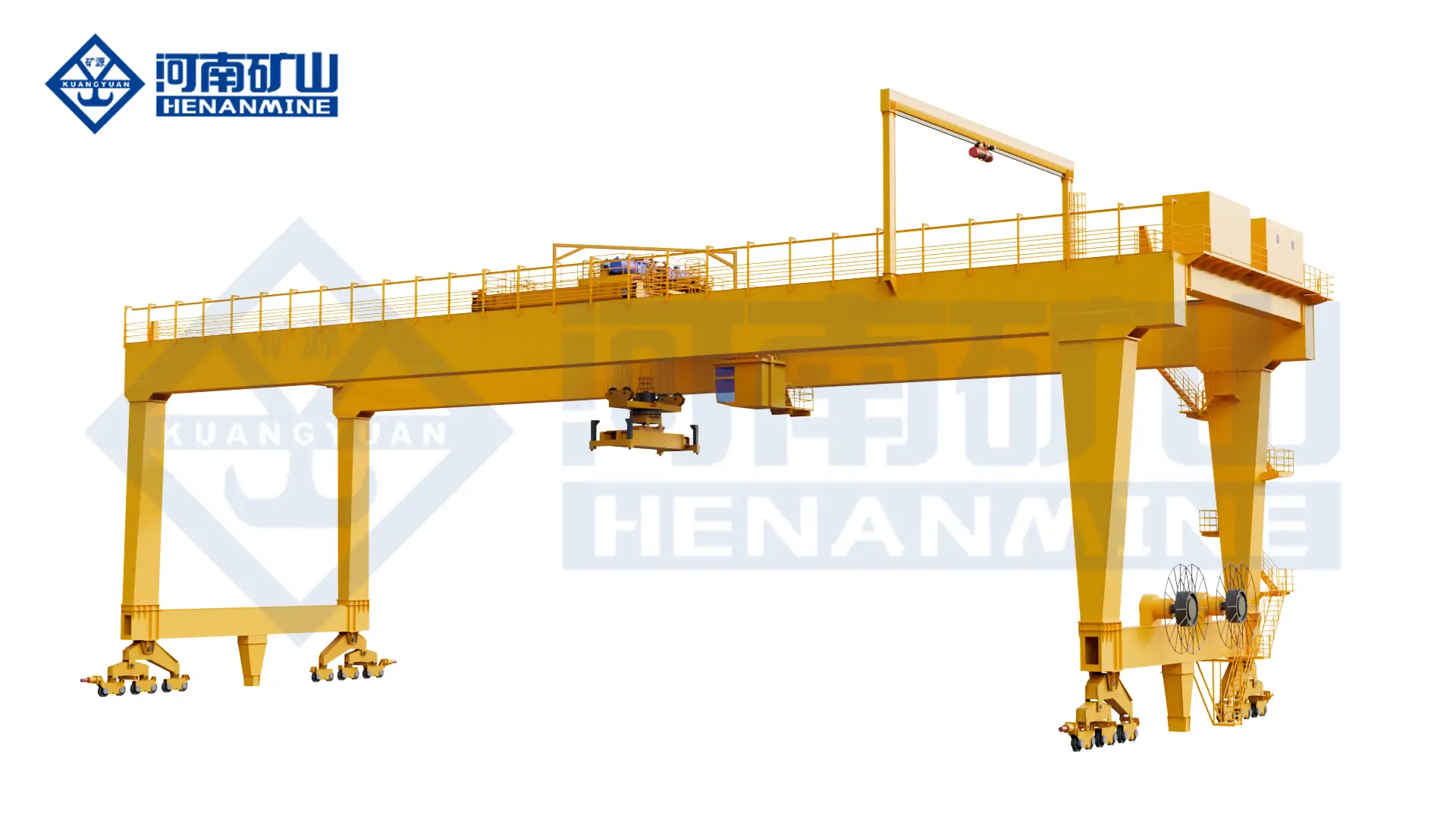
  • Double-Girder Bridge Cranes for Steel Plants: Select by Handling Task

    Double-Girder Bridge Cranes for Steel Plants: Select by Handling Task

    Technical guide

    Double-Girder Bridge Cranes for Steel Plants: Select by Handling Task

    Steel plants require different lifting arrangements for stock, production and maintenance work. State the material and attachment requirements, then compare the double-girder proposal with the working envelope and operating duty.

    Henan Mine CraneTechnical guide · Updated 2026Crane selection, project scope and operating requirements
    Henan Mine Crane LH Electric Hoist Double Girder Crane
    Henan Mine Crane LH Electric Hoist Double Girder Crane
    Project planning notes

    Key points for this crane project.

    1. First clear crane application scenarios in the steel
    2. Before selecting the type, first collect the site
    3. Why steel mills prefer overhead double girder cranes
    Read the technical guide

    First clear crane application scenarios in the steel plant

    The operational needs of different regions vary greatly, the first application scenarios down, the selection will not be biased. The most common scenarios are mainly in these categories:

    Scrap charging and raw material field processing, which is the starting point of steel production, the need for cranes to frequently lift scrap, with the hopper to the blast furnace charging, the crane’s lifting speed and durability requirements are high, but also often need to be used with grapples.

    Billets, ingots, slabs processing, this type of load is regular shape but large weight, mostly in the rolling shop, continuous casting workshop, the crane needs to be accurately positioned to avoid collision, and sometimes use special spreader to ensure the stability of lifting.

    Steel coil handling, whether it is semi-finished or finished steel coils, need special spreader, such as C-shaped hook, not only to ensure that the coil does not slip, but also to avoid damage to the surface of the coil, mostly used in cold rolling, hot rolling workshop and finished product warehouse.

    Workshop equipment maintenance and installation, this type of operation is infrequent, but the load is uncertain, sometimes need to lift heavy equipment parts, the flexibility and versatility of the crane requires a high degree of flexibility and versatility, generally with a common hook can be.

    Finished product warehouse loading and unloading, mainly responsible for the finished steel coils, steel plates, etc. lifting to the transport vehicle, need to take into account the efficiency and accuracy, to avoid damage to the finished product, often with a special spreader and remote control operation.

    There are also steel-related areas (such as steel ladle lifting), this type of scene is a high-risk operation, the requirements of the crane is much higher than the ordinary workshop, need to be designed in accordance with the special standards of metallurgical cranes, additional safety protection measures.

    Why do we need to clarify the application scenarios first?

    Differences in working conditions in different application areas directly determine the core requirements of the crane, which may affect the use of a little worse. For example, high-temperature areas and ordinary workshops, the heat resistance requirements for cranes are completely different.

    Temperature, near the steel package, hot rolling workshop temperature is very high, there will be radiant heat, crane cables, motors, brakes need special heat-resistant design, otherwise it is easy to age and damage; and raw materials field, finished goods warehouse temperature is relatively mild, conventional configuration can be.

    Speed and positioning accuracy, billet, steel coil transfer needs accurate positioning, speed cannot be too fast, but also has a smooth acceleration and deceleration function; and scrap steel charging is more important to the lifting and running speed, improve operational efficiency.

    The choice of spreader is also directly related to the application scenario, the grab is suitable for scrap, C-hook is suitable for steel coils, billet needs to use the lifting tongs or lifting beams, choose the right spreader in order to ensure the safety and efficiency of the operation.

    Here is a special reminder: steel ladle and other molten metal lifting crane, does not belong to the conventional bridge double girder crane, must comply with the special standards of metallurgical cranes, but also equipped with redundant braking, emergency descent and other additional safety devices, cannot be replaced by ordinary workshop cranes.

    Before selecting the type, first collect the site and process data

    Many purchasers only give a rated lifting capacity and span when selecting a model, which can easily lead to the crane does not meet the actual use of demand, and even rework and return.

    Load Characteristics: Define what to lift and how much to lift

    First of all, to determine the rated load and maximum load, here is an easy to ignore the point: the rated lifting capacity of the crane, need to include the weight of the spreader.

    Also pay attention to the size and centre of gravity of the load, such as the inner diameter, outer diameter, width of the steel coil, the length of the steel billet and the cross-section size, which will affect the choice of spreader and the positioning accuracy of the crane.

    In addition, whether hot or ambient material is being lifted makes a big difference.

    The lifting method is also very critical, whether it is a single point lifting or with special lifting tools (such as C-hooks, lifting tongs, electromagnetic suction cups, grabs, lifting beams), different lifting methods, the crane lifting mechanism, wire rope configuration have different requirements.

    Work cycle and mode of operation

    Most of the iron and steel mills are multi-shift continuous production, the crane’s operating intensity is very high, which requires a clear understanding of its work cycle parameters, to avoid the selection of ‘underestimation’ of the intensity of the operation, resulting in early wear and tear of the crane.

    For example, how many shifts per day, how long each shift runs, how many times per hour, these data directly determine the crane’s work level (-duty class). The more frequent the operation and the higher the load, the higher the duty class needs to be.

    Also pay attention to the intensity of the peak production period, such as the peak of steelmaking, the crane may need to run continuously at full load, this time if the crane’s working level is not enough, it is easy to motor overheating, brake wear and tear too fast and other problems, which will lead to downtime.

    Factory environment: the test of cranes in harsh environments

    The environment of the steel plant has a great impact on the durability of the crane, especially the three factors of high temperature, dust and corrosiveness, which must be focused on.

    High-temperature environment is mainly concentrated in the hot rolling shop, steel ladle lifting area, in addition to ambient temperature is high, there is also radiant heat, the need to equip the crane’s motor, brake, electrical control cabinets with heat dissipation devices, cables should be selected to resist high temperature models, and, if necessary, to be added to the heat shield.

    Dust and oxidised skin are common problems in steel mills. Dust can get into the bearings, gears and electrical parts of cranes, leading to wear and tear and failure.

    Corrosive environments are mainly found in pickling lines, chemical treatment areas, and steel mills in coastal areas, where corrosive gases or seawater can corrode the metal structure and electrical components of cranes.

    It is also important to clarify whether the crane is installed indoors, semi-outdoors or outdoors. Outdoor installation requires consideration of rain and wind protection measures to avoid bad weather affecting crane operation.

    Installation constraints: plant conditions determine the size limit of the crane

    Many steel mills are retrofit projects, the original plant structure of the limitations, will directly affect the selection of the crane, confirm these parameters in advance, to avoid the crane transported to the site cannot be installed.

    Firstly, the plant span and track length, the crane span must match the plant span, the track length should be determined according to the scope of the operation area, but also reserve a certain safety margin.

    Clearance height is another key parameter, the height of the beam bottom of the plant, pipelines, platforms, lighting equipment, etc., will affect the lifting height of the crane and the range of hook activity, you need to measure the exact clearance height to avoid the crane installation cannot reach the required lifting height.

    If it is a retrofit project, it is also necessary to check the condition of the original track beams, such as the carrying capacity of the track beams, alignment, if the track beams are not sufficiently load-bearing, they may need to be reinforced, otherwise there will be potential safety hazards

    Why steel mills prefer overhead double girder cranes

    In the heavy-duty operation of steel mills, the usage rate of overhead double girder cranes is much higher than that of single girder cranes, not because it is more ‘advanced’, but because it is better suited to the harsh working conditions of steel mills.

    Structural and operational advantages

    Firstly, the double girder structure has a stronger load carrying capacity, which is more suitable for the high load and large span requirements of steel mills. For example, when lifting heavy billets and coils, or high-capacity scrap grabs, double girder cranes have a stronger metal structure with better rigidity, which can withstand greater impacts and be more stable during operation.

    Secondly, double girder cranes are easier to integrate maintenance platforms and walkways. Cranes in steel mills require regular maintenance, and maintenance platforms allow staff to more safely and conveniently inspect and repair the crane’s hoisting mechanism and electrical components, reducing maintenance difficulties and safety risks.

    Double girder cranes also have advantages in terms of hook travel and space utilisation. Many double girder cranes have hooks that can be closer to plant columns and higher lifting heights, making full use of plant space, especially suitable for retrofit of old plants with limited space.

    In addition, double girder cranes have better operational stability and can reduce shaking, position accurately and avoid load collision during continuous high load operation, which is crucial for precision operations in steel plants.

    When is a single girder crane not enough

    Although single girder cranes are cheaper and simpler to install, there are many scenarios in steel mills where the performance of single girder cranes cannot meet the demand.

    If the intensity of the operation is high and multiple shifts are run continuously every day, the structure and mechanism of the single girder crane are prone to early wear and tear and failure; if the load to be lifted is heavy or needs to be paired with a large lifting device (such as a high-capacity grab or electromagnetic suction cup), the load carrying capacity and stability of the single girder crane will be insufficient.

    There are also some scenarios that require precise positioning, such as the stacking of steel coils, billet rolling assistance, single girder cranes do not have enough operational precision and stability, which can easily lead to load offset, collision, affecting production efficiency and product quality.

    Simply put, in steel mills, as long as it involves high loads, high operating intensity and precise positioning scenes, double girder cranes are preferred in order to ensure long-term stable operation.

    Core technical parameters must be correctly defined

    Technical parameters are the core of crane selection, each parameter directly affects the performance of the crane and the use of the effect, cannot be estimated empirically, must be combined with the actual needs of the site to determine.

    Lifting capacity (SWL)

    Lifting capacity is the most basic parameter, but cannot only look at the rated load, but also consider the actual operation of various situations. For example, in addition to the weight of the material to be lifted, the weight of the spreader must also be added, which is easily ignored.

    The load situation of different processes is also different, such as lifting steel coils and lifting steel billets, the load is stressed in different ways; lifting bundles of steel billets and single billets, the weight distribution is also different, you need to determine the rated lifting capacity of the crane according to the actual load situation.

    Also consider the dynamic load, crane lifting, running, braking, the load will produce inertia force, resulting in the actual force is greater than the static load, the selection needs to be reserved for a certain margin of safety.

    Span

    The span of the crane, that is, the distance between the two rails, must be matched with the span of the plant, cannot be arbitrarily determined. Firstly, the actual span size of the plant should be checked, and then the span of the crane should be determined according to the scope of the operation area.

    Attention should also be paid to the safety gap when the crane is in operation, for example, between the end beams of the crane and the columns of the plant, and between the crane and other equipment, it is necessary to reserve a certain gap to avoid collision during operation.

    If it is a retrofit project, the span of the original track must be checked to ensure that the span of the crane is the same as the span of the track, otherwise it cannot be installed and used. The best way is to provide the actual drawing of the plant and let the supplier help to confirm.

    Lifting height/hook travel

    Lifting height refers to the distance from the lowest position to the highest position of the hook, which needs to be determined according to the operational requirements, such as the stacking height of the materials and the installation height of the equipment, all need to be taken into account.

    Also pay attention to the headroom of the plant, the highest position of the hook should not exceed the bottom of the beam of the plant, and at the same time, a certain safety distance should be reserved to avoid the hook colliding with the structure of the plant or other equipment.

    In addition, it is also necessary to consider the future process changes or equipment replacement needs, if the future may need to lift a higher load, the selection can be appropriate to increase the lifting height, to avoid the later transformation.

    Lifting, traversing and longitudinal speed

    Many buyers will blindly pursue the ‘high speed’, think the faster the efficiency is higher, but in fact, the speed of the crane needs to match the rhythm of the production process, not the faster the better.

    For example, in the scrap charging scene, the lifting and longitudinal speed can be faster, to improve operational efficiency; but in the steel coil stacking, billet positioning scene, the speed cannot be too fast, otherwise it will lead to load shaking, affecting the positioning accuracy, there may also be safety hazards.

    In addition to the maximum speed, but also pay attention to acceleration and deceleration performance, smooth acceleration and deceleration can reduce mechanical impact, extend the service life of the crane, but also to avoid load collision. For scenes that require precise positioning, there should also be fine-tuning (inching) function, which is convenient for operators to control accurately.

    Work Class (Duty Class)

    Duty class is a key parameter in the selection of cranes for steel mills, which directly determines the service life and reliability of cranes and should never be underestimated.

    Select the right hoisting mechanism and spreader

    Crane lifting mechanism and spreader, directly determines the safety and efficiency of lifting, different types of materials, need to match different lifting mechanism and spreader, cannot be generalised. Many purchasers only focus on the crane itself, ignoring the choice of spreader, resulting in the later cannot work properly.

    Hook: suitable for general maintenance and equipment lifting

    Hook is the most versatile spreader, suitable for workshop maintenance, equipment installation, general cargo lifting and other scenarios, such as lifting crane parts, small equipment, scattered materials.

    The advantage of this kind of spreader is flexible, can adapt to a variety of loads, but for the repetitive material lifting in steel mills (such as steel coils, billets), the efficiency is not high, and is not safe enough, it is not recommended as the main spreader.

    C-hook: the first choice for steel coil lifting

    C-hooks are the most commonly used and practical spreader for lifting steel coils, both cold rolled and hot rolled coils. It can directly hook the inner diameter of the steel coil, stable during the lifting process, not easy to slip, but also to avoid damage to the surface of the steel coil.

    When choosing C-hooks, you need to determine the size and load capacity of C-hooks according to the inner diameter, outer diameter, width and weight of the steel coils to ensure that it matches the steel coils. For example, different sizes of steel coils with different inner diameters require different types of C-hooks, which cannot be used universally.

    Clamps, clamps, lifting beams: special lifting tools for billets and slabs

    When lifting billets, ingots, slabs and other long, lumpy materials, it is suitable to use lifting tongs, jigs or beams. This kind of spreader can firmly clamp or hold the material to avoid the material slipping off during the lifting process, and at the same time, it can ensure the uniform force of the material and reduce the damage.

    For example, a single billet can be lifted with a lifting tongs, lifting a number of billets or slabs, you can use a lifting beam with a number of lifting tongs, to improve operational efficiency. When choosing this kind of spreader, according to the size, weight and shape of the material, determine the type and quantity of spreader to ensure the safety of lifting.

    Electromagnetic suction cups: suitable for lifting scrap steel and steel plates

    Electromagnetic suction cup is suitable for lifting scrap steel, steel plate, small billet and other materials, the advantage of high efficiency, can quickly adsorb and release the material, do not need artificial hook.

    But the use of electromagnetic suction cups have a few precautions: firstly, need a stable power supply, once the power failure, the material will fall, there is a safety hazard, so must be equipped with a backup power supply or emergency device; Secondly, the electromagnetic suction cup adsorption force and the weight of the material to match, to avoid adsorption of the material is not firmly caused by the material slipping; Finally, the high temperature of the material will affect the adsorption performance of electromagnetic suction cups, is not suitable for lifting the hot material.

    Grab: special spreader for scrap charging

    In the scrap yard and blast furnace charging area, grab is an essential spreader, which can quickly grab the scrap and improve the charging efficiency. There are many types of grabs, such as single-rope grabs and double-rope grabs, which need to be selected according to the type of scrap and operational requirements.

    The work intensity of the grab is very high, need to match the high strength lifting mechanism, at the same time, we should do a good job of maintenance of the grab, regularly check the wear and tear of the grab, to avoid damage to the grab resulting in the scattering of scrap steel.

    Here to give you a practical advice: crane and spreader selection should be synchronised, do not buy a crane first, and then select a separate spreader. The weight of the spreader, the installation method, will affect the crane lifting mechanism and carrying capacity, synchronised selection can avoid mismatch problems later.

    Steel plant environment on the special requirements of the crane

    The harsh environment of steel mills is one of the main causes of crane failure. Many cranes can run stably for many years in ordinary workshops, but frequent failures in steel mills, just because they do not consider the impact of the environment and do not do a good job of targeted protection.

    High temperature and radiant heat

    Cranes in high-temperature areas should first do a good job of heat-resistant protection of electrical components. Motors, brakes, electrical control cabinets and other components, to choose high-temperature resistant models, while equipped with heat dissipation devices, such as forced ventilation fans, cooling water pipes, to avoid parts due to high-temperature aging, damage.

    Cables should also use high-temperature resistant cables, and should be well protected to avoid being scalded by high-temperature oxidised skin or accelerated aging by high-temperature environment. In the area near the steel package and other strong radiant heat, but also to the crane’s metal structure and electrical components to add a heat shield to reduce the impact of radiant heat.

    In addition, high temperature environment, the viscosity of the lubricant will be reduced, the lubrication effect will be reduced, the need to use high temperature resistant lubricants, and shorten the lubrication cycle, to ensure that the moving parts of the crane is well lubricated.

    Dust, oxide skin and pollution

    Dust and oxidised skin from the steel mill will enter the bearings, gears, wire ropes and electrical parts of the crane, leading to wear and tear of the parts, jamming and short-circuiting and affecting the normal operation of the crane.

    Therefore, the key components of the crane need to be well sealed and protected, such as the electrical control cabinet to choose IP54 and above grade sealing, to avoid dust entry; bearings, gears and other moving parts, to be installed with a sealing cover, to prevent dust and oxidised skin from entering; wire ropes should be cleaned and lubricated on a regular basis, to avoid dust abrasion of the wire ropes.

    Cranes should also be cleaned regularly to remove dust and oxidised skin on the surface, especially electrical parts and moving parts, to avoid excessive accumulation of dust leading to failure.

    Corrosion protection

    First of all, the metal structure should be anti-corrosion treatment, such as sandblasting rust removal, painting corrosion-resistant coatings, paint layers and thickness should be determined according to the degree of corrosion and sealing to prevent corrosive gases from entering.

    Power supply quality and electrical stability

    The normal operation of the crane requires a stable power supply, more production equipment in steel mills, prone to voltage fluctuations, which will affect the electrical system of the crane, resulting in motor burnout, control system failure.

    When selecting the type, we should consider the impact of voltage fluctuations, choose motors and control systems that can adapt to a certain voltage fluctuations, and at the same time, equipped with voltage protection devices, such as voltage regulators, over-voltage protectors, to avoid voltage fluctuations on the crane damage.

    Drive and control system

    Drive and control system, determines the crane’s operating performance and ease of operation, selection should not only consider the process requirements, but also combined with the factory’s maintenance capabilities, to avoid choosing too complex, difficult to maintain the system.

    Variable frequency (VFD) control vs conventional control

    At present, most of the cranes in steel mills use variable frequency control (VFD), which has obvious advantages over conventional control.

    Secondly, VFD control can achieve stepless speed regulation, adjusting the speed according to the operational requirements, which not only improves the efficiency, but also ensures accurate positioning.

    In addition, frequency control saves energy, especially in the crane frequent start and stop, load changes in the scene, energy saving effect is more obvious.

    Conventional control is low-cost and simple to maintain, suitable for low intensity operations, low requirements for speed and positioning accuracy of the scene, such as small maintenance cranes.

    Selection of speed control strategy according to application scenarios

    Different application scenarios require different speed control strategies and cannot be generalised. For example, scrap charging, finished product loading and unloading and other scenes, the need for rapid transit, lifting and running speed can be faster; while billet positioning, equipment installation and other scenes, the need for precise control, the speed should be slower, but also fine-tuning function.

    For scenes that require frequent starting and stopping, choose a control system with good acceleration and deceleration performance to reduce mechanical impact; for scenes of continuous operation, ensure the stability of the control system to avoid failure.

    Operation mode

    There are three main crane operation modes: pendant control (handle control), radio remote control, and cab operation, which need to be selected according to the operational scenarios.

    Handle control is simple, low-cost, suitable for small cranes or close-range operations, such as workshop maintenance cranes, but the operation is less flexible, the operator needs to follow the crane to move, and safety is not high.

    Radio remote control is the most commonly used mode of operation in steel mills, the operator can control the crane remotely in a safe area, with a wide field of vision and flexible operation, which can effectively avoid operational risks, especially suitable for scrap charging, steel coil lifting and transporting and other scenarios.

    The cab operation is suitable for complex, high-risk, high-capacity operation scenarios, such as steel ladle lifting, heavy equipment installation, the operator in the cab, a good field of vision, can accurately control the crane, and at the same time, higher safety.

    Many steel mills will choose multiple operation modes, such as remote control + cab operation, to ensure operational flexibility and to cope with complex scenarios, but also as a back-up to avoid downtime due to failure of one operation mode.

    Monitoring and Diagnostics: Easy Maintenance and Troubleshooting

    Once a crane in a steel plant breaks down, it will affect production. Therefore, the monitoring and diagnostic functions of the control system are important to help the staff find faults and troubleshooting in time to reduce downtime.

    For example, the fault alarm and history log function can record the fault information of the crane, which is convenient for the staff to trace the cause of the fault; the motor temperature and brake wear monitoring function can provide early warning of component wear and tear and preventive maintenance; the remote diagnostic function (if any) allows the supplier to remotely assist in troubleshooting to improve the maintenance efficiency.

    Compliance and Redundancy

    Crane operations in steel mills are high-risk, and safety is the top priority.

    Necessary safety devices

    Regardless of the scenario of the crane, the following safety devices are necessary and indispensable:

    Overload protection device, which can prevent the crane from overload operation, avoiding structural damage and safety accidents

    Upper and lower limit switches to limit the lifting and lowering range of the hook, preventing the hook from colliding with the crane structure or the ground.

    Emergency stop system, which can quickly stop the crane operation in case of emergency to avoid the accident from expanding.

    Running limit switches and buffers, which can limit the running range of the crane and prevent the crane from colliding with the ends of the track or other equipment

    Anti-collision protection device, if there are more than one crane on the same track, must be equipped with anti-collision device to prevent collision between cranes.

    Load display and warning system, which can display the weight of the lifting load in real time, and issue an early warning when the load is close to the rated value to remind the operator to pay attention

    Brake monitoring device, which is recommended for high work intensity scenarios, can monitor brake wear and warn of failures in advance.

    Additional safety requirements for high-risk, high-temperature areas

    For high-risk scenarios such as ladle lifting and high-temperature areas, in addition to the necessary safety devices, additional safety measures need to be added to improve safety.

    For example, equip redundant brakes or safety brakes, so that even if the main brake fails, the back-up brake can act as a brake to prevent the load from falling down

    Adding thermal protection to electrical components to prevent damage from high temperatures, and equipping emergency lowering devices that can manually lower the load safely in the event of a power failure or malfunction to avoid accidents.

    Also set up interlocking devices with plant equipment and area entrances, such as steel ladle lifting area, the crane can only operate when no one is in the area and the equipment is in a safe condition, to avoid personnel accidentally entering the dangerous area.

    Standards and Compliance

    Metallurgical cranes, for example, must comply with special standards for metallurgical cranes and cannot be replaced by ordinary cranes;

    The manufacture, installation and commissioning of cranes must be completed by enterprises with appropriate qualifications to ensure quality and safety.

    Also pay attention to the inspection, commissioning and documentation requirements, the crane installation is completed, you need to pass the inspection by a professional organisation before it can be put into use

    Suppliers need to provide complete technical documentation, inspection reports, operating manuals, etc., to facilitate late maintenance and inspection.

    Track, structure and installation

    Many purchasers in the selection, only focus on the purchase price of the crane, ignoring the track, structure and installation links, resulting in hidden costs in the later stage, such as track reinforcement, installation stoppages, rework, etc., but increased the total expenditure.

    Carrying capacity and alignment of track beams

    The track beam is the foundation of the crane, and its carrying capacity and alignment directly affect the operational safety and service life of the crane. If it is a retrofit project, the condition of the original track beam must be checked in advance, such as whether the load carrying capacity meets the wheel load of the crane and whether the track alignment meets the requirements.

    If the track beam has insufficient bearing capacity, reinforcement is required, and the reinforcement cost is often not low; if the track alignment is insufficient, it will lead to deflection when the crane is running, and the wheels will wear out too fast, which will increase the maintenance cost and even affect the normal operation of the crane.

    It is recommended that at the early stage of selection, structural engineers should be asked to account for the track beams to determine whether reinforcement or adjustment is required, to avoid reworking when problems are found at a later stage.

    Headroom height and plant interference

    The headroom height of the plant, pipelines, platforms, lighting equipment, etc., will affect the installation and use of the crane, verify these parameters in advance, can avoid the crane cannot be installed after delivery to the site.

    Also consider the maintenance space of the crane, such as the top and side of the crane, you need to reserve enough space to facilitate the staff to carry out maintenance and overhaul, otherwise the maintenance will be very difficult later.

    Installation and shutdown planning

    The production continuity of the steel plant is very strong, the installation and commissioning of the crane, it is easy to affect the production, therefore, it is necessary to do a good job in advance of the installation and shutdown planning to reduce the production interruption time.

    If it is a new plant, crane installation can be synchronised with the construction of the plant to avoid later installation affecting production;

    If it is a retrofit project, it is necessary to choose a suitable downtime window, such as the production off-season, maintenance period, to minimise the installation and commissioning time.

    Detailed installation and lifting programmes also need to be developed to ensure that the installation process is safe and efficient, and to avoid accidents during installation, which can further extend downtime.

    Total Life Cycle Cost (TCO)

    Many purchasers only compare the purchase price of cranes when selecting a model, thinking that the lower the price, the more cost-effective. However, in steel mills, cranes have a long service life, and later maintenance costs, energy consumption, downtime losses, etc., are much higher than the purchase price of the first stage, so the total life cycle cost (TCO) is a more important selection index.

    Capital expenditure (CAPEX)

    CAPEX includes not only the price of the crane itself, but also the following aspects, the selection needs to be a comprehensive comparison, not just a single crane price:

    The price of the crane body and lifting, trolley system; the price of the spreader (e.g., C-hooks, grabs, electromagnetic suction cups, etc.);

    The price of the electrical and control system, such as frequency control is more expensive than conventional control, but it can save energy consumption in the later stage; the installation and commissioning costs, including the cost of crane installation, track reinforcement, commissioning and so on.

    There are also track modification, structural reinforcement costs (retrofit project); operators and maintenance personnel training costs; technical documentation, inspection reports and other costs. These costs add up to the total capital expenditure of the crane.

    Operating Expenditure (OPEX)

    Operating expenditure refers to the annual costs incurred after the crane is put into use, this part of the cost will be accompanied by the entire service life of the crane, need to focus on:

    Preventive maintenance costs, including lubricants, maintenance labour and other costs, regular maintenance can extend the service life of the crane and reduce the breakdown downtime; spare parts consumption and procurement cycle, the longer the procurement cycle of spare parts, the more likely to lead to prolongation of downtime, therefore, you need to choose the supplier with sufficient supply of spare parts and short procurement cycle.

    Downtime loss, this is the most easily ignored cost, once the crane fails, it will lead to the interruption of the production line, the downtime loss per hour may be up to tens of thousands of yuan, therefore, the higher the reliability of the crane, the less downtime loss.

    Life cycle reliability

    Crane reliability, directly affecting the full life cycle costs, the higher the reliability, the later the maintenance costs and downtime losses the less.

    For example: two cranes, A crane procurement price is low, but the work level is not enough, the quality of the core components is average, frequent failures in the late stage, the annual maintenance costs and downtime losses are very high; B crane procurement price is slightly higher, but the work level matches, the quality of the core components is good, few failures, maintenance costs and downtime losses are low, in the long run, the full life cycle cost of the B crane instead of lower.

    Supplier Evaluation

    Cranes in steel mills not only require reliable quality, but also need perfect after-sales service, therefore, when selecting the type, you cannot only look at the supplier’s offer, but also a comprehensive assessment of the supplier’s strength, to avoid choosing a supplier with insufficient strength, and later problems cannot be solved.

    Iron and steel industry project experience

    Iron and steel mills have special working conditions, the design and manufacture of cranes need to be combined with the characteristics of iron and steel production, so it is crucial for the supplier to have project experience in the iron and steel industry.

    You can ask the supplier to provide relevant cases, such as projects with other steel mills, especially those with similar processes to your own plant, such as the same cold rolling plant, billet handling, scrap charging and other scenarios.

    Suppliers with experience in the steel industry have a better understanding of the harsh environment and operational needs of steel mills, and can design more suitable cranes, and at the same time, are more experienced in installation, commissioning, maintenance, etc., and can better solve the problems that arise later.

    Engineering Design Capability: Ensure Cranes are Adapted to Site Requirements

    Many cranes in steel mills need to be customised according to on-site working conditions, so the engineering design capability of the supplier is very important. The supplier needs to be able to design a crane that meets the needs based on the factory drawings and site data, including structural design, spreader matching, control system selection, etc. The supplier can be asked to provide a detailed design plan.

    Suppliers can be asked to provide detailed design plans, assembly drawings, load tables and other technical documents to assess the supplier’s design capabilities

    At the same time, the supplier needs to be able to assist in checking the load capacity of the track beam, headroom height, etc., and give reasonable suggestions to avoid selection errors.

    If the crane needs to be integrated with the factory’s control system, the supplier also needs to have the appropriate integration capabilities to ensure that the crane can be linked with the factory’s production system to improve operational efficiency.

    Manufacturing and quality assurance

    The quality of the crane directly affects its reliability and service life, so it is necessary to assess the supplier’s manufacturing capacity and quality assurance system.

    You can learn about the supplier’s production scale, production equipment, welding process, etc. Welding quality is the key to the safety of the crane structure, which requires the supplier to have a perfect welding quality control system and provide welding quality records.

    Factory acceptance test (FAT) is also very important, before the crane leaves the factory, it is necessary to carry out factory acceptance test, check the performance of the crane, safety devices, control systems, etc., to ensure that the crane meets the design requirements, the supplier needs to co-operate with the completion of the FAT test, and to provide test reports.

    In addition, suppliers need to provide traceability records of key components and materials to ensure the quality of components and materials and avoid using inferior components.

    Installation and after-sales service

    Installation and after-sales service is the guarantee of later use, the supplier needs to have a professional installation team, can complete the installation and commissioning of the crane according to the plan, to ensure that the crane is normally put into use.

    After-sales service, the supplier needs to provide operators and maintenance personnel training to ensure that the staff can operate and maintain the crane correctly.

    Need to provide sufficient spare parts to ensure that spare parts can be supplied in a timely manner; need to have a perfect service response mechanism, commitment to respond to faults within the specified time, send technicians to solve the problem on-site.

    If the supplier can provide remote diagnostic services, it is even more advantageous to remotely assist in troubleshooting and reduce downtime.

    A few questions you must ask the supplier before purchasing

    1. what is the working level of the crane you choose for us?

    Do you include the weight of the spreader when calculating the lifting capacity of the crane?

    10 common misunderstandings in the procurement of double girder cranes for steel mills

    Only look at the procurement price, ignoring the full life cycle cost. Many purchasers choose low-priced, poor-quality cranes in order to save up-front costs, and the later maintenance costs and downtime losses are much higher than the up-front savings.

    Use the specifications of ordinary workshop cranes for high load operations in steel mills. Ordinary workshop cranes, working level, heat resistance, protection level do not meet the needs of steel mills, and are prone to failure.

    3. ignoring the weight of the spreader when calculating the lifting capacity. The actual lifting capacity is not enough to lift the material properly, and even there is a potential safety hazard.

    Underestimate the impact of high temperature and dust on crane components, without proper targeted protection. Resulting in rapid aging, damage to crane components, frequent failures.

    5. do not check the bearing capacity and alignment of the track beam at the early stage of selection, and later found that the track beam cannot withstand the load of the crane, need to be reinforced, increasing the hidden costs.

    Excessive attention to the maximum speed of the crane, ignoring the actual process rhythm and positioning accuracy. Resulting in unstable crane operation, load collision, affecting productivity and product quality.

    According to the ‘normal’ intensity of work to choose the level of work, ignoring the peak production period of the intensity of work. Lead to the crane in the peak period of full-load operation, early wear and tear, failure. 8.

    Choose too complex control system, beyond the factory’s maintenance capacity. In case of failure at a later stage, it is impossible to troubleshoot and repair in time, prolonging the downtime.

    There is no clear requirement for spare parts supply and after-sales service. When the crane breaks down at a later stage, the spare parts cannot be supplied in time, and the supplier does not respond in time, resulting in prolonged downtime.

    Cranes and spreaders are purchased separately without synchronised selection.

    As a result, the spreader is not matched with the crane and cannot operate normally, and even need to re-procure the spreader.

    Discuss the crane arrangement for your project.

    Steel plants require different lifting arrangements for stock, production and maintenance work. State the material and attachment requirements, then compare the double-girder proposal with the working envelope and operating duty. Share the load, available drawings, working cycle and site conditions with Henan Mine Crane so the required configuration and supply boundary can be discussed.

    Related crane configurations

    LH Electric Hoist Double Girder Crane

    View product parameters
    Lifting capacity: 3, 5, 10, 16, 20 tSpan: 10.5–31.5 mLifting height: 6, 9, 12 or 18 m

    Use an LH double-girder bridge with an electric-hoist trolley for workshop lifting, assembly and maintenance. Match the hoist arrangement to the suspended load, hook travel and available building space.

    Double Girder Casting Crane

    View product parameters
    Lifting capacity: 75/20–200/50 tSpan: 10m – 35mLifting height: 6m – 25m

    Lift and transfer molten-metal ladles with a YZ casting crane configured for the full suspended load and casting process. Review ladle interfaces, thermal exposure and the operating sequence together.

    Updated 2026 · Henan Mine Crane
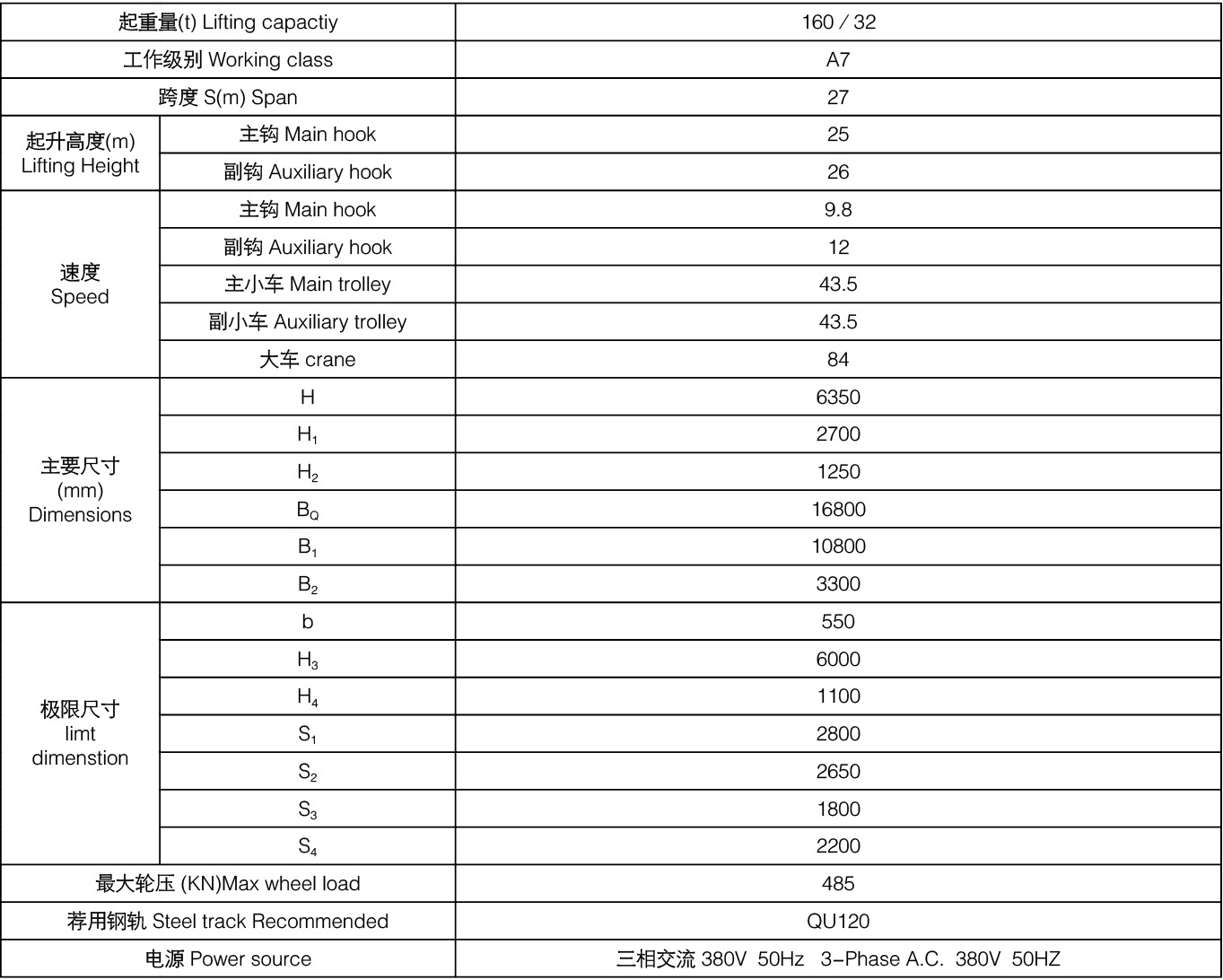
  • Double-Girder Bridge Cranes for Chemical Plants: Environment and Scope

    Double-Girder Bridge Cranes for Chemical Plants: Environment and Scope

    Technical guide

    Double-Girder Bridge Cranes for Chemical Plants: Environment and Scope

    A chemical plant crane needs the lifting task and local operating conditions defined together. Provide the load, building information and area requirements so the proposed double-girder configuration can be reviewed for the intended service.

    Henan Mine CraneTechnical guide · Updated 2026Crane selection, project scope and operating requirements
    Double-Girder Bridge Cranes for Chemical Plants: Environment and Scope
    Henan Mine Crane lifting equipment
    Project planning notes

    Key points for this crane project.

    1. Why chemical plants give priority to double girder
    2. Higher lifting capacity and operational stability
    3. Larger lifting height
    Read the technical guide

    Why chemical plants give priority to double girder overhead travelling crane?

    In the chemical industry, double girder overhead travelling crane is always the mainstream choice for equipment lifting and production support operations. This is not a single specification choice, but is determined by the operational needs of chemical plants and the advantages of double girder structure. Compared with single girder cranes, the double girder structure can accurately match the production and overhaul scenarios of chemical plants due to its characteristics of load bearing, height and operational durability.

    Higher lifting capacity and operational stability

    Chemical plant production is inseparable from all kinds of heavy equipment, from tens of tonnes of reactors, tanks, to large pumps, heat exchangers, the installation, relocation and overhaul of these equipment, the crane needs to have enough lifting capacity. The main girder of double girder overhead travelling crane adopts double track design, which has much higher loading capacity than single girder equipment of the same specification, and can easily cope with the lifting demand of heavy chemical equipment.

    At the same time, the double girder structure is more rigid, less deflection during heavy load operation, and no obvious deformation of the main girder will occur. When lifting heavy equipment, the swaying amplitude of the equipment can be effectively controlled, which not only ensures the smoothness of the lifting process, but also avoids the collision of the equipment with the pipelines and frames of the plant, which is especially important for chemical plants with dense pipelines.

    Double-Girder Bridge Cranes for Chemical Plants: Environment and Scope
    Lifting equipment and application context

    Larger lifting height

    The layout of chemical plants is mostly multi-storey structure, the production equipment may be distributed on different floors of the process platform, the equipment in the storage tank area and reaction area is also mostly installed in the vertical position, which has higher requirements on the lifting height of the crane’s hook. The structural design of double girder overhead travelling crane can achieve greater effective lifting height, and the operating range of the hook can cover the lifting points of multi-storey process platforms and high vertical equipment.

    Whether it is lifting heavy equipment from the ground to the second-floor process platform or overhauling and hoisting storage tanks at high altitude, the double girder overhead travelling crane’s lifting height meets the demand without the need to build additional lifting brackets, which not only improves the operational efficiency, but also reduces the safety hazards of on-site operation.

    Suitable for heavy-duty continuous operation

    The production of chemical plants is continuous, and equipment maintenance is mostly planned for short-term operations, which requires cranes to be able to respond to lifting needs at any time, and to withstand frequent start-stop operations. At the same time, part of the chemical production chain of equipment maintenance frequency is high, cranes need to participate in various types of long-term small maintenance lifting, operating load is not low.

    The overall structure and core components of the double girder overhead travelling crane are designed according to the heavy duty operation standard, which can adapt to the high frequency of lifting operations in chemical plants, whether it is the production of supporting equipment shifting, or unexpected equipment overhaul, can run stably, and provide reliable lifting support for the continuous production of the plant. Henan Mine Crane’s double girder equipment is equipped with motors and brakes in accordance with heavy-duty operation standards, which can easily cope with the needs of 24-hour continuous operation in chemical plant areas, and has outstanding batch delivery capacity, with an annual production capacity of 500-600 units of various types of overhead travelling cranes.

    bridge double girder crane for chemical plants(
    bridge double girder crane for chemical plants(

    Step 1 – Define the actual working environment of the plant

    The first step in the selection process is not to look at the equipment parameters, but to understand the operating environment of the chemical plant. The environment of chemical production varies greatly, with different workshops having different hazard levels, corrosion, temperature and humidity. Only by accurately defining the environmental characteristics can the subsequent selection of equipment be accurately adapted to avoid a ‘one size fits all’ selection error.

    Classification of hazardous areas

    One of the core risks of chemical plants is flammable and explosive, need to be based on the type of plant media, according to ATEX or local equivalent standards to complete the classification of hazardous areas, mainly divided into Zone 1 and Zone 2, the explosion-proof requirements of the two types of areas have clear differences.

    Zone 1 is the area where explosive gas environment occurs continuously or exists for a long time, such as the reaction kettle area of petrochemical plants and the periphery of oil and gas transmission pipelines; Zone 2 is the area where explosive gas environment occurs occasionally, such as the loading and unloading area of the chemical raw material warehouse. In addition to the risk of gas explosion, coal chemical industry, powder chemical industry and other workshops there is also a risk of dust explosion, this type of regional equipment selection also need to take into account the requirements of dust explosion-proof, cannot only be designed according to the gas explosion-proof standards.

    Henan Mine Crane cranes in undertaking chemical projects, will first arrange for professional and technical team to visit the survey, to assist customers to complete the classification of hazardous areas, combined with the type of media to formulate targeted explosion-proof programme, to avoid the selection deviation caused by the inability to assess the environment.

    Comprehensive assessment of corrosive environment

    Corrosive is another major test of the chemical environment on the crane, need to be clear in advance of the plant crane operating area in contact with the type and concentration of the media. Pickling workshop, electroplating workshop will be exposed to high concentrations of acid, alkali media, organic chemical workshop will be exposed to various types of organic solvents, and many chemical workshops will have a continuous chemical vapour, media droplet emissions, which will cause corrosion of the crane’s metal structure and electrical components.

    Different corrosive media corresponding to different protection programmes, such as strong acidic environment need to choose acid-resistant corrosion-resistant materials and coatings, organic solvent environment should consider the solvent resistance of the coating, only accurate assessment of the degree of corrosion, in order to avoid subsequent local corrosion of equipment, structural damage problems.

    Consideration of temperature and humidity conditions

    Chemical plant part of the process area there are high temperature conditions, such as ammonia, steelmaking supporting chemical workshop reaction area, the ambient temperature is much higher than the conventional industrial areas, the crane’s electrical components, lubrication system needs to adapt to the high temperature environment, to avoid aging of components, lubrication failure.

    At the same time, but also to distinguish between the crane’s operating area is indoor or outdoor, outdoor tanks, raw material loading and unloading area, will be affected by rain and snow, day and night temperature difference, humidity fluctuations, metal structure is prone to oxidation and corrosion, and indoor workshop humidity is relatively stable, but there may be a media condensation, also need to do a good job of moisture protection.

    Step 2 – Determine the explosion-proof design requirements of the equipment

    Explosion-proof is one of the core requirements of the chemical plant crane selection, especially in Zone 1, Zone 2 hazardous areas of the crane, explosion-proof design needs to cover all electrical and mechanical components, any one of the details of the negligence, may produce sparks triggered by the explosion, explosion-proof design is the core from the source to eliminate the generation and accumulation of sparks.

    The whole process of electrical explosion-proof components configuration

    The crane’s electrical system is the main source of sparks, double girder overhead travelling crane used in hazardous areas, all electrical components must be selected explosion-proof models, and explosion-proof level needs to match the regional hazard level. Explosion-proof motor is the core, and it should be of explosion-proof or safety-increasing type to avoid spark leakage when the motor is running; the control cabinet adopts explosion-proof design, and the internal wiring arrangement is standardised to prevent sparks from short-circuit of the wiring.

    Limit switches, travel switches and other electrical components that are prone to mechanical friction, you need to use spark-proof models, even lighting, junction boxes and such small parts, cannot miss the explosion-proof design. The explosion-proof grade of all electrical components should be unified, and there should be no ‘high-grade parts with low-grade accessories’ to ensure the overall explosion-proof effect of the electrical system.

    corrosion resistant double girder crane for chemical plants

    Special design for anti-static and grounding

    Static electricity accumulation is a source of sparks easily ignored in the chemical environment, cranes in the operation process, the car body and the track, the friction between the grab and the equipment will generate static electricity, if you can’t conductive removal in time, the static electricity accumulated to a certain extent will produce static sparks, lead to gas or dust.

    Therefore, the crane needs to design a perfect anti-static grounding system, set up between the car body and the track special grounding brush, to ensure that the static electricity can be conducted in real time; cable with shielded layer of special cables, cable protection system to do a good job of sealing, to avoid cable breakage caused by the leakage of static electricity. At the same time, the metal structure of the crane to ensure electrical connectivity, to eliminate the dead space of static electricity accumulation.

    Match the relevant explosion-proof certification standards

    All certifications need to cover the whole equipment of the crane, rather than a single component, to ensure that the explosion-proof design of the equipment meets the standard requirements.

    Discuss the crane arrangement for your project.

    A chemical plant crane needs the lifting task and local operating conditions defined together. Provide the load, building information and area requirements so the proposed double-girder configuration can be reviewed for the intended service. Share the load, available drawings, working cycle and site conditions with Henan Mine Crane so the required configuration and supply boundary can be discussed.

    Related crane configurations

    LH Electric Hoist Double Girder Crane

    View product parameters
    Lifting capacity: 3, 5, 10, 16, 20 tSpan: 10.5–31.5 mLifting height: 6, 9, 12 or 18 m

    Use an LH double-girder bridge with an electric-hoist trolley for workshop lifting, assembly and maintenance. Match the hoist arrangement to the suspended load, hook travel and available building space.

    Double Girder Casting Crane

    View product parameters
    Lifting capacity: 75/20–200/50 tSpan: 10m – 35mLifting height: 6m – 25m

    Lift and transfer molten-metal ladles with a YZ casting crane configured for the full suspended load and casting process. Review ladle interfaces, thermal exposure and the operating sequence together.

    Updated 2026 · Henan Mine Crane
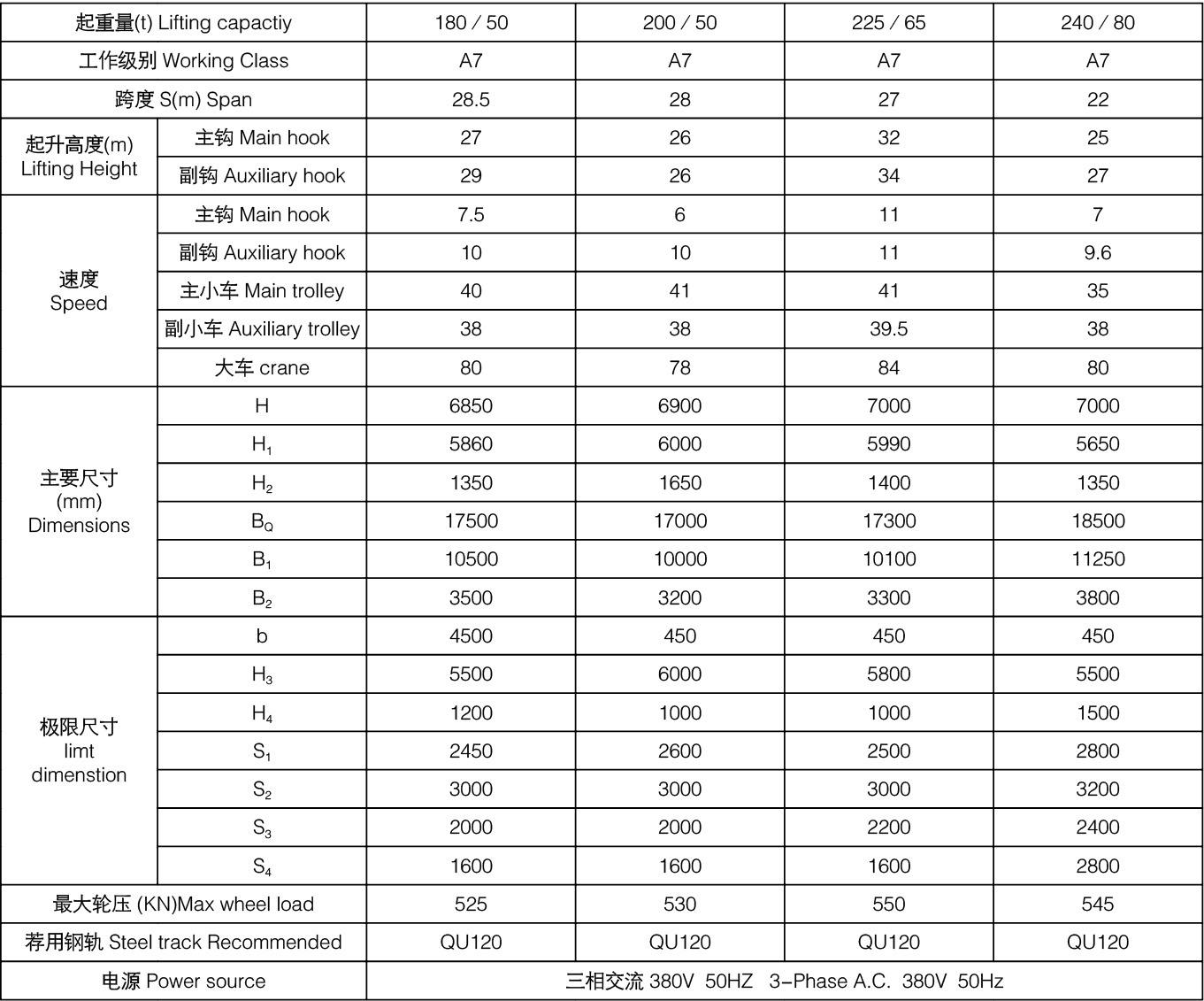
  • Factory Crane Ownership Cost: Build a Consistent Project Comparison

    Factory Crane Ownership Cost: Build a Consistent Project Comparison

    Technical guide

    Factory Crane Ownership Cost: Build a Consistent Project Comparison

    Ownership cost needs a defined period, operating cycle and responsibility boundary. Separate equipment, site work, energy, maintenance and downtime assumptions so alternative crane proposals are compared on the same basis.

    Henan Mine CraneTechnical guide · Updated 2026Crane selection, project scope and operating requirements
    Henan Mine Crane overhead crane inside a workshop bay
    Henan Mine Crane overhead crane inside a workshop bay
    Project planning notes

    Key points for this crane project.

    1. Set one scope and planning period
    2. Separate initial and annual costs
    3. Check the USD 280,000 worked example
    Read the technical guide

    Define the ownership-cost boundary

    A factory crane budget should cover what the business will pay to obtain, operate, maintain and eventually remove the equipment. Start with the same lifting duty, building layout, annual use and supply boundary for every proposal.

    Use this undiscounted planning formula: TCO = initial investment + operating and support costs over the planning period − net residual value. Net residual value means resale proceeds less removal and disposal costs. Keep the currency and price basis consistent.

    Build the initial investment schedule

    Record the quoted equipment price separately from the costs of making the crane usable at the destination. A lower equipment price can be outweighed by extra building work or a different installation scope.

    Cost groupItems to confirm
    Crane equipmentBridge, hoist or trolley, drives, controls and agreed lifting attachments
    Building and runwayRunway beams, rails, columns, foundations, structural review and reinforcement
    Delivery and site workPacking, transport, import charges, erection equipment, electrical connection and access
    HandoverCommissioning, required testing, training, documents and initial spare parts

    Assign every item to either the crane supplier or the site contractor. Count it once in the project budget.

    Estimate annual energy and operating costs

    Base energy use on the operating cycle: load, lifting distance, travel distance, starts, working hours and idle time. Connected motor power is not the same as average energy consumption.

    Where measured or supplier-estimated consumption is available, calculate annual energy cost as kWh per year × the applicable electricity tariff. Include demand or other tariff charges where relevant. Record staffing and supervision separately if the crane alternatives change those requirements.

    Include maintenance, inspection and downtime

    Build maintenance costs from the proposed service plan, component duty, access arrangements and local labour rates. Separate routine servicing, planned component replacement and inspections so the same work is not counted twice.

    Estimate downtime using expected unavailable hours and the actual financial effect per hour. Use lost contribution, replacement handling cost or another documented business measure; avoid counting the same production loss in several categories. Test uncertain failure assumptions as a range.

    Choose a planning period and net residual value

    Use a common planning period for the alternatives. A ten-year comparison is a budgeting choice, not a prediction that the crane has a ten-year service life. Component replacement and continued suitability depend on use, condition and the applicable inspection and engineering requirements.

    At the end of that period, subtract expected removal and disposal costs from expected resale proceeds. If removal costs exceed resale proceeds, the net residual value is negative and increases TCO. State whether tax, financing, inflation and discounting are included.

    Worked example: the budget inputs

    Illustrative assumptions only: the following constant-USD figures demonstrate the calculation. They are not equipment prices or a Henan Mine Crane quotation. The example uses a ten-year planning period and excludes financing, tax, inflation and discounting.

    InputAssumed amount (USD)Basis
    Crane equipment120,000One initial payment
    Delivery, site work and commissioning30,000One initial payment
    Energy4,500Per year
    Maintenance and replacement allowance3,500Per year
    Inspection and training1,000Per year
    Downtime allowance5,000Per year
    Resale proceeds at year 1015,000End-of-period assumption
    Removal cost at year 105,000End-of-period assumption

    Actual project values must come from the quotation, site budget, operating records and service assumptions. Add omitted costs before comparing a real purchase.

    Worked example: calculate the ten-year TCO

    CalculationAmount (USD)
    Initial investment = 120,000 + 30,000150,000
    Annual recurring costs = 4,500 + 3,500 + 1,000 + 5,00014,000
    Ten-year recurring costs = 14,000 × 10140,000
    Net residual value = 15,000 − 5,00010,000
    Ten-year TCO = 150,000 + 140,000 − 10,000280,000
    Simple annual average = 280,000 ÷ 1028,000 per year

    This annual average is a planning measure, not a rental payment or an annual supplier charge. For an investment appraisal, apply the agreed discount rate to each cash flow at its actual timing.

    Compare sensitivity as well as the headline total

    Change the uncertain inputs one at a time. In this example, increasing the annual downtime allowance from USD 5,000 to USD 10,000 adds USD 50,000 over ten years, taking undiscounted TCO from USD 280,000 to USD 330,000. That calculation shows why reliability and recovery arrangements can affect a purchasing decision.

    Compare alternatives using the same load cycle, energy tariff, planning period and site scope. Ask each supplier to identify which performance, support and maintenance assumptions are documented and which are estimates.

    Turn the cost comparison into a project brief

    Send Henan Mine Crane the complete suspended load, building and runway drawings, required hook positions, lifts per hour, annual operating hours and environmental conditions. Include the destination and your preferred installation and service responsibilities.

    Request an itemised equipment and site-scope proposal, a maintenance plan, spare-parts recommendations and the assumptions needed for your ownership-cost model. Review the overhead crane RFQ checklist before comparing offers.

    Discuss the crane arrangement for your project.

    Ownership cost needs a defined period, operating cycle and responsibility boundary. Separate equipment, site work, energy, maintenance and downtime assumptions so alternative crane proposals are compared on the same basis. Share the load, available drawings, working cycle and site conditions with Henan Mine Crane so the required configuration and supply boundary can be discussed.

    Related crane configurations

    Explore crane product families and technical parameters ↗

    Updated 2026 · Henan Mine Crane