Engineering · Manufacturing · Project support
info@hnksglobal.comWhatsApp +86 18836207779 ↗

分类: Technical Resources

Crane selection, technology, operation and purchasing knowledge.

  • How to Improve Efficiency with Container Straddle Carrier?

    How to Improve Efficiency with Container Straddle Carrier?

    How to Improve Efficiency with Container Straddle Carrier?

    Henan Mine Crane do harbor straddle car equipment service these years, I have seen too many terminals fall into a misunderstanding: always think that the efficiency of bank bridge up, the throughput capacity of the whole terminal will go up. But the actual run down to find that the efficiency of short-distance container transportation is the core bottleneck stuck in the throughput of the entire terminal.

    Cross-traffic car as the core equipment of the terminal short-distance transportation, the biggest advantage is that it can independently complete the container pickup, transportation, storage of the whole process, without additional with tractor and yard crane, eliminating the middle of the transfer link. But I have contacted the vast majority of terminals, have not been able to cross-transportation trucks to fully play out the ability.

    Common problems are only these categories: too many yard channel crossings, peak blockage; equipment idling rate remains high, running a lot of invalid mileage; stacking strategy is unreasonable, frequent dumping lengthened the operating cycle; and fuel costs run higher and higher, devouring the terminal’s profit margins.

    Today, I will take the perspective of a front-line engineer, combined with Henan Mine Crane’s practical experience in serving terminals in more than 50 countries and regions around the world, and talk to you about how to raise the efficiency of trans-carrier trucks from the core dimensions of operation indexes, yard layouts, scheduling logics, energy management, fleet operation and maintenance. Help you solve the pain points in actual operation.
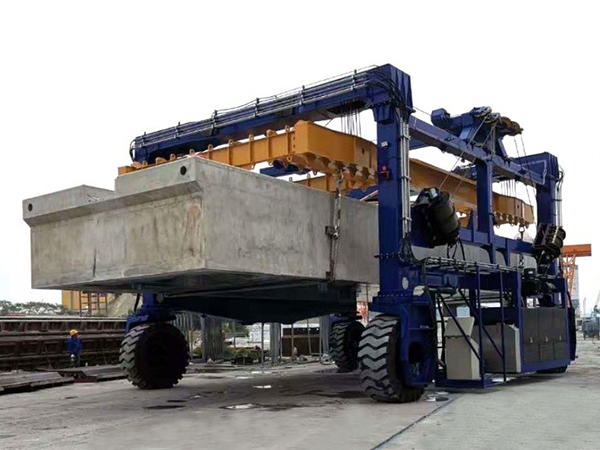
    Container Straddle Carrier by Henan Mine Crane

    Understanding Straddle Carrier Operational Workflow

    Typical Container Handling Cycle

    If you want to improve the efficiency, first of all, you have to figure out the complete operational cycle of the straddle carrier, and the time consumption of each link will directly affect the final operational efficiency.

    The most basic operation cycle starts with the unloading of containers from the shore bridge (STS). The bridge unloads the container from the ship to the shoreline handover area, and the transporter drives to the designated location to pick up the container and put it into its own gantry.

    Next is the transportation segment, where the straddle carrier carries the container and drives from the shore to the designated yard block. The driving distance and route smoothness of this link are the key variables that determine the length of the cycle.

    After arriving at the yard, it is the stacking operation, the trans-carrier stacks the containers accurately to the designated box position. If the container needs to leave the port, there will be a second extraction link, cross-transportation vehicle from the yard to take out the container, transported to the gate or railroad station, to complete the entire operation of the closed loop.

    A lot of terminal efficiency can not go, is because only focus on the storage and take the box link, ignoring the transportation and scheduling optimization. In a complete operation cycle, the driving time often accounts for more than 60% of the time, the optimization space of this link is much larger than just improving the lifting speed.

    Key Efficiency Indicators

    To judge the efficiency of a straddle carrier, you can’t just look at the parameters of the equipment itself, but also focus on these core indicators in conjunction with the actual operation of the terminal.

    The first one is Moves per hour (MPH), which is the most common efficiency indicator in the industry, directly reflecting the operational capacity of straddle carriers. Under regular working conditions, a cross-traffic truck in good condition, MPH can do 25-35 times, automated equipment in ideal working conditions can be close to 40 times. If the MPH of your equipment is lower than 20 times for a long time, it means that there is an obvious bottleneck in the operation link.

    The second is the single cycle time, that is, to complete a “pickup – transportation – storage” of the whole process time. This indicator can directly reflect the rationality of the yard layout and scheduling logic, the shorter the cycle time, the higher the operational efficiency of the equipment.

    The third is the fuel consumption of single operation, which is directly related to the operation cost of the terminal. Especially diesel-powered transporter, fuel costs can account for more than 40% of the operating costs of the equipment, even if a single operation only save a little oil, the whole year running down is also a small amount of money.

    The fourth is the yard congestion rate, that is, cross-traffic trucks in the operation process, because of the meeting, avoidance, route blockage generated by the waiting time ratio. The higher the congestion rate, the less effective operating time of the equipment, the efficiency naturally does not go up.

    The last is the equipment utilization rate, that is, the proportion of the actual operating hours of the equipment to the operable hours. This indicator not only depends on whether the equipment is on or not, but also how much time is spent doing effective work after it is on, excluding the ineffective hours of waiting, idling, and downtime.

    Improve Moves Per Hour (MPH)

    MPH is the most intuitive reflection of the efficiency of the cross-traffic trucks, to improve this indicator, the core is not to make the equipment run faster, but to reduce the ineffective waiting and driving, so that each operation is smoother.

    Optimize Travel Routes

    I’ve seen too many terminals with yard layouts that don’t take into account the traveling characteristics of cross-traffic trucks, with intersections everywhere and two-way lanes mixing up, and when rush hour arrives, the whole yard is jammed up and can’t move.

    Want to solve this problem, the most direct way is to design a one-way traffic flow. The access to the yard is divided into one-way traffic lanes to avoid traffic jams and opposite blockage, especially the shore to the yard of the main channel, must ensure one-way traffic to reduce cross-conflict.

    The number of intersections should also be minimized. When we optimized a medium-sized terminal in Southeast Asia, we reduced the number of intersections in the yard from 28 to 12, and at the same time set up a priority right of way for the main access road, which alone shortened the average cycle time of cross-haul trucks by 18%, and the MPH was directly increased from 22 to 28 times.

    Then there is the zoning operation. Each transporter is assigned to a fixed operation area, responsible for a fixed shore bridge and yard area, avoiding the transporter from running around in the whole yard, and significantly reducing the ineffective mileage of inter-area traveling.

    Reduce Empty Travel Time

    Empty traveling is the biggest hidden killer of the efficiency of trans-shipment trucks. We have done statistics, many terminals in the world’s intermodal trucks, empty driving rate can be more than 35%, which is equivalent to one-third of the daily driving mileage is ineffective, not only a waste of fuel, but also occupy the yard access, exacerbating congestion.

    To reduce idling, the core is to optimize the task allocation logic. You can’t let the trans-carrier run back to the shore empty after unloading boxes and wait for the next task. Instead, through intelligent scheduling, to return to the empty car near the assignment of the box task, such as the gate of the inbound box, the yard in the dump box task, assigned to the return of the empty car, so that the equipment “to have boxes, return cargo”, to minimize idling.

    When we did the scheduling optimization for an inland port in Europe, we reduced the idling rate of cross-docking trucks from 32% to 18% through this task allocation logic of “bringing containers along the way”, and the number of daily operations of a single piece of equipment directly increased more than 40 times, which is a very obvious effect.

    Balance Quay and Yard Operations

    Often, the efficiency of the trans-carrier cannot be improved, not because of the equipment itself, but because of the mismatch between the operating rhythm of the quay and the trans-carrier.

    Either the bridge unloading speed is too fast, trans-carrier can not keep up, the bank piled up a bunch of containers no one to pick up, the bridge can only stop work and wait; or trans-carrier are waiting for boxes on the bank, no one to do the task of picking up boxes in the yard, resulting in congestion at the gate, trucks lined up in a long queue.

    To solve this problem, we should do a good job of linkage between shore bridge operation and cross-truck scheduling. In advance, according to the ship’s berthing plan, unloading order, to the cross-truck task scheduling, shore bridge unloading fast tempo, on the deployment of a few more units of equipment to the shore; unloading operations into the trough, the excess equipment to the yard to do the pickup and dumping operations, so that the capacity of the equipment to get the full use of it.

    At the same time to set up a reasonable buffer zone on the shore. Even if there is a short-term mismatch between the rhythm of shore bridge and trans-shipment trucks, containers can be unloaded to the buffer zone first, avoiding shore bridge downtime and giving trans-shipment trucks a buffer time for scheduling.
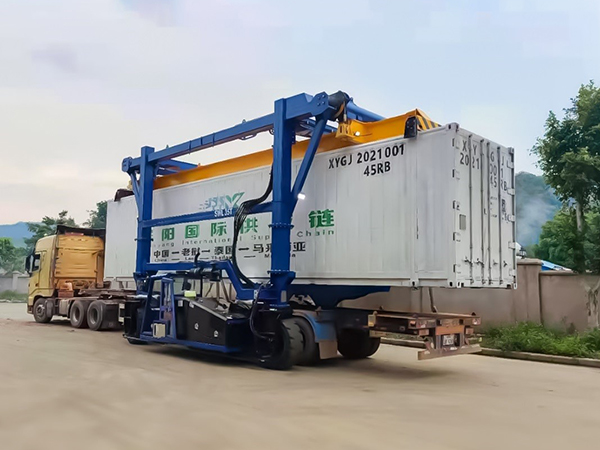
    Container Straddle Carrier by Henan Mine Crane

    Reduce Cycle Time

    The shorter the cycle time is, the more operations can be accomplished per unit of time by trans-shipment trucks, and the efficiency will naturally increase. To reduce cycle time, the core is to reduce the ineffective action in each operation, so that the pick-and-drop, stacking, and traveling are all smoother.

    Improve Pick-and-Drop Efficiency

    Pick-and-drop time is a point that many terminals tend to overlook. I’ve seen many operators spend half a minute just aligning and adjusting boxes, which is a huge amount of wasted time in a day.

    Want to improve the efficiency of pick and place the box, the most direct way is to add the equipment to the precise positioning system and visual aid system. Henan Mine Crane’s cross-traffic trucks, standard with a centimeter-level positioning system and box position identification camera, can help operators quickly align the container and box position, the length of a single alignment compressed from 30 seconds to less than 10 seconds, significantly reducing the ineffective adjustment action.

    There is also to standardize the operator’s operating habits. Many operators like to park the car far away, and then adjust the alignment a little bit, which not only wastes time, but also increases the wear and tear of tires. When we give training to customers, we will teach operators to predict the box position in advance and park in place at one time to reduce repeated adjustments, which can effectively compress the time of picking and placing boxes.

    Optimize Stacking Strategy

    Stacking strategy directly determines the traveling distance of straddle car and the difficulty of stacking operation, unreasonable stacking strategy will make straddle car do a lot of ineffective action, and lengthen the cycle time.

    Many terminals like to stack containers as high as possible, thinking that this can improve the utilization rate of the yard. But in fact, 1-over-3 stacking height, although more than 1-over-2 stacked one layer, but the cross-truck stacking and pickup time will increase by more than 30%, but also increase the probability of reversal of the container.

    The correct approach is to develop different stacking strategies according to the frequency of container turnover. High-frequency turnover of import and export containers, placed in 1-over-2 of the low-level stacking area, to facilitate the transporter to quickly pick up and place, reducing the time of stacking and picking up boxes; low-frequency turnover of empty containers, spare containers, placed in 1-over-3 of the high-level stacking area, maximizing the use of yard space.

    At the same time, we should follow the principle of “close stacking and storage”, stacking the containers unloaded from the ship to the yard block closest to the corresponding shore bridge, and stacking the containers to be loaded on the ship to the area close to the shore in advance, so as to minimize the driving distance of the trans-shipment trucks and compression of the cycle time.

    Minimize Rehandles

    Rehandling is an important reason to lengthen cycle time and reduce efficiency. Many terminals have a rehandling rate of more than 20%, which is equivalent to one rehandling for every five boxes picked up, and the transporter has to do a lot of ineffective work, so the cycle time naturally goes up.

    Want to reduce the reversal of boxes, the core is to use advanced yard planning algorithms, in advance to the container allocation of box space. For example, the same ship’s export box, centralized stacking in the same block, and in accordance with the order of loading, from inside to outside stacked in order, when loading the ship can be in order to take the box, do not have to reverse the box.

    There is also the pre-allocation of export container space. In advance, according to the berthing plan of the ship, the containers that are about to leave the port are transferred to the loading area near the shore in advance, so as to avoid loading the ship, taking the boxes from the deep box space in the yard, and also dumping the boxes above, which greatly compresses the cycle time of loading operation.

    When we optimized a coastal terminal in China, through the optimization of yard planning algorithms, we reduced the dumping rate from 22% to 9%, and shortened the single cycle time of a single straddle carrier by 22 seconds on average, which is a significant improvement in operational efficiency.

    Improve Fuel and Energy Efficiency

    Fuel and energy costs are one of the largest fixed expenses in the operation of cross-docking trucks. Especially nowadays, the global fuel price fluctuates greatly and the environmental protection requirement is getting more and more strict, improving energy efficiency can not only reduce the operation cost, but also meet the environmental protection compliance requirement.

    Diesel vs Hybrid vs Electric Straddle Carrier

    Choosing the right type of power is the basis for improving energy efficiency. The energy cost and application scenarios of different power straddle carriers are very different, there is no absolute good or bad, only suitable or not suitable.

    Diesel-powered straddle carrier has the most mature technology and the lowest initial procurement cost, which is suitable for small and medium-sized terminals with unstable operation volume and scattered sites. However, it has the highest fuel cost and large emission, and the energy expenditure will be very considerable in the long run.

    Hybrid transporter is the mainstream choice nowadays. Through the cooperation of lithium battery and diesel engine, it can recover the kinetic energy during braking and descending, and convert it into electric energy for storage to provide auxiliary power for the equipment.

    Pure electric transporter is the future development trend. Its single operation energy cost is only about one-third of the diesel model, and with zero emission and low noise, it is suitable for large terminals with fixed charging facilities and stable operation volume.

    Henan Mine Crane can customize three kinds of power transporters, namely diesel, hybrid and pure electric, according to customer’s working condition and energy planning, and help you choose the most suitable power type to reduce energy cost from the source.

    Engine Idle Reduction

    Engine idling is the worst area of fuel waste. Many terminal operators do not turn off the engine when they stop and wait, and the equipment idles for a long time, which not only burns diesel for nothing, but also accelerates the wear and tear of the engine and increases the maintenance cost.

    Want to solve this problem, the most direct way is to equip the equipment with automatic idling management system. This system can monitor the operation status of the equipment in real time, when the equipment stops for more than a set time, it will automatically reduce the engine speed, or even automatically shut down; when the operator starts to operate, it can be quickly started, without affecting the operation.

    We give the customer’s diesel cross-traffic trucks retrofitted with this system, the idling time of the equipment has been reduced by more than 60%, a single device can save nearly 10,000 yuan of fuel costs per month, the effect is very obvious.

    At the same time, we also need to give operators standardized training, so that they can develop the habit of turning off the engine when stopping and reduce unnecessary idling, so as to reduce fuel consumption from the operating habits.

    Smart Power Management

    In addition to reducing idling speed, smart power management can also significantly improve energy utilization efficiency and reduce unnecessary energy consumption.

    For example, the kinetic energy recovery system, hybrid and purely electric transporters can use this system to convert the kinetic energy generated during braking and container descent into electrical energy for storage, which can be used for driving and lifting the equipment, and can reduce energy consumption by about 20%.

    There is also the optimization of the acceleration curve. Many operators like to slam on the gas pedal and brake sharply, which will not only aggravate the wear and tear of tires and components, but also cause a lot of energy waste. Through the PLC control system, the acceleration and deceleration curves of the equipment are optimized, so that the driving and lifting movements of the equipment are smoother, which not only reduces energy consumption, but also extends the service life of the equipment.

    Our transporters will optimize the matching of the power system in advance according to the customer’s working conditions, so that the engine and motor are always running in the most efficient zone, avoiding the waste of energy caused by “big horse-drawn carts”.
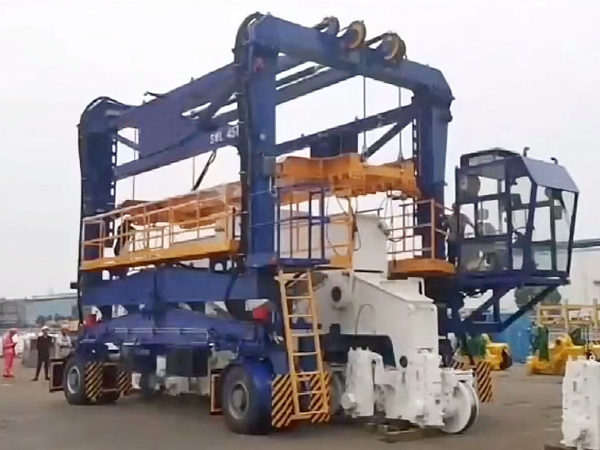
    Container Straddle Carrier by Henan Mine Crane

    Fleet Management Optimization

    No matter how high the efficiency of a single piece of equipment is, without reasonable fleet management, the operational efficiency of the whole yard will not go up. The core of fleet management is to let the right number of equipment, at the right time, appear in the right place, maximize the ability of each piece of equipment.

    Right Fleet Size Planning

    Fleet size planning is the foundation of fleet management. If there are fewer equipments, the operation volume can not keep up, the yard and the shore will be congested, and the throughput capacity can not be increased; if there are more equipments, a large number of equipments will be idle, which not only wastes the purchase cost, but also aggravates the traffic congestion in the yard, which in turn lowers the overall efficiency.

    To determine the appropriate fleet size, we cannot only look at the annual throughput of the terminal, but also combine the number of shoreline bridges, operating shifts, yard layout, and the MPH of a single piece of equipment comprehensive calculation. Routinely, a bridge needs to be matched with 3-4 straddle carriers in order to match the operational rhythm of unloading boxes and loading ships.

    When we do the planning for our customers, we will simulate the actual operation scenario of the terminal through discrete event simulation model to figure out the optimal number of equipments required under different operation volume, so as to avoid the problem of insufficient or excessive equipments.

    Real-Time Fleet Monitoring

    If you want to manage your fleet well, you must first be able to see the real-time status of each piece of equipment. If you don’t know where the equipment is, what it is doing, and whether it is malfunctioning, you can’t talk about rational dispatching.

    Through GPS positioning and remote diagnostic system, we can monitor the location, traveling speed, operation status, fuel level, equipment fault code and other information of each cross-traffic truck in real time. Dispatcher in the center control room, you can see the entire fleet of running status, where there is congestion, which equipment failure, can be the first time to make adjustments to avoid the expansion of the problem.

    For example, if a small fault occurs in a piece of equipment, the remote system can warn in advance, and the dispatcher can immediately assign the task of this piece of equipment to other equipment, and at the same time arrange for maintenance personnel to overhaul, so as to avoid equipment downtime, which affects the whole operation process.

    Preventive Maintenance Strategy

    Equipment downtime is an important factor that affects efficiency. When a piece of equipment suddenly breaks down, not only will it be unable to operate itself, but it will also disrupt the entire scheduling program, causing a chain reaction. To avoid this, you need to do preventive maintenance, not wait for equipment to break down and then fix it.

    Tires are the most easily worn parts of a straddle carrier, and they are also the biggest part of the maintenance cost. The weight of the truck plus the weight of the container are all on the tires, and unreasonable driving, harsh braking, and uneven road surfaces will accelerate the wear and tear of the tires. We provide our customers with a tire life management program, which regularly checks tire wear, adjusts tire pressure and alignment, extends tire life, and reduces downtime due to tire failure.

    There is also predictive maintenance of key components. Through the sensors on the equipment, real-time monitoring of the operating status of the engine, hydraulic system, lifting mechanism, and through data analysis, the wear and tear of the components can be predicted in advance, and maintenance and replacement can be arranged before the components fail, so as to avoid sudden breakdowns and downtime, and to increase the effective utilization rate of the equipment.

    The preventive maintenance program we provide to our customers can reduce the downtime rate of cross-trucks by more than 70% and increase the equipment utilization rate from 60% to more than 85%, which is a very obvious effect.
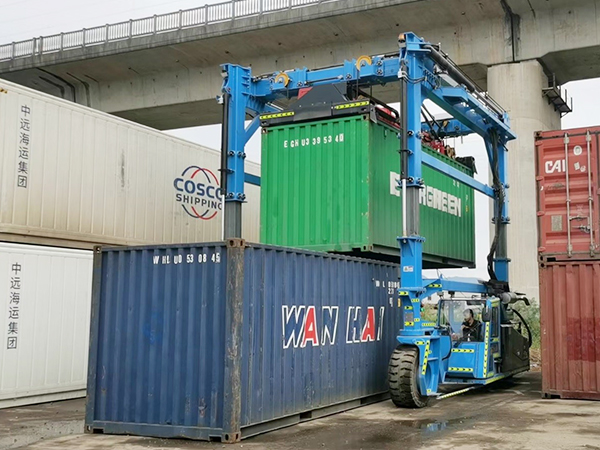
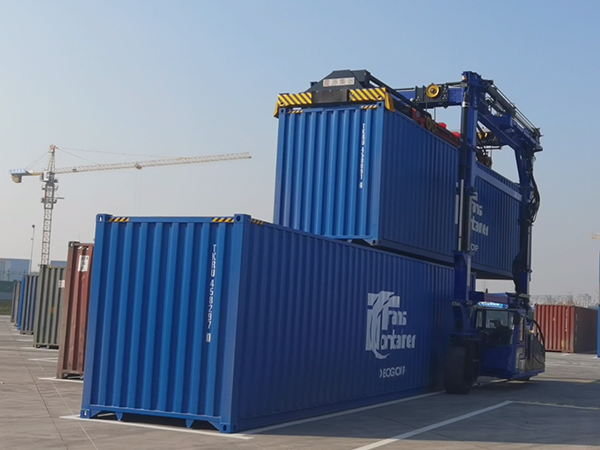
    Container Straddle Carrier by Henan Mine Crane

    Yard Design and Pavement Considerations

    In many terminals, the efficiency of straddle carriers cannot be improved because of the design of the yard and the road surface. Unreasonable yard layout will make cross-docking trucks run a lot of wrong way; substandard road surface will accelerate the wear and tear of the equipment, and even cause safety hazards, which can be avoided in the preliminary planning.

    Pavement Strength and Ground Pressure

    The axle load of trans-carrier is very high, when fully loaded, the ground pressure of a single wheel can be more than 10 tons, which requires very high strength of the road surface. Many pavements in terminals are designed without considering the ground pressure of trans-carrier, and after one or two years of use, settlement, cracking and rutting will occur, which will not only accelerate the wear and tear of the tires, but also make the trans-carrier move in a bumpy way, which will affect the operational efficiency and even cause potential safety hazards.

    The choice of road surface, mainly two kinds of concrete and asphalt. Concrete pavement has high strength, strong bearing capacity, long service life, and is not prone to rutting, which is suitable for large terminals with high-frequency operation of cross-traffic trucks, and although the initial construction cost is high, the later maintenance cost is very low. Asphalt pavement has low up-front construction cost and fast paving speed, but the bearing capacity is not as good as concrete and is prone to rutting and settlement, suitable for small and medium-sized terminals with low operation volume and requires regular maintenance.

    When we do the yard planning for our customers, we will give the design suggestions for the thickness and strength of the pavement according to the type of straddle carrier, full load grounding pressure, and the annual operation volume, so as to avoid the pavement being damaged in the later stage, which will affect the operation of the equipment.

    Lane Width Optimization

    The design of lane width directly affects the driving efficiency and turning time of straddle car. If the lane is too narrow, the transporter has to be careful when meeting and turning, slowing down and lengthening the driving time; if the lane is too wide, it will waste the space of the yard, reduce the storage space and lower the utilization rate of the yard.

    Routinely, cross-transportation vehicle one-way driving lane, the width should be wider than the maximum width of the equipment 0.8-1 meters, two-way lane should be about 2 meters wide, both to ensure the smooth passage of the equipment, but not a waste of space. Turning position, according to the minimum turning radius of cross-transportation trucks, to design enough turning space, to avoid repeated adjustments when the equipment turns, wasting time.

    In one of the terminals in the Middle East that we have served, the previous lane design was not reasonable and there was not enough turning space, so the transporter had to back up every time it made a turn to get through. After we helped them optimize the lane width and turning radius, the cross-haul trucks could pass through in one turn, and the duration of a single turn was shortened from 40 seconds to 10 seconds, which greatly improved the traffic efficiency of the whole yard.

    Traffic Flow Planning

    Reasonable traffic flow planning is the core of solving yard congestion and improving traffic efficiency. Congestion in many terminals is not due to insufficient lanes, but to unreasonable traffic flow planning, resulting in many bottlenecks and conflict points.

    Bottleneck areas should be avoided first. Shore to the yard of the main channel, the width should be enough, can not appear “wide road into the narrow mouth” situation, otherwise the peak period all the cars are blocked in the narrow mouth, the whole yard can not move. The number of main channel should be determined according to the number of shoreline bridges and the amount of work, generally every 2 shoreline bridges should be supported by a main channel.

    Then the buffer zone should be set up. In the shore handover area, gate, yard entrance to these easily congested location, set up enough waiting buffer zone, to avoid waiting for the vehicle occupies the passing lane, resulting in channel blockage.

    There is also the need to separate different flows of traffic. Separate the inbound and outbound traffic, and separate the transportation channels for heavy and empty containers to avoid cross conflicts of vehicles in different directions, reduce the waiting time for meeting and avoiding, and improve the efficiency of the whole yard.
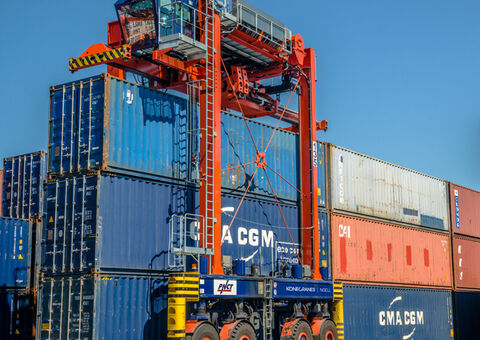
    Container Straddle Carrier by Henan Mine Crane

    Automation and Smart Technology Trends

    Nowadays, terminals around the world are developing in the direction of intelligence and automation. Automation technology not only reduces labor costs, but also makes the operation of straddle carriers more stable and efficient, and reduces human errors and fluctuations in operation.

    Remote-Controlled Straddle Carriers

    Remote-Controlled Straddle Carriers are the easiest and fastest automation solution to implement today. Operators do not have to sit in the cab of the equipment, but can remotely control multiple straddle carriers from the center control room to complete the whole process of picking up, transporting and stacking.

    Firstly, the safety of the operation has been improved. Operators do not have to run in the yard, away from the risk of high temperature, noise, collision, the operating environment has been greatly improved. Secondly, it reduces the labor cost, an operator can manipulate 2-3 sets of equipment at the same time, the labor demand is reduced by more than half, especially in Europe and the United States where the labor cost is high, it can save a very considerable amount of manpower expenditure.

    There is also a higher stability of operation. Remote control system with precise positioning can reduce human errors, so that each pick and place boxes, driving are more standard, less fluctuations in operating efficiency, the overall MPH can be stabilized at a higher level.

    Henan Mine Crane’s straddle carriers can be adapted to the world’s mainstream remote control systems, and can be customized according to customer needs, semi-remote or fully remote control solutions, to help customers smoothly realize the automation upgrade.

    Semi-Automated Routing Systems

    Semi-automated Routing Systems can solve the irrationality of manual scheduling, make the routes of cross-docking trucks better, and significantly reduce idling and congestion.

    This system can automatically plan optimal routes for cross-docking trucks according to real-time operation tasks and yard traffic conditions, avoiding congested road sections and choosing the shortest driving distance, without the need for dispatchers to manually assign routes. And can be adjusted in real time, such as a channel congestion, the system will automatically give the equipment to plan a new route to avoid vehicles piled up together.

    The semi-automated route optimization we did for a terminal in Europe, after landing, the average driving distance of cross-trucks was shortened by 22%, the idling rate was reduced by 19%, and the congestion rate of the whole yard was reduced by more than half, which is a very significant effect.

    Integration with TOS (Terminal Operating System)

    The scheduling and operation of trans-shipment trucks can only be realized through the terminal operating system (TOS), which contains all the core data such as vessel plans, container information, gate plans, operation instructions, etc. Only by seamlessly integrating the scheduling system of trans-shipment trucks with the TOS system can data-driven intelligent scheduling be realized.

    After the integration, the operation instructions of TOS system can be directly sent to the scheduling system of trans-carrier, automatically assigning tasks to the equipment without manual entry and communication, reducing the errors and delays in the intermediate links. The operation status and box position information of the trans-carrier can also be transmitted back to the TOS system in real time, so that the terminal managers can grasp the operation progress in real time and make more reasonable planning.

    For example, before a ship berths, the TOS system can synchronize the unloading plan and loading plan to the scheduling system in advance, so that the scheduling and route planning of trans-shipment trucks can be done well in advance, and the operation can be started as soon as the ship berths, so that there is no need for temporary scheduling, which greatly improves the operation efficiency.

    Lifecycle Cost Optimization

    Enhancing the efficiency of trans-shipment trucks ultimately comes down to reducing operating costs and improving return on investment. Many terminals only look at the initial purchase price when selecting a model, ignoring the whole life cycle cost, and as a result, it is cheaper to buy, but more and more expensive to use.

    CAPEX vs OPEX Analysis

    The whole life cycle cost, mainly including the initial procurement cost (CAPEX) and operating cost (OPEX) two parts.

    Initial Purchase Cost. Diesel transporters have the lowest CAPEX, hybrids are 15%-20% higher, and electrics are 30%-40% higher. Many customers only focus on this figure, choose the cheapest diesel model, but ignored the subsequent operating costs.

    Operating costs, which are the costs incurred continuously during the use of the equipment, include fuel/electricity costs, maintenance costs, tire replacement costs, labor costs, losses from breakdowns and downtime, and so on. A straddle carrier has a service life of 15-20 years, and operating costs often add up to several times the initial purchase cost.

    For example, a diesel transporter, the initial purchase cost is 2 million, the annual fuel, maintenance, labor costs are 800,000, 15 years of operating costs is 12 million, plus the initial purchase, the whole life cycle cost is 14 million. While a pure electric transporter, the initial procurement cost is 2.8 million, the annual cost of electricity, maintenance, labor costs is 300,000, 15 years of operating costs is 4.5 million, the full life cycle cost is only 7.3 million, far more cost-effective than diesel models.

    Therefore, when selecting a model, you can’t just look at how much money you spend when you buy it, but you should calculate the total account of 15-20 years to see which program has a lower life cycle cost.

    10-15 Year ROI Perspective

    From a 10-15 year ROI perspective, efficiency gains and cost reductions will eventually translate into tangible benefits.

    There are also reductions in energy and labor costs. For example, replacing a diesel transporter with a hybrid model will save $300,000 per year in fuel costs per unit, and a fleet of 10 units will save $30 million over 10 years. Remote control systems can reduce operators by half, saving millions in labor costs each year, all of which is a real return on investment.

    There’s also the improvement in land utilization. By optimizing the stacking strategy and yard layout, the storage capacity of the yard can be increased without expanding the land, which is of immeasurable value to ports with tight land resources and expensive land prices.

    Straddle Carrier vs RTG for Efficiency Improvement

    Many terminals in the selection of models, will be torn between straddle carriers and RTG (tire gantry crane) in the end to choose which. In fact, there is no absolute advantage or disadvantage of these two types of equipment, the core is to look at your terminal’s operating scenarios and efficiency improvement goals.

    Factor Straddle Carrier RTG
    Short-distance Transportation Obvious advantage, capable of independently completing the full-process transportation from STS to yard Relies on tractors for horizontal transportation, requiring multi-equipment coordination
    Stacking Density Medium, usually 1-over-2 to 1-over-3 High, usually 1-over-5 to 1-over-6, with higher land utilization rate
    Flexibility High, can move freely throughout the yard, adapting to flexible operation needs Medium, can only move within fixed yard blocks
    Automation Maturity Rapidly improving, with remote control gradually popularized More mature, with wider application of fully automated solutions

    Efficiency improvement is never only look at the parameters of a single piece of equipment, but look at the system design of the entire terminal.

    If your terminal is small or medium-sized, with medium operation volume, yard layout needs to be flexibly adjusted, and you want to simplify the operation process and reduce the types of equipment, the advantage of straddle carriers is very obvious. It doesn’t need to match with tractor and yard crane, one equipment can complete the whole process of operation, reducing the waiting time of multi-equipment coordination, and the efficiency of short-distance transportation is higher.

    If your terminal is a large deep-water port with high annual throughput and tight land resources, and you want to maximize the storage density of the yard and have a clear plan for full automation, then RTG will be more suitable. It has higher stacking density, can store more containers on limited land, has a more mature automation program, and is more stable for long-term operation.

    Henan Mine Crane can produce both straddle carriers and RTGs, and we will recommend the most suitable equipment solution according to the customer’s terminal size, yard layout, and throughput target, rather than just selling a certain product.
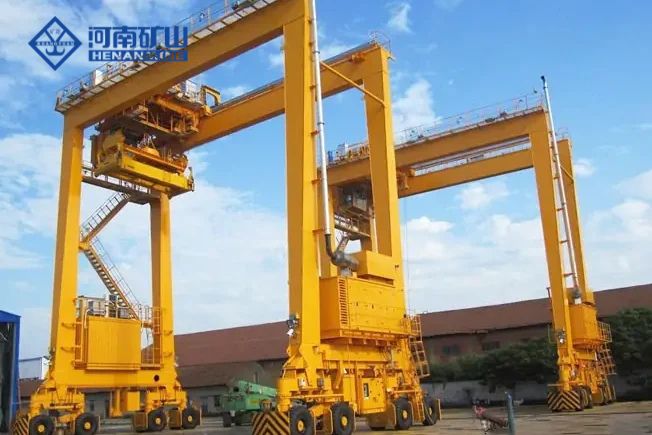
    Common Efficiency Bottlenecks

    In the course of serving our customers around the world, we have summarized the most common efficiency bottlenecks in the operation of trans-shipment trucks, and most of the efficiency problems in terminals are found in these places.

    The first is traffic conflicts. There are too many intersections in the yard, the two-way lanes are mixed, the traffic flows in different directions cross, congestion is easy to occur during peak hours, and a large amount of time is wasted on waiting for the cross-traffic trucks to avoid, and the effective operation time is reduced dramatically.

    The second is unreasonable scheduling. Task allocation is unscientific, high idling rate, equipment piled up in the same area, while other areas of the task no one to do, not only a waste of equipment capacity, but also exacerbate the local congestion, the entire operating rhythm of the yard has been disrupted.

    The third is excessive heavy container stacking. Do not distinguish between the frequency of container turnover, all boxes are stacked high, resulting in high-frequency turnover of the box is pressed under the box, every time you pick up the box have to frequently pour the box, lengthening the operating cycle time, reducing operational efficiency.

    The fourth is that tires wear out too quickly. Road surface unevenness, operator operation is not standardized, tire maintenance is not in place, resulting in frequent replacement of tires, increased equipment downtime, maintenance costs, affecting the effective utilization of equipment.

    The fifth is inadequate operator skills. The operating habits of different operators vary greatly. While a skilled operator can do more than 30 MPHs, a novice may only be able to do 20 MPHs, and the artificial differences in operation lead to great fluctuations in the efficiency of the entire fleet, which cannot be stabilized at a high level.

    Efficiency Improvement Checklist

    In order to facilitate you to quickly check the problems of your own dock, I have compiled an Efficiency Improvement Checklist, against which you can quickly find out where your bottlenecks are and clarify the direction of optimization.

    1. What is the current average Moves per hour for your transporter? How far off is it from the industry average of 25-35 Moves?
    2. Does your fleet have a high idle rate? Does the idle rate exceed 20%?
    3. What is your fuel cost as a percentage of operating cost? Is fuel consumption for single-tank operations higher than the industry average?
    4. What is your equipment utilization rate? Is the ratio of effective operating hours to operable hours below 70%?
    5. Is your yard congestion rate too high? Is the percentage of equipment waiting hours more than 15%?
    6. Do you have a clear automation upgrade plan? Do you need to upgrade to hybrid or electric transporters?

    Frequently Asked Questions

    Q1: What is the average productivity of a straddle carrier?

    Under normal working conditions, a manually operated straddle carrier is capable of completing an average of 25-35 operations per hour (MPH), depending on the yard layout, operating distance and dispatch level.

    Semi-automated equipment operated remotely will have a more stable operating efficiency of 30-35 MPH, while fully automated straddle carriers will be able to complete close to 40 MPH under ideal working conditions.

    Q2: How can I reduce fuel consumption?

    The most direct way is to replace the diesel-powered straddle carrier with a hybrid or pure electric model, which has been tested to reduce fuel consumption by about 40%. Besides, optimizing driving routes to reduce idling, installing automatic idle management system, optimizing acceleration curves to reduce harsh acceleration and braking, and doing regular engine maintenance can all effectively reduce fuel consumption.

    Q3: Are automated straddle carriers worth it?

    For terminals with high throughput and high labor costs, automated straddle carriers are worth it. It significantly reduces labor costs, allows one operator to control multiple pieces of equipment at the same time, and has a more stable operating efficiency, which reduces the number of human errors and reduces the accident rate. For small and medium-sized terminals with fluctuating workloads, it is possible to start with a semi-automated solution that is remotely operated, with lower investment and faster results.

    Q4: What affects straddle carrier efficiency the most?

    Yard layout and scheduling system are the two factors that affect straddle carrier efficiency the most. Unreasonable yard layout will lead to longer traveling distance and increased congestion; unreasonable scheduling will lead to high idling rate and waste of equipment capacity. If these two problems are solved, the efficiency of straddle carriers can be increased by more than 30%, which is far more obvious than simply increasing the traveling speed of the equipment.

    Q5: How long does a straddle carrier last?

    With regular maintenance and preventive care, a straddle carrier can last 15-20 years. Many of our customers have equipment that has been in use for more than 15 years and is still working stably. If not properly maintained and operated, the service life of a straddle carrier can be drastically shortened, with severe structural wear and component failures occurring in less than 10 years.

    Conclusion

    The efficiency of a straddle carrier is never determined by the parameters of the equipment itself, but by the system design, scheduling logic, operation and maintenance management of the yard. Even if you use the most advanced equipment, but the layout of the yard is not reasonable, scheduling is a mess, the efficiency will not go up.

    If you want to really improve the efficiency of cross-docking trucks, you can’t just focus on the equipment itself, you have to start from every link of the operation process, optimize the driving route to reduce idling, optimize the stacking strategy to reduce the inverted boxes, optimize the fleet management to improve the utilization rate of the equipment, and optimize the energy scheme to reduce the operation cost.

    Reasonable optimization will enable you to significantly increase the terminal’s throughput capacity and operating income without expanding land or adding a large amount of new equipment. And intelligent fleet management and automation technology is the core direction of the future terminal to improve efficiency, which can help you solve the core pain points of rising labor cost and fluctuating operation efficiency.

    Henan Mine Crane Factory Custom

    Henan Mine Crane has been focusing on the design, production and service of heavy-duty port equipment for more than 20 years, and has provided a full range of port equipment such as straddle carriers, RTGs, shore bridges and other port equipment, as well as complete efficiency optimization solutions for terminals in more than 50 countries and regions around the world.

    If you have your own terminal layout plan, you can submit it to us and we will give you a free efficiency assessment and customized optimization solution; you can also contact our port equipment experts to apply for a straddle carrier optimization proposal, which will help you find the efficiency bottleneck of your terminal and achieve a double increase in throughput capacity and revenue.
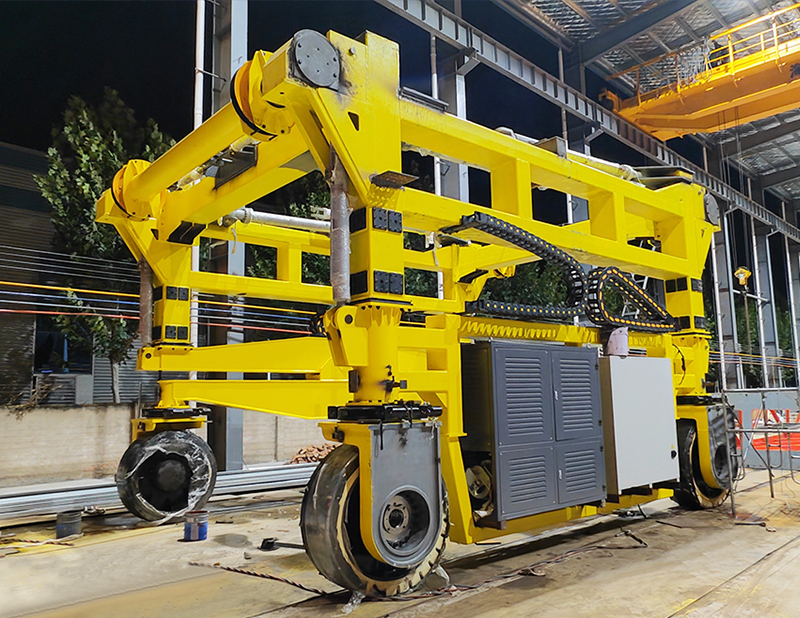
    Henan Mine CraneDiscuss your requirements ↗
  • How to Improve Efficiency with Container Straddle Carrier in Middle East Ports?

    How to Improve Efficiency with Container Straddle Carrier in Middle East Ports?

    How to Improve Efficiency with Container Straddle Carrier in Middle East Ports?

    In the past few years when Henan Mine Crane was in charge of straddle carrier business in Middle East ports, I have traveled all over the major ports in the United Arab Emirates, Saudi Arabia, Qatar and other countries. The most intuitive feeling is that Middle East ports are rapidly emerging as global core transshipment hubs, especially Dubai Jebel Ali Port and Saudi Jeddah Islamic Port, which are leading the transformation of smart ports in the whole region.

    However, the operating environment here is vastly different from that of European and Asian ports, with extreme temperatures ranging from 45 to 55 degrees Celsius, dust and sand, coupled with the peak operational pressures associated with large-scale transshipment, presenting unique challenges to the efficiency of container straddle carriers.

    Many ports have purchased European specification straddle carriers, but did not do the targeted adaptation, resulting in frequent overheating of the engine, equipment failure rate remains high, operational efficiency does not go on the problem. In fact, to improve the efficiency of transporters in Middle East ports, the core does not lie in how advanced the equipment itself is, but whether it can be adapted to the local extreme environment and transit needs.

    Today, I will combine Henan Mine Crane’s practical experience in serving Middle East ports to talk about how to improve the operational efficiency of container straddle carriers in Middle East ports. We will not talk about false theories, but only methods that can be put into practice, to help you avoid misunderstandings and truly realize the value of straddle carriers in Middle East ports.

    Operational Challenges in Middle East Container Yards

    Extreme High Temperature (45-55°C)

    High temperatures in the Middle East are the first obstacle to the efficiency of straddle carriers. Every summer, daytime road temperatures can easily exceed 60 degrees Celsius, putting the components of the equipment to the test.

    The most common problem is engine overheating. Conventional cross-traffic vehicle cooling system, below 35 degrees Celsius can work normally, but in the Middle East in summer, continuous operation for 1 to 2 hours, the engine temperature will exceed the standard, had to shut down to cool down, seriously affecting the operational rhythm.

    The hydraulic system will also be affected by high temperature. High temperature will make the hydraulic oil viscosity drop, seal aging accelerate, easy to leakage problems, not only increase the maintenance cost, but also lead to lifting, walking action stuttering, elongate the operating time.

    The aging speed of tires will also be greatly accelerated. High-temperature road surface will make the tire rubber softening, wear and tear increased, originally can be used for 3 years of tires, in the Middle East may be less than 2 years need to be replaced, not only to increase the cost, but also because of tire failure caused by equipment downtime.

    For operators, the heat also reduces endurance. Even if the cab is air-conditioned, prolonged exposure to high temperatures reduces the operator’s reaction speed and precision, indirectly affecting operational efficiency and even increasing safety risks.

    Sand and Dust Environment

    The sand and dust environment in the Middle East is the second major challenge for transporters. Fine sand and dust can get into the crevices of the equipment, causing a series of malfunctions and drastically reducing the availability of the equipment.

    Clogged air filters are the most common problem. Sand and dust can quickly clog the filter, leading to inadequate engine air intake, reduced power, increased fuel consumption and, in severe cases, damage to the engine block, causing major failures.

    Sensor contamination is also tricky. The positioning sensors and pressure sensors on the trans-carrier, once covered by sand and dust, will have inaccurate signals, leading to deviations in the alignment of the pickup box, misjudgment of operating instructions, requiring repeated adjustments by the operator, wasting a lot of time.

    The wear and tear of the brake system will also increase. Sand and dust can get between the brake discs and brake pads, increasing friction loss, and at the same time may cause the brakes to stall, affecting driving safety, and also requiring more frequent replacement of brake parts.

    The cooling system is also susceptible to clogging by sand and dust. When the radiator fins are covered with sand and dust, the cooling effect will be greatly reduced, which will further aggravate the engine overheating problem, forming a vicious cycle.

    Large-Scale Transshipment Operations

    As a global transshipment hub, Middle East ports are characterized by large-scale transshipment operations, which puts additional pressure on transporter efficiency.

    Container volumes are extremely high during peak hours. For example, the annual throughput capacity of Jeddah Islamic Port in Saudi Arabia jumped from 1.8 million TEUs to 4 million TEUs after the expansion, and a large number of containers need to be unloaded, transferred and stacked within a short period of time when the ship berths, which puts a very high demand on the operation capacity of transshipment trucks.

    The turnaround time of berth is very short. Middle East ports have high berthing costs, shipping companies require berth turnaround efficiency is very high, once the trans-carrier operation can not keep up, it will lead to ship delays, the port needs to pay a high amount of delay penalties.

    Key KPIs for Middle East Ports

    Moves Per Hour (MPH)

    Moves Per Hour (MPH) is the most important indicator for measuring the efficiency of straddle carriers in Middle East ports, especially in the Gulf hub ports such as Dubai and Saudi Arabia, which have extremely high throughputs.

    Combined with the actual working conditions of the Middle East ports, the MPH target for the straddle carriers in the high throughput Gulf hubs should be set at more than 30 to 40 times. This target seems strict, but as long as good equipment adaptation and operation optimization, it can be achieved.

    A large transshipment port in Dubai, which I have served, optimized the cooling system and scheduling logic of transshipment trucks to increase the MPH from 28 to 35 times, which greatly improved the turnover efficiency of the berths and reduced the cost of ship delays by millions of dollars per year.

    Cycle Time Under Heat Conditions

    Maintaining a stable cycle time under summer heat conditions is key to the efficiency of straddle carriers in Middle East ports. In many ports, straddle carriers are able to maintain consistent cycle times in the spring and fall, but in the summer months, cycle times are significantly extended due to overheating and malfunctioning equipment.

    For example, in a Saudi port, the single cycle time of trans-shipment trucks in summer is more than 20% longer than that in spring and fall, which directly leads to a decrease in the turnover efficiency of berths and fails to meet the requirements of shipping companies.

    For Middle East ports, it is more important to optimize the high-temperature adaptability of straddle carriers so that they can maintain a stable cycle time even during the summer peak hours, rather than simply improving MPH.

    Fuel Efficiency per Move

    The Middle East is an oil-producing region where diesel fuel is relatively competitively priced, but that doesn’t mean that fuel efficiency doesn’t need to be a concern. Cross-docking trucks are extremely heavy duty, and the difference in fuel consumption on a single job can make a huge difference in cost in the long run.

    High-temperature environment will lead to increased engine fuel consumption, for example, conventional trans-carrier at 35 degrees Celsius, a single operation fuel consumption of 5 liters, to 50 degrees Celsius, fuel consumption will rise to more than 6.5 liters, in the long term, a piece of equipment will be consumed thousands of liters of diesel fuel per year.

    Therefore, optimizing the fuel efficiency of transporters in Middle East ports focuses on reducing the extra fuel consumption under high temperature environment, and achieving stable control of fuel consumption in a single operation through equipment modification and operation optimization.

    Equipment Availability Rate

    Equipment Availability Rate is the basic guarantee for the efficiency of trans-shipment trucks in Middle East ports. Due to high temperatures and sand, the failure rate of trans-shipment trucks is inherently higher than in other regions, so the target equipment availability rate should be set at 95% or above.

    Once the availability rate is below 90%, there will be insufficient equipment capacity, leading to yard congestion and vessel delays. I have seen a Qatari port lose more than ten million dollars in operating revenue each year because the equipment availability rate has been around 85% for a long time.

    The core of improving equipment availability is to do a good job of preventive maintenance and equipment adaptation to the desert environment, so as to reduce downtime.

    Optimize Straddle Carrier Performance in High Temperature

    Enhanced Cooling Systems

    To cope with the high temperatures in the Middle East, the first step is to upgrade the cooling system of the straddle carriers, which is the core to ensure the stable operation of the equipment. Conventional cooling systems simply cannot meet the heat dissipation needs of the Middle East in summer.

    Our customized transporters for Middle East customers are equipped with oversized radiators. Compared with the conventional radiator, the size increases by more than 30%, the heat dissipation area is greatly increased, which can effectively reduce the temperature of the engine and hydraulic system.

    At the same time with a high-capacity cooling fan, the use of frequency control technology, according to the temperature of the equipment can automatically adjust the fan speed, not only to ensure the cooling effect, but also to reduce fuel consumption.

    Hydraulic oil also needs to be replaced with a high-temperature resistant model. The upper limit of the applicable temperature of conventional hydraulic oil is 60 degrees Celsius, while the high-temperature hydraulic oil we choose can be applied to the upper limit of the temperature of 80 degrees Celsius, in the high-temperature environment can still maintain good viscosity and lubrication performance, to reduce the failure of the hydraulic system.

    High-Temperature Electrical Components

    The electrical components of the transporter are prone to aging and short-circuiting under high-temperature environment, which affects the normal operation of the equipment, so it is necessary to choose high-temperature electrical components and take good protective measures.

    The lines are insulated and wrapped with high-temperature-resistant insulating layer to avoid aging and short-circuiting of the lines caused by high temperature. At the same time, the electrical connectors are sealed to prevent high-temperature oxidation and reduce the problem of poor contact.

    The air conditioning system in the operator’s cab also needs to be upgraded. Adopting a dual air conditioning system, the cooling capacity is 50% higher than the conventional model, which can quickly reduce the temperature in the cab to ensure the comfort of the operator and improve operational efficiency.

    Some high-end equipment will also be equipped with a temperature warning system in the cab, which will automatically remind the operator to take a break when the indoor temperature exceeds the set value, avoiding operation errors due to high-temperature fatigue.

    Tire Selection for Desert Conditions

    The selection of tires directly affects the operational efficiency and cost of the transporter in the Middle East ports. Conventional tires wear out quickly and are prone to blowout under high temperature and desert conditions, which cannot meet the needs of long-term operation.

    Tires with high-temperature resistant rubber compound should be used, which can withstand high temperatures above 60 degrees Celsius, wear more than 30% slower than conventional tires, and have a longer service life.

    At the same time equipped with tire pressure monitoring system, real-time monitoring of tire pressure and temperature, when there is abnormal pressure or high temperature, timely alert operators to avoid tire blowout.

    In addition, the tread pattern of the tires also needs to be adapted to the desert environment. The use of deep tread, puncture-resistant tires can effectively reduce the wear and tear of sand and dust on the tires, and at the same time, improve the vehicle’s grip on sandy road surfaces to avoid skidding.

    Sand & Dust Adaptation Strategies

    Advanced Filtration Systems

    The core of sand and dust adaptation is to protect the equipment from filtration and prevent sand and dust from entering the equipment and causing malfunctions. Conventional filtration systems are simply not adequate in the sandy environment of the Middle East.

    The cross-traffic trucks we supply to our Middle East customers are equipped with multi-stage air filtration systems. Adopting primary, medium and high efficiency three-stage filtration, it can effectively intercept sand and dust with different particle sizes, and the filtration efficiency reaches more than 99%, avoiding sand and dust from entering the engine.

    At the same time, it is equipped with a sand-proof air intake system, with the air intake designed on the top of the equipment, away from the ground sand and dust, and with a dust cover to further reduce the entry of sand and dust.

    The filtration system is also equipped with a clogging warning function, which alerts the maintenance personnel to replace the filter when it is clogged, avoiding the loss of engine power and increase in fuel consumption due to insufficient air intake.

    Sealed Electrical Cabinets

    The electrical control cabinet of the transporter is the “brain” of the equipment. Once it is contaminated by sand and dust, electrical failure will occur, affecting the normal operation of the equipment. Therefore, the electrical control cabinets need to be well sealed and protected.

    IP67 and above grade sealing design can effectively prevent sand, dust and water vapor from entering the control cabinet to protect the electrical components.IP67 grade control cabinet, even in the sand and dust environment for a long period of time, can also keep the internal clean.

    The cabinet is also equipped with a positive pressure cabinet system, through the clean air into the cabinet, the pressure inside the cabinet is higher than the external atmospheric pressure, forming a positive pressure environment, preventing sand and dust from entering through the sealing gaps, and further improving the protection effect.

    Preventive Maintenance Frequency Adjustment

    Under the sandy, dusty and high-temperature environment of the Middle East, the wear and tear of the transporter is faster than in other regions, so the frequency of preventive maintenance needs to be adjusted appropriately, and it cannot be carried out in accordance with the maintenance cycle of the conventional regions.

    The air filter replacement cycle, needs to be shortened by more than half. Every 30 days in regular areas, and every 15 days in the Middle East is recommended to avoid clogging of the filter leading to engine failure.

    The cooling system needs to be cleaned regularly, and it is recommended that the radiator fins be cleaned once a week to remove sand and dust from the surface to ensure the cooling effect. At the same time, check the operating status of the cooling fan once a quarter and replace worn parts in time.

    In addition, the electrical components and hydraulic system of the equipment need to be comprehensively inspected every month, so as to find and deal with potential faults in time, avoid the expansion of faults and reduce downtime.

    Fuel vs Electrification Strategy in Gulf Countries

    Diesel Advantage in Oil-Producing Regions

    The Middle East is a major oil-producing region in the world, and the relatively low price of diesel fuel is a core advantage of diesel-powered trans-shipment trucks in Middle East ports. For most small and medium-sized ports, diesel-powered straddle carriers are still the optimal choice.

    Diesel-powered straddle carriers have mature technology and perfect maintenance system. Most of the ports in the Middle East have mature diesel equipment maintenance teams, which can quickly deal with equipment failures and ensure the availability of equipment.

    At the same time, the initial purchase cost of diesel trans-shipment vehicles is lower, compared with hybrid and electric trans-shipment vehicles, which can reduce the initial investment pressure of the port. For ports with fluctuating operations and limited budgets, diesel transporters are more cost-effective.

    Hybrid and Electric Transition

    Hybrid and electric transitions are making inroads into the Middle East ports market, particularly in the UAE and Saudi Arabia, as a result of increased environmental awareness globally and sustainability initiatives in the Middle East.

    The UAE has launched a number of sustainability initiatives dedicated to creating green ports and encouraging ports to adopt electric equipment to reduce carbon emissions. Dubai’s Jebel Ali Port has deployed a number of electric straddle carriers for yard operations, with good results.

    Saudi Arabia’s “Vision 2030”, clearly put forward the goal of intelligent port construction, requiring ports to enhance automation, green level, electrification equipment to become an important support for the realization of this goal. Saudi Arabia spent 500 billion U.S. dollars to build the port of Oksargon, plans to rely entirely on renewable energy drive, the use of fully automated electric equipment operations.

    Hybrid and electric trans-shipment vehicles can effectively reduce carbon emissions, which is in line with the Middle East’s carbon reduction targets, and also reduce long-term operating costs, which is the future development trend of Middle East ports.

    ROI Comparison for Gulf Ports

    From a return on investment (ROI) perspective, diesel, hybrid and electric straddle carriers are suitable for different types of Middle East ports and cannot be generalized.

    Diesel straddle carriers have the lowest CAPEX and are suitable for small and medium-sized ports with limited capital budgets and fluctuating operations. However, fuel costs are higher in the long term, and operating costs (OPEX) will vary as fuel prices fluctuate.

    The initial investment of hybrid straddle carrier is 15%-20% higher than diesel model, but fuel consumption can be reduced by about 40%, with lower long-term OPEX, suitable for medium-sized ports with stable operation volume and focus on environmental protection, and it can recover the additional initial investment in 3-5 years.

    Electric transporters have the highest initial investment, 30%-40% higher than diesel models, but the lowest long-term operating costs, with electricity costs only about one-third of diesel costs. For large ports, smart ports, and especially ports with renewable energy supply, electric trans-shipment vehicles have a higher long-term ROI and are suitable for ports with long-term planning.
    Container Straddle Carrier by Henan Mine Crane

    Fleet Optimization for Large Transshipment Hubs

    Optimal Fleet Size Planning

    Large transshipment hub ports in the Middle East have large yard areas and high operational volumes, and fleet size planning for straddle carriers has a direct impact on operational efficiency and operating costs.

    If the fleet size is too small, it will lead to insufficient capacity of the equipment, and the containers unloaded on the shore bridge cannot be transferred in time, which will cause congestion on the shore, prolong the berthing time of the ship, and incur a high penalty for delay.

    Fleet size is too large, will lead to idle equipment, increase procurement costs and maintenance costs, but also exacerbate the traffic congestion in the yard, but reduce the overall operational efficiency.

    A reasonable fleet size needs to be planned in conjunction with the output capacity of the shorebridge. Usually, a shorebridge needs to be matched with 3-4 sets of straddle carriers in order to match the operational rhythm of unloading boxes and loading ships. For example, Jeddah Islamic Port in Saudi Arabia is equipped with 17 shore bridges after expansion, and the corresponding fleet size of straddle carriers is controlled at 50-60 units, which can meet the operational needs without causing idle equipment.

    Dynamic Dispatching Systems

    Large transshipment hub ports have large yard areas and complex operation tasks. Traditional manual scheduling cannot meet the demand for efficient operations and requires the use of dynamic dispatching systems.

    AI-based route optimization technology can plan the optimal route for each trans-shipment truck in real time according to the traffic conditions and operation tasks in the yard, avoiding the congested road and reducing the driving time.

    At the same time, the scheduling system needs to be integrated with the terminal operating system (TOS) in real time, so that the operation instructions can be sent directly to the trans-carrier without manual entry and communication, reducing errors and delays in the intermediate links.

    The dynamic scheduling system adopted by Dubai’s Jebel Ali Port can monitor the operation status of each straddle carrier in real time and automatically assign tasks, making full use of the equipment’s capacity and improving operational efficiency by more than 25%.

    Minimizing Empty Travel in Large Yards

    In the Middle East, large transshipment hubs have large yards, which tend to have a high rate of empty trucks, an important factor that affects operational efficiency. Empty traveling not only wastes fuel, but also takes up yard lanes and increases congestion.

    Adopting a zonal dispatching method can effectively reduce idling. Each transporter is assigned a fixed operation area, responsible for a fixed shore bridge and yard range, to avoid transporters running around in the whole yard, and to reduce the ineffective mileage of trans-regional driving.

    At the same time, through the intelligent task allocation, to the return of the empty car near the allocation of the task of picking up boxes, so that the equipment “to have boxes, return cargo” to minimize the empty driving. For example, the incoming containers at the gate and the dumping tasks in the yard are assigned to the returning empty trucks to enhance the effective operation time of the equipment.

    Pavement Design in Extreme Heat

    Concrete vs Asphalt in Gulf Climate

    The extreme heat in the Middle East places very high demands on yard pavement. The choice of pavement directly affects the operational efficiency of the transporter and the service life of the pavement, and the common pavement materials are concrete and asphalt.

    Asphalt pavement has a lower initial construction cost and is quicker to pave, but is prone to softening, deformation, rutting and other problems in the high temperature environment of the Middle East. In summer, when the pavement temperature exceeds 60 degrees Celsius, the asphalt will soften and leave obvious ruts after the cross-traffic trucks drive over it, affecting the speed and safety of vehicles.

    Reinforced concrete pavement has a higher initial construction cost, but it has a strong bearing capacity, high temperature resistance, long service life, and is less prone to deformation and rutting, which makes it suitable for cross-traffic trucks in the Middle East’s high-temperature environment.

    Most large ports in the Middle East use reinforced concrete pavements. Although the initial investment is high, the maintenance cost is low, which reduces the impact of pavement damage on operational efficiency.

    High Ground Pressure Management

    The axle load of trans-shipment trucks is very high, and the ground pressure of a single wheel can be more than 10 tons when fully loaded, which puts high demands on the bearing capacity of the road surface. Insufficient pavement strength will lead to settlement and cracking of the pavement, which will affect the operation of straddle carriers.

    When designing the pavement, it is necessary to carry out accurate axle load calculations according to the axle load of straddle carriers to determine the thickness and strength of the pavement. For yard pavements in Middle East ports, the thickness is usually 10-15 cm thicker than in conventional ports to withstand the high grounding pressure of straddle carriers.

    At the same time, the long-term durability of the pavement should be taken into consideration, and high-strength concrete and steel reinforcement should be used to avoid damage to the pavement due to long-term high pressure, and to minimize the impact of pavement maintenance on operations.

    Expansion Joint Design for Heat Expansion

    The high temperature environment in the Middle East will lead to thermal expansion and contraction of concrete pavement, which is easy to crack, arch and other problems, so the design of expansion joints in pavement is very important.

    The spacing of expansion joints needs to be set reasonably, usually every 5-8 meters, to avoid the stress caused by thermal expansion and cracking of the pavement.

    At the same time, the expansion joints need to be made of high-temperature resistant sealing materials to prevent sand, dust and rainwater from entering and avoiding damage to the expansion joints, which will affect the smoothness of the pavement. A smooth road surface reduces bumps for cross-haul trucks, improves driving speed and reduces tire wear.
    Container Straddle Carrier by Henan Mine Crane

    Automation Trends in Middle East Smart Ports

    Remote-Controlled Straddle Carriers

    Remote-Controlled Straddle Carriers are an important trend in Middle East Smart Ports, especially suitable for the Middle East’s high temperature and dusty environment, which can effectively improve operational safety and efficiency.

    Instead of sitting in the driver’s cab of the equipment, the operator can remotely control multiple straddle carriers from the center control room to complete the whole process of picking up, transporting and storing. In this way, the operator can stay away from the high temperature and dusty environment, the operation comfort is greatly improved, and the reaction speed and operation precision can be kept stable.

    At the same time, remote control can reduce labor costs, an operator can control 2-3 sets of equipment at the same time, especially in the Middle East, where labor costs are high, can save a lot of labor expenses.

    Dubai’s Jebel Ali Port has deployed a number of remotely operated straddle carriers, which have increased operational efficiency by more than 15% compared to manual operation, and have significantly reduced the rate of safety accidents.

    Semi-Automated Routing

    Semi-automated Routing is a system that further improves the operational efficiency of straddle carriers and reduces human errors. The system uses AI traffic management technology to optimize straddle car routes in real time.

    The system can monitor the traffic conditions in the yard in real time, avoid congested roads and choose the shortest traveling distance, while avoiding collisions between equipment and improving operational safety.

    For example, when there is congestion in a certain channel, the system will automatically plan a new route for the equipment to avoid vehicles piling up and blocking together, ensuring smooth traffic in the yard.

    Full Smart Terminal Vision

    Countries in the Middle East are pushing forward the construction of smart ports, especially Saudi Arabia’s “Vision 2030”, which clearly puts forward the goal of building the world’s leading smart ports, and the fully smart terminal has become the future development direction.

    The core of the fully intelligent terminal is the seamless integration of cross-transportation trucks, shore bridges, and TOS systems, and the realization of full-process automation and intelligence of port operations through the digital twin port model.

    Saudi Arabia’s Port of Oxagon, as a core component of the “City of the Future” NEOM, is moving towards the world’s first port driven by renewable energy, AI fully automated operations, transporter as the core equipment of yard operations, will realize the whole process of automated scheduling and operations.

    This fully-intelligent model will maximize the port’s operational efficiency, reduce manual intervention, and lower operating costs, and will be tailored to the large-scale transshipment needs of Middle Eastern ports.

    Lifecycle Cost Strategy for Gulf Region

    15-Year Cost Analysis

    The service life of straddle carriers in Middle East ports is usually 15-20 years, so analyzing the cost of the equipment from a 15-year lifecycle perspective is crucial to the investment decision of the port.

    High temperatures increase fuel consumption. In the Middle East, where high temperatures last for long periods of time during the summer, the annual fuel consumption of straddle carriers is 20-30% higher than in conventional regions, which is an important part of the operating costs.

    Tire replacement intervals are reduced in desert environments. The tire replacement cycle in conventional areas is 3-4 years, while in the Middle East it is usually 2-3 years. Tire replacement cost accounts for 15-20% of the operating cost, which is a considerable expense in the long run.

    At the same time, sand, dust and high temperature will accelerate the wear and tear of equipment components, maintenance frequency needs to be increased, and maintenance costs will increase accordingly. Therefore, when selecting a model, you need to choose equipment that is suitable for desert environments to reduce long-term maintenance costs.

    Availability vs Downtime Cost

    For Middle East ports, the availability of trans-carrier equipment directly affects the port’s operating income, and the downtime cost is very high.

    Vessel delay penalties are a major downtime cost. Vessel berthing costs are high in Middle East ports, and fines can run into hundreds of thousands of dollars per day for vessel delays due to straddle carriers failing.

    At the same time, downtime also leads to yard congestion, which affects the normal operation of subsequent operations, further reducing the port’s throughput efficiency and causing additional economic losses.

    Therefore, improving equipment availability and minimizing downtime is the key to reducing full life cycle costs. Through proper preventive maintenance and equipment adaptation, the availability rate can be effectively improved and downtime costs can be reduced.

    Long-Term Investment Logic

    When investing in transporters for Middle East ports, it is important to focus not only on the initial purchase cost, but also on the long-term investment logic. Choosing equipment designed for desert environments, although the initial investment may be higher, can significantly reduce long-term operational risks and costs.

    The straddle carriers designed specifically for desert environments have been optimized in terms of cooling system, filtration system, tires, etc., which have a lower failure rate and longer service life, and can reduce maintenance costs and downtime losses.

    For example, Henan Mine Crane’s straddle carriers customized for Middle East ports have been adapted for high temperature and sand, and the failure rate of the equipment is more than 40% lower than that of conventional equipment, and the service life has been extended by 2-3 years, resulting in a higher return on investment in the long term.

    Straddle Carrier vs RTG in Middle East Context

    Factor Straddle Carrier RTG
    Flexibility High Medium
    Stacking Density Moderate High
    Heat Resistance Requires adaptation Rail system less affected
    Automation Trend Emerging More mature

    Many Middle East ports in the selection of models, will be torn between straddle carriers and RTG (tire gantry crane) in the end which to choose. In fact, there is no absolute advantage or disadvantage of these two types of equipment, the core is to look at the port’s operational scenarios and needs.

    The Middle East has sufficient land resources, most ports have large yard areas, and the requirements for stockpiling density are not as high as those of European and Asian ports, so flexibility is often more important than stockpiling density.

    Transporter is highly flexible, can move freely in the whole yard, suitable for large-scale transshipment and flexible operation demand, no need to rely on tractor, can independently complete the whole process of picking up, transportation and storage, suitable for most of the ports in the Middle East.

    RTG’s high stockpiling density is suitable for ports with tight land resources, but it is less flexible, can only operate in fixed blocks, and needs to be coupled with tractors, which is suitable for large-scale hub ports with extremely high throughput and high stockpiling density requirements.
    Port Container Crane Comparison

    Common Efficiency Mistakes in Gulf Ports

    Combined with the experience of serving Middle East ports over the years, I have summarized a few of the most common efficiency missteps, which many ports have stepped into, and I hope you can avoid them.

    The first mistake is to use European specification equipment without adapting to the desert environment. European climate is mild, no sand, equipment cooling system, filtration system, simply can not meet the extreme environment of the Middle East, resulting in high equipment failure rate, low efficiency.

    A Saudi customer, the beginning of the procurement of a European brand of cross-transportation trucks, did not do any adaptation, the result is that every day in the summer there are 3-4 sets of equipment due to overheating, sand and dust clogging shutdown, operational efficiency simply can not meet the requirements, and finally can only find us to do the transformation.

    The second misunderstanding is to ignore the impact of high temperature on the life cycle of tires. Many ports choose conventional tires, the result is less than 2 years need to be replaced, not only increase the cost, but also frequently lead to equipment downtime, affecting operational efficiency.

    The third misunderstanding is to underestimate the sand and dust filtration needs. Selection of conventional air filters, frequent clogging, resulting in reduced engine power, increased fuel consumption, and even damage to the engine, increasing maintenance costs.

    The fourth misunderstanding, is not to do traffic modeling, blindly expanding fleet size. Thinking that the more equipment, the higher the efficiency, the result is that the yard is congested, idle equipment, but increased operating costs, reducing the overall efficiency.

    Efficiency Optimization Checklist for Middle East Ports

    In order to make it easier for you to quickly check your port’s problems, I have compiled an efficiency optimization checklist, against which you can quickly find bottlenecks and clarify the direction of optimization.

    1. Can your straddle carriers withstand the extreme heat of 55 degrees Celsius? Has the cooling system been upgraded?

    2. Is the cooling system equipped with oversized radiators and high-capacity fans to meet the peak cooling demand in summer?

    3. What is the fuel cost of your transporter for a single operation? Is it higher than the industry average?

    4. is the yard surface made of reinforced concrete to withstand the high grounding pressures of straddle carriers?

    5. Does your equipment and operation model fit in with the smart port initiatives and carbon reduction targets of the UAE, Saudi Arabia and other countries?

    Frequently Asked Questions

    Q1: Can straddle carriers operate efficiently in 50°C heat?

    Yes, it is possible. As long as the straddle carriers are specially adapted for high temperatures, equipped with enhanced cooling systems, heat-resistant electrical components and tires, they can operate efficiently in 50°C heat.

    Our customized straddle carrier in Dubai is able to maintain 30-35 trips/hour at 50 degrees Celsius in summer, with an equipment availability rate of more than 95%.

    Q2: Is electrification practical in Gulf ports?

    It is becoming more and more practical. Especially in smart port projects in the UAE and Saudi Arabia, electric straddle carriers have been widely used.

    The UAE’s Green Ports Initiative and Saudi Arabia’s Vision 2030 are promoting the electrification of ports, and with the rapid development of renewable energy in the Middle East, the operating costs of electric straddle carriers will be further reduced, making them more and more practical.

    Q3: How often should maintenance be done in desert ports?

    More often than in temperate regions. Due to the dust and high temperatures, the components of a straddle carrier wear out more quickly and maintenance intervals need to be shortened.

    It is recommended that air filters be changed every 15 days, the cooling system be cleaned weekly, a thorough equipment inspection be performed monthly, and in-depth maintenance be performed quarterly to ensure stable operation.

    Q4: What is the ideal stacking height for transshipment hubs?

    There is no set standard, it depends on the cost of land and flexibility strategy. In the Middle East, where land resources are abundant and land costs are relatively low, there is no need to pursue high stacking densities.

    For most Middle East transshipment hubs, 1-over-2 or 1-over-3 stacking heights are appropriate to ensure a certain level of stacking capacity and flexibility for transporters to minimize the number of reversals.

    Q5: Which system aligns better with Vision 2030 smart ports?

    An automated or semi-automated straddle carrier system with digital integration aligns better with Vision 2030 smart ports.

    Such systems can be seamlessly integrated with TOS systems and digital twin port models to automate the entire process of scheduling and operations, increasing efficiency and reducing costs, as well as conforming to the direction of green and smart development.

    Conclusion

    The core of improving the efficiency of intermodal trucks in Middle East ports is “adaptability” – adaptability to the extreme high temperature and dusty environment of the region, adaptability to the operational needs of large-scale transshipment, and adaptability to the development trend of smart ports.

    Unlike European and Asian ports, the optimization of cross-docking trucks in Middle East ports can not be copied from off-the-shelf experience, but must be targeted to solve the equipment failure problems brought by high temperature and dust, and at the same time, combined with the local fuel advantage and land resource characteristics, choose the right type of power and fleet size.

    Intelligent fleet management and automation technology is the core direction of the future Middle East ports to improve the efficiency of cross-haul trucks. Remote control, semi-automated route planning, and fully intelligent terminal integration can effectively reduce manual intervention, improve operational stability and efficiency, and fit the transformation needs of Middle East smart ports.

    Henan Mine Crane Factory Custom

    Henan Mine Crane has been focusing on the design, production and service of heavy port equipment for more than 20 years, and has an in-depth understanding of the operational characteristics of Middle East ports, and has provided customized straddle carrier solutions for ports in more than 50 countries and regions around the world, including large ports in Middle East countries, such as Dubai, Saudi Arabia, etc. We can meet the specific work requirements of Middle East ports according to the specific work requirements of Middle East ports.

    According to the specific working conditions of Middle East ports, we can customize straddle carriers that are suitable for high temperature and sandy environment, and provide professional services from equipment selection and modification to operation optimization and maintenance support, so as to help you avoid efficiency misunderstandings, reduce operation costs and maximize return on investment.

    If you have your own port layout and operational requirements, you can submit them to us and we will do a free efficiency assessment and customized optimization plan for you; you can also contact our port equipment experts to apply for a straddle carrier optimization proposal, which will help you to improve the straddle carrier operational efficiency in Middle East ports.

    Henan Mine CraneDiscuss your requirements ↗
  • How to Import a Crane from China: Step by Step Guide

    How to Import a Crane from China: Step by Step Guide

    How to Import a Crane from China: Step by Step Guide

    China builds a majority of the world’s mobile, tower, and overhead cranes, and buyers who import directly from Chinese manufacturers typically save 30–40% compared to sourcing the same equipment from European or American brands. That cost advantage only materializes if the import process is handled correctlya single misclassified HS code, a fake compliance certificate, or the wrong shipping method can erase those savings in storage fees, customs holds, or a seized shipment.

    This guide walks through how to import a crane from China from initial sourcing to final commissioning, covering the nine decisions that determine whether your shipment arrives on schedule, on budget, and legally compliant.

    What Does It Mean to Import a Crane From China?

    The import of a crane from China involves buying the lifting equipment from a Chinese supplier and then arranging a freight forwarder to ship it to a destination port, via the overseas customs authority before bringing onto a destination site for commissioning. This includes supplier due diligence, type approval, customs classification, freightbooking, paperwork and onsite installation.

    The reason China dominates crane production is they have an integrated supply chain. Steel making, hydraulic components and final assembly are often in the same industrial region (especially Shandong, Jiangsu and Hunan), which offers them economies of scale and integration that enable competitive pricing relative to build quality. (Level Of Build, above). This is why some vendors appear to be offering competitive prices without necessarily making inferior products (although quality varies substantially by manufacturer, which is why Supplier Vetting (Step 2) is quite important).

    This guide applies to first-time importers, contractors equipping a new project, and equipment dealers building inventory, regardless of whether you’re importing a single unit or a fleet.

    Choose the Right Crane Type for Your Application

    Before contacting any supplier, narrow down the crane category your project actually needs. Crane types are not interchangeable, and choosing the wrong category wastes time in supplier negotiations and complicates HS code classification later.

    Crane Type Typical Use Case Mobility
    Mobile/truck-mounted crane Construction sites, road-accessible lifts Self-propelled, drives between sites
    Tower crane High-rise construction Fixed to ground, assembled on-site
    Overhead/gantry crane Factories, warehouses, workshops Fixed rail system, indoor use
    Crawler crane Heavy lifts on uneven or soft terrain Self-propelled on tracks, not road-legal
    Rough terrain crane Off-road construction, mining sites Self-propelled on rubber tires, four-wheel drive

    If your project involves repeated relocation between job sites, a mobile or rough terrain crane is the default choice. If you’re equipping a fixed facilitya factory floor or a single construction siteoverhead cranes and tower cranes respectively make more sense.

    Henan Mine Crane Crane, as a well-known crane manufacturer in China, can provide a full range of lifting solutions, covering overhead cranes, gantry cranes, tire gantry cranes, jib cranes and customized material handling equipment systems.

    Find and Vet a Qualified Manufacturer

    Sourcing happens primarily through three channels: B2B platforms like Alibaba and Made-in-China, direct outreach to manufacturers in known crane-producing regions, or in-person visits to trade fairs such as the Canton Fair. Each channel surfaces suppliers, but none of them verifies quality on your behalfthat responsibility falls on you.

    Start by checking the supplier’s business license and export history rather than relying on platform badges alone. A “Gold Supplier” or “Verified” label on a sourcing platform typically confirms that a business license exists, not that the manufacturer’s products meet your destination country’s safety standards. Ask directly for previous test reports from accredited labs, not just certificates, since certificates can be issued without the underlying testing actually being performed.

    For any order above a few thousand dollars, commission a third-party inspection from an internationally recognized firm such as SGS, TÜV, or Bureau Veritas. A pre-shipment inspection checks the specific unit you’re buying against your purchase specification, which catches problems that a general factory audit won’tincluding mismatched components, missing safety features, or substituted materials.

    If you can, send your own representative (or a paid local inspector) to collect samples directly rather than trusting the supplier to send a “representative sample,” since suppliers have been known to forward better units than what ships in the actual order.

    Confirm Certification and Compliance Requirements

    The single most consequential misunderstanding in crane importing is who’s responsible for compliance. In nearly every destination market, the importer not the Chinese manufactureris legally responsible for ensuring the crane meets local safety standards. If customs or a market surveillance authority later finds the equipment non-compliant, the penalty, recall, or destruction order falls on you, not your supplier.

    Compliance requirements vary by destination:

    • European Union:CE marking under the Machinery Directive, with a Declaration of Conformity and technical file. Many Chinese-issued CE documents are unverified self-declarations rather than results of independent lab testing, so EU importers should commission third-party verification before mass production rather than accepting an existing certificate at face value.
    • United States:No blanket import certification scheme, but cranes must meet OSHA 1910 subpart N requirements and relevant ASME B30 series design standards once in operational use.
    • Australia:AS 1418 crane design and safety standards, enforced through state work-health-and-safety codes.
    • China (manufacturing baseline):Domestic manufacturers build to GB/T 3811 crane design standards, which is a useful baseline but does not substitute for your destination country’s requirements.

    Before placing an order, tell your supplier exactly which standard appliesdon’t assume a supplier who mentions “CE compliant” understands which specific directive your crane type falls under. Then verify independently. Treat any certificate you receive as a starting point for verification, not proof of compliance.

    Classify the Crane and Calculate Duties

    Customs classification determines your duty rate, and crane classification is more nuanced than it looks because different crane types fall under different Harmonized System headings.

    • HS 8426covers ships’ derricks, cranes (including cable cranes), and mobile lifting framesthis is where overhead traveling cranes, gantry cranes, and tower cranes are classified, generally under subheadings 8426.11, 8426.19, or 8426.20.
    • HS 8705.10covers self-propelled mobile cranes mounted on a truck or wheeled chassis.
    • HS 8431covers parts and components for lifting machinery, used when importing spares or attachments separately rather than a complete unit.

    Misclassification is a common and costly error: filing a tower crane under a general machinery parts code instead of 8426.20, for example, can trigger an audit, retroactive duty assessment, and penalties of up to the full shipment value in some jurisdictions. If you’re uncertain which subheading applies, request a binding tariff ruling from your destination country’s customs authority, or consult a licensed customs broker before the shipment leaves China.

    Duty rates vary by country and trade agreement, and US importers specifically need to account for Section 301 tariffs on Chinese-origin goods on top of the standard Most Favored Nation ratethese have materially increased landed costs for construction equipment imported from China in recent years.

    To estimate your true cost, calculate the customs value , then apply the duty rate to that total, not just the purchase price. A crane purchased for $50,000 FOB with $4,000 in freight and insurance has a customs value of $54,000and that’s the number duty and VAT calculations are based on, not the original $50,000 quote.

    Negotiate Terms and Place the Order

    Once you’ve selected a supplier and confirmed compliance requirements, the purchase contract should lock down five things beyond price: Incoterms, payment structure, lead time, warranty, and after-sales support.

    Incoterms determine who’s responsible for what at each stage of transit. FOB (Free On Board) is the most common for crane importsthe supplier handles export clearance and loading at the Chinese port, and you take over costs and risk from there. EXW (Ex Works) shifts more responsibility to you earlier in the process, while DDP (Delivered Duty Paid) shifts nearly everything to the supplier, which sounds convenient but means you have less visibility into and control over customs declarations made in your name.

    Payment is typically structured as a deposit (commonly 30%) at order confirmation, with the balance due before shipment or against shipping documents. Avoid paying the full balance before a pre-shipment inspection has confirmed the unit matches specification. Lead times for custom-configured cranes commonly run 60–120 days depending on capacity and complexity, so build that into your project timeline well before committing to a delivery date downstream.

    Choose the Right Shipping Method

    Crane shipments use one of three ocean freight methods, and the right choice depends on whether the crane is self-propelled and whether it fits within standard container dimensions.

    Method Best For Relative Cost
    RoRo (Roll-on/Roll-off) Self-propelled mobile and rough terrain cranes that can drive onto the vessel Lowest, for self-propelled units
    Flat rack container Disassembled or mid-size cranes too wide/tall for a standard container Moderate, plus out-of-gauge surcharges
    Breakbulk Oversized cranes (tower crane sections, large crawler cranes) that exceed RoRo or flat rack limits Highest, charged per freight ton

    Ro Ro is naturally the cheapest alternative when a crane, self propelled or otherwise, can roll straight on to the vessel without being lifted by the crane or requiring special lashings. Flat racks can be suitable where a crane can be split down to remove booms, outriggers or cabs so that the load can be carried within the confines of an out of gauge container. Breakbulk should be reserved for a crane section which is impractical to roll down a roller bed or fit in an out of gauge container;

    tower crane mast sections and large crawler crane bodies are two examples. Your specialist freight forwarder or heavy lift shipper should verify what your crane is eligible for and whether your port of destination has the crane capacity to unload the load in the breakbulk state.

    Regardless of method, insure the shipment. Cranes are high-value cargo, and the cost of marine cargo insurance is small relative to the financial exposure of a damaged or lost unit mid-transit.

    Prepare Export and Import Documentation

    Both the export clearance in China and the import clearance at the destination isinvolved the same set of documents. Any missing or incorrectly matched documentscan result in delays at the port.

    • Commercial invoice: specifies the goods, value, and trade conditions;
    • Packing list: specifies the weight, size and packaging configuration of each item.
    • Bill of lading: the provider‘s contract for carriage, and acknowledgement of the receipt of goods; used as evidence of the contract and as a document of title to the goods; also acts as a document of shipment.
    • Certificate of origin: for Chinese manufacture; if used to determine tariff preference levels under Applicable Trade Agreements.
    • Inspection certificate: report from a third-party body testing quality or compliance, critical if a disagreement develops later on.

    Import license or permit sometimes necessary for heavy equipment in some places. Verify your destination country‘s customs agency before shipping or you will not be able to deliver, not when you pick it up While the vessel is in transit be sure to have your freight forwarder or customs broker check the entire set of documents notwhen it reachesdestination as corrections are much more difficult to make after the bill of lading has been negotiated.

    Clear Customs and Arrange Delivery

    Before export, Chinese customs (via CIQ, China Inspection and Quarantine) may inspect the shipment, particularly for larger or higher-value machinery. On the destination side, your customs broker submits the entry documentation, pays applicable duties and VAT, and coordinates with port authorities to release the cargo.

    For breakbulk and oversized loads, factor in inland transport separately from ocean freight. Moving a crane from the port to its final site frequently requires oversize-load permits, route surveys, and in some jurisdictions a police escortnone of which are included in standard ocean freight quotes, and all of which need to be arranged before the vessel arrives to avoid storage fees accumulating at the port.

    Installation, Commissioning, and After–Sales Support

    A crane import isn’t complete until the unit is assembled, tested, and certified for operational use on site. For tower cranes and larger overhead systems, this typically means a multi-day installation involving the supplier’s technical team or a licensed local installer working from the supplier’s assembly documentation.

    Before finalizing the purchase contract, confirm what after-sales support the supplier provides: remote technical assistance, on-site commissioning support, operator training, andcriticallythe supply chain for spare parts once the crane is in service. A crane that’s cheap to import but expensive or slow to maintain afterward often costs more over its operating life than a slightly pricier unit backed by a responsive parts and service network.

    Common Mistakes to Avoid

    Most crane import problems trace back to a small set of recurring errors:

    • Skipping third-party inspection to save cost.A pre-shipment inspection costs a few hundred dollars; a non-compliant or mismatched crane stuck at a foreign port costs vastly more.
    • Misclassifying the HS code.Using a generic machinery code instead of the correct 8426 or 8705.10 subheading invites audits and retroactive penalties.
    • Pricing the project on FOB cost alone.Freight, insurance, duties, VAT, inland transport, and installation can add 25–40% on top of the unit’s FOB pricebudget for the landed cost, not the quote.
    • Choosing a shipping method based on price alone.A crane that doesn’t fit safely on a flat rack or can’t be driven onto a RoRo ramp needs breakbulk, regardless of what’s cheapest on paper.
    • Treating a supplier’s certificate as proof of compliance.Certificates can be outdated, fraudulent, or scoped to a different product than what’s actually being shippedverify independently.

    Conclusion

    Importing cranes from China is cost-effective. Standardize the whole process of selection, qualification audit, compliance filing, logistics and after-sales control, the implementation of quality inspection and certification and after-sales protection, can effectively reduce the procurement risk, to avoid delays, compliance issues and equipment failure and other additional costs, to protect the return on investment.

    For the first time for the procurement of customers, before the inquiry to clarify their lifting needs, project technical parameters and local industry compliance standards, is to streamline the supplier selection process, to avoid the hidden costs of procurement, to ensure that the procurement process to promote the optimal and efficient way.

    Henan Mine Crane is a professional lifting equipment manufacturer, mainly engaged in bridge,  gantry crane, jib crane and customized handling equipment. Relying on a wealth of overseas project experience and strict quality control, we provide consulting, production, logistics, after-sales one-stop service to help customers comply with the procurement, stable operation of the equipment, to provide cost-effective lifting solutions.


    Henan Mine CraneDiscuss your requirements ↗
  • How to Handle Eccentric Loads with an Overhead Crane

    How to Handle Eccentric Loads with an Overhead Crane

    How to Handle Eccentric Loads with an Overhead Crane

    Factory workshops, steel structure processing plants, and transformer manufacturing plants often need to use bridge cranes to lift loads with offset center of gravity.If the position of the hook, the arrangement of the sling, or the load balance are not judged properly, problems such as tilt, swing, or uneven force may occur during the hoisting process, increasing the risk of equipment damage and personnel injury.Reasonably evaluate the center of gravity of the load, formulate a suitable hoisting plan, and select matching lifting equipment and spreaders, which will help improve the stability of hoisting, ensure the safety of operations, and reduce the additional wear and tear of key components of the bridge crane.

    What Is an Eccentric Load in Overhead Crane Operations?

    Understanding load eccentricity

    Load eccentricity in bridge crane operation refers to the position of the center of gravity of a heavy object that does not coincide with the line of action of the lifting force of the hook, and the lifting force deviates from the center of gravity, resulting in additional overturning torque, which is different from concentric hoisting where the center of gravity falls on the vertical line of the hook.Even if the total load weight does not exceed the rated load of the crane, the bending moment and torsional force caused by eccentricity will still destroy the entire lifting system.The greater the eccentricity distance, the higher the additional torque, and the uneven force on the wire rope, spreader, main beam, and trolley wheel pressure will occur.Many on-site personnel mistakenly believe that it is safe as long as it is not overloaded, ignoring the hidden stress caused by eccentricity, which will accelerate component fatigue for a long time, and a single severe eccentricity will even cause load tilt and slippage at the moment of lifting.Identifying the load eccentricity is the first step in all non-standard workpiece hoisting operations.

    Common eccentric load examples

    Eccentric loads are very common in industrial sites, and a large number of non-standard workpieces naturally have a center of gravity offset.The cast thick-walled box, the transformer with a motor on one side, the long steel structure with heavy weight at one end, the material box with uneven internal material distribution, and the asymmetric welding frame are all typical eccentric loads.There are also temporary assembly equipment, molds for partial assembly parts, containers with internal fillers that can slide, and the center of gravity will shift twice after lifting.The design of the lug position in some scenes is unreasonable, and the hanging point and center of gravity are misplaced. Even if the shape is symmetrical, an eccentric load is still formed.This kind of workpiece is transferred very frequently in the workshop, and it is also a type of hoisting with a high incidence of bridge crane accidents. The position of the center of gravity must be evaluated separately before operation, and conventional symmetrical workpiece hoisting schemes cannot be applied.

    Eccentric vs. uneven loads

    Eccentric loads and uneven loads are often confused by on-site personnel, and there are obvious differences in the force mechanism and risk performance of the two.The core of the eccentric load is the offset of the center of gravity, and the line of action of the lifting force deviates from the center of gravity, resulting in a overturning bending moment, and the weight distribution of the load itself can be fixed.Uneven load refers to the uneven distribution of materials inside the load, and the center of gravity may move during the lifting process, such as bulk bins.Eccentric loads belong to the problem of geometric position offset, and uneven loads belong to the problem of dynamic center of gravity change.The same workpiece can have both eccentricity and uneven load characteristics at the same time.The eccentric load can be balanced by adjusting the hanging point and the position of the hook.In addition to adjusting the spreader for uneven loads, it is also necessary to fix the internal materials to prevent the center of gravity from sliding during lifting. The evaluation and control plans of the two cannot be equivalent.

    What Risks Do Eccentric Loads Create During Lifting?

    Load tilting and swinging

    The moment the eccentric load is lifted off the ground, the most intuitive risk is the tilt and swing of the load.The offset of the center of gravity will cause the heavy object to automatically tilt to the heavier side, the length of the spreader force is inconsistent, and the load loses its horizontal attitude.Once the load is tilted, when the trolley or crane moves, a pendulum effect will form, and the load will continue to swing laterally, and the swing amplitude will increase with the operating speed.Swinging workpieces can easily hit workshop columns, shelves, and production line equipment, causing damage to workpieces and damage to plant structures.What is more dangerous is that the hanging point slides off by force after tilting, and heavy objects fall.It is difficult to rely on the operator to manually control the swing of the eccentric load. Simply slowing down the speed can only reduce the risk and cannot eliminate the root cause. The amount of eccentricity must be eliminated or suppressed before lifting.

    Uneven forces on lifting gear

    In the eccentric state, the force of lifting accessories such as slings, shackles, and lugs is no longer uniform, and the sling on one side close to the center of gravity will bear a load much higher than the other side, and a single sling will be overloaded.In many cases, the total load does not exceed the standard, but the stress of one-sided spreader breaks through the rated value, and the wire rope is extruded and deformed, the lug cracks, and the plastic deformation of the shackle occurs.Uneven force on the spreader can also cause the sling to twist and knot, further exacerbating the stress concentration.Most of these injuries are hidden injuries. A single hoisting will not break immediately, but fatigue cracks will be left. After multiple eccentric hoisting accumulates, the spreader will suddenly fail in subsequent conventional hoisting.For eccentric load operations, the selection of spreader cannot only refer to the total weight, but the actual force of each lifting point must be calculated separately.

    Side pulling and component stress

    Eccentric loads will naturally produce lateral tension, that is, cable-stayed side pull, which is a strictly restricted working condition for Henan Mine Crane Factory supply bridge cranes.After the hook is subjected to lateral force, the wire rope deviates from the vertical direction of the reel and squeezes the pulley groove, causing the wire rope to wear and change jobs, while introducing additional horizontal bending moments to the trolley, cart walking mechanism, and crane main beam.The main beam is subjected to bending+torsional composite stress, and the track and wheels are subjected to lateral thrust. Long-term eccentric hoisting will cause rim wear, track deformation, and trolley stagnation.Severe side pulling can even cause the car to derail.The factory rated load index of the crane is generally based on the vertical lifting conditions, and the eccentric side is pulled down, and the safety margin of the whole machine is greatly reduced, which can easily cause permanent structural damage.

    How to Assess an Eccentric Load Before Lifting

    Check load weight and center of gravity

    The first step in eccentric load evaluation is to confirm the total weight of the workpiece and lock the center of gravity position.Regular workpieces can rely on drawings to calculate the center of gravity.Irregular castings and welded components need to be measured and estimated to have a center of gravity, and if necessary, they can be positioned by pre-test hoisting.After the center of gravity position is marked, the eccentric distance between the center of gravity and the preset hanging point is measured to calculate the overturning torque.The ancillary parts, pipelines, and counterweight blocks attached to the workpiece need to be included in the total weight and cannot be missed.If it is a box with movable filling, make sure that the material has been fixed to prevent the center of gravity from shifting during the lifting process.A complete record of weight, center of gravity coordinates, and eccentricity is used as the basic data for spreader selection and crane verification. It is strictly forbidden to judge the center of gravity position based on experience alone.

    Identify unstable load points

    After completing the center of gravity positioning, investigate the unstable hanging points and weak positions on the workpiece.Some workpiece lugs are temporary welding lugs, and the bearing capacity of the welds is insufficient.The workpiece shell is thin, and direct binding will cause local extrusion deformation.When the center of gravity is close to the edge of the workpiece, a small eccentricity will greatly amplify the risk of tilt, which is a highly unstable hanging point.It is also necessary to check whether the surface of the workpiece is smooth, the binding sling is at risk of slipping, and the sharp corners need to be protected by corner guards.At the same time, evaluate whether there are local protruding components of the workpiece, which can easily block the surrounding facilities when lifting and swinging.After identifying the unstable hanging point, the position of the hanging point should be replaced, the reinforcement tooling should be added, or the form of the spreader should be adjusted, and the eccentric load cannot be lifted directly at the weak point.

    Calculate sling and lifting point forces

    The eccentric load cannot simply estimate the sling force according to the equal weight, and the load of each sling point needs to be calculated separately by means of the torque formula.When the center of gravity is tilted to one side, the hanging point near the center of gravity bears most of the load, and the tension of the sling will increase synchronously with the angle between the slings.When calculating, the angle between the slings, the eccentricity distance, and the weight of the workpiece should all be included, and the rated load of each sling and shackle should be confirmed to be greater than the calculated maximum force.At the same time, reserve the safety factor to avoid the impact load of dynamic lifting.If the calculation results show that the load of a single lifting point exceeds the rated capacity of the spreader, it is necessary to increase the number of lifting points, replace the spreader with a higher bearing capacity or use a balance beam, and the original spreader cannot be forcibly used to lift the eccentric workpiece.

    Verify crane capacity and hook position

    After the force accounting of the lifting point is completed, check the capacity of the Henan Mine Crane Factory supply bridge crane and the position of the hook.The rated load of the crane is suitable for vertical concentric lifting. Under eccentric working conditions, the composite stress of the main beam, trolley, and wheels should be reviewed to confirm that the whole machine still meets the safety standards under the additional bending moment.The hook must be able to be adjusted directly above the center of gravity. If the travel of the trolley is limited and cannot be aligned, it cannot be hoisted directly.At the same time, check the status of the hoist and pulley block to confirm that there is no damage to the wire rope.It is also necessary to evaluate the working space and reserve a safety gap for the tilt and swing of the load.When the eccentric torque exceeds the allowable range of the crane design, a larger crane should be replaced, or special balancing tooling should be used to reduce the impact of eccentricity.

    eccentric load overhead crane

    How to Handle Eccentric Loads with an Overhead Crane

    Position the hook correctly

    The core operation of handling eccentric loads is to precisely arrange the hooks vertically above the center of gravity of the load.The offset of the hook position is the most important cause of eccentric hoisting accidents.The operator moves the cart and trolley, and repeatedly fine-tunes the horizontal position of the hook until the vertical line of the hook passes through the center of gravity.After the adjustment is completed, gently lift until the wire rope is just tight, and observe the posture of the workpiece again to confirm that it is not tilted on one side.If the workpiece is tilted, it means that the hook still deviates from the center of gravity and needs to fall back to the ground to readjust the position of the hook, and it is forbidden to lift forcibly.For lifting eccentric workpieces, it is absolutely impossible to rely on cable-stayed workpieces to align the hooks. Cable-stayed workpieces will produce lateral forces, damage the crane structure, and bury major safety risks.

    Select suitable lifting attachments

    For eccentric loads, it is necessary to choose a special sling for adaptation, and ordinary slings cannot be used directly to bundle.The adjustable balance beam is preferred for eccentric hoisting. The balance beam can flexibly adjust the span of the lifting point, apportion the unbalanced torque, and limit the tilt of the load.For workpieces with a large center of gravity offset, multiple sets of shackles and sling combinations can be used to protect the edges of the workpiece with angle guards.The material and rated load of the spreader must match the hanging point to calculate the force, and the angle of the sling must be controlled within a reasonable range to avoid the surge of tension caused by small angles.Check the spreader for cracks, wear, and deformation before each use, and scrap it immediately if damage occurs.Customized spreaders need to be verified by lifting engineers to ensure that the spreaders can withstand the unbalanced tension caused by eccentricity.

    Adjust lifting points for balance

    After the position of the hook is fixed, the eccentricity effect is offset by adjusting the position of the hanging point.If the position of the lug of the workpiece is fixed, the length of the sling can be changed, and the hanging point on the side of the workpiece can be raised to keep the workpiece horizontal after lifting.When multiple hanging points are laid out, the spacing between the hanging points is redistributed to reduce the offset distance between the center of gravity and the center of the hanging point.Some non-standard workpieces do not have reserved lugs, and temporary lugs can be welded. The position of the lugs needs to be verified by strength.After adjusting the hanging point, check that all slings remain effectively tensioned and cannot relax the slings, otherwise the load will impact and flip at the moment of lifting.The adjustment of the lifting point belongs to the core link of the hoisting plan, and the layout of the lifting point needs to be recorded in writing for major eccentric hoisting.


    Perform a trial lift

    Test hoisting must be performed before the formal transfer. Test hoisting is a key step to verify the effectiveness of the complete eccentric hoisting scheme.Slowly lift the load, control the height from the ground to 100~200mm, hover for a period of time, and observe the attitude of the workpiece, the force of the spreader, and the crane for abnormal deformation.Focus on checking whether the workpiece is tilted, whether the sling is sliding, and whether the Henan Mine Crane Factory supply crane has signs of lateral force.During the test hoisting period, special personnel will be arranged to observe the status of each hoisting point, main beam, and trolley in the safe area.Once abnormalities such as tilt and slip are found, the load will fall smoothly immediately, and the hanging point and hook position will be re-optimized, or the spreader will be replaced.After the test crane confirms that it is stable and there is no abnormality, it can enter the subsequent horizontal transfer operation.

    Control crane movements

    During the whole process of eccentric load transfer, the crane must move at a low speed and smoothly, and emergency start, emergency stop, and rapid change of direction are prohibited.The acceleration and deceleration of carts and trolleys should be gentle, so as to reduce the inertial force and cause the load to swing.The operator maintains a visual observation of the load state. Once the swing occurs, do not yank the trolley in reverse to offset the swing, and wait for the load to stabilize naturally before continuing to move.The operating path cleans up obstacles in advance, delineates alert areas, and prohibits personnel from passing and staying under the load.The lifting action is also operated slowly to avoid the impact load amplifying the eccentric bending moment.The eccentric load is transported at a low altitude throughout the whole process to reduce the risk of falling. After reaching the target position, it will land smoothly, and then release the spreader after confirming that the load is stable.

    How to Choose the Right Overhead Crane Configuration for Eccentric Loads

    Choose a suitable crane type

    Long-term frequent hoisting of eccentric loads requires targeted selection of bridge cranes.Single-beam bridge cranes are suitable for conditions with mild eccentricity and small load and weight.Double-girder bridge cranes are preferred for heavy-duty eccentric and large overturning torque conditions. The double-girder structure has stronger torsional resistance and can withstand the composite bending moment caused by eccentricity.If the eccentric working conditions of the workpiece in the workshop are changeable, you can also consider a double trolley bridge crane, which is lifted in concert with the double trolley, and the center of gravity offset is balanced synchronously through the double lifting points.When selecting the model, it is not only to look at the rated lifting weight, but also to evaluate the cross-section of the main beam, the track, and the anti-lateral load capacity of the wheel set.In long-term eccentric operation scenarios, the safety factor of the crane structure is higher than that of conventional concentric hoisting equipment.

    Consider hoist and trolley positioning

    The arrangement of the hoist and trolley directly affects the lifting capacity of the eccentric load.Conventional fixed trolley, the range of movement of the hook is limited.In workshops with more eccentric workpieces, a model with a larger trolley stroke can be selected to facilitate the movement of the hook directly above the center of gravity.The dual-trolley scheme can independently control the lifting of two hoists, dynamically adjust the height of the hanging points on both sides, and automatically compensate for the tilt caused by eccentricity.At the purchase stage, communicate with the manufacturer the daily eccentricity range, so that engineers can optimize the wheel pressure design of the trolley and strengthen the trolley’s anti-lateral force structure.At the same time, a synchronous control system is optional to maintain the synchronization of lifting and lowering when the double hoist is hoisted, so as to avoid the load flip caused by excessive lifting on one side, and to adapt to the normal hoisting of workpieces with offset center of gravity.

    Use specialized lifting attachments

    In addition to the crane body, the supporting special spreader system is an important component of the eccentric load scheme.Adjustable spreader beam (spreader beam) is the most commonly used tooling, which is suitable for workpieces with large length and asymmetric center of gravity, and can slide the lug to flexibly adjust the spacing of the hanging points.For heavy-duty workpieces with multiple hanging points, frame-type hanging beams can be used to disperse multi-point loads.It can also be used with tension monitoring sensors to view the force of each sling in real time and find the force imbalance in advance.The spreader needs to be designed in conjunction with the crane, and the weight of the crane beam must also be included in the total lifting load, and the crane capacity must be checked.The original supporting spreader can ensure that it matches the performance of the Henan Mine Crane Factory supply crane. Compared with the outsourcing of scattered spreaders, the overall safety is higher and the hoisting risks caused by mismatches are reduced.

    Verify the complete lifting capacity

    Under eccentric load conditions, the crane capacity verification cannot only look at the rated load of the nameplate, and the comprehensive bearing capacity of the whole machine needs to be verified.The verification includes the weight of the workpiece, the weight of the spreader, the weight of the balance beam, the additional bending moment and lateral force generated by the superposition of eccentricity, and the strength and stability of the main beam, end beam, trolley, track, wire rope, and reel are checked.It is also necessary to consider the lifting impact coefficient and operating inertial load, and reserve sufficient safety margin.If the verification finds that the local structural stress exceeds the standard, it is necessary to upgrade the crane specifications, strengthen the main beam structure, or limit the maximum allowable eccentricity distance.Provide a complete calculation book before delivery, clarify the eccentricity range of the crane allowed to be hoisted, and give the on-site operation boundary.

    How Can a Crane Manufacturer Help with Eccentric Load Handling?

    Review load and lifting requirements

    Professional crane manufacturers can deeply sort out the eccentric hoisting conditions of the factory, and collect parameters such as workpiece size, weight, center of gravity position, common eccentric distance, workshop space restrictions, and daily hoisting frequency.The engineer will understand the type of workpiece, determine whether the eccentricity is a fixed center of gravity offset or a dynamic variable center of gravity, and record the layout of the workshop operation track and the height of the workshop.Identify hoisting pain points based on on-site working conditions, judge the safety vulnerabilities in the current operation process, and distinguish between mild eccentric and high-risk eccentric operation scenarios.Through the review of working conditions, clarify the lifting constraints, and provide complete input for crane selection, structure customization, and spreader matching, so as to avoid the purchase of equipment that cannot be adapted to the lifting needs of eccentric workpieces.

    Recommend suitable lifting equipment

    Based on the results of the working condition review, the crane manufacturer recommends a matching host and spreader combination plan.For mild eccentricity, it is recommended that standard double-girder cranes be equipped with adjustable balance beams.For large eccentric and heavy workpieces, a double trolley bridge crane + multi-point hanging beam system is recommended.At the same time, recommendations for sling and shackle specifications are given, and the safety factor of the sling and the angle control requirements of the sling are clarified.The manufacturer will also provide guidance and suggestions for hoisting operations, mark the allowable eccentricity limit value, and the main points of the test hoisting process.The complete set of solutions takes into account the cost of equipment procurement and the safety of long-term operations, so as to avoid the waste of budget caused by customers blindly purchasing large-tonnage cranes, or insufficient equipment selection, and long-term risky operations under over-limit eccentric working conditions.

    Customize crane configurations

    When standard models cannot meet the needs of high-frequency eccentric hoisting, manufacturers can provide customized bridge cranes.Engineers optimized the cross-section of the main beam, improved the torsional and bending resistance, strengthened the anti-lateral force structure of the trolley wheels and tracks, and upgraded the hoist system.The dual-trolley model can be customized with a synchronous lifting control system to realize synchronous fine-tuning of the lifting points on both sides.Load monitoring and tilt alarm modules can also be added to provide real-time warning of load imbalance during hoisting.The customization stage synchronously optimizes the hook stroke and the moving range of the trolley to facilitate the alignment of the center of gravity of the eccentric load.All customized changes will be mechanically calculated to ensure that the structure of the whole machine is stable and reliable within the design eccentricity range, and to meet the long-term lifting of non-standard workpieces in the workshop.

    Confirm specifications before production

    Before the official production, the manufacturer outputs a full set of technical documents, including the crane general drawing, the mechanical verification report, the eccentric working condition bearing description, the spreader drawing, and the customer’s technical team to confirm the parameters one by one.Check the rated load, the maximum allowable eccentricity, the parameters of the spreader, the control function, and the size of the plant interface, and confirm that all parameters match the requirements of on-site hoisting.Conduct technical reports on key risk items, clarify the boundaries of equipment use, and inform which eccentric working conditions exceed the scope of equipment design, and prohibit operations.After the parameters are confirmed to be correct, manufacturing will start.This process can avoid early communication deviations, prevent the equipment from being found to be unable to adapt to eccentric load hoisting after completion, and reduce rework and construction period losses.

    Henan Mine Crane Factory Custom

    Eccentric load hoisting must not only consider the rated lifting weight of the bridge crane, but also comprehensively evaluate the center of gravity of the workpiece, the position of the lifting point, the configuration of the spreader and the actual operating conditions.For industrial scenarios such as steel structure processing and transformer manufacturing, reasonable crane configuration and matching hoisting accessories can help reduce load tilt, uneven force, and additional stress on equipment components, and improve the stability and safety of the hoisting process.

    Henan Mine Crane Factory can provide single-beam and double-beam bridge cranes and customized lifting solutions according to different hoisting needs.Whether it is a workpiece with an offset center of gravity, an irregularly shaped load, or a production condition that requires repeated precise hoisting, the appropriate equipment configuration should be determined based on the actual load characteristics and workshop conditions.If you are planning an eccentric load hoisting project, you can provide workpiece weight, size, center of gravity position, hoisting requirements and workshop drawings to obtain targeted crane configuration recommendations and project plans to help the equipment better adapt to actual production needs.

    Henan Mine CraneDiscuss your requirements ↗
  • How to Expand Port Handling Capacity Without Expanding the Terminal

    How to Expand Port Handling Capacity Without Expanding the Terminal

    How to Expand Port Handling Capacity Without Expanding the Terminal

    At a time when global maritime trade continues to expand and the demand for container transportation is surging year by year, major ports generally face the same core problem. Terminal land resources are scarce, expansion approval cycles are long, and infrastructure transformation costs are high, but the pressure on cargo throughput and the pressure on ships to dock continue to rise.Many port companies have fallen into a misunderstanding and believe that to improve the loading and unloading capacity of the port, they must expand the terminal land and add new shoreline resources. In fact, a large number of terminals have problems such as waste of production capacity, inefficient equipment, and redundant processes.For port operators, terminal managers, and logistics engineering companies, there is no need for large-scale land acquisition and expansion, and no need for large-scale infrastructure investment. By investigating capacity loss, optimizing lifting equipment, upgrading operating processes, and implementing automated control, the operating potential of existing terminals can be maximized, and the port’s loading and unloading capacity and cargo throughput can be steadily improved.

    Identify Where Port Handling Capacity Is Being Lost

    The insufficient loading and unloading capacity of the port is not due to the insufficient carrying capacity of the hardware facilities in most cases, but to the existence of many invisible capacity losses in the whole process of the operation.These losses are scattered in all aspects of crane operation, equipment standby, yard turnover, gate access, etc., and the overall throughput of the terminal is limited over time.If you want to expand capacity accurately, the first step is to comprehensively investigate the nodes of production capacity loss, identify inefficient shortcomings, and provide precise directions for subsequent optimization and transformation.

    Check crane productivity

    Shore bridge, yard bridge, and gantry cranes are the core equipment of port loading and unloading operations. The operating efficiency of Henan Mine Crane manufactured cranes directly determines the daily and single-ship loading and unloading capacity of the port, and it is also the core source of production capacity loss.Many terminals only pay attention to whether the equipment is operating normally, but ignore the actual operating efficiency of the crane.Common inefficiency problems include that the lifting, luffing, and walking speed of lifting equipment do not match the rhythm of the operation, and the operating proficiency of the operators is uneven, resulting in large differences in operating efficiency. The response of the hydraulic system and electronic control system of the old crane is lagging behind, and the time-consuming operation of a single box far exceeds the industry standard.At the same time, the distribution operation scenarios of cranes of different tonnages and arm lengths are unreasonable, and the large equipment does small work and the small equipment is overloaded, which will cause a waste of equipment efficiency.Regularly test the effective crane operation rate, single-cycle loading and unloading capacity, and single-ship operation efficiency, and compare industry standard parameters to quickly locate the production capacity gap at the equipment level, and lock in the loss problem from the core hardware side.

    Measure idle time

    Equipment standby idling and invalid waiting are the most neglected waste of production capacity in ports.In terminal operations, a large number of cranes, collection cards, and yard equipment have meaningless standby situations. The delay in the ship’s arrival at the port leads to the crane being on standby in advance, the cargo is not dispatched in time, the equipment is empty, and the team handover fault causes the operation to be interrupted, and the small equipment failure is not dealt with in time, causing a long shutdown.In addition, insufficient prediction of bad weather, temporary adjustment of operation plans, and manual scheduling errors will greatly increase the standby time of equipment.Accurately count the effective operating time, standby time, and idling time of each lifting equipment every day and every day, calculate the equipment utilization rate, and clearly quantify the loss of invalid production capacity.A large number of port data show that the comprehensive standby loss of most traditional terminal equipment accounts for more than 20%, and optimizing the standby efficiency can directly increase the potential production capacity by one-fifth.

    Track yard congestion

    The yard is the core transit area for cargo turnover in the port, and yard congestion is a key bottleneck restricting the overall throughput efficiency of the port.The operating efficiency of many terminal shore line cranes is up to standard, but the cargo cannot be quickly transferred, stacked, and shipped out of the warehouse after unloading, resulting in the stagnation of shore bridge operations, resulting in increased front-end processing efficiency, but the back-end link can’t keep up, forming a new bottleneck.The core causes of yard congestion include chaotic container stacking planning, mixed stacking of high and low boxes, and disordered placement of heavy empty boxes, which leads to excessive time-consuming picking up and emptying boxes.The division of the yard is unreasonable, and the cross-flow of import and export goods and different types of goods has caused conflicts in movement lines.The dispatching of yard equipment is chaotic, and the yard bridge and forklift operations are cross-congested.Continuous tracking of yard storage density, cargo turnover time, and high-congestion areas can solve the problem of transit caton in a targeted manner, open up the link in the second half of port operations, and release the operating capacity of front-end lifting equipment.

    Review gate delays

    The terminal gate is a key node for the connection of logistics inside and outside the port. The delay in the passage of the gate will directly lead to the retention of collection cards and the poor entry and exit of goods, which in turn restricts the efficiency of terminal loading, unloading and storage operations.The traditional manual registration and manual verification of documents are inefficient, and the gates are prone to congestion during peak periods. It takes too long for the collection card to queue for entry and exit, which indirectly causes the crane to be out of stock and out of stock, and the overall operation rhythm is disrupted.At the same time, the cumbersome gate control process, lagging information verification, and disordered vehicle scheduling will all prolong the cargo turnover cycle.Resetting the length of traffic at the gate, the number of vehicles stuck, and the peak congestion period, and optimizing the traffic mechanism at the gate, can open up the logistics links inside and outside the port, so that the terminal lifting equipment and yard equipment can maintain continuous operation, and completely solve the problem of idle operations and vehicle congestion. Mismatch problem.

    Increase Crane Productivity Within the Existing Quay

    The coastline is the most core scarce resource of the port. Upgrading the operating efficiency of the existing shore bridge without expanding the terminal coastline or adding new shoreline land is the core means to quickly increase the port’s loading and unloading capacity and increase the throughput of a single shoreline.By optimizing equipment performance, operating processes, and operating partitions, the operating potential of existing shoreline equipment can be maximized, and the production capacity of the shoreline can be doubled.

    Boost crane speed

    The speed of crane operation is the core index that determines the unloading capacity of a single ship and a single ship.For existing shore bridges and gantry cranes, within the scope of equipment safety loads and specifications, the electronic control system can be upgraded, the hydraulic transmission system can be optimized, and the drive components can be updated to comprehensively improve the crane lifting, luffing, cart walking, and trolley operation speed.Old port cranes generally have problems such as transmission lag, speed-up caton, and low speed limit. After professional speed optimization and upgrading, the smooth operation speed of the equipment can be increased by 15%-30%, and the frequency of loading and unloading in a single hour has been greatly increased.At the same time, by standardizing the operating procedures of operators, unifying the operating rhythm, eliminating artificial deceleration and invalid pauses, so that the crane can continue to maintain an efficient operating state, without replacing equipment and occupying new shoreline, the production capacity of shoreline operations can be directly increased.

    Cut cycle time

    Henan Mine Crane manufactured crane operation cycle time, that is, the complete length of time for a single cargo to be grabbed, transferred, dropped, and reset, is the core parameter to measure the operating efficiency of the equipment.The shorter the cycle time, the higher the frequency of operations per unit time, and the greater the overall throughput of the terminal.Many port cranes have a large number of redundant steps in a single operation cycle, such as unreasonable moving lines, waiting for instructions, slow alignment, and cumbersome resetting.By optimizing the operation line, streamlining invalid operation steps, accurately calibrating the crane alignment system, and shortening the time-consuming alignment of containers and bulk cargo.At the same time, linkage ship dispatching and cargo dispatching, plan the sequence of operations in advance, and reduce the waiting time for operations.Compressing the length of single-cycle operations in an all-round way can significantly increase the number of effective daily operations of the crane, completely solve the problem of normal operation of the equipment but low actual efficiency, and maximize the activation of existing shoreline operation capabilities.

    Optimize crane zones

    Unreasonable operation zoning of shore line cranes is an important cause of waste of shore line resources and operation conflicts.Some docks have problems of overlapping operation partitions, idle empty areas, and cross-operation of equipment. Popular berth cranes get together to operate, resulting in congestion and mutual interference with moving lines.The unpopular coastline has been idle for a long time, and the coastline resources cannot be fully utilized.Combining the tonnage of the ship, the type of cargo, and the loading and unloading volume, the crane operation area is re-scientifically divided, and the number of equipment and the scope of operation are allocated according to the operation needs to avoid cross-interference and invalid shuttling of equipment.At the same time, according to the tidal period and the peak of the ship’s arrival in the port, the operation zone is dynamically adjusted, and the equipment is flexibly deployed, so that each section of the coastline and each crane can maximize the value of the operation and realize the efficient use of the existing coastline space.

    Add quay cranes

    There is no need to expand the shoreline of the terminal. Within the carrying range of the existing shoreline, suitable shore bridges and small lifting equipment can be reasonably supplemented to fill the blank areas of shoreline operations.The early equipment layout of many traditional docks was sparse, and there was still room for the installation of compliance equipment on the shoreline, and the idle shoreline resources were not fully utilized.According to the existing coastline carrying capacity, berth layout, and ship docking specifications, professional cranes adapted to tonnage and arm length will be accurately supplemented to fill the blind spots in the operation in a targeted manner and share the operating pressure of the main equipment.Compared with the civil construction and expansion of the terminal, the input cost of adding crane equipment is lower, the landing cycle is shorter, and the effect is faster. It can quickly improve the comprehensive loading and unloading capacity of single berths and single shoreline, and greatly improve the overall throughput of the port.

    Improve Yard Capacity Without Adding Land

    The land resources of the terminal yard are fixed, and it is extremely difficult and costly to add land to the yard.To improve the overall turnover capacity of the port, the core lies in activating the existing yard stock resources. By optimizing the storage mode, upgrading the yard equipment, and streamlining the operating process, the yard’s storage capacity and turnover efficiency can be greatly improved without adding an inch of land, and the core problems such as cargo backlog and slow turnover can be solved.

    port handling capacity

    Increase stack density

    Most traditional port depots have problems of loose storage and serious waste of space. The number of container and bulk cargo stacking layers is insufficient and the spacing is too large. A large amount of yard space is invalidly occupied, and the actual storage capacity is much lower than the upper limit of the site design.Increasing the storage density is the most direct and lowest-cost way to expand the yard.Under the premise of complying with port safety regulations and cargo storage standards, scientifically increase the number of container stacking layers, accurately calibrate the cargo storage spacing, and eliminate invalid voids.According to the specifications, weight, and storage cycle of the goods, the storage area is classified and planned, and the vertical space and idle space in the corners of the yard are fully utilized.Through high-density and standardized storage, the storage capacity of the existing yard can be increased by 20%-40%, the backlog of goods can be greatly reduced, and sufficient transit space can be provided for the continuous operation of the terminal.

    Use yard cranes

    Traditional yards rely on forklifts and manual auxiliary operations, which are not only inefficient, but also have low stacking accuracy and limited storage height, making it impossible to make full use of yard space.The configuration of professional yard cranes is the core hardware upgrade method to activate the yard’s production capacity.Rail-type field bridges and tire-type field bridges have the advantages of wide operating range, high stacking height, accurate alignment, and stable operation.Through the popularization of special lifting equipment for the yard, high-level container stacking and precise pick-and-place can be realized, breaking through the storage restrictions of manual and ordinary equipment, and maximizing the value of the vertical space of the yard.At the same time, the yard bridge can realize large-scale and continuous operations, greatly improve the efficiency of cargo storage, retrieval, and transshipment, solve the problems of yard operations stuck and slow turnover, and allow the yard to match the high-speed loading and unloading rhythm of the coastline.

    Optimize stacking

    Disordered storage is the core pain point of the low efficiency of the yard. Many terminal goods are stacked at will, the categories are mixed, and the entry and exit are unplanned, which not only wastes space, but also greatly increases the cost of picking up and dumping.To optimize the storage strategy, a standardized and refined storage system needs to be established.Plan the storage location rationally according to the weight of the goods, the entry and exit time and the transportation distance, and improve the site utilization rate and operating efficiency.Store in partitions according to import and export, cargo category, transportation direction, and storage cycle to avoid cross-stacking.For high-frequency turnover goods, plan a dedicated and convenient storage area to shorten the retrieval distance.Standardized storage can improve the utilization rate of the yard without expanding the site, while greatly speeding up the speed of cargo turnover and improving the overall efficiency of the port.

    Reduce rehandling

    Secondary dumping, repeated handling, and invalid movement of goods are the most important production capacity losses in the yard, and they are also important reasons for congestion and inefficient turnover in the yard.Due to unreasonable storage planning and chaotic cargo scheduling in many terminals, the same batch of goods needs to be moved multiple times and moved repeatedly, which not only consumes equipment energy consumption and takes up operating time, but also greatly reduces the turnover efficiency of the yard.By formulating a cargo storage plan in advance, the initial storage location is accurately planned according to the ship’s departure time, cargo destination, and pick-up cycle, so as to reduce secondary handling from the source.Synchronize and optimize the scheduling process, unify the rhythm of yard, shoreline, and gate operations, and avoid disorderly accumulation of goods.After significantly reducing repetitive operations, the effective operation rate of yard equipment and cargo turnover speed have been significantly improved, and the overall throughput capacity of the port has been upgraded synchronously.

    Use Automation to Increase Throughput

    The traditional operating mode of manual scheduling and manual operation has problems such as low efficiency, large errors, slow response, and low fault tolerance, which are the core bottlenecks restricting the upgrading of port production capacity.The introduction of an automated control system to realize the intelligent linkage of equipment, goods, and processes can break through the limitations of manual operations and maximize port throughput and operational stability on the basis of existing hardware and sites.

    Automate crane scheduling

    Track containers

    Container information is opaque, location tracking is difficult, and the status of the cargo cannot be monitored in real time, which can easily lead to cargo retention, wrong delivery, and missed delivery, delay ship operations and vehicle traffic, and drag down the overall throughput rhythm of the port.The intelligent container tracking system can collect the stacking location, operating status, and turnover progress of each container in real time through the Internet of Things and positioning technology.Managers can view the dynamics of the whole cargo process in real time, accurately grasp the storage situation and operation progress, predict the risks of congestion and backlog in advance, and adjust the operation plan in time.Accurate cargo tracking can reduce cargo retention time, avoid delays in invalid operations, and ensure that the whole process of cargo turnover in the port is efficient and smooth.

    Connect terminal systems

    Many traditional terminals have system silos. The shore bridge operating system, yard management system, gate access system, and ship dispatching system are independent of each other. Data cannot be interoperable, and information synchronization lags behind, resulting in disjointed operations and stuck connections in all links.Open up the intelligent system of the whole process of the terminal, realize the real-time exchange and synchronization of equipment operation data, cargo data, ship data, and vehicle data, and form a closed-loop linkage between shore loading and unloading, yard turnover, gate access, and ship dispatching.There is no need for manual docking and repeated reporting of all links. The system automatically synchronizes information and connects operations to completely solve the problem of process faults and greatly improve the overall operating efficiency of the terminal.

    Coordinate equipment

    Port operations involve many types of equipment such as cranes, collection trucks, forklifts, and handling equipment. It is difficult to achieve efficient coordination of multiple equipment by manual coordination, and problems such as equipment operation conflicts, disjointed waiting, and inconsistent rhythm are prone to occur.The automated collaborative control system can realize unified scheduling and intelligent linkage of all types of equipment.According to the overall operation plan, the system synchronously allocates various equipment operation tasks, accurately matches the rhythm of lifting equipment loading and unloading, the rhythm of card collection and transfer, and the rhythm of yard storage, so as to achieve a smooth connection between loading and unloading, transshipment, storage and outbound links.After the collaborative efficiency of the equipment has been improved, the invalid waiting time of the terminal has been greatly shortened, and the overall throughput efficiency has been qualitatively improved.

    Optimize Existing Port Crane Infrastructure

    As the core operating hardware of the port, lifting equipment is old and aging, backward performance, limited parameters, and frequent failures are the core reasons for the insufficient production capacity of many old terminals.There is no need to replace new equipment in batches or expand supporting facilities. Through intelligent upgrading, performance transformation, and operation and maintenance optimization of the existing Henan Mine Crane manufactured crane infrastructure, the operating capacity and stability of the equipment can be greatly improved, and the stock of hardware resources can be activated.

    Modernize old cranes

    A large number of old port cranes that have been in service for many years generally have problems such as aging electronic control systems, backward operating modes, high energy consumption, low efficiency, and many safety hazards, which cannot be adapted to the efficient operation needs of modern ports.Modernization and upgrading of old equipment is a low-cost and high-return way to upgrade production capacity.The intelligent and efficient upgrade of old cranes can be realized by replacing the intelligent electronic control system, upgrading the hydraulic transmission components, updating the operating terminal, and installing intelligent monitoring equipment.After the transformation of the old equipment, the operating stability, accuracy and efficiency have been greatly improved, and the incidence of failures has been significantly reduced. Peak operating performance can be restored without the need to purchase new equipment, and the cost of terminal hardware upgrade is greatly reduced.

    Extend crane reach

    The existing crane arm length and operating coverage of some terminals are limited, which cannot be adapted to the loading and unloading needs of large ships and wide-body cargo ships. There are blind spots in the operation, which require frequent adjustment of ship berths and repeated alignment operations, wasting a lot of operating time.Under the premise of equipment safety compliance and structural bearing capacity compliance, the crane can be optimized for boom length and upgraded for operating range.Through professional structural transformation and boom optimization and adjustment, the coverage of crane operations is extended, so that a single equipment can cover more ship berths and wider operating areas, reduce the frequency of ship displacement and equipment displacement, greatly improve the efficiency of single-ship operations, and solve the pain points of inefficient loading and unloading of large ships.

    Increase load capacity

    Some old cranes have limited rated loads and cannot be adapted to the loading and unloading operations of large-tonnage containers and heavy bulk cargo. They can only be split and loaded and unloaded in batches. The operation process is cumbersome and time-consuming.On the basis of safety verification of equipment structure and compliance transformation, the load-bearing structure of the crane can be optimized in a targeted manner, the hydraulic carrying capacity can be improved, and the rated load of the equipment can be rationally upgraded.The upgraded crane can complete the loading and unloading of large-tonnage cargo at once, reduce the batch of operations, streamline the operation process, greatly improve the efficiency of heavy-duty cargo loading and unloading, adapt to the needs of diversified and large-tonnage maritime operations, and broaden the adaptation scenarios of terminal operations.

    Add predictive maintenance

    Sudden crane failures and downtime for maintenance are important factors that cause port operations to be interrupted and production capacity to be lost.The traditional mode of post-mortem maintenance and regular maintenance cannot predict the hidden dangers of equipment in advance, and it is prone to problems such as mid-operation failures and long-term downtime for maintenance, which seriously affects the continuous operation rhythm of the terminal.Install a predictive maintenance system for the crane, through real-time monitoring of equipment operating temperature, vibration, pressure, energy consumption, wear and other core data, intelligent prediction of potential equipment failures, formulate maintenance plans in advance, and complete maintenance before the outbreak of hidden dangers. Predictive maintenance can significantly reduce the sudden failure rate of equipment, reduce unplanned downtime, ensure the stable and continuous operation of the crane for 24 hours, and maximize the release of equipment production capacity.

    Build a Higher-Capacity Handling Strategy

    The long-term improvement of port loading and unloading capacity not only depends on equipment optimization and process upgrading, but also requires a systematic and standardized high-end operation strategy.Single-link optimization can only achieve short-term efficiency improvement, match equipment performance in all directions, balance operating processes, quantify production capacity gains, and strictly control downtime losses, so as to build a sustainable high-throughput operation system and achieve long-term and stable growth of port production capacity.

    Match crane capacity

    Many ports have the problem of equipment capacity mismatch. Large-tonnage cranes handle small pieces of cargo, small equipment undertakes heavy-duty operations, and the operating capabilities of shore bridges and field bridges are not matched, resulting in waste of equipment efficiency and unbalanced operation rhythm.To build an efficient operation system, we must first achieve accurate matching of equipment production capacity.According to the mainstream cargo tonnage, ship specifications, and operation scenarios of the terminal, crane operation tasks of different specifications and different loads are rationally allocated, so that large-scale equipment can mainly focus on heavy-duty operations, and small equipment can be adapted to lightweight turnover. The operating efficiency of shore line equipment and yard equipment matches each other to form an efficient and collaborative operation matrix, eliminating waste of equipment performance and maximizing the core value of each equipment.

    Balance terminal flow

    The bottleneck of terminal throughput often occurs in the imbalance of processes, the loading and unloading of the shoreline is too fast, the turnover of the yard is lagging, or the yard operation is efficient, and the traffic at the gate is congested. A single link will restrict the overall production capacity.Balancing the flow of the whole process of the terminal is the key to improving the overall throughput.Through intelligent scheduling and control, the operation rhythm of shoreline loading and unloading, yard storage, gate access, ship turnover, and vehicle transshipment is unified, so as to avoid unbalanced flow and congested backlog in all links.Dynamically allocate equipment and manpower to strengthen weak links during peak periods of operations, and optimize equipment maintenance during trough periods, so that the whole process of the terminal flows smoothly and at a balanced pace, and the overall throughput capacity is steadily improved.

    Estimate throughput gains

    After completing equipment optimization, process upgrading, and automation transformation, it is necessary to accurately quantify the effect of production capacity improvement, and optimize the follow-up operation strategy through data review.Through statistics of core data such as single-ship operation time, single-day throughput, equipment utilization rate, cargo turnover cycle, and congestion time before and after the transformation, the increase in production capacity can be accurately calculated.Based on data feedback, identify the remaining inefficient shortcomings, continuously optimize the operation plan, equipment layout, and scheduling mode, and form a closed-loop system of optimization, resetting, and upgrading, so that the port’s throughput capacity can continue to iterate and grow steadily.

    Minimize downtime

    Non-operational shutdowns, failure shutdowns, waiting shutdowns, and maintenance shutdowns are the core obstacles restricting the full-load operation of the port.One of the core goals of building a high-capacity operation strategy is to compress invalid downtime in all directions.Reduce downtime through predictive maintenance, eliminate waiting downtime through intelligent scheduling, streamline switching downtime through standardized operations, and optimize manpower handover downtime through reasonable scheduling.Maximize and shorten the length of various types of invalid downtime, ensure that terminal lifting equipment, yard equipment, and transshipment equipment continue to operate at full load, so that the terminal hardware production capacity can be released 100%, and the port handling capacity can be maximized without expansion or new resources. Increase.

    Henan Mine Crane Factory Custom

    To improve the loading and unloading capacity of the port, it is not necessary to rely on land acquisition to expand or add new shoreline.For most terminals, fully tapping the potential of existing facilities, improving the efficiency of crane operations, optimizing the loading and unloading process, and upgrading the intelligent control system can also effectively break through the bottleneck of production capacity.From analyzing the operating efficiency of existing equipment, to upgrading key lifting equipment such as shore bridges and gate machines, to customizing more efficient crane solutions according to terminal conditions, every link directly affects the overall throughput capacity of the port.As a large-scale industrial crane manufacturer, Henan Mine Crane Factory can provide supporting solutions from crane selection, design and manufacturing to upgrading according to the cargo type, operating intensity, site conditions and existing equipment conditions of the terminal, to help the port release more loading and unloading capacity in the case of small-scale expansion, so that existing sites and equipment can play a higher value.


    Henan Mine CraneDiscuss your requirements ↗
  • How to Determine the Ideal Wheel Load for Overhead Crane Runway Design

    How to Determine the Ideal Wheel Load for Overhead Crane Runway Design

    How to Determine the Ideal Wheel Load for Overhead Crane Runway Design

    In the track design of bridge cranes, wheel pressure is the core parameter of the load-bearing design of steel beams, rails, brackets and plant buildings, and its calculation accuracy directly affects the safety of equipment operation, service life and project compliance.Common faults such as track wear, structural deformation cracking, brake slippage, etc. are mainly due to inaccurate wheel pressure values, missing dynamic loads and extreme working conditions.

    This article will comprehensively disassemble the definition of wheel pressure of bridge cranes, core influencing factors, standard calculation methods, practical cases, common design misunderstandings and data verification schemes to help engineering designers accurately determine the ideal wheel pressure for the project and complete the design of a compliant, safe and economical crane runway system.

    What Is Wheel Load in an Overhead Crane

    The wheel pressure of the bridge crane wheel refers to the concentrated pressure of the crane wheel acting vertically on the runway track. It is the vertical concentrated load transmitted by the wheel to the track, steel beam, support column and building structure.Regardless of the crane’s static standby, no-load driving, heavy-duty take-off and landing, each wheel will continue to exert pressure on the track. This value is the basic raw data for all runway structural mechanics calculations and component selection.

    In engineering design, two types of wheel pressure values must be strictly distinguished. The uses of the two are very different and cannot be mixed:

    • Static wheel pressure: The wheel pressure calculated only based on the gravity load, including the crane’s own weight, the trolley hoist’s own weight, and the rated lifting load, does not consider the dynamic impact effect during operation, take-off and landing, and is only used for basic load distribution analysis.
    • Dynamic/design wheel pressure: On the basis of static wheel pressure, the values obtained by superimposing the impact coefficient and dynamic load coefficient required by the specification are the only compliance values for crane runway structure design and component selection.

    The difference between maximum wheel pressure and minimum wheel pressure

    • The operating conditions of the crane change dynamically, and the wheel pressure is not a fixed value. The core is divided into the maximum wheel pressure and the minimum wheel pressure. The two are indispensable to jointly ensure the integrity of the runway design.:
    • Maximum wheel pressure: When the crane is fully loaded and the trolley is traveling to the limit near-rail position on one side of the bridge, the limit pressure on the wheels of the near-side end beam.This value is the control condition of the bending resistance, shear resistance, track selection, and column bracket structure design of the runway steel beam, which determines the maximum carrying capacity of the structure.
    • Minimum wheel pressure: The minimum pressure of the wheels of the opposite end beam when the crane is no-load and the trolley is in the limit position at the far end of the bridge.This value is mainly used to verify the anti-skid performance of the wheels when the crane’s walking mechanism starts, stops and brakes, and at the same time to guide the design of the anti-pull and anti-side force of the track pressure plate and fasteners.

    Only accounting for the maximum wheel pressure will ignore the hidden dangers of non-slip operation of the equipment. Only referring to the minimum wheel pressure cannot guarantee the safety of the structure, and two-way verification can cover the operating requirements of all working conditions.

    The core influence of wheel pressure on runway design

    Wheel pressure is the core basis of the design of the crane runway system, which directly determines the performance indicators of the structure. The specific impact dimensions are as follows:

    • Mechanical properties of runway steel beams: the size and position of the wheel pressure directly control the maximum bending moment and shear force of the steel beam, and at the same time limit the deflection deformation range of the steel beam to avoid bending and sagging deformation during long-term operation.
    • Track and wheel contact stress: centralized wheel pressure determines the track model and cross-section specifications, which affects the contact wear rate between the wheel and the track, and avoids the problems of track collapse and excessive wheel wear caused by local stress overload.
    • The force of the column and the bracket: The wheel pressure is transmitted to the column and the connecting bracket through the runway steel beam, which directly determines the cross-section, weld specifications and connection method of the bracket to ensure the carrying stability of the node.
    • The main load of the building: the complete force transmission path from the wheels, rails, steel beams, and columns to the foundation, the source of the core load is wheel pressure, which is the key parameter for the load-bearing verification of the plant structure.
    • Structural fatigue durability: The crane runs thousands of times a day, and repeated wheel pressure will produce continuous stress cycles. Accurate wheel pressure values can avoid fatigue damage to runway steel beams, welds, and connectors, and ensure long-term reliable operation of the equipment.

    Key Factors That Determine Overhead Crane Wheel Load

    Crane wheel pressure is not determined by a single parameter, but the result of the combination of equipment parameters, structural layout, operating conditions, and dynamic effects. A single reference rated lifting weight is prone to design deviations.

    Crane rated lifting weight

    The rated lifting weight is the most intuitive parameter that affects the wheel pressure. The greater the lifting weight, the greater the vertical load, and the higher the wheel pressure value.However, it is impossible to determine the true wheel pressure by relying only on the rated lifting weight. Parameters such as crane weight, trolley position, and wheel track layout often significantly change the final wheel pressure value. This is the most common cognitive misunderstanding in industry design.

    Crane self-weight load

    Crane self-weight is the core component of wheel pressure. In small and medium-tonnage cranes, the self-weight load is even close to or exceeds the rated lifting load. The core contains four major modules:

    • The weight of the main beam of the bridge frame: The core load-bearing steel structure connecting the end beams at both ends is the main force-bearing body of the crane.;
    • End beam assembly self-weight: the support structure assembly at both ends of the crane integrates core operating components such as walking wheels and driving mechanisms.;
    • The weight of the trolley and the hoist: the weight of the movable operation assembly of the whole machine, including the trolley frame, lifting mechanism, reel, drive motor, wire rope and other complete set of moving components;
    • Electrical and ancillary accessories: the weight of the attached equipment supporting the whole machine, covering cable carts, electric control cabinets, maintenance walkways, safety protection components and other ancillary devices.

    The operating position of the trolley and the hoist

    The position of the trolley along the bridge is the key dynamic factor that changes the wheel pressure distribution.When the trolley is in the middle of the bridge span, the load is evenly distributed to the wheels at both ends, the wheel pressure value is the smallest and the distribution is balanced;

    When the trolley travels to the minimum near-rail distance on one side (the limit is close to the runway position), most of the load is concentrated on the wheels of the near-side end beam, resulting in the maximum wheel pressure in the whole field. This is also the limit working condition that must be used in runway design.

    Crane span and end beam wheel track

    The span of the crane and the wheel track of the end beam directly affect the load distribution ratio.The larger the span and the smaller the distance between the near-track of the trolley, the more obvious the load concentration effect of the near-side wheels; the wheel track of the end beam determines the load distribution ratio of each wheel inside the single-end beam.The design calculation must use the accurate measured size provided by the manufacturer, and the estimated value will cause a significant deviation in the wheel pressure calculation.

    Number and arrangement of wheels

    The wheel configuration of different tonnage cranes varies significantly, and the load is not simply evenly distributed:

    • Small and medium-sized cranes: generally adopt two-wheeled end beams and four-wheeled layout of the whole machine, with simple and stable structure, uniform load distribution, and suitable for conventional light and intermediate frequency operating conditions.;
    • Large-tonnage crane: equipped with four-wheeled and above multi-wheeled end beams, with balanced beam balanced structure, it can effectively disperse and concentrate wheel pressure, reduce single-point track and structural load, and meet the needs of heavy-duty operations.

    It should be emphasized that the balanced beam structure is only an optimization scheme for load sharing. It is affected by processing tolerances, track flatness, and structural deformation. The loads of each wheel cannot be completely equal. It is strictly prohibited to directly divide the total load by the number of wheels to calculate the wheel pressure of a single wheel. The real load distribution must be verified in combination with the actual layout.

    Dynamic impact and operating conditions

    Crane start-stop, rapid take-off and landing, load swing and other working conditions will produce dynamic impact, far exceeding static gravity load, which is the core variable that must be considered in the design of wheel pressure:

    • The horizontal impact load generated by the start-stop and braking process of the crane’s walking mechanism;
    • Vertical dynamic amplification load caused by rapid lifting of heavy objects;
    • The instantaneous impact load generated by the load swing and sudden lifting during the operation.
    • According to industry specifications, the impact coefficient is usually between 10% and 25%. The high value (25%) is taken for cab and hand-operated cranes, and the low value (10%) is taken for ground-operated cranes. The specific value must strictly follow the corresponding design standards and project specifications.

    Basic Formula for Calculating Maximum Wheel Load

    Total vertical load accounting

    The total vertical load is the basis for the calculation of wheel pressure. The complete calculation formula is as follows:

    Total vertical load = crane weight + trolley hoist weight + rated lifting load

    Calculation priority: Priority is given to the use of certified measured data provided by the equipment manufacturer, and it is strictly prohibited to use samples to estimate the weight to avoid excessive deviation from the actual completion parameters of the equipment, resulting in design failure.

    Principle of calculation of reaction force of wheel support

    In the engineering calculation, the crane bridge frame is simplified to a simple support beam structure, with the end beams at both ends as support supports.Through the principle of torque balance, according to the limit position of the trolley, the total reaction force of the support at both ends of the end beam is calculated, and then combined with the wheel arrangement of the end beam, the total reaction force of the end beam is apportioned to a single wheel, and the static wheel pressure of a single wheel is obtained.

    Standard calculation steps for maximum wheel pressure

    The following is the general standardized wheel pressure calculation process for bridge crane runway engineering, which is suitable for most project design scenarios, the process is rigorous and standardized, and it fully meets the requirements of industry design standards.:

    1. Calculate the fixed weight of the crane, count the load of the fixed structure such as the main beam, end beam, electrical system, and operation room, exclude the weight of the moving components, and consolidate the basic data for wheel pressure calculation.
    2. Counting the mobile load of equipment, including the weight of moving parts such as trolleys, electric hoists, hooks, wire ropes, pulley blocks, etc., fully covers the variable load unit to ensure that the load statistics are complete and correct.
    3. Superimpose the rated maximum lifting load, integrate the fixed weight, mobile weight and rated lifting weight, determine the reference for the total vertical load of the whole machine, and match the rated operating conditions of the equipment.
    4. In accordance with the safety design principle, select the most unfavorable limit working conditions, park the trolley in the one-sided limit near-rail position, simulate the maximum eccentric force state, and meet the structural safety verification standards.
    5. According to the principle of torque balance, combined with the load distribution and eccentricity parameters, the reaction force of the end beam support is accurately calculated, which provides the core calculation basis for the pressure distribution of a single wheel.
    6. According to the number and arrangement of the end beam wheels, the total reaction force of the support is apportioned, and the maximum static wheel pressure of a single wheel for equipment operation is calculated.
    7. According to current industry specifications, combined with dynamic working conditions such as equipment start-stop and brake impact, the impact coefficient is introduced to correct the static wheel pressure, and the design wheel pressure value available for compliance is obtained, which is used for the selection of tracks, steel beams, brackets and load-bearing structures of factories.

    Worked Example: Calculating Maximum Wheel Load

    In order to facilitate the landing of the project, taking a common 20-ton bridge crane as an example, the whole process of wheel pressure calculation is fully demonstrated, and the influence of the position of the trolley on the wheel pressure is intuitively reflected.

    Basic equipment parameters

    Parameter item Specific value
    Rated lifting weight 20 tons (20000kg)
    Total weight of the whole machine (including trolley) 32500kg
    Weight of trolley + hoist + hook assembly 8000kg
    Crane span 22.5m
    The minimum near-rail distance of the trolley 1.5m
    Wheel configuration The whole machine has 4 wheels, 2 wheels for each end beam
    Operation form Cab operation (impact coefficient 1.25)

    Step-by-step calculation process

    Step 1: Split fixed load and mobile load

    Fixed weight of bridge frame and end beam = 32500kg-8000kg = 25000kg

    Total ultimate mobile load (trolley + full load) = 8000kg + 20000kg = 28000kg

    Step 2: Calculation of static maximum wheel pressure under extreme working conditions

    Fixed load single wheel equal weight = 25000kg ÷ 4 = 6250kg

    Moving load, distribution weight of the wheels on the near side of the load = 28000×(22.5-1.5)÷(2×22.5) = 13067kg

    Static maximum wheel pressure = 6250kg + 13067kg = 19317kg

    Step 3: Static minimum wheel pressure calculation

    Moving load, the weight of the far wheel is distributed = 28000×1.5÷(2×22.5) = 933kg

    Static minimum wheel pressure = 6250kg + 933kg = 7183kg

    Step 4: Superimpose the dynamic impact coefficient to obtain the design wheel pressure

    Design maximum wheel pressure = 19317kg × 1.25 ≈ 24146kg (about 237kN)

    Comparison of the influence of trolley position on wheel pressure

    When the trolley is in the straddle position, the load is evenly distributed, and the static wheel pressure of a single wheel is only 13250kg; when the trolley is in the extreme near-rail position, the maximum wheel pressure is increased by 46%.It can be seen that ignoring the limit working conditions and calculating the wheel pressure only according to the centered position will directly lead to the runway structure design is seriously too small, laying safety risks.

    Static Wheel Load vs. Design Wheel Load

    Static wheel pressure

    Static wheel pressure is the pure gravity pressure generated by the equipment only by its own weight and rated load under ideal static working conditions, and does not include any dynamic additional effects such as start-stop, take-off and landing, and load swing.This value is only used to assist in the analysis of the basic load distribution law, and is only used as a reference for design accounting. It cannot be directly used for engineering structure bearing design.

    Dynamic design wheel pressure

    The dynamic design wheel pressure is based on the static wheel pressure and is calculated by superimposing the dynamic impact coefficient generated by the real working conditions such as crane start-stop braking, heavy lifting, and load swing. It is the core control parameter of runway structure design.

    The crane runway belongs to a special industrial load-bearing structure. The force conditions are complex and the cyclic loads are frequent. The engineering design must be checked by the dynamically corrected design wheel pressure. It is strictly prohibited to directly apply the static wheel pressure value to avoid the structural design is biased towards unsafe.

    Complete design load combination

    The complete design of the crane runway system does not only account for the vertical wheel pressure, but also needs to be combined with the multi-dimensional load conditions for a combination check to fully cover the real operating force state of the equipment. The core load types are as follows:

    • Vertical load: The design wheel pressure obtained based on the correction of the impact coefficient of the static wheel pressure superposition specification is the core design load that controls the vertical bearing of the runway structure and the selection of components.;
    • Horizontal horizontal load: the lateral thrust generated during the partial load operation of the crane trolley and the takeoff and landing of heavy objects, according to the CMAA industry specification, the value is 20% of the total moving load%;
    • Longitudinal horizontal load: the longitudinal traction resistance generated by the crane’s walking start-stop and braking conditions shall follow the AISC design specifications, and the value shall be 10% of the maximum design wheel pressure.%;
    • Additional environmental loads: For cranes under outdoor working conditions, additional loads caused by environmental factors such as wind load and temperature deformation stress need to be included to ensure the operating stability of open-air equipment.
    • Design key reminder: All kinds of load coefficients need to strictly match the corresponding industry specifications and working conditions of the project, and it is strictly forbidden to directly apply general fixed coefficients to eliminate load accounting deviations and ensure accurate compliance with runway structure design.

    How Wheel Load Affects Overhead Crane Runway Design

    Runway steel beam selection

    Track specification selection

    The size of the wheel pressure directly determines the track model (43kg/m, 60kg/m and other commonly used specifications), and at the same time affects the contact stress and wear rate of the wheel and the track.In addition, the wheel pressure distribution law can guide track leveling, alignment and fastener selection to avoid track offset and local pressure loss caused by partial load.

    Column and bracket design

    The runway bracket and column need to withstand vertical wheel pressure and horizontal lateral and longitudinal forces at the same time.The hidden dangers of most old projects stem from the fact that only the vertical load is calculated and the horizontal force is ignored, which leads to cracking of the bracket welds, loosening of bolts, and structural offset. The accuracy of the wheel pressure value directly determines the reliability of the node connection.

    Structural fatigue design

    Cranes are high-frequency circulating operating equipment, and tens of thousands of wheel pressure cycles occur every day, which will continue to produce alternating stress.Combined with the working level of the equipment (CMAA A-F level, FEM/ISO level), according to the wheel pressure extreme value and stress interval, the fatigue life of steel beams, rails, and welds can be accurately calculated to ensure the long-term stable operation of the equipment.

    Common Mistakes When Determining Crane Wheel Load

    Combining a large number of construction sites and structural verification cases, the following are the most common and typical misunderstandings in crane wheel pressure calculation and runway design that are most likely to cause safety hazards. The design stage needs to focus on avoiding:

    1. The wheel pressure is determined only by the rated lifting weight: the tonnage of the equipment is used as the basis for the wheel pressure value on one side, ignoring the key influencing factors such as the weight of the whole machine and the eccentric position of the trolley, resulting in the calculated value of the wheel pressure is too small, and the structural design reserves are insufficient.;
    2. By default, the load of each wheel is evenly distributed: ignoring the ultra-static characteristics of the crane structure, equipment processing tolerances and track installation deviations, the total load is simply evenly divided, resulting in distortion in the calculation of wheel pressure distribution.;
    3. Ignore the weight load of the trolley and the hoist: the trolley, hoist and hook assembly are key mobile loads, which account for a higher proportion of the weight. If the statistics are missed, the design load value will be greatly reduced, and the hidden dangers of structural carrying will be buried.;
    4. Omit the correction of dynamic impact effect: pure static load is directly used for structural design, and the dynamic impact effects of equipment start and stop, heavy object take-off and landing, and load swing are not considered, which is seriously inconsistent with the actual operating conditions.;
    5. The most unfavorable working conditions of the near-rail limit of the trolley are not checked: the wheel pressure is calculated only according to the center-centered working conditions of the trolley, ignoring the increase in wheel pressure of more than 40% under the eccentric limit working conditions, which cannot meet the design requirements of the limit bearing.;
    6. Only calculate the vertical wheel pressure and ignore the horizontal load: Only the vertical load is considered in the design, and the horizontal load such as the lateral force and the longitudinal braking force is missed, resulting in insufficient node connection and track fastener selection, which is prone to loosening, cracking and failure.;
    7. Apply old parameters and general empirical coefficients: directly follow the old sample parameters and general fixed coefficients. The measured data of the completion of the equipment has not been checked, and the corresponding design specifications of the project have not been matched, and the calculation accuracy cannot be guaranteed.;
    8. Focus on ultimate strength, ignore fatigue and deformation control: only check the ultimate bearing capacity of the structure, ignore the high-frequency cycle operation characteristics of the crane, and do not verify the fatigue life of the structure and the standard deflection limit, long-term operation is prone to fatigue damage, structural deformation exceeds the standard problem.

    How to Verify Manufacturer Wheel Load Data

    The wheel pressure parameters issued by the crane manufacturer cannot be directly copied for design. They must be independently reviewed and verified in accordance with the actual working conditions of the project to avoid design problems such as parameter deviation and mismatch of working conditions. The standardized verification process is as follows:

    1. Clarify the type of parameters: request the formal parameter documents of the maximum and minimum wheel pressure of the equipment from the manufacturer in writing, and clearly identify whether the data is pure static wheel pressure or a compliance design wheel pressure with superimposed impact coefficients to prevent parameter mixing.;
    2. Independent accounting comparison: Relying on the standardized wheel pressure calculation method of this paper, combined with the independent calculation of project equipment parameters, the self-developed calculation results are cross-compared with the nominal data of the manufacturer to check the rationality of the value;
    3. Verification and calculation prerequisites: Verify the core assumptions calculated by the manufacturer one by one, including key parameters such as the limit eccentric position of the trolley, the rated operating load, and the value of the equipment’s own weight, to ensure that the calculated working conditions are in line with the actual situation on the site.;
    4. Matching equipment working conditions: confirm that the wheel pressure parameters issued are adapted to the actual configuration and working level of the equipment, exclude the data of the general model model, and avoid mismatches between the parameters and the on-site equipment.;
    5. Perfect technical archiving: complete retention of technical data such as wheel pressure calculation book, equipment general drawing, parameter verification records, etc., to form a complete design ledger for project completion acceptance and later equipment operation and maintenance, transformation and verification.

    Conclusion

    Wheel pressure is the core parameter of the runway and structure verification of bridge cranes, which directly determines the safety of equipment and plant operation.Accurate wheel pressure calculation needs to integrate self-weight, lifting, partial load, dynamic impact and working level, and check according to specifications, not only with reference to the rated lifting weight.

    During the procurement phase of the new plant and equipment, the maximum wheel pressure and distribution parameters are accurately approved, which can optimize the load-bearing design of the runway beam, track and plant, effectively avoid hidden dangers such as track wear, structural deformation, fatigue cracking, etc., and reduce the cost of late-stage transformation and reinforcement. Heavy-duty, high-frequency and multi-machine operating conditions are particularly critical.

    Henan Mine Crane can provide suitable equipment design and engineering verification services based on project lifting weight, span, work level, wheel set and plant conditions.Through accurate parameter accounting in the early stage, the equipment and runway design standards are accurately matched, taking into account project safety, operational reliability and full life cycle economy.

    Henan Mine CraneDiscuss your requirements ↗
  • How to Design an Overhead Crane for Multi-Bay Workshops

    How to Design an Overhead Crane for Multi-Bay Workshops

    How to Design an Overhead Crane for Multi-Bay Workshops

    Heavy-duty manufacturing, equipment processing and other industries generally adopt multi-span integrated workshops, which have large differences in cross-district working conditions and production functions, and complex material flow.Standardized cranes are difficult to adapt to differentiated operating needs, and they are prone to problems such as inconsistent loads, equipment interference, and blind spots in operations, which restrict production efficiency and have safety risks.

    In this regard, the multi-span workshop bridge crane needs to be customized in combination with on-site working conditions, taking into account the needs of safety, efficiency, collaboration and expansion.This article details its complete engineering design plan in all directions, and provides a technical reference for the customization and transformation of plant lifting equipment.

    How to Design an Overhead Crane for Multi-Bay Workshops

    A multi-span workshop is an industrial plant composed of two or more parallel adjacent production areas, separated by columns and partitions, and unified into a complete production system. It is widely used in heavy manufacturing, shipbuilding, automobile assembly, steel processing and other heavy industry scenes.

    Compared with a single-layer open workshop, the carrying capacity, headroom, structure size, and production functions of each cross-zone are significantly differentiated, and the cross-zone layout is compact, and the production can be operated independently or cooperatively linked.

    The core goal of multi-span crane design

    A set of qualified multi-span bridge crane systems must meet the five design indicators at the same time, taking into account safety, practicality and long-term performance.:

    1. Rated lifting weight: Each crane needs to match the corresponding maximum operating load across the area, reserve a reasonable safety margin, and fully consider additional loads such as spreaders, tooling, and dynamic operating impact.
    2. Operational efficiency: The operation logic of the crane needs to fit the production process, shorten the material handling path, reduce the waiting time of the equipment, and realize the seamless connection of materials in each process without interfering with the normal production rhythm.
    3. Operational safety: Multi-equipment, multi-cross-zone collaborative operation is prone to collisions, path conflicts and other problems. The design stage needs to configure a protection system in advance to avoid various risks of joint operations and optimize maintenance operating conditions.
    4. Expansion compatibility: Adapt to future development needs such as factory capacity upgrading, new equipment, and cross-district expansion. System upgrades can be achieved without large-scale demolition and transformation of existing equipment and structures.

    Overall design process

    The design of multi-span cranes follows a standardized and systematic process: first survey the physical layout of the workshop, clarify the production functions of each span, and then calculate the operating load and work level, and match the adapted crane model and cross-zone transfer plan.

    Then complete the design of the structure, electrical, and control system, complete a full set of safety protection devices, and finally verify the collaborative operation ability of the entire system.All links are interlocking, and the early design decisions directly determine the performance and transformation costs of the later equipment, so rigorous engineering thinking must be adhered to throughout the process.

    Assess the Workshop Layout Before Crane Design

    Cross-zone size and net cross-zone surveying and mapping

    Accurately measure the core parameters of each span: the effective net span between the columns, the total longitudinal length of the track, and the effective net height of the lowest obstacle from the ground to the top.For the renovation and expansion of old factories and workshops, the drawing parameters are often inconsistent with the actual situation on the site, and must be checked point by point to avoid errors in the selection of end beams and track positioning due to millimeter-level errors.

    Among them, the net span of the span is the core parameter, which directly determines the span of the main beam of the crane, and at the same time affects the structural carrying pressure of the track beam and the plant column, which is the key basis for equipment selection and structural verification.

    Positioning of each cross-production function

    Workshops with different functions span regions, and have very different requirements for the tonnage, working level, control accuracy, and operating speed of the crane. Precise division of functions is a prerequisite for customized design.:

    • Cross-zone production and processing: high-frequency hoisting of raw materials and semi-finished products, high operating frequency and large load-bearing movement, need to be adapted to high-level cranes, stable adaptation to continuous operating conditions.
    • Equipment assembly across regions: The core requirements are precise alignment and smooth start and stop. It needs to be equipped with a frequency conversion speed control system to prevent load shaking and protect precision parts from damage.
    • Cross-regional material warehousing: priority is given to ensuring global coverage and rapid transit, with low requirements for high-precision control and large tonnage loads, and a focus on improving operating efficiency.
    • Equipment maintenance and maintenance across regions: flexible operation scenarios and fixed hoisting material specifications require strong crane adaptability, wide operating range, and flexible and convenient operation.
    • Loading and unloading cross-zone: connecting indoor and outdoor operations, it is necessary to adapt to the rapid loading and unloading rhythm, and at the same time have a certain environmental adaptation ability to reduce the waiting time for vehicles to stop.

    Cross-regional material flow combing

    Comprehensively count the complete path of material entry, process transfer, and finished product out of the warehouse, and clarify the direction, frequency, and volume of material flow across regions.Determine whether cross-regional transshipment is a conventional core process or an occasional industry, in order to determine whether it is necessary to configure special programs such as cross-regional collaborative hoisting and docking transshipment platforms.

    Clarify crane operation coverage requirements

    Delineate the core hoisting area

    Accurately mark all hoisting points in the workshop, including machine tool loading and unloading area, tooling assembly area, material stacking area, finished product delivery area, etc., to ensure that the hook can reach all operating points directly, and there is no blind spot in the operation.Operation blind spots will force workers to adopt illegal hoisting, manual material movement, etc., greatly increasing safety risks and production losses.

    Investigation of blind spots and restricted areas

    Demand and frequency of transshipment across regions

    Cross-zone material transfer is the core difficulty of multi-span crane design.For conventional process-based cross-regional transshipment, transshipment channels and collaborative operation intervals must be reserved during the design phase; occasional transshipment can simplify the configuration.At the same time, according to the frequency of daily and hourly transshipment, match the corresponding transshipment plan to avoid overallocation or insufficient capacity.

    Verify the existing structural conditions of the plant

    • Survey of column spacing: The layout of the column of the plant determines the support point and span of the track beam. If the spacing is too large, the specifications of the track beam need to be upgraded to improve the bearing capacity; for old factories with irregular spacing, the track arrangement needs to be optimized to ensure the stable operation of the equipment.
    • Track support structure verification: It is necessary to fully verify the bearing capacity of the steel structure and column of the plant, taking into account the weight of the equipment, the static lifting load and the dynamic impact of start-stop braking.Old factories without the original load-bearing design must not rely on the main body of the factory to bear the load, and an independent support structure must be built.
    • Top clearance and obstacle investigation: Comprehensively investigate roof trusses, pipelines, fire fighting, lighting and other top obstacles, accurately calculate the effective lifting height, and avoid the risk of interference and collision between obstacles and crane main beams and spreaders.
    • Plant height calculation: The effective lifting height is the total floor height of the plant, deducting the height of the track beam, main beam, hoist structure and safety margin.In workshops with limited headroom, low-headroom hoists and lower-hanging cranes can be selected to fine-tune the structure and optimize the working space.
    • Verification of supporting facilities: The layout of the crane shall not block or interfere with the original supporting systems such as fire protection, lighting, ventilation, and electrical. If the pipeline needs to be adjusted, it must be uniformly planned during the design phase to ensure the normal operation of the facilities.

    Determine the Required Overhead Crane Capacity

    Load selection is the core decision-making link of crane design: selection is too small will cause safety hazards and cannot meet production needs; selection is too large to waste procurement costs, increase the load on the building structure, and increase the loss of operation and maintenance. Precise matching and on-demand selection are required.

    Cross-zone static load accounting

    Count the maximum weight of all hoisting materials step by step, including raw materials, semi-finished products, finished products, molds, tooling, large equipment accessories, etc. At the same time, the weight of all lower spreaders must be included, including lifting beams, vacuum suction cups, hanging chains, shackles, wire ropes and other accessories.

    In engineering practice, many load calculations only count the weight of the workpiece and ignore the weight of the spreader, which will cause the actual operating load to exceed the rated parameters of the equipment and lay hidden dangers of overload.For example, a 10-ton workpiece with a special spreader of 800kg, the actual total operating load is 10.8 tons, and the tonnage of the equipment needs to be matched according to this standard.

    Dynamic load and operating condition loss

    • Dynamic impact force of start and stop: According to international crane design standards such as FEM, CMAA, ISO, etc., equipment start and stop, braking, and dynamic reclaiming will produce vertical and horizontal impact forces. Dynamic load coefficients need to be superimposed during design to avoid static load selection that cannot be adapted to dynamic operating scenarios.
    • Precise alignment operation requirements: precision assembly and equipment alignment scenarios require long-term hovering of the load and fine-tuning of the position, and the corresponding control mode and load redundancy need to be matched to ensure the stability and accuracy of the operation.
    • Matching the frequency of operations with the level of work: cranes that operate at high frequency and full load in a single day have a great difference in mechanical fatigue loss from cranes that operate sporadically every day.It is necessary to match the corresponding equipment working condition level according to the ISO working level and FEM working system, combined with the hoisting frequency and load utilization rate, rather than just referring to the maximum load.
    • Reserve capacity upgrade margin: Combined with the factory’s 10-20 year production capacity plan, reserve 10%-25% load redundancy to adapt to future equipment upgrades and capacity expansion needs, and avoid the problem of insufficient equipment performance in the short term and the need for overall replacement.

    Choose the Right Crane Configuration for Multiple Bays

    Single-girder and double-girder bridge cranes

    Rated lifting weight adaptation

    Single-girder bridge cranes are generally adapted to light-duty working conditions of 20 tons and below, and some customized models can reach 32 tons, which are suitable for light-duty assembly, warehousing, and sporadic maintenance operations;

    double-girder bridge cranes mainly focus on heavy-duty working conditions of more than 20 tons, and are suitable for all high-level and high-frequency operating scenarios. It is the first choice for heavy-duty processing and large-scale assembly.

    Span and lifting height

    The main beam of the double-girder crane has stronger rigidity and less deflection, can be adapted to large-span workshops, and has higher stability in heavy-duty operation; at the same time, the top-mounted trolley structure is used, and the hoist is installed between the double beams. Under the same height conditions, the effective lifting height is far better than that of a single-girder crane.

    Top headroom adaptability

    The single-girder crane hoist hangs down, the structure occupies a larger net height, and the effective lifting height is limited; the double-girder crane has a compact structure layout and a higher headroom utilization rate, which is the best choice for heavy-duty workshops with low headroom.

    Operation and maintenance and service life

    The single-girder crane has a simple structure and low procurement cost, but the maintenance and operation space is small, and the lower flange of the main beam is easily lost due to long-term heavy loads; the double-girder crane is equipped with maintenance walkways, convenient operation and maintenance, high structural strength, strong fatigue resistance, and longer service life throughout the life cycle, which is suitable for continuous industrial production.

    Upper rail and lower rail crane systems

    Structural carrying requirements

    The end beam of the upper rail crane walks on the top of the track beam, with direct load transmission and uniform force, which is suitable for large-tonnage and high-frequency heavy-duty operations; the lower rail (suspension) crane is suspended at the bottom of the steel beam, and the force mode is special. It is only suitable for light loads and low-level working conditions.

    Headroom utilization efficiency

    Under the same operating conditions, the headroom utilization rate of the upper rail crane is higher and the effective lifting height is greater; the overall suspension of the lower rail equipment is sagging, taking up a lot of effective headroom, and the lifting height is obviously limited.

    Adaptability of existing factories

    For old factories where crane load-bearing conditions are not reserved, lower-rail suspension cranes can be used to install on roof steel beams without strengthening the column foundation; however, the bearing capacity of the roof structure must be verified in advance to eliminate safety hazards.The upper rail system is preferred for the newly built heavy-duty workshop, which has better stability and safety.

    Design Crane Span, Runway Length, and Lifting Height

    Precise selection of crane span

    The span of the crane is the distance between the center lines of the two tracks. The core design principles are: adapt to the effective width of the workshop, cover all hoisting points, and avoid structural obstacles.

    The span design needs to match the net width of the workshop to ensure that the hook can cover the whole area of the workshop through the end distance; at the same time, it is necessary to accurately avoid obstacles such as columns, equipment, and fixed tooling, and fine-tune the span of the main beam according to the location of the obstacles on the site to eliminate operational interference.

    Track length design specification

    1. Longitudinal global coverage: The longitudinal length of the track needs to cover all loading and unloading points and operating stations in the workshop to ensure that the crane can complete all hoisting operations without moving tooling or manual assistance.
    2. Reserved end safety distance: According to industry standards, 500mm-1500mm end safety distance needs to be reserved at both ends of the crane track to adapt to the installation requirements of the end beam structure, buffer, and limit device to avoid equipment rushing to the top and colliding. This distance needs to be included in the total length of the track design.
    3. Docking loading and unloading points: material loading and unloading ports, cross-zone transfer points, and outdoor docking points must be included in the coverage of the track to achieve seamless material transfer and eliminate blind spots in operations.

    Lifting height accounting and optimization

    Effective lifting height is the core parameter to ensure the feasibility of the operation. The accounting needs to include four dimensions to eliminate estimation errors.:

    1. The maximum self-height of the workpiece;
    2. Spreader, tooling, wire rope suspension height;
    3. The minimum safety margin for the workpiece to cross obstacles;
    4. The equipment runs at a safe distance from the top.

    If the standard model cannot meet the lifting needs, the effective height can be increased by selecting a low-clearance hoist, a compact main beam structure, and optimizing the layout of the spreader. It is strictly prohibited to reduce the safety margin in violation of regulations.

    Plan Cross-Bay Material Transfer

    Cross-regional material transfer is the core link of multi-cross workshop production. The unreasonable design of the transfer plan will directly form a production bottleneck and drag down the efficiency of the entire production line. It is the top priority in the design stage.

    Definition of cross-zone transfer scenarios

    When the production process requires workpieces to complete roughing, finishing, assembly, heat treatment, warehousing and other processes in different cross-regions in turn, a standardized cross-region transfer plan must be designed to adapt to the needs of normalized material flow.

    Machine-to-machine docking and transfer mode

    The most commonly used cross-zone transfer method is the collaborative docking of two machines: the upstream cross-zone crane transports the materials to the cross-zone boundary transfer area, and the downstream cross-zone crane relays the hoisting to complete the cross-zone transfer of materials.The plan requires that a common operating area be reserved across the boundary of the district, a passage hole be reserved for the partition wall, and a dual-machine anti-collision system be configured to ensure the safety of collaborative operations.

    Design of transfer hole and work area

    For the location of the cross-zone partition wall and column partition, a standardized transfer hole needs to be opened in advance. The size of the hole must be greater than the overall dimensions of the largest workpiece + spreader, and a safe passage margin should be reserved.The opening of the cave entrance needs to be completed in combination with structural verification. It is strictly forbidden to destroy the load-bearing structure of the building. The renovation of the old factory building needs to be strengthened in advance.

    Dual-machine synchronous lifting scheme

    For large-weight workpieces that cannot be carried by a single crane, a dual-machine synchronous lifting mode can be used. The two cranes work together and operate synchronously to increase the overall lifting load.

    In this mode, special equipment that supports synchronous control must be selected, a load sharing monitoring system must be equipped, and special training for operators must be carried out, and it is forbidden to temporarily team up and lift at will.

    Avoid cross-regional transit bottlenecks

    The traffic capacity and operating efficiency of the transfer point need to match the maximum production capacity of the production line to avoid the accumulation and retention of materials at the boundary of the cross-zone.In the design stage, it is necessary to match the corresponding transfer channel and operating mode according to the transfer frequency and workpiece specifications to ensure smooth flow.

    Coordinate Multiple Cranes and Avoid Operational Conflicts

    Synchronous operation of multiple equipment across multiple workshops is extremely prone to path conflicts, equipment collisions, and job interference. Hardware protection + process control must be passed to achieve orderly and coordinated operation of equipment.

    Crane anti-collision protection

    Multi-equipment common rail and adjacent rail operations need to be equipped with intelligent anti-collision systems, relying on laser, ultrasonic, and encoder positioning technology, real-time monitoring of equipment spacing, automatic deceleration, emergency shutdown, and avoidance of collision risks.At the same time, both ends of the equipment need to be equipped with mechanical and electrical dual limit devices to prevent over-stroke operation.

    In the design stage, it is necessary to clarify the minimum safety spacing of the equipment, and reserve a safety margin based on the braking distance and operating speed of the equipment to eliminate the risk of contact under extreme working conditions.

    Multi-machine collaborative control logic

    Multi-equipment common rail operations need to be divided into dedicated intervals, and the priority of operations should be clarified, and simultaneous operations of multiple machines in the same interval are prohibited.The conventional working conditions are independently controlled, and the equipment does not interfere with each other; the synchronous control system is enabled for the dual-machine lifting working conditions to ensure the accurate synchronization of operating parameters.

    The wireless remote control system needs to be equipped with a dedicated identification code to eliminate the risk of cross-device serial control and false control; the wired handle has stronger control stability and is suitable for high-precision and high-safety operation scenarios.

    Standardized control of hoisting path

    For high-frequency conventional hoisting operations, formulate standardized hoisting paths, standardize equipment operation trajectories, and reduce the randomness of operations and the probability of conflicts.Simultaneous construction of multiple equipment is strictly prohibited in overlapping work intervals, and crane operation scheduling is incorporated into the overall production plan to achieve accurate matching of equipment operations and production processes, and reduce waiting time for vacancy.

    Electrical and Control System Design

    Power supply system configuration

    Configure a dedicated power supply circuit according to the total power and peak load of the crane, adapt to the maximum power requirements of equipment lifting, cart, and trolley operation, and be compatible with frequency conversion braking and regenerative power feedback to ensure stable power supply and eliminate voltage fluctuations and overload tripping problems.

    Power supply and transmission system selection

    Three power supply modes are commonly used in industrial workshops, which can be adapted on demand:

    1. Sliding contact line power supply: strong stability, long service life, suitable for high-frequency and long-distance operation, is the mainstream solution for multi-span cranes;
    2. Cable towline power supply: suitable for short-stroke, clean environment workshop, regular wiring and easy maintenance;
    3. Cable reel power supply: suitable for ultra-long travel, outdoor connection scenes, can automatically receive and discharge cables, and has strong adaptability.

    Frequency conversion speed control system

    All series are equipped with a frequency conversion drive system (VFD) as standard, which realizes stepless speed regulation of crane lifting, cart and trolley, smooth start and stop, and no load shaking. It can not only protect precision workpieces, but also reduce mechanical impact, reduce equipment wear, and extend the service life of the whole machine.

    Control system configuration

    Conventional working conditions use wireless remote control, flexible operation, wide field of vision, suitable for multi-span and wide-range operations; high-precision alignment, high-risk operation scenarios can be used with wired handles for dual control.All remote control equipment comes with unique coding, anti-interference, and fault self-locking functions to prevent misoperation.

    PLC intelligent control system

    It adopts PLC programmable control system, integrates anti-collision, interval protection, overload protection, fault self-inspection, remote diagnosis and other functions, and can realize the automated operation of repetitive processes. At the same time, it supports docking with factory MES, WMS, and ERP systems to realize intelligent material management and equipment operation and maintenance monitoring.

    Load monitoring and overload protection

    Each crane comes standard with an intelligent load monitor, which displays the lifting weight in real time, triggers an early warning when it reaches 90%-95% of the rated load, and automatically locks the lifting action when it is overloaded, eliminating the risk of overloading operations from the root cause, and automatically retaining operation data for equipment operation and maintenance traceability.

    Safety Design for Multi-Bay Overhead Cranes

    Safety design runs through the whole process of equipment design, installation, operation, operation and maintenance, and is the core guarantee for multi-equipment collaborative operation. It is necessary to build an all-round and integrated safety protection system.

    Core safety protection device

    1. Overload protection: fail-safe fail-safe design, automatically locks the equipment when the system fails to prevent overloading and hoisting;
    2. Emergency stop system: The fuselage and remote control handle are equipped with emergency stop buttons, which can instantly cut off all power and avoid danger in an emergency.;
    3. Multiple limit switches: lifting the upper and lower limits, the travel limits of the cart and the trolley, to prevent the collision accidents of rushing to the top and over-travel.;
    4. Intelligent anti-collision system: necessary for multi-device collaborative operation, automatically avoiding equipment interference;
    5. Sound and light early warning device: Sound and light alarms are automatically triggered when the equipment is running to remind on-site personnel to avoid and adapt to noisy industrial environments.

    Safety maintenance channel design

    In the design stage, a complete maintenance channel, operation and maintenance platform, and ladder walkway are reserved. The double-girder crane is equipped with an on-board maintenance walkway as standard to ensure that operation and maintenance personnel can safely access all components such as hoists, motors, rails, and electrical cabinets, and prevent illegal operations at high altitude.

    Standardized maintenance plan

    According to the working level and running time of the equipment, formulate normalized inspection, regular maintenance, and annual verification plans, clarify the maintenance process, division of responsibilities, and record standards, and ensure the long-term safe and stable operation of the equipment.

    Compliance standard adaptation

    The design, manufacture, installation and acceptance of the complete set of equipment are fully adapted to ISO 4301, FEM 1.001, CMAA 70/74, EN 13001, OSHA 1910.179 and domestic lifting machinery specifications, while meeting the local construction and safety standards of the project location.

    Conclusion

    The multi-span workshop bridge crane is designed as a comprehensive system project. It needs to be customized to match the span, lifting parameters, work level and operating process based on on-site working conditions and production needs, taking into account the collaborative operation of equipment and the later capacity expansion.

    Accurate working condition evaluation and customized design can optimize equipment adaptability, improve handling efficiency, and reduce full-cycle operation and maintenance costs.Henan Mine Crane can provide customized design and manufacturing solutions for exclusive bridge cranes according to workshop layout and hoisting needs, which are suitable for the actual production conditions of the enterprise.

    Henan Mine CraneDiscuss your requirements ↗
  • How to Design a Gantry Crane for Uneven Ground Conditions

    How to Design a Gantry Crane for Uneven Ground Conditions

    How to Design a Gantry Crane for Uneven Ground Conditions

    Complex working conditions such as uneven ground, uneven slope, and soft soil are common in construction sites, field infrastructure, and port warehousing. Standard gantry cranes are difficult to adapt to such sites, and they are prone to problems such as fuselage tilt, force imbalance, derailment, deformation, and even overturning during operation, which not only reduces construction efficiency, but also hides major safety risks and increases equipment loss and construction costs.Customized design of gantry cranes for uneven ground conditions can fundamentally improve the operating stability and safety of gantry cranes, and adapt to the lifting needs of gantry cranes on various complex non-flat sites.

    Assess The Ground Conditions Before Gantry Crane Design

    Site survey is the pre-core process of the design of gantry cranes on uneven ground. The design of all structures, systems, and parameters must rely on real site working condition data to directly determine the site adaptability and operating safety of gantry cranes.Skipping site survey and designing based on experience alone will lead to a serious mismatch between the gantry crane and the working conditions, laying permanent safety hazards.Accurate site survey can be fully carried out from the three dimensions of surface morphology and slope, ground carrying capacity, site obstacles and drainage system, and provide accurate data support for the subsequent customized design of non-standard gantry cranes.

    Surface type and slope

    The construction site covers a variety of surface types such as concrete floor, gravel pavement, soft soil and backfill soil. Among them, loose soil can easily settle and collapse, which is the key focus of the design of gantry cranes on uneven ground.There are widespread natural gradients and local bumps in field sites, which will directly affect the support stability and walking safety of gantry cranes. It is also the core difficulty of Henan Mine Crane manufactured terrain adaptation gantry crane design.Before the design, it is necessary to accurately survey and record the slope parameters, concave and convex points and gap values of the site, and formulate a foundation leveling or equipment adaptive adjustment plan based on the actual terrain to avoid safety hazards such as tilt of the gantry crane fuselage and unilateral force overload from the source.

    Ground bearing capacity

    The ground carrying capacity is the core parameter of the gantry crane design, which directly determines whether the heavy-duty gantry crane can stably carry its own weight, rated lifting weight and dynamic impact load.Most temporary field sites are not reinforced, the bearing capacity of soft soil and backfill soil is weak, and long-term operations are prone to uneven settlement, causing problems such as deformation of the track of the gantry crane, offset of the fuselage, and structural cracking.Before the design, the bearing capacity and settlement coefficient of the site must be calculated through professional geotechnical testing, and the grounding pressure of the gantry crane equipment must be matched. Cushion laying and foundation reinforcement are used for sites with insufficient bearing capacity to ensure that the ground load fully meets the operating needs of gantry cranes on uneven sites.

    Site obstacles and drainage

    Obstacles such as piles, materials, pipelines, foundation pits, etc. on the construction site will limit the walking range of the gantry crane, and the offset trajectory will exacerbate the force deviation of the uneven ground, which directly affects the operating stability of the mobile gantry crane.During the survey phase, the location and size of obstacles need to be fully marked, and the span, walking stroke and outrigger layout of the gantry crane equipment should be reasonably planned to avoid operational interference.At the same time, it is necessary to focus on investigating the stagnant water area of the site, build a supporting drainage system, and discharge the stagnant water in time to avoid the stagnant water softening the soil layer, reducing the bearing capacity of the foundation, and preventing the structure and components of the outdoor gantry crane from being corroded by water vapor.

    Design The Gantry Crane Structure For Uneven Ground

    Based on accurate site survey data, the main structure of the gantry crane needs to be optimized in a targeted manner to break the fixed design limitations of standard gantry crane models. By strengthening the stability of the frame, optimizing the load distribution, and configuring the adjustable support structure, Henan Mine Crane manufactured customized gantry cranes can adapt to the complex force state of uneven ground, and solve the core working conditions such as tilt, deformation, and instability of the gantry crane from the structural level.

    Gantry frame stability

    The gantry frame is the core load-bearing structure of the gantry crane. The rigidity of the standard gantry crane frame is insufficient. Under the influence of the slope and gap of the uneven ground, it is prone to distortion, deformation of the outriggers, and excessive deflection of the main beam.For complex terrain conditions, it is necessary to adopt a high-strength box beam structure, thicken the steel plate of the core components and optimize the welding process to improve the torsional and bending resistance of the terrain-adapted gantry crane.At the same time, a symmetrical load-bearing layout is adopted, node connections are strengthened, and reinforced ribs are added to appropriately reduce the center of gravity of the gantry crane, effectively offset the force deviation caused by the terrain, and ensure that the gantry crane fuselage is stable and free of deformation and violent shaking throughout the process.

    Structural load distribution

    Uneven load distribution caused by uneven ground is the main cause of structural wear, deformation and cracking of gantry cranes. Terrain gaps can easily cause overload of one-sided outriggers and wheels of gantry cranes, and long-term eccentric loads will greatly shorten the service life of gantry cranes.In the design stage, it is necessary to rely on the topographic data of the site, and simulate the force state of the gantry crane parking, walking, hoisting and other working conditions through mechanical simulation, and accurately adjust the structural stiffness and load-bearing ratio.The non-standard gantry crane adopts a flexible adaptation structure to disperse and concentrate the stress, so that the load of the gantry crane is evenly distributed, and sufficient safety margin is reserved to effectively offset the dynamic force deviation caused by the terrain.

    Adjustable support solutions

    The adjustable support structure is a cost-effective adaptation solution for gantry cranes on uneven ground. It can effectively replace the high-cost full-site foundation transformation, quickly adapt to the slope and local drop of the site, and greatly improve the adaptability of gantry cranes to complex sites.At present, the mainstream configuration of gantry cranes is divided into hydraulic adjustable outriggers and mechanical heightening outriggers. The hydraulic outriggers can be adjusted independently, with large adjustment stroke and high leveling accuracy. With a locking device, the operation offset of the gantry crane can be eliminated.The mechanical outrigger has a simple structure and easy maintenance, and is suitable for small gap sites.With a large-size bottom pad, the grounding area can be expanded, the grounding pressure can be reduced, and the soft foundation of the gantry crane can be effectively prevented from settling and subsiding.

    Select The Right Wheels and Traveling System

    The walking system is the core component of the gantry crane in direct contact with the uneven ground. The wheel selection, load distribution, and anti-deviation walking control of the gantry crane directly determine the walking smoothness, stability and service life of the gantry crane.Ordinary standard walking wheels are prone to stagnation, derailment, partial wear, slippage and other problems on uneven ground, and the walking system scheme adapted to gantry cranes on uneven ground needs to be customized in a targeted manner.

    Wheel type and size

    The material, type and size of the wheels of the gantry crane need to be accurately selected according to the working conditions of the site, and adapted to the operating needs of the gantry crane on different uneven ground.Hardened concave-convex and gravel pavement is suitable for high-strength quenched cast steel wheels, which are impact-resistant and wear-resistant, can resist the wear and impact of gravel and raised pavement, and protect the walking structure of gantry cranes.For soft soil, loose sand and gravel, it is better to widen the rubber wheels to increase the grounding area and reduce the grounding pressure to avoid the wheels of the gantry crane from sinking and slipping.Heavy-duty gantry cranes are equipped with large-diameter wide-width wheels to buffer vibration, and light-duty gantry cranes use lightweight adjustable wheels to optimize ground clearance and avoid obstacles.

    Wheel load distribution

    The slope of the ground and the height difference can easily cause uneven force on the wheels of the gantry crane. The working conditions of overloading on one side and floating on one side can cause partial wear of the wheels of the gantry crane, bearing damage, and track deformation. In severe cases, the gantry crane derails and capsizes. Accidents.In order to solve this problem, the walking system needs to adopt a balanced beam and an articulated bracket structure, so that the wheels can adapt to the ups and downs of the ground and automatically fine-tune the height to ensure that the wheels of all Henan Mine Crane manufactured gantry cranes fit the ground throughout the process and are evenly forced.Combining the total weight of the gantry crane with the dynamic load, the bearing capacity of the single wheel is accurately distributed, and sufficient safety margin is reserved to adapt to the dynamic force changes of the gantry crane in complex terrain.

    gantry crane design

    Anti-skew traveling control

    The imbalance of force caused by uneven ground can easily cause the walking deviation of the gantry crane, the skew of the body and the gnawing of the rail, which accelerates the wear of the wheels and rails of the gantry crane, causing the structure of the gantry crane to be distorted and the operating resistance to increase, greatly reducing the service life of the gantry crane equipment.For this working condition, it is necessary to be equipped with a professional anti-deviation walking control system, relying on the PLC intelligent module to monitor the speed and displacement deviation of the gantry crane walking on both sides in real time, and automatically fine-tune the motor speed to achieve accurate correction.With the dual protection of the guide wheel and the mechanical limit, the walking offset failure of the gantry crane caused by the terrain is completely solved.

    Improve Stability With Proper Ground and Track Design

    The optimization of the structure of gantry crane equipment is the basis for adapting to uneven ground, and the standardized design of the ground, track and foundation of the site is the core guarantee for the long-term stable operation of gantry cranes.By standardizing ground leveling standards, optimizing track alignment accuracy, and strengthening foundation support structures, terrain defects can be compensated from the level of external working conditions, forming a dual guarantee with the customized design of Henan Mine Crane manufactured gantry crane, and comprehensively improving the safety of uneven ground gantry crane operations.

    Ground leveling requirements

    There is no need for full-field high-precision leveling of uneven ground, but the walking operation area of the gantry crane must be guaranteed to be flat and solid, and the hidden dangers of the operation of the gantry crane must be reduced from the basic level.Before construction, it is necessary to clean up the gravel and debris of the site, fill the pits, compactor and crush the soft soil layer, improve the compactness of the surface, and provide a stable operating base surface for the gantry crane.Strictly control the slope parameters of the site. The longitudinal slope of conventional gantry cranes does not exceed 3% and the transverse slope does not exceed 2%. The local gap needs to be controlled within the adjustable range of gantry crane equipment.Areas with excessive gaps can be leveled with concrete or gravel cushions to avoid the uneven tilt and force of gantry cranes caused by the ups and downs of the terrain.

    Rail and track alignment

    The track flatness and alignment accuracy directly determine the operating stability of the orbital gantry crane. Uneven ground can easily cause track offset, uneven height, and gauge deviation, causing the gantry crane to travel stuck, derailment, and structural deformation.Before the track is laid, the site needs to be leveled and compacted, and the sleepers and cushions need to be laid to disperse the pressure to prevent the track of the gantry crane from settling and deformation.Accurately calibrate the straightness, level and track gauge of the track during laying to ensure the parallel height of the two tracks. The site with a small slope adopts a homeopathic laying method and is equipped with adjustable fixtures. The calibration can be fine-tuned regularly in the later stage to maintain the long-term operation accuracy of the gantry crane.

    Foundation and support design

    For uneven, soft, and easy-to-settle construction sites, customized foundation support design is the key to the long-term stable operation of gantry cranes.The layered rolling process can be used for temporary work sites to lay gravel and ash cushions to enhance the compactness and bearing capacity of the foundation, and to ensure the stability of the temporary operation of the gantry crane.Gantry cranes for long-term heavy-duty operations need to pour reinforced concrete foundations, and calculate the foundation thickness and reinforcement specifications according to the soil bearing capacity to expand the force area.In weak soil areas, pile foundation reinforcement and soil layer replacement processes can be used, and special load-bearing foundations can be added at the force points of the gantry crane legs and the track to eliminate the problem of local overload and settlement.

    Control Load Swing and Dynamic Forces

    Uneven ground will exacerbate the dynamic force fluctuations in the operation of the gantry crane, causing problems such as swing, inertial shock, and structural vibration of the gantry crane, greatly increasing the risk of instability of the gantry crane equipment.By accurately controlling the lifting swing of the gantry crane, optimizing the lifting speed, and adapting to outdoor wind conditions, it can effectively offset the impact of dynamic loads and ensure the safety of gantry cranes in uneven sites under complex terrain.

    Load movement control

    The slight tilt of the fuselage caused by uneven ground can easily cause the lifting center of the gantry crane to shift, and a large swing occurs during operation, which not only affects the lifting accuracy of the gantry crane, but also has the safety risks of lifting collision and fuselage overturning.Therefore, gantry cranes operating in complex terrain need to be equipped with an intelligent anti-swing control system to monitor the swing angle and swing speed of gantry cranes in real time.The system can accurately control the start and stop rhythm of gantry crane carts and trolleys through PLC, and adopts flexible start and stop mode to compensate for swing inertia, quickly suppress lifting shaking, and effectively improve the lifting stability and operating accuracy of gantry cranes under complex terrain.

    Lifting speed and acceleration

    Conventional high-speed and high-acceleration operating modes are not suitable for uneven ground conditions, which are prone to strong inertial shocks, which exacerbate the vibration of the gantry crane structure, crane swing and component wear.In order to adapt to complex terrain, it is necessary to optimize the driving parameters of gantry crane equipment, reduce the lifting and walking speed under heavy-duty conditions, slow down the start-stop acceleration and deceleration, and adopt a low-speed flexible operating mode to weaken the dynamic impact force.The equipment can be set to multi-speed adjustment, the operator can flexibly switch gears according to the degree of irregularities on the ground, and the low-speed safety mode is enabled for complex terrain, taking into account the operating efficiency and operating safety of the gantry crane.

    Wind and outdoor conditions

    When outdoor gantry cranes are operating on uneven ground, the tilt of the fuselage will be superimposed with the wind load, which greatly increases the risk of overturning of the gantry crane, which is the main safety hazard in the construction of field gantry cranes.When designing, it is necessary to calculate the wind load based on the maximum wind strength level of the operating area, strengthen the wind-resistant rigidity of the main beam and outriggers of the gantry crane, and optimize the structure of the gantry crane fuselage to improve the overall wind resistance.Equipped with intelligent wind speed monitoring equipment, it collects on-site wind data in real time, automatically alarms when the wind speed exceeds the standard, and restricts the heavy-duty operation of the gantry crane to avoid the construction risk of terrain and wind superposition.

    Add Safety Systems For Uneven Ground Operation

    Complex and uneven site working conditions are complex and changeable, and risks cannot be completely avoided by structural optimization and operation control alone. Gantry cranes must be equipped with a full set of dedicated safety protection systems. Through real-time monitoring, intelligent protection, and emergency braking, an all-round safety barrier is built to prevent safety accidents such as tilting, overloading, and crossing boundaries of gantry cranes.

    Tilt and level monitoring

    The inclination and level monitoring system is the core safety guarantee for gantry crane operations on uneven ground. It can dynamically monitor the horizontal state and tilt angle of the fuselage of Henan Mine Crane manufactured gantry crane 24 hours a day, and predict the risk of instability of the gantry crane in advance.The equipment is equipped with a high-precision sensing module, which can accurately capture the tilt changes of the gantry crane fuselage caused by ground settlement and terrain gaps. Once the value exceeds the safety threshold, a sound and light alarm will be triggered immediately.The intelligent model can be linked with a control system to automatically lock the heavy-duty and walking functions of the gantry crane, eliminate safety accidents such as tilting and overturning of the gantry crane from the source, and adapt to dynamically changing complex site working conditions.

    Overload protection

    Uneven ground operations are prone to uneven force, dynamic impact loads exceeding the standard, etc., which can easily cause safety accidents such as structural damage and falling of gantry cranes. Therefore, high-precision overload protection systems for gantry cranes are essential.The equipment is equipped with weight sensing and load monitoring modules, which can collect static lifting weight and dynamic impact load data of gantry cranes in real time, and accurately identify overload conditions.Once the load is detected to exceed the rated standard, the system will immediately cut off the lifting power of the gantry crane, lock the dangerous operation and issue an alarm, effectively avoiding the risk of force fluctuations of the gantry crane caused by the terrain.

    Travel limit and emergency systems

    Irregular site obstacles can easily cause gantry cranes to cross boundaries, collide, and derail, and they need to be equipped with a perfect limit and emergency system to ensure the safety of gantry cranes.The walking end point of the gantry crane is equipped with a dual mechanical and electrical limiting device to accurately limit the walking stroke and prevent cross-border collision failures.At the same time, emergency braking and power-off devices are equipped. When the fuselage of the gantry crane tilts, the walking is stuck, and the hoisting is out of control, it can be stopped with one key to avoid danger.The high-end model comes with a fault self-inspection function, which can investigate anomalies of gantry cranes in real time, give early warning, and adapt to complex and uneven site operations.

    Consider Mobile and Custom Gantry Crane Solutions

    For uneven working conditions with complex terrain, unstable sites, and frequent transitions, standardized transformation cannot meet the needs, and customized mobile gantry cranes are the optimal solution.Through the selection of adaptable models and personalized configuration customization, it can be adapted to all kinds of complex and uneven sites in all directions, and the versatility of gantry crane equipment and the practicality of field construction can be improved.

    Rubber-tired gantry cranes

    Henan Mine Crane manufactured tire-type gantry crane is an ideal model for complex, uneven and soft sites. It does not need to lay a fixed track and relies on rubber tires to walk directly on the ground. The adaptability of the site far exceeds that of traditional rail-type gantry cranes.Widened and thickened rubber tires can increase the grounding area and reduce the grounding specific pressure, effectively avoid the subsidence and slippage of soft soil and gravel sites, and easily adapt to small slopes and uneven terrain.The equipment has strong mobility and flexible transition. With hydraulic leveling legs, it can compensate for ground gaps in real time. It is a high-quality uneven ground gantry crane suitable for temporary construction in the field.

    Adjustable wheel systems

    The adjustable wheel system is the core customized configuration of the gantry crane. The height, angle and spacing of the wheels can be adjusted adaptively according to the terrain of the site, which perfectly solves the problems of easy suspension, uneven force, and stuck walking of the fixed wheels of the gantry crane.The mechanically adjustable wheels rely on manual adjustment, with simple structure and easy maintenance, and are suitable for small light-load gantry cranes and small drop sites.The hydraulically adjustable wheels support automatic and independent adjustment, with higher accuracy and stronger stability. They can cope with complex working conditions with large slopes and high gaps, and greatly improve the versatility of gantry crane site adaptation.

    Custom crane configurations

    Standardized gantry cranes cannot be adapted to differentiated uneven site working conditions. Personalized customization of gantry cranes is the key to ensuring the efficient and safe operation of equipment.The core structure and functional configuration of gantry cranes can be customized according to the actual slope, soil quality, span, lifting weight and other parameters of the construction site.Lengthen the hydraulic parallel adjustment range of the gantry crane for large drop sites, optimize the low-pressure load-bearing walking structure of the gantry crane for soft base surfaces, and strengthen the wind resistance system of the gantry crane for windy outdoor scenes.The precise customized design of gantry cranes can fundamentally solve the problem of uneven site adaptation, balancing operating efficiency and equipment service life.

    Henan Mine Crane Factory Custom

    The core of gantry cranes adapted to uneven ground lies in the integrated customized design of precise survey, structural optimization and a full set of safety configurations.As a professional gantry crane manufacturer, Henan Mine Crane Factory relies on mature non-standard customization experience to optimize equipment structure, walking system and safety protection for complex working conditions such as slope, soft foundation, and uneven sites, and solve problems such as fuselage tilt, derailment instability, and frequent failures from the root cause, greatly improving the operating stability and service life of gantry cranes on uneven ground, and providing highly adaptable and safe hoisting equipment solutions for all kinds of complex field sites.

    Henan Mine CraneDiscuss your requirements ↗
  • How to Decide Between a Semi-Gantry Crane and a Full Gantry Crane for Factory Operations

    How to Decide Between a Semi-Gantry Crane and a Full Gantry Crane for Factory Operations

    How to Decide Between a Semi-Gantry Crane and a Full Gantry Crane for Factory Operations

    For material handling projects on the factory floor, the person in charge of procurement and equipment often needs to choose between full gantry cranes and semi-gantry cranes.Although both types of equipment can meet the needs of industrial lifting, they have their own characteristics in terms of structural design, space utilization, installation conditions and overall cost.If the selection is improper, it may increase the cost of plant renovation and foundation construction, and it will also affect the efficiency of daily operations.When the workshop already has building support, limited ground space, or needs to take into account indoor and outdoor material handling, semi-gantry cranes may be a more economical and flexible solution.

    What Is the Difference Between a Semi-Gantry Crane and a Full Gantry Crane?

    Semi-gantry crane design

    Henan Crane manufacturing semi-gantry crane crane is a kind of lifting equipment with one side of the outrigger landing and the other side relying on the original building structure of the plant.Independent outriggers are set on one side of the equipment and run along the ground track.The end beam of the cart on the other side is mounted on the high-altitude track of the plant column, ox leg or prefabricated crane beam, and there is no need to build a second track and outriggers on the ground.The complete set of door frame, lifting trolley, lifting mechanism, and electrical control system are integrated, and the electric hoist or hoist lifting mechanism can be configured to adapt to a variety of single-beam and double-beam structures, taking into account the indoor workshop, and also supporting the transition operation scene of semi-indoor and semi-outdoor at the entrance of the plant.

    Key structural differences

    The full gantry crane adopts double-sided landing legs, and both sides require ground tracks and independent concrete foundations. The complete set of equipment is completely self-supporting and does not depend on the bearing capacity of the plant wall or column. It is an independent and complete gantry system.The semi-gantry crane crane has only one side of the landing legs, and the load on the other side is transferred to the steel structure of the building, eliminating the need for one side of the ground rail, legs and corresponding civil foundation.This is the core structural difference between the two, and it also directly determines the area, construction volume, cost and installation cycle.The overall stiffness of the full gantry gantry is higher, and it is not limited by the structure of the plant.Semi-gantry cranes need to verify the load-bearing capacity of the original beams and columns of the plant in advance.

    When Is a Semi-Gantry Crane the Better Choice?

    Limited floor area

    When the ground space of the workshop is tight, the passages are narrow, and the production lines are densely arranged, the advantages of semi-gantry cranes are outstanding.The whole gantry has reserved space for outriggers on both sides, which will take up a lot of ground and squeeze the passage of forklifts and transshipment trucks.The semi-gantry crane has a ground outrigger track on only one side, and the other side is carried by the high-altitude beam of the plant, which can release a large amount of available ground area. It is suitable for narrow and long workshops, wall-mounted stations, and finished and semi-finished products stacked against the wall. The area will not interfere with the assembly line and tooling.For the renovation project of the old factory building, when the ground space cannot be excavated for the foundation of the double-sided track, the semi-gantry crane is the preferred solution.

    Existing building support

    If the original columns, cattle legs, and crane beams of the plant have undergone structural verification and the bearing capacity meets the crane load requirements, priority will be given to semi-gantry cranes.It can directly reuse the building structure as a high-altitude carrying track, eliminating the need to build a large steel structure bracket and ground foundation on one side.Many old factories do not want to dismantle the main building on a large scale, and do not want to invest in high civil construction and reinforcement costs. Under such working conditions, gantry cranes can significantly compress the scope of construction and shorten the downtime and transformation cycle.The premise is that professional engineers must complete the construction load test to confirm that the plant structure can withstand the dynamic load caused by crane operation and braking.

    Indoor and outdoor operation

    Crane manufacturing in Henan Province, semi-gantry cranes, cranes support semi-indoor and semi-outdoor mixed operations at the entrances and exits of indoor and factory buildings.Many factories need to hoist the workpiece from the indoor station to the outdoor yard at the gate of the workshop, or transfer it in reverse.One side of the track is arranged on the ground inside the workshop, and the other side of the track is erected on the beam of the workshop at the gate, and the lifting is completed across the inner and outer boundaries.Compared with the full gantry, it does not need to build a complete set of bilateral foundations outdoors, which is suitable for this kind of semi-open transition lifting scene.Purely large-area open-air yards and sites without building support are not suitable for semi-gantry crane schemes.

    Semi-Gantry Crane vs Full Gantry Crane

    Installation space

    The semi-gantry crane crane has only one side of the ground track, which takes up less space on the ground and is friendly to the workshop passage, especially suitable for wall-mounted stations and narrow and long workshops.However, there must be beams and columns on one side of the building that can erect high-altitude tracks. There are hard requirements for the height of the plant and the position of the beam body, and the carrying capacity of the structure needs to be verified in advance.Ground tracks and foundations are required on both sides of the whole gantry. There is a large demand for reserved space on the ground and higher requirements for the horizontal width of the workshop. However, the advantage is that it is completely independent and does not need to rely on any building body. The open site and the newly built open-air site can be arranged.When selecting the type, the available width of the workshop should be measured first, and then combined with the structural conditions of the workshop to determine which scheme is more suitable.

    Improve ability

    The mainstream lifting weight of semi-gantry cranes covers 3~32 tons, mainly for medium-light and medium-duty material handling. Single-beam models are mostly used for 3-20 tons. Double-beam semi-gantry cranes can be selected for large tonnage, but they are limited by the carrying capacity of the building side structure, and it is not recommended for heavy-duty conditions with large tonnage.The full gantry can achieve large loads of tens or even hundreds of tons, with stable structure, better performance in heavy-duty, frequent impact, and heavy-duty work scenarios, and is suitable for heavy-duty steel components, large-scale equipment, ship segments, etc. Large-weight lifting.When selecting the type, it should be judged comprehensively based on the actual lifting weight and operating intensity to avoid affecting efficiency or safety due to insufficient capacity selection.

    full gantry crane

    Installation and operating costs

    Civil construction costs are the biggest gap.Henan Mine Crane manufactured semi-gantry cranes are only used for single-sided foundations, and the amount of civil engineering is greatly reduced, the amount of steel is used is less, and the overall procurement + civil construction budget is lower.The installation period is short, and the workshop shutdown construction time is short, which reduces the loss of production line shutdown.However, it is necessary to increase the cost of building structure inspection and beam reinforcement. If the carrying capacity of the original plant is insufficient, the reinforcement cost will rise.The volume of civil engineering projects in the whole gantry has doubled, two tracks and foundations on both sides have been excavated and poured, the amount of steel is greater, and the total investment in pre-procurement, civil construction, and installation is higher.In the later stage, the outriggers on both sides and the two tracks must be inspected and maintained regularly, and there are more operation and maintenance points.

    Which Industries Use Semi-Gantry Cranes?

    Machinery manufacturing

    Semi-gantry cranes are widely used in general machinery, machine tool processing, and construction machinery parts workshops.Machining workshops usually arrange machining centers, tooling and fixtures against the wall, and castings, forgings, machine tool bases and large tooling need to be frequently hoisted next to the station, and the ground access is already tight.The semi-gantry crane is arranged with one-sided ground rails against the wall, saving ground access and not interfering with the normal operation of the CNC production line. It is suitable for loading, unloading and transshipment of single-piece and small-batch workpieces.The conventional working system of A3-A5 fully matches the intermediate frequency hoisting needs of the machining workshop, which not only ensures the operating efficiency, but also effectively reduces the investment in plant renovation and civil construction.

    Steel manufacturing

    Steel structure processing plants, sheet metal workshops, and profile storage areas often stack long-size materials such as steel plates, pipes, and pipes against the wall.The semi-gantry crane is arranged along the side of the workshop, responsible for the unloading, transfer of steel and the lifting of workpieces in pairs, and releases a large area of ground in the middle of the workshop to the core stations such as cutting and welding, reducing the back and forth intersection of materials and equipment.It does not need to occupy the ground in the middle of the workshop, can take into account the stable lifting of long materials such as steel, and with medium tonnage lifting weight, it is very suitable for the intermediate frequency transfer rhythm of steel structure plants, and it is also convenient for subsequent installation and centralized maintenance.

    Industrial warehousing

    The factory’s raw material warehouse and finished product storage workshop are equipped with semi-gantry cranes against the wall, which are mainly used for the stacking and loading of pallets, heavy-duty bins and large finished products.Warehouse access resources are precious, and forklifts and transshipment trucks need to travel frequently between shelves. Semi-gantry cranes manufactured by cranes in Henan Province only retain the arrangement of one-sided ground rails against the wall, leaving the middle area intact for forklift traffic and shelf arrangement to avoid interference between loading and unloading equipment and transportation vehicles.It can not only complete the stable lifting of large materials, but also maintain high-density storage in warehouses, especially suitable for heavy-duty bins and large-scale finished product loading, unloading and transshipment scenarios.

    What Should Buyers Check Before Choosing a Semi-Gantry Crane?

    Capacity and category of responsibilities

    First confirm the rated lifting weight, and at the same time, the working level (working system) of the crane cannot be ignored.Many customers only look at tonnage, but ignore the number of daily cycles, continuous running time and impact load, which can easily lead to low selection.Working Principle: Working Principle: Working Principle: Working Principle: Working Principle: Working Principle: Working Principle: Working Principle: Working Principle: Working Principle: Working Principle: Working Principle: Working principle Workshop 3/a4.Overloading or choosing a working level that is lower than the requirements of working conditions will accelerate the aging of equipment and bring safety risks.Manufacturers should recommend matching single-beam or double-beam solutions based on the actual number of lifting cycles and the intensity of workshop operations.

    Runway and foundation

    The two rail systems of the semi-gantry crane must be evaluated. The track on the ground side needs to verify the foundation bearing capacity, ground flatness and long-term settlement requirements.For the high-altitude rail beam on the side of the building, the building structure must be verified and the static load must be checked against the dynamic load generated by the braking of the crane cart.If the bearing capacity of the beams and columns of the original plant is insufficient, the reinforcement design needs to be made in advance.The embedding, grounding, and limit installation of foundations and tracks are the key to the safe operation of semi-gantry cranes. Any lack may affect the accuracy and safety of lifting, so the preliminary survey cannot be omitted.

    Span and lifting height

    The span is the distance from the centerline of the ground track to the centerline of the side track of the building, which directly determines the steel selection and overall stiffness of the main beam and outriggers of the gantry.The lifting height needs to consider the lowest and highest positions of the hook, reserve sufficient operating safety distance, and avoid plant pipelines, bridges, and lighting pipelines to prevent interference during lifting.It is also necessary to combine the height of the workpiece and the tooling to confirm whether it is necessary to add a cantilever, and simultaneously check the additional bending moment caused by the cantilever on the side structure of the building to ensure that the whole machine and the plant structure are safe and reliable under dynamic load.

    How to Choose the Right Gantry Crane

    When to choose semi-gantry

    If the following conditions are met, Henan Mine Crane Factory supply Crane will be preferred to manufacture semi-gantry cranes. The workshop floor is narrow and the space for forklifts and transshipment trucks needs to be reserved.The plant has a qualified and reusable original beam and column structure, which can carry high-altitude tracks.The lifting weight is medium-light to medium-tonnage, and the working system is conventional frequency.The scope of operation is indoors, or semi-indoor and semi-outdoor transfer is required at the entrance of the factory.The budget is limited, and it is hoped that civil construction will be reduced and the installation cycle will be shortened.This kind of project is especially suitable for the renovation of old factories. Without major demolition and construction, the equipment can be quickly completed and put into operation.

    When to choose a full gantry

    In these working conditions, a full gantry crane should be selected. There is no available building support on the site and it needs to be operated in a pure open-air environment.It requires frequent heavy-duty lifting under the large tonnage and heavy-duty work system.The workshop walls and columns cannot be reinforced, and the structural bearing capacity is insufficient.It needs to move freely within the full width of the entire site, and there are no buildings on both sides to set up high-altitude tracks.A complete set of equipment that is completely independent and does not depend on the main structure of the plant is required.The full gantry has self-supporting landing legs on both sides, which can stably carry large loads on open sites without building support, and is suitable for heavy-duty and high-frequency operations.

    Customized crane solutions

    The workshop size, foundation conditions, workpiece specifications, and work shifts of each factory are different, and it is difficult for standardized cranes to be perfectly adapted.Professional crane manufacturers will provide customized solutions based on site survey data, and design main beams, outriggers, rails, lifting mechanisms, electronic controls, limits and various safety protection devices in a targeted manner.Whether it is a semi-gantry crane or a full gantry crane, it can be customized according to your span, lifting height, tonnage, explosion-proof, frequency conversion and other needs. At the same time, it is equipped with civil construction recommendations, structural verification, installation guidance and after-sales maintenance plans to ensure the safe and stable landing of the entire lifting system and long-term reliable operation.

    Henan Mining Crane Factory

    Choosing between a semi-gantry crane and a full-gantry crane requires more than just comparing lifting capacity and purchase price. Your workshop layout, existing building structure, runway conditions, load requirements, and daily operating frequency will all affect the correct solution. A well-matched crane can reduce unnecessary construction costs, improve material handling efficiency and support long-term production needs.

    In Henan Mine Crane Factory, we provide industrial crane solutions according to different facility layout and important operating conditions. Whether you need a semi-gantry crane to maximize workshop space or a full-gantry crane for independent heavy lifting, our team can help evaluate your project requirements and recommend suitable configurations. Contact us with your required capabilities, span, lifting height and site conditions to discuss a customized crane solution for your factory.

    Henan Mine CraneDiscuss your requirements ↗
  • How to Cover More Factory Floor Area With One Overhead Crane

    How to Cover More Factory Floor Area With One Overhead Crane

    How to Cover More Factory Floor Area With One Overhead Crane

    For manufacturing enterprises and warehousing and processing workshops, bridge cranes are the core equipment for material handling and workpiece hoisting.Many factories have such demands: can only one bridge crane be used to cover as many ground areas of the plant as possible, and the procurement, infrastructure and maintenance costs of multiple cranes can be reduced.

    The theoretical coverage of the crane is not equal to the actual hoisting area.To maximize the operating coverage area through a single bridge crane, it is necessary to comprehensively consider the geometric parameters, structure selection, plant layout, electronic control and safety structure.This article analyzes the key factors affecting the coverage, shares the selection and layout optimization plans, and introduces the applicable conditions and common misunderstandings of single-vehicle driving.

    Understand What Determines an Overhead Crane’s Coverage Area

    The effective coverage area of a bridge crane refers to the actual operating area where the crane can safely lift, move, and place loads.This range is determined by the mechanical geometry, plant restrictions, structural bearing capacity, operating blind spots, and plane layout.

    Crane span and track length

    The span is the distance between the centerlines of the two tracks, which determines the width of the crane operation.A larger span allows the trolley to cover farther stations laterally, but it is constrained by the width of the plant, the column, the roof and the deflection of the main beam (L/600~L/1000, CMAA/FEM/ISO standard) and cannot be increased infinitely.

    The length of the track controls the longitudinal coverage, and the longer the track, the more stations can be served; the track relies on the plant column or special track beam, and the column arrangement, expansion joints and available net length will limit the track design.Messy column grids and short plant segments will reduce coverage, and sometimes multiple cranes need to be added.

    The size of the plant and the spacing between the columns are the underlying constraints.Safety gaps between the crane installation and the wall, roof, and other equipment must be reserved. The design phase must also consider the future expansion of the plant, seismic and wind loads, and the wheel pressure loads transmitted to the building when the crane is running.

    Trolley stroke and lifting height

    The stroke of the lifting trolley is the distance at which the hoist moves laterally along the main beam.The horizontal movement of the trolley + the longitudinal movement of the main beam along the track together constitute the operating range of the crane’s X-Y plane.Affected by the structure of the end beam, the shape of the hoist, and the safety clearance on both sides, the actual available stroke of the trolley is less than the nominal span.

    The limit proximity distance and lifting height of the hook determine the reach range of the end of the track and the vertical operation.Insufficient this parameter will produce a blind spot in the operation or fail to cross the equipment.The nominal parameters of the sample are not equal to the actual available coverage. The evaluation should be combined with the load size and safety clearance to simulate the trajectory of the hook.

    Job blind spots and unreachable areas

    Most of the blind spots appear near the wall, around the plant column, at the end of the track, under the roof beam, maintenance platform, fixed machinery and equipment, overhead pipeline locations, and restricted hoisting passages such as above personnel and above precision equipment.Building obstacles and safety regulations will further compress the actual working space.

    The theoretical coverage range defaults that the hook can be moved to the mechanical limit position; however, the actual hoisting range needs to consider the load swing, safety clearance, operator’s field of vision, anti-collision protection zone, and production process.Plane layout verification combined with three-dimensional modeling is the most effective means to quantify and reduce blind spots.

    Choose the Right Crane Configuration for Maximum Coverage

    Single girder bridge crane VS Double girder bridge crane

    Single girder bridge crane

    Only one main steel beam is set up, which has a lighter weight and lower procurement costs. Most plans occupy a smaller headroom height of the plant, which is suitable for small and medium-sized tonnage (according to the span and work level, the maximum is generally 20~30 tons) and medium-span working conditions.Under the premise that the headroom and load conditions of the plant are met, it is widely used in general manufacturing, assembly workshops and warehouses.

    Double girder bridge crane

    Equipped with two main beams, the advantages are that the rated load is greater, the span is supported, the lifting height of the hook is better (the hoist can be arranged in the middle of the two main beams), the main beam has higher stiffness and less deflection, and it is also convenient to install maintenance platforms or multiple lifting trolleys.When the load is heavy, the work level is high, the span is large, or the distance and lifting height of the hook are demanding, the double main beam scheme is preferred.

    The selection of the type needs to weigh the initial cost and the long-term use requirements: the single main beam has low cost and fast installation; the double main beam has good performance, heavy-duty and durable, and more flexible operation coverage.The final plan must be determined by comprehensive structural verification, plant headroom, forward production capacity and load conditions.

    Optimize the layout of the main beam and track

    Align the crane track with the main production and material flow routes, so that the crane for high-frequency hoisting operations can travel the shortest distance.Make full use of the existing width and length of the plant to avoid large areas of idle areas.

    Long-span design can reduce the number of rails or cranes, but rigorous structural calculations must be carried out for deflection, natural frequency, and building load, and wheel pressure, track beam bearing capacity, and column force must be verified at the same time.

    Low headroom and customized solutions

    In scenarios where the height of the plant is limited, a low-clearance hoist or a similar monorail scheme can be used to compress the distance from the top surface of the track to the hook.Side-mounted and lower-hanging gourds, optimized end beam structure, and customized main beam size can all improve the proximity of single-sided or double-sided hooks to the limit.

    When the standard crane scheme causes the key station to be in a blind spot, the end beam, split-layer main beam or special spreader can be customized.All customized retrofits must meet structural strength, deflection and safety specifications.

    Henan Mine Crane can provide customized design and manufacturing solutions for low-clearance bridge cranes according to plant headroom, hook height, load requirements and station layout to help enterprises improve the adaptability of hoisting in limited spaces.

    Extend Coverage Through Better Crane Design and Movement

    • Maximize the limit proximity distance of the hooks at both ends: optimize the end beam structure, hoist installation position, buffer and limit switch arrangement, and reduce the redundant gap between the hooks at the limit position of the trolley and the main beam.Improving the proximity performance of the hook ends can eliminate common blind spots at the ends of walls and factories, and there is no need to lengthen the track; both sides of the main beam and both ends of the track need to be evaluated simultaneously.
    • A single main beam is equipped with multiple lifting trolleys (optional as needed): A single main beam can be equipped with two or more trolleys, which can be hoisted independently at different points, and can also be used to lift long pieces and special heavy objects in concert.The design needs to consider the load distribution of the main beam, mechanical/electronic synchronous control, anti-collision and safety interlocking of the trolley.The program expands the scope of effective operations and improves production efficiency, but it will increase equipment complexity and procurement costs.
    • Frequency conversion drive and automatic positioning system (VFD) can make the crane cart, trolley and lifting mechanism start and stop smoothly, accurately locate, and reduce the shaking of the crane.Repeated hoisting conditions can be used with preset positioning, anti-swing and automatic control.The scheme does not change the physical operating range of the crane, but can achieve accurate and safe blanking, shorten the hoisting cycle, reduce invalid movement, and improve effective operation coverage.

    Plan the Factory Layout Around One Crane

    • Draw production partitions and material flow diagrams: divide the functional areas of raw material reception, processing, assembly, warehousing, and shipment, and mark the high-frequency hoisting points and the material transportation routes between the points.The crane track is arranged to give priority to the highest priority material flow, shorten the driving distance, and reduce the secondary transfer of materials.
    • Clean up obstacles and optimize the hoisting path: investigate machine tools, shelves, columns and overhead pipelines to ensure unobstructed hoisting passages, reduce transit, and avoid hoisting above personnel and high-risk work areas.In most cases, adjusting the layout of the equipment can more effectively expand the coverage of the operation than retrofitting the crane.
    • The layout of the station is adapted to the scope of operation of the hook: the station, loading and unloading point and material temporary storage area are arranged in the area reachable by the hook, and special reclaiming points are set up to improve the safety and efficiency of the operation.In most scenarios, rearranging equipment is more economical than lengthening the track and increasing the span to expand the available coverage.

    Can One Overhead Crane Cover an Entire Factory?

    Applicable scenarios

    • Small and medium-sized production workshops, the overall production process is arranged in a linear manner, the lifting operations of various materials are relatively concentrated, and the production lines are simple and clear.;
    • Most lifting tasks in the workshop can fall within the operating coverage of the continuous track of the crane, without the need to be hoisted across independent work areas.;
    • The frequency of hoisting operations can be controlled, and there is sufficient surplus production capacity in the operation cycle, and the crane will not be in continuous operation at full load for a long time.;
    • The actual load spectrum of the site can be well matched with the selected work level of the crane. Considering the comprehensive input and operation and maintenance costs, the use of a single bridge crane is an economically feasible solution.

    Scenarios that are not enough to meet the needs

    The plant area is huge and the production areas are isolated from each other; the throughput is high, and multiple sets of hoisting operations need to be carried out at the same time; the site has dense obstacles, large differences in load type/lifting height, or the driving distance is too long.Peak operating pressure is high, and a single point of equipment failure will cause the entire line to be discontinued. Such scenarios generally require multiple cranes, or with jib cranes and gantry cranes to assist.

    Program trade-off evaluation method

    Compare the full cost of a large-tonnage long-span crane with multiple small cranes: infrastructure renovation, track construction, energy consumption, maintenance, and downtime losses.At the same time, evaluate the redundancy of peak production capacity, equipment redundancy, and the impact of crane failure and shutdown on production.Material flow simulation and whole life cycle cost analysis are the most reliable evaluation methods.

    Common Mistakes When Trying to Increase Crane Coverage

    • Blindly choose a larger span, without reviewing the structure and deflection limits of the plant: the large-span main beam is selected simply to expand the coverage, and the plant column, roof carrying capacity, and main beam deflection standards are not verified in advance, which can easily cause structural safety hazards.
    • Equate the driving distance of the cart track with the actual available coverage of the hook: Mistakenly treat the moving distance of the crane cart along the track as the real operating range of the hook, ignore the blind spots caused by the end beam and safety gaps, and overestimate the actual lifting reachable area.
    • Ignore the proximity distance of the hook, the clearance height of the plant, and fixed obstacles: Only the nominal parameters are paid attention to in the design and selection, and the limit proximity distance of the hook, the clearance of the workshop, and obstacles such as columns, equipment, and pipelines are ignored, causing some stations to be unable to be hoisted.
    • Simply improve the operating speed, without supporting positioning accuracy and anti-sway measures: blindly speed up the operating speed of carts and trolleys, but no anti-sway system and precise positioning device are installed, the lifting shaking is large, and the safety of operation and the accuracy of blanking are reduced.
    • Direct procurement of large-tonnage cranes, but the root cause of the problem is actually the unreasonable layout of the workshop: when encountering material handling problems, the large-tonnage cranes are directly replaced, and the layout problems such as workshop equipment placement and material movement lines are not investigated first, resulting in unnecessary high investment.
    • It is believed that the hook can physically reach all stations, which means that a single crane can meet the peak production demand: A single crane is selected only based on the hook to reach the station. The demand for hoisting equipment during peak hours has not been evaluated. Under peak working conditions, insufficient production capacity will occur, restricting the entire production line.

    How to Select a Customized Overhead Crane for Your Factory

    • Evaluate on-site working conditions: collect the length, width and basic dimensions of the plant, confirm the load weight and dimensions, count the daily hoisting frequency and material type, and record the workshop environmental conditions, including dust, temperature and humidity, corrosive media, etc., to provide a basic basis for crane selection.
    • Clear coverage goals: sort out all key hoisting points on the production line, determine the required moving distance between the cart and the trolley, mark the current operating blind spots, and clearly define the coverage that the crane needs to achieve.
    • Determine the crane configuration: select the single main beam or double main beam structure, determine the span of the main beam and the total length of the track, select the type of hoist (wire rope hoist / chain hoist, low headroom hoist), and plan the layout of the lifting trolley and the supporting electronic control system.
    • Verify operating conditions: determine the working level of the crane (CMAA A-F level), evaluate environmental factors such as workshop temperature, dust, humidity, etc., and determine whether the environment will affect the life and operating stability of crane parts.
    • Evaluate the complete set of installation projects: comprehensively consider the crane body, track support structure, power supply system, operation control system, various safety protection devices, and the reserved design of later equipment maintenance and maintenance channels.
    • Cooperation with professional crane manufacturers: provide manufacturers with accurate plant drawings and load parameters, require manufacturers to complete on-site layout review, construction and crane structure verification, and issue a complete customized engineering plan.

    Conclusion

    The coverage of bridge crane operations is determined by the span, track length, hook geometry parameters, plant conditions, blind spots and workshop layout.The key to maximizing the effective operating area lies in the crane’s adaptation to the flow direction of materials, reducing obstacles, optimizing the proximity performance of the hook and the electronic control system, and ensuring the safety of structure and operation.

    The optimal solution usually requires simultaneous optimization of the workshop layout, rather than simply replacing the crane hardware.In the early stage of the project, professional lifting engineers are invited to design based on on-site measured data to create a crane solution that takes into account operating capacity, efficiency, cost and reliability.

    Henan Mine CraneDiscuss your requirements ↗