Henan Mine Crane · Power Generation Lifting
Power Plant Crane
Engineered overhead crane systems for turbine-generator installation, powerhouse maintenance and supporting material handling across power-generation facilities.
From a high-capacity turbine-hall bridge crane to a smaller service-bay hoist, Henan Mine Crane selects each configuration around the heaviest approved lift, building geometry, operational life and plant-specific environment.
Core application
Generating-unit erection and scheduled maintenance
Main structure
Project-rated overhead crane and runway interface
Control selection
Defined slow-speed handling, braking and positioning
Commercial approach
Scope-based technical and price proposal
A Power Plant Needs More Than One Lifting Specification
The main turbine hall must accommodate high-value generators, turbine components, casings and related equipment during initial erection and later overhauls. A power plant crane in this zone is normally a bridge crane selected from the approved lift study, with the required main-hook capacity, potential auxiliary hook, building coverage and controlled motion.
Other plant zones have different duty. A coal or biomass handling area may need a grab rather than a hook. A mill maintenance bay may need cross-bay access or a compact hoist. A waste-to-energy bunker requires a dedicated high-cycle feed arrangement. Treating all these jobs as one model would produce an incomplete technical and commercial specification.
Henan Mine Crane can configure separate lifting packages for the turbine hall, auxiliary maintenance areas and suitable bulk-material operations, with a defined interface to the power-station structure and installation schedule.
Power Plant Crane Configurations
01 · Turbine-Hall Bridge Crane
A heavy-duty double-girder configuration for approved turbine-generator erection loads and major maintenance lifts.
02 · Main and Auxiliary Hooks
Two separately rated hook functions where the lift plan calls for high-capacity lifts and smaller service operations.
03 · Auxiliary-Bay Crane
An appropriately rated bridge crane or electric-hoist solution for workshop, pump, valve or other service-bay loads.
04 · Track-Switching Access
A project-specific cross-travel arrangement for designated maintenance routes between compatible track sections.
05 · Coal or Biomass Grab
A grab crane for approved loose fuel handling, sized for material properties and actual handling cycles.
06 · Ash and Slag Handling
A separate bulk-handling design for the temperature, dust, abrasiveness and operating frequency of the ash area.
07 · Hydropower Powerhouse Crane
A generating-unit lifting arrangement developed around turbine, generator and maintenance access in the powerhouse.
08 · Retrofit or Upgrade
A replacement study that checks existing runway reactions, hook reach, electrical supply and construction access.
Power Plant Crane Compared with Other Lifting Configurations
The equipment must fit its actual lifting duty. A compact electric-hoist bridge crane, for example, is not a direct substitute for a heavy turbine-hall erection crane.
| Crane arrangement | Typical task | Selection basis | Main limitation |
|---|---|---|---|
| Heavy double-girder bridge | Turbine and generator erection | Full suspended load, reach and runway capacity | Greater building and installation interface |
| Electric-hoist bridge | Auxiliary maintenance and service bays | Local loads, frequency and headroom | Not inherently suitable for major-unit erection |
| Cross-travel bridge | Selected inter-bay maintenance routes | Track geometry and safe transfers | Requires a designed track-switch interface |
| Grab overhead crane | Fuel, ash or other loose materials | Grab payload, throughput and environment | Not a replacement for a hook-type turbine lift |
Engineer the Heaviest Lift and the Everyday Overhaul
The main hook rating starts with the heaviest approved component, but the suspended weight also includes the lifting beam, slings, shackles and any other below-the-hook equipment. The component’s centre of gravity, certified lifting points and necessary clearances determine how it can be raised and transferred.
A second design check covers planned maintenance after commissioning: turbine-casing removal, rotor handling, generator work, pump replacement and laydown routes. Hook coverage at both ends of the hall can be as important as rated tonnage. The turbine supplier’s maintenance procedure should be reconciled with the crane’s hook approach and usable lifting height.
If two cranes or two trolleys will handle one load, the lifting sequence, load sharing, controls and structural reactions require a separate engineered plan. Two nameplate capacities must never simply be added to define an allowable tandem lift.
Lift Envelope Check
Maximum component and rigging weight
Component dimensions and lifting points
Lowest required hook position
Highest transfer elevation
End approach and side approach
Laydown area and approved travel route
Technical Specification for a Power Plant Crane
Every project value is established from turbine supplier drawings, the EPC lifting plan and the station’s maintenance strategy. Installed power-generation capacity, measured in MW, is not the crane’s lifting capacity, measured in tonnes.
| Project parameter | Information required to define the crane |
|---|---|
| Main lifting capacity | Heaviest component plus lifting beam, slings and accessories |
| Auxiliary hook | Required secondary loads, service tasks and independent rating |
| Span and runway | Rail gauge, runway length, rail-top elevation and permitted wheel reactions |
| Lifting height | Hook and load path above equipment, foundations and obstacles |
| Hook approaches | Coverage at generator, turbine, service platforms and laydown zones |
| Duty and speeds | Construction lifts, overhaul frequency, load spectrum and low-speed handling |
| Controls and protection | Operator station, speed control, brakes, limits and emergency functions |
| Environment | Actual heat, dust, humidity, corrosion and electrical area classification |
| Delivery interface | Site power, access, erection window, testing requirements and destination |
Controlled Motion, Safety and Plant Conditions
Low-Speed Positioning
Hoist and travel drives can be specified for smooth acceleration and a defined slow-speed range as equipment approaches its final position. Acceptance criteria should state the required operating behavior rather than promising an unverified positioning tolerance.
Protection and Interlocks
Overload protection, upper and lower limits, end-of-travel controls, emergency stop, braking and safe operation near other cranes are reviewed against the actual crane design and applicable project requirements.
Dust, Heat and Humidity
Electrical enclosure protection, cable routing, paint system and service access are selected for measured conditions. Explosion-protected equipment is considered only where a documented hazardous-area classification requires it.
For nuclear applications, safety classification and project-specific regulatory requirements must be established separately. A conventional thermal-power turbine-hall crane must not be presented as a nuclear-qualified lifting system.
Power Plant Project · Xinjiang, China
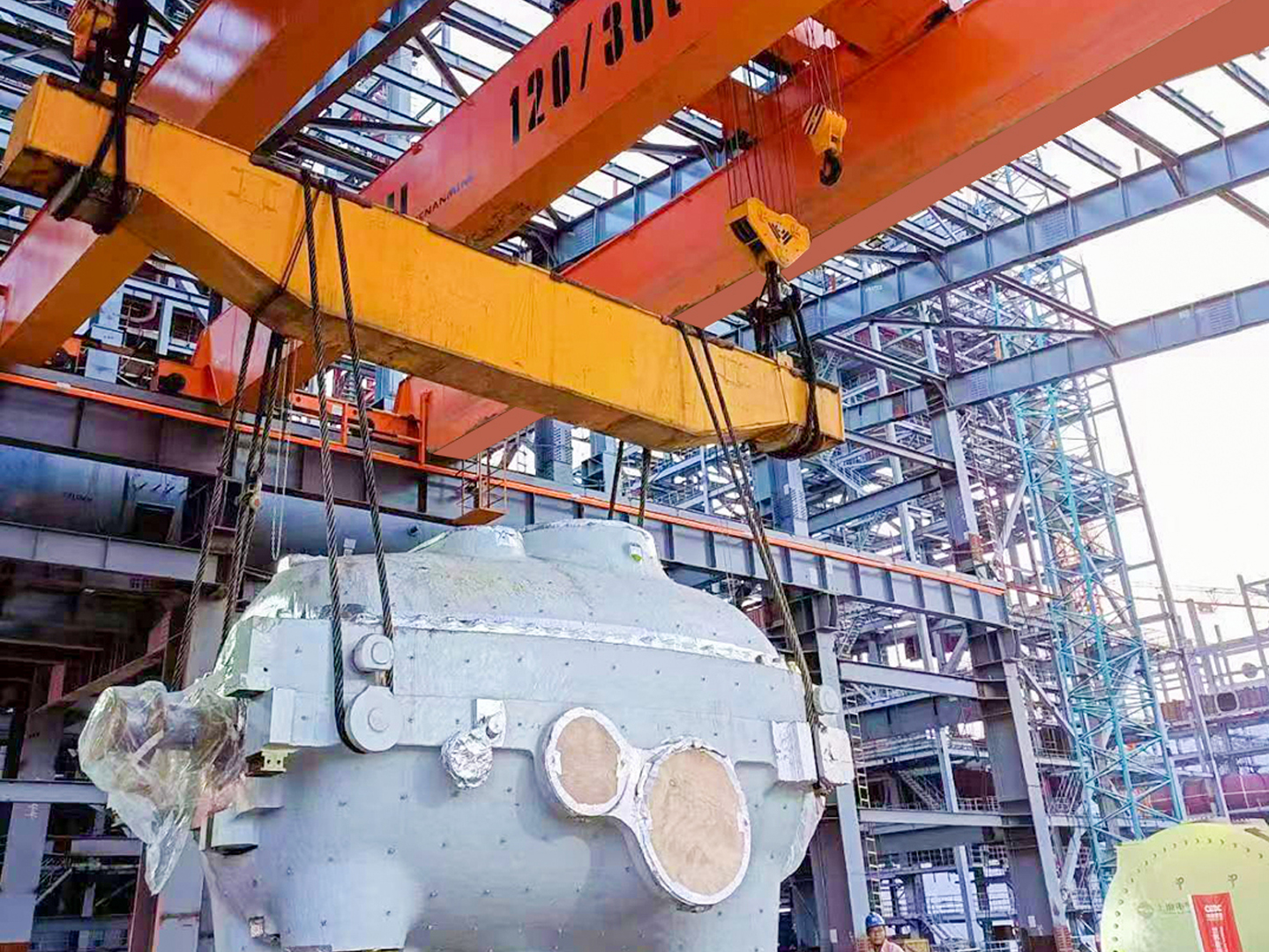
Generator Stator Lift at a 2 × 350 MW Cogeneration Project
Henan Mine Crane supplied lifting equipment for a 2 × 350 MW cogeneration project in Jimsar, Xinjiang. During construction, the project crane supported the lift of the Unit 1 generator stator—a critical generating-unit installation task.
The crane solution incorporates full variable-frequency speed control and PLC-based control for regulated motion, with equipment selected for the site’s heat and dust. The 2 × 350 MW designation describes the plant’s generating output, not the crane’s lifting rating; the latter is defined by the approved lift plan.
This installation illustrates why the crane, rigging, generator delivery sequence and building clearances must be coordinated before the heavy lift. The project lift path and the station’s subsequent maintenance needs both belong in the original technical specification.
Overseas Project · Indonesia
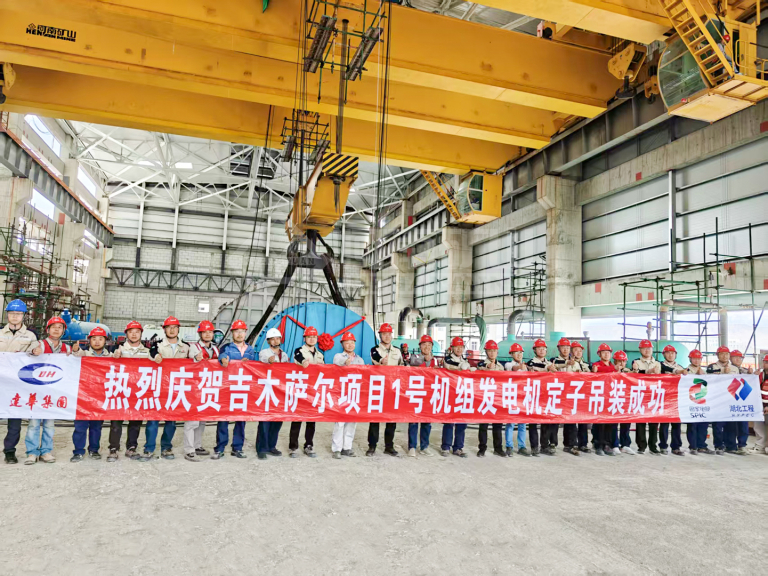
Two 120 t Turbine-Hall Cranes for a Thermal Power Project
At a thermal power project in Morowali, Central Sulawesi, Henan Mine Crane supplied two double-girder overhead cranes for the construction of three 380 MW generating units. The cranes are described with 120 t main and 30 t auxiliary hook ratings and are used for major unit installation and future maintenance access.
The project demonstrates a defined main-and-auxiliary-hook arrangement for heavy erection and smaller support lifts. Its ratings are project-specific; a new station’s crane cannot be selected solely from a previous plant’s 120 t marking or the output of its generating units.
Project Data
Location: Morowali, Central Sulawesi
Supply: two double-girder overhead cranes
Hook marking: 120 t main / 30 t auxiliary
Plant: three 380 MW thermal generating units
Installation, Acceptance and Long-Term Support
Building Interface
Check runway geometry, support reactions, end clearances, lifting access and the stage at which the crane can be assembled inside the turbine hall.
Testing and Handover
Agree on factory inspection, site commissioning, load tests, protection checks, manuals and operator instruction under the applicable project standard.
Lifecycle Maintenance
Specify inspectable brakes, ropes, wheels, electrics and service platforms; define spare parts and the maintenance plan before the first scheduled outage.
The purchase schedule should identify when the crane is needed for generator-unit erection, not just when the entire facility is commissioned. Crane delivery, runway completion and load testing are therefore coordinated with the EPC construction milestones.
Power Plant Crane Price and Supply Scope
There is no dependable single list price for a power plant crane. Online figures for general workshop bridges, individual hoists or loosely specified high-capacity cranes do not establish the price of a turbine-hall system with approved rigging loads, auxiliary lifting, control requirements and site installation.
Henan Mine Crane quotes against a defined technical scope. To compare offers on a like-for-like basis, the commercial schedule should identify the following separately:
Crane and hoists
Bridge, main and auxiliary hooks, drives, controls and designed duty.
Civil interface
Runway, power feed, support checks and any structural modification.
Project execution
Inspection, packing, shipping, erection, commissioning and load testing.
After handover
Documentation, operator training, warranty boundaries and initial spares.
Price changes with the heaviest approved load, crane span, lift height, precision-control functions, environmental protection, location and delivery terms. Each quotation should state its currency, Incoterm, validity, exclusions and responsibilities for site work.
Power Plant Crane RFQ Information
Supply the turbine-hall and runway drawings, generating-unit component lift list, maximum load including rigging, hook approach targets, lift height, building clearance, erection sequence, expected maintenance lifts, site power, environmental conditions, destination and required acceptance standard. Include the turbine supplier’s lifting instructions where available.
Frequently Asked Questions
What crane is used in a turbine hall?
A double-girder overhead crane is commonly specified for heavy turbine and generator erection and future overhaul work. Its final ratings, hook configuration and bridge geometry depend on the approved lift plan.
How is power plant crane capacity selected?
Assess the heaviest approved component plus lifting beam and rigging, then check its handling path and site requirements. A generating unit’s MW rating is not an overhead crane capacity.
What is the auxiliary hook for?
A separately rated auxiliary hook can handle smaller components, approved rigging operations and some maintenance lifts. Its use with the main hook must be governed by the crane design and lift plan.
Can an electric-hoist bridge crane replace a turbine-hall crane?
Not automatically. An electric-hoist bridge may suit a service bay or other defined loads, while main generating-unit erection may require a different lifting mechanism, capacity, hook approach and structural rating.
Why are hook approach and lifting height important?
A crane must reach the turbine, generator and service areas while lifting the rigged component clear of foundations, platforms and pipework. A correct tonnage without sufficient reach may still be unusable.
Can two cranes lift one component together?
Only under an engineered tandem-lift arrangement that defines load sharing, coordinated control, rigging and runway reactions. Adding the two rated capacities does not establish a permitted combined load.
Is a grab crane appropriate for all power plant areas?
No. Grabs are for suitable bulk fuel, ash or other loose materials. Turbine-generator equipment requires approved hooks and rigging; a waste-to-energy feed bunker requires its own application-specific grab system.
Does every power plant crane need explosion protection?
No. Electrical protection is selected according to a documented area classification and the applicable local requirements. Heat and dust alone do not justify assigning a universal explosion-proof rating.
What determines the price of a turbine-hall crane?
Hook ratings, span, lifting height, control requirements, duty, plant environment, runway interface, testing and delivery scope. A detailed technical offer is necessary for a meaningful price comparison.
Can a crane be installed in an existing power station?
A replacement or retrofit is possible subject to runway capacity, remaining hook travel, power supply, access openings and the construction window available without disrupting operations.
Related Power Plant Crane Products
Thermal Power Bridge Crane
Heavy turbine-generator installation and planned maintenance applications.
Electric-Hoist Double-Girder Crane
A separate option for appropriately rated power-station service bays.
Cross-Travel Overhead Crane
Track-switching access for engineered power-plant maintenance routes.
Single-Girder Service Crane
Smaller maintenance loads where its rating and duty are suitable.
Grab Double-Girder Overhead Crane
Bulk fuel or approved loose-material applications, not turbine lifts.
Power Plant Lifting Proposal
Request a Power Plant Crane Quote
Share the power-station lift study, turbine-hall drawings, heaviest component and rigging weights, required hook coverage, environmental conditions and project destination. Henan Mine Crane will develop a defined crane configuration and commercial scope for the generating facility.