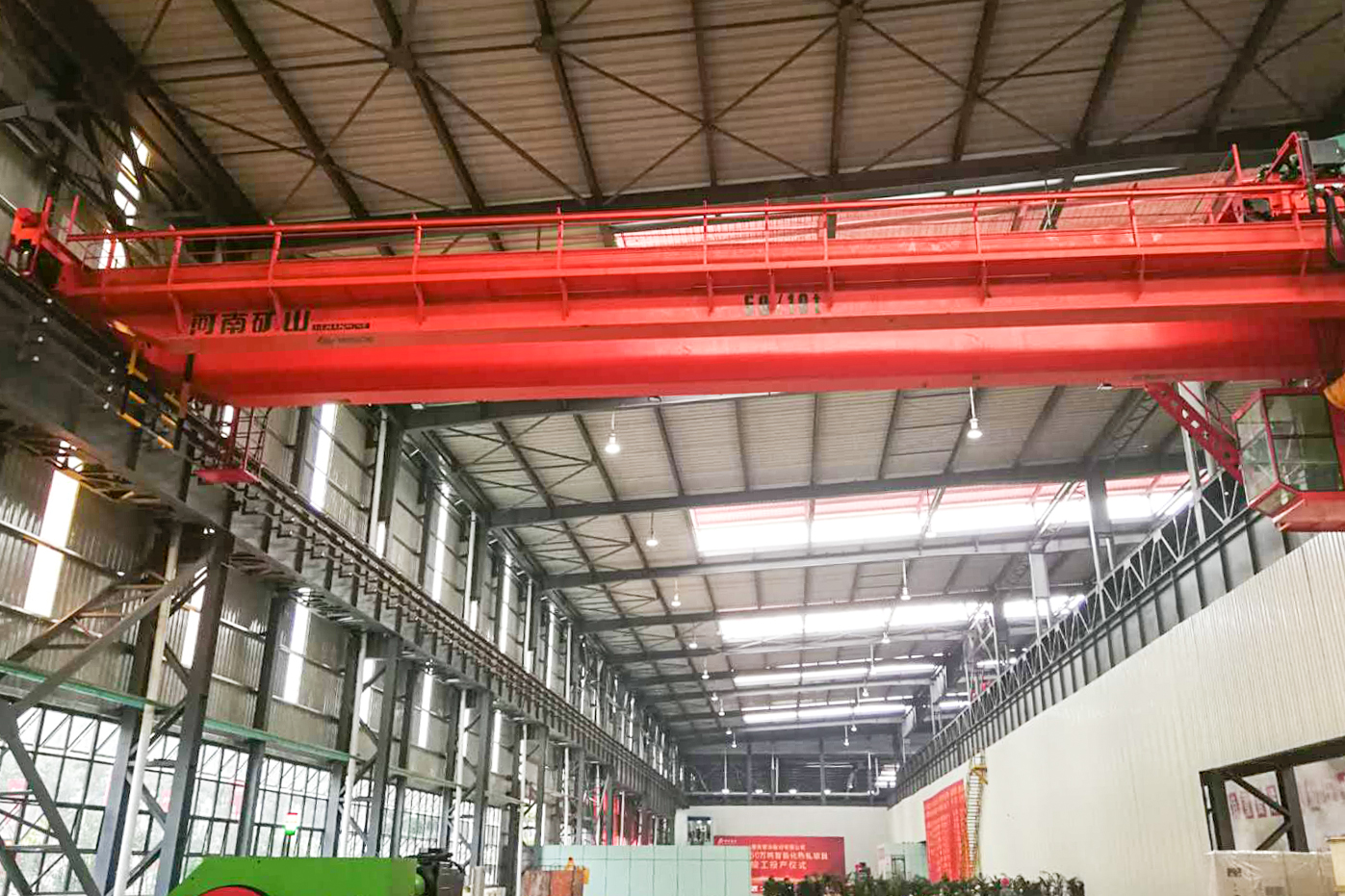
Henan Mine Crane · Process Lifting Systems for Plate Mills
Plate Mill Crane Systems
Heavy-duty overhead cranes for slab receiving, furnace and mill-area transfer, roll change, plate handling, finishing, stacking, storage and dispatch.
Henan Mine Crane engineers each plate mill crane around the actual material route, gross suspended load, plate dimensions and temperature, handling attachment, operating duty, runway interface, production controls and maintenance strategy. The resulting proposal can cover an individual process crane or a coordinated fleet across the rolling and finished-plate areas.
PRIMARY ARCHITECTURE
Top-Running Double Girder
LOAD ATTACHMENTS
Hook, Clamp, Magnet or Beam
OPERATING PROFILE
Process-Defined Heavy Duty
CONTROL OPTIONS
Cabin, Radio, PLC & Automation
What Is a Plate Mill Crane?
A plate mill crane is an overhead process crane configured for the production and internal logistics of steel plate. It may handle hot or cold slabs, work rolls, mill equipment, lifting beams, magnets, clamps, finished plates or plate packs. The term identifies the production environment; it does not describe one universal crane model.
The correct crane depends on its process zone. A slab-yard crane must control long, heavy and sometimes hot feedstock. A mill-maintenance crane needs accurate low-speed positioning for roll and equipment changes. A finishing or warehouse crane must lift plates without uncontrolled bending, surface damage or accidental pickup of additional layers. One facility can therefore require several crane configurations with different capacities, duties, attachments and control philosophies.
Plate mill cranes are different from ladle cranes. Ladle cranes are engineered for molten-metal handling and its specific redundancy and risk controls. They are also different from coil-handling cranes, which use C-hooks, coil grabs or other devices designed around a cylindrical load. A plate mill project should identify the material form and production step before the crane type is selected.
Henan Mine Crane supplies hot-rolling mill bridge cranes, slab handling cranes, rotating electromagnetic beam cranes and automated plate-handling systems as separate engineered platforms.
Where Cranes Work in a Plate Mill
Crane scope should follow the plate flow from incoming slab to dispatch. Separating the work by process zone prevents a maintenance crane, production crane and warehouse crane from being specified as if they perform the same task.
Slab Receiving and Buffer Storage
Unload, identify, stack and retrieve slabs by grade, heat or rolling schedule. Clamp, magnet or lifting-beam selection depends on slab temperature, dimensions, surface scale, stack arrangement and traceability requirements.
Furnace and Mill-Line Transfer
Move feedstock or process components near reheating and rolling equipment. Radiant heat, scale, restricted access, collision zones and production interlocks become part of the crane design basis.
Roll Change and Mill Maintenance
Lift work rolls, backup rolls, chocks, drive components and maintenance tools. Low-speed control, hook approach, lift height, rigging clearance and reliable inching are often more important than high travel speed.
Finishing and Inspection
Transfer plates between cooling, leveling, cutting, inspection, marking and repair stations. The attachment must support the plate without excessive deflection, marking or unintended multi-sheet pickup.
Finished-Plate Warehouse
Stack and retrieve individual plates or packs by order, grade and size. Position feedback, inventory interfaces, stack-height control and automated scheduling can reduce search time and handling damage.
Dispatch and Loading
Load rail wagons, trucks or internal transfer vehicles. Side approach, outdoor exposure, vehicle-clearance zoning, communication with ground personnel and the required loading sequence govern the configuration.
A process map should record every pickup point, placement point, load state, handling frequency, travel distance, traffic conflict and upstream or downstream interlock. This is the basis for deciding whether the mill needs one versatile crane, dedicated zone cranes or a coordinated fleet.
For plant-wide planning, the steel mill crane system should separate molten-metal, slab, billet, plate, coil, scrap, roll-change and general-maintenance duties.
Components and Operating Principle
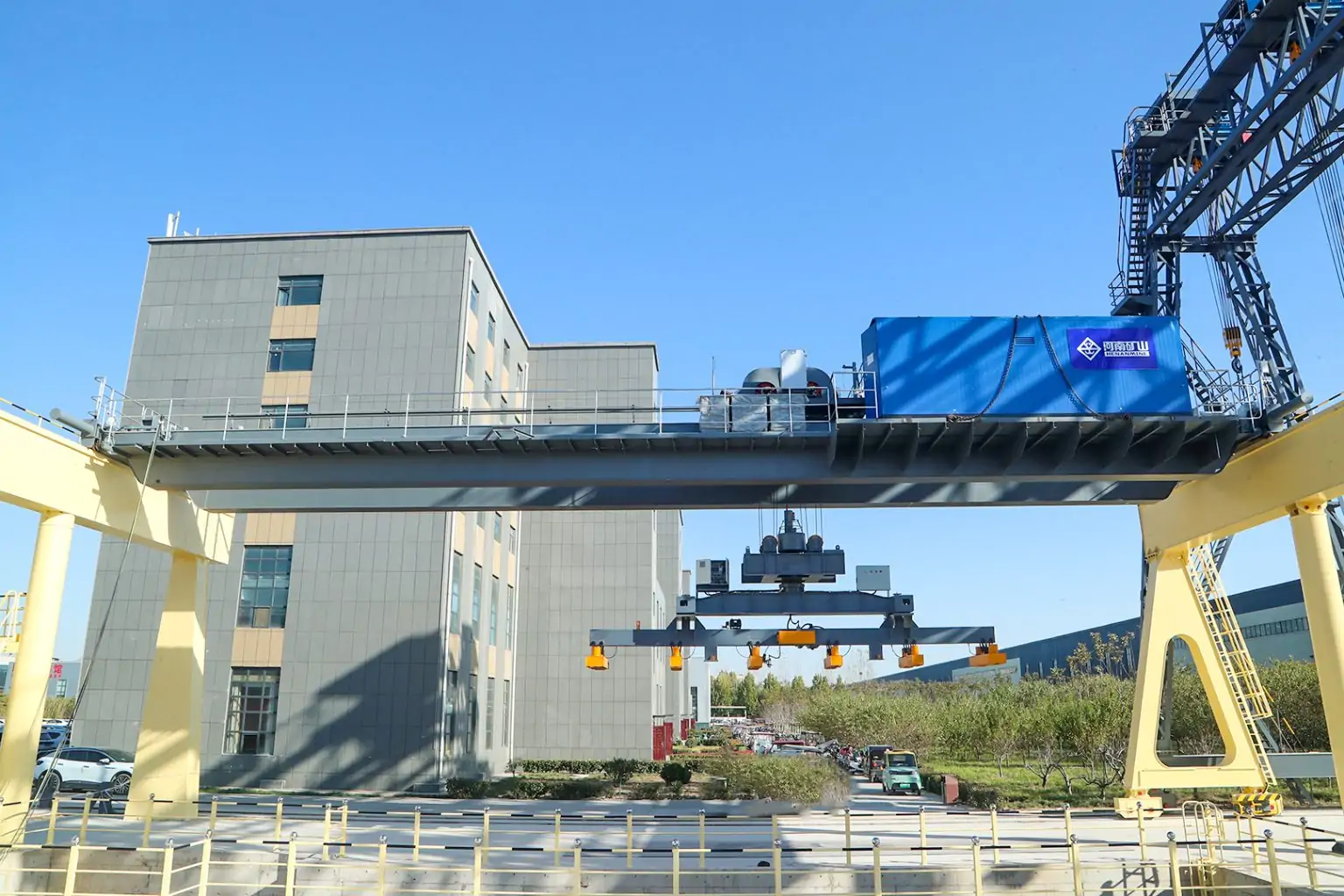
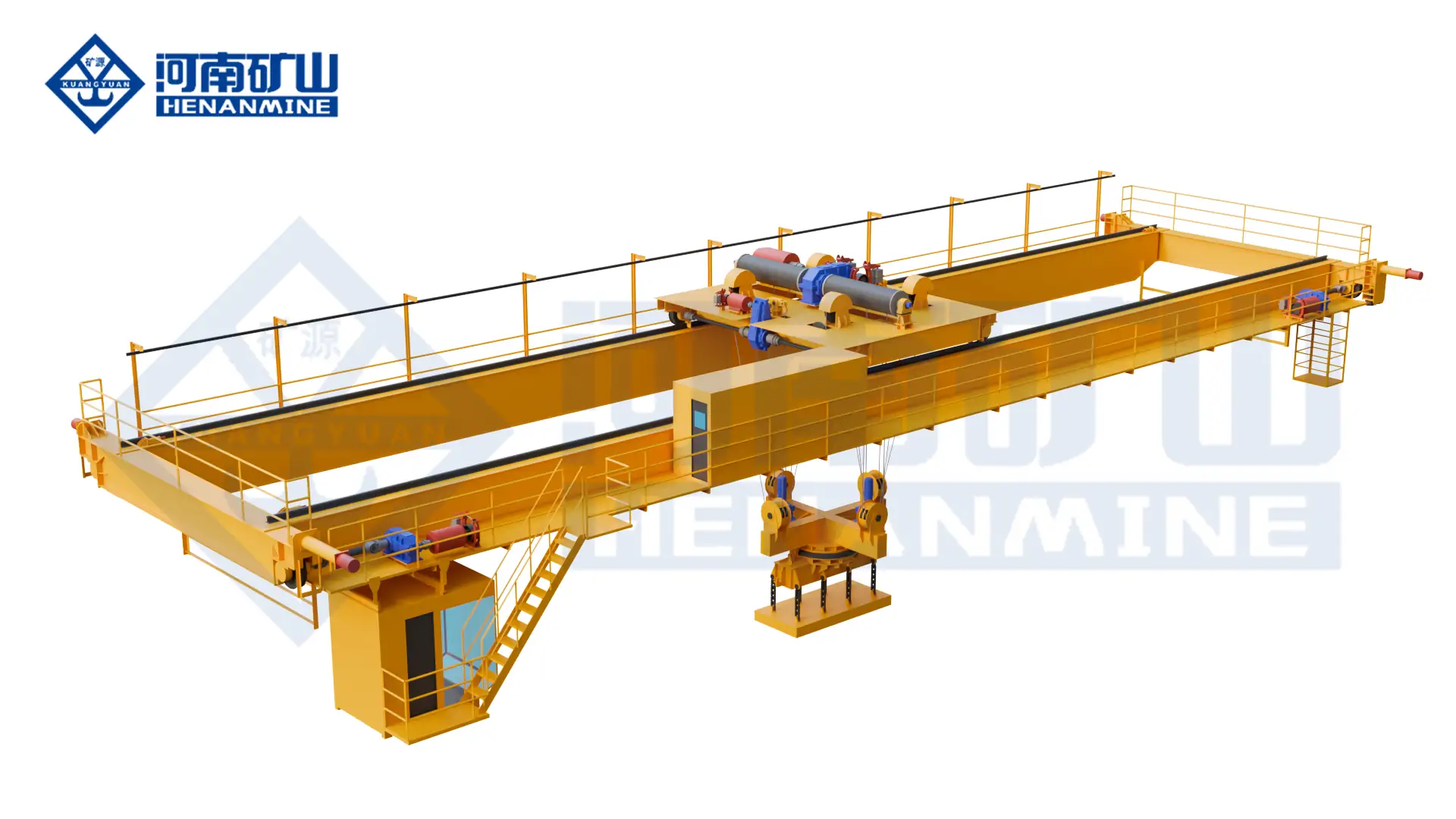
A plate mill crane normally uses a top-running bridge with an open-winch trolley or another process-duty lifting mechanism. The hoist raises the load and attachment, the trolley crosses the bay and the bridge travels along the runway. Drives, brakes and controls coordinate these motions so the load can be picked, transported and placed within the required tolerance.
Bridge and End Carriages
Box girders, diaphragms, end carriages, wheels and travel drives carry vertical, lateral, acceleration and skew forces. Span, duty, fatigue spectrum, wheel loads and runway stiffness govern the structure.
Open-Winch Trolley
Drum, wire rope, sheaves, reducer, motor, service brake and specified emergency or redundant braking form the lifting mechanism. The reeving and rope fleet angle are engineered for the attachment and lift path.
Load Attachment
Hooks, slab clamps, plate clamps, fixed or rotating magnet beams, vacuum lifters and mechanical beams address different materials. Attachment mass is included in the gross suspended load.
Electrification and Protection
Runway power, trolley festoon or energy chain, panels, VFDs, motors, encoders and cables are selected for temperature, scale, dust, vibration, maintenance access and the declared enclosure level.
Control and Position Feedback
Cabin, radio or PLC control can combine encoders, anti-sway, cameras, laser or barcode identification, load measurement, zoning and production-system interfaces.
Runway Interface
Rails, clips, runway beams, columns, brackets and foundations receive crane reactions. Maximum and minimum wheel loads, transverse forces and longitudinal forces are issued for structural coordination.
Plate Mill Crane Selection Considerations
Selection begins with the material and process consequence, not nominal capacity alone. The operating data below should be fixed before a technical quotation is compared.
01 · Gross Suspended Load
Include the heaviest slab, plate, roll or component plus clamp, magnet, beam, hook block, slings and every below-hook item. State normal and maximum load cases.
02 · Material Geometry and Stack
Provide minimum and maximum length, width, thickness, mass, flatness, center of gravity, bundle form, support points, stack height and gaps between layers.
03 · Temperature and Surface
Declare material temperature, radiant heat, scale, oil, water, paint, surface quality and permitted contact marks. These factors can change magnet, clamp and vacuum performance.
04 · Duty and Production Cycle
Define lifts per hour, shifts, annual hours, load spectrum, travel distances, acceleration, waiting time and the production effect of a crane outage.
05 · Attachment and Retention
State whether the crane lifts one plate, a plate pack, a slab, a roll or maintenance equipment. Define power-loss behavior, locking, pickup confirmation and load-release control.
06 · Geometry and Runway
Confirm span, runway length, rail elevation, lift height, hook approaches, maintenance clearances, existing rail data, building reactions and installation access.
07 · Motion and Automation
Specify full and creep speeds, acceleration, positioning tolerance, anti-sway, synchronized motion, inventory tracking, MES/WMS interface and manual recovery mode.
08 · Reliability and Project Boundary
Define required redundancy, maintainability, critical spares, runway and electrification scope, freight, erection, testing, training, local inspection and performance acceptance.
Plate Mill Crane Configurations Compared
The handling device is part of the crane system. Its mass, load path, power supply, retention method, rotation and control logic must be included in the equipment specification.
| Configuration | Primary Load | Operating Advantage | Critical Selection Point | Relevant Henan Mine Crane Platform |
|---|---|---|---|---|
| Heavy-duty hook crane | Rolls, chocks, mill components, maintenance loads and rigged plate bundles | Flexible use with conventional lifting beams, slings and project-specific tools | Rigging time, safe access and load control may limit high-cycle production handling | Double-Girder Bridge Crane |
| Slab clamp crane | Hot or ambient slabs within an approved thickness and width range | Positive mechanical engagement and efficient slab-yard stacking | Clamp geometry, locking, contact pressure, slab temperature and pickup confirmation | Slab Handling Crane |
| Fixed electromagnetic beam crane | Ferromagnetic plates, billets, profiles and selected plate packs | Fast pickup without manual slinging and distributed support along long material | Steel grade, temperature, thickness, air gaps, scale, stack count and power-loss retention | Electromagnetic Bridge Crane |
| Rotating electromagnetic beam crane | Long plates and profiles that must change orientation | Aligns loads with stacks, vehicles or production lines without rotating the crane bridge | Rotation envelope, anti-sway, cable routing, stops, load clearance and orientation feedback | Electromagnetic Hanging Crane |
| Vacuum plate lifter crane | Individual flat plates with compatible, sufficiently clean surfaces | Useful where magnetic pickup is unsuitable or surface contact must be distributed | Surface porosity, scale, oil, temperature, sealing, reserve vacuum and loss-of-power response | Engineered attachment with a compatible process crane |
| Automated plate handling crane | Slabs, plates or plate packs within a controlled product and storage envelope | Repeatable positioning, inventory tracking, task scheduling and reduced manual traffic | Data quality, obstacle detection, fail-safe logic, exception recovery and production interfaces | Automatic Steel Plate Handling Crane |
A changeable attachment can increase flexibility, but changeover time, storage stands, connector design, control-mode selection and proof of correct engagement must be included. A single multi-purpose crane is not automatically more reliable or economical than dedicated process cranes.
Plate Mill Crane Technical Specification Framework
Henan Mine Crane maintains several steel-plate and slab-handling platforms. The published positions below support preliminary configuration; they are not guaranteed combinations. Final capacity, span, lift, working class, speeds, wheel loads, attachment and controls are confirmed on the approved technical schedule.
| Product Platform | Published Capacity Position | Published Span Position | Published Lift Position | Published Working Class | Typical Plate-Mill Role |
|---|---|---|---|---|---|
| Hot-rolling mill specialized bridge crane | 50–200 t | 13–35 m | Up to 26 m in the published position | A6 published; final duty by process | Heavy production handling, roll or tooling service and hot-rolling workshop duties |
| Slab handling crane | 20–150 t | 10–39 m | 5–23 m | A7–A8 published | Continuous-casting transfer, slab yard, buffer storage and furnace-feed logistics |
| Rotating electromagnetic hanging-beam crane | 5–50 t | 10.5–31.5 m | 6–20 m | A6–A7 published | Finished plate, profile and long-product handling where load rotation is required |
| Electromagnetic bridge crane | 5–32 t including attachment in the published product position | 10.5–31.5 m | 6–30 m | Project-defined within the published family | Plate, billet, profile and ferromagnetic material transfer |
| Automatic steel plate handling crane | 0.5–100 t in the published solution position | Project-defined | Project-defined | A5–A7 published | Automated stacking, retrieval, line feeding, warehouse transfer and dispatch |
Specification rule: attachment capacity, crane rated load, structural duty and mechanism duty are separate entries. A published maximum from one product family should not be combined with another product family’s maximum span, lift or speed unless the engineered offer confirms that combination.
Plate, Slab and Roll Handling Attachments
Attachment selection determines how force enters the load. Long plate can deflect, thin plate can peel from a magnetic stack, hot scale can create an air gap, and a clamp can damage edges or surfaces if its contact geometry is wrong. Testing must therefore use representative materials, temperatures and stack conditions rather than a nominal dead weight alone.
The approved design records the full range of material properties and the unacceptable conditions. Operators and automation logic need a clear permissive for correct pickup, a defined response to incomplete engagement and a controlled release sequence.
| Attachment | Data Required | Retention and Confirmation | Typical Restriction |
|---|---|---|---|
| Electromagnet | Steel grade, thickness, temperature, air gap, surface scale, plate count, magnet layout and center of gravity | Current monitoring, pickup permissive, backup power or other approved retention strategy, audible/visual status and controlled release | Performance changes with temperature, alloy, surface gaps and unintended multi-sheet attraction |
| Mechanical slab or plate clamp | Thickness and width range, edge condition, temperature, coefficient of friction, contact-pressure limit and permitted pickup faces | Positive locking, open/closed indication, load confirmation and release prevention while suspended | Contact damage, variable geometry and misaligned pickup must be evaluated |
| Vacuum lifter | Surface flatness, roughness, porosity, coating, contamination, temperature, pad arrangement and allowable deflection | Independent circuits where required, reserve capacity, vacuum monitoring, low-vacuum alarm and release interlock | Hot, heavily scaled, warped or leaking surfaces can make vacuum unsuitable |
| Hook, beam and sling system | Lifting points, sling angle, beam self-weight, plate support spacing, center of gravity and rigging access | Hook latch or approved connection, proof-tested beam, identified rigging and controlled lift plan | Manual rigging time and personnel exposure may conflict with production-cycle targets |
Heat, Scale, Dust and Runway Conditions
Plate mills combine thermal exposure, abrasive scale, vibration, frequent reversing and long runway travel. Environmental controls should be based on measured or specified conditions at the crane components, not furnace or material temperature alone.
Thermal Survey
Record ambient temperature, radiant-heat intensity, exposure duration, hot-material path and ventilation. Shields, component separation, insulation and cooling are then assigned where required.
Scale and Dust Control
Enclosures, seals, filtered ventilation and accessible cleaning points protect panels, brakes, motors, encoders and bearings. Accumulation zones should not obstruct cooling or inspection.
Runway Geometry
Rail gauge, elevation, straightness, joints, clips and support settlement affect skewing and wheel wear. Existing runways require survey and structural verification before crane manufacture.
Wheel and Rail Interface
Wheel diameter, flange geometry, hardness, rail section, bearing arrangement and drive balance are coordinated with duty, wheel loads and runway alignment.
Cabin Environment
Visibility, glazing protection, filtration, cooling or heating, seat ergonomics, access, escape route and camera coverage are defined for the operator’s actual exposure and sight lines.
Outdoor and Coastal Areas
Dispatch yards may require wind monitoring, storm parking, rain protection, corrosion category, drainage, lightning protection and weather-dependent operating limits.
Controls, Safety Functions and Automation
Safety functions are selected from the risk assessment, applicable code and process consequence. Automation can improve repeatability, but it also requires defined equipment states, protected operating zones, verified sensor coverage and a controlled recovery method.
| Function | Purpose | Specification Detail | Acceptance Evidence |
|---|---|---|---|
| Variable-frequency motion control | Smooth acceleration, controlled stopping and creep positioning | Full speed, minimum stable speed, ramp time, braking sequence and load-dependent settings | Recorded motion tests under defined load cases |
| Overload, limits and braking | Prevent overload and motion beyond the approved envelope | Rated load limiter, upper/lower limits, travel limits, overspeed protection and braking architecture | Set-point records and functional test results |
| Attachment permissive | Confirm correct magnet, clamp, vacuum or beam engagement before transport | Sensor voting, minimum retention state, alarm, inhibited motions and controlled release conditions | Normal and fault-condition test matrix |
| Anti-collision and protected zones | Separate cranes, structures, mill equipment, vehicles and restricted areas | Slowdown and stop distances, sensor coverage, blind zones, bypass authority and reset logic | Zone map and witnessed approach tests |
| Positioning and anti-sway | Support repeatable pickup, stacking and machine-interface movements | Coordinate system, target tolerance, load dependence, calibration and fallback mode | Repeatability trials at representative stations |
| MES/WMS and inventory interface | Exchange tasks, product identity, storage location and completion status | Protocol, data ownership, time synchronization, task arbitration, cybersecurity and offline recovery | Interface simulation and integrated production trial |
Design Basis, Inspection and Acceptance
The contract should identify one coherent design and safety basis. Standards are not interchangeable line by line, and a CE, ISO, FEM, CMAA or ASME reference does not replace a project-specific compliance matrix. Local statutory requirements remain applicable at the installation site.
Possible International Design Basis
A project may specify the ISO 4301 classification framework with relevant crane standards, the EN 13001 series with EN 15011 for bridge and gantry cranes, or a North American basis using CMAA specifications and applicable ASME B30 requirements. The purchase specification states the selected route.
Engineering Deliverables
General arrangement, wheel loads and reactions, design calculations where contracted, duty classification, mechanism data, attachment calculations, electrical drawings, control narrative, interface list and maintenance-access plan.
Manufacturing Inspection
Material identification, welding procedure and welder qualification, dimensional inspection, specified nondestructive examination, wheel and rail-interface checks, assembly verification, coating records and electrical-panel inspection.
FAT and Site Acceptance
Factory testing verifies accessible functions before shipment. Site acceptance then checks runway, erection, alignment, electrical protection, no-load operation, load testing, attachment behavior, interfaces, training and handover against agreed criteria.
Plate Mill and Slab Handling Project Experience
Relevant experience is evaluated by process similarity: material form, temperature, duty, attachment, automation, runway span and production consequence. Two Henan Mine Crane references illustrate the difference between a coordinated mill fleet and a dedicated slab-handling crane.
Intelligent Hot-Rolling Mill Project
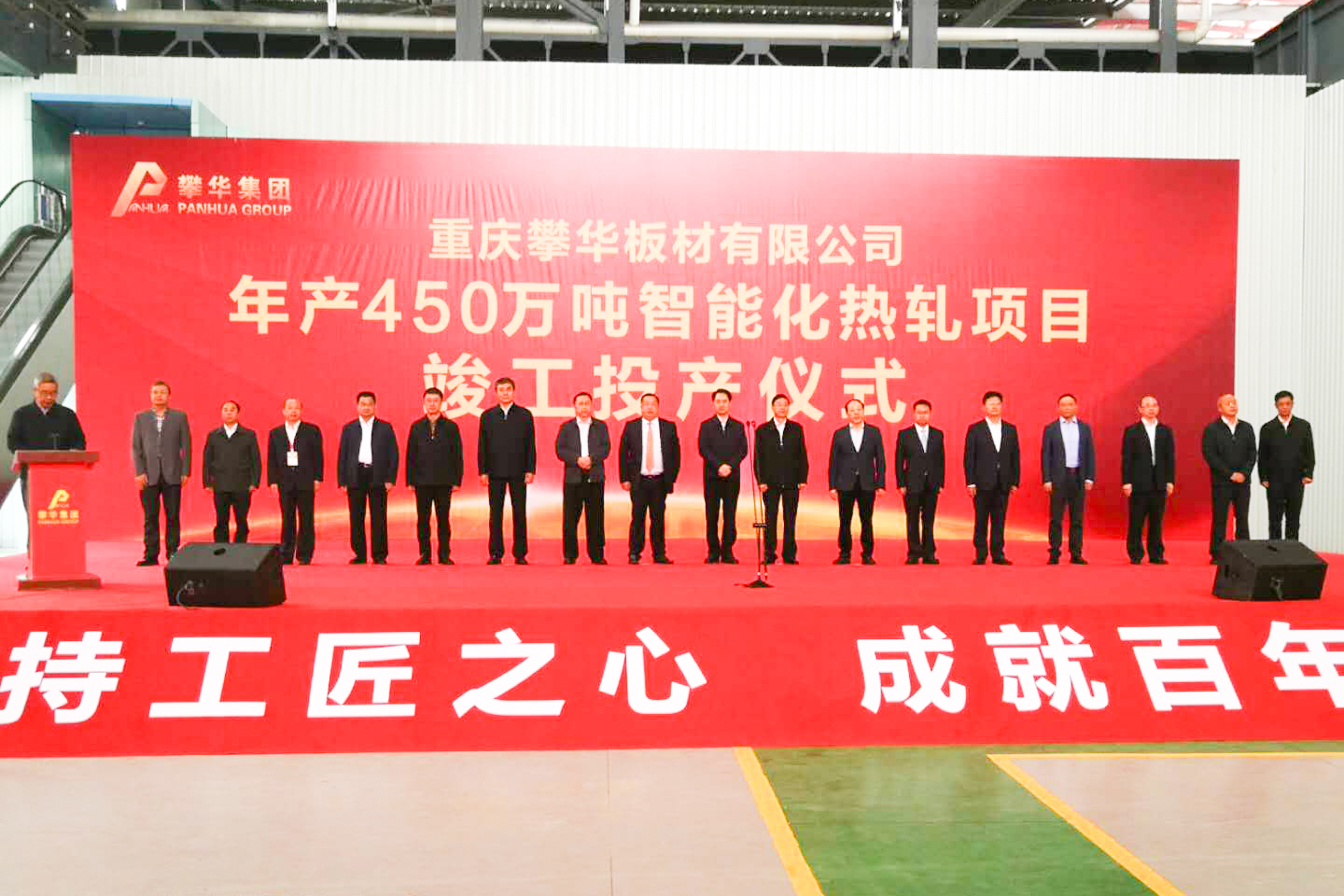
34-Crane Fleet for Chongqing Panhua Plate
Henan Mine Crane supplied 34 double-girder overhead cranes rated from 10 t to 100 t for production, roll handling, tooling, equipment service and maintenance across a 4.5-million-tonne steel plate facility.
The project demonstrates why a plate mill is normally planned as a crane fleet. Capacity and controls are assigned by station instead of forcing every duty into one oversized common model.
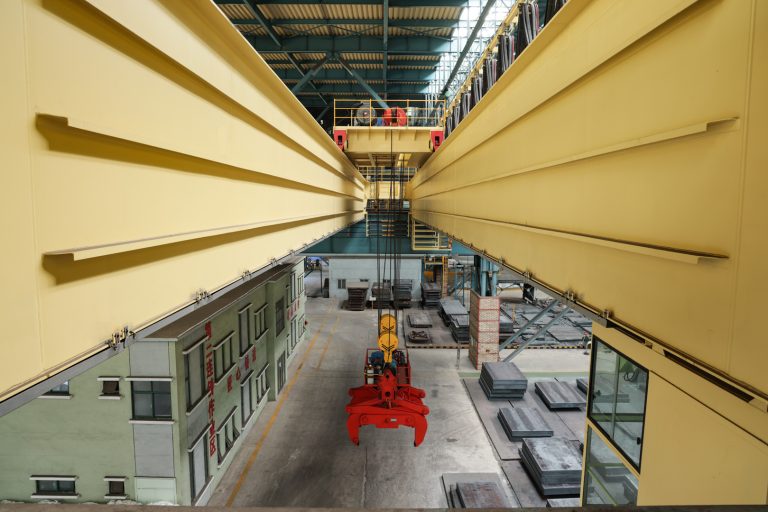
High-Temperature Slab Handling Project
50+50t Slab Clamp Crane for Shandong Iron & Steel
The crane uses an electrically adjustable slab clamp with digital speed control, guidance, PLC monitoring, weighing, fault display and positioning functions for high-temperature steel-material handling.
The reference is relevant where slab geometry, heat exposure, heavy duty and accurate placement require a dedicated clamp crane rather than a general hook bridge.
Project verification: final crane selection still requires the new plant’s process data. A reference proves experience with comparable engineering problems; it does not make the reference crane an automatic fit for another runway, load spectrum or automation system.
Engineering, Manufacturing, Installation and Handover
A plate mill crane project moves through controlled design and acceptance stages. Process inputs are frozen before the bridge, trolley, attachment, runway reactions and interfaces are released for manufacture.
| Stage | Main Activity | Approval Output | Procurement Control |
|---|---|---|---|
| 1 · Process definition | Confirm material route, loads, temperatures, cycles, attachment and production interfaces | Design-basis and duty schedule | Open assumptions and excluded operating cases listed |
| 2 · Interface engineering | Coordinate runway, clearances, wheel loads, power, controls, data and maintenance access | Approved general arrangement and interface list | Building and civil responsibilities assigned |
| 3 · Detailed design | Finalize structure, mechanisms, attachment, protection, controls and safety functions | Approved drawings, component schedule and control narrative | Deviation register closed before production release |
| 4 · Manufacture and inspection | Fabricate, assemble and inspect to the agreed inspection and test plan | Material, weld, dimensional, coating and component records | Witness and hold points identified in advance |
| 5 · FAT, packing and shipment | Test available functions, preserve equipment, identify shipping splits and pack for the agreed route | FAT record, packing list, marks and shipment release | Incoterm, transport envelope and site unloading plan confirmed |
| 6 · Erection, SAT and training | Verify runway, assemble, align, commission, load test, integrate and train | Site test report, settings, punch-list closure and handover package | Test weights, labor, permits and inspection authority assigned contractually |
Plate Mill Crane Price and Budget Scope
A plate mill crane does not have a responsible fixed price without capacity, span, lift, duty, attachment, temperature, control level, runway scope and destination. Public listings can show the scale of variation, but they do not establish the installed cost of a process crane.
| Public Market Signal Checked in September 2026 | Published Position | What It Indicates | Why It Is Not a Plate Mill Project Price |
|---|---|---|---|
| Eurocrane DQ 50 t double-girder price guide | Approximately US$9,800–110,000 on a supplier price guide | Capacity alone permits a very wide commercial range | Duty, span, open-winch trolley, heat protection, attachment, automation and site scope are not normalized |
| Alibaba 50 t double-girder marketplace listing | Approximately US$45,500–45,700 | A platform offer can provide a mid-range equipment signal | The listed machine is not confirmed for plate-mill duty, attachment, runway, delivery or commissioning |
| Made-in-China 10+10 t steel-mill double-bridge listing | US$5,000–100,000 published range | Steel-mill labels still cover materially different specifications | The range is too broad for capital approval and does not define process performance |
| Made-in-China lower-rotating electromagnetic bridge crane listing | Approximately US$208,930 | A rotating magnet system can be priced far above a basic bridge crane | Capacity, span, duty, magnet arrangement, controls and commercial boundary still require confirmation |
| Engineered plate mill process crane | Project quotation | Price is built from an approved technical and supply scope | Only the completed specification defines comparable value and contract risk |
Budget drivers: rated load and attachment mass; span and lift; working class and load spectrum; hoisting architecture; plate or slab temperature; magnet, clamp or vacuum package; redundant functions; positioning and automation; cabin and heat protection; runway and electrification; export packing and freight; erection, testing and local compliance.
The named public sources were checked in September 2026 for budget context. The published figures are market observations, not Henan Mine Crane offers or endorsements. Marketplace prices can be placeholders or equipment-only values and should not be used for contract comparison without a line-by-line scope reconciliation.
Plate Mill Crane RFQ Information
A complete enquiry allows capacity, duty, attachment, runway reactions, electrical load and commercial scope to be priced on the same basis. Drawings, plate schedules, process layouts and photographs can be submitted with the data below.
Material and Attachment Data
Material type and grade; individual or pack handling; minimum and maximum mass, length, width and thickness; temperature; surface condition; stack arrangement; center of gravity; attachment preference; permitted contact marks; lifting points.
Process and Duty Data
Pickup and placement stations; cycle sequence; lifts per hour; shifts; annual operating hours; load spectrum; travel distance; required speeds; creep speed; outage consequence; shared or dedicated crane; future production increase.
Building and Runway Data
Span between rail centers; runway length; rail section; rail elevation; required lift; end and side approaches; roof and machine clearances; existing wheel-load limits; runway drawings; alignment survey; erection and maintenance access.
Controls, Site and Commercial Data
Cabin, radio or automatic operation; positioning tolerance; MES/WMS protocol; anti-collision zones; voltage and frequency; ambient and radiant heat; dust; destination; design standard; Incoterm; installation scope; inspection authority; documentation language.
Frequently Asked Questions
How is plate mill crane capacity calculated?
Capacity starts with the maximum gross suspended load: material plus magnet, clamp, vacuum lifter, lifting beam, hook block, slings and every other item below the hoist. Load distribution, dynamic effects, duty and the selected design standard are then applied.
Is a magnet or clamp better for steel plate?
Neither is universally better. Magnets offer rapid non-rigged pickup of compatible ferromagnetic material. Clamps provide mechanical engagement within an approved geometry. Steel grade, plate thickness, temperature, surface, stack count, damage limits and power-loss response determine the choice.
Can a plate mill crane handle hot slabs or plates?
Yes, when the maximum material temperature, radiant exposure and handling duration are declared. The attachment, wire ropes, cables, sensors, panels, motors, brakes, cabin and structural shielding are then selected or protected for the actual exposure.
Can one crane handle slabs, plates, rolls and maintenance loads?
A multi-purpose crane is possible when capacity, duty, attachment changeover, controls and clearance support every task. High-cycle production and precision maintenance often justify separate cranes because sharing can create scheduling conflict, unnecessary complexity and a larger outage consequence.
How much does a plate mill crane cost?
The price is project-specific. Public listings reviewed in September 2026 ranged from tens of thousands of US dollars for generic double-girder equipment to about US$208,930 for one lower-rotating electromagnetic bridge-crane listing. A contract price requires the complete process and supply scope.
Can a new crane use the existing plate mill runway?
Only after the rails, beams, columns, brackets, connections and foundations are checked for condition, alignment, fatigue and new crane reactions. The crane design must remain within verified structural limits or the runway must be strengthened.
Can the crane connect to MES or warehouse software?
Yes. The interface specification defines task messages, product identity, locations, status feedback, protocol, time synchronization, data ownership, safety boundaries, cybersecurity, manual override and recovery after a network or system interruption.
What documents are needed for final handover?
The agreed package can include approved drawings, wheel-load data, manuals, component schedules, electrical diagrams, software backups, settings, inspection and test records, certificates, spare-parts lists, training records and site load-test or commissioning reports.
Related Plate Mill Crane Products and Solutions
Each linked platform addresses a distinct load or process condition. Final selection follows the approved material, attachment, duty, span, environment and control requirement.
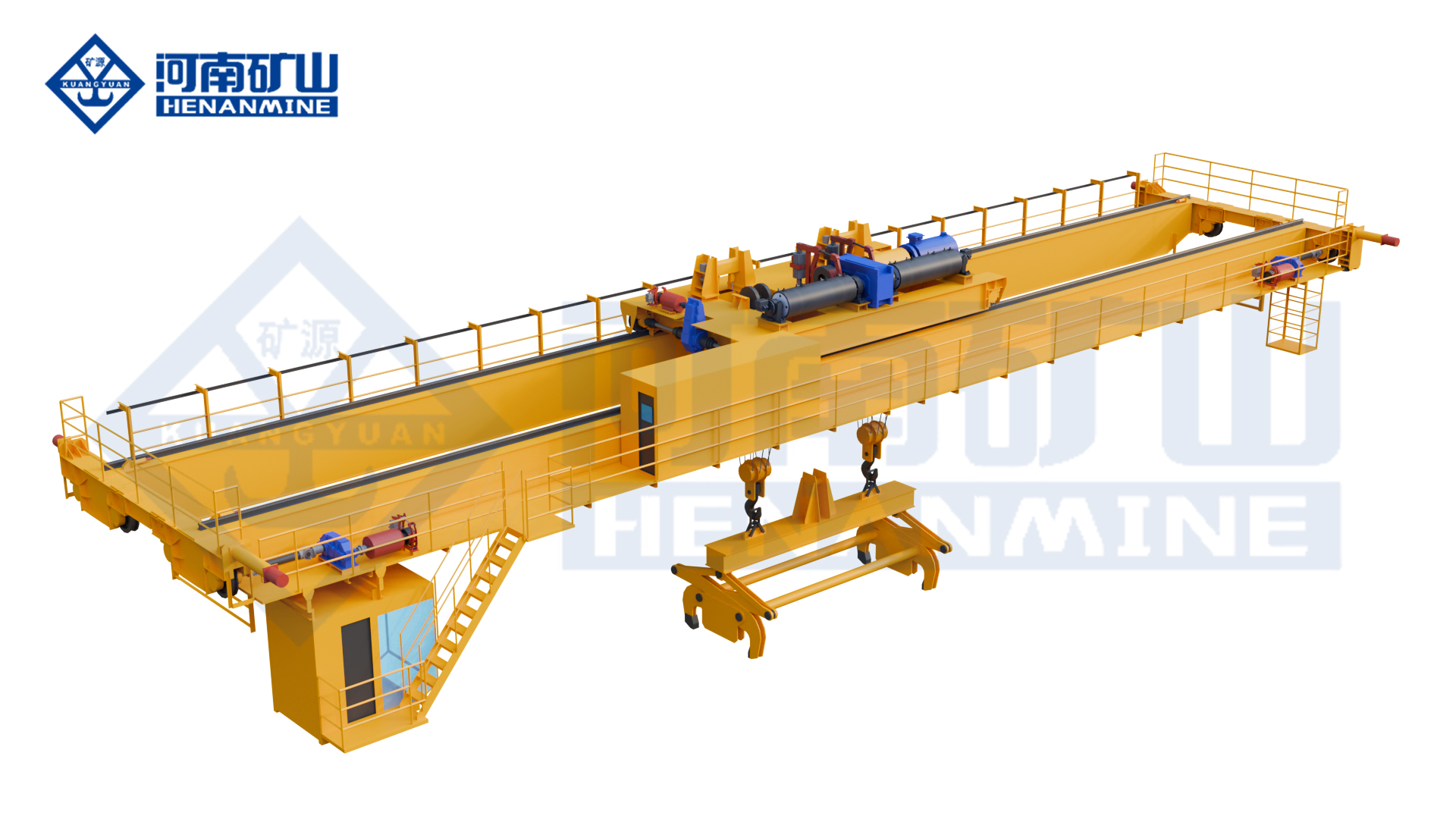
Slab Handling Crane
Clamp-based process crane for high-duty slab transfer, stacking and production logistics.
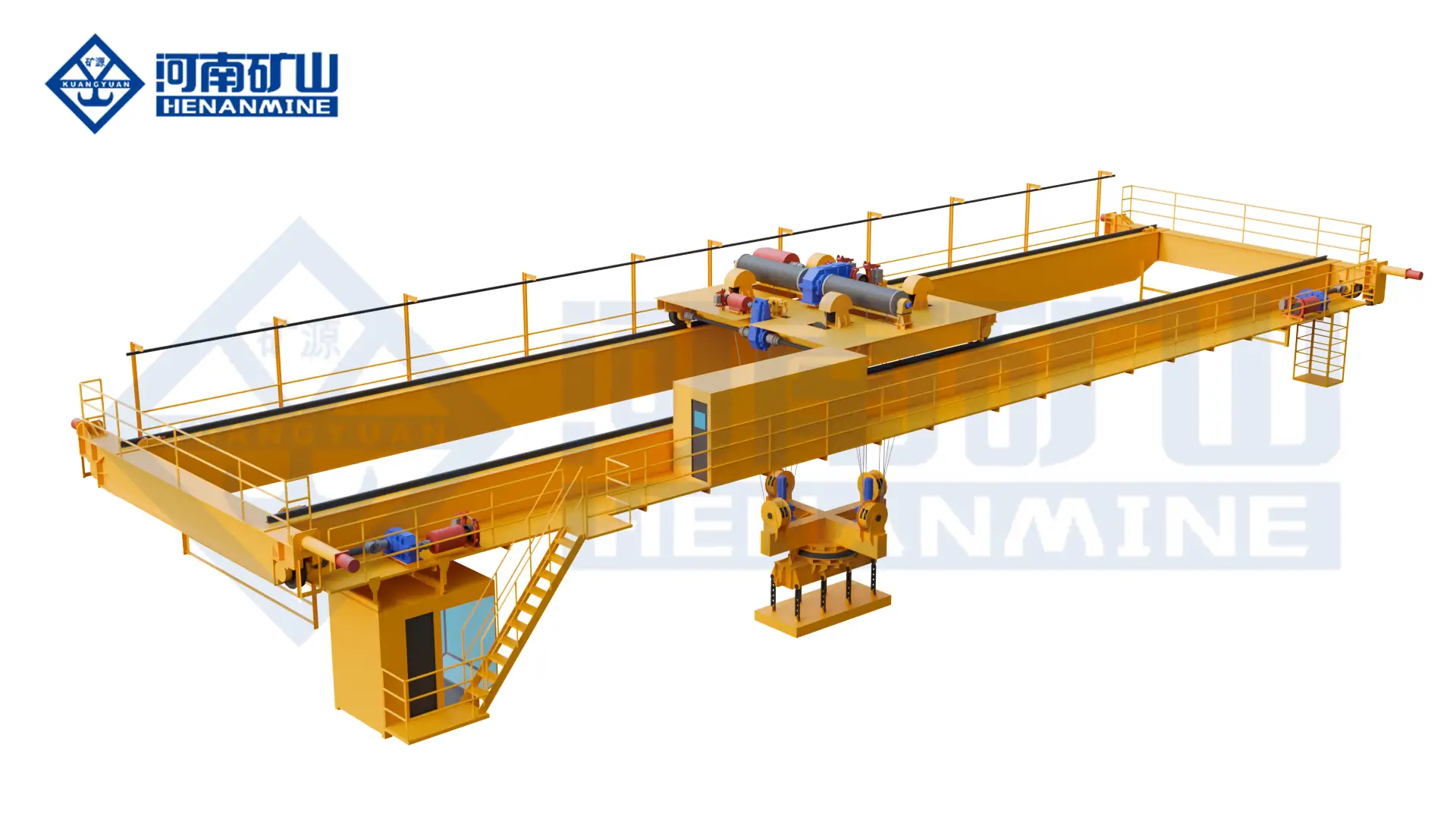
Electromagnetic Hanging Crane
Rotating beam configuration for long plate, profile, billet and compatible steel-product handling.
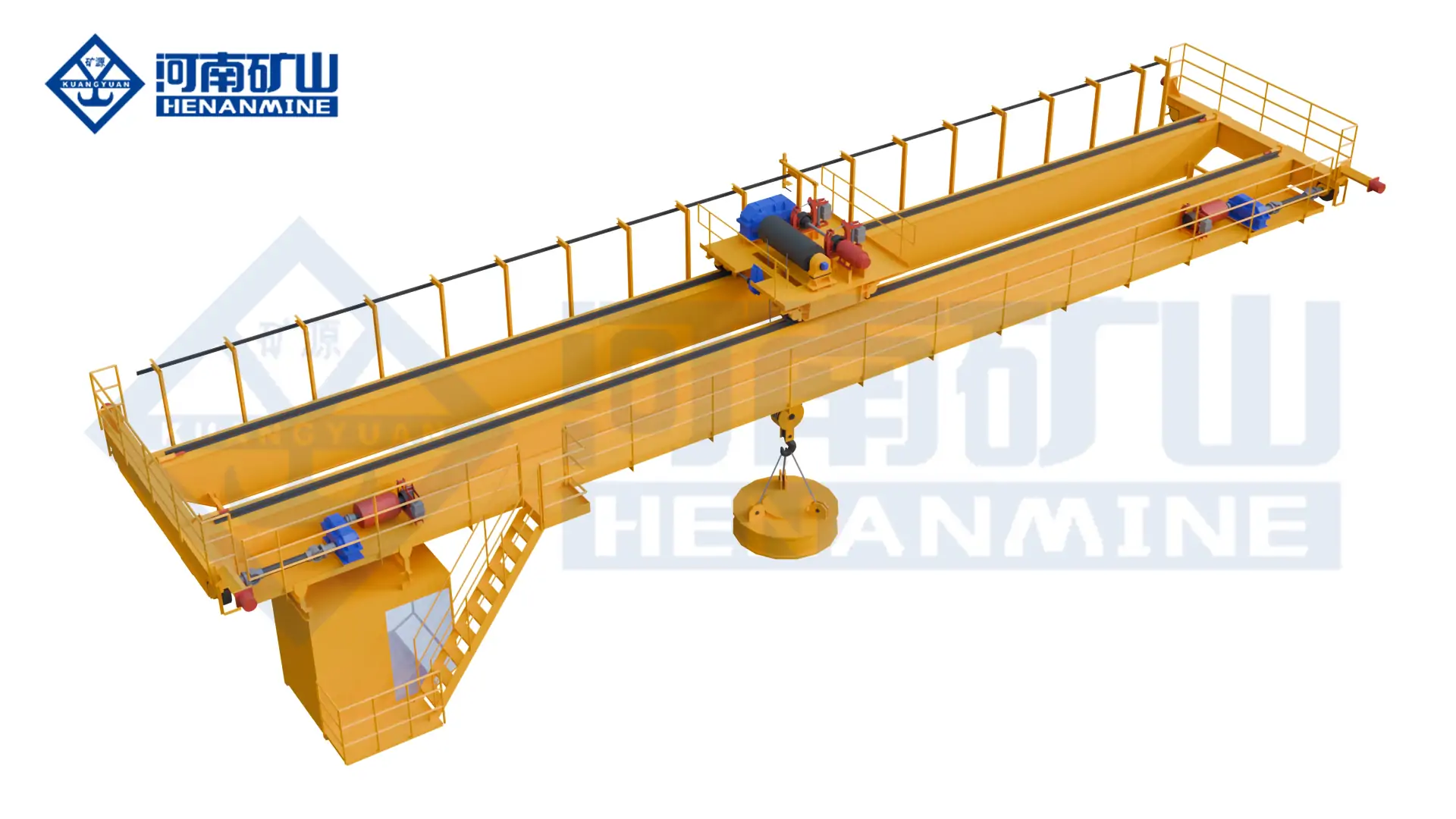
Electromagnetic Bridge Crane
Magnetic pickup system for compatible plate, billet, profile and ferrous-material transfer.
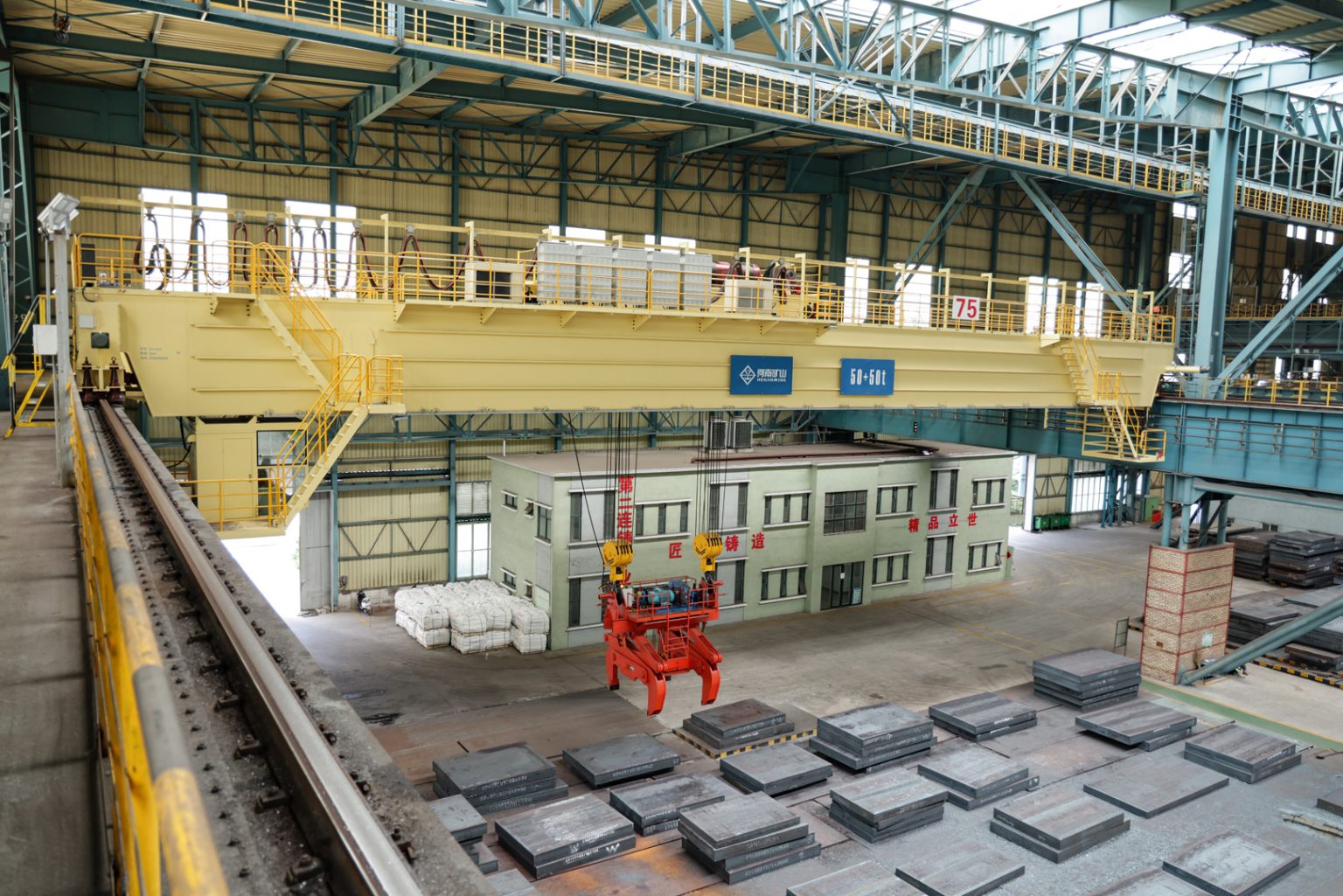
Metallurgical Bridge Crane
Process-duty bridge platform for specified high-temperature and steel-production environments.
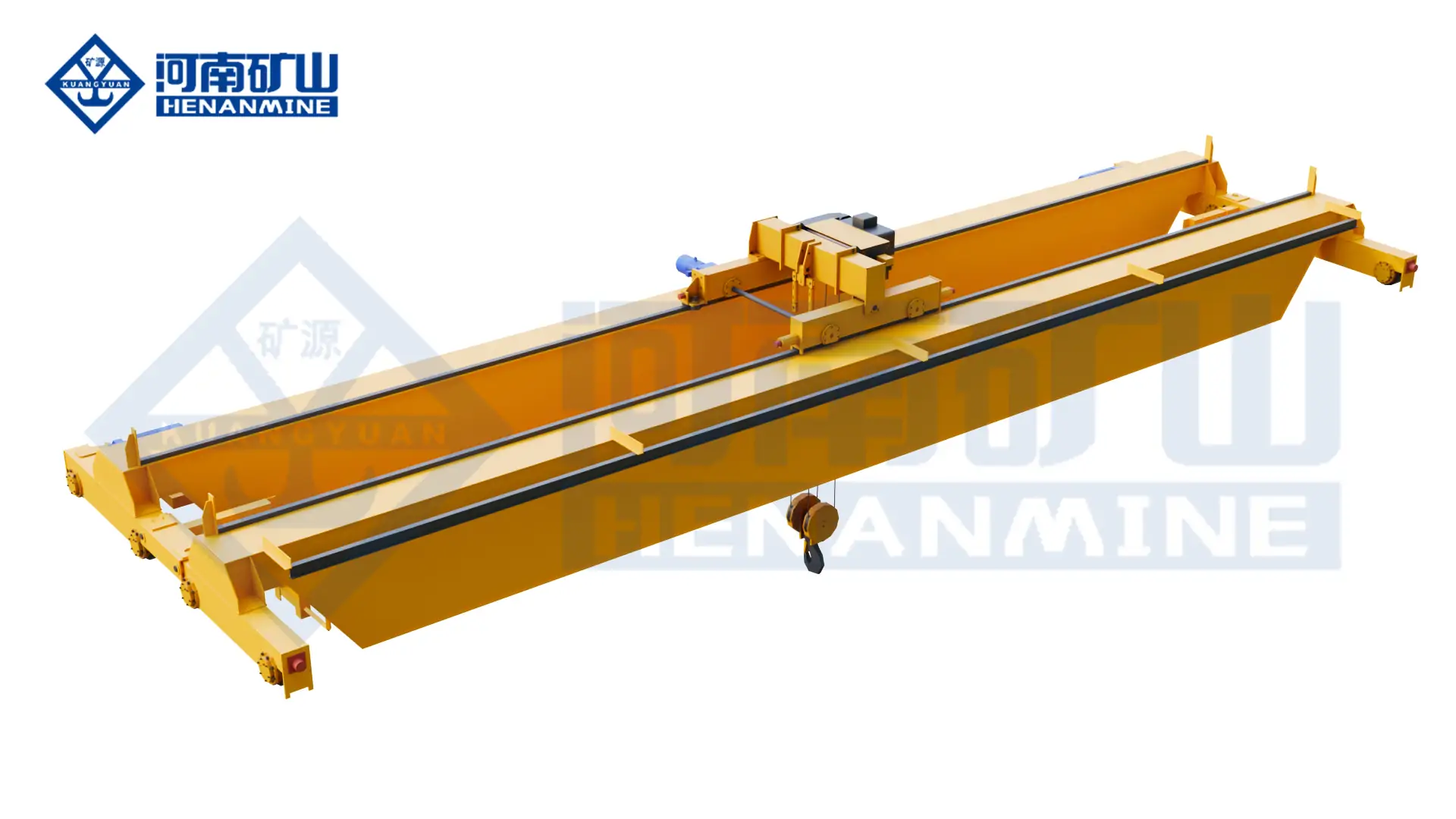
Double-Girder Bridge Crane
Configurable two-girder platform for roll change, tooling, maintenance and general heavy lifting.

Automatic Steel Plate Handling Crane
Integrated crane, attachment, positioning and task-control solution for plate logistics.
Request a Plate Mill Crane Quote
Submit the material schedule, maximum gross load, plate or slab temperature, attachment requirement, process cycle, span, lift, runway information, control level, power supply, destination and required supply boundary. Henan Mine Crane will prepare a configuration-based technical and commercial proposal.