分类: Technical Resources

Crane selection, technology, operation and purchasing knowledge.

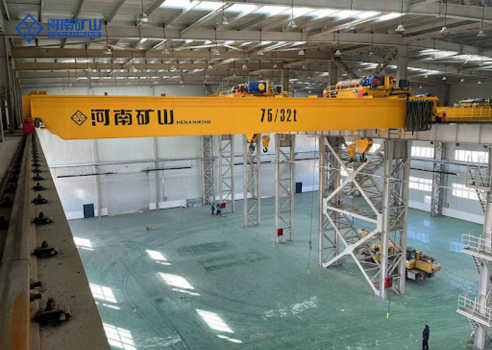
  • 75t Heavy Industrial Bridge Cranes: Precision Lifting for Large Transformer & Stator Plants

    75t Heavy Industrial Bridge Cranes: Precision Lifting for Large Transformer & Stator Plants

    75t Heavy Industrial Bridge Cranes: Precision Lifting for Large Transformer & Stator Plants

    In UHV and large-scale power equipment manufacturing scenarios, the hoisting and assembly of heavy-duty precision components such as transformers and motor stators requires extremely high bearing capacity, stability and accuracy of lifting equipment.The performance of traditional cranes is insufficient and cannot be adapted to the needs of precision production.

    The 75-ton heavy-duty industrial bridge crane is specially built for the electric power heavy industry scene. It has the advantages of heavy-duty stability, precise alignment, safety and reliability. It can be adapted to the whole process of the production line of related components, and provides high-quality hoisting solutions for intelligent power manufacturing.

    What Is a 75t Heavy Industrial Bridge Crane?

    75-ton heavy-duty bridge crane, focusing on the power heavy industry scene, can complete the transfer, assembly and maintenance of precision heavy-duty components such as transformers and motor stators.Relying on high-strength structure, intelligent frequency conversion control and multiple safety protections, it solves the problems of heavy-duty hoisting shaking, difficult alignment, and poor safety. It is the core lifting equipment for stable production and quality improvement in electric power intelligent manufacturing workshops.

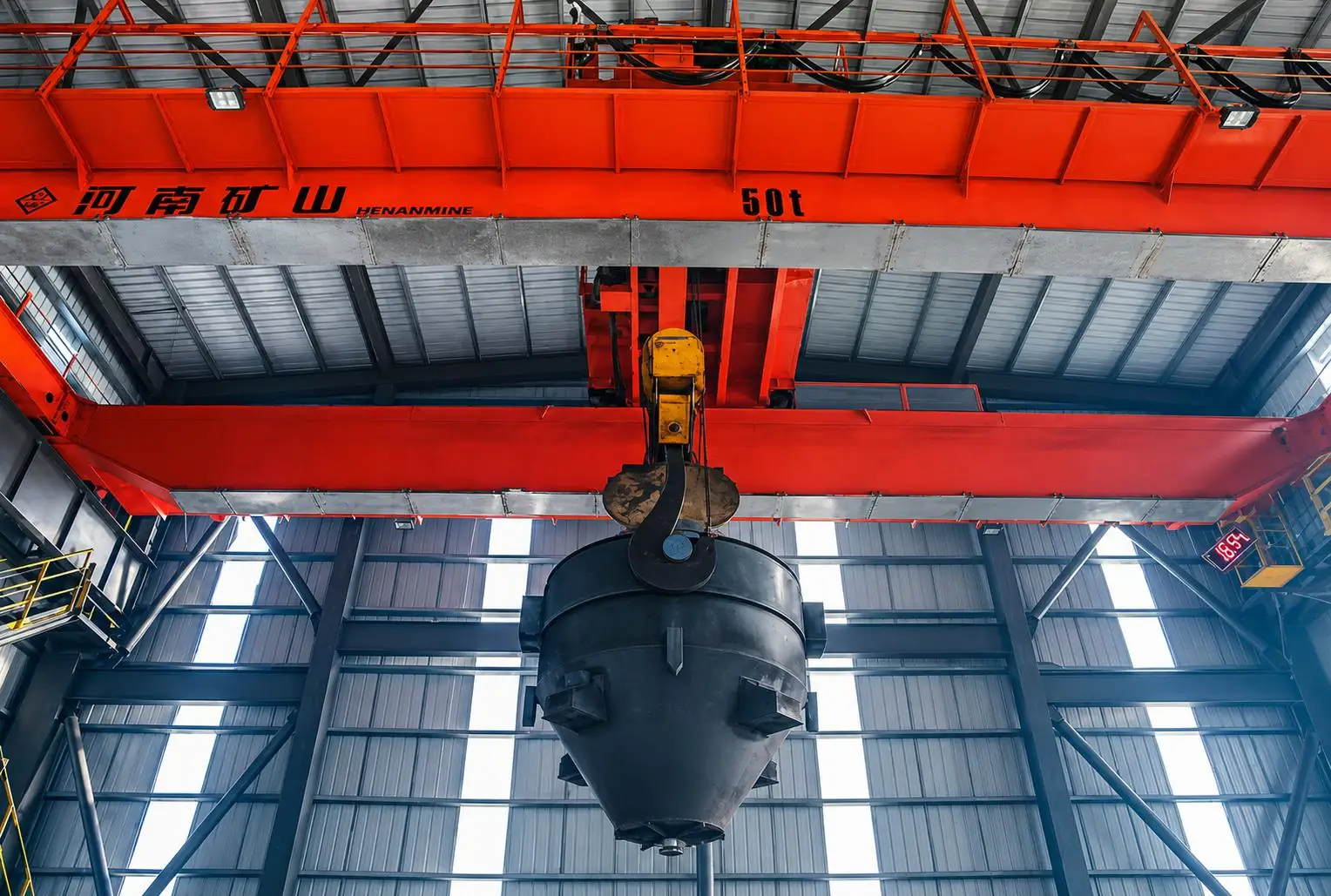
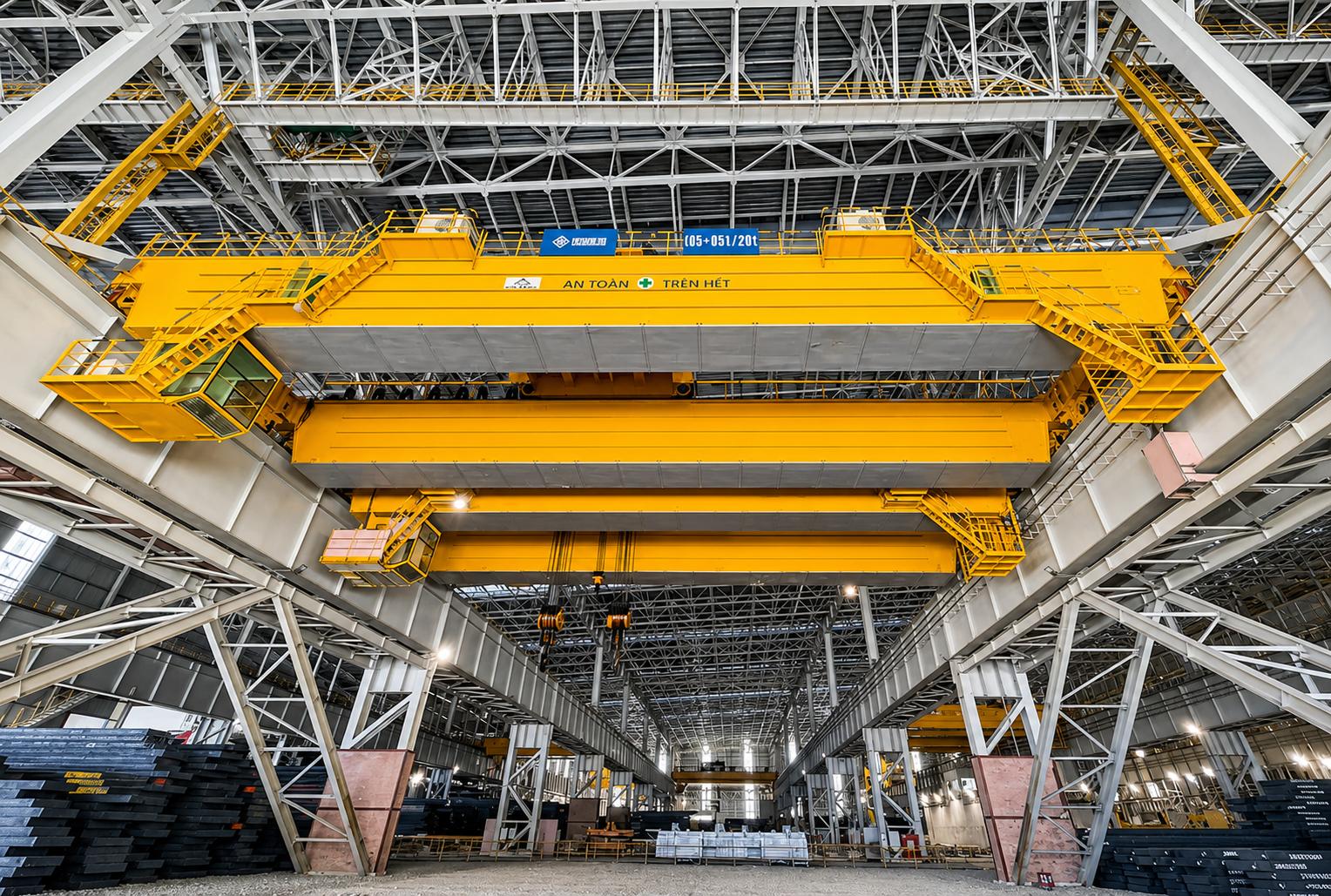
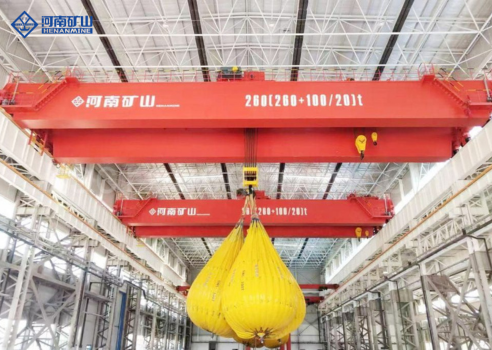
    The equipment takes the double-beam bridge as the main body, integrates the lifting trolley, end beam, track system, electronic control and lifting mechanism, and can safely complete the vertical lifting of 75-ton heavy loads and the global horizontal movement of the workshop. It has strong bearing capacity, stable operation and high positioning accuracy.

    Core structure composition

    1. The main body of the bridge frame: it adopts an integral welded double-beam box-type load-bearing structure, with high structural rigidity, minimal deformation at full load, stable and reliable carrying performance, and can be perfectly adapted to long-span working conditions and 75-ton heavy-duty continuous cycle operation, laying a solid structural foundation for the operation of the whole machine.
    2. Lifting trolley and hoist mechanism: The top-mounted type is installed above the main beam of the bridge frame, integrating heavy-duty lifting and horizontal fine-tuning functions, responsive and accurate positioning. It is the core actuator for completing high-precision alignment and assembly of transformers and stators.
    3. Operation and electronic control system: integrate the end beam walking mechanism, a dedicated track base, a stable power supply system and an intelligent electronic control unit to achieve stepless speed regulation, smooth start and stop, and precise positioning of the whole machine to ensure the automation, refinement and stable operation of the equipment throughout the process.

    Core technical parameters

    1. Lifting configuration: Adopt the industry’s mature 75/20t main and auxiliary hook combination.The 75-ton main hook is responsible for heavy-duty hoisting of the main body such as the transformer box and the stator core; the 20-ton auxiliary hook is used for small-piece assembly and fine-tuning of the point position, taking into account the heavy-duty capacity and operational flexibility.
    2. Spatial parameters: The standard span is 10.5m–5m, which supports non-standard customization; the maximum lifting height can reach more than 30m, which meets the space requirements of ultra-high assembly, internal decentralization, and top installation of large power components, and avoids structural interference.
    3. Working condition level: The whole machine is A5/A6 medium and heavy-duty working system, which is suitable for high-frequency, continuous and high-strength assembly line hoisting in electric power plants, fatigue-resistant and wear-resistant, and suitable for mass-produced production scenarios.
    4. Frequency conversion operation performance: equipped with VFD stepless frequency conversion system, it can speed control in all dimensions of lifting, cart, and trolley.No-load high-speed transfer improves efficiency, the station is accurately aligned at low speed, the start and stop are soft and impact-free, and it has the advantages of energy saving, noise reduction and wear reduction.
    5. Environment and power supply adaptation: standard models are adapted to indoor clean workshops; dust-proof, anti-corrosion, and waterproof models can be customized to adapt to complex working conditions.The power supply system is compatible with the conventional infrastructure of the plant, with a small amount of transformation and stable operation.

    Why Transformer Plants Need Precision 75t Crane Systems

    Suitable for hoisting large heavy-duty components

    With the iterative upgrading of high-voltage and UHV transmission equipment, the overall volume of large transformers is larger and the weight of the monomer is higher. The core components such as the box, iron core, winding, and sealed end cap are all heavy-duty hoisting units. Conventional lifting equipment has limited bearing capacity and insufficient positioning accuracy, which cannot meet production standards.

    The 75-ton heavy-duty bridge crane is specially customized for power heavy industry scenarios, and can fully cover the precise transfer, alignment assembly and floor installation of various heavy-duty components of transformers.

    Smooth hoisting

    The internal windings, insulation layers and precision electrical structures of the transformer are extremely fragile. Inertial shaking, sudden start-stop shocks, and displacement deviations during hoisting can easily cause irreversible quality defects such as component deformation and insulation damage.

    The 75t bridge crane is equipped with a VFD frequency conversion steady speed system and intelligent anti-shake technology to achieve flexible start-stop, uniform displacement, and stable hovering, avoiding load jitter and offset from the source, protecting high-value precision components in all directions, and greatly reducing product scrap and rework costs.

    The whole process is adapted to the production process

    The equipment can be deeply integrated into the complete transformer production link, and can be fully adapted to the whole process of parts assembly, precise installation of iron core coils, overall box assembly, finished product withstand voltage testing, equipment maintenance and displacement. It is the core supporting equipment to ensure the continuous, standardized and efficient production of transformer workshop assembly lines.

    Ultra-high lifting stroke

    The equipment has a large vertical lifting stroke, which can be perfectly adapted to high-altitude work scenarios such as vertical assembly of large transformers, decentralization of internal components, and installation of top accessories.While meeting the assembly process of large-scale components, efficiently use the vertical space of the plant, completely avoid the structural interference of equipment, loads, beams, columns, and tooling equipment during the hoisting process, and ensure operation safety and construction efficiency.

    75t Bridge Cranes for Large Stator Manufacturing Plants

    Heavy-duty precision hoisting is just needed

    The generator, motor stator frame and iron core components have huge self-weight, large diameter and span, and complex curved surface structure. The difficulty of hoisting and alignment is high, and the fault tolerance space is very small. There are strict requirements for the stability and positioning accuracy of lifting equipment.

    The 75-ton heavy-duty bridge crane has super heavy-duty stability and micron-level positioning capabilities, and can be perfectly adapted to the intensive lifting conditions of the stator. It is the standard core lifting equipment for large-scale stator intelligent manufacturing production lines.

    Core job scenarios

    • Core assembly operations: core processes such as stator core placement, main frame positioning, and coil assembly can be accurately completed to ensure the assembly accuracy of stator core components and build a solid foundation for the quality of finished equipment.
    • Component transfer operations: it can efficiently complete the cross-regional transfer of various heavy parts of generators and motors and the precise scheduling of stations, smoothly connect various production processes, open up material flow bottlenecks, and ensure the efficient and consistent operation of the production line.
    • Operation and maintenance shift operation: it can complete the maintenance, displacement and alignment adjustment of finished equipment and tooling components, taking into account the needs of the whole scene of manufacturing and post-operation and maintenance, and ensure the continuous and efficient operation of the production line.

    Millimeter precision assembly capability

    The machine is equipped with frequency conversion low-speed micro-control technology and flexible start-stop braking system, which can achieve high-precision micro-alignment in the assembly station area, and correct the hoisting offset error of heavy-duty components in real time.There is no hard impact and no inertial shaking throughout the process, which effectively guarantees the assembly accuracy of the core components of the stator, stabilizes the assembly quality of the finished product, and improves the stability and reliability of the long-term operation of the unit.

    Key Design Features of a 75t Heavy Industrial Bridge Crane

    Graded variable speed operation

    The equipment is equipped with intelligent hierarchical speed regulation logic to realize differentiated operation under working conditions.No-load cross-zone operations can be transferred at high speed, greatly improving the efficiency of material turnover; switch to a low-speed micro-control mode near the assembly station to accurately complete the alignment and calibration of components, and efficiently balance the production capacity of the production line with the quality of precision assembly.

    Intelligent anti-shake control

    Relying on high-end PLC intelligent computing algorithms, it dynamically monitors and compensates for the inertial swing of the load in real time, and accurately cancels the shaking offset generated during the hoisting process.Without manual correction, heavy objects can hover and shift smoothly throughout the process, effectively eliminating collision damage to high-value components and reducing the risk of precision assembly operations.

    Precise positioning of multiple limits

    The equipment is equipped with multiple protective devices for lifting upper and lower limits and operating limits of large and small vehicles as standard, which accurately locks the safe operating interval and eliminates the hidden dangers of over-range operations.Laser positioning and encoder precision measurement and control modules can be selected as needed to achieve millimeter-level positioning accuracy, and are fully adapted to the high-end precision assembly process standards of transformers and stators.

    Synchronous hoisting technology

    Safety Considerations for 75t Transformer & Stator Cranes

    Overload protection

    The equipment is equipped with a real-time intelligent load monitoring module, which can dynamically collect lifting weight data throughout the process.Once the load exceeds the rated working condition of 75 tons, the system will immediately automatically lock the lifting action and trigger a sound and light alarm to eliminate major safety hazards such as structural deformation and component fall caused by overload operations from the source, and fully guarantee the safety of equipment, components and factory operations.

    Emergency stop and limit protection

    The equipment is equipped with a one-button emergency stop function and a full range of stroke limit protection mechanism. In the event of sudden abnormal working conditions, the power can be cut off instantly and the emergency shutdown can be carried out. It cooperates with the full stroke limit control to effectively eliminate safety accidents such as over-range operation, equipment collisions and structural interference, and ensure the safety of equipment and production lines in all directions.

    Dual redundant braking

    The whole machine adopts the dual redundant safety architecture of electrical flexible braking and mechanical emergency braking, which takes into account the dual performance of smooth buffer shutdown and instantaneous emergency locking.Under normal operating conditions, soft braking and no impact alignment are achieved.

    In the event of a sudden failure, the load can be locked instantly, ensuring the absolute stability of heavy-duty hovering throughout the process, completely avoiding major safety risks such as sliding hooks and carts, and providing a comprehensive and highly reliable safety guarantee for the hoisting of high-value heavy-duty precision components.

    Sound and light early warning and visualization operations

    The equipment is equipped with an integrated sound and light early warning system, which actively issues warning signals during operation, start and stop, cooperates with a broad and clear operating vision, effectively regulates the operation line of the factory area, reminds on-site personnel to avoid in time, avoids the risk of collision from the level of human-made control, and builds a three-dimensional safe operating environment.

    Path control and anti-shaking and risk avoidance

    The equipment is equipped with controllable acceleration and deceleration operation logic and intelligent anti-shake system, combined with refined regional limit control, which can effectively avoid the collision of the equipment body, tooling components and plant walls, avoid the risk of interference in the operation in all directions, and ensure the safety and order of the hoisting operation.

    Choosing the Right 75t Crane Configuration for Your Plant

    The 75-ton heavy-duty bridge crane supports personalized customization in all dimensions. The selection needs to be considered in combination with the working conditions of the plant, production requirements, and assembly technology. The core selection dimensions are classified as follows to accurately match the production scenario and eliminate the problem of excess equipment performance or insufficient operating capacity.

    1. Load and working condition selection: Determine the rated bearing capacity of the equipment based on the maximum hoisting load of the workshop, combine the hoisting frequency of the production line and the intensity of continuous operation, and match the adapted A5/A6 working level to ensure the stability of the equipment’s long-term heavy-duty cycle operation, taking into account durability and production efficiency.
    2. Space size selection: Determine the operating span of the equipment according to the opening of the plant and the spacing of beams and columns, and customize the lifting height based on the assembly height of the components and the vertical operation requirements to avoid spatial interference in the hoisting process and adapt to the inherent infrastructure conditions of the workshop.
    3. Equipment configuration selection: match the combination configuration of the main and auxiliary hooks as needed to adapt to the dual scenarios of heavy-duty hoisting and precision fine-tuning; optional frequency conversion speed control system, customized equipment operating speed, balance material transfer efficiency and component alignment accuracy, adapt to precision assembly technology.
    4. Adaptation of environment and infrastructure: the corresponding protection level is selected according to the operating environment of the workshop, and special configurations such as dustproof, anticorrosive, and waterproof are selected; combined with the power supply parameters of the factory area and the size of the existing rail infrastructure to adapt to the equipment parameters, there is no need to transform the plant on a large scale to reduce the cost of landing.

    Customization Requirements for Large Transformer & Stator Plants

    • Customization of plant working conditions: According to the actual opening size, floor height conditions, and operating environment of the workshop, the operating span of the equipment, the maximum lifting height, and the protection level of the whole machine can be customized, which is perfectly adapted to the needs of old and new factories, non-standard workshops, and complex working conditions, without the need to significantly transform the infrastructure.
    • Operation level adaptation: According to the frequency of production hoisting and continuous operation intensity in the factory area, it can accurately match the A5/A6 medium and heavy-duty work level, and adjust the fatigue performance and operating parameters of the equipment as needed, taking into account the service life of the equipment and the efficiency of production operations.
    • Special customization of special-shaped components: For ultra-long, large-span, and special-shaped irregular power components, the double-hook linkage and dual-machine synchronous hoisting configuration can be upgraded to ensure uniform force and stable attitude of the components, prevent deformation of the hoisting, and meet the non-standard high-end assembly process.
    • Intelligent operation and maintenance upgrade: Support the installation of intelligent monitoring modules for the Internet of Things to collect equipment operation data in real time, realize active fault early warning, real-time status monitoring and refined preventive maintenance, effectively reduce equipment failure rate and reduce downtime losses.
    • Automation system docking: The equipment reserves a PLC intelligent interface, which can be seamlessly connected to the intelligent factory production line system to realize the linkage control of equipment and the collaborative scheduling of processes, and adapt to the modern unmanned and intelligent production mode.

    Conclusion

    With its high-strength structure, precise frequency conversion control and all-round safety protection, the 75-ton heavy-duty industrial bridge crane is perfectly adapted to the heavy-duty precision hoisting conditions of heavy-duty power components such as transformers and stators.

    Scientific customized selection and standardized operation and maintenance can effectively improve the safety, stability and production efficiency of workshop operations, and reduce operation and maintenance costs.Henan Mine Crane can provide customized design, manufacturing and supporting solutions for suitable 75-ton bridge cranes according to plant conditions and production needs.
    Henan Mine CraneDiscuss your requirements ↗
  • 7 Types of Overhead Cranes Which One Is Right for Your Project

    7 Types of Overhead Cranes Which One Is Right for Your Project

    7 Types of Overhead Cranes Which One Is Right for Your Project

    Overhead cranes are the core equipment for industrial production and heavy material handling, and choosing the right type can make the factory operation smooth and improve efficiency, and choosing the wrong type will increase the operating cost, lower efficiency and lay hidden safety hazards. This article analyzes the 7 mainstream types, combined with scene comparison, selection guide, to help you accurately match the project requirements, to solve the problem of crane selection.

    What Is an Overhead Crane?

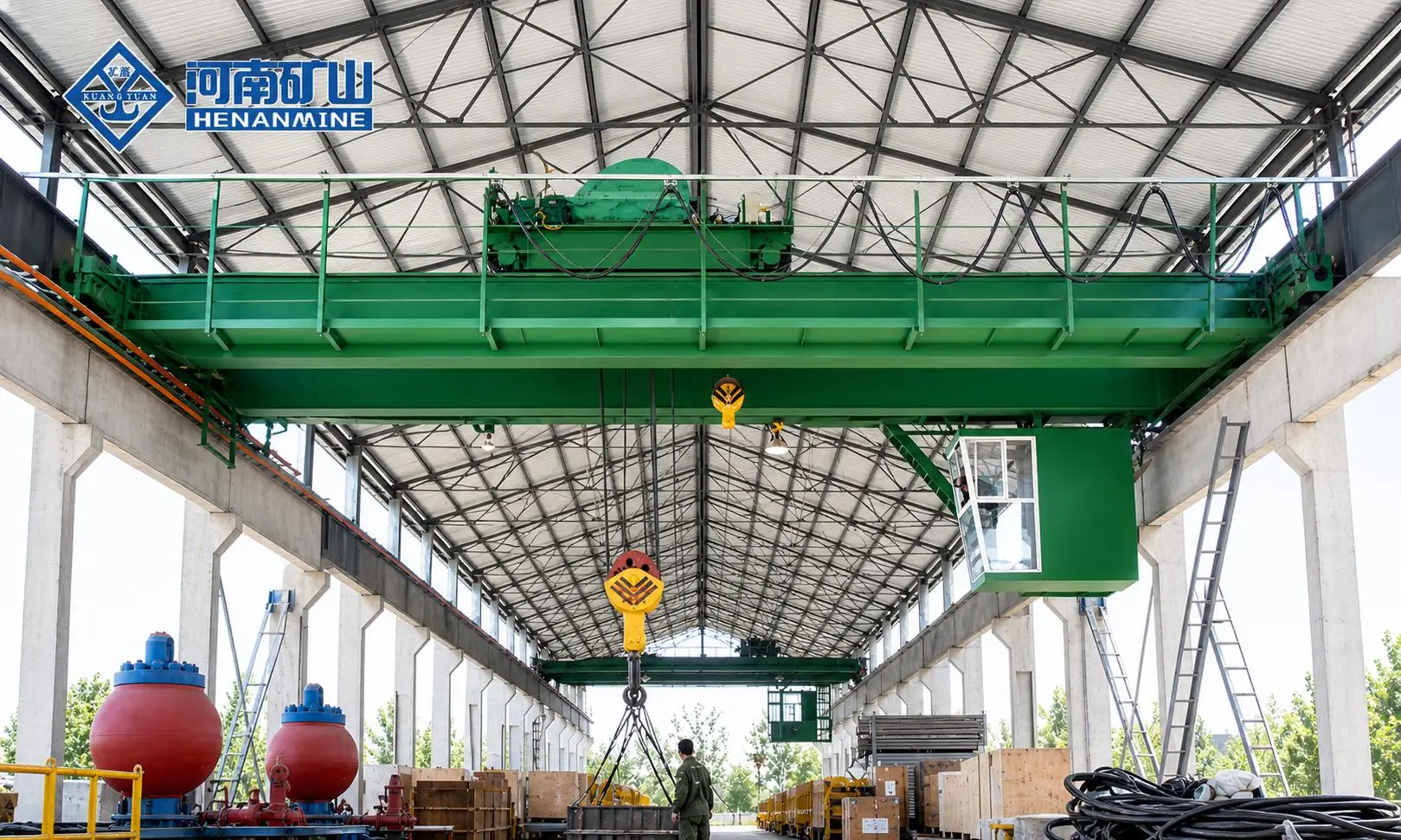
    Overhead Crane is a lifting system that realizes horizontal and vertical movement of heavy loads on track beams through hoisting mechanism, trolley and bridge, which is the core heavy material handling equipment in the industrial field, widely used in various factories, warehouses, yards and other scenes.

    Its core components include four key components, one is indispensable. The lifting mechanism is the core to realize the lifting and lowering of heavy loads, and bears the role of direct lifting loads. The trolley can drive the hoisting mechanism to move laterally along the bridge to expand the operating range. The main girder is the main bearing structure of the crane, supporting the overall lifting weight. The track system provides a fixed path for the movement of the bridge and the trolley to ensure the stability of the equipment operation.

    However, not all overhead cranes are the same, different types of equipment in the load capacity, scope of operation, applicable scenarios on the significant differences in the selection of the key is to find the characteristics of the equipment and the project needs of the point of convergence.

    7 Types of Overhead Cranes Explained

    Bridge Crane

    1. Bridge Crane

    • Core positioning: bridge cranes are the most common and widely used core lifting equipment in the industrial field. The core structure is that the main bridge girder runs longitudinally along the parallel track beams, and is paired with a transversely movable trolley, which realizes full-scope handling in the operation area.
    • Types of classification: according to the load capacity and structure is divided into single girder and double girder overhead travelling crane. Single girder is cost-effective, simple structure, suitable for light load, small and medium tonnage operation. Double girder is designed for heavy duty, stronger load bearing, suitable for large tonnage, high frequency heavy lifting.
    • Core Advantage: The bridge crane can cover the whole working area without dead angle. With rich load ratings, it can be adapted to different tonnages of material handling needs, and has high operating efficiency.
    • Application Scenario: Gantry cranes are mainly used in large manufacturing factories, iron and steel mills, large warehousing and logistics centers, etc. They are suitable for large-scale and high-frequency material handling needs.

    2. Gantry Crane

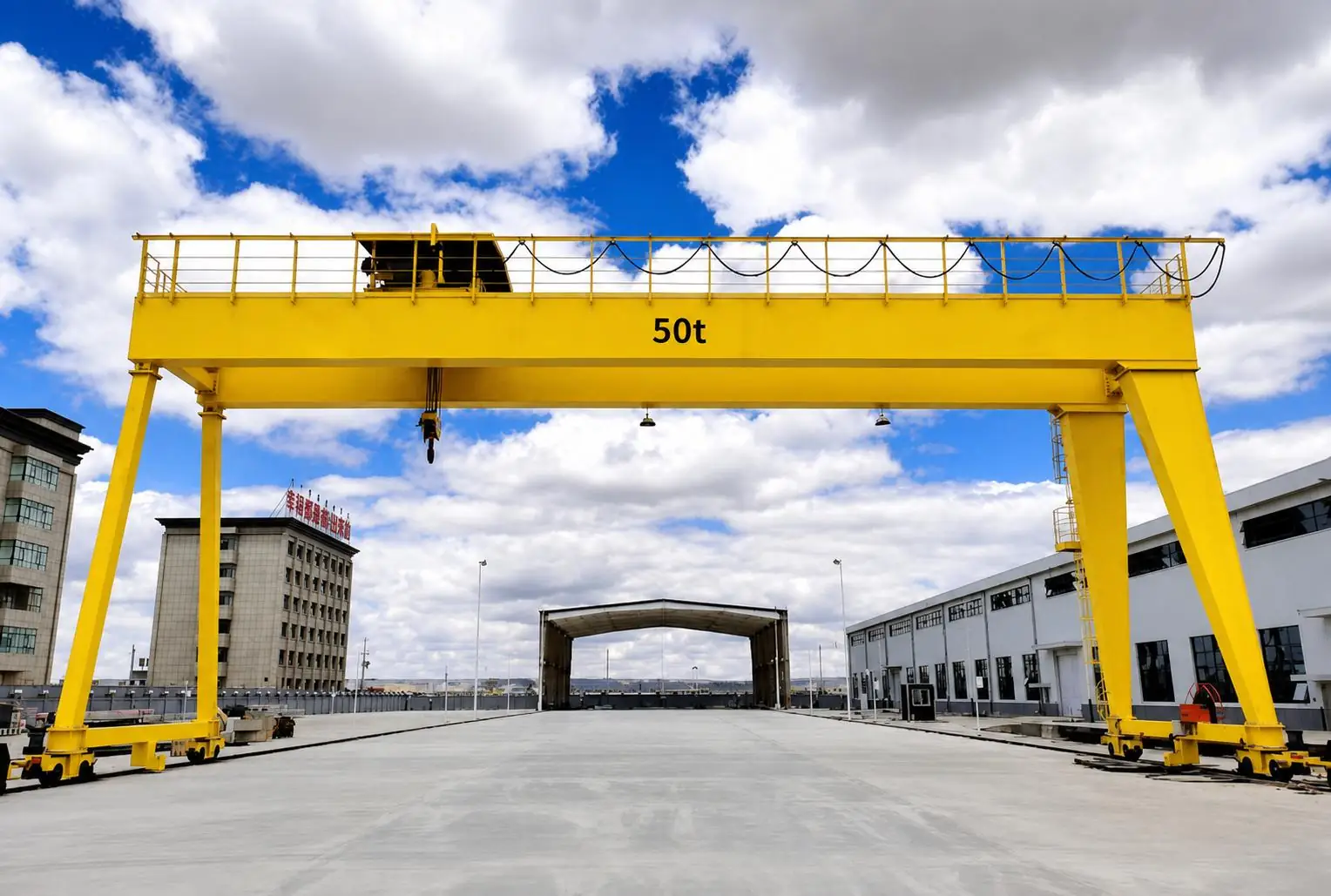
    • Core structure: Gantry cranes do not need to rely on plant buildings, through the two sides of the outriggers to support the overall structure, directly erected on the ground track or foundation, site adaptability is stronger.
    • Types of classification: Gantry cranes are divided into fixed and mobile, fixed to adapt to the fixed area of heavy material handling, mobile can be flexible to switch the operating site, without the need to rebuild the track.
    • Core advantages: no need to transform the structure of the plant can be installed, mobile and flexible, according to the size of the outdoor site to adjust the scope of operation, strong wind resistance, suitable for all kinds of complex outdoor environments, can efficiently complete the heavy material handling, taking into account the flexibility and practicality.
    • Scenario: The core of the gantry crane is suitable for outdoor work, including shipyard hull assembly, outdoor construction site building materials transfer, ports and container yards container loading and unloading and so on.

    3. Jib Crane

    • Core structure: Jib Crane takes the rotatable jib as the core, the rotating angle can be designed to be adjusted to 180°-360°, which can realize the flexible lifting and transferring of heavy loads within the specified rotating range, and the overall footprint of the equipment is small, which belongs to the compact lifting equipment, and does not need to take up a large amount of space in the factory.
    • Core advantages: jib crane structure is simple, easy to operate, small footprint, high efficiency of fixed-point lifting, can quickly complete the heavy lifting, shifting operations, without taking up a lot of factory space, suitable for small-scale operation scenes.
    • Applicable scenes: jib cranes are suitable for small workstations in factories, production line fixed-point process, as well as machining, parts assembly and other operations that require repetitive lifting scenes.

    Jib Crane

    4. Monorail Crane

    • Core structure: Monorail Crane takes the fixed single track as the core, the operation path is fixed as linear, and it can only realize longitudinal linear movement along the track, no lateral movement ability, and the overall structure is simple.
    • Core advantage: monorail crane structure is simple, low manufacturing cost and installation cost, outstanding cost performance. Smooth operation, low failure rate, convenient maintenance, can effectively reduce equipment operation and maintenance costs. Suitable for fixed-path transportation, stable efficiency.
    • Scenario: monorail cranes are suitable for all kinds of industrial production lines, assembly line material transfer, automated assembly line parts conveyance, as well as fixed-path goods sorting and handling in the warehouse and other scenarios.

    5. Workstation Crane

    • Core structure: light-load design modular lifting system, the use of flexible splicing modular structure, the workstation crane can be freely assembled according to the layout of the workstation, with ergonomically designed operating components, the overall structure is simple and lightweight.
    • Core advantage: the modular design of the workstation crane can be flexibly spliced and assembled to fit different workstation layouts. Ergonomic design, lightweight operation, reducing the intensity of the operator’s work; with the ability to transform and expand, can be adjusted with the production requirements of the scope of work. Light load precision, suitable for high-precision handling needs.
    • Application Scenario: The workstation crane is suitable for small assembly workstations in various factories, electronic components manufacturing, small mechanical parts processing and other light load, high-precision material handling scenarios.

    6. Top-Running Crane

    • Core structure: Top-Running Crane bridge is directly mounted on the top of the rail beam, with a solid rail connection, the overall heavy-duty structural design, focusing on large-tonnage, large-span work adaptation.
    • Core advantages: top cranes have solid connection and strong carrying capacity, which are suitable for large tonnage and large span lifting requirements; high operational stability, which can cope with high-frequency heavy-duty operations and are not easy to experience equipment failure.
    • Application Scenario: Top cranes are often used in metallurgy, mining, heavy machinery manufacturing and other heavy industry, as well as large-span industrial plants, large material warehouses and other facilities that require large-tonnage material handling.

    7. Under-Running Crane

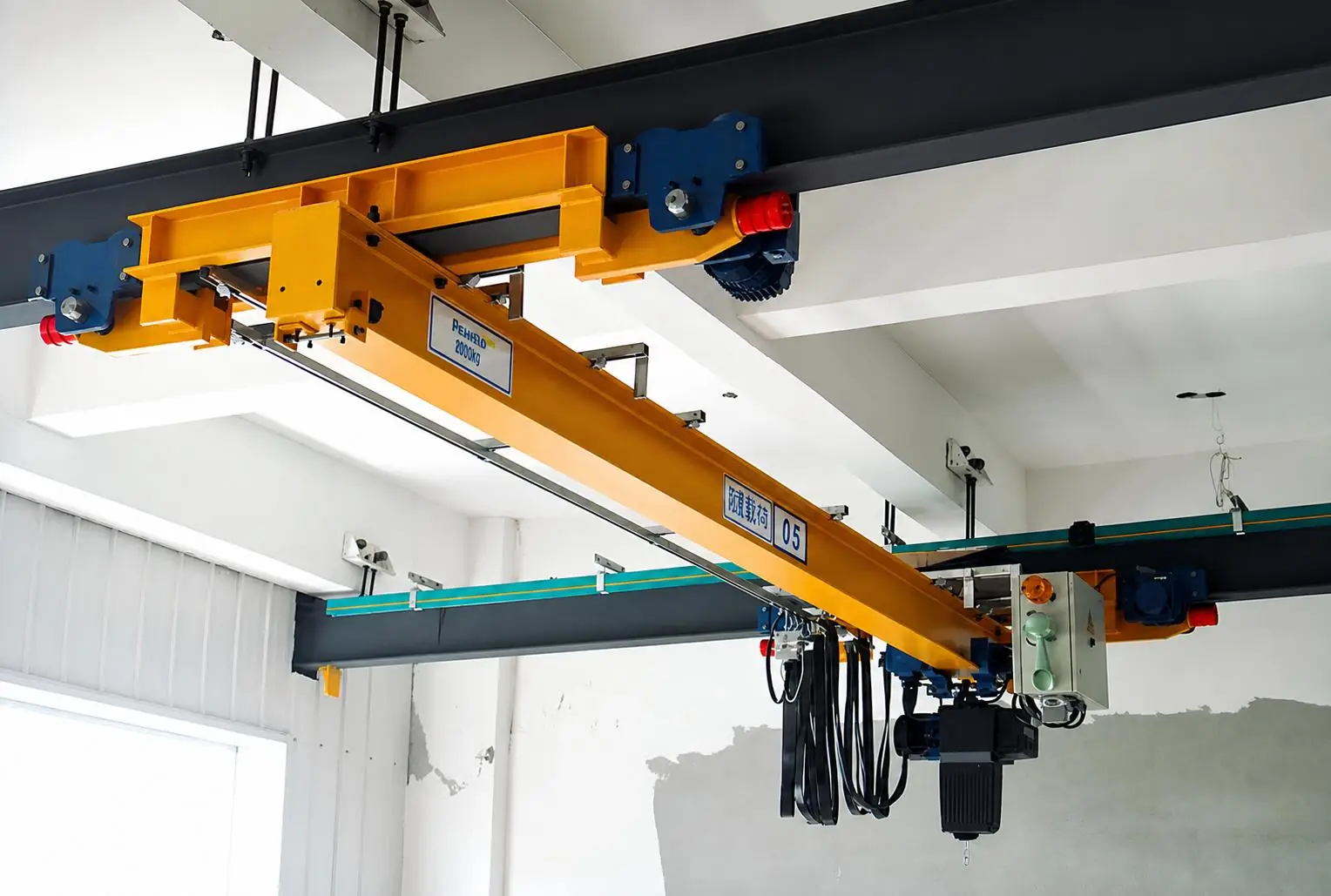
    • Core structure: Under-Running Crane bridge is installed under the rail beam, different from the upper suspension crane, the overall structure is compact, without taking up too much space above the plant, suitable for low headroom environment.
    • Core Advantage: Saving space on the upper part of the plant, suitable for low headroom environment. Stalking crane installation flexibility, can be directly adapted to the existing plant structure transformation, without large-scale reinforcement of the plant; stable operation, convenient maintenance, outstanding cost-effectiveness.
    • Application Scenario: The snorkeling crane is suitable for small-scale processing workshops with low headroom, upgrading of equipment in old plants, and various types of industrial operation scenarios with limited space.

    How to Choose the Right Overhead Crane

    Choosing the right overhead crane needs to be considered in conjunction with the actual needs of the project, the core decision-making factors include five major aspects, which are also the key points of industrial crane selection, each of which has a direct impact on the use of the equipment and operating costs:

    • Load capacity requirements: clear project needs to lift the maximum tonnage of heavy objects, conventional lifting load, as well as whether there is occasional overloading needs, in order to determine the load level of the crane.
    • Span and lifting height: According to the actual size of the plant, determine the operating span of the crane, combined with the headroom height of the plant, the height of the material handling needs, the lifting height of the selected equipment.
    • Indoor and outdoor use: outdoor operations need to prioritize the selection of bridge cranes that do not require architectural support and have strong wind resistance, while indoor operations can be combined with the structure of the plant and the spatial layout of the selection of the appropriate type.
    • Frequency of operation: For high frequency operation, choose heavy-duty design and high stability overhead travelling crane, while for low frequency and light load operation, choose more cost-effective lightweight equipment.
    • Budget constraints: Balance the quality, performance and cost of the equipment with the overall budget of the project, and consider the cost of maintenance, upgrades and repairs.

    Bridge cranes are the preferred choice for most industrial projects because of their full-range operational advantages and wide range of load ratings, which bring better long-term ROI and operational efficiency. Gantry cranes are the best choice for outdoor heavy material handling due to their flexible installation and mobility, and can be flexibly adapted to the site requirements.

    different type Overhead Cranes

    Common Mistakes to Avoid

    In the process of selecting industrial cranes, many companies will be ill-considered into the selection of the wrong products, not only affect the use of equipment, but also increase the cost of transformation in the later stages, these common mistakes must be avoided:

    1. Only price as the selection criteria: blind pursuit of low-priced equipment, ignoring the quality of the crane, load-bearing capacity and adaptability, the later equipment failure, low operating efficiency and other issues, but increase maintenance costs.
    2. Ignoring the future business expansion: only consider the current production demand, not reserved for the expansion and upgrading of overhead cranes, when the enterprise production capacity, material handling needs to increase, the existing equipment can not meet the demand, the need to re-purchase, resulting in a waste of resources.
    3. Underestimation of load demand: to save costs by choosing low load rating industrial cranes, the actual operation of the equipment frequently close to or beyond the rated load, not only will accelerate the aging of the equipment, but also lead to equipment tipping over, falling objects and other serious safety accidents.
    4. Failure to consider the installation environment: Neglecting the structure of the plant, headroom height, ground foundation and other factors of the installation environment, resulting in the equipment can not be installed on the site, or the installation of poor operation, the need for large-scale remodeling of the plant, increasing additional construction costs.

    Why Bridge Cranes Are the Most Popular Choice

    Among the many types of bridge cranes, bridge cranes can become the mainstream choice in the industrial field, thanks to their comprehensive advantages of adaptability, efficiency and scalability, which are also the core highlights that distinguish them from other types of equipment:

    1. Covering the entire operating space: the design of the bridge with the trolley can realize the full coverage of the operating area of the factory, no handling dead ends, and can meet the large-scale material handling needs of large factories and warehouses.
    2. Industry-leading operating efficiency: the running speed of the equipment can be adjusted, and the lifting, transverse and longitudinal movement can be synchronized with the rapid completion of the transfer of heavy loads, which greatly improves the efficiency of material handling and is suitable for high-frequency industrial production.
    3. Expandable design: with modular design, it can be used to increase the lifting mechanism, extend the working span or upgrade the load capacity at any time according to the production demand of the enterprise, which is suitable for the development demand of the enterprise at different stages.
    4. Compatible with automation system: it can be seamlessly connected with industrial automation control system and intelligent warehousing system to realize the automation and intelligent operation of material handling, which is in line with the intelligent development trend of modern industry.

    If your project requires heavy-duty, high-efficiency material lifting and handling, overhead travelling crane is usually the best long-term investment choice. Its comprehensive operational performance and adaptability can bring continuous efficiency improvement and cost savings for industrial production.

    Conclusion

    Summarize the characteristics and application scenarios of 7 types of overhead cranes, to help you quickly match the project needs: heavy industry, large factories and warehouses for large-scale handling, give priority to overhead cranes. Outdoor work gantry cranes are the most suitable. Workshop small fixed-point operation selection of jib cranes, assembly line fixed-path transportation selection of monorail cranes.

    Select the right bridge crane, is the basis for efficient and safe operation of industrial production, as a professional manufacturer of large cranes, we have many years of industry R & D and production experience, according to the actual needs of your project, our professional and technical team will provide you with professional advice on selection, to create an exclusive industrial lifting solutions, to help your project to improve production efficiency and reduce operating costs!

    Henan Mine CraneDiscuss your requirements ↗
  • 7 Reasons Why the Best Gantry Crane is Essential for Your Manufacturing Efficiency

    7 Reasons Why the Best Gantry Crane is Essential for Your Manufacturing Efficiency

    7 Reasons Why the Best Gantry Crane is Essential for Your Manufacturing Efficiency

    In the modern manufacturing industry is increasingly competitive, production efficiency directly determines the core competitiveness of enterprises, and efficient material handling equipment is to optimize the production process, improve efficiency of the key support.

    Gantry crane is an indispensable core equipment for modern manufacturing industry, with its unique structure and powerful functions to help optimize business operations. It is not simply a “handling tool”, but a strategic asset that empowers production, reduces costs and ensures safety. The following is an analysis of its 7 core reasons for improving manufacturing efficiency.

    Improved Load Handling Capacity

    For manufacturing enterprises, the efficient handling of heavy materials is the basis for the smooth progress of the production process, and the advantages of high-quality gantry cranes in load handling are particularly prominent.

    Unlike ordinary lifting equipment, high-quality gantry cranes (such as aluminum alloy gantry cranes) have excellent strength-to-weight ratio, even if the design is lightweight, it can easily carry heavy equipment, raw materials and mechanical components, which completely solves the industry’s pain point of “portability and performance can not be combined”.

    In actual production scenarios, whether it is the transfer of heavy parts in the workshop, or the deployment of materials between production lines, high-quality gantry cranes can stably play the load advantage, without the need to invest a lot of additional manpower and material resources, effectively reducing the time cost of material handling, so that the heavy material handling is more efficient, more convenient, and speed up the entire production process.

    Precision and Productivity

    In the manufacturing industry, “accuracy” directly determines the quality and efficiency of production, especially in assembly lines, precision manufacturing and other scenarios, the precise positioning of materials is the most important. High-quality gantry cranes with advanced control technology can realize the precise positioning of materials and parts, effectively avoiding production delays and material loss caused by positioning deviations, and ensuring the smoothness of the production process.

    Nowadays, high-quality gantry cranes are generally integrated with variable frequency drives (VFDs), programmable logic controllers (PLCs) and remote operating systems and other advanced configurations, operators can accurately control the lifting speed and positioning accuracy, not only significantly reduce the error of manual operation, but also reduces the intensity of manual labor, so that operators can devote their energy to more complex production processes.

    At the same time, precise operation also improves production throughput and product consistency, which are two core indicators that directly determine the overall operational efficiency of manufacturing enterprises.

    Flexibility and Versatility

    There are significant differences in the production scenarios, workshop layouts, and material types of different manufacturing enterprises, which put forward higher requirements on the adaptability of lifting equipment. One of the biggest advantages of high-quality gantry cranes is that they have great flexibility and versatility, and can be flexibly adjusted according to different production needs, and adapted to diverse manufacturing scenarios.

    From the structural design point of view, the wheelbase, height and span of high-quality gantry cranes can be flexibly adjusted to easily adapt to narrow passages, irregular workshop layout and other complex environments, without the need for large-scale modification of existing production sites.

    At the same time, it has a wide range of models and supports customized design, which can be adapted to different sizes and shapes of material handling needs according to specific production requirements. In addition, high-quality gantry cranes have good portability, aluminum alloy models can be easily assembled and disassembled, and can be flexibly transferred to different workstations or work sites, to meet the needs of multi-location, multi-scenario production, and to further enhance the flexibility and efficiency of the production layout.

    Enhanced Worker Safety

    Safe production is a prerequisite for the efficient operation of manufacturing enterprises. Once a safety accident occurs, it will not only cause casualties and equipment damage, but also lead to production interruptions, which will bring huge economic losses and liability risks. High-quality gantry cranes prioritize safety performance during the design process, integrating a variety of built-in safety protection features to avoid potential safety hazards at the source.

    Common safety configurations include overload protection devices, emergency stop systems, limit switches, etc., which can effectively prevent safety accidents caused by lifting overload, operational errors, etc., and protect the safety of operators and equipment.

    These safety measures not only reduce the incidence of safety accidents, but also minimize equipment damage and production downtime due to accidents, as well as reducing liability risks and insurance costs, providing a solid guarantee of uninterrupted production processes, and indirectly improving overall manufacturing efficiency.

    Supporting Sustainable Operations

    Nowadays, sustainable development has become the development trend of the manufacturing industry, green production is not only the embodiment of corporate social responsibility, but also an important way to reduce operating costs and enhance core competitiveness. High-quality gantry cranes, through optimized design, can effectively help manufacturing enterprises to achieve sustainable operations, while achieving the dual objectives of cost reduction and efficiency.

    High-quality gantry cranes mostly use electric drive mode, with regenerative braking system and energy-saving drive, significantly reduce energy waste, reduce carbon emissions, while effectively reducing the cost of energy consumption of enterprises.

    In addition, high-quality gantry cranes have good reusability and transformability, can be transferred to different scenarios according to production needs or functional transformation, to achieve efficient use of resources, reduce equipment idling and waste. For manufacturing enterprises focusing on green production, the environmental advantages of high-quality gantry cranes can help enterprises to achieve sustainable development, while further optimizing operating costs and improving efficiency.

    Durability and Long-Term Reliability

    The efficient operation of manufacturing enterprises can not be separated from the stable operation of equipment, equipment failure and frequent maintenance will not only increase operating costs, but also lead to production interruptions, seriously affecting production efficiency.

    High-quality gantry cranes are made of high-quality durable materials and undergo rigorous quality testing to withstand high loads and high-frequency industrial operating environments, and have strong durability and long-term reliability.

    Compared with low-quality gantry cranes, high-quality gantry cranes have a lower failure rate and significantly lower maintenance costs, and are able to maintain a stable operating condition over time, avoiding production downtime due to equipment failure.

    Stable equipment performance ensures the continuity of the production process, reduces the time loss and economic loss caused by downtime, and provides reliable equipment support for the efficient operation of manufacturing enterprises.

    Cost-Benefit Analysis

    Many manufacturing enterprises in the choice of gantry cranes, often only focus on the initial investment costs, but ignored the long-term cost-effectiveness. High-quality gantry cranes, although the initial investment is relatively high, but from a long-term operational point of view, can bring significant cost returns for the enterprise, and become an important strategic investment for the enterprise to build competitive advantage.

    High-quality gantry cranes can bring long-term cost savings to enterprises by improving productivity, reducing labor costs, lowering maintenance costs and downtime losses. At the same time, its efficient material handling ability can help enterprises to improve production throughput, easily cope with higher production demand, without having to invest a lot of additional costs to expand the scale of production.

    In addition, the stability and reliability of high-quality gantry cranes can improve product quality, reduce product loss due to improper material handling, and further enhance the market competitiveness of enterprises. Therefore, investing in high-quality gantry cranes is not simply a matter of equipment procurement, but a strategic move to promote the sustainable development of enterprises and improve operational efficiency.

    Conclusion

    In summary, high-quality gantry cranes empower enterprises from the seven core dimensions of load handling, precise control, flexibility, safety, sustainability, stability and cost-effectiveness, directly enhancing manufacturing efficiency. In the context of the transformation and upgrading of the manufacturing industry, the choice of high-quality gantry cranes is the key to optimize the process, reduce costs and increase efficiency, and build a competitive advantage.

    Enterprises need to combine their own production, layout and load demand to choose the appropriate model, and rely on reliable manufacturers to obtain customized solutions and perfect service; if there are material handling inefficiency, equipment instability and other issues, you can consult the experts to choose the right high-quality gantry cranes to help improve efficiency.

    Frequently Asked Questions (FAQ)

    Q1:Quality gantry cranes and ordinary gantry cranes, what are the core differences in improving manufacturing efficiency?

    The core difference lies in the better stability, accuracy and durability of quality models: ordinary models are prone to failures, large positioning deviations and easy downtime; quality models can reduce downtime, improve handling accuracy, reduce labor and maintenance costs, and significantly improve productivity in the long term.

    Q2:How to choose the right quality gantry crane for different manufacturing scenarios (e.g. workshop, outdoor)?

    Workshops are prioritized to choose models with flexible adjustment of wheelbase and height to meet the needs of narrow space and precision handling;

    Outdoor scenes can choose portable, weather-resistant aluminum alloy models, which do not require fixed installation and can be flexibly transferred to the work site; heavy-duty load scenes focus on high-strength, large load capacity of the customized models.

    Q3: The upfront investment of quality gantry cranes is high, how long does it take to recover the cost?

    The cost recovery cycle is usually 1-3 years, depending on the frequency of use and production scale; quality gantry cranes can reduce labor, maintenance and downtime costs, improve throughput, the more frequent the use, the larger the scale, the faster the recovery, and significant long-term savings in operating costs.

    Q4: Is the daily maintenance of quality gantry cranes complicated? How to ensure its long-term stable operation?

    The daily maintenance of quality gantry cranes is simple, only need to regularly check the safety devices (such as overload protection, limit switches), lubrication of key components; choose a reliable manufacturer, you can get professional maintenance guidance and after-sales service, to protect the stable operation of the equipment, reduce the failure of downtime.

    Q5:Can quality gantry cranes be customized to meet the special production needs of enterprises?

    Yes, it can. High-quality gantry cranes support customized design, according to the enterprise’s load demand, workshop layout, material type, etc., to adjust the wheelbase, span, lifting height, and even integrate exclusive control functions, fully adapted to the enterprise’s special production scenarios, and maximize its role in enhancing efficiency.


    Henan Mine CraneDiscuss your requirements ↗
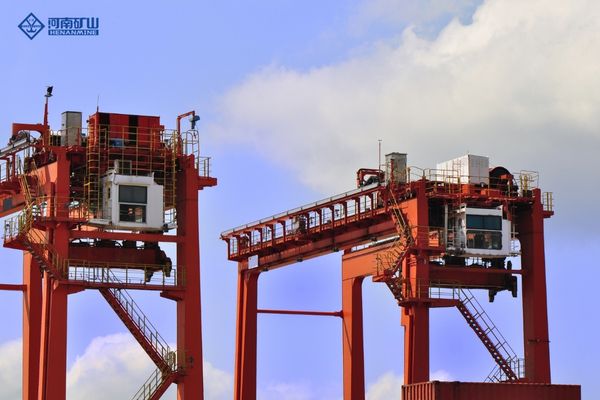
  • 65t Ship-to-Shore (STS) Portal Cranes: High-Speed Container Unloading and Anti-Sway Control

    65t Ship-to-Shore (STS) Portal Cranes: High-Speed Container Unloading and Anti-Sway Control

    65t Ship-to-Shore (STS) Portal Cranes: High-Speed Container Unloading and Anti-Sway Control

    In modern deep-water container ports, the 65-ton ship-to-shore (STS) Portal Crane is the core loading and unloading equipment, which directly affects port throughput, shipping schedule turnover and logistics costs.The equipment is suitable for ultra-large and ultra-large container ships (ULCV), relying on a 65-ton rated load, large operating coverage and intelligent anti-swing system, and is mostly used in high-load container operation scenarios such as international hub ports and transit terminals.

    This article will analyze the structural principle, core parameters, performance advantages, selection points, operation and maintenance plans and procurement standards of the 65-ton STS crane in an all-round way, and provide a professional reference for the upgrading of port equipment and the selection of new terminal equipment.

    What Is a 65t Ship-to-Shore (STS) Portal Crane?

    ship-to-shore (STS) Portal Crane, also known as shore container crane, is a rail-type lifting equipment installed at the forefront of the terminal and used for ship-shore container transshipment.The 65-ton shore bridge belongs to the fixed infrastructure of the terminal, which is adapted to the civil construction and power supply system of the berth, and supports high-intensity continuous operation. A single unit can complete 25-40 operation cycles per hour.

    65 tons represents the rated safe lifting load under the spreader. It is the mainstream specification of large international ports. It supports single-box and double-box hoisting. It is compatible with 20/40/45-foot standard containers, can load and unload ordinary and heavy-duty special containers, and has a balanced versatility and carrying capacity.

    Compared with mobile port cranes, the 65t STS crane has stronger structural stability, higher operating efficiency, and better automation adaptability. It is designed for all-weather, high-intensity continuous port operations and is an indispensable core equipment for large container terminals.

    Core structure composition

    The 65-ton ship-to-shore (STS) gantry crane adopts a modular high-strength steel structure design. The overall structure is stable, wind-resistant and corrosion-resistant, and can be adapted to complex port environments such as high coastal salt spray and strong winds. The core structural system is mainly divided into five major sectors.:

    1. Gantry and rail walking system: the carrying frame is composed of outriggers and balance beams, and the load is transmitted to the walking mechanism and the dock base.The equipment moves vertically along the track, its positioning is stable, and it can be adapted to the loading and unloading of different compartments of the ship to ensure the stability of the operation.
    2. Boom, main beam and trolley mechanism: The boom supports pitch folding, which is convenient for navigation and avoidance; the main beam is for the trolley to walk.The trolley belt lifting and spreader system, which moves laterally along the main beam to complete the shore transfer of container ships, is the core component of efficient operation.
    3. Lifting mechanism and spreader: The high-power lifting motor cooperates with the wire rope to realize the vertical lifting of the container.Standard telescopic spreader, suitable for 20-45-foot containers, automatically locks and unlocks the corners of the box; it can be replaced with a 75-ton hook beam to expand heavy-duty bulk cargo operations.
    4. Operation cab: integrated on the side of the trolley, equipped with a panoramic field of view, shock absorption and noise reduction, and constant temperature control system to provide operators with a comfortable operating environment. At the same time, it is equipped with a full set of operation control handles and monitoring display screens to achieve precise control of the operation of the whole machine.
    5. Electrical and intelligent control system: With PLC programmable controller and frequency conversion drive system as the core, it integrates sensors, encoders, anti-swing systems, and safety protection devices to realize intelligent control of the whole process of equipment start and stop, speed regulation, positioning, anti-swing, and safety early warning.

    Core application scenarios

    With high-strength carrying capacity, large operating range and efficient operating capabilities, 65t STS cranes are widely used in various high-end container operating scenarios, including core scenarios.:

    • Container loading and unloading of large ships: suitable for ultra-Panama and ULCV ultra-large container ships, which can cover multiple rows of container operations on the deck of the ship to meet the loading and unloading needs of large ships.;
    • High-frequency operation of international hub ports: suitable for high-load terminals with an annual throughput of more than one million TEU, to achieve 24-hour uninterrupted continuous operation, greatly improving the efficiency of port turnover;
    • Container transit terminal: to meet the needs of rapid transit and distribution operations between ships, and shorten the berthing time of ships in the port;
    • Heavy-duty special container operations: for the lifting and transshipment operations of fully loaded heavy-duty containers and special dry cargo containers, it makes up for the short load of conventional small-tonnage cranes.

    Key Specifications to Consider When Selecting a 65t STS Crane

    The core of the selection of the 65-ton STS shore bridge lies in the precise matching of various working condition parameters with the actual operating needs of the terminal. Each core parameter directly affects the safety, coverage and overall operating efficiency of the equipment, which is the key basis for the selection of equipment.

    • The rated lifting capacity is the basic core of the safe operation of the equipment. It specifically refers to the rated load under the 65-ton spreader, which clarifies the maximum safe operating load of the equipment, which can be perfectly adapted to the heavy-duty container operation scenario of the terminal, and guarantees the safety of all-weather high-intensity operations from the root cause, and eliminates the risk of overloading operations.
    • The forward extension distance determines the operating coverage of the equipment facing the outside of the ship. When selecting the type, it is necessary to meet the loading and unloading needs of containers with more than 15 rows on the deck of large ships, and fully adapt to the width of ultra-large ships to ensure that the equipment can cover most of the ship’s operating areas without operating blind spots.
    • The rear extension distance is mainly used to ensure the working space of the terminal shore base, and to support the precise placement of containers on the terminal yard, collection card and AGV automated transshipment equipment, so as to realize the efficient connection and transshipment of ship and shore containers, and adapt to the automated terminal operation process.
    • The lifting height is divided into two dimensions: on-rail and off-rail. It can be flexibly adapted to ultra-high container stacking operations on the ship deck. At the same time, it can adapt to changes in tidal water levels to ensure barrier-free loading and unloading operations under different water levels and different container height scenarios, and adapt to complex terminal conditions.
    • The lifting speed of full load and no load directly determines the length of the single box operation cycle, which is the core index that affects the overall operation efficiency of the terminal.The differentiated speed configuration can achieve stable operation at full load and fast return at no load, greatly reducing the time-consuming of invalid operations, and effectively increasing the hourly operation volume of a single equipment.
    • The operating speed of the trolley controls the efficiency of the horizontal transfer of container ships on the shore. The faster and smoother operating speed can effectively shorten the positioning and movement time of the container between the ship and the shore base, compress the single operation cycle, and improve the turnover efficiency.
    • The walking speed guarantee equipment of the cart can be quickly shifted along the dock track, which can flexibly adapt to the needs of batch loading and unloading operations of different compartments of the ship, without frequent standby adjustments, to ensure the continuity of container loading and unloading operations of the whole ship.
    • The track gauge span needs to strictly match the existing track infrastructure of the terminal. The accurately adapted track gauge can avoid large-scale civil engineering transformation of the terminal, reduce the cost of equipment landing, and ensure stable equipment installation and stable operation. Adapt to the original infrastructure system of the terminal.
    • The working level determines the continuous operation carrying capacity of the equipment. The high-working level models are specially adapted to the 24-hour uninterrupted, high-intensity and high-frequency operation mode of the port. The equipment is more durable and stable in operation, and it is suitable for high-throughput terminal operation needs.
    • The type of spreader determines the flexibility and compatibility of container operations. Single-box and double-box retractable spreaders can be adapted to different terminal operating processes, compatible with multi-specification standard container loading and unloading, and can flexibly switch operating modes according to the cargo flow structure, greatly improving the adaptability of equipment.

    Anti-Sway Control: The Key to Faster and More Accurate Container Handling

    Container swing is the core pain point that restricts the efficiency of port operations and affects the safety of operations. The intelligent anti-swing control system is the core technology of the 65t container crane to achieve high-speed and accurate operation, and it is also the core advantage that distinguishes it from ordinary lifting equipment.

    Core causes of container operation swing

    Container shaking in port operations is mainly caused by the combination of two major internal and external factors.:

    • Internal equipment factors: the inertial force generated by the start, stop and variable speed of small cars and carts, and the pendulum effect formed by the long-distance suspension of wire ropes are the main causes of load swing.;
    • External environmental factors: the normalization of high winds and gusty weather in coastal ports, the floating displacement of ships, further exacerbate the swing of containers, and in severe cases, it will lead to interruption of operations.Usually when the wind speed exceeds 22m/s, conventional cranes need to stop operating.

    Working principle

    The 65-ton STS crane is equipped with a closed-loop intelligent anti-swing system, relying on the integrated control logic of “sensor detection + controller operation + actuator compensation” to achieve dynamic pendulum suppression”:

    The equipment has built-in high-precision displacement, speed, and angle sensors, which collect container swing amplitude, speed, and equipment operating status data in real time and transmit it to the core controller; the system accurately calculates the reverse compensation torque through algorithms, and automatically fine-tunes the acceleration and deceleration rhythm of small cars and carts to offset the swing force generated by inertia and wind, and realize dynamic pendulum suppression, which can maintain load stability without manual intervention.

    Core values

    The anti-swing system comprehensively optimizes the operation experience from the three dimensions of efficiency, safety, and operation and maintenance.:

    • Shorten the stable standing time of the load, reduce the repeated fine-tuning actions when the container is aligned, and the number of operating cycles per hour of the equipment can be increased by more than 30%, continuously improve the efficiency of container loading and unloading at the terminal, and improve the overall throughput.
    • Effectively reduce the risk of collision between containers and ship compartments, dock walls, and surrounding supporting facilities, reduce cargo damage and equipment damage accidents, and ensure the safety of cargo, shore bridge equipment, and on-site operators.
    • Achieve stable and standardized operation processes, reduce the difficulty and intensity of driver operation, reduce manual operation deviations, and alleviate the problem of human error caused by long-term and high-intensity operations.
    • Weaken the impact load generated by loading and unloading operations, reduce the wear and tear of equipment parts, extend the service life of wire ropes, brake components and gantry steel structures, reduce the frequency of equipment maintenance, and reduce long-term operation and maintenance investment.

    65t STS Crane Control Systems for Precision Container Positioning

    Precise positioning is the basis for the standardization and automation of container operations. The 65-ton 65-ton STS crane is equipped with a full set of intelligent control systems to achieve precise positioning and stable operation at the millimeter level.

    PLC frequency conversion drive control

    The equipment adopts industrial-grade PLC programmable controller as the core control unit, and is equipped with a VFD frequency conversion speed control system to realize collaborative variable speed control of the four major mechanisms of lifting, trolley walking, cart walking, and boom pitch.

    The system supports flexible start-stop, stepless speed regulation, and synchronous linkage operation. The action response is accurate and the operation is stable. It completely solves the problems of large start-stop impact and large positioning deviation of traditional cranes, and is suitable for high-frequency continuous operation scenarios.

    Sensor and encoder feedback system

    The whole machine is equipped with high-precision position encoders, load sensors, height detection sensors, and visual positioning equipment to feedback data such as equipment walking position, lifting height, load weight, and container alignment status in real time to form a closed-loop control system.All operation data is synchronized to the control system in real time to realize dynamic correction and ensure the accuracy of each hoisting, transshipment, and placement action.

    Semi-automatic and fully automatic operation

    Adapted to the needs of modern smart port construction, the 65-ton shore bridge supports multi-level automated operation modes: the basic mode assists the operator in anti-swing operations to reduce the difficulty of operation; the advanced mode supports automatic alignment, automatic placement, and trajectory preset functions.;

    The high-end models can be connected to the terminal operating system (TOS) to realize fully automated unmanned operations, and work in concert with AGV automatic guided vehicles and yard gantry cranes to create a full-process automated container operation system, benchmarking Shanghai Yangshan Port, Rotterdam Port and other top automated terminal operation standards.

    Safety Features for 65t Ship-to-Shore Cranes

    The safety of heavy-duty port equipment operations is of the utmost importance. The 65-ton port container crane is equipped with a comprehensive and multi-level safety protection system, covering all mechanical, electrical, environmental, and operating scenarios to ensure the safe operation of the equipment around the clock.:

    • Load protection system: real-time collection of operating load data, once the rated lifting capacity of 65 tons is exceeded, the mechanism action is immediately locked and the sound and light alarm is triggered to stop, avoiding the hidden dangers of overload operations from the source.
    • Emergency stop system: The whole machine is equipped with a global emergency stop button, and the driver and the ground personnel can trigger the shutdown with one key to quickly deal with all kinds of sudden failures and dangerous working conditions.
    • Stroke limit protection: Limit switches are configured on the upper and lower ends of the lifting, trolley and trolley running tracks to effectively prevent equipment from over-stroke operation and avoid collisions and structural damage.
    • Anti-collision system: rely on the intelligent sensing module to continuously detect peripheral equipment and obstacles, and perform early warning, deceleration and even shutdown instructions in a hierarchical manner to prevent multi-machine cross-operation collision accidents.
    • Wind speed monitoring system: monitor the environmental wind speed in the port area in real time, automatically issue an alarm and lock the equipment when the wind exceeds the safety threshold, and prohibit hoisting operations in strong wind environments.
    • Electrical safety protection: integrated overcurrent, overload, leakage and grounding protection functions to protect electrical components in all directions, reduce the risk of electric shock and circuit failure, and protect the safety of personnel.
    • Fail-safe braking: The brake automatically locks when there is a power failure or system failure, and the crane is firmly fixed to prevent heavy objects from falling and the risk of the whole machine slipping.
    • Safety protection of the cab: it adopts shock absorption, sound insulation, and anti-shaking structure design, and is equipped with a panoramic field of view window to create a stable and safe long-term operating environment for operators.

    Designing a 65t STS Crane for Different Port Conditions

    The ship specifications, terminal infrastructure, climate environment, and operating requirements of different ports vary greatly. The 65-ton STS crane supports customized design and adapts to various working conditions and scenarios.:

    • Adapt to the height of ships and containers: facing the working conditions of multi-row containers and ultra-high containers on the deck of large ships, the forward extension and lifting height can be customized to increase, completely covering the scope of ship operations.
    • Match the infrastructure conditions of the terminal: customize the gantry span and the size of the whole machine according to the track span, berth width, and ground load-bearing indicators of the terminal, greatly reducing the amount of civil engineering renovation projects of the terminal.
    • Adapt to the meteorological environment: coastal typhoons and high salt spray areas can strengthen the anti-corrosion and wind resistance of steel structures, and install storm anchoring devices; low-temperature ports are equipped with antifreeze-type electrical systems to ensure reliable operation in harsh climates.
    • Adaptation to power supply infrastructure: docking with the existing power supply standards of the terminal, supporting high-voltage power supply and cable retractable system to ensure long-term continuous and stable power supply of the shore bridge.
    • Adapt to automation needs: manual, semi-automatic, and fully automatic multi-level operating modes can be flexibly selected according to the port’s intelligent upgrade plan to facilitate later function expansion.
    • Adapt to the frequency of operations: for high-load terminal conditions with 24-hour uninterrupted operation, high-level electromechanical components are used to effectively extend the service life of the whole machine and improve the durability of the equipment.

    Maintenance Considerations for a 65t STS Portal Crane

    The 65t container crane is a high-value heavy-duty infrastructure. Long-term 24-hour high-frequency operation is prone to component wear and tear. Standardized preventive maintenance is the key to extending equipment life and ensuring stable production capacity. The operation and maintenance focus is divided into three major modules.:

    Mechanical parts

    Focus on checking the wear, corrosion, and deformation of the wire rope, and replace it in time according to the operating cycle; regularly check the flatness of pulleys, brakes, walking wheels, and tracks, and lubricate the transmission gearboxes and articulated parts in time; verify the flexibility of the spreader locking mechanism to ensure that the container is locked and unlocked accurately and reliably; regularly investigate the welds and deformation of the steel structure of the main beam and gantry to eliminate structural safety hazards.

    Electrical control system

    Regularly detect the insulation status of lifting motors, frequency conversion drives, PLC controllers, and circuits, and clean up dust and oil stains in electric control cabinets; verify the detection accuracy of various sensors and encoders, and investigate signal transmission failures; establish a core spare parts inventory to ensure the rapid replacement of key components such as motors, frequency converters, and control modules to reduce downtime.

    Anti-swing system

    The anti-swing system is the core of efficient operation. It is necessary to calibrate the attitude sensor and position encoder regularly to detect the algorithm parameters of the control system; conduct regular dynamic pendulum suppression tests to ensure that the compensation accuracy of the system is up to standard; upgrade the control system software in time to repair operating loopholes and ensure the stability of long-term pendulum suppression effect.

    How to Choose a 65t STS Crane Manufacturer

    The 65-ton shore bridge is a large-scale customized port equipment with a long procurement cycle, high input cost and long service cycle. The manufacturer’s selection directly determines the equipment quality, operating performance and late operation and maintenance guarantee. The core selection criteria are as follows:

    Selection Core Criteria Key Considerations
    Custom Engineering Capability Parameters such as outreach, hoisting height, rail gauge, and protective configurations can be customized based on terminal conditions, vessel specifications, and automation requirements
    Industry Project Experience Proven track record of large-port 65t STS crane deployments, with project performance and client references available for verification
    Structural & Load Design Strict compliance with FEM, ISO, and EN international standards; fatigue-resistant, wind-resistant, and corrosion-protected steel structures with ample load safety margins
    Core Technical Capability Self-developed anti-sway algorithms, variable-frequency drive control, and precision positioning systems, delivering mature and reliable core technologies
    Safety System Configuration Full suite of overload, limit, anti-collision, wind-speed monitoring, and emergency braking systems, with options for custom upgrades
    Automation Expansion Capability Compatible with terminal TOS integration, supporting semi-automatic and fully automatic upgrades to meet smart-port development needs
    Testing & Acceptance System Pre-delivery load testing at 100%, 110%, and 125% of rated capacity, with full inspection of machine dynamic performance and control systems
    Spare Parts & After-Sales Support Global spare parts warehousing for rapid delivery of core components, plus one-stop on-site installation, commissioning, maintenance, and technical training
    Qualifications & Compliance Full qualifications for crane manufacturing, installation, and inspection; products comply with common international port equipment standards

    Conclusion

    The 65-ton STS shore bridge is mostly used for shore loading and unloading of large container terminals.With a large rated load and operating range, combined with a high-speed and precise control system, it meets the needs of heavy-duty container operations in terms of efficiency, stability and positioning accuracy.The equipment integrates anti-shake, frequency conversion drive and automation system to continuously improve the continuity of loading and unloading.

    Unlike the RTG and RMG equipment in the yard, the STS shore bridge is responsible for the container transfer from the ship to the terminal. The selection needs to integrate the ship specifications, shore line parts, operation frequency, lifting height and extension distance.Henan Mine Crane can customize the 65-ton STS shore bridge according to the working conditions of the port, supporting the control system, safety protection and operation and maintenance plan, and adapt to the container loading and unloading process of the terminal.

    Henan Mine CraneDiscuss your requirements ↗
  • 5t Single Girder Overhead Cranes Cost-Effective Indoor Lifting for Light Manufacturing Bays

    5t Single Girder Overhead Cranes Cost-Effective Indoor Lifting for Light Manufacturing Bays

    5t Single Girder Overhead Cranes Cost-Effective Indoor Lifting for Light Manufacturing Bays

    The light industry manufacturing industry is paying more and more attention to refined and low-cost production. Most of the indoor lifting operating loads of small and medium-sized factories are concentrated within 5 tons, and the demand for indoor lifting equipment for economical 5t single-beam bridge cranes has increased significantly.Traditional manual handling is inefficient, easy to cause material loss, and there are safety risks. Commonly used forklifts are limited by ground space and operating scenarios, and cannot complete high-altitude fixed-point hoisting, and the comprehensive cost of long-term use is high.The 5-ton single-girder bridge crane is suitable for standardized indoor hoisting conditions in light workshops. It is cost-effective and can take into account factory production efficiency, workshop operation safety and equipment cost control. It is an ideal economical indoor lifting equipment for small and medium-sized light industrial plants.

    Why Choose a 5 Ton Single Girder Overhead Crane for Indoor Workshops?

    Among the many indoor lifting equipment, Henan Mine Crane manufactured 5t single-beam bridge crane can occupy the mainstream position of indoor lifting equipment in small and medium-sized light industrial plants for a long time. The core stems from the core product characteristics of this light bridge crane that fits the actual indoor lifting conditions of small and medium-sized factories and the operating needs of factories. It has irreplaceable core advantages in the four dimensions of equipment input cost, plant space occupied, material lifting efficiency, and daily equipment operation and maintenance.

    Lower investment cost

    For small and medium-sized manufacturing companies with limited budgets, the initial investment in lifting equipment and the cost of plant renovation are the core considerations in the selection of 5t single-beam bridge cranes.The economical 5t single-girder bridge crane adopts a very simple main beam structure design. Compared with the double-girder bridge crane, the steel material is greatly reduced, the weight of the whole machine is lighter, the structure consumes less materials, and the equipment purchase price is very cost-effective. Advantage.At the same time, this light-duty lifting equipment has lower requirements for the civil construction and load-bearing structure of the plant, and there is no need to carry out high-strength reinforcement and transformation of the beams, columns and foundations of the plant, and the equipment installation supporting accessories, construction period, and labor installation costs are also greatly reduced.From the point of view of long-term investment, this indoor lifting equipment has no high hidden costs, and can be used stably for a long time with a one-time investment. It is perfectly adapted to the needs of small and medium-sized factories to invest in lightweight lifting equipment and put it into production quickly.

    Space-saving design

    Most light-duty manufacturing buildings have the problems of limited floor height, small workshop span, and intensive station layout. Large-scale industrial lifting equipment can easily occupy effective production space.The 5t single-beam bridge crane adopts a compact modular structure, the main beam is thin and thin, the end beam is compact, and the supporting lifting electric hoist is suspended under the main beam for operation, which greatly saves the vertical clearance space of the plant and is suitable for indoor lifting operation scenarios in low-rise factories.This small 5-ton single-beam bridge crane relies on the original beam-column track installation of the plant, does not occupy ground production, transportation, and storage space, and can maximize the use of the idle space in the upper part of the workshop to carry out material lifting operations. It is perfectly adapted to the layout requirements of small workshops and compact factories, and does not affect the normal operation of the production line and the stacking of materials in the workshop.

    Higher handling efficiency

    The traditional manual handling and forklift transfer modes are cumbersome and slow-paced, which seriously restricts the increase of production line capacity.The 5t single-beam bridge crane can realize mechanized lifting of the workshop’s global coverage, complete vertical and horizontal precise movement along the fixed crane track, and quickly complete the whole process of lifting operations such as factory raw material loading, production parts transfer, and industrial finished product hoisting and warehousing.This industrial 5-ton single-beam truck runs smoothly, starts and stops accurately, and can operate in a continuous cycle, effectively shortening the material turnover time in the workshop, and completely solving the problem of low manual handling efficiency and limited indoor operation of forklifts.The standardized mechanized lifting mode can accurately match the rhythm of production line operations, greatly improve the overall production flow efficiency of the workshop, and help the factory realize the upgrading of production capacity.

    Easy maintenance

    The operation and maintenance cost and convenience of lifting equipment directly affect the long-term operating efficiency of the factory.The 5t single-beam bridge crane has a simple structure, few parts, stable transmission system, no complex precision components, and extremely low incidence of equipment failures.The daily operation and maintenance of a light-duty 5-ton bridge crane only requires regular inspection of the crane’s main beam, operating track, lifting electric hoist, electrical control system and other core components. The cleaning, fastening and lubrication process is simple, and there is no need for professional high-end technical personnel to operate, and ordinary factory equipment personnel can complete the basic maintenance.At the same time, the market coverage rate of general accessories for indoor lifting equipment is high, the price is low, the procurement is convenient, the maintenance and replacement time is short, the equipment downtime loss and long-term operation and maintenance costs are greatly reduced, and the equipment attendance rate and service life far exceed that of similar light lifting equipment.

    Applications of 5t Single Girder Overhead Cranes in Manufacturing

    The 5t single-girder bridge crane is suitable for indoor lifting conditions in most light industrial manufacturing, and the equipment is extremely versatile. It is widely used in many core production scenarios such as factory machinery assembly, metal processing, warehousing and logistics, and equipment maintenance. It is an economical lifting equipment adapted to the whole area of light factories.

    Machine assembly

    In the assembly workshops of small and medium-sized machinery and equipment, hardware equipment, and automation accessories, the 5t single-beam bridge crane undertakes the hoisting of core materials.This 5-ton single-girder crane in the workshop can accurately lift all kinds of equipment racks, housings, transmission components, and precision accessories to achieve precise alignment and lifting assembly of parts, replacing manual dragging and lifting operations, effectively avoiding collision damage to precision parts, and improving assembly accuracy and finished product pass rate.At the same time, mechanized hoisting greatly reduces the intensity of manual labor, speeds up the equipment assembly process, and improves the overall assembly capacity of the workshop.

    Metal fabrication

    There is frequent demand for the transfer of raw materials and finished products in metal processing, sheet metal welding, and steel structure small parts processing workshops. The weight of steel, profiles, and welded components is concentrated at 1-5 tons, which is fully adapted to the rated operating load of 5t single-beam bridge cranes.This industrial light-duty bridge crane can quickly complete the loading and transportation of steel plates, angle steels, channel steels and other raw materials, as well as the hoisting, shifting, sorting and stacking of welded and formed components and sheet metal finished products.The stable lifting performance can be adapted to the collaborative operation of multiple processes such as welding, cutting, and grinding, and effectively solves the pain points of the industry such as bulky materials, difficult transportation, and low operating efficiency in metal processing workshops.

    Warehouse operations

    Henan Mine Crane manufactured 5t single-beam bridge crane can be fully adapted to the needs of lifting operations in factory warehousing and equipment maintenance workshops. It can efficiently complete the warehousing of raw materials, loading of finished products, high-level stacking of materials and inventory sorting in the warehouse, breaking through the space constraints of forklifts and manual operations, and greatly improving the efficiency of storage turnover.At the same time, this indoor 5-ton truck can flexibly complete the hoisting, disassembly and alignment installation of small and medium-sized production equipment and heavy-duty accessories, and is suitable for refined lifting operations such as workshop equipment overhaul, maintenance, and reset, effectively shortening the equipment shutdown cycle and ensuring the orderly advancement of factory production.

    How to Select the Right 5t Single Girder Overhead Crane for a Factory

    The equipment configuration of the same 5t single-girder bridge crane adapted to different plant working conditions is very different. Blindly selecting a 5-ton single-girder crane is prone to problems such as idle equipment, low adaptability to working conditions, and hidden dangers in operation.Combined with the precise selection of the actual lifting conditions of the factory, the use value of light lifting equipment can be maximized and the input cost of enterprise equipment can be controlled.

    Check lifting requirements

    First of all, clarify the core operating parameters of the 5t single-beam bridge crane, combine the daily maximum lifting material weight, and reserve the safe load margin to ensure that the crane’s 5-ton rated load is fully adapted to the workshop operation requirements.At the same time, the average daily operating time of the equipment, the frequency of single hoisting, and the continuous operating cycle are counted to distinguish between low-frequency occasional operations and high-frequency continuous operating conditions. High-frequency operating conditions require the selection of reinforced main beams and wear-resistant accessories to enhance the durability of light bridge crane equipment.In addition, the operating environment needs to be considered. Standard models are selected for conventional indoor room temperature environments, and dust, humidity, and slightly corrosive environments need to be equipped with optional protective configurations to ensure the stable operation of lifting equipment.

    Match factory layout

    The layout of the plant is the key factor that determines the adaptability of the working conditions of the 5t single-beam bridge crane.It is necessary to accurately measure the actual span of the workshop, the effective lifting height, the track installation spacing, and the load-bearing parameters of the beams and columns of the workshop, and match the corresponding crane span and lifting height to avoid light lifting equipment that does not match the size and cannot be installed or the operating range is limited.At the same time, combining the layout of the workshop station, the direction of the production line, and the material transfer route, plan the installation location of the crane track and the coverage of the equipment operation to ensure that the 5-ton single-beam bridge crane can cover all core operating areas and adapt to the overall production layout of the workshop.

    Choose suitable hoist options

    The lifting electric hoist is the core lifting component of a 5t single-beam bridge crane, which directly determines the efficiency of workshop lifting operations and the safety of equipment operation.The appropriate lifting speed and operating speed can be selected according to the needs of indoor lifting operations. The low-speed and stable-speed models can be selected for refined assembly and precision material hoisting, and the high-speed and high-efficiency models can be selected for high-frequency batch transfer.The control method can be equipped with ground operation handle, wireless remote control, and cab operation as needed. The wireless remote control is adapted to long-distance and high-risk operation scenarios, making operation more convenient and safe.At the same time, it must be equipped with a full set of safety configurations such as overload protection, limit protection, emergency braking, and anti-decoupling to eliminate safety accidents in light crane lifting operations from the hardware.

    Consider customization

    According to the needs of special factories and personalized production, the 5t single-beam bridge crane can be customized and adjusted.The low-rise factory building can be customized with ultra-low headroom and 5-ton driving models to maximize the effective lifting height.Compact end beams can be customized in narrow workshops to reduce the space occupied by lifting equipment.High-frequency and heavy-duty working conditions can be customized to thicken the main beam and strengthen the walking mechanism to improve the bearing capacity and stability of the customized 5t single-girder crane.At the same time, customized functions such as frequency conversion speed regulation, anti-collision devices, remote monitoring, and stroke limits can be installed according to the operation requirements to adapt to the special working conditions of the factory and improve the adaptability and performance of the equipment.

    5t single girder overhead crane

    5t Single Girder Overhead Crane vs Other Lifting Solutions

    When many factories choose lifting equipment, they often struggle with various types of equipment such as single-girder cranes, double-girder cranes, forklifts, and custom cranes.Through multi-dimensional comparison, the adaptation scenarios and core advantages of 5t single-beam bridge cranes can be clearly clarified, helping small and medium-sized enterprises to accurately avoid pits and efficiently complete the selection of light lifting equipment.

    Single girder vs double girder crane

    The core differences between the two are concentrated in equipment structure, input cost, carrying capacity and applicable operating scenarios.The single-beam bridge crane adopts a single main beam structure, with a small amount of steel, light weight, low cost, convenient installation, simple operation and maintenance, and the rated load is suitable for light-duty operations of 1-16 tons, which is perfectly suitable for small and medium-sized factories, low-frequency to intermediate-frequency, and lightweight lifting scenarios.The double-girder crane adopts a double-girder load-bearing structure, which has higher structural strength, stronger stability, larger carrying tonnage, and can be adapted to high-frequency heavy-duty continuous operation, but the equipment procurement cost, installation cost, and operation and maintenance cost are significantly higher than the 5t single-girder crane model, and its own weight is larger, which requires higher load-bearing, floor height, and span of the plant.In simple terms, the 5-ton light-duty normalized indoor lifting operation, the single-beam model is cost-effective.For large-tonnage, high-frequency heavy-duty, and large-scale plant operations, double-beam models should be considered.

    Overhead crane vs forklift

    As a ground handling equipment, forklifts have the advantage of being flexible and mobile, and can be transported for short distances, but the shortcomings are very obvious.Forklifts rely on ground passages and take up ground space in the workshop. They cannot be vertically hoisted at high altitude and accurately positioned at fixed points. The efficiency of large-scale transshipment across regions is low, and long-term fuel, maintenance, and labor costs are high. There are safety risks of ground rolling and collision.Henan Mine Crane manufactured 5t single-beam bridge crane adopts fixed track operation, which covers the entire space of the upper part of the workshop and does not occupy the ground area. It can realize vertical lifting, precise positioning, and continuous cycle lifting operations. The stability, safety, and work efficiency of the equipment are much higher than that of forklifts.In the scenario of normalized lifting operations in fixed workshops, the comprehensive price ratio and practicality of light bridge cranes far exceed that of forklift equipment.

    Standard crane vs customized crane

    The standard 5t single girder crane is a general standardized model, which is suitable for most conventional indoor light industrial lifting conditions. It has low mass production cost, short delivery cycle, universal accessories and high cost performance. It is suitable for factories with ordinary working conditions and no special environment and operating requirements.Customized 5t single-beam bridge cranes are tailored for special working conditions, and can be adapted to individual needs such as low-rise factories, narrow spaces, dust and humidity, high-frequency operations, and special material hoisting. Through structural optimization, configuration upgrades, and functional installations, they can solve operational problems that cannot be adapted to standard models.Although the price of customized models is slightly higher, the equipment fits the factory’s production rhythm, has more stable operation, lower failure rate, and longer service life. Under special working conditions, the comprehensive use value far exceeds that of standard crane models.

    Choosing a Professional 5t Single Girder Overhead Crane Manufacturer

    The core of the selection of 5t single-girder bridge crane equipment is not only parameter matching, but also relying on reliable crane manufacturers.High-quality lifting equipment manufacturers can guarantee the quality, installation, landing and long-term after-sales of light-duty bridge crane equipment, and avoid frequent equipment failures, unmanned maintenance, difficult-to-find accessories, and delays in construction, which directly determine the service life of lifting equipment and the stability of factory production.

    Engineering capability

    Professional 5t single-beam bridge crane manufacturers have mature engineering design capabilities, and can provide one-to-one exclusive equipment design solutions based on customer site data, lifting operation conditions, and production needs, rather than copying standardized drawings.Engineers can accurately calculate the load-bearing capacity of the plant, the span of crane equipment, the lifting height, and the operating parameters of the crane, and optimize the structure and configuration of the equipment in combination with the operating frequency and environmental conditions to ensure that the 5-ton single-beam crane is adapted to on-site working conditions, stable operation, safety and compliance, and avoid problems such as improper equipment selection, misplaced installation, and insufficient performance from the source.

    Manufacturing quality

    The quality of 5t single-beam bridge crane equipment depends on the production process and quality control system.Regular large-scale crane manufacturers use national standard high-strength steel, and the core components such as the main beam and end beam of the crane are fully automatic welding technology. The welds are uniform and the structure is stable, so as to eliminate problems such as cutting corners and inferior materials.The production process follows the production standards of industrial lifting equipment. From raw material procurement, parts processing, machine assembly, pressure testing, load testing, and safety verification, the whole process is strictly quality controlled. Each light lifting equipment has undergone full load test lifting, operation testing, and safety testing before leaving the factory to ensure that the equipment’s carrying capacity meets the standards, runs smoothly, is safe and reliable, and complies with industrial safety production specifications.

    After-sales support

    Perfect after-sales service is the core guarantee for the long-term stable operation of the 5t single-beam bridge crane.Professional brand manufacturers can provide one-stop lifting equipment landing services, including free on-site survey, program design, on-site installation guidance, equipment commissioning, operator training and other pre-services.The after-sales service can provide lifetime technical consultation, rapid parts supply, regular maintenance inspections, and rapid emergency repair services to effectively solve the operation and maintenance problems of light bridge crane equipment in enterprises and shorten the downtime of equipment failures.At the same time, it has a perfect quality assurance system, free maintenance and replacement during the warranty period, so that enterprises can purchase without worries, and ensure the long-term efficient operation of lifting equipment.

    Henan Mine Crane Factory Custom

    With the outstanding advantages of economical and practical, space-saving, efficient operation, and convenient operation and maintenance, the 5t single-beam bridge crane is accurately adapted to the indoor lifting scenarios of various light-duty manufacturing buildings. It is the preferred light-duty lifting equipment for small and medium-sized factories to optimize production, reduce costs and improve efficiency, and ensure operation safety.Henan Mine Crane Factory is deeply engaged in the production of 5-ton single-beam bridge cranes. It can provide standardized and customized lifting equipment adapted to various plant conditions, with strict quality control and perfect after-sales service, to help enterprises build a stable, efficient and low-cost workshop lifting operation system.

    Henan Mine CraneDiscuss your requirements ↗
  • 50t Steel Mill Billet Cranes: Continuous 247 Duty Cycle with Heavy Motorized Tongs

    50t Steel Mill Billet Cranes: Continuous 247 Duty Cycle with Heavy Motorized Tongs

    50t Steel Mill Billet Cranes: Continuous 247 Duty Cycle with Heavy Motorized Tongs

    Billet transfer is a key link in the continuous casting, heating, and rolling processes in the metallurgical production of steel. The stability and continuity of the operation of the 50t steel mill billet crane equipment are directly related to the production capacity and production efficiency of the entire production line.Ordinary industrial lifting equipment is difficult to adapt to the harsh working conditions of high temperature, high dust, and high frequency operations in steel mills, while the metallurgical special 50t steel mill billet crane is specially developed for harsh working conditions, which is prone to failure and shutdown, unstable clamping, and rapid component loss, which seriously affects production progress and increases operation and maintenance costs.The 50t steel mill billet crane is tailored for the billet transfer conditions. With a heavy-duty capacity of 50 tons, 24-hour uninterrupted operation performance and heavy-duty electric clamp configuration, it can be stably adapted to the high-strength and high-load continuous transfer operations of steel mills, and the 24-hour uninterrupted operation of the 50t steel mill billet crane is the core heavy-duty lifting equipment for steel companies to ensure the efficient operation of production lines and improve metallurgical production efficiency.

    50t Steel Mill Billet Crane for Continuous Billet Handling

    Billet handling in steel mills

    Billet handling in steel mills is the basic core process of steel production, covering the whole process of billet release, displacement, stacking, transfer to the heating furnace, furnace area alignment, and finished billet out of the warehouse after continuous casting.Unlike ordinary material hoisting, the billet has the characteristics of high temperature, high density, large weight, and regular long strip shape, and the frequency of transfer operations is extremely high, and the process connection is zero fault tolerance, which has strict requirements for the crane’s clamping stability, alignment accuracy, heavy-duty safety and adaptability to working conditions.

    Traditional general-purpose bridge cranes do not have a special clamping device, and more wire ropes are used for binding and hoisting. Not only is the operation efficiency low and the labor cost high, but there are also safety risks such as billet slipping, offset, and bumping deformation, which cannot match the large-scale, automated, and continuous production rhythm of modern steel mills.The high-performance 50t steel mill billet crane is specially optimized for metallurgical billet transfer conditions. The 50t steel mill billet crane with electric clamps is equipped with professional clamps adapted to the billet form. It is mechanized and automatically clamped and transported throughout the process without manual assistance. It completely solves the pain points of traditional hoisting methods and adapts to the standardized handling of various types of billet and rectangular billet.

    24/7 continuous operation

    The iron and steel metallurgical industry belongs to an uninterrupted and continuous production mode. Once the production line is started, it will operate all year round and day and night. This requires that the supporting billet crane must support 24/7 continuous cycle operation to prevent downtime and failure from affecting the production capacity of the entire production line.Ordinary civil and general industrial cranes are only suitable for intermittent operations. Long-term high-frequency start-stop and continuous heavy-duty operation will quickly lead to motor overheating, brake failure, structural deformation, and component wear and scrap.

    The 50t steel mill billet crane is designed for heavy-duty working conditions for metallurgy. The structure, power system, braking system, and cooling system of the whole machine are all optimized for long-term uninterrupted operation, avoiding the fatigue loss problem of conventional equipment.The heavy-duty 50t steel mill billet crane can realize uninterrupted start-stop and round-trip transportation day and night. The high-temperature resistant 50t steel mill billet crane does not require frequent downtime to cool down and wait for maintenance. It is perfectly adapted to the three-shift continuous production mode of steel mills, maximizing the production capacity of the production line, and ensuring the seamless connection between the billet transfer process and the smelting and rolling processes. It is the core heavy-duty supporting equipment of modern intelligent steel mills.

    50t lifting capacity

    The rated lifting weight of 50 tons is the gold load specification for billet transportation in large and medium-sized steel mills. It is accurately adapted to the single/group hoisting needs of billet of mainstream specifications, taking into account the heavy-duty capacity and operational flexibility.At present, the weight of a single group of mainstream large billet and continuous casting billet in the industry is generally concentrated at 30-45 tons, and the rated load of 50 tons reserves sufficient safety redundancy, which can easily complete heavy-duty hoisting and eliminate the risk of overloading operations.

    Compared with 32-ton and 40-ton small-tonnage billet cranes, the 50t lifting capacity can be adapted to large-scale billet handling without the need for batch hoisting, greatly improving the transfer efficiency.Compared with 63-ton and 80-ton large-tonnage equipment, the 50t model is more cost-effective, the weight of the equipment is more reasonable, the energy consumption is lower, and the operation and maintenance costs are less. It is perfectly adapted to the dual scenarios of large-scale production of small and medium-sized steel mills and auxiliary transportation of large steel mills. It is currently the most widely used and adaptable heavy-duty 50t steel mill billet crane tonnage specifications in the steel industry. Henan Mine Crane manufactured high-frequency operation 50t steel mill billet crane is perfectly adapted to various steel mill production scenarios.

    How the 50t Billet Crane Handles Continuous 24/7 Operation

    Heavy-duty bridge and trolley

    The core foundation of continuous 24-hour uninterrupted operation is the high-strength structure of the whole machine. The 50t steel mill billet crane adopts a heavy-duty double-beam bridge-type main structure. The main beam, end beam, and trolley frame are all welded and formed with thickened steel plates, and multiple transverse and longitudinal stiffeners are added inside to greatly improve structural rigidity, fatigue resistance, and impact resistance.The whole machine is designed in strict accordance with the standards of metallurgical heavy-duty working conditions, and the deflection under the rated load is controlled within a reasonable range. The industrial-grade 50t steel mill billet crane is not prone to structural deformation and weld cracking during long-term high-frequency heavy-duty operation. The stable structural design allows the 50t steel mill billet crane to have a service life far beyond that of ordinary lifting equipment.

    The lifting trolley adopts an integrated heavy-duty forged frame with compact structure and strong load-bearing capacity. The wheels, axles and bearings are all made of high-strength alloy materials, which are wear-resistant and compression-resistant, and can be adapted to high-frequency round-trip walking operations.Compared with the light structure of ordinary cranes, the heavy-duty bridge and trolley system can withstand long-term continuous start and stop, heavy-duty impact, and high-temperature environmental aging, and the service life of the whole machine is greatly extended, providing a solid structural support for 24/7 uninterrupted operation.

    High-frequency lifting and travel

    The billet transfer in steel mills has the characteristics of high-frequency, short-cycle, and continuous round-trip operations. The number of daily start-stop and round-trip operations can reach hundreds of times, and the operating stability and response speed of the equipment are extremely demanding.The 50t steel mill billet crane is equipped with a frequency conversion speed regulation operation system, which realizes stepless speed regulation for lifting, cart walking, and trolley walking, which can achieve smooth start, uniform speed operation, and precise braking, and eliminate structural loss and billet shaking caused by start-stop impact. Offset.

    The equipment is adapted to the high-frequency operation rhythm of steel mills, and can realize continuous hoisting and transportation at short intervals without downtime and buffering, which perfectly matches the production needs of continuous billet output in the continuous casting process and continuous feeding in the rolling process.The frequency conversion speed control system not only improves operating efficiency, but also effectively reduces mechanical wear and electrical shock, allowing the frequency conversion speed control 50t steel mill billet crane to maintain stable working conditions under high-frequency continuous operation, greatly reducing the probability of failure and shutdown of 50t steel mill billet crane.

    Motors and braking systems

    The power and braking system are the core components that ensure 24/7 continuous operation, and they are also the key configuration that distinguishes them from ordinary cranes.The 50t steel mill billet crane is equipped with a special high-temperature-resistant heavy-duty motor for metallurgy. It has the advantages of strong overload capacity, good heat dissipation performance, high temperature resistance and anti-aging. It can continue to operate at full load for a long time without motor overheating, power attenuation, burning and other problems due to continuous operation. It is perfectly adapted to the high-temperature working conditions of steel mills and the needs of uninterrupted operation.

    The braking system adopts dual-circuit hydraulic push rod brakes, equipped with dual braking protection, sufficient braking torque, rapid braking response, and stable locking.The equipment can realize precise braking every time it starts and stops, aligns, and stops, eliminating the risk of slipping hooks and cars.At the same time, the brake components have excellent wear resistance, can be adapted to high-frequency braking operations, long-term continuous operation without brake failure, rapid wear of brake pads and other problems, and cooperate with motor overload protection and power-off braking functions to ensure the safety and stability of metallurgical special 50t steel mill billet crane all-weather operations, allowing heavy-duty operations 50t steel mill billet crane to operate with zero hidden dangers.

    High-temperature operation

    After the billet is baked, the temperature can reach thousands of degrees Celsius. The ambient temperature in the operating area is high and the thermal radiation is strong. The electrical components, wire ropes, and sealing structures of ordinary lifting equipment can easily fail due to high temperature aging and cannot operate stably for a long time.50t steel mill billet crane has made a full range of special optimizations for high-temperature working conditions. The electrical system of the whole machine is equipped with high-temperature protection kits. The cables, contactors, and controllers are all made of metallurgical high-temperature special accessories, which can withstand long-term thermal radiation and high-temperature baking.The key transmission components, bearings, and pulleys of the equipment are all made of high-temperature-resistant lubricating greases to avoid wear and tear caused by lubrication failure in high-temperature environments.The protection level of the whole machine reaches IP54, and it has the ability to prevent dust, high temperature, and thermal radiation. It can operate continuously in the harsh environment of high temperature, dust, and high thermal radiation in steel mills for a long time. It will not cause failures and shutdowns due to environmental factors. It is fully adapted to the 24-hour operation requirements of high-temperature core operating areas such as furnace mouths and continuous casters. Henan Mine Crane manufactured high-temperature and heavy-duty 50t steel mill billet crane without fear of extreme working conditions in steel mills.

    Heavy Motorized Tongs for 50t Billet Handling

    Motorized tong operation

    50t billet crane

    Adjustable tong opening

    The specifications of the billet produced by the steel mill are not single. There are differences in the width and thickness of the billet in different batches and different production lines. The adaptability of the fixed opening clamp is poor, and it is prone to problems such as poor clamping and inability to adapt to working conditions.The supporting heavy-duty electric clamps support stepless opening adjustment, and the opening and closing amplitude can be accurately adjusted according to the size of billet and rectangular billet of different specifications, and they are suitable for clamping operations of billet of various sizes.The clamp has high adjustment accuracy and stable locking. After adjustment, it can accurately fit the surface of the billet, and there will be no empty clamping, partial clamping, too loose clamping or too tight clamping.One machine is suitable for multi-specification billet handling, without the need to replace clamp accessories, greatly improving the versatility of equipment, adapting to the needs of steel mills for multi-category billet production and transportation, reducing equipment investment and replacement time, and ensuring uninterrupted continuous production in steel mills. Multifunctional adjustable clamp 50t steel mill billet crane is suitable for all types of billet transportation.

    Stable billet gripping

    The billet has a great weight, the surface is hard and smooth, and the surface is prone to oxidized skin at high temperature. Ordinary clamping devices are prone to slippage, offset, and slip risks, which seriously threaten production safety.The 50t heavy-duty electric clamp adopts a high-strength alloy clamp tooth structure. The jaws are hardened with non-slip, wear-resistant, and high temperature resistance. The bite friction is large, and the billet can be firmly locked to prevent slippage, offset, and shedding during hoisting.At the same time, the clamp adopts a symmetrical force design, and the billet is subjected to uniform force during the clamping process, and there will be no unilateral force offset, deformation and collision of the billet, which can not only ensure the safety of hoisting, but also protect the quality of the finished billet.Even under the conditions of high-speed walking, start-stop alignment, and high-altitude transportation, it can still maintain an absolutely stable clamping state, which provides the core guarantee for the 24-hour continuous safe operation of the heavy-duty and non-slip 50t steel mill billet crane. The 50t steel mill billet crane with stable clamping eliminates the risk of material falling off.

    High-frequency billet handling

    Heavy-duty electric clamps are designed for high-frequency continuous operation. The mechanical structure is compact, the transmission components are wear-resistant and durable, and they can be adapted to hundreds of daily opening and closing, clamping, and unloading cycles without fatigue failure.The hydraulic system of the clamp is equipped with a heat dissipation regulator device, so that long-term high-frequency operation will not have problems such as pressure attenuation, excessive oil temperature, and motion caton, and it will always maintain a stable clamping force and response speed.Compared with traditional hoisting methods, the operation process of electric clamps is simplified, the operation efficiency is greatly improved, and the single billet transfer cycle is significantly shortened, which perfectly matches the high-density and uninterrupted production rhythm of steel mills.The high-frequency and stable clamping operation ability allows the 24/7 continuous operation advantages of the entire crane equipment to be fully utilized, and effectively improves the operating efficiency of the entire billet transfer assembly line. Henan Mine Crane manufactured high-frequency and high-efficiency 50t steel mill billet crane is the core equipment for steel mills to increase production.

    Key Specifications of a 50t Billet Crane

    1. Lifting capacity: The rated lifting weight of the main hook is 50 tons, sufficient redundancy for safe operation is reserved, and it can be adapted to heavy-duty hoisting of 30-45 tons of conventional steel billet.Optional 10-ton auxiliary hook to meet the needs of light auxiliary hoisting operations.The rated load of the equipment strictly follows the national standard of metallurgical lifting equipment. The performance is stable under heavy-duty conditions, with no hidden dangers of power attenuation and structural overload. It is fully adapted to the working conditions of 50t steel mill billet crane for normal heavy-duty continuous operation in steel mills. The standard load 50t steel mill billet crane has stable performance and no attenuation.
    2. Span and lifting height: The standard span of the equipment covers 10.5m-31.5m, and the mainstream commonly used spans are 24m and 30m, which can be customized and adjusted according to the column spacing and production line layout of the steel mill workshop.The standard lifting height is 6m-24m, and the conventional working conditions are adapted to 10m-16m. The height can be customized according to the furnace mouth height, stacking height, and production line height difference. It can be fully adapted to the layout and operating height requirements of different steel mill workshops, and the customized span of 50t steel mill billet crane is suitable for various plant scenarios.
    3. Crane operating speeds: The whole set of equipment adopts a frequency conversion speed control system, the operating speed is stable and controllable, and it is suitable for high-frequency operations: the lifting speed is 3.2-11.5m/min, the heavy-duty and low-speed are stable, and the light-load speed is efficient.The operating speed of the trolley is 0-20m/min, and the operating speed of the cart is 0-30m/min. It can be flexibly adjusted according to the needs of the operation, taking into account the alignment accuracy and transfer efficiency, and adapting to the continuous high-frequency transfer conditions of the 50t steel mill billet crane. The 50t steel mill billet crane with accurate speed regulation takes into account efficiency and accuracy.
    4. Duty class: The working level of the equipment is A7 heavy-duty metallurgical working condition level, which belongs to the special ultra-high-frequency heavy-duty operating level for steel mills. It is designed for 24/7 uninterrupted continuous operation, high-frequency start-stop, high-temperature and heavy-duty harsh working conditions, far exceeding the ordinary A3-A5 general crane working condition level.It can operate at full load for a long time, at high frequencies, and around the clock. It has strong fatigue resistance and loss resistance. It perfectly matches the harsh working conditions of continuous production in the steel industry. The A7-level 50t steel mill billet crane is specially built for high-intensity metallurgical operations.
    5. Tong capacity and range: Supporting heavy-duty electric clamps with a rated clamping capacity of 50 tons, which accurately matches the load of the crane host. The clamping opening range can be customized and adjusted according to customer billet specifications, and it is suitable for mainstream 80mm-400mm billet and rectangular billet specifications.The maximum clamping force of the clamp is stable and controllable, and it is suitable for the non-slip clamping needs of high-temperature steel billets, so that the clamp-type 50t steel mill billet crane has a wide adjustable range, high clamping accuracy and strong versatility, and is suitable for the transfer needs of most steel mills.

    Safety and Reliability in 24/7 Steel Mill Operation

    Overload protection

    In order to ensure the safety of continuous operation around the clock, the equipment is equipped with an intelligent overload protection system to dynamically monitor the lifting load in real time. In the event of overload, partial load, sudden heavy load impact, etc., the system will automatically trigger power failure, shutdown, limit protection, and prohibit the equipment from continuing to operate. Prevent structural deformation, billet fall, equipment damage and other safety accidents caused by overload from the root cause.The system is on duty in real time 24 hours a day, with no blind spots and no monitoring delays. It is perfectly adapted to the long-term uninterrupted operation conditions of 50t steel mill billet crane, and intelligent protection of 50t steel mill billet crane. Safe operation around the clock.

    Limit and braking systems

    The equipment is equipped with multiple limit protection devices, including lifting height limit, descending limit, cart walking limit, and trolley walking limit, to achieve full-stroke operation limit protection and prevent failures such as rushing to the top, falling hooks, and offside collisions.At the same time, it is equipped with a dual braking system, the working brake is responsible for smooth start, stop and deceleration, the safety brake is responsible for emergency power failure and locking, and the dual brakes are redundant to each other.Even under high-frequency continuous operation and high-temperature aging conditions, precise limits and stable braking can still be maintained, effectively eliminating operational safety hazards, and the 50t steel mill billet crane with dual brake protection guarantees the safe production of steel mills.

    Positioning control

    The complete set of equipment is equipped with a high-precision frequency conversion positioning control system, which can achieve precise alignment at the millimeter level, and is perfectly adapted to the operation needs of furnace mouth feeding, precise stacking of steel billets, and precise docking of processes.The system is responsive and the positioning error is small. There will be no positioning offset or cumulative error in long-term high-frequency reciprocating operation. There is no need for frequent calibration and debugging, which greatly reduces manual intervention and downtime and debugging time, and accurately guarantees the accuracy and stability of 50t steel mill billet crane’s 24-hour continuous operation, and high-precision positioning of 50t steel mill billet crane. Zero error in process docking.

    Heat and dust protection

    In view of the harsh environment of high temperature, high dust, and high thermal radiation in steel mills, the equipment has been upgraded with comprehensive protection.The electrical cabinet, motor, and controller of the whole machine are all designed to be sealed, dustproof, and high temperature resistant, with a protection level of IP54, which can effectively block dust accumulation, high temperature baking, and thermal radiation erosion.Key transmission components, bearings, and pulleys are equipped with dust-proof and heat-insulating shields, and are equipped with high-temperature-resistant lubrication and heat dissipation systems to avoid dust caton, high-temperature aging, component failure, etc., greatly reducing the failure rate of Henan Mine Crane manufactured50t steel mill billet crane all-weather operation, effectively extending the service life of the protective 50t steel mill billet crane equipment.

    Henan Mine Crane Factory Custom

    The 50t steel mill billet crane, which is adapted to the harsh, high-temperature, dusty and heavy-duty working conditions of steel mills, relies on mature metallurgical heavy-duty design and stable all-weather operating performance to completely improve the industry shortcomings of traditional hoisting equipment with high failure rate, unstable operation and limited operating efficiency.The overall durability of the billet crane is strong, the degree of automation is high, and the operation and maintenance are convenient, which can stably support the uninterrupted large-scale production of steel mills for a long time.As a professional lifting equipment manufacturer, Henan Mine Crane Factory is deeply engaged in the research and development and manufacturing of metallurgical lifting equipment. It can provide customized billet crane solutions with high adaptability and high reliability. It can provide customized 50t steel mill billet crane solutions with high adaptability and high reliability. Professional metallurgical 50t steel mill billet crane helps steel mills stabilize production and increase efficiency and reduce production operation and maintenance costs.

    Henan Mine CraneDiscuss your requirements ↗
  • 50t Double Girder Overhead Cranes: Severe Duty Cycle Operations for Heavy Fabrication Shops

    50t Double Girder Overhead Cranes: Severe Duty Cycle Operations for Heavy Fabrication Shops

    50t Double Girder Overhead Cranes: Severe Duty Cycle Operations for Heavy Fabrication Shops

    In heavy-duty processing workshops such as steel structure processing, heavy machinery manufacturing, and welding of large components, the performance of hoisting equipment directly determines the operating efficiency, construction safety, and upper limit of production capacity of the production line.Ordinary light and medium-sized cranes are limited by carrying capacity, operating frequency, and structural strength, and cannot be adapted to the harsh operating scenarios of normal heavy-duty, high-frequency, and uninterrupted operation in the workshop.With its mature heavy-duty structure, stable cycle operation ability, and comprehensive safety configuration, the 50t double-girder bridge crane has become the core standard equipment for harsh working conditions in heavy-duty processing workshops. It perfectly solves the various operational problems of heavy-duty component handling, positioning, and loading and unloading. It is the key core equipment for heavy industrial production to improve quality and efficiency.

    Why Heavy Fabrication Shops Need 50t Double Girder Overhead Cranes

    Heavy-duty processing workshops often need to hoist dozens of tons of thick steel plates, steel structure frames and welded assembly parts. The center of gravity of large pieces is unstable, the hoisting is difficult, and the equipment load and stability requirements are strict.Ordinary small and medium-tonnage cranes have insufficient rigidity and low safety redundancy. They are easy to shake and deform when operating at full load, and there are safety risks.The industrial-grade 50t double-girder bridge crane adopts a box-body double-girder structure, with strong carrying capacity, outstanding stability, and sufficient safety margin. This high-frequency 50t double-girder bridge crane can stably undertake all kinds of heavy-duty workpiece hoisting, which is perfectly adapted to the needs of large-load operations in the workshop.

    Heavy-duty processing is a continuous operation of assembly lines. The crane has a high frequency of hoisting and frequent load switching in a single day. Long-term high-frequency start and stop can easily lead to the failure and shutdown of ordinary equipment, affecting production capacity.This 50t double-girder bridge crane is specially designed for high-intensity continuous working conditions and is suitable for two-shift and three-shift uninterrupted production in the workshop. It can efficiently complete high-frequency operations such as raw material transfer, process shift, and finished product loading and unloading.At the same time, the double-girder structure of the 50t double-girder bridge crane for heavy-duty is more rigid than that of the single-girder model, with a wider span and lifting range. It can be equipped with intelligent configuration, stable operation and strong expandability. It is the preferred equipment for heavy-duty and harsh working conditions.

    What Makes a 50t Crane Suitable for Severe Duty Cycles?

    High-frequency lifting requirements

    The core core requirement of cyclic operation under harsh working conditions is high-frequency, uninterrupted, variable-load hoisting.In the production process of heavy-duty processing workshops, cranes need to repeatedly complete lifting, translation, positioning, and unloading actions, with high start-stop frequency, frequent load switching, and no fixed intermittent time, which has strict requirements for the dynamic operating performance of the equipment.The customized 50t double-girder bridge crane manufactured by Henan Mine Crane optimizes the operating logic of the whole machine in a targeted manner. The transmission system, walking system, and lifting system are all adapted to high-frequency start-and-stop conditions, and can withstand long-term and high-frequency cyclic operations. Power attenuation, component caton, positioning offset and other problems will not occur due to frequent start-and-stop.This 50t double-girder bridge crane for heavy-duty processing can perfectly match the continuous operation mode of the workshop for 16-24 hours a day, easily cope with high-intensity and high-density hoisting tasks, and ensure the stable operation of the production line around the clock.

    Duty classification and operating cycles

    The working level of industrial cranes is the core standard for determining the adaptability of their working conditions, corresponding to different operating cycles and load frequencies.Ordinary workshop cranes are mostly A3-A5 light and intermediate work levels, which are only suitable for intermittent and low-frequency operations.The harsh working conditions of heavy-duty processing workshops require the support of A6-A7 heavy-duty work-level equipment.The 50t double-girder bridge crane comes standard with A6-A7 high-level working standard. The rated number of operating cycles and load continuity rate far exceed ordinary models. It can work stably at full load and high cycle conditions for a long time, allowing hundreds of full-load hoisting cycles per day, and the fatigue life is greatly improved.The equipment strictly follows the design standards of harsh working conditions in the heavy industry, effectively avoids structural fatigue, component aging, and performance attenuation caused by long-term high-frequency cyclic operations, and is perfectly adapted to the high-intensity operating cycle of heavy-duty processing workshops.

    Motor, gearbox and hoist performance

    The performance of the core power and transmission components is the key to the crane’s adaptation to harsh cycle conditions.The heavy-duty model of the 50t double-girder bridge crane is equipped with a special heavy-duty frequency conversion motor, which has the characteristics of high starting torque, stable power output, and strong overload resistance. It can withstand the impact load caused by frequent start and stop, and eliminate the problem of insufficient power and motor jitter in high-frequency operations.The supporting high-precision heavy-duty gearboxes are made of alloy materials and precision gear ratios, with high transmission efficiency, low wear rate, excellent fatigue resistance, and long-term continuous transmission without caton or heat failure.The lifting hoist of this 50t double-girder bridge crane for working conditions adopts a large-tonnage hoist heavy-duty design. The core carrying components such as wire ropes, hooks, and pulleys have been strengthened. The load-bearing redundancy is large, and it can repeatedly withstand the lifting and landing shocks of 50-ton loads. The complete power transmission system operates in concert to ensure that the equipment is trouble-free for long-term harsh cycle operations.

    Thermal management for continuous operation

    Long-term continuous high-frequency operation will cause the motor, gearbox, and electronic control system to continue to generate heat. Excessive temperature will cause the equipment to slow down, trip and stop, and even burn down the core components. It is the main cause of failure for heavy-duty continuous operation.The upgraded 50t double-girder bridge crane with heat dissipation is equipped with a complete intelligent heat dissipation and temperature control system, and the heavy-duty motor is equipped with a forced air cooling device, which can take away the operating heat in real time.The gearbox adopts a large-capacity lubrication and heat dissipation structure to reduce the friction and heating of high-speed transmission.The electronic control cabinet adopts dust-proof and heat-dissipation design, and is equipped with an intelligent temperature control and monitoring module.The complete thermal management system can monitor the temperature of the core components of the equipment in real time and automatically adjust the heat dissipation efficiency to ensure that the temperature of the 50t double-girder bridge crane is always in a safe range under 24-hour continuous operation and high-frequency start-up and shutdown conditions, eliminating high-temperature shutdown failures and greatly improving the stability and service life of the continuous operation of the equipment.

    50t double girder overhead crane

    Key Design Features of 50t Double Girder Overhead Cranes

    Heavy-duty bridge structure

    High-capacity wire rope hoist

    The 50t double-girder bridge crane equipment comes standard with a large-tonnage special wire rope heavy-duty hoist, which is specially customized for 50-ton heavy-duty hoisting conditions, which is different from ordinary light-duty hoists.The hoist adopts a multi-magnification wire rope winding design, with balanced force and strong load-bearing capacity. The wire rope is made of high-strength wear-resistant alloy material, which has high tensile strength, is not easy to break and deform, and has excellent wear resistance and fatigue resistance.The hook adopts an integrated forging and forming process, has ultra-high toughness and strength, and is equipped with an anti-jamming safety device to eliminate the risk of decoupling the hanging object.This Henan Mine Crane manufactured precision positioning 50t double-girder bridge crane hoist has a stable and controllable lifting speed, which can achieve slow lifting and precise positioning of heavy loads. It can not only meet the needs of rapid transfer of heavy workpieces, but also adapt to the fine-tuning and positioning of precision components, taking into account operating efficiency and hoisting safety.

    Long travel and cross travel systems

    The cart walking and trolley horizontal walking system adopts a heavy-duty frequency conversion drive scheme, and the walking wheels are made of high-strength cast steel, which is wear-resistant and pressure-resistant, and is suitable for long-span and long-distance continuous walking operations.Frequency conversion and speed regulation 50t double-girder bridge crane drive motor is equipped with frequency conversion and speed regulation technology to achieve soft start and soft stop, completely solve the problem of large start-stop impact and load shaking of traditional cranes, and ensure the smooth operation of heavy loads.The walking mechanism is equipped with a precise limit device and a buffer device, which can effectively avoid the risk of collision at the end of the track and over-range operation.The complete walking system is responsive and stable in operation. The 50t double-girder bridge crane can realize a wide range of material transfer without dead ends in the whole workshop, and the horizontal and vertical movement is accurate and controllable, which is perfectly adapted to the complex operation needs of heavy-duty workshops with large spaces and multiple stations.

    Robust brakes and safety devices

    The safety system is the core configuration of the heavy-duty crane, and the safe 50t double-girder bridge crane is equipped with a full set of special safety protection devices for heavy-duty.The walking and lifting mechanism is equipped with a dual-circuit electromagnetic braking system, which has a fast braking response speed and sufficient braking force, and can be urgently locked at the moment of power failure, eliminating the risk of heavy-duty slip hooks and slip cars.At the same time, multiple safety configurations such as overload limiter, lifting height limit, travel limit, emergency stop button, buffer, and anti-swing system are standard, which can monitor the load weight and operating position in real time, and automatically avoid safety hazards such as overload, over-range, and shaking offset.Some 50t double-girder bridge crane models can expand the intelligent monitoring system to record equipment operation data and fault information in real time, realize the visualization of equipment safety status, and ensure the safety of heavy-duty and high-frequency operations in all directions.

    How 50t Overhead Cranes Handle Heavy Fabrication Applications

    Steel plate and structural steel handling

    The basic raw materials of heavy-duty processing workshops are thick steel plates, H-shaped steel, I-beams, and large steel profiles. These materials are heavy in weight, wide in area, and easy to load and unload.With the advantages of large load and high stability, the heavy-duty special 50t double-girder bridge crane can easily complete the unloading, yard transfer, and loading operations of various heavy-duty steel vehicles.The 50t double-girder bridge crane equipment runs smoothly, which can effectively avoid shaking and tilting during the hoisting of steel plates and sections, prevent material bumps, deformation and damage, and ensure the integrity of raw materials.At the same time, it is adapted to the high-frequency transfer operations of bulk steel, greatly improving the efficiency of raw material loading and turnover, and providing efficient material support for subsequent cutting, bending, and welding processes.

    Moving welded assemblies and fabricated components

    The large-scale molded components, equipment frames, and steel structure assemblies that have been welded and assembled have large overall weight, precise structure, and easy deformation, and require extremely high hoisting stability and positioning accuracy.Ordinary cranes run with a lot of shaking, which can easily cause cracking of the welds and structural deformation of the components, resulting in the scrap of the workpieces.The anti-swing 50t double-girder bridge crane has strong rigidity and high operating stability. It is equipped with frequency conversion speed regulation and anti-swing technology to achieve smooth displacement and cross-station transfer of large-scale welded assemblies and precision-machined components without severe shaking throughout the process, effectively protecting the structural integrity of finished components, avoiding processing losses, and greatly improving the pass rate of finished products.

    Loading and unloading heavy equipment

    The finished heavy equipment and large steel structure components in the workshop need to be loaded and unloaded frequently. This kind of operation belongs to full-load and heavy-duty conditions, and the controllability of hoisting is highly required.Efficient loading and unloading of 50t double-girder bridge cranes can stably complete the loading and unloading of heavy-duty finished products of 50 tons and less. The whole process of lifting, running, and landing is stable and controllable, and the transportation vehicles are accurately docked. Without the cooperation of auxiliary equipment, a single person can complete the operation, greatly simplifying the loading and unloading process and improving operational efficiency.At the same time, the 50t double-girder bridge crane has sufficient safety redundancy, which can effectively deal with problems such as center of gravity shift and sudden shaking during loading and unloading, prevent heavy-duty loading and unloading safety accidents, and adapt to the normal outbound operation of batch finished products.

    Positioning loads during fabrication

    During the welding, splicing, and assembly of heavy-duty components, cranes are required to accurately suspend the workpieces, and manually complete the alignment, fine-tuning, and fixing processes, which are long-term hovering and precise positioning operations.Seiko positioning 50t double-girder bridge crane has the performance advantages of low-speed fine-tuning, precise positioning, and stable hovering. It can achieve millimeter-level position fine-tuning, long-term hovering without offset or slippage, and is perfectly adapted to the processing and alignment of heavy workpieces, precise assembly, and welding setting operations.Effectively solve the problems of large positioning deviation, unstable hovering, and difficult fine-tuning of ordinary cranes, greatly improve the machining accuracy and assembly efficiency of components, and ensure product processing quality.

    How to Select a 50t Double Girder Crane for a Fabrication Shop

    Lifting height and span

    The selection of models first needs to accurately match the parameters of the workshop to directly determine the adaptability of the equipment and the coverage of the operation.The lifting height must be calculated comprehensively based on the net height of the workshop, the maximum height of the workpiece, and the height of the tooling equipment, and sufficient safe spacing should be reserved to ensure that the heavy-duty workpieces of the Henan Mine Crane manufactured50t double-girder bridge crane can successfully complete the high-level hoisting and stacking operations, so as to avoid the operation being restricted due to insufficient height.The span needs to strictly match the size of the column spacing of the plant, and combine the layout of the workshop work area to select the appropriate main beam span to ensure that the 50t double-girder bridge crane operates without dead ends, and fully covers the entire work area of processing, transshipment, and loading and unloading.Accurately matching the lifting height and span can maximize the operating capacity of the equipment and avoid the problems of idle equipment and restricted operations caused by inconsistent dimensions.

    Working class and duty cycle

    The work level and work cycle are the core indicators adapted to the harsh working conditions of heavy-duty workshops, which directly affect the service life and operation stability of equipment.A4-A5 levels can be selected for light-duty intermittent work workshops, while for high-frequency, full-load, and continuous work conditions in heavy-duty processing workshops, A6-A7 heavy-duty work-level models must be preferred.When selecting the type, it is necessary to combine the average daily hoisting frequency of the workshop, the single load rate, and the daily operating time to confirm the parameters of the equipment load continuity rate and the number of operating cycles to ensure that the equipment can be adapted to high-intensity and harsh working conditions for a long time, and avoid frequent failures and sudden life loss in long-term heavy-duty operations of low-configuration models, and ensure the long-term stable operation of the equipment from the root cause.

    Load distribution and workspace layout

    The selection needs to be combined with the load-bearing of the workshop’s cattle legs, the ground layout, and the distribution of stations to optimize the equipment configuration.First of all, it is necessary to calculate the carrying capacity of the cow leg column of the plant, match the weight and fulcrum load of the 50t double-girder bridge crane, and ensure that the plant structure can withstand the heavy-duty operating load of the equipment for a long time, and eliminate the hidden dangers of structural safety.Secondly, according to the layout of the workshop processing station, material yard, and loading and unloading area, the track installation method and walking stroke of the 50t double-girder bridge crane are determined to ensure that the equipment can efficiently connect the various processes and reduce the blind spots in the operation.At the same time, it combines the conventional hoisting points and transfer routes of the workpieces to optimize the operating parameters of the equipment and improve the overall operation fluency and workshop space utilization.

    Indoor temperature and operating conditions

    There are many harsh working conditions such as high temperature, dust, welding smoke and dust, and high humidity in heavy-duty processing workshops. The environmental parameters need to be adapted in a targeted manner when selecting the type.The temperature range of the conventional workshop is -10℃~40℃, and the standard configuration of 50t double-girder bridge crane model can be selected.In view of the high temperature of welding and the continuous high temperature environment of the summer workshop, the cooling system of the 50t double-girder bridge crane and the electronic control dust-proof and heat-insulating configuration need to be strengthened.For dust and humid environments, the protection levels of motors, electronic controls, and brakes need to be upgraded, and enhanced configurations for dust, moisture, and rust prevention are selected.Customized protection plans according to actual working conditions and environment can effectively avoid equipment failures caused by environmental factors and improve equipment environmental adaptability and durability.

    50t Double Girder Overhead Crane: Customization and Long-Term Reliability

    Custom crane dimensions and lifting configurations

    There are differentiated requirements for plant sizes, workpiece specifications, and operating processes in different heavy-duty processing workshops, and it is difficult for standardized equipment to be fully adapted.We provide full-dimensional customized services for 50t double-girder bridge cranes, and can customize the core dimensions of 50t double-girder bridge cranes such as main beam length, lifting height, and track gauge according to plant span, net height, and station layout.According to the weight, shape, and hoisting method of the workpiece, the adaptation scheme of single-hook, double-hook, and special-shaped spreaders can be customized. At the same time, the lifting magnification and carrying structure can be optimized to accurately match the hoisting needs of various heavy-duty components, so that the equipment can fully fit the workshop’s exclusive operation scenarios, maximizing operation adaptability and production efficiency.

    Variable speed and positioning requirements

    In view of the differentiated needs of different processes of heavy-duty processing, the 50t double-girder bridge crane equipment supports frequency conversion speed regulation and precise positioning customization.According to different operating scenarios such as transshipment, loading and unloading, and processing alignment, multi-stage speed regulation modes can be customized. High-speed operation is used for fast transshipment conditions to improve efficiency, and low-speed fine-tuning is used for precision alignment conditions to ensure accuracy.At the same time, the intelligent customized 50t double-girder bridge crane can be equipped with an intelligent positioning system, an anti-swing system, and a frequency conversion control system to achieve smooth start and stop of heavy loads, precise positioning, and no shaking operation. It is perfectly adapted to the dual needs of efficient transportation of heavy workpieces and precision machining, taking into account production efficiency and machining accuracy.

    Maintenance access and component replacement

    The 50t double-girder bridge crane equipment adopts a modular and easy-to-maintain design as a whole, with reasonable layout of core components and sufficient maintenance space reserved to facilitate daily inspection, maintenance and component replacement by staff.Vulnerable parts such as motors, gearboxes, hoists, brakes, etc. are all standardized general-purpose accessories, which are convenient to purchase and easy to replace, greatly reducing the maintenance cost and downtime of 50t double-girder bridge cranes.The equipment structure design takes into account the needs of heat dissipation, dustproof, and maintenance. It only needs simple lubrication, fastening, and cleaning to maintain efficient operation. The characteristics of low maintenance cost and high maintenance efficiency ensure long-term continuous and stable operation of the production line and reduce equipment downtime and loss.

    Safety, inspection and service support

    Long-term reliability is inseparable from a perfect safety guarantee and after-sales system. Henan Mine Crane manufactured50t double-girder bridge crane is produced in strict accordance with heavy industry safety standards. It has undergone multiple load tests and safety tests at the factory, and its performance indicators are up to standard.The durable 50t double-girder bridge crane supports normalized safety inspections, regular maintenance and verification, can be adapted to the annual inspection standards of special equipment, and has strong compliance.At the same time, professional manufacturers can provide full-cycle services such as installation and commissioning, regular maintenance, emergency repair of faults, technical training, and supply of accessories, so as to provide a full range of guarantees for the long-term operation of equipment under harsh working conditions, help enterprises reduce the risk of equipment failure, extend the service life of equipment, and ensure the continuous and efficient output of production lines.

    Henan Mine Crane Factory Custom

    The 50t double-girder bridge crane, which is suitable for high-intensity and harsh working conditions in heavy-duty processing workshops, is perfectly adapted to the transportation and precise positioning of heavy-duty steel and welded components with its stable heavy-duty structure, high-frequency cycle operation capabilities and multiple safety configurations.Henan Mine Crane Factory can customize exclusive equipment according to plant working conditions and production needs. The whole machine is durable, easy to maintain, stable and efficient operation, and effectively helps enterprises reduce costs and improve efficiency.Direct supply from the original factory and full after-sales escort are the best choice for upgrading hoisting equipment for heavy industry production lines.
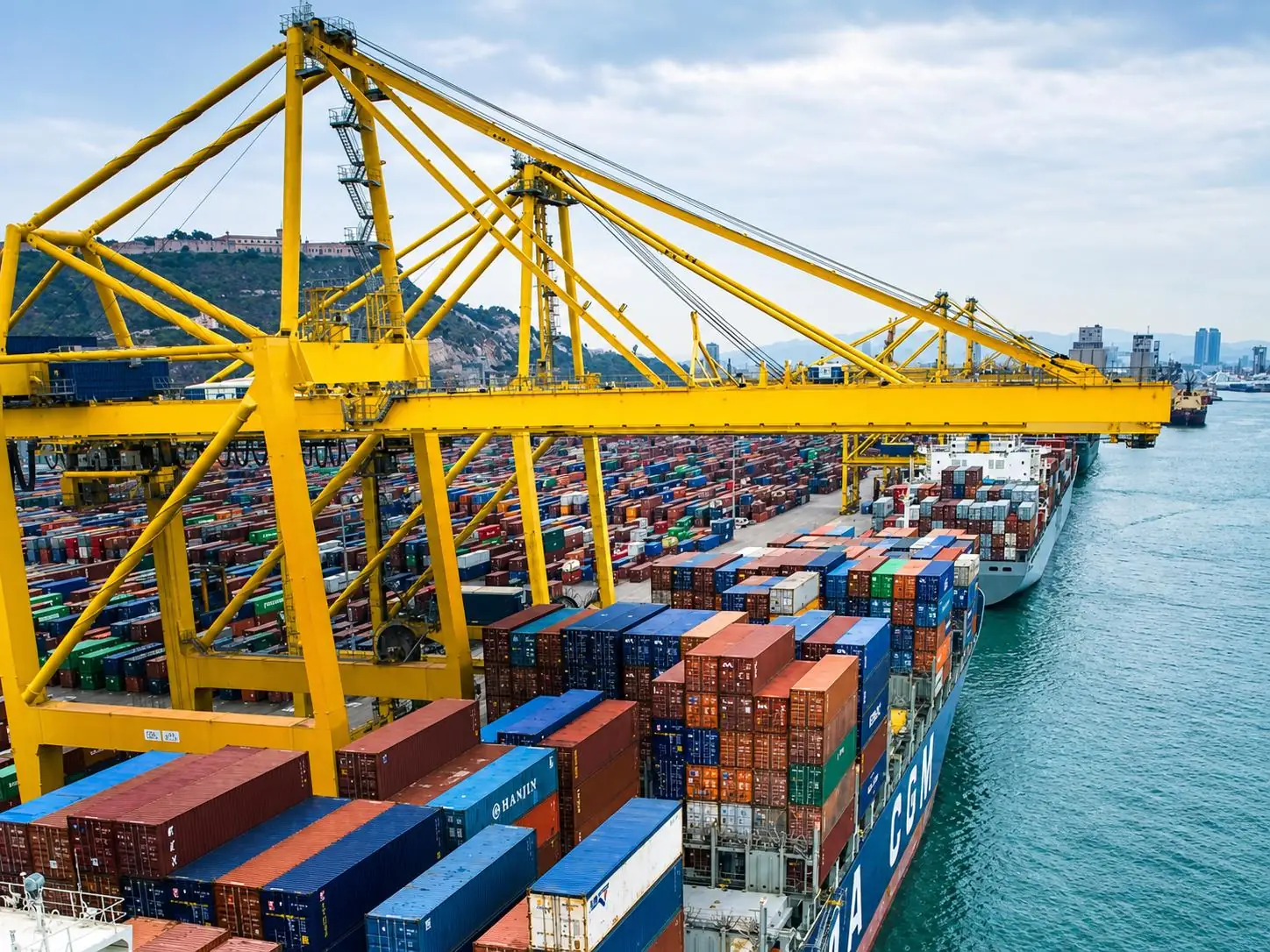
    Henan Mine CraneDiscuss your requirements ↗
  • 50t Automated Steel Coil Cranes: Anti-Collision Radar and Smart Automatic Positioning

    50t Automated Steel Coil Cranes: Anti-Collision Radar and Smart Automatic Positioning

    50t Automated Steel Coil Cranes: Anti-Collision Radar and Smart Automatic Positioning

    In the steel coil storage area and rolling workshop of steel mills, heavy-duty steel coil handling has always been a major difficulty in material logistics.Manual operation of cranes has pain points such as limited field of vision, high risk of collision, and low alignment efficiency.The 50-ton automatic steel coil heavy machine integrates anti-collision radar and intelligent positioning system to realize automatic steel coil stacking and reclaiming operations.The following will analyze its structure, intelligent technology advantages and supplier selection recommendations

    What Is a 50t Automated Steel Coil Crane?

    The 50-ton automatic steel coil lifting machine is a heavy-duty bridge crane designed for modern steel production and processing scenarios. It can safely and accurately complete large-scale steel coil handling operations with very little manual intervention.

    The equipment integrates high-strength mechanical structure, PLC control system, multi-type sensors, positioning devices, and anti-collision technology. It can carry up to 50 tons of steel coils and realize steel coil transportation, storage and stacking, production line alignment and other operations.

    This kind of crane is widely used in steel mills, steel coil warehouses, rolling production lines, and slitting workshops. It mainly handles large-scale master coils of automotive steel, galvanized steel, stainless steel, etc.The 50-ton lifting capacity takes into account the needs of heavy-duty operations and the flexibility of on-site operation. It is a very mainstream choice in the intelligent transformation of steel enterprises.

    Core components

    • Main beam and bridge structure: The high-strength box-shaped double main beam welded structure is adopted, with strong bending and torsional resistance, and can be adapted to the span of the plant above 15 to 35 meters.The whole machine has good rigidity, small deformation in the operation of carts and trolleys, and high stability. After flaw detection and anti-corrosion treatment, it is suitable for high-frequency automated operations in steel mills A6-A8.
    • Large tonnage lifting mechanism: equipped with wire rope hoist mechanism, equipped with frequency conversion drive, support stepless speed regulation or two-speed lifting.Precise alignment at low speed, high speed to improve the transfer efficiency, small start-stop impact, with brake protection, smooth completion of the steel coil lifting, reduce the steel coil swing and bump.
    • Special spreader for steel coil
    1. C-shaped hook: suitable for horizontal inner hole steel coil hoisting, the structure is simple and durable, the hook body penetrates into the inner hole of the steel coil to support, easy maintenance, and can be used with automatic positioning to achieve automatic winding.
    2. Electromagnetic spreader: quickly absorb and release ferrous metal steel coils, high operating efficiency; it must be equipped with a backup power supply to maintain suction to prevent the steel coils from falling when power is off, and it can be connected to the system to realize automatic suction and discharge.
    3. Hydraulic steel coil clamp: relying on hydraulic drive to open and close, it can clamp steel coils in a variety of poses, and the structure is compact and suitable for small storage locations; built-in pressure monitoring, easy to connect to the automated PLC system.
    • PLC control system: the control core of the crane machine, collects various sensor signals, and performs logical operations to uniformly control the whole process of walking, lifting, spreader action, anti-collision protection, etc., and supports automatic/manual mode switching.
    • Sensor and positioning device: integrated laser ranging, absolute encoder, RFID, anti-collision radar, visual sensing and other equipment, using a multi-sensor fusion scheme to sense the position, steel coil shape and surrounding obstacles to ensure high-precision positioning in harsh environments.
    • Industrial communication network: wireless or optical fiber industrial communication is used, low latency and anti-interference, through the crane PLC and the factory MES and WMS systems, two-way real-time transmission of task instructions, equipment status and inventory data.
    • Optional configuration: anti-swing control system, weighing module, remote monitoring console, while retaining the local manual operation mode, convenient for emergency use.

    Why 50 tons is the mainstream tonnage choice

    The weight of the master coil of automobile steel, galvanized steel, and stainless steel production lines is generally close to the 50-ton level, and the 50-ton lifting specification can meet the handling needs of such large steel coils.At the same time, the tonnage equipment can also flexibly lift lighter steel coils, and can be used with auxiliary hoists or replaceable spreaders to achieve continuous operation of multi-specification steel coils.

    The 50-ton model finds a balance between structural cost, energy consumption, and operational flexibility. It will neither be unable to meet heavy-duty master coil operations due to insufficient tonnage, nor will it be wasteful due to over-design. It is suitable for most steel mills and steel coil warehouses. Working conditions.

    Why Steel Coil Handling Requires Intelligent Automation

    Among the large steel enterprises pursuing the transformation of smart factories, the traditional manual and semi-manual crane operation modes are prominent, and intelligent automation has become the inevitable direction for the upgrading of steel coil logistics.

    Security risks

    The operator’s field of vision is limited, making it difficult to fully observe the status of steel coils, peripheral equipment and on-site personnel.Steel coils are prone to swing during the start and stop of carts and trolleys, and there is a risk of colliding with other cranes, storage shelves, and production equipment, or squeezing on-site personnel.

    Once the hoisting operation is improper, accidents such as steel coil falling and steel coil edge bumping damage will occur, especially in the dusty and high temperature environment of steel mills, which further amplifies the operating risks.

    Low efficiency of traditional operations

    Manual alignment takes a long time, the accuracy of the operation is highly dependent on the driver’s experience level, the operation effect of different operators varies greatly, and the stability of the production process is poor.Under long-term shift work, operator fatigue will further reduce operating efficiency, and it is difficult to continuously and stably guarantee production capacity.

    The automation value of smart steel mills

    The automated crane can independently complete the loading and unloading of steel coils and the precise management of warehouse locations, seamlessly connect the manufacturing execution system MES and the warehouse management system WMS, and support uninterrupted operations 24 hours a day.The system can automatically plan the walking path, coordinate multiple cranes to work together, and turn the steel coil warehouse area into an intelligent logistics center with low manual intervention.

    Anti-Collision Radar Technology for Automated Steel Coil Cranes

    In the scenario of multi-crane shared operation span and high-speed automated operation, the anti-collision system is the core configuration to ensure the safe operation of the equipment.

    Working principle of anti-collision radar

    Industrial-grade radar sensors (common in the 24GHz frequency band) continuously scan the surrounding environment, measure the distance of obstacles in real time and identify the target object. The collected data is directly transmitted to the crane PLC control system, and the system responds instantly based on the distance signal.Radar is a non-contact detection, with a long detection distance and can adapt to the harsh working conditions of steel mills.

    Core security features

    • Anti-collision between cranes: radar dynamically monitors the operating spacing of multiple cranes across the same span in real time, and is equipped with electrical interlocking protection logic. Once the spacing is lower than the safe value, it will automatically intervene to effectively avoid multi-vehicle collisions. Accidents.
    • Limit protection at the end of the track: Set up protective monitoring at both ends of the track of the crane cart to prevent the crane from exceeding the operating boundary of the track and eliminate the risk of collision with the track.
    • Automatic deceleration when approaching obstacles: When the radar detects obstacles such as shelves and equipment in front of it, the control system automatically reduces the operating speed of the crane and reserves a safe braking distance.
    • Emergency shutdown is triggered when the safety threshold is exceeded: When the distance of the equipment from the obstacle reaches the danger threshold, the system immediately issues an emergency stop command to quickly brake the crane to avoid collision accidents.
    • Division of operating areas, restrict cranes from entering hazardous areas and issue early warnings: pre-delineate no-go areas and safe operating areas, trigger sound and light warnings before the cranes enter restricted areas, and restrict equipment from entering hazardous areas at the same time.

    Comparative advantages of anti-collision scheme

    The traditional limit switch only provides protection at a fixed point, and cannot be continuously monitored throughout the process, and the detection range is limited.The impact and vibration caused by high-frequency reciprocating operations in steel mills can easily cause switch wear and stagnation, reduce reliability, and there is a risk of safety protection failure.

    The radar anti-collision system supports continuous dynamic monitoring and is a non-contact detection. It is more stable in the dust and vibration environment of steel mills and does not require frequent calibration.It can be connected to the PLC through relays and Modbus buses, and the integration difficulty is low.

    Smart Automatic Positioning System: Achieving Millimeter-Level Handling Accuracy

    If you want to safely stack steel coils, accurately feed the rolling production line, and at the same time increase the storage density of the warehouse, high-precision positioning technology is essential.

    Positioning technology

    Mainstream technologies include laser positioning and ranging, shaft-end absolute encoder, RFID location tag, indoor GNSS positioning scheme, and multi-sensor fusion technology; some equipment is equipped with lidar and visual recognition to complete the steel coil shape recognition.The positioning accuracy of carts and trolleys can reach ±10mm, and the accuracy of the lifting direction is also excellent, and the positioning ability of the millimeter level can be achieved in some working conditions.

    Automatic walking and lifting control

    The equipment relies on frequency conversion drive + closed-loop feedback to achieve precise horizontal movement of carts and trolleys, and the trolleys automatically travel to the top of the target warehouse; the lifting and descending actions are precise and controllable.The system is equipped with soft start, soft stop algorithms and anti-swing procedures to suppress the swing of the steel coil to the maximum extent possible, while ensuring the operating speed, to avoid the steel coil collision damage.

    Intelligent warehouse management

    The crane relies on various sensors and the WMS warehouse management system to identify the location of steel coils, collect and synchronize inventory data in real time, and automatically plan the optimal winding and unwinding operation path.The system can dynamically allocate free storage locations, greatly shortening the time-consuming retrieval of steel coils, and effectively improving the space utilization rate of the warehouse area.

    PLC Control System: The Brain Behind Automated Coil Crane Operation

    The programmable logic controller coordinates all the automated actions of the crane and is the core of the entire intelligent lifting system.

    1. Intelligent control architecture based on PLC: various sensors collect position, load, operating speed, obstacles and other status data in real time, PLC centrally processes positioning signals and safety interlock signals, outputs commands to control frequency converters, drives motors and braking mechanisms.The anti-swing algorithm, path planning, and safety interlock logic are all run in the PLC, and the supporting man-machine interface (HMI) is used for operation and maintenance personnel to check the status.
    2. Docking with the factory automation system: PLC can interface with the MES manufacturing execution system to receive production work orders, connect to the WMS warehouse management system to obtain warehouse location information, and synchronize with the production scheduling system.Realize task issuance and status return, and open up the material flow process of the whole factory.
    3. Remote monitoring and data analysis: The system supports real-time monitoring of equipment operating status, fault alarm diagnosis, predictive maintenance based on operating data, and complete recording of each job data to facilitate traceability and continuous optimization.With SCADA or cloud platform, you can also build a digital twin to achieve remote visual management.

    Key Design Considerations for 50t Automated Steel Coil Cranes

    Equipment design must give priority to ensuring long-term stable and reliable operation under harsh working conditions.

    Load operation reliability

    In the calculation stage of structural strength, the concentrated load and partial load hoisting conditions are fully considered. The whole machine adopts an anti-fatigue design, which can adapt to long-term and high-frequency cyclic hoisting operations.The steel coil spreader has a sturdy structure, equipped with steel coil edge protection and reliable locking mechanism; the electromagnetic crane is equipped with a backup battery, and the clamp is equipped with a mechanical lock to ensure the safety of the spreader.

    Environmental adaptability design

    The working conditions of steel mills are complex, and the equipment is specially designed for harsh environments: high temperature resistant structure (heat insulation protective cover if necessary), dust and metal debris protection, electrical components protection level up to IP55~IP67, strong vibration resistance, support long-term continuous operation.Special coating and sealed electrical structure enhance the durability of the whole machine.

    Security system configuration

    The whole machine is equipped with overload limiter, anti-swing control system, emergency braking device, lifting and operating limit protection, and radar anti-collision system.The core safety components adopt a redundant architecture, and safety-certified components are selected to build a multi-layer protection system, which significantly reduces the operational risks in the steel coil hoisting process.Pretend to be a job risk.

    Benefits of Using Automated Steel Coil Cranes in Steel Plants

    The landing of automated steel rolling heavy machinery can bring significant improvements in safety, production capacity, cost, and warehouse management.

    Improve job safety

    Automated operations can minimize the entry of personnel into the hoisting high-risk operation area, reduce the probability of direct contact between personnel and heavy-duty steel coils from the source, and significantly avoid the risk of major safety accidents such as steel coils falling and equipment colliding and injuring people.

    The operation actions of the complete set of lifting equipment are all standardized, and the movement process is highly controllable. With the built-in anti-swing algorithm, the swing amplitude of the steel coil during the lifting process can be greatly reduced, the possibility of alignment operation errors can be reduced, and a more reliable safety guarantee can be built for the handling of steel coils in the warehouse area.

    Improve production efficiency

    The rhythm of the automated handling cycle is faster, the waiting time for the job is significantly shortened, and the equipment can achieve stable and uninterrupted 24-hour unattended operation with no one or few people on duty, continuously improving the overall material throughput of the warehouse area.

    The system supports the collaborative scheduling of multiple cranes, combined with intelligent path planning algorithms, to automatically avoid obstacles and equipment conflicts, further accelerate the efficiency of steel coil logistics in the factory, and ensure the continuous supply of materials in the production line.

    Reduce operating costs

    The automation system can reduce the dependence on senior crane operators, reduce labor costs, and at the same time reduce equipment bumps and steel coil damage caused by human misoperation, reduce the cost of subsequent maintenance and replacement, and effectively improve the comprehensive utilization rate of cranes.

    The supporting predictive maintenance function can collect equipment operation data in real time, identify aging and potential failures of components in advance, extend the service cycle of components, and reduce production losses caused by sudden downtime.

    Optimize warehouse management

    The system can accurately track the whole process of steel coil information, which can improve the density of warehousing and stacking, optimize the utilization rate of warehouse space, and effectively speed up the delivery speed of orders out of the warehouse.

    Relying on real-time inventory data collected to support production scheduling and planning, it avoids problems such as manual search for steel coils and misplaced warehouse locations, reduces the resulting time loss, and makes warehouse management in the warehouse area more orderly and efficient.

    Conclusion

    The 50-ton automatic steel rolling machine is the core equipment of intelligent material handling in steel enterprises.Relying on heavy-duty structure, radar anti-collision, high-precision positioning, PLC control and system integration, it meets the safe and efficient operation needs of steel coil storage, rolling and deep processing.

    When selecting a company, it is necessary to comprehensively consider the steel coil parameters, site layout, automation requirements and system compatibility, and investigate the supplier’s manufacturing, electronic control development and project landing capabilities.Henan Mine Crane can customize a 50-ton fully automatic steel lifting machine with automatic positioning and anti-collision system to help enterprises build a safe, efficient and scalable intelligent lifting system.

    Henan Mine CraneDiscuss your requirements ↗
  • 50 Ton vs 100 Ton Gantry Crane for Industrial Applications

    50 Ton vs 100 Ton Gantry Crane for Industrial Applications

    50 Ton vs 100 Ton Gantry Crane for Industrial Applications

    In heavy industry manufacturing, steel structure processing, infrastructure and heavy equipment loading and unloading scenarios, gantry cranes undertake the key tasks of material transfer, equipment installation and component hoisting.50-ton and 100-ton gantry cranes are mainstream medium and large-scale lifting equipment, and they are often purchased and selected by the person in charge of the project.Many projects are prone to misjudgment during the equipment procurement phase, and blindly choose large-tonnage models to increase the overall investment, or insufficient tonnage is difficult to cope with heavy-duty working conditions, thereby reducing operating efficiency, bringing safety risks, and slowing down the progress of the project.Combining the carrying capacity, structural configuration, applicable industry, operating performance and project cost, the differences between the two gantry cranes can be sorted out, and the suitable tonnage can be selected based on the lifting load, site conditions and production capacity planning.

    What Is the Difference Between 50-Ton and 100-Ton Gantry Cranes?

    The core differences between 50-ton and 100-ton gantry cranes are concentrated in the three dimensions of carrying capacity, structural design, and configuration of core accessories. The two are not a simple doubling of tonnage, but a comprehensive upgrade of overall equipment specifications, load-bearing standards, and operating configurations to adapt to completely different industrial operation intensities and working conditions. Requirements.The following is a detailed breakdown of the differences from the four core dimensions.

    Lifting capacity

    The rated lifting weight is the most important difference between the two gantry cranes, and it is also the basic basis for selection.Henan Mine Crane Factory supply 50-ton gantry crane has a rated maximum lifting load of 50 tons. It is suitable for the lifting and transportation of medium-weight workpieces, equipment, and components. It allows short-term and small overload operations and meets the operating standards of medium-sized lifting equipment. It mainly serves conventional heavy industry production lines.The rated lifting weight of a 100-ton gantry crane reaches 100 tons. It is a heavy-duty industrial lifting equipment. The carrying limit is directly doubled. It can not only easily lift heavy-duty components of the 100-ton class, but also adapt to the overall lifting of large-size and large-weight integrated equipment without splitting components. Operation.At the same time, the 100-ton gantry crane has greater safety load redundancy, stronger impact resistance and overload resistance, can cope with heavy-duty and irregular heavy-duty material hoisting conditions, and completely avoid the safety risks caused by overload operations.

    Crane structure and dimensions

    The difference in tonnage directly determines the overall structural specifications, material standards and dimensions of the gantry crane, and the structural design of the two equipment is fundamentally different.The 50-ton gantry crane adopts the standard double-beam gantry structure, and the truss structure can be selected for some lightweight working conditions. The overall weight is light, the footprint is small, and the column spacing is flexible.The overall steel thickness of the equipment and the cross-section size of the main beam are moderate, and the height and width of the whole machine are suitable for conventional factories and open-air work sites, and the basic carrying requirements are low.

    In order to meet the heavy-duty load-bearing needs of the 100-ton gantry crane, all heavy-duty thickened double-beam solid structures are used, and the lightweight truss design is eliminated. The steel thickness and cross-sectional area of the main beam, end beam, and column have been greatly increased. The weight of the whole machine is 1.8-2.2 times that of the 50-ton gantry crane.At the same time, the overall dimensions of the equipment are larger, the height of the column, the width of the fuselage, and the specifications of the walking mechanism are fully upgraded, and the structural rigidity, stability, and wind and seismic resistance are stronger. It can adapt to open-air high winds and high-frequency heavy-duty operating environments, but it covers a larger area and requires extremely high operating site space and ground foundation carrying capacity, which requires special infrastructure construction.

    Hoist and trolley configuration

    The lifting hoist and trolley walking system are the core operating components of the gantry crane, and the configuration level of the 50-ton and 100-ton models is significantly different.The 50-ton gantry crane is equipped with a medium-sized industrial electric hoist or a standard lifting trolley. The lifting motor power and walking motor parameters are moderate. It adopts a conventional deceleration and braking system, which starts and stops smoothly, and meets the needs of medium-frequency and medium-load operations. The accessories are versatile and easy to replace.

    Henan Mine Crane Factory supply 100-ton gantry crane is equipped with a heavy-duty special lifting mechanism and an enhanced walking trolley, equipped with a high-power frequency conversion motor, a heavy-duty reducer, a dual-brake protection system, and an overload limit protection device. Some high-end models are equipped with a synchronous lifting control system.Its trolley wheel track, wheel pressure, and walking track specifications are fully upgraded, which can withstand the huge impact force during heavy-duty movement, and eliminate the problem of slippage, offset, and caton of the trolley.At the same time, the lifting speed and walking speed control accuracy of the 100-ton model are higher, and the heavy-duty alignment accuracy far exceeds that of the 50-ton model, which is suitable for high-precision heavy-duty hoisting operations.

    Where Are 50-Ton and 100-Ton Gantry Cranes Used?

    Based on the differences in carrying capacity, structural performance, and operating accuracy, the industrial application scenarios of 50-ton and 100-ton gantry cranes have clear subdivision boundaries, accurately matching the operating loads and production needs of different industries. The following are the core application areas of the two models.

    Steel and metal processing

    In the steel and metal processing industry, the 50-ton gantry crane is the main equipment of small and medium-sized steel processing plants and profile processing workshops. It is mainly used for the handling, stacking, and hoisting of steel plates, sections, steel pipes, and medium-sized steel components. It is suitable for batch conventional profile processing, semi-finished product transportation, and finished product loading operations. The operation frequency is high, the load is stable, and the cost-effective advantage is outstanding.The 100-ton gantry crane focuses on large-scale steel mills and heavy-duty steel structure processing plants, and is specially used for the hoisting and assembly of heavy-duty steel box girders, large-scale steel structure trusses, thick steel plates, and complete sets of metal heavy-duty components.For the processing and transportation of 100-ton heavy-duty products such as steel structures for large-scale factories, steel components for bridges, and metal parts for wind power, the 100-ton gantry crane can be hoisted as a whole without splitting the components, greatly improving the machining accuracy and production efficiency of large-scale steel structures. It is the core equipment for deep processing of heavy metals.

    Machinery manufacturing

    In the machinery manufacturing industry, 50-ton gantry cranes are widely used in general machinery, small and medium-sized construction machinery, agricultural machinery and equipment, and mold manufacturing workshops. They are mainly responsible for the hoisting, assembly, and transportation of medium-sized machine tool bodies, complete sets of molds, small and medium-sized equipment assemblies, and component assemblies. They are adapted to the assembly conditions of conventional machinery manufacturing, taking into account efficiency and economy.The 100-ton gantry crane mainly serves heavy machinery, construction machinery, mining machinery, and large generator set manufacturing enterprises.The core products of such enterprises, such as large excavator fuselage, crusher equipment, generator set assembly, and large machine tool equipment, all weigh more than 50 tons, and must rely on a 100-ton gantry crane to complete the overall assembly, flip, shift, and factory loading operations. It is a just-needed equipment for heavy machinery manufacturing.

    Construction and heavy equipment handling

    In the field of infrastructure engineering, 50-ton gantry cranes are mostly used for small and medium-sized infrastructure projects, municipal projects, and prefabricated component factories. They mainly lift medium-weight materials such as concrete prefabricated panels, small bridge components, construction auxiliary equipment, template brackets, etc., which are suitable for normal hoisting operations on small and medium-sized construction sites. The equipment is flexible in movement and easy to deploy.The 100-ton gantry crane is the core equipment for hoisting large-scale infrastructure, road and bridge projects, and large-scale equipment. It is widely used in large-scale bridge construction sites, high-speed rail station infrastructure, port depots, and large-scale equipment disassembly and assembly projects.Mainly responsible for the hoisting and shifting of large-scale bridge box girders, heavy-duty infrastructure modules, large-scale construction machinery, and port heavy equipment, which can meet the needs of heavy-duty construction with large loads, large spans, and high precision, and adapt to the high-intensity operating conditions of large-scale key projects.

    How Do 50-Ton and 100-Ton Gantry Cranes Compare?

    In addition to the differences in structure, configuration, and application scenarios, the two gantry cranes have obvious differences in core operating parameters such as operating span, lifting height, working level, and operating performance, which directly determine the operating efficiency, service life, and adaptability of the equipment. The comprehensive performance of the two models can be clearly distinguished by all-round comparison.

    Span and lifting height

    The conventional operating span of the 50-ton gantry crane is 18-40 meters, the maximum customized span does not exceed 45 meters, and the standard lifting height is 6-12 meters, which can be slightly customized according to the needs of the plant and site.The parameter design is adapted to the space size of conventional industrial plants and small and medium-sized open-air depots, which can meet the span and lifting needs of most medium-sized industrial scenes, and the space adaptability is flexible.

    The standard span of a 100-ton gantry crane can reach 20-50 meters, and the large-span customized models can be adapted to operating scenarios above 55 meters. The lifting height is generally 10-18 meters, and the ultra-high customized models can meet the lifting operations above 20 meters.The larger span and lifting height can cover the large-space operation requirements of large factories, large depots, bridge projects, and port sites, and can complete the hoisting of heavy-duty components with high positions and large spacing, and the operation coverage far exceeds the 50-ton model.

    Working class and operating frequency

    The work level is the core indicator to measure the durability and work intensity of gantry cranes.The conventional working level of the 50-ton gantry crane is A5-A6, which is a medium-sized work system, suitable for medium-frequency and intermittent operation scenarios, and the effective daily operation time is 8-10 hours. It is suitable for factory normalized production and intermittent hoisting operations, and can be stably adapted to the supporting production conditions of the assembly line.The standard working level of the 100-ton gantry crane is A7-A8, which belongs to the heavy-duty working system and is a special level for industrial heavy-duty. It supports high-frequency, all-weather and continuous operation, and can achieve 24-hour uninterrupted rotation operation. It has strong anti-fatigue and anti-loss capabilities.In view of the high-intensity operation needs of large factories, key projects, and port depots, the 100-ton gantry crane can maintain stable operation for a long time, with low equipment failure rate and longer service life, and is fully adapted to heavy-duty continuous operation conditions.

    heavy-duty gantry crane installation

    Operating performance

    In terms of operating performance, the 50-ton gantry crane has a moderate start-stop speed, stable operation and low difficulty in operation. Ordinary licensed operators can skillfully control it, low energy consumption, low noise in daily operations, and lightweight structure. The equipment is more flexible in walking and steering, and it is suitable for refined and normalized medium-sized hoisting operations.However, in heavy-duty, long-span, and windy environments, the stability of the equipment will decrease, and it cannot be adapted to the needs of super-heavy and high-precision hoisting.

    The 100-ton gantry crane is equipped with frequency conversion speed regulation, intelligent limit, cushioning and shock absorption, and dual brake protection system. It has no shaking during heavy-duty operation and extremely high alignment accuracy. It can achieve precise alignment at the millimeter level to meet the needs of precision assembly of heavy equipment.At the same time, the equipment has excellent wind resistance, seismic resistance and overload resistance, stronger adaptability to harsh environments, and overall operating stability, safety and reliability are better than the 50-ton model.The only shortcoming is that the equipment is large, the steering flexibility is slightly weak, and the energy consumption is relatively higher. It is suitable for heavy-duty operations on fixed sites, and it is not suitable for lightweight working conditions with frequent shifts.

    How Does Crane Capacity Affect Project Cost?

    The tonnage of Henan Mine Crane Factory supply gantry crane directly determines the overall input cost of the project, covering the three core sectors of equipment procurement, infrastructure installation, and operation and maintenance.The cost gap between 50-ton and 100-ton models is not simply doubled, but a structural and long-term cost difference. When selecting models, companies need to consider the project budget and long-term benefits comprehensively.

    Equipment purchase cost

    The bare metal purchase price of equipment is the most intuitive cost difference.According to the market quotation of industrial lifting equipment in 2026, the bare metal price range of the standard double-beam 50-ton gantry crane is 65,000-120,000 US dollars, and the conventional configuration is extremely cost-effective, which is suitable for small and medium-sized enterprises to purchase in bulk.Due to the large amount of materials used, the high grade of core accessories, and the complex technology of the 100-ton heavy-duty gantry crane, the price range of bare metal is 85,000-205,000 US dollars, and the price of customized long-span, high-lift, and intelligent models will rise further.Compared with the 50-ton model, the procurement cost of 100-ton equipment is 30%-70% higher, and the difference between intelligent and high-configuration models can be more than doubled, and the threshold for equipment investment in the early stage is higher.

    Installation and infrastructure

    Infrastructure and installation costs are core expenditures that are easily overlooked.The 50-ton gantry crane has light weight and low wheel pressure, and has low requirements for the bearing capacity of the ground foundation. The installation needs can be met by simple reinforcement of conventional cement floors. The amount of track laying and foundation construction projects is small, the installation cycle is short, and the overall infrastructure installation cost is low. Small and medium-sized sites can be quickly deployed on the ground.The 100-ton gantry crane has a huge weight and high wheel pressure. Special heavy-duty infrastructure construction must be carried out. It is necessary to thicken the concrete foundation, lay heavy-duty special tracks, and strengthen the foundation carrying structure. Windproof anchoring devices and lightning protection systems need to be installed in some open-air scenes.The amount of infrastructure projects, construction cycle, and material costs have increased significantly, and the overall installation infrastructure cost is more than 50% higher than that of the 50-ton model. There are strict requirements for site infrastructure conditions, and the initial construction investment is higher.

    Maintenance and operating costs

    There is a significant gap in long-term operation and maintenance costs.The 50-ton gantry crane accessories have strong versatility, simple structure, and slow wear rate. Daily maintenance only requires conventional lubrication, fastening, and testing. The annual maintenance cost is about 4,500-6,000 US dollars. The energy consumption of the equipment is low, the daily operating expenses are small, and the late operation and maintenance pressure is minimal.The core accessories of the 100-ton gantry crane have large specifications, high precision and complex structure. The wear and loss of components under heavy-duty operations are relatively higher, and regular professional testing, precision calibration, and maintenance of accessories are required.Its annual maintenance cost is about 7,000-9,000 US dollars. At the same time, the motor power of the equipment is large and the whole machine consumes more energy. The electricity bill, operation and maintenance labor cost, and parts replacement cost of long-term continuous operation are much higher than that of the 50-ton model, and the total cost of long-term operation is higher.

    How to Choose the Right Gantry Crane Capacity?

    The core principles of gantry crane selection are not over-matched, not under-matched, adapted to working conditions, and taking into account future expansion.Combining the performance, scenario, and cost differences of 50-ton and 100-ton models, from the three dimensions of load requirements, operating environment, and long-term planning, the adapted tonnage can be accurately locked to maximize cost performance.

    Maximum load and lifting frequency

    First, clarify the maximum lifting load of the project and the frequency of daily operations.If the weight of the daily hoisting workpieces is concentrated at 20-50 tons, mainly intermittent and normalized operations, and the daily operation time is less than 8 hours, Henan Mine Crane Factory supply 50-ton gantry crane is preferred to fully meet the operation needs, which can significantly reduce equipment procurement and operation and maintenance costs, and the best price/performance ratio.If the maximum weight of the workpiece exceeds 50 tons, or the daily frequent hoisting of 40-50 tons of heavy loads requires 24 hours of continuous operation, and there is a need for the overall hoisting of heavy components, a 100-ton gantry crane must be selected.Avoid the premature aging of equipment, safety hazards and low efficiency caused by overloading of small-tonnage equipment and frequent full-load operation, and ensure the stable development of high-intensity heavy-duty operations.

    Working environment and available space

    The space and environment of the work site are the key constraints for selection.If the space of the factory area and yard is limited, the span and height of the plant are small, the bearing capacity of the ground foundation is general, and the wind speed for open-air operations is small, 50-ton gantry cranes are preferred. The equipment occupies a small area, is flexible in deployment, and is adapted to conventional site conditions. There is no need for large-scale infrastructure transformation.If the work site is open and there is sufficient space, the site can carry heavy infrastructure loads, and there are complex working conditions such as high winds, rain and snow in the open air, which require large-span and high-lifting operations, it is recommended to choose a 100-ton gantry crane.Its stronger structural stability, environmental adaptability and large operating coverage can be perfectly adapted to the heavy-duty operation needs of large-scale sites and complex operating conditions.

    Future production requirements

    The selection of models needs to take into account the long-term production planning of the enterprise to avoid the waste of short-term equipment iteration.If the enterprise focuses on the processing of medium-sized workpieces at this stage, there will be no heavy-duty production capacity upgrade, no large-scale component production, and no heavy-duty equipment hoisting requirements in the next 3-5 years. The 50-ton gantry crane is fully adapted to long-term production, and the input cost can be controlled.If an enterprise has plans to expand production capacity, upgrade products, and undertake large-scale engineering orders, it will add 100-ton component production, heavy equipment assembly, and large-scale infrastructure hoisting services in the future. It is recommended to directly select a 100-ton gantry crane.One-time investment can avoid the high costs of late equipment replacement, secondary infrastructure, and equipment disassembly and assembly, adapt to the long-term development needs of enterprises, and have a higher equipment service life and value utilization rate.

    Henan Mine Crane Factory Custom

    The 50-ton gantry crane mainly focuses on medium-sized loads, conventional working conditions, high cost performance, and low operation and maintenance costs. It is suitable for small and medium-sized steel structure processing, general machinery manufacturing, and small and medium-sized infrastructure projects.The 100-ton gantry crane mainly focuses on heavy-duty, high-frequency, high-precision, high-stability, and complex working conditions, and serves the fields of heavy-duty manufacturing, large-scale infrastructure, and deep processing of large-scale steel structures.

    Industrial enterprises do not need to blindly pursue large tonnage in the selection of models. They combine their own maximum hoisting load, operating frequency, site conditions and future production capacity planning to accurately match tonnage equipment, which can not only ensure operation safety and efficiency, but also maximize project cost control, and achieve the optimal balance between equipment value and input cost.If you need customized solutions for gantry cranes with personalized span, lifting height, and intelligent configuration, you can consult Henan Mine Crane Factory at any time for professional one-to-one selection services.

    Henan Mine CraneDiscuss your requirements ↗
  • 50 Ton Double Girder Overhead Crane: Full Specification Sheet & Key Parameters

    50 Ton Double Girder Overhead Crane: Full Specification Sheet & Key Parameters

    50 Ton Double Girder Overhead Crane: Full Specification Sheet & Key Parameters

    A 50 ton double girder overhead crane sits at the boundary between medium-duty material handling and true heavy-industrial lifting. Get the specification wrong undersized span, the wrong duty class, an underrated runway and you’re looking at premature wear, structural risk, or a crane that simply can’t do the job it was bought for. This guide breaks down every parameter that belongs on a real 50 ton double girder overhead crane spec sheet, explains what each number actually means for your operation, and gives you a practical framework for choosing the right configuration.

    Whether you’re specifying a new crane for a steel mill, fabrication shop, or warehouse, the goal here is the same: understand the spec sheet well enough to ask your supplier the right questions before you sign a purchase order.

    What Is a 50 Ton Double Girder Overhead Crane?

    A double girder overhead crane uses two parallel bridge girders, with the trolley and hoist running on top of (or between) them, rather than the single beam used in lighter-duty cranes. At 50 tons, this two-girder design is essentially mandatory a single girder can’t carry that load over an industrial span without excessive deflection.

    The “overhead” part means the crane bridge travels on elevated runway rails mounted to the building’s columns or an independent steel structure, moving the full length of the workshop while the trolley moves crosswise along the bridge. This combination gives the crane access to virtually the entire floor area beneath it.

    Double girder cranes at 50 tons are almost always top-running, meaning the crane wheels sit on top of the runway rail. Underhung designs, where the crane hangs from rails fixed to the underside of the roof structure, are reserved for much lighter capacities because the supporting structure can’t economically handle 50 tons of suspended load.

    Span and Lifting Height

    Span isn’t a number you pick freely it’s dictated by your building’s column spacing or the runway structure’s design width, measured between the centerlines of the rail at each end of the bridge. Most 50 ton double girder cranes fall between 10.5m and 31.5m, but the wider the span, the more the girder has to resist deflection under load, which means heavier steel sections and, often, a camber built into the girder to offset sag at full load.

    Lifting height is the vertical travel of the hook from its lowest working position to its highest. For a 50 ton crane, this typically runs 6m to 30m, constrained by:

    • Building clearance height below the runway beam: the vertical clearance between the bottom of the crane runway beam and the ground, equipment and other obstacles, which is the core parameter of equipment selection, installation and operation, and can effectively avoid the problem of workspace interference.
    • Height of hook assembly under rated load: the overall vertical height of the hook assembly under the rated load condition of the crane. The larger the tonnage of the equipment, the larger the size of the hook and pulley assembly, the higher the height of the hook assembly, which will take up the effective lifting space and is an important basis for lifting height calculation.
    • Low headroom plant hook across the main beam adaptation requirements: for plant floor height, the top of the headroom is limited scenarios, can be used to hook across the main beam through the structure. Utilizing the gap between the main beams to complete the hook lifting and lowering can reduce the occupation of the upper space and greatly increase the effective lifting height, which is suitable for the operation conditions in the restricted space.

    If your building has limited headroom, ask your supplier specifically about reduced-headroom trolley designs this is a configuration choice, not a fixed limitation of double girder cranes.

    Working Duty Classification Explained

    The working duty class (also called duty cycle or service class) is one of the most misunderstood fields on a crane spec sheet, yet it has a direct impact on component sizing, motor selection, and bearing life.

    Two systems are commonly referenced:

    • European FEM Classification Standard:According to the spectrum of load conditions and cumulative working hours of the equipment, it is divided into 1Bm ~ 5m working levels, which is suitable for different frequency and load lifting scenarios.
    • Chinese national standard A classification standard: follow the domestic lifting equipment standards, the equipment is divided into A1 ~ A8 eight working levels, complete coverage from light duty light work to heavy duty heavy duty work of the full range of working conditions to meet the needs of use.

    For a 50 ton double girder crane in genuine industrial use, the relevant range is A5 to A7 (roughly FEM 3m–5m):

    • A5 (medium-heavy level): medium frequency of operation, daily lifting load mixed light and heavy, moderate fluctuations in working conditions, applicable to general mechanical processing, general assembly workshop and other conventional production occasions.
    • A6 (heavy grade): high frequency operation, frequent full-load lifting under normal conditions, stable and high working load, mostly used in steel processing, foundry and other high-intensity work conditions.
    • A7 (extra heavy grade): close to uninterrupted full-load cyclic operation, the equipment continues to run at high loads, harsh working conditions, mainly used in iron and steel mills, bulk metal raw materials transfer and other heavy-duty continuous operation scenarios.

    Choosing too light a duty class for your actual usage shortens component life dramatically; choosing too heavy adds unnecessary cost. This is a parameter worth discussing honestly with your supplier based on actual cycles-per-shift, not aspirational future use.

    Speed Parameters: Lifting, Crane Travel, and Trolley Travel

    Three independent motion speeds define how a double girder crane performs:

    1. Lifting speed: the vertical speed of the hook at rated motor speed. For a 50 ton main hook, expect roughly 3–8 m/min; auxiliary hooks move faster since they carry lighter loads.
    2. Crane travel speed:how fast the entire bridge moves along the runway, typically 50–90 m/min for this capacity class.
    3. Trolley travel speed:how fast the trolley moves across the bridge, generally 20–45 m/min.

    Higher speeds increase throughput but also increase dynamic loading on the structure and braking demands another reason speed specifications and structural design need to be reviewed together, not picked independently.

    Wheel Pressure and Structural Loading

    Wheel pressure is the maximum vertical force a single crane wheel transmits to the runway rail. It’s calculated from the combined dead weight of the bridge and trolley plus the rated lifting load, taken at the trolley’s most unfavorable position generally at the end of its travel, closest to one rail.

    This number matters because it’s the figure your structural engineer uses to size:

    • Runway beams
    • Supporting columns
    • Rail sections and rail clips
    • Foundation loading, in some installations

    A 50 ton crane’s wheel pressure is not simply “50 tons divided by the number of wheels” the crane’s own dead weight, the trolley’s position, and dynamic factors during acceleration and braking all factor in. Always request the calculated wheel pressure figure from your supplier rather than estimating it yourself; getting this wrong is one of the more common causes of premature runway beam failure.

    Main Components and Mechanisms

    A 50 ton double girder overhead crane is built from five core systems:

    • Bridge (double girder):The two parallel main girders, end-connected to the end carriages, forming the structure the trolley travels on.
    • Trolley and hoist:Carries the lifting mechanism either a wire rope hoist or an open winch/drum system at this capacity and travels along the top of the girders.
    • End carriages:Connect the bridge girders to the wheel assemblies that ride on the runway rails.
    • Crane travel mechanism:Motors, gearboxes, and wheels that move the entire bridge along the runway.
    • Electrical control system:Power supply, control panel, and either cab, pendant, or radio remote control for the operator.

    At 50 tons, the hoist mechanism is typically a wire-rope-and-drum system rather than a chain hoist, given the load involved, and many configurations use an open winch trolley for the heaviest-duty applications.

    Main Hook vs. Auxiliary Hook Configurations

    Many 50 ton double girder cranes are specified with a dual-hook arrangement commonly written as “50/10” or “50/15” ton where:

    • The main hook is rated for the full 50 tons and handles primary heavy lifts.
    • Theauxiliary hook is rated lower (often 10–15 tons) and is used for lighter loads, faster cycle work, or to assist the main hook in tilting and repositioning large workpieces.

    The critical safety rule here: the two hooks are never used to lift two separate loads simultaneously, and when working together to maneuver one piece, the combined load can never exceed the main hook’s rated capacity. If your application regularly involves turning or rotating heavy molds, coils, or fabrications, a dual-hook setup is worth specifying upfront rather than retrofitting later.

    How to Choose the Right Spec for Your Application

    Before requesting quotes, work through this checklist:

    • Accurate measurement of the actual span requirements: based on the centerline of the existing columns in the plant or the planned runway structure measured values, strictly prohibited by experience prediction, estimation of dimensions, to ensure that the span of the equipment to adapt to the site installation conditions.
    • Verify the real operation cycle frequency: Combined with the daily lifting operation intensity, work frequency accounting for the real working conditions, accurate matching of equipment working level, A5 to A7 different levels of equipment procurement costs, service life differences are significant, need to adapt to the actual working conditions of the selection of models, to avoid the selection of excess or insufficient.
    • Confirmation of plant headroom constraints: Comprehensive verification of the site vertical headroom dimensions, top space constraints, to determine the need for low headroom trolley, maximize the adaptability of the restricted space operating scenarios, to ensure the effective lifting height.
    • Evaluating whether to equip the auxiliary hook device: according to the operational needs of the lifted workpiece, if the operation requires the rotation, fine-tuning alignment, attitude reorientation and other operations of the heavy object, the auxiliary hook must be set up as a supporting device.
    • Written implementation of wheel pressure calculation parameters: complete the professional accounting of crane wheel pressure and issue written calculation documents, which will be submitted to the structural engineer before the runway structure is finalized and the drawings are finalized, and serve as the core basis for civil and steel structure design.
    • Match the technical parameters of on-site power supply: check the actual power supply infrastructure of the plant to ensure that the electrical parameters such as voltage, frequency, number of phases, etc. of the equipment and the on-site power supply system are fully matched to avoid electrical adaptation problems caused by the equipment.
    • Select the equipment control mode according to the needs: Combining with the operator’s field of vision, site operating environment and safety control requirements, reasonably select the cab control, handle suspension control, wireless control, and other controlmodes to meet the needs of the operator.

    Every facility has different lifting requirements, building layouts, and duty cycles. Choosing the right crane configuration requires more than comparing specifications, it requires matching the crane to your actual operating conditions.

    Henan Mine Crane provides customized engineering support, including crane selection, structural design, wheel load calculations, electrical control options, and project consultation. Contact our team to receive a tailored solution and an accurate quotation based on your specific application requirements.

    Installation and Safety Considerations

    Installation of a 50 ton double girder crane carries real structural stakes, given the loads involved:

    • Runway alignment:must be precise; misaligned rails create uneven wheel loading and accelerate wear.
    • Test loading:should be performed and documented before the crane is released for production use, typically at and above rated capacity per applicable standards.
    • Overload protection, limit switches, and emergency stop systems:should be standard, not optional, at this capacity.
    • Periodic inspection schedules:should be established for wire ropes, brakes, and structural welds, given the consequences of failure at heavy loads.

    Work with a qualified crane installer and have your structural engineer sign off on runway and column loading before commissioning this isn’t a step to shortcut on equipment handling 50 tons.

    Conclusion

    50 tons double girder overhead travelling crane is a long-lasting industrial equipment, the performance, efficiency, life and safety of the whole machine depends on many parameters such as working level, span, lifting height, wheel pressure, running speed, hook and electric control system, not only on the rated lifting capacity.

    Selection should be based on the complete project parameters, not just on simple samples. Customers need to clarify the lifting requirements, plant size, headroom conditions, frequency of operation and production planning, so that manufacturers can customize the exclusive equipment program to suit the working conditions.

    Henan Mine Crane specializes in manufacturing 50-ton double girder overhead travelling crane, which can be adapted to steel mills, factories, warehouses, power stations and other heavy-duty working conditions. Relying on a professional team, we can provide one-stop services such as working condition analysis, structural accounting, customized design, etc. We can provide standard or customized equipment solutions according to the needs to ensure that the equipment is safe, stable and durable.


    Henan Mine CraneDiscuss your requirements ↗