Engineering · Manufacturing · Project support
info@hnksglobal.comWhatsApp +86 18836207779 ↗

作者: YUWEI, YUWEI

  • 10 Ton Bridge Crane

    10 Ton Bridge Crane

    10 Ton Bridge Crane

    Henan Mine Crane · 10 Ton Overhead Bridge Crane Systems

    10 Ton Bridge Crane

    Henan Mine Crane manufactures project-configured 10 ton bridge cranes for machinery production, fabrication, assembly, warehousing and plant maintenance. Also specified as a 10 ton overhead crane or 10 ton EOT crane, the system can use single-girder, double-girder, top-running or underhung construction based on the load spectrum, span, hook envelope, operating duty and building structure.

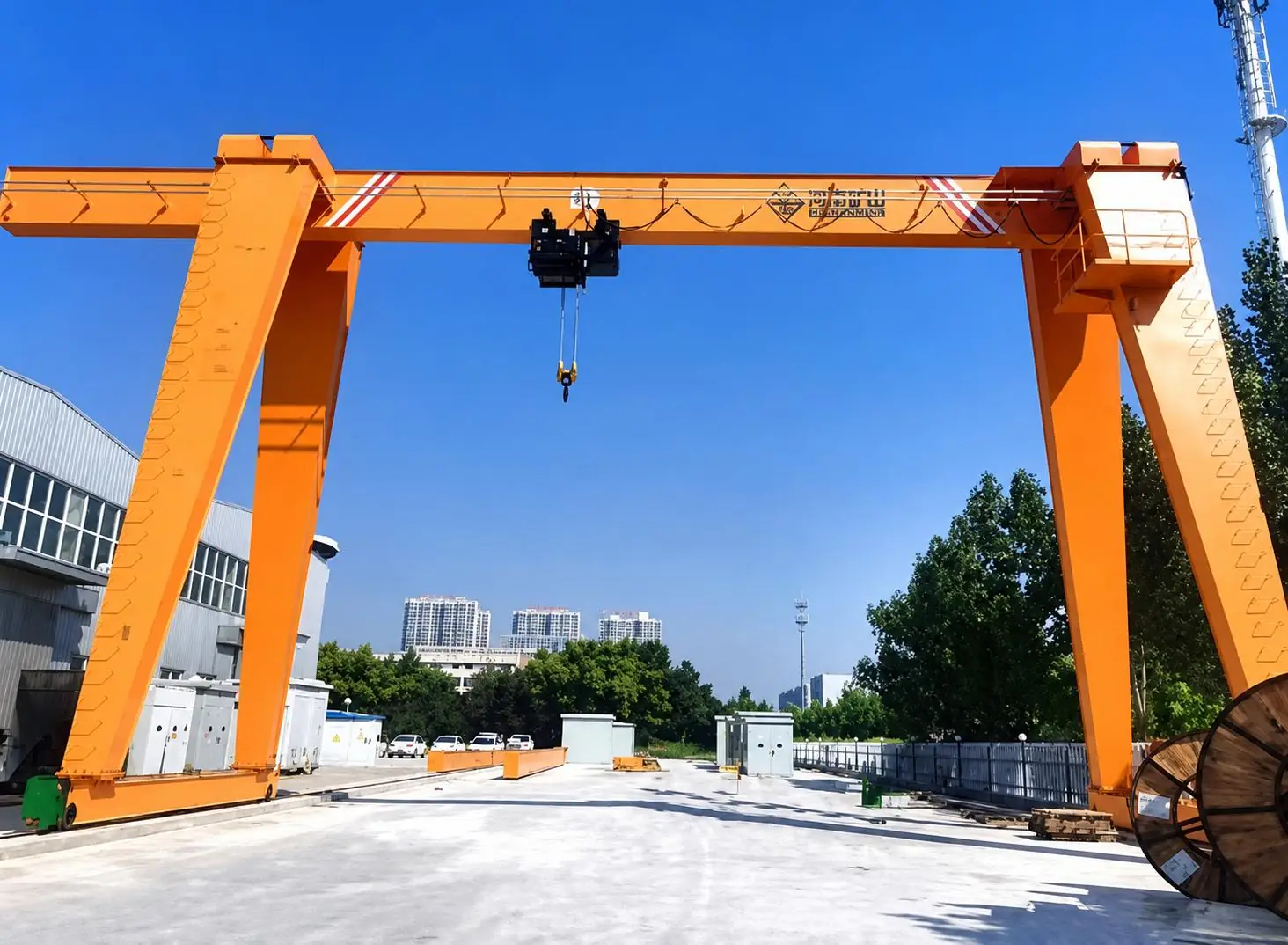
    Henan Mine Crane 10 ton single girder bridge crane for an industrial workshop
    Single-girder electric-hoist arrangement for a project-defined 10 t lifting system. Final dimensions, duty and building interfaces are established in the approved technical proposal.

    RATED CAPACITY

    10 t / 10,000 kg

    GENERAL WORKSHOP OPTION

    Single Girder + Electric Hoist

    CONFIGURATION OPTIONS

    Double Girder & Underhung

    INITIAL EQUIPMENT BUDGET

    US$10,000–$32,000

    10 Ton Bridge Crane Capacity and Applications

    A 10 ton bridge crane is an overhead travelling crane rated to lift 10 metric tonnes, or 10,000 kg, within its approved configuration. The bridge travels along parallel runways, the hoist or trolley crosses the bridge, and the hook raises or lowers the load to provide three-axis material handling across a defined bay.

    Commercial specifications for a 10 ton bridge crane, 10 ton overhead crane, 10 ton EOT crane or 10 tonne overhead bridge crane commonly describe the same moving-bridge equipment family. The capacity unit must remain explicit because 10 metric tonnes and 10 US short tons are not equal. For a hook crane, the payload and separately suspended lifting gear must remain within the permitted load for the approved lifting arrangement.

    Capacity example: a 9,600 kg component plus a 600 kg lifting beam and slings totals 10,200 kg. That exceeds a 10,000 kg rating. The complete suspended load must remain within the permitted capacity of the selected lifting arrangement.

    Machinery and Tooling

    Transfer machine components, fixtures, dies and tooling between storage, preparation and production stations. Load geometry, lifting points and placement tolerance form part of the specification.

    Fabrication and Assembly

    Move fabricated frames, vessels and assemblies through a production bay. The crane layout must cover pickup, welding, inspection and assembly positions without interference from fixed equipment.

    Warehouse and Maintenance

    Handle suitable unit loads or remove pumps, motors and production machinery for service. Hook coverage must be coordinated with racks, maintenance platforms and removal routes.

    Selection Considerations

    01 / LOAD

    Complete Suspended Load

    Define the maximum payload, typical load distribution, attachment mass, dimensions and centre of gravity. Anticipated production changes should be included before capacity is fixed.

    02 / COVERAGE

    Span and Hook Coverage

    Define runway centreline spacing, travel length, highest and lowest hook positions, and all pickup and placement points. Side and end approaches affect usable coverage.

    03 / STRUCTURE

    Building and Supports

    Provide runway elevation, rail details, roof members, doors and overhead services. Existing supports or a new freestanding runway require verification against crane reactions.

    04 / DUTY

    Operating Cycle

    State lifts per hour, travel distances, shifts, operating hours and the proportion of lifts near 10 t. Crane and mechanism duty must match the actual load spectrum.

    05 / CONTROL

    Motion and Positioning

    Select pendant, radio or cabin control together with motion speeds, dual-speed or variable-frequency drives, braking response and required positioning performance.

    06 / ENVIRONMENT

    Operating Conditions

    Temperature, dust, humidity, corrosion, outdoor exposure and hazardous-area classification determine enclosure, coating, component and conformity requirements.

    Single and double girder describe the bridge beams. Top running and underhung describe how the bridge travels on its runways. A hoist travelling below one girder does not by itself make the whole crane an underhung design.

    10 Ton Bridge Crane Compared with Other Bridge Crane Configurations

    Compare bridge structure and application requirements at the same rated load. The linked pages describe product families; special-purpose configurations require confirmation of their 10 t rating, lifting attachment and operating duty in the proposal.

    Configuration Arrangement Application Selection Point
    Single-Girder Overhead Crane One bridge girder with a travelling electric hoist. Routine workshop, assembly and warehouse hook handling. Compare hook height, approaches, hoist duty and runway loading.
    LH Double-Girder Overhead Crane Two bridge girders support the electric-hoist trolley. Projects needing a different trolley layout or lifting envelope. Confirm the complete crane dimensions and duty; girder count alone does not establish service class.
    LX Underhung Overhead Crane Bridge end carriages travel on the lower flanges of suitable runway beams. Layouts where a suspended runway arrangement suits the building. Assess beams, connections, support loads and clearances. Roof suitability requires verification.
    Explosion-Proof Overhead Crane Equipment protection is selected for the classified environment. Handling in a specified hazardous gas or dust area. Provide the area classification, substance information and documentation requirements.
    European-Style Single-Girder Crane A compact bridge and low-headroom hoist use selected drive and control packages. Production handling requiring controlled motion and efficient use of vertical space. Compare the actual hook height, wheel loads, speeds, component schedule and maintenance access.
    Electromagnetic Overhead Crane A lifting magnet and power system handle suitable steel products. Handling selected plates, sections or other ferromagnetic loads. Account for magnet mass, material condition and the required response to loss of power.
    Metallurgical Overhead Crane The crane is designed for the stated hot-material process. Specified steelmaking or other thermal handling duties. Describe heat exposure, load containment and fault consequences; molten-metal lifting needs a dedicated design.

    10 Ton Bridge Crane Specifications

    The following catalogue data identifies available 10 t configurations within three Henan Mine Crane product families. Single-girder and LX underhung values are shown for the 10 t model; LH double-girder values show the configurable family envelope because the final trolley and mechanism package is selected for the project.

    Parameter Single-Girder Configuration LH Double-Girder Family LX Underhung Configuration
    Rated capacity 10 t 10 t 10 t
    Listed spans 7.5, 11.5, 14.5, 17.5, 19.5, 22.5, 25.5, 28.5 m 7.5–31.5 m family range; final span project-selected 3.5, 8.5, 12.5, 16.5, 20, 22.5 m
    Listed lifting heights 6, 9, 12, 18, 24, 30 m 6–30 m family range; final lift project-selected 6, 9, 12, 18, 24, 30 m
    Configurable hoisting speed 7 m/min or 7/0.7 m/min Project-selected for mechanism duty and positioning requirements 7 m/min or 7/0.7 m/min
    Configurable trolley travel 20 or 30 m/min 10–40 m/min family range 20 m/min
    Configurable bridge travel 20 or 30 m/min 10–40 m/min family range 20 m/min
    Working class A5 catalogue configuration A3–A5 family range A3–A5 family range
    Catalogue motor power 13.8 kW Project-defined 15.2 kW

    The 7/0.7 m/min entry denotes a two-speed hoisting option. Catalogue values establish available equipment ranges, not an automatic combination. Lifting height describes vertical hook travel and does not establish minimum building height.

    Confirm crane and mechanism duty, control method, site voltage, frequency and phases separately. Obtain the selected crane weight, wheel loads, wheel spacing, rail or beam interface and hook approaches in the project drawings.

    Headroom, Hook Coverage and Runway Loads
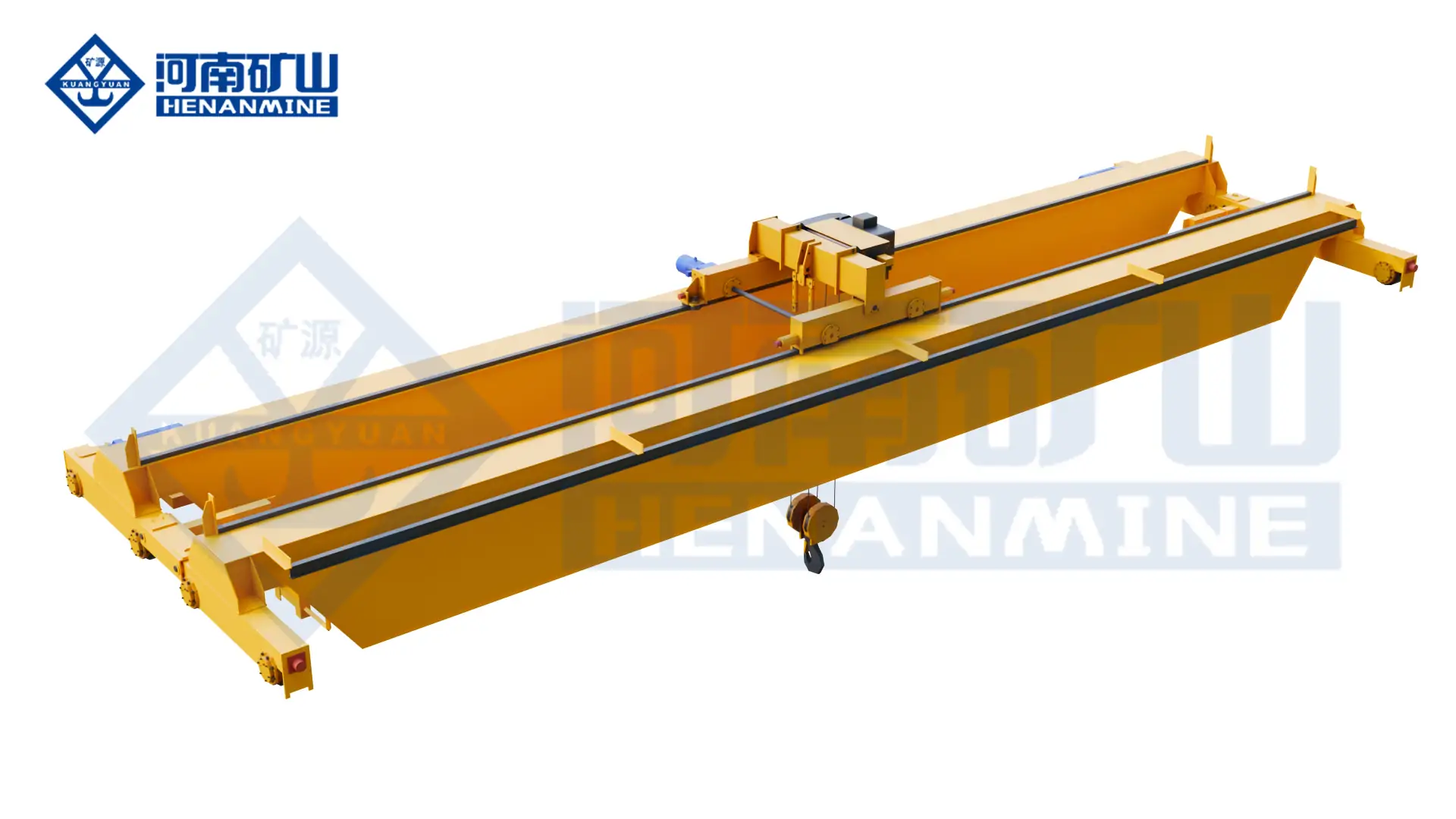
    Double-girder electric-hoist bridge crane from Henan Mine Crane
    Double-girder electric-hoist arrangement. Compare its crane envelope, highest hook position and runway interfaces against the workshop drawing.

    Check the Complete Lifting Envelope

    Show the highest and lowest required hook positions, load dimensions, slings or lifting beam, and any extraction distance above a machine. Allow for the crane structure, trolley, hook block and clearances to roof members and services.

    A low-headroom hoist and an underhung bridge are different design choices. Compare dimensioned arrangements at the required hook position. Include door tracks, lights, ducts and the load route between stations.

    Verify Runway Compatibility

    A runway previously carrying a 10 t crane may still need modification for a replacement. Different crane weights, wheel spacing, reactions and rail interfaces can change the support requirements.

    Where existing building steelwork is unsuitable, a separate engineered support system may be considered. Its columns, bracing and foundations must fit the site and handling routes.

    Hoisting, Travel and Control Options

    Hoisting Motion

    The hoist raises and lowers the load. Select hook travel, braking and speed control around the lifting task, especially when placing a component into machinery.

    Trolley Motion

    The trolley or travelling hoist moves across the bridge. Its dimensions and stopping positions determine usable side approaches.

    Bridge Motion

    End carriages move the bridge along the runways. The drive arrangement and runway alignment must work together over the required travel length.

    Pendant or radio control should suit operator visibility and access. Discuss variable-speed requirements through the Frequency-Conversion Overhead Crane configuration. Frequent starts, short positioning moves and repeated near-capacity lifts all form part of duty selection; a 10 t rating alone does not define continuous operating capability.

    Safety Features and Application Requirements

    Include the safety and control schedule in the technical agreement, with required functions and their verification method identified for the selected crane.

    Load and Motion Protection

    Specify overload protection, hoisting limits, travel limits, brakes, emergency stops and applicable electrical protections. Agree the inspection and functional checks for acceptance.

    Runway and Operator Safety

    Define end stops, buffers and relevant wheel-protection details. Assess shared-runway separation, operator visibility and safe access for inspection and isolation.

    Application-Specific Protection

    Hot loads, lifting magnets and classified hazardous areas require additional design decisions. Define thermal protection, braking or retained-load functions around the actual process.

    For two-hoist handling, review the Double-Trolley Overhead Crane arrangement. State individual and shared-load limits, lifting-point spacing and coordinated movements. Two hoist ratings cannot simply be added to establish the permissible load of the crane.

    Manufacturing and Order Documentation
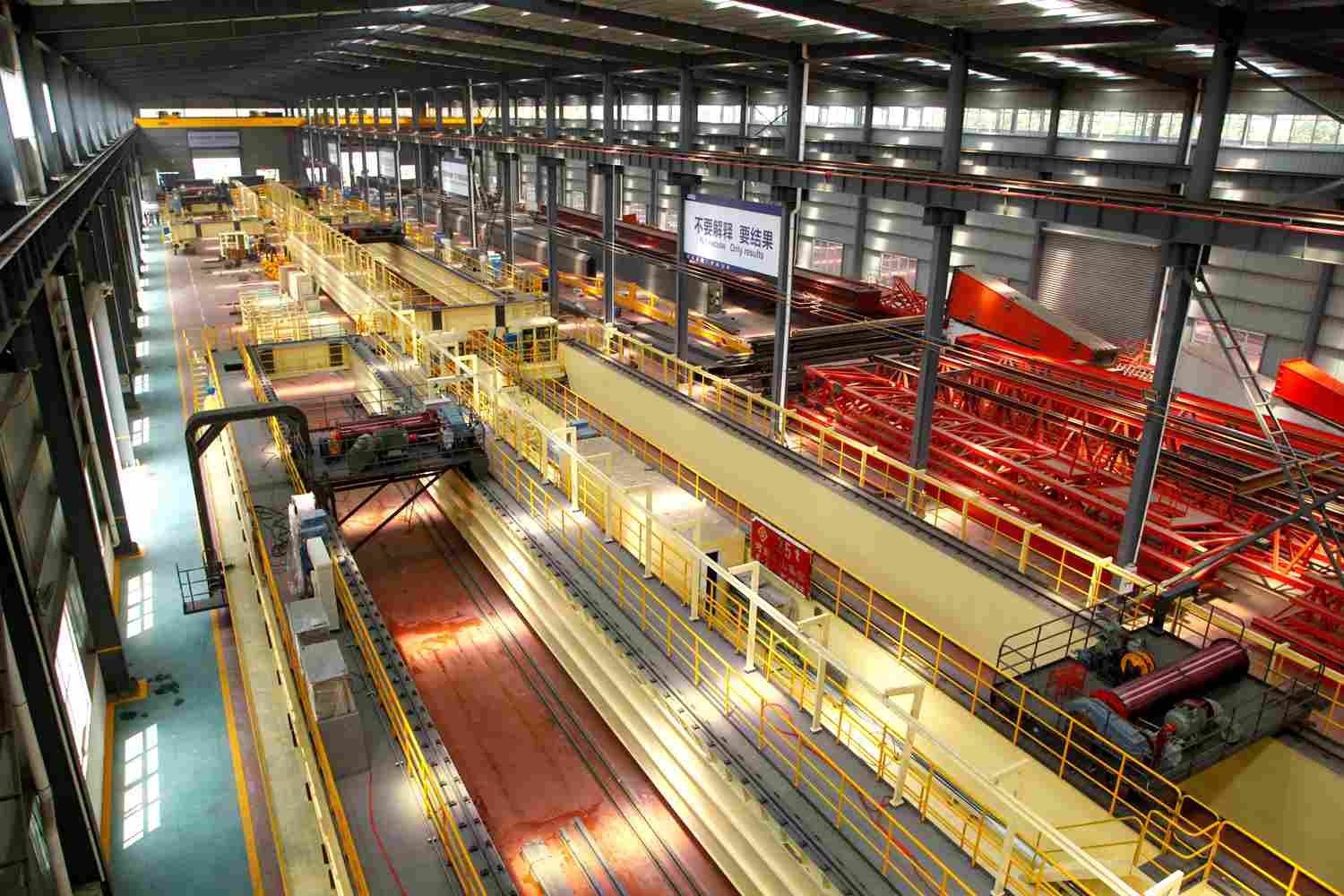
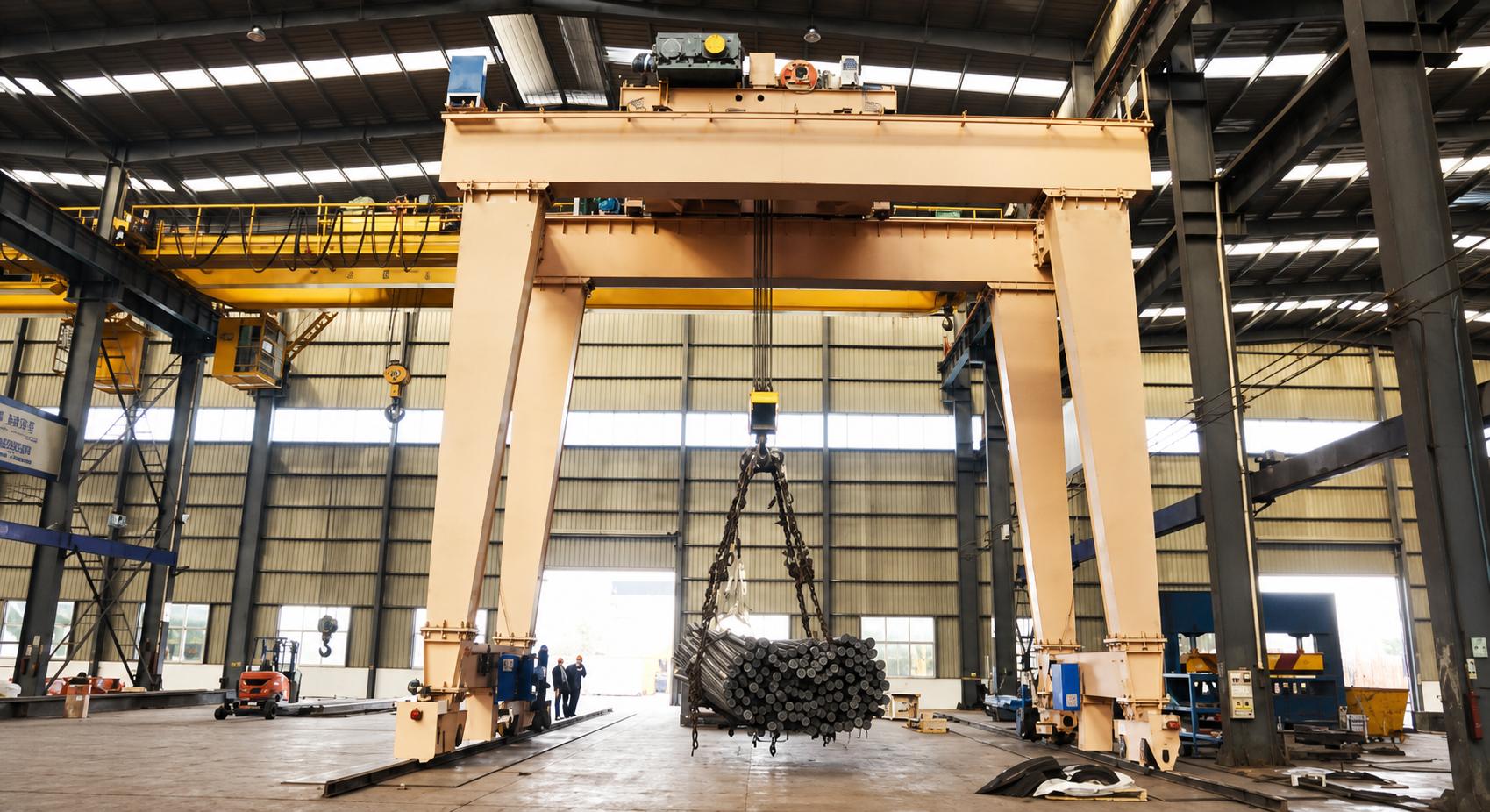
    Crane structure manufacturing workshop shown by Henan Mine Crane
    Crane manufacturing workshop photographed for the Henan Mine Crane factory display.

    Henan Mine Crane provides manufacturing visibility through the Factory Scene Display. The technical agreement and inspection plan should define approved drawings, material and component identification, fabrication checkpoints, functional tests and records supplied with the equipment.

    • General arrangement drawing with crane envelope and hook approaches.
    • Runway interface data, wheel loads and support reactions.
    • Hoist, motors, brakes, drives, controls and electrical component schedule.
    • Electrical drawings, operating instructions and maintenance documentation.
    • Dimensional, electrical and functional inspection records within the agreed scope.
    • Factory and site test records, including load testing where contractually required.

    Project location, governing regulations, design standard, documentation language and conformity scope must be stated before order placement. The signed technical agreement establishes applicable requirements, inspection responsibilities and acceptance criteria.

    Installation, Commissioning and Maintenance

    Prepare the Site

    Survey runway geometry and clearances, confirm structural suitability and arrange the incoming electrical supply. Plan unloading, assembly space and installation equipment.

    Agree Commissioning

    Define who supplies runway beams, rails, conductors and supports. Agree site inspection, functional testing, applicable load tests, handover and operator familiarisation before installation.

    Maintain the Complete System

    Plan access to ropes, hooks, brakes, limits, wheels, drives and electrical equipment. Set inspection and maintenance intervals using the supplied manuals, operating duty and applicable requirements.

    For an operating workshop, coordinate the installation sequence and required shutdown with production. Confirm component replacement clearances and spare-parts requirements during the layout review.

    10 Ton Bridge Crane Price

    A standard 10 ton single-girder overhead crane commonly falls within an indicative factory-equipment market budget of US$10,000–$22,000. A double-girder factory package commonly falls within approximately US$15,000–$32,000.

    These figures are market budget bands rather than fixed Henan Mine Crane selling prices. Span, lift, working class, hoist or trolley design, controls, environmental protection, destination and contracted scope determine the formal quotation.

    10 Ton Configuration Indicative Equipment Budget Commercial Basis Principal Cost Variables
    Standard Single-Girder Factory Supply US$10,000–$22,000 Bridge, end carriages and standard electric-hoist equipment; site work normally separate Span, lifting height, hoist, speeds, controls and destination voltage
    Indicative Landed Single-Girder Equipment US$14,000–$28,000 Factory equipment with indicative ocean freight, basic import duty and destination port handling Destination, freight market, duties, port charges and delivery term
    Double-Girder Factory Supply US$15,000–$32,000 Two bridge girders with the selected trolley or electric-hoist arrangement Trolley design, service access, bridge mass, duty, controls and wheel loads
    North American Installed-System Benchmark About US$65,000 single girder; near US$100,000 double girder U.S.-market installation benchmark rather than factory-export equipment pricing Regional labor, runway condition, access, erection, startup and testing scope

    Low advertised amounts may cover only a hoist, component kit or basic factory package. Runway beams, columns, foundations, incoming power, international freight, import charges, unloading, erection, site wiring, commissioning and third-party inspection remain outside the price unless expressly included.

    Crane Equipment

    Bridge, end carriages, hoist or trolley, travel drives, control panel, operator controls and specified protective functions.

    Runway and Electrical Scope

    Rails, runway beams, columns, brackets, foundations, conductor system and incoming electrical interface.

    Delivery and Site Work

    Export packing, freight, insurance, unloading, erection, testing, commissioning, training and handover records.

    A valid commercial comparison uses the same capacity unit, span, lift, working class, control method, component scope, environmental protection and delivery term. Equipment-only pricing is not directly comparable with an installation-inclusive proposal. A detailed cost structure is available in the 10 Ton Bridge Crane Price Guide.

    10 Ton Bridge Crane FAQ

    Are the 10 ton bridge cranes supplied as new equipment?

    Henan Mine Crane supplies newly manufactured, project-configured equipment. The order documents define the bridge arrangement, hoist, components, controls, drawings, inspection scope, delivery boundary and warranty terms.

    How much does a 10 ton bridge crane cost?

    Indicative factory-equipment budgets commonly range from US$10,000–$22,000 for single-girder configurations and US$15,000–$32,000 for double-girder configurations. Runways, freight, foundations, installation, site wiring and commissioning remain additional unless expressly included.

    Is a 10 ton bridge crane the same as a 10 ton bridge crane or EOT crane?

    These terms commonly describe the same electrically powered moving-bridge lifting system. The specification should identify the bridge structure, runway arrangement, hoist and capacity unit so that quotations describe the same equipment.

    Which is more suitable at 10 tons: single girder or double girder?

    Compare usable hook height, side approaches, crane duty, runway reactions and total installed scope. A single-girder electric-hoist design is a starting option for general handling; a double-girder layout is evaluated where the required lifting envelope or equipment arrangement benefits from it.

    How much building height does a 10 ton crane need?

    There is no single minimum for every configuration. Provide the required highest hook position, load and rigging dimensions, runway elevation, roof structure and overhead services. A dimensioned proposal establishes the remaining clearances.

    Can a 10 ton crane be installed on an existing runway?

    It can be assessed using the runway survey, rail or beam details, support information and new crane reactions. The old crane rating alone is insufficient: wheel loads, wheel spacing, geometry and power demand may differ.

    Can a 10 ton crane repeatedly lift its full rated load?

    The selected duty and mechanism ratings must match the load spectrum and operating cycle. State how often near-capacity lifts occur, the lifting and travel distances, and the number of shifts. Rated capacity does not specify an unrestricted continuous work cycle.

    When is a capacity above 10 tons required?

    A higher rating is required when the maximum payload plus below-the-hook equipment exceeds the permitted 10 t load or when planned production changes make 10 t insufficient. The higher-capacity alternative must be checked against crane dimensions, runway reactions and total installed cost.

    Does the quoted price include installation and runway beams?

    The supply scope must say so explicitly. Request separate identification of crane equipment, runway components, supports, power supply, freight, installation, testing and commissioning. This makes equipment-only and installed-system quotations easier to compare.

    How long does delivery take?

    Delivery depends on drawing approval, configuration, component availability, production scheduling, inspection scope and transport route. Confirm the agreed milestones and any site-readiness requirements in the order documents.

    Request A 10 Ton Bridge Crane Quote

    A project-specific 10 ton bridge crane proposal is prepared from the load data, workshop drawing and required commercial boundary. The RFQ should include:

    • Maximum and typical loads, attachment weights and load dimensions.
    • Runway span and length, required hook positions and building cross-section.
    • Operating cycle, environment, power supply and project location.
    • Required crane, runway, installation, testing and delivery scope.
    Henan Mine CraneDiscuss your requirements ↗
  • Crane Requirements for Oil & Gas Facilities in Kuwait

    Crane Requirements for Oil & Gas Facilities in Kuwait

    Crane Requirements for Oil & Gas Facilities in Kuwait

    Kuwait as an important OPEC oil-producing countries, the oil and gas industry is the core pillar of its economy, contributing 90% of the fiscal revenue and 95% of the share of exports, with 7% of the world’s oil reserves, covering oil and gas extraction, storage and transportation, refining the whole industry chain, the project working conditions are complex, the scale of infrastructure is huge.

    Cranes are the core equipment for oil and gas project construction, operation and maintenance in Kuwait. The local oil and gas plant is a flammable and explosive high-risk environment, superimposed on the harsh regulations and standards and harsh desert conditions, the lifting operation of compliance, safety and professionalism requirements are extremely high.

    This article explains the Kuwaiti oil and gas industry crane operation specifications, suitable models, safety standards, environmental response measures, maintenance requirements and selection criteria for service providers, to provide professional practical guidance for relevant enterprises to effectively avoid compliance and safety risks.

    Understanding Kuwait’s Oil & Gas Infrastructure

    Kuwait’s oil and gas industry is coordinated and operated by the state-owned KPC, which was established in 1980, with a clear division of labor among its subsidiaries and a complete industrial system, and all the oil and gas lifting standards and safety norms are uniformly formulated and enforced by KPC.

    Industry Core Management Structure

    KPC’s core subsidiaries cover the whole oil and gas industry chain:

    • KOC: the core upstream company, responsible for onshore oil and gas exploration and exploitation, and gradually expanding offshore business;
    • KGOC: manages oil and gas resources in the neutral zone of Kosha;
    • KNPC: responsible for downstream refining, oil products sales and gas processing;
    • KIPIC: operating the large-scale refining and petrochemical complex in Arzur;

    Supporting shipping, overseas exploration and petrochemical enterprises to form a complete industrial closed loop.

    Core Facilities and Project characteristics

    • Kuwait’s main onshore oil field guarantees production capacity, with a crude oil production capacity of 3.2 million barrels per day in 2025 and a forward target of 4 million barrels per day. Local natural gas is mainly associated gas, short supply, dependent on LNG imports, focus on developing non-associated gas resources in the future.
    • The midstream has about 2,000 kilometers of pipeline network and gathering, transportation and storage facilities to realize efficient oil and gas storage, transportation and transit.
    • Kuwait has three main refineries with a total refining capacity of 1.42 million barrels per day, has completed clean fuel upgrading, has a well-developed petrochemical industry chain, and exports a large amount of oil and gas products.
    • In terms of export logistics, the Port of Ahmadi is the core crude oil and refined oil product export terminal, together with supporting hubs such as the Port of Abdullah and the Port of Shuaiba, relying on the gravity loading and unloading system to realize large-scale export, mainly supplying the Asian market.

    Kuwait oil and gas scene covers in operation plant, new construction, remote oil fields and coastal terminals, complex working conditions, high risk, crane performance, operating standards and safety control requirements are stringent.

    Key Crane Requirements for Oil & Gas Projects in Kuwait

    Kuwait oil and gas lifting operations are subject to triple control by local regulations, the KPC-HSSE system and international standards, strict control of compliance, equipment safety, personnel qualifications and work processes, and violations will face work stoppages, fines, blacklists and other penalties.

    Compliance Framework

    The industry’s core compliance is based on the Kuwait Industrial Authority’s Ministerial Resolution No. 42 of 2023, which mandates that lifting equipment be equipped with core safety devices such as torque limiters, collision avoidance systems and emergency brakes as standard. All lifting operations must strictly comply with KOC, KNPC, KIPIC proprietary lifting regulations, international standards such as ASME, API, OSHA, and local labor safety and special equipment regulations.

    Equipment Hard Standards

    Cranes for oil and gas projects must comply with international standards such as ISO, ASME and EN, and be equipped with safety devices such as overload protection, load indication, limit switches, etc., as well as being suitable for high-temperature-resistant, dust-resistant and corrosion-resistant working conditions in the desert. Explosion-proof models must be used in flammable and explosive areas, and all equipment and spreaders must have valid third-party certification and load test reports, and the maintenance information can be checked on site.

    Personnel Qualification Requirements

    All lifting operators must have valid practicing qualifications recognized by Kuwait or Gulf countries, and the company gives priority to operators with 5-10 years of hands-on experience in local oil and gas projects. Lifters, riggers and on-site commanders are required to complete KPC certified HSE special training and regular retraining, proficient in high-risk operations risk control specifications and emergency response procedures, without valid qualifications are strictly prohibited to work.

    Operation Process Standardization

    All lifting operations must prepare special construction plans in advance, and for critical heavy loads, cross-equipment, and high-risk lifting conditions, JSA operation risk analysis, accurate load accounting and special approvals must be carried out simultaneously.

    Before operation, PTW operation permit must be applied, equipment verification, wind speed monitoring, site isolation enclosure and pre-shift safety briefing must be completed; full-time supervisors must be provided throughout the operation, standardized command must be implemented, and hazardous operation areas must be strictly controlled to prevent unrelated personnel from entering the area.

    Oil and Gas Scene Exclusive Requirements

    High risk such as must be equipped with hidden dangers. Carry out when the existing oil and gas flammable and explosive, containing hydrogen sulfide high-risk areas, must use intrinsically safe explosion-proof lifting equipment to eliminate the risk of sparks. Refinery renovation, equipment lifting needs to be combined with the site pipeline and equipment layout refinement of the construction, to avoid collision and leakage hazards, the whole process of retaining operating accounts, to achieve traceable management.

    Types of Cranes Commonly Used in Kuwait’s Oil & Gas Sector

    Kuwait oil and gas industry chain working conditions vary greatly, combined with the extreme desert environment and heavy-duty needs, the industry has formed a mature crane selection standards, all types of models are clearly defined, can fully cover the oilfield, refinery, warehousing and infrastructure lifting needs.

    Mobile Crane

    Mobile cranes are the most commonly used lifting equipment for oil and gas projects in Kuwait due to their flexibility, efficiency and strong site adaptability. Among them, 100-400 tons class all-terrain cranes can be adapted to complex desert conditions, and are capable of heavy lifting operations of large equipment modules;

    Truck cranes are flexible and suitable for inter-regional short-distance transfer operations; 50-300-ton rough terrain cranes are designed for soft and rugged desert sites and are widely used in field oilfield infrastructure and long-distance pipeline laying projects.

    Crawler Crane

    Crawler cranes have become the equipment of choice for large-scale oil and gas heavy-duty lifting scenarios in Kuwait due to their core advantages of small ground pressure, large load carrying capacity, strong operational stability, and excellent wind-resistant performance. The tonnage of the model covers 50-1600 tons, and it is suitable for full-gradient heavy-duty lifting work conditions.

    The model does not require hardened road surface, suitable for the desert soft and harsh conditions, is the core lifting equipment for key projects such as Alzur Refinery, Ahmadi Port, etc., and specializes in lifting and installation of large equipment, steel structures and EPC heavy modules.

    Bridge/Electric Single Girder Crane (EOT)

    Overhead  crane is a fixed and specialized lifting equipment in Kuwait oil and gas refineries, production workshops, and installation plants. Relying on the solid rail erection structure, it has the advantages of high operational precision, strong stability, stable load, and does not take up the ground maneuvering space, which is suitable for the normalized and repetitive lifting and loading operation scenarios in the plant.

    Among them, double girder overhead travelling crane with large load capacity and high operating precision is suitable for the installation, overhaul and replacement of core heavy equipment in the refining and chemical industry; single girder overhead travelling crane is lightweight and easy to maintain, and is mainly responsible for the daily maintenance work such as light equipment handling and parts replacement in the plant.

    Coking and refining workshop belongs to the first-class explosion-proof area, there are flammable and explosive media, the overhead travelling crane must comply with ATEX, IECEx explosion-proof standards, adopt intrinsically safe explosion-proof structure, eliminate the hidden danger of sparks, and satisfy the local high-risk operation compliance and safety requirements.

    Gantry Cranes

    Gantry cranes are specially designed for open-air and uncovered operation scenarios, with solid structure, wide coverage and strong site adaptability. It is mainly used in outdoor prefabrication yards, storage areas and infrastructure sites of oil and gas projects in Kuwait, and can efficiently complete the transfer, lifting and hoisting of steel structures, equipment and pipeline modules.

    Compared with other models, the gantry crane can be fixed for a long time to adapt to the open-air site operation, not limited by the indoor space of the plant, stable operating efficiency, and able to adapt to the needs of the desert open-air construction on a regular basis, which is the core of the Kuwaiti oil and gas project infrastructure, equipment storage and transportation, prefabricated components processing and installation of the commonly used models.

    Tower Crane

    Tower cranes have outstanding working height advantages and wide coverage, mainly applicable to large civil and structural engineering construction scenarios such as new oil and gas plants, refinery complex expansion, etc., and are suitable for installation of high-rise structures and large-scale equipment frames, and are particularly widely used in key projects such as new construction of Alzour refinery and plant expansion.

    Safety Standards and Compliance Requirements

    Kuwait oil and gas industry lifting safety standards are one of the most stringent systems in the Gulf region, with “zero accidents, zero injuries” as the core objective, combined with local regulations and top international industry standards, to achieve the full process of compliance control of equipment, personnel, operations and management.

    Local Regulatory System

    In addition to Ministerial Resolution No. 42 of 2023, all lifting operations must strictly comply with the Kuwaiti Labor Law, the Ministry of Public Works’ equipment supervision regulations, the Environmental Protection Agency’s environmental requirements, and at the same time, implement the HSSE management system of KPC and its subsidiaries, the lifting operation special procedures, and all contractors and equipment service providers must be included in the Party A’s safety control system.

    Adapted International Authoritative Standards

    Kuwait oil and gas lifting operations are fully aligned with top international standards, the core of which includes ASME B30 series crane design and operation standards, API offshore lifting equipment specifications, ISO and IEC explosion-proof certification standards, OSHA safety practices, from the design of equipment, testing and maintenance, personnel operations, risk prevention and control of the whole dimension to achieve standardization.

    Full Life Cycle Safety Control

    We have established a safety management mechanism for the whole life cycle of the equipment, and must complete load testing and certification after the entry of new equipment and overhaul of equipment, and implement daily, monthly and annual inspection systems; implement color-coded management and regular scrapping and replacement of all spreaders and rigging; and implement a system of licensed personnel, regular assessment and continuous training to ensure that personnel capacity matches the needs of high-risk operations.

    Special Control of High-risk Operations

    For high-risk operations such as critical lifting, high-altitude lifting, lifting around pressurized equipment, and lifting in flammable and explosive areas, special approval, special guardianship, and full risk monitoring mechanisms are implemented. Establish a perfect closed-loop mechanism for accident reporting, investigation and rectification, and all minor hidden dangers, abnormal situations and irregular operations should be recorded and archived, so as to continuously optimize the safety management system.

    Environmental and Site Challenges Affecting Crane Operations

    Kuwait is located in the tropical desert climate, extreme weather, special terrain, high-risk plant environment to the lifting operation brings a lot of uncertainty and risk, must be targeted to formulate preventive and control measures in order to protect the safety of operations and stable operation of equipment.

    Extreme Heat

    Kuwait’s extreme summer temperatures can reach more than 50 ℃, high-intensity sunshine will lead to crane hydraulic system aging leakage, motor equipment overheating failure, wire rope thermal expansion and deformation, and at the same time is very easy to cause heatstroke, loss of concentration and other safety issues.

    Local regulations clearly stipulate that outdoor high-risk operations are prohibited from 11:00 to 15:00 in summer, while requiring equipment equipped with high-temperature-resistant hydraulic fluid, strengthened heat dissipation system, sealed and heat-insulated cabs, the entire monitoring of the wet bulb black bulb temperature, and the implementation of the personnel rotation system.

    Dust and Dust Storm Disasters

    The perennial Shamal monsoon is prone to sand and dust storms, causing obstruction to the field of view, and fine sand and dust will invade equipment gears, bearings, motors, and hydraulic systems, aggravating the wear and tear of the equipment, clogging the filter cartridges, and contaminating the lubricating oils, thus greatly increasing the probability of failures.

    The solution is to adopt dustproof sealing design for the whole equipment, carry out regular cleaning and maintenance of the whole machine, stop lifting operation immediately in sandstorm weather, and do anticorrosion treatment for the equipment in time after rain.

    High Wind Load

    Strong desert winds are prone to cause load swing, jib deflection and instability, which in extreme cases can lead to crane overturning and other major safety accidents. Different models, different lifting loads are equipped with corresponding safe wind speed operating limits, the site must be configured with real-time wind speed monitoring instruments, dynamic control of wind conditions.

    In case of gale warning and exceeding the wind limit conditions, it is necessary to stop work in time to avoid danger, and in the special lifting program to refine the wind prevention and control and emergency response measures, and prohibit illegal operation of excessive wind speed.

    Complex Site Terrain

    The desert site has soft soil and insufficient bearing capacity, old oilfield pipelines are dense, equipment layout is compact, there are a large number of construction sites left with oil pollution, poor hardening areas, and it is very easy to have the risk of outrigger settling and equipment tilting. Before operation, it is necessary to complete the geotechnical survey of the site, calculate the ground bearing capacity, lay special outrigger pads, and harden the operation area to avoid the risk of site destabilization.

    Corrosive and High-risk Media Environment

    Coastal oil and gas export terminals are subject to salt spray erosion all year round, while chemical corrosion, hydrogen sulfide toxic media and flammable and explosive gases are present in the refinery and oil and gas field scenes, which put forward strict requirements on the anti-corrosion and explosion-proof performance of lifting equipment. All incoming equipment needs to be coated with professional anti-corrosion protective coating, and equipment in high-risk explosion-proof areas must be intrinsically safe explosion-proof models to completely avoid safety risks from the source of the equipment.

    Vision and Logistic Problems

    Dust, foggy days and nighttime working conditions can significantly reduce the clarity of the operating field of vision, while remote oilfield sites are not easily accessible, there are many problems such as lagging emergency response, difficulty in equipment maintenance, and inconvenience in personnel resupply. The site needs to be equipped with adequate lighting facilities, build a standardized signal command system, improve the special emergency plan in advance, all-round protection of remote sites lifting operations in a safe and orderly manner.

    Crane Inspection and Maintenance Requirements

    In order to meet the harsh working conditions and strict compliance requirements in Kuwait, the local oil and gas industry has established a hierarchical inspection, preventive maintenance, full traceability of the equipment management system, and all processes are strictly in line with the KPC norms and ASME international standards, to prevent the equipment from working with disease.

    Graded Inspection System

    Four levels of normalized inspection mechanism:

    • Daily pre-shift inspection: operators need to comprehensively check the equipment before starting work, verify equipment leakage, wire rope, brake and various types of safety protection devices, through visual inspection and functional test run, to confirm that the equipment is in perfect condition and can be safely operated.
    • Periodic normalized inspection: Strictly implement the weekly and monthly normalized inspection system, appropriately increase the frequency of inspection for harsh operating environments such as sand, dust, high temperature, etc., and focus on checking the core stress components of the equipment, so as to investigate and eliminate potential safety hazards in advance.
    • Annual third-party inspection: KPC certification body carries out comprehensive annual inspection, including dismantling inspection, non-destructive testing, load testing and other items, and issues official compliance inspection certificates to ensure the compliant operation of the equipment.
    • Specialized testing and spreader management: equipment overhaul, accident disposal, transformation and upgrading are required to carry out special testing and acceptance before being put into use; spreaders and rigging carry out semi-annual periodic testing and color-coded update system, and are uniformly and compulsorily scrapped upon expiration.

    Specialized Maintenance Mechanism

    On the basis of the original maintenance specification, combined with the special desert working conditions of high temperature, sand and dust, and high corrosion in Kuwait, the company optimizes the preventive maintenance program, replaces the cartridges, lubricating oils, seals and other perishable consumables as scheduled, and focuses on strengthening the dust sealing and anticorrosive protection of the equipment as well as the maintenance of heat dissipation system.

    All maintenance operations must be carried out by professional technicians, and complete maintenance accounts are kept throughout the process to build a traceable full-cycle file of the equipment.

    Defect Control and Compliance Archives

    Equipment defects found immediately listed out of service, isolation and storage, rectification and re-inspection of qualified and certified before resumption of work. The site must retain a full set of information such as equipment inspection certificates, maintenance ledgers, load test reports, personnel qualification documents, etc., at any time to deal with the Party and the regulatory authorities to audit and verify.

    At present, the industry generally adopts the Internet of Things equipment monitoring, information-based maintenance system to achieve real-time monitoring of equipment status and predictive maintenance.

    Factors to Consider When Selecting a Crane Provider in Kuwait

    Kuwait oil and gas project access threshold is extremely high, the crane service provider’s qualifications, strength, experience directly determines the project compliance and safety, screening service providers need to focus on the consideration of ten core factors, giving priority to match the local oil and gas project exclusive needs.

    Compliance Qualification and Safety Reputation

    High-quality service providers, such as Henan Mining, must have the official access qualification of KPC, KOC, KNPC, and the whole series of equipments and operators are fully compliant with the local regulations of Kuwait and international standards such as ASME and IECEx;

    Relying on the mature intelligent manufacturing system and strict quality control standards, the company maintains an excellent performance record of zero major safety accidents, and strictly implements the Party A’s work stoppage authorization management system, so that it can professionally undertake lifting tasks in high-risk explosion-proof scenarios such as refining and chemical and oil and gas terminals, which is suitable for the high-standard safety control needs of Kuwaiti oil and gas projects.

    Equipments and Working Condition Suitability

    Need to be equipped with a complete range of lifting equipment, gradient perfect lifting equipment echelon, covering large-tonnage crawler cranes, all-ground car cranes, explosion-proof bridge cranes and other oil and gas project-specific models; the overall condition of the equipment is excellent, the age of the machine is new, and have been completed for the desert high temperature, sand and dust, corrosive conditions of the special adapted to the renovation, and at the same time, complete with a full set of lifting tackle, leg pads, and other ancillary materials, to meet the Kuwaiti lifting conditions of various types of oil and gas Requirements.

    Local Oil and Gas Project Experience

    Priority is given to service providers that are deeply engaged in the oil and gas field in Kuwait and have long-term experience in local projects. They are required to be familiar with the local regulatory system, the characteristics of site conditions and high-risk operations, and have mature service cases of landmark key projects such as the Alzour Refinery and Burgan Oil Field, so that they can accurately adapt to the operational standards and control requirements of local projects.

    Team of Professionals

    Our team of licensed lifting operators, cable conductors, and hoisting managers are well versed in local oil and gas hoisting scenarios, and have rich hands-on experience in Kuwaiti projects. The team regularly participates in KPC official certification training, with a stable team of personnel and skilled practical skills, which can efficiently adapt to the standardized control requirements of local high-risk lifting operations.

    Maintenance and Protection Capability

    Equipped with a mature localized maintenance team and sufficient original spare parts reserves, it can provide 24-hour emergency repair services around the clock. Relying on the intelligent digital monitoring system, it realizes real-time monitoring of equipment operation status and early warning of hidden dangers, which effectively guarantees high attendance and low failure of the equipment, and fully adapts to the high-intensity operation requirements of continuous project construction and uninterrupted maintenance of the plant.

    Territorial Mobility and Protection Capability

    With the integrated mobility deployment capability throughout Kuwait, it can complete the whole process of lifting equipment transfer, disassembling and commissioning across the region, and set up in the field, and can flexibly adapt to the characteristics of the local area spanning a wide range of operational scenarios, and the inconvenience of transportation in remote oilfields.

    It can be adapted to the logistics transfer and construction deployment in complex and restricted working conditions such as coastal terminals and urban refineries. Relying on mature local transportation capacity and standardized approach process, the company can efficiently avoid the problems of scheduling and site adaptation, compress the approach cycle, ensure the rapid landing of the project, and meet the requirements of high-intensity continuous construction.

    Transparent Business System

    We have a standardized and transparent commercial quotation system, with clear and detailed billing standards, open and fair, and no invisible charges and surcharges. According to the project construction cycle, construction scenarios and operational needs, the company can flexibly adapt to short-term temporary leasing, medium- and long-term on-site support, all-inclusive project services and other diversified cooperation modes.

    Meanwhile, the company is equipped with a perfect risk protection system, with a full range of insurance coverage, such as engineering insurance, equipment insurance and third-party liability insurance, together with a formal performance guarantee mechanism, which effectively avoids all kinds of project cooperation risks, such as business disputes, equipment damage, construction accidents, etc., and ensures that the whole cooperation process is compliant, stable, efficient and controllable.

    Technical Value-added Services

    We can provide one-stop value-added technical services such as customization of special lifting scheme, site bearing capacity calculation, operation risk study and judgment, and special technical support for critical heavy load lifting. Relying on the senior engineering team, we can accurately solve the difficult lifting problems in all kinds of complex working conditions and high-risk scenarios, and provide solid whole-process technical guarantee for standardized construction and safe operation of the project.

    Brand Strength and Reputation

    As a leading enterprise in the domestic lifting industry, Henan Mining has been plowing into the field of global engineering lifting services for many years, and has won a number of national quality and credibility awards, and has accumulated an excellent reputation in the industry and the performance evaluation of the A-party at home and abroad by virtue of the stringent quality control system, stable delivery capacity and high-quality on-site services.

    With a sound financial system and strong operational strength, the company has been recognized as a high-quality cooperative supplier officially certified by the Kuwait Petroleum Corporation for its excellent comprehensive strength and compliance service capability.

    Green Compliance Operation Capability

    Henan Mine Crane Grane’s lifting equipment is energy-saving and environmentally friendly, the dust control at the construction site is standardized and regulated, and the low-carbon operation mode deeply fits Kuwait’s long-term development strategy of green transformation and low-carbon upgrading of the oil and gas industry, and it can fully satisfy the compliance standards of green construction and environmental protection requirements of overseas high-end projects.

    Conclusion

    Kuwait oil and gas lifting operation is a specialized system project that integrates local regulations, international standards, extreme working conditions and high-risk risk control, with compliance, safety and working conditions as the core bottom line, throughout the whole process of equipment, personnel, operation, maintenance and service providers, and with stringent standards in all aspects.

    Henan Mine Crane Grane has ploughed into the Middle East oil and gas lifting market for many years, and accurately understands Kuwait’s KPC control system and international industry norms, and relies on the whole chain standardized service system to perfectly meet the core requirements of local operations in high-risk, complex and extreme working conditions.

    Henan Mine CraneDiscuss your requirements ↗
  • Crane Rail Misalignment: Wheel Wear, Alignment Inspection and Fixes

    Crane Rail Misalignment: Wheel Wear, Alignment Inspection and Fixes

    Crane Rail Misalignment: Wheel Wear, Alignment Inspection and Fixes

    In the long-term heavy-duty operations of various large cranes such as bridge, gantry, tower, etc., track dislocation is a very hidden high-risk failure, and it is also the core cause of most equipment failures.Many operation and maintenance personnel focus on maintaining core components such as main beams, motors, and brakes, ignoring the problem of track accuracy offset. Although minor misalignment will not directly stop, it will continue to cause wheel wear, equipment vibration, rail gnawing and other problems, greatly increasing operation and maintenance costs. Over time, it will cause the crane to deviate and derail, laying major safety hazards. More than 70% of the crane wheel abnormal loss and fuselage jitter problems in the industry are all due to excessive track alignment deviation.

    What Is Crane Rail Misalignment and Why Does It Matter?

    Crane track misalignment is a geometric accuracy fault where the straightness, track gauge, elevation, and parallelism of the track deviate from industry standards, covering various forms such as overall offset, local bending, height difference, and uneven track gauge.This kind of deviation is different from dominant faults such as rust and surface wear, which are extremely concealed and will continue to accumulate.As the core foundation of the operation of Henan Mine Crane manufactured crane, unbalanced track accuracy will disrupt the walking trajectory of the equipment, causing problems such as deviation, caton, and uneven resistance, causing wheel load to be biased, and gradually reducing the operating accuracy of the whole machine, affecting accurate hoisting operations.

    Track misalignment, fuselage skew, wheel wear and safety hazards will form a closed loop of vicious failures, and deviations will force the wheels to tilt and fit the track, causing common rail gnawing problems.Long-term friction and extrusion will cause unilateral wheel wear and rim damage, and deformed wheels will further increase track offset, exacerbate equipment vibration and abnormal noise, and overload and lose transmission components such as motors and reducers.Severe misalignment can lead to unbalanced lifting force, uncontrolled shaking of the crane, and even accidents such as derailment and distortion of the main beam, bringing serious safety risks and high production and maintenance losses.

    Signs and Common Causes of Crane Rail Misalignment

    Uneven wheel and rail wear

    Uneven wear of wheels and tracks is the most important initial sign of crane track dislocation, and it is the key basis for operation and maintenance investigation.Under normal working conditions, the wheels and track tread wear evenly and there is no obvious friction damage.Once the alignment deviation of the track occurs and the contact angle of the wheel is unbalanced, problems such as unilateral partial wear, thinning of the rim, peeling of the tread, etc. will occur, and dense scratches and depressions will also occur on the side of the track.According to industry standards, excessive wear of rims and tread surfaces can determine the existence of long-term orbital dislocation. Such asymmetric wear will continue to amplify the accuracy deviation and cause irreversible equipment loss.

    Abnormal noise and vibration

    The abnormal noise and vibration of the crane when it is running are typical mid-term fault signals for track dislocation, which can be intuitively and quickly identified.When the equipment is walking normally, it is stable, low-noise, and there is no obvious jitter, and the deviation of the track alignment will cause the wheels to continue to rub and squeeze the track, resulting in abnormal sound of gnawing the track, caton impact sound, and the fuselage will shake with regularity.The greater the misalignment deviation, the more obvious the vibration and noise.Long-term operation with faults will cause fatigue stress on the main beam and end beam, cause deformation of the fuselage structure, continue to expand the scope of equipment failures, and exacerbate the loss of the whole machine.

    Rail gauge and elevation errors

    Gauge error and elevation error are the core geometric faults of track misalignment, and they are also the fundamental causes of equipment wear and abnormal noise.Excessive gauge is manifested as uneven track width and narrowness, forcing the wheels to continue to rub sideways when walking; elevation errors are divided into local ups and downs and overall gaps, which will cause the crane to tilt and force, uneven wheel load, unilateral overload and pressure, and unilateral suspension.These two types of deviations not only accelerate the loss of track and wheels, but also cause equipment deviation and braking offset, which seriously affect the stability of hoisting. After exceeding the standard, it is necessary to stop and correct immediately.

    Loose fasteners and foundation settlement

    Loose fasteners and foundation settlement are the most common causes of crane track dislocation in industrial plants.Long-term heavy-duty and high-frequency start and stop of the crane will produce a continuous impact force, causing the track bolts, pressure plates, and pads to loose and shift, causing the track to lose its fixed constraints, and gradually offset and bend problems.At the same time, the foundation of the plant is affected by heavy pressure, rainwater erosion and natural sedimentation, which is prone to cracking and uneven collapse, causing the track to tilt and sink.This kind of progressive failure has strong concealment in the early stage, and continuous operation will continue to exacerbate the problem of misalignment, causing various chain equipment failures.

    How to Inspect Crane Rail Alignment

    Inspect rails, wheels, joints, and fasteners

    Accurate inspection of appearance parts is the basic step of track alignment inspection, and it is necessary to follow the inspection logic from the parts to the whole, from the appearance to the details.First check the track body to see if there is wear, scratches, cracks, flaking, or deformation on the track tread, and whether the track joints are uneven, misplaced, and the gaps exceed the standard.Secondly, check the walking wheels of the crane, check the degree of wear on the tread of the wheels, the integrity of the rims, and the flexibility of the wheel rotation, and check whether there are problems such as stagnation, deformation, and eccentricity.

    Focus on investigating the track connection nodes and fixed parts, and check the track joint connectors, fixing bolts, compression plates, and buffer pads one by one to confirm that there are no loose bolts, missing accessories, offset plates, aging and failure of pads, etc.At the same time, check whether the limit position of the track end and the buffer device are intact, so as to avoid the track offset and equipment wear caused by the failure of the accessories, and fully lock in the hidden dangers of failure visible in the appearance.

    Measure gauge, elevation, straightness, and span

    Geometric size detection is the core of determining the degree of track dislocation and formulating a repair plan. Professional tools such as laser aligners and level meters are required to detect the four core parameters of track gauge, elevation, straightness and span according to industry standards.Measure and record data in segments along the track, investigate problems such as uneven track width, height gap, bending offset, etc., check the difference between the actual track parameters and the equipment factory standards, accurately locate the fault point and the deviation amplitude, all test data must be completely archived, and strictly compare the industry acceptance specifications to determine whether the deviation exceeds the standard.

    Track inspection needs to be combined with wheel alignment, runway geometry and equipment operating status comprehensive verification to avoid single inspection leading to failure omissions.The staff needs to verify the parallelism and verticality of the wheel installation, investigate the deformation and cracking of the runway steel beams and foundations, and lock the root cause of structural dislocation.At the same time, the measured data is matched with the working conditions of equipment deviation, rail gnawing, abnormal noise, etc., to distinguish the main and secondary fault problems, accurately identify the proportion of track, wheel, and structural deformation faults, eliminate blind maintenance, and ensure that track correction and repair work are accurate and efficient.

    How to Fix Crane Rail Misalignment

    Adjust rail position and fasteners

    For minor track misalignment and loose fasteners, priority is given to low-cost repair solutions such as fastening correction and position fine-tuning to adapt to initial faults with small deviations.First, the bolts, pressure plates, and pads of the entire line of the track are fully tightened and reset, and the aging, deformed, and missing fasteners are replaced to restore the fixed strength of the track and eliminate the problem of loosening and offset of the track.Combined with the previous measurement data, the track level, verticality and spacing are accurately adjusted by increasing or decreasing the track pads, fine-tuning the position of the pressure plate, and correcting the centerline of the track, and minor gauge errors, elevation errors, and straightness deviations are corrected.After the adjustment is completed, review the dimensional data one by one to ensure that all parameters return to the industry standard tolerance range, and solve the wear and abnormal noise problems caused by minor misalignment from the source. The repair cost is low, the efficiency is high, and the normal operation of the equipment can be quickly restored.

    Correct local alignment problems

    In view of regional misalignment faults such as local bending of the crane track, local high and low deviations, and local gauge offsets, a fixed-point and accurate correction scheme is adopted, without the need to disassemble and assemble the track as a whole.The laser alignment instrument is used to accurately mark the fault point, and the curved track is straightened and corrected by hydraulic correction equipment, and the thickness of the pad is fine-tuned for the local high and low gap area to correct local settlement and tilt problems.For the problem of wrong joints and uneven gaps in the track joints, re-adjust the position of the joints, compactor the butt gaps, and correct the height difference of the joints to ensure that the track is smooth and smooth throughout the process.Local correction follows the principle of ”small amplitude, multiple fine-tuning, and repeated review” to avoid secondary deformation of the track caused by one-time large adjustments, accurately solve the rail gnawing and caton failures caused by local misalignment, and maximize the retention of the original track service life.

    crane rail misalignment

    Repair damaged rails and runways

    Replace severely damaged rails

    For the track of the crane that is severely damaged and cannot be repaired, it must be replaced as a whole in time to prevent sick operation.When the track flakes off in a large area, deep cracks, severe bending deformation, severe tread wear, or the track metal is exhausted or hardened, and the accuracy and structural strength cannot be restored by local repair, the old and damaged track needs to be removed and replaced with a brand new track of the same model and specification.Track replacement needs to strictly follow the installation specifications, and laser alignment calibration is used throughout the process to accurately control the track gauge, elevation, straightness, and parallelism, and update all fasteners, pads, and buffer accessories simultaneously to ensure that the installation accuracy of the new track is up to standard.After the replacement is completed, no-load and heavy-duty test runs will be carried out, and the operating status of the equipment will be comprehensively tested to confirm that there are no problems such as deviation, abnormal noise, vibration, and partial wear, and the severe track misalignment failure will be completely solved.

    How to Prevent Repeated Rail Misalignment

    Schedule regular rail and wheel inspections

    The establishment of a normalized regular inspection system is the core means to prevent the recurrence of orbital dislocation.Enterprises need to formulate daily, weekly, and monthly three-level inspection plans based on the frequency and load intensity of Henan Mine Crane manufactured cranes, and daily inspections focus on investigating abnormal operating noise, vibration, and wheel wear marks.Weekly inspections check the tightness of fasteners, the appearance of the track, and the state of the joints.A comprehensive accuracy test is carried out once a month to measure core data such as track gauge, elevation, and straightness.At the same time, an equipment operation and maintenance ledger is established to record each inspection data, wear conditions, and maintenance records, so as to achieve traceability of track and wheel status, predict the development trend of deviations in advance, and intervene in correction in time during the stage of minor misalignment to avoid the accumulation of minor faults into severe equipment failures, and prevent the recurrence of track misalignment from the institutional level.

    Monitor abnormal wear and crane travel

    In daily operation and maintenance, focus on monitoring abnormal equipment losses and changes in operating conditions to achieve early detection and early handling of faults.Pay attention to the wear speed of the wheels and tracks in real time. If the wear suddenly increases in the short term and the wear on one side increases rapidly, stop immediately to check the accuracy of the track alignment.Closely monitor the walking status of the crane, and once abnormalities such as slight deviation, intermittent caton, abnormal noise, and jitter are found, they will be detected and corrected in time.At the same time, monitor the operating load of the motor and reducer. Track misalignment will lead to increased walking resistance and abnormal equipment load. Electrical data is used to assist in judging track faults, multi-dimensional monitoring of equipment status, and accurately capture hidden hidden dangers of misalignment to avoid continuous deterioration of faults.

    Recheck alignment after major repairs

    When Should You Repair or Replace the Crane Rail System?

    Repair vs. replacement factors

    Crane track maintenance and replacement are mainly determined based on the deviation range, degree of damage, equipment working conditions and operation and maintenance costs.For minor faults such as minor misalignment, local wear, and loose fasteners, priority is given to maintenance and correction, with lower costs and shorter downtime.If the track is deformed in a large area, metal fatigue, multiple cracks, or foundation settlement leads to repeated misalignment and a surge in maintenance frequency, and the accuracy and safety of the operation cannot be guaranteed, the entire track system needs to be replaced in time based on the age of the equipment and production requirements.

    When wheel replacement is insufficient

    Most companies have operation and maintenance misunderstandings. They only replace worn crane wheels but do not deal with track dislocation, which leads to the new wheels gnawing and grinding again in the short term.If there is loss and abnormal noise of equipment deviation one to three months after the wheel is replaced, it means that the root cause of the failure is the track accuracy exceeds the standard and the runway structure is deformed.Operation and maintenance need to give priority to correcting track alignment, repairing track defects, and then replacing brand new wheels in order to completely solve the vicious circle of repeated wheel wear and tear.

    When to consider runway or crane modernization

    When the crane track and equipment experience systematic and structural aging failures, runway renovation or equipment modernization and upgrading need to be considered.Tracks that have been in use for more than ten years are prone to overall deformation and fatigue damage, and repeated corrections still fail to meet the standards. Problems such as continuous foundation settlement and deformation of the main beam and walking mechanism will cause frequent failures and shutdowns.The accuracy of the old track cannot be adapted to the needs of heavy-duty and high-precision hoisting. Refurbishing the runway and upgrading equipment can effectively reduce operation and maintenance costs and improve operation safety and operating efficiency.

    Henan Mine Crane Factory Custom Custom

    Crane track misalignment is a common hidden danger that eats away at equipment life and drags down production efficiency. Long-term deviations can cause problems such as wheel wear, equipment jitter, and frequent downtime, which greatly increases the operation and maintenance costs of enterprises, and also hides safety risks.Doing a good job of track inspection, correction and maintenance is the key to the long-term stable operation of the crane.As a professional crane manufacturer, Henan Mine Crane Factory relies on mature equipment manufacturing and a complete set of maintenance and adjustment technology to solve all kinds of track matching failures in one stop, adapt to the needs of multi-scenario operations, and escort the safe and efficient production of enterprise equipment.

    Henan Mine CraneDiscuss your requirements ↗
  • Crane Prices Explained: What Determines the Cost of the Same Tonnage?

    Crane Prices Explained: What Determines the Cost of the Same Tonnage?

    Crane Prices Explained: What Determines the Cost of the Same Tonnage?

    Most crane buyers have serious price comparison misunderstandings, and the price of equipment is determined solely by tonnage, and the quotation of industrial cranes of the same tonnage is basically the same.In fact, the same tonnage crane different prices are the norm in the industry. The tonnage only represents the maximum rated lifting weight of the equipment, and cannot determine the configuration, adaptability to working conditions and service life.Crane price is determined by multiple crane price factors such as structure, working conditions, configuration, technology, and service. Low-price quotation is by no means cost-effective. Blind price comparison can easily cause poor adaptation and high operation and maintenance costs.

    8 Key Factors That Make Crane Prices Different

    The root cause of the price difference between cranes of the same tonnage is the differentiated superposition of multi-dimensional configurations and standards.For customers with commercial research and equipment procurement needs, accurately mastering the eight core price influencing factors is the key to learning how to compare crane quotations, avoiding procurement traps, and achieving cost-effective procurement.The following are the most core pricing factors in the industry, fully covering the core variables of industrial crane prices.

    Crane type and structural design

    The category and structural design of Henan Mine Crane Factory supply cranes are the basic factors that determine the price of equipment of the same tonnage. The production technology, steel usage, load-bearing design, and manufacturing difficulty of different structural forms vary greatly, which directly determines the core manufacturing cost. It is also the primary core index of crane price factors.First of all, there is a significant price difference between single-beam and double-beam cranes.Under the same tonnage conditions, double-girder cranes adopt a double-girder load-bearing structure. Compared with single-girder equipment, the steel consumption is greatly increased. At the same time, the main beam has stronger bending, torsional and load-bearing stability, and the production welding and assembly processes are more complex. It is suitable for heavy-duty and long-cycle operation scenarios, and the manufacturing cost and selling price are much higher than that of single-girder cranes.

    Secondly, the structure of bridge cranes and gantry cranes is significantly different.The bridge crane is installed on the steel structure track of the plant, and the structure is relatively streamlined.Gantry cranes require independent gantry support structures, the overall frame volume is larger, the amount of steel is more, and the production and processing standards of outdoor floor-standing designs are higher. The price of gantry cranes of the same tonnage is generally higher than that of bridge cranes.In addition, the top-up and bottom-up operating structures will also affect pricing.The operating mechanism of the top-mounted crane trolley is located above the main beam, with reasonable load-bearing layout, high structural strength, good operating stability, and higher requirements for the main beam technology.The bottom-mounted structure is streamlined, the process difficulty is low, and the cost is lower.Overall, the higher the structural strength, the more complex the process, and the stronger the stability of the crane, the higher the manufacturing investment, and the higher the terminal price.

    Span and lifting height

    Crane span and lifting height are the core shape parameters, and they are also price variables that can easily be ignored by purchasing personnel. The core logic is that under the same tonnage parameters, the larger the equipment size, the higher the manufacturing cost, which directly affects the positioning of industrial crane price.The span of the crane directly determines the design standard of the main beam and the amount of consumables.Under the same 20-ton rated load, the design of the main beam with an 18-meter span is completely different from that of the 30-meter span.The longer the span, the greater the bending moment and torque that the main beam needs to withstand. Thickened steel plates, optimized box-shaped structures, and reinforced ribs must be used to avoid the risk of deformation, shaking, and collapse in long-term operation, which will directly increase steel consumption and processing costs.

    The lifting height determines the configuration specifications of the lifting mechanism such as the hoist, wire rope, pulley block, etc.The higher the lifting height, the longer the high-strength wire rope, the larger the rope capacity of the reel, and the more adaptable lifting drive components are required. At the same time, the stability and braking accuracy of the lifting system are higher.The configuration gap between the crane components of the Henan Mine Crane Factory supply crane with a lifting height of 6 meters and a lifting height of 12 meters is obvious, and the cost difference is intuitive.In addition, the on-site installation conditions of some factories are limited, and the main beam and support structure of the crane need to be reinforced and customized, or adapted to special track sizes, which will further increase the design and transformation costs.

    Working duty and lifting frequency

    The working level and lifting frequency are the core hidden factors that distinguish the cost performance and adaptability of cranes of the same tonnage, and they are also the core difference between professional procurement and ordinary inquiry. The vast majority of low-cost cranes of the same tonnage are low-profile models in light working conditions and cannot be adapted to high-frequency production scenarios.According to the international standards of FEM, ISO, and CMAA, the industry divides cranes into different working levels, and the core is divided into two types: light working conditions and heavy working conditions.Class A1-A3 cranes in light working conditions are suitable for occasional operations, single-day operations, and low lifting frequency scenarios, such as sporadic loading and unloading in warehouses, intermittent equipment maintenance, durability of accessories, low redundancy design of the whole machine, and low cost.The A4-A5 and above heavy-duty cranes are suitable for production line scenarios with multi-shift, all-weather, and high-frequency lifting operations. The equipment needs to have stronger anti-fatigue and anti-loss capabilities, and the core components are all customized with heavy loads. Configuration.

    In simple terms, a 20-ton crane that lifts several times a day and operates intermittently, and a 20-ton crane that operates continuously on an assembly line, lifts dozens of times per hour, and runs in multiple shifts for 24 hours, are essentially not the same equipment.The former focuses on basic load-bearing, while the latter focuses on continuous stability and wear resistance. The fuselage structure, motor, brake, and transmission system have all been upgraded with heavy loads, and the manufacturing cost has been greatly increased. This is also the core hidden reason for the disparity in the price of equipment of the same tonnage. It is the main procurement point emphasized in the crane buying guide.

    Hoist, trolley and drive system

    The lifting mechanism, trolley operating mechanism and drive system are the core power core of the crane, and they are also the core details of the quotation difference. Under the same tonnage, the upgrade of the power configuration will directly open the price gap, which is the key verification module of crane cost comparison.The first is the difference in the configuration of lifting hoists. Different types of hoists have very different weight, load-bearing accuracy, and operating stability. Compared with ordinary civilian hoists, industrial-grade heavy-duty hoists have fully upgraded materials, craftsmanship, sealing, and durability, and the price gap is significant.At the same time, the customized adjustment of the lifting speed and the operating speed of the trolley will also affect the cost. High-frequency and high-speed operations need to adapt to high-precision motors and strengthen the gear transmission structure to avoid high-speed operation failures.

    Secondly, the differences in the specifications of the three core transmission accessories, motor, gearbox and brake, are of vital importance.Ordinary low-profile equipment adopts standard universal accessories, which are suitable for low-speed and low-frequency operations.The high-end configuration adopts a special lifting motor, a hard gear gearbox, and an electromagnetic dual braking system, which has higher transmission efficiency, more accurate braking, and lower failure rate, and is suitable for long-term heavy-duty operation.In addition, the variable frequency drive (VFD) system is the core spread configuration.The basic low-profile crane adopts fixed-speed operation, with large start-stop impact, obvious shaking, and easy loss of equipment.Equipment equipped with VFD frequency conversion control system can achieve smooth start-stop and stepless speed regulation, reduce the impact of the fuselage and component wear, and greatly extend the service life of the equipment.The same 20-ton crane, with or without VFD system, the grade difference of drive accessories, can directly cause a price gap of thousands or even tens of thousands of yuan.

    Steel structure and component quality

    The steel material and the quality of the core accessories determine the service life, operation and maintenance cost and operating stability of the crane. It is also the core source of the difference in the price of different crane manufacturers. It is not that the expensive ones are good, but that different configurations are adapted to different use needs.At the steel structure level, high-quality manufacturers use national standard high-strength alloy steel materials with stronger toughness, load-bearing and deformation resistance. They strictly follow the national standard welding process and adopt automatic submerged arc welding and non-destructive flaw detection. The main beam has uniform welds, stable structure, and is not easy to deform and crack.The low-cost and low-configuration equipment uses ordinary carbon steel to simplify the welding process, without professional testing processes, and long-term heavy-duty operation is prone to deformation of the main beam and cracking of the welds.At the same time, high-end equipment adopts sandblasting and rust removal, multi-layer anticorrosive painting treatment, and its anti-rust and corrosion resistance far exceeds that of ordinary painting process equipment.

    Control system and automation level

    The control system and degree of automation are the core manifestations of the intelligent upgrading of cranes, and they are also an important dimension to determine the price of equipment of the same tonnage. The higher the automation configuration, the more electrical components and the higher the technical cost, the higher the equipment price. Naturally.The basic configuration is handle operation control, which has a simple structure and low cost. It can only realize basic lifting and translation operations, and is suitable for simple low-frequency operation scenarios.The mid-range configuration is upgraded to wireless remote control, which gets rid of the shackles of cables, makes the operation more flexible, has a longer safe distance, and is suitable for complex operation scenarios.High-end models can be equipped with centralized control in the cab, which is suitable for large-scale heavy-duty, high-altitude and high-risk operations, with better operating vision and higher control accuracy.

    At the level of intelligent automation configuration, VFD frequency conversion control and PLC programmable control system are the core upgrades, which can realize accurate speed regulation, intelligent start and stop of equipment, and operation data monitoring.At the same time, customized configurations such as anti-swing system, precise positioning system, and fully automatic intelligent lifting system can effectively avoid lifting shaking deviation, improve operating accuracy, and reduce manual operation errors.It is necessary to focus on reminding purchasing personnel that the upgrade of automated configuration will directly increase the initial procurement cost of equipment. If the enterprise only needs basic and simple operations, there is no need to blindly install high-end intelligent configuration to avoid cost waste caused by excessive procurement.For high-precision, high-frequency, and standardized production line operations, intelligent configuration can greatly improve operational efficiency, reduce safety risks, and have a higher long-term price ratio.

    crane price factors

    Working environment and special requirements

    The operating environment and the special needs of customization are important special factors in the price differentiation of Henan Mine Crane Factory supply industrial cranes. Conventional standard equipment cannot be adapted to special working conditions. Customized transformation will directly increase the design, accessories, and process costs, covering all kinds of heavy-duty and special working conditions industrial lifting scenarios.Conventional indoor cranes at room temperature, dust-free and dry environments can meet the needs of use with standard configuration and the lowest cost.However, outdoor operating equipment needs to be adapted to changes in wind and rain, exposure, and temperature difference. Rainproof, sunscreen, and windproof devices must be installed, and the fuselage must be strengthened for weather resistance.In high-temperature, high-humidity, and dusty workshop scenarios, the motor, electrical box, and control components need to be sealed, dust-proof, moisture-proof, and high-temperature-resistant to improve the protection level of the equipment.

    In the coastal salt spray and chemical corrosion environment, the crane needs to do a full set of anti-corrosion spraying and galvanized anti-corrosion treatment. The core accessories are made of special materials for corrosion resistance to avoid salt spray and chemical media from corroding the equipment structure and electrical system.In the operation scenarios of flammable and explosive workshops, mines, and chemical dangerous goods, explosion-proof cranes need to be customized, equipped with explosion-proof motors, explosion-proof electrical components, explosion-proof switches and other special accessories, and the whole machine meets explosion-proof safety standards. The manufacturing cost of such customized equipment is much higher than that of ordinary standard models.

    Safety standards and certification

    Safety standards and industry certifications seem to be differences in qualifications, but in fact they run through the whole process of crane design, production, testing, and delivery, directly increasing equipment manufacturing costs and compliance costs, which is the core reason why the price of regular brand cranes is higher than that of small workshop products.The production of formal industrial cranes strictly follows international general safety standards such as CE, ISO, FEM, and CMAA, and at the same time conforms to local safety regulations in various countries.Different safety standards have clear and hard requirements for the structural design redundancy of equipment, the configuration of safety accessories, load test standards, production technology, factory inspection, and data filing.

    For example, high-standard compliance equipment must be equipped with a full set of safety accessories such as overload protection, limit protection, emergency braking, anti-collision device, and leakage protection. Multiple load tests and safety performance tests must be completed before leaving the factory, and a complete test report, compliance information, and certification documents must be issued at the same time.The low-cost non-standard equipment will simplify safety accessories, omit professional testing processes, and have no compliance certification information, which will significantly reduce production costs, but there are great safety risks.Therefore, the certification standard is not a simple endorsement of qualifications, but a manifestation of the whole process of production and testing costs. The safety, stability and compliance of high-priced equipment are far better than that of non-standard low-priced equipment.

    What Is Usually Included in a Crane Quotation?

    Many buyers are puzzled that the quotation gap between different manufacturers of the same tonnage crane is very wide. The core reason is not only the difference in configuration, but also the different scope of the quotation.Low-price quotations are often simple equipment quotations, and a large number of supporting projects are missing. Additional installation and construction are required in the later stage, and the final landing cost far exceeds expectations.In order to help buyers accurately check quotations and avoid invisible consumption, the following is a standard crane quotation checklist.

    Item Included?
    Main crane structure ✓
    Hoist ✓
    Trolley ✓
    Electrical system ✓
    Control system ✓
    Safety devices ?
    Power supply system ?
    Installation ?
    Testing and commissioning ?
    Spare parts ?
    Transportation ?
    Warranty ?

    It is clear from the quotation list that the infrastructure and core institutions are standard for all quotations, but most low-cost quotations for safety accessories, power supply systems, installation and commissioning, transportation, spare parts, and quality assurance services are not included.When purchasing and comparing, you can’t just look at the unit price of bare metal. You must unify the scope of the quotation. This is the core basis of how to compare crane quotations.

    How to Compare Crane Prices Correctly

    Combining all the above price influencing factors and quotation rules, according to the commercial research and equipment selection needs of purchasing personnel, a set of standardized and landing crane price comparison procurement processes have been compiled to completely solve the misunderstanding of price comparison of equipment of the same tonnage, and accurately screen Henan Mine Crane Factory supply industrial cranes that are cost-effective and adapted to working conditions.

    Step 1: Confirm the actual lifting requirements

    Get rid of the misunderstanding that only the maximum tonnage is used as the selection standard, and accurately sort out the actual lifting requirements.Clarify the conventional lifting load and maximum limit load of the equipment, and distinguish between daily operating load and sudden heavy load requirements.Count the number of lifting times per day and hour, clarify the lifting frequency, distinguish between intermittent light working conditions and continuous heavy working conditions, and provide a basis for the selection of equipment working level, so as to avoid the problem of waste of high configuration and insufficient low configuration from the root cause.

    Step 2: Confirm key dimensions

    Accurately check the on-site installation size parameters and unify the price comparison standards.Focus on confirming the core dimensions such as the effective span of the crane, the maximum lifting height, the total length of the track operation, and the limit distance of the hook.All inquiry manufacturers must quote based on unified size parameters to avoid price errors caused by the deviation of span and lifting height, and to ensure the fairness and accuracy of price comparison.

    Step 3: Define the working duty

    Clarify the intensity of equipment operation and lock in the work level standards.Count the daily working time of the equipment, the number of working days per month, and the production shift, combined with the lifting frequency, to determine the FEM/ISO work level required by the equipment.Heavy-duty equipment must be selected for multi-shift high-frequency operations, and light-load models can be selected for low-frequency intermittent operations to control costs as needed.

    Step 4: Define the working environment

    Comprehensively sort out the on-site operating environment and confirm whether customized transformation is required.Distinguish between indoor or outdoor operation scenarios, verify the temperature, dust concentration, and humidity of the operating environment, confirm whether there are special working conditions such as corrosion, salt spray, flammable and explosive, and clarify customized requirements such as explosion-proof, anti-corrosion, dust-proof, and weather-resistant in advance, so that manufacturers can issue accurate quotations based on the actual environment to avoid price increases in later retrofits.

    Step 5: Compare complete configurations

    After completing the standardization of all parameters, carry out a full range of configuration price comparison, and refuse a single tonnage price comparison.Don’t just compare bare metal quotations for cranes of the same tonnage, but comprehensively compare a full set of configuration and service plans, including all items such as rated tonnage, operating span, lifting height, working level, lifting mechanism, drive control system, safety configuration, installation and commissioning, transportation and quality assurance.Only when the parameters, configuration, services, and qualifications are completely unified can an accurate and effective crane cost comparison be achieved, and truly cost-effective lifting equipment can be selected.

    Henan Mine Crane Factory Custom Custom

    The price of a crane is never determined by a single tonnage.Even if the rated tonnage is exactly the same, the structure, operating span, lifting height, working level, core accessories, control system, and customized requirements for special working conditions will cause significant price differences.If purchasing personnel only compare tonnage quotations, it is easy to ignore hidden costs such as inefficient equipment, frequent failures, and shortened service life.If you want to accurately complete the crane cost comparison, the purchaser must comprehensively check the full set of technical parameters, the adaptability of actual working conditions and supporting services, so as to eliminate the one-sided misunderstanding of the price comparison of a single parameter.

    As a professional industrial crane manufacturer, Henan Mine Crane Factory can provide standardized and customized lifting solutions according to the actual working conditions of customers, covering different working levels, operating spans, and lifting heights. At the same time, it supports explosion-proof, anti-corrosion and other special environmental customization, complete equipment qualifications, stable and reliable performance.We provide a full set of detailed and transparent quotations, including the structure of the whole machine, accessories, installation and commissioning, and quality assurance services, to eliminate the trap of low prices.If you need accurate crane quotation and professional procurement guidance, you can contact us at any time to obtain a highly adaptable and cost-effective exclusive solution.

    Henan Mine CraneDiscuss your requirements ↗
  • Crane Hook Types and Load Capacity Guide

    Crane Hook Types and Load Capacity Guide

    Crane Hook Types and Load Capacity Guide

    Crane hooks are the core load-bearing accessories of lifting operations. They connect lifting equipment and hoisting loads, which directly determine the safety and stability of operations, and are widely used in various industrial hoisting scenarios.Most of the safety hazards of hoisting are due to improper hook selection, incorrect load control, substandard materials or lack of maintenance.

    This article will comprehensively popularize the definition structure, core type, material technology, load capacity standards, key factors affecting the load, selection techniques, and testing and maintenance specifications of crane hooks, so as to help construction companies and equipment operation and maintenance personnel accurately grasp the main points of hook use, and carry out lifting operations in compliance with safety.

    What Is a Crane Hook?

    Crane hooks are special lifting and hoisting accessories. As the core load-bearing interface between cranes, winches and hoisting loads, they are mainly used to connect hook pulley blocks, winches and slings, shackles, chains, hoisting beams and other rigging accessories to achieve smooth lifting, shifting and dropping of heavy objects.

    Unlike ordinary hardware hooks, crane hooks are industrial-grade load-bearing components. They are manufactured by professional engineering design and rigorous technology. They can withstand high-strength tensile, impact, bending and cyclic fatigue loads. They are the core safety components of lifting operations.

    Common Crane Hook Types

    Crane hooks can be classified in four dimensions according to structure, manufacturing process, connection method and functional characteristics. They mainly include single and double hooks, forged/laminated, various connections and safety self-locking styles. They are widely adapted to various types of lifting equipment and are used in heavy lifting operations in construction, manufacturing, ports, metallurgy and other industries.

    Single hook

    The most popular basic hook style on the market has only one load-bearing hook.The overall structure is simple, the weight is light, and the production and daily flaw detection and inspection are very convenient. It is suitable for light and medium-sized lifting conditions, and the upper limit of conventional carrying capacity is about 80 tons.It is mostly used for general industrial cranes, which are suitable for scenarios where the lifting space is limited and the lifting process is simple.When lifting large-weight objects, load eccentricity is prone to occur.

    Double hook

    It has two symmetrical hook bodies, sharing a hook handle, and its shape resembles a sheep’s horn.The load sharing effect is better, the hoisting stability is stronger, the wire rope has less force and higher rated load, and it is generally suitable for heavy-duty operations of more than 100 tons.

    It is mostly used in metallurgy, ship construction, steel structure processing, and port industries, and is suitable for hoisting long heavy objects such as steel beams and pipes.Some industry standards refer to it as DIN 15402 hook.

    Forged hooks and laminated hooks

    1. Forged hooks: formed from alloy steel by high-pressure forging process, the overall strength is high, the toughness is good, and the durability is durable. It is the mainstream manufacturing process of conventional single hooks and double hooks.
    2. Laminated hook: It is made of multi-layer steel plates stacked and bolted and assembled. It is mostly used for customized lifting scenarios with large tonnage. The advantage is that the bearing capacity is extremely strong, and the steel plate can be replaced separately after damage, which is convenient for maintenance.

    Different connection structure and function hooks

    • Ring eye hook: The top adopts a closed ring structure, which can be easily matched with various hoisting accessories such as slings and shackles, which are suitable for general light-load hoisting conditions, and are mostly used for normal hoisting operations at fixed points.
    • Clamp hook: The lifting accessories are fixed by the pin shaft locking structure, which is stable in connection and easy to disassemble and assemble. It is a common mainstream style for binding and hoisting on the construction site.
    • Straight shank hook: It is a standard supporting accessory for cranes, divided into two types: smooth straight shank and threaded straight shank. It is a standard hook for bridge cranes of 10 tons and below, with strong adaptability and high versatility.
    • Rotating hook: Built-in precision bearing rotating mechanism, which can achieve 360° unhindered rotation, effectively avoiding load torsion and rope winding problems during lifting, and greatly improving the flexibility and adaptability of lifting operations.
    • Self-locking safety hook: Equipped with mature self-locking buckle structures such as Shur-Loc, Latchlok, and Bullard, it has a protective function to prevent accidental decoupling, which can effectively avoid the risk of falling off the spreader during hoisting operations, and significantly improve the safety and stability of heavy-duty hoisting.

    Other special special hooks

    • Sorting hook: The hook type is slender and sharp, which is tailored to the sorting and hoisting operations of logs, pipes, and various types of bundled materials, with accurate grasping and strong practicality.
    • C-shaped hook: It adopts an exclusive C-shaped structure design, which is specially designed for hoisting various types of rolled materials such as steel coils and paper rolls. It fits the shape of the material, and the hoisting is stable and not easy to slip off.
    • Special working condition hooks: including casting hooks, J-shaped hooks, grappling hooks, barrel hooks and other categories, they are all customized for subdivided working conditions and are suitable for special scenarios such as casting operations, pipe hoisting, and barreled material handling, with strong adaptability.
    • Electric rotary hook: integrated motor drive structure, which can realize automatic electric rotation without manual auxiliary torsion, effectively improving the operating efficiency and control flexibility of heavy-duty hoisting.

    Crane Hook Materials and Manufacturing

    Classification of materials and applicable scenarios

    • Alloy steel: The mainstream materials are nickel-chromium-molybdenum alloy steels such as 34CrNiMo6, 30CrNiMo8, and 34CrMo4. After quenching and tempering heat treatment, the tensile strength can reach more than 1000MPa. It has high strength, high toughness, and low temperature impact resistance. It is suitable for heavy-duty and high-frequency hoisting scenarios such as ports, metallurgy, wind power, and heavy industries. It is the preferred material for industrial hooks.
    • Carbon steel steel: represented by 20# steel and A36 steel, it has lower cost, excellent ductility and forging properties, and moderate overall strength. It is only suitable for light and medium-sized conventional hoisting operations, and is not suitable for heavy loads, impact loads, and high-frequency working conditions.
    • Low-alloy high-strength steel : mainly DG20Mn and A572 Grade 50, with a balanced strength-to-weight ratio and high cost performance, it is widely used in medium-load hoisting scenarios of ordinary factories and small and medium-sized lifting equipment.
    • Stainless steel steel: 316/316L austenitic stainless steel, 410 martensitic stainless steel, with strong corrosion resistance and rust resistance, suitable for marine, chemical, food and medicine and other humid and corrosive environments.The disadvantage is that the strength and fatigue resistance are lower than that of alloy steel, and the procurement cost is higher.

    Standardized manufacturing process

    Compliance hooks strictly follow DIN 15400, ISO 12209, ASME B30.10, GB/T 10051 and other international and domestic standards, and the complete production process is as follows:

    1. Simulation design optimization: Through CAD modeling + finite element stress analysis (FEA), the curvature, shank diameter, and opening size of the hook are optimized to evenly disperse the load-bearing stress, and the design safety factor can reach 4:1 or more than 5:1.
    2. Raw material selection and testing: select high-quality steel billets, detect chemical composition, mechanical properties, and internal defects, and cut standard-size raw materials to eliminate unqualified substrates.
    3. High-temperature heating and shaping: the billet is heated to 1100-1200℃ to improve the plasticity of the steel, while accurately controlling the grain size to ensure the subsequent structural strength.
    4. Core forging processing: free forging and die forging processes are used, and thousands of tons of pressure are formed to make the metal streamline fit the contour of the hook, greatly improving the structural density, impact resistance and fatigue resistance.Large-scale customized hooks adopt composite forging technology to ensure overall stability.
    5. Quenching and tempering heat treatment: Through the integrated treatment of normalizing, quenching and tempering, the steel grains are refined and the internal stress of forging is eliminated, so that the hook can take into account the high strength and high toughness, and prevent the deformation and fracture failure of the hoisting from the root cause.
    6. Precision machining: remove excess flying edges from forging, adopt CNC precision machining of key structures such as threads, buckle holes, and load-bearing arcs, and match shot blasting and painting processes to achieve anti-corrosion and anti-rust, while improving the accuracy of components and the overall appearance quality.
    7. Comprehensive quality inspection: perform three-dimensional dimensional verification, ultrasonic internal flaw detection, magnetic powder surface flaw detection, 125%-200% rated load pressure test and hardness testing throughout the process, comprehensively investigate internal cracks, surface damage, non-standard loads and other quality problems, to ensure the factory pass rate.
    8. Identification and packaging: Key parameters such as rated load, manufacturer information, and traceability number are permanently engraved on the hook body, and an EN 3.1 material testing certificate is issued. After professional protective packaging, the product is shipped out of the factory to ensure that the product is traceable and transported without damage.

    Understanding Crane Hook Load Capacity

    The load capacity is the most core parameter of the hook, which refers to the maximum weight that the hook can safely carry under standard working conditions. It is jointly defined by design, material, technology, and industry standards, and is the core basis for selection and operation.

    Core load jargon

    • Rated working load (SWL/WLL): The maximum weight allowed to be carried by the hook in daily operations, which is permanently engraved on the surface of the hook body, which is the only reference standard for on-site hoisting operations.
    • Test load (verification load): The pressure test load that is shipped from the factory and regularly tested is usually 1.25-2 times the rated load. The hook is qualified if there is no permanent deformation and no cracks under this load.
    • Ultimate destructive load: The critical load for the hook to break or fail. Industry standards require that the ultimate load be 4-5 times the rated load, and sufficient safety margin is reserved.
    • Safety factor: The ratio of rated load to ultimate load, the standard safety factor of industrial hooks is 4:1-5:1, which can offset the safety risks caused by dynamic impact, wear, and fluctuations in working conditions.

    Basis for determining load capacity

    1. Material properties: The tensile strength, yield strength, and fatigue resistance of steel are the basis of load, and high-strength alloy steel can achieve greater load-bearing in a smaller volume.
    2. Structural geometry and stress design: dimensional parameters such as hook opening, hook shank diameter, and load-bearing arc surface, combined with finite element stress optimization, determine the uniformity of load distribution and avoid local stress concentration failure.
    3. Factory pressure test verification: Each hook has passed the pressure test test of the rated multiple load to ensure that the design matches the actual load-bearing capacity.
    4. Industry standard constraints: follow ASME B30.10, DIN 15401/15402, ISO 12209, GB/T 10051 and other standards, and unify load classification, testing, and marking specifications.

    Load identification specification

    All compliance hooks must be permanently and clearly engraved with four major information: rated load, manufacturer identification, traceable serial number, and implementation standards.Hooks with vague and missing logos are strictly prohibited from being put into use, and there are major safety risks if the load capacity cannot be confirmed.

    Practical load case

    Conventional 10-ton standard hook parameters: rated working load of 10 tons, test load of 20 tons, ultimate destructive load of 40-50 tons, safety factor ≥4:1.In actual operations, the total weight of heavy objects, rigging, hanging beams, etc. needs to be included in the load, and it is recommended that the actual load-bearing does not exceed 80% of the rated load, and a dynamic safety margin is reserved.

    Factors That Affect Crane Hook Load Capacity

    The rated load of the hook is the standard static working condition parameter. In actual operation, a variety of working conditions, environment, and equipment problems will greatly reduce the effective load-bearing capacity, which can easily cause overload accidents and need to be avoided.:

    Design and manufacturing factors

    Problems such as insufficient design safety factor, substandard raw material materials, substandard heat treatment technology, forging defects, and poor dimensional tolerances will all weaken the actual carrying performance of the hook, making it lower than the rated standard, and laying hidden dangers of fracture and failure.

    Work force factor

    • Lateral force/cable-stayed force: The hook is only adapted to vertical linear force. Lateral tension and cable-stayed will produce torsional and bending stress, which can reduce the payload by 50%-80%, which is a high-frequency illegal operation risk point.
    • Dynamic impact load: The impact force generated by the rapid lifting of heavy objects, sudden start and stop, and the shaking of the load will instantly amplify the actual load-bearing and exceed the static rated load bearing range.
    • Offset of the force position: The load is hung on the tip of the hook instead of the central load-bearing arc, which will cause local stress concentration and greatly reduce the load-bearing stability.

    Ambient temperature factor

    The high temperature environment (>200℃) will reduce the strength of the steel, and the low temperature environment will weaken the toughness of the steel. At extreme temperatures, the hook load needs to be derated to avoid brittleness and deformation failure.The corrosive environment will cause pitting and stress corrosion cracks in steel, and continue to lose load-bearing capacity.

    Equipment wear

    Long-term high-frequency hoisting will produce cyclic fatigue loads and breed microcracks; wear and reaming of the hook mouth, bending and deformation of the hook body, surface scratches, damage to the buckle, and lack of marking wear will directly lead to load degradation, and it must be discontinued in time for maintenance.

    How to Choose the Right Crane Hook

    Suitable hooks are the basis for hoisting safety. The selection needs to combine the four dimensions of load, working conditions, environment, and standards, and follow the following standardized steps:

    Calculate the required rated load

    Accurately calculate the total lifting weight, including the weight of the workpiece, sling, shackle, hanging beam and other auxiliary aids, and superimpose the dynamic impact margin; when selecting the type, the rated load of the hook is ≥ the total load, and the daily operating load does not exceed 80% of the rated value to ensure safety redundancy.At the same time, check the hook safety factor (above 4:1) and the test load parameters.

    Matching hook type and structure

    • Single hook: The most versatile, suitable for most conventional light, medium and heavy-duty hoisting scenarios, divided into eye-type, shank-type, and shackle-type structures.
    • Double hook (claw hook): Suitable for super heavy loads of more than 200 tons, the double-point force is more uniform and the stability is stronger, and it is mostly used for large-scale heavy industry and port hoisting.
    • Rotating hook: it comes with a rotating bearing, which can avoid torsion and entanglement of rigging, and is suitable for special-shaped and rotatable load hoisting.
    • Special hooks: insulated hooks, high temperature resistant hooks (for metallurgical high temperature scenarios), weighing hooks, suitable for special working conditions.

    Adapt to operating conditions and environment

    Match the size of the hook according to the load shape, center of gravity position, hoisting frequency, and rigging type; stainless steel hooks are selected for corrosion/marine environments, heat-resistant alloy steel hooks are selected for high-temperature working conditions, high-toughness alloy steel hooks are selected for low-temperature impact working conditions, and explosion-proof and anti-magnetic special hooks are selected for high-risk scenarios.

    Verify material and configuration

    Forged alloy steel materials such as 34CrNiMo6 are preferred for heavy-duty working conditions; they must be equipped with intact anti-release safety buckles, anti-rotation structure, and wear-resistant accessories; at the same time, product qualifications are verified to ensure compliance with ASME, DIN, ISO, and national standard specifications, and complete material reports and pressure test certificates are available.

    Screening regular manufacturers and after-sales service

    When selecting models, priority should be given to screening regular manufacturers with perfect quality control system and professional non-destructive testing qualifications, and priority should be given to high-quality brands that support non-standard customization and provide a full set of after-sales maintenance and quality assurance, so as to eliminate non-standard inferior hooks from the source and ensure the safety of equipment operation.

    Crane Hook Inspection and Maintenance

    The hook is a force-bearing part of special equipment, and it must strictly follow ASME B30.10, OSHA, and GB specifications to carry out regular testing and maintenance, investigate hidden dangers in time, and prevent sick operations.

    Detection type and frequency

    • Daily visual inspection before shift: The operator checks before each shift to check whether the hook has cracks, deformation, buckle damage, missing identification, and serious wear and tear, and to investigate the hidden dangers of the hook. There is no need to force written records. It is recommended that the company keep the ledger.
    • Regular professional testing: carried out by licensed professionals, regular working conditions are at least once a year, and the testing cycle needs to be shortened for high-frequency, heavy-duty, and harsh environments; it can be used with magnetic powder and ultrasonic nondestructive testing to investigate hidden internal cracks.The OSHA specification requires bridge crane hooks to carry out monthly written record inspections.

    Hook mandatory deactivation standard

    If the hook has any of the following faults or defects, it must be immediately stopped from use and removed from the shelf for isolation. After being tested and evaluated by professionals or replaced with brand new accessories, it can be put back into operation.:

    • The original factory logo such as the rated load of the hook body, the manufacturer’s number, etc. is blurred, faded or completely off, and the equipment parameters and traceability information cannot be verified.;
    • Structural damage such as cracks, deep scratches, pits, corrosion and pitting on the surface of the hook body, and the depth of the defect reaches the standard for determining whether the nail can be stuck.;
    • The wear of the force cross-section of the hook body exceeds 10% of the original size, or the expansion of the opening of the hook mouth exceeds 5% of the original size (the maximum allowable overrun value is 6mm);
    • The hook body produces visual bending and torsional deformation, and the overall distortion angle exceeds 10°, which exceeds the standard allowable deviation range.;
    • Safety and anti-release buckle is damaged, missing, stuck or action fails, and cannot reliably lock and prevent the sling member from falling off.;
    • The hook has traces of illegal maintenance such as welding, polishing, and restructuring without authorization, resulting in damage to the structural integrity and mechanical properties of the body.

    Daily maintenance best practices

    Standardized daily maintenance can effectively extend the service life of the hook and avoid hidden dangers of equipment. The industry’s general standardized maintenance specifications are as follows:

    • Clean and rust-proof: Regularly clean up oil, dust and debris on the surface of the hook body, keep the components clean, facilitate daily investigation of hidden dangers, and prevent corrosion and pitting caused by long-term attachment of corrosive media.
    • Regular lubrication: For movable structures such as buckle shafts and rotating hook bearings, special lubricating greases are regularly filled to ensure flexible operation of components and reduce friction loss and the probability of stuck failure.
    • Standardized storage: Idle hooks should be stored in a dry, clean and ventilated indoor environment, with anti-collision, anti-rust, and sun protection to avoid damage to components caused by external force bumps and environmental corrosion.
    • Illegal maintenance is prohibited: It is strictly prohibited to carry out transformation operations such as welding, polishing, and welding of hooks without authorization. Damaged parts must be replaced with original supporting authentic products to eliminate safety risks caused by non-standard maintenance.
    • Post-failure re-inspection: After the hook undergoes abnormal working conditions such as overload, impact, and fall, load pressure testing and non-destructive testing must be carried out to verify the structural strength and integrity, and it can be put into use again after passing the test.
    • Improve ledger management: complete retention of equipment inspection reports, material certificates, maintenance records, and re-inspection records to realize the traceability of the whole life cycle of the equipment and meet the compliance and supervision requirements of special equipment.

    Conclusion

    The core of the safe operation of crane hooks lies in standardized selection, load control, regular testing and standard operation and maintenance.The material technology, carrying performance and maintenance status of the hook are the key to the safety of hoisting. All kinds of industrial hoisting scenarios need to be selected and adapted to the hook in strict accordance with industry specifications to prevent illegal operations such as overload, cable-stayed, and sick operations.

    Accurately grasp the knowledge of hook type and load capacity, and implement normalized testing and maintenance, which can not only effectively avoid safety accidents, but also extend the service life of equipment, reduce operation and maintenance costs, and ensure that lifting operations are carried out efficiently, in compliance with regulations, and safely.

    Henan Mine CraneDiscuss your requirements ↗
  • Crane Factory Direct vs. Distributor: Which Should You Choose?

    Crane Factory Direct vs. Distributor: Which Should You Choose?

    Crane Factory Direct vs. Distributor: Which Should You Choose?

    Buying a crane is rarely a small decision. A single overhead crane can run from the low five figures into six figures, and the wrong sourcing choice doesn’t just cost money up front it can cost you in lead time, downtime, and years of frustrating parts orders. The crane factory direct vs. distributor decision sits at the center of that risk, and most buyers make it without fully understanding what they’re trading away.

    This guide breaks down exactly what separates a factory-direct purchase from a distributor purchase, where the real cost differences come from, and how to decide which model fits your facility, budget, and timeline.

    Quick Answer: Factory Direct vs. Distributor at a Glance

    Factor Factory Direct Distributor
    Upfront cost Generally lower (no middleman markup) Higher (includes distributor margin)
    Lead time Longer (built to order) Often shorter (stocked or regional inventory)
    Customization High direct engineering input Limited to what the OEM allows the dealer to configure
    Brand/model choice Locked to one manufacturer’s line Often multi-brand
    Local service & parts Depends on manufacturer’s own network Usually stronger, especially for established dealers
    Communication Direct with engineers, but can be slower across time zones Faster local point of contact
    Best for Large, complex, or specialized orders Smaller, faster, or first-time purchases

    If you need a highly customized, high-volume, or specialized crane and have flexibility on timeline, factory direct usually wins on cost and control. If you need something installed soon, want a single point of local contact, or aren’t sure exactly which brand fits your application, a distributor is usually the safer path.

    What Factory Direct Actually Means in the Crane Industry

    Factory-direct purchasing means buying straight from the company that designs, engineers, and manufactures the crane with no dealer, trading company, or sales intermediary in between. You’re working directly with the OEM’s sales engineers from quote to delivery.

    This model is most common with manufacturers who are vertically integrated, meaning they control most of the production chain steel fabrication, electrical systems, hoists, and final assembly in-house rather than buying in finished subassemblies from third parties. Vertical integration matters because it gives the manufacturer (and indirectly the buyer) more control over the supply chain that would otherwise be diluted at each outside vendor stage.

    Factory-direct doesn’t automatically mean “small operation” or “no support.” Many large OEMs run factory-direct sales teams precisely because they want to control specification accuracy, pricing, and the engineering relationship with the end user particularly on custom or heavy-duty cranes where a generic dealer questionnaire isn’t enough to capture the application’s real requirements.

    What it does mean is that you are the manufacturer’s only point of contact. There’s no dealer absorbing communication gaps, smoothing over scheduling conflicts, or stepping in if the OEM is slow to respond.

    Whether you’re comparing factory-direct suppliers or local distributors, selecting the right partner is just as important as selecting the right crane.

    Henan Mine Crane offers customized crane solutions, engineering consultation, factory inspections, international shipping support, and technical assistance for customers worldwide. Contact our team to discuss your lifting requirements and receive a tailored solution with competitive pricing and reliable long-term support.

    What a Crane Distributor Does and Doesn’t Do

    Crane dealer is an intermediate service provider connecting equipment manufacturers and end-users, responsible for purchasing and reselling complete cranes and accessories, relying on regional inventory, local sales and after-sales team to provide customers with one-stop services such as installation, maintenance and so on.

    Dealers can provide customers with three core service advantages:

    Multi-brand Product Selection Channels

    Customers can rely on a single dealer docking multi-brand crane product line, without having to dock one by one to the original equipment manufacturers. Can be completed within a unified docking channel of different brands of equipment, technical parameters, configuration and price comparison, effectively simplify the pre-selection process, reduce communication costs, significantly improve the efficiency of procurement selection.

    Localized Service Capability

    Dealers in the industry generally adopt a grid-based regional layout, equipped with licensed, systematic training of technicians around the manufacturer to ensure that customers can quickly arrive at the scene around the plant.

    Relying on the advantages of nearby service, we can efficiently complete the equipment site survey, supervision of the installation process, acceptance and commissioning and emergency repair of unexpected failures and other on-site work, so as to achieve a rapid response to the needs of closed-loop problem solving and minimize the loss of equipment downtime.

    Integrated Package Service Program

    Dealers can provide customers with integrated packaged services, packages covering the whole chain of services such as equipment installation, commissioning, operator skills training, long-term maintenance contracts.

    All services are delivered in a unified and integrated manner, one-stop landing, without the need for customers to docking, separate negotiations, greatly simplifying the procurement and operation and maintenance of the cooperation process, so that the full cycle of the use of equipment to ensure a more complete and efficient.

    Dealers do not have the original R & D authority, can not independently complete the non-standard customization, need to be forwarded to the original factory to deal with, more communication links, customization cycle is longer. Most of the crane manufacturers to the distribution model instead of the terminal direct sales, with the dealer’s localization advantages, to provide customers with pre-sales assessment, after-sales operation and maintenance and parts protection services.

    Some mainstream crane manufacturers rely entirely on dealer sales, not directly facing the end customer, in order to protect the dealer’s service and parts revenue, solid local customer relations, to maintain the service quality of the entire distribution system and operational stability.

    Cost Comparison: Where the Price Difference Really Comes From

    The headline difference buyers care about most is price and on paper, factory direct is almost always cheaper. Direct manufacturer purchases tend to offer lower costs and direct communication with engineers, while dealer purchases typically carry higher prices due to the added markup of the middleman.

    That markup isn’t arbitrary. It funds:

    • Local inventory carrying costswarehousing, regional staff, and showroom or yard overhead
    • Pre-sale technical consultationtime spent by sales engineers helping you spec the right machine
    • Post-sale service infrastructuretechnicians, service trucks, and parts stock held closer to your facility

    For commoditized, standard-spec equipment, that markup can feel like pure overhead. For complex or first-time purchases, it’s effectively prepaid consulting and risk insurance.

    There’s a parallel pattern in other industrial sourcing categories that maps almost exactly onto cranes: buyers closer to the source of production get more control over specification, pricing, and packaging decisions, while distributor buyers are paying for the convenience of inventory that’s already landed, already cleared, and ready to ship.

    Factory-direct sourcing puts the buyer closer to raw material selection, production scheduling, and packaging decisions, while a distributor buys inventory from factories and resells it from local or regional stock a difference that changes the entire purchasing process. Neither model is universally cheaper;

    it depends on order complexity and volume. Factory-direct purchasing tends to become more attractive as order complexity and volume increase, while distributors remain the more practical choice for buyers who need a small quantity immediately or don’t want to manage production coordination themselves.

    Lead Times and Customization: Direct’s Biggest Advantage

    If your facility has an unusual bay width, a non-standard hook path, or specific duty-class requirements, factory direct gives you a real advantage: you’re talking to the people who will actually engineer the machine, not a sales rep relaying your requirements secondhand.

    That said, direct orders typically take longer to reach delivery. Direct manufacturer purchases come with the tradeoff of potentially longer lead times and communication barriers, compared to the faster access and broader guidance a dealer can offer. Custom-engineered cranes require structural calculations, sometimes coordination with your existing building records, and a full design review before fabrication even starts.

    A genuinely capable manufacturer direct or through a distributor should walk through a structured technical process before finalizing your spec, not just take a paint-color and hook-height order. Look for a partner who confirms span, lifting height, travel speed, hook path, and control interface against your actual facility data, and who can coordinate structural integration if you have an existing runway system already in place.

    If your facility already has crane infrastructure and you’re not changing duty class or capacity significantly, a distributor’s stocked or semi-stocked inventory may get you running again faster which matters enormously if you’re replacing a failed crane mid-production rather than planning a new installation.

    Service, Parts, and Warranty Support: Distributor’s Strongest Case

    This is where the distributor model earns its markup back. Dealer purchases typically come bundled with expertise, guidance through the buying process, and structured after-sales support. The core advantage of dealer purchases is access to a range of brands and models, hands-on expertise and guidance, and after-sales support while direct purchases can come with limited brand options and potential communication barriers down the line.

    Warranty servicing is a particularly underrated factor. If something goes wrong post-installation, you want a clear, fast escalation path. Buying through an established local dealer generally means a technician is a phone call away, while factory-direct warranty claims may have to route through a national or even international support desk, depending on where the manufacturer is based.

    There’s a real difference, too, between buying from a manufacturer or dealer versus a third-party trading company. Going through a trading company can introduce extra friction specifically around warranty coordination, since claims may need to route through the trading company rather than straight to the manufacturer. Warranty claims and servicing arranged through a trading company can become more complex, since they have to be coordinated through that company rather than handled directly with the manufacturer.

    This is also where the proprietary parts issue becomes relevant, regardless of which sourcing path you choose. Many cranes are built with OEM-exclusive components that can only be sourced through that manufacturer or an authorized distributor. Proprietary parts are components designed and manufactured by the original equipment manufacturer and exclusive to that brand, meaning they’re typically unavailable through third-party distributors and must be purchased directly from the OEM or an OEM-authorized distributor.

    If you go factory direct on a brand with heavy proprietary parts reliance, you may find yourself permanently dependent on that single relationship for every future repair.

    Hidden Risks Each Model Carries

    Factory direct risks:

    • Single-brand lock-in.You only see one manufacturer’s product line, so there’s no built-in comparison shopping unless you run a separate RFQ process yourself.
    • Proprietary parts dependency.As noted above, OEM-exclusive components can leave you tied to one supplier for the life of the equipment.
    • Geographic service gaps.If the OEM’s own service footprint is thin in your region, a warranty claim or emergency repair may take longer than a local dealer relationship would.

    Distributor risks:

    • Markup stacking.On large or repeat orders, dealer margin adds up fast this is where the cost gap with factory direct becomes most noticeable.
    • Limited customization authority.Dealers can typically only configure what the OEM allows in their dealer agreement; truly custom engineering requests still have to go back to the factory.
    • Variable quality of the dealer itself.Not every distributor offers the same level of technical competence vetting the dealer matters as much as vetting the manufacturer.

    A useful gut check either way: ask who is actually designing and manufacturing the core components structural steelwork, electrical panels, hoists, gearboxes versus assembling bought-in parts under a single nameplate. That answer affects both pricing leverage and long-term parts availability, no matter which sourcing channel you use.

    A Practical Decision Framework: 5 Questions to Ask Before You Buy

    • How standard is my spec?If you need a catalog-spec crane at a common capacity and span, the customization advantage of factory direct mostly disappears go with whichever option gets you better service and faster delivery.
    • How fast do I need it installed?If a crane failure has stopped production, distributor inventory and quicker installation crews usually beat the lead time of a built-to-order direct purchase.
    • What’s my parts and service runway look like?Confirm in writing what proprietary components exist, who stocks the replacement parts, and how far the nearest qualified technician is from your facility.
    • What’s the real order volume?Single-unit buyers often do better working with a distributor’s expertise; buyers with recurring, multi-unit, or fleet-level orders typically get enough cost benefit from factory direct to justify the longer relationship management.
    • Can I verify the manufacturer’s actual capabilities?Ask for current certifications ISO 9001 and CE marking are the common baseline internationally and ask which core components are made in-house versus sourced from third parties. A manufacturer who cannot produce current certification documentation on request is one whose quality claims can’t be trusted, and asking which core components structural steelwork, electrical panels, hoists, gearboxes are designed and built on-site is a direct way to verify real manufacturing capability.

    Total Cost of Ownership

    Sticker price comparisons miss the cost that matters most over a crane’s working life: downtime. Production losses from an idle crane compound fast, and the financial stakes vary sharply by industry. A 2023 industry report found average downtime costs surging past $2 million per hour in automotive manufacturing, with general manufacturing averaging closer to $260,000 per hour.

    That number should reshape how you weigh the factory-direct-vs-distributor decision. A slightly cheaper direct purchase that takes longer to repair after a failure because parts have to ship internationally, or because the nearest qualified technician is hours away can erase its upfront savings in a single extended outage.

    This is also where commercially available components matter. Crane systems built primarily around commercial, off-the-shelf parts motors, gearboxes, VFDs, standard control stations give you more flexibility to use independent service providers and shop around for pricing, rather than waiting on a single OEM channel. The tradeoff between proprietary and commercial components affects total cost of ownership directly, regardless of whether you bought direct or through a dealer, because it determines how quickly and cheaply you can get the crane running again after a failure.

    When comparing quotes, ask both factory-direct and distributor candidates to break out:

    • Expected lead time to delivery and installation
    • Standard warranty length and what voids it
    • Parts availability and typical replacement lead time for wear components
    • Whether routine maintenance can be performed by your in-house team or requires the OEM/dealer

    A true cost comparison includes all four, not just the invoice total.

    Conclusion

    Crane procurement can be selected according to need: customization, large quantities, need technical support for the project is suitable for the original factory direct procurement, standard equipment can be quickly picked up through the dealer, enjoy local service. Procurement decisions should focus on the full life cycle value of the equipment, comprehensive quality, qualification, technology, spare parts and after-sales advantages, cost reduction and risk avoidance.

    Henan Mine Crane Crane focuses on all kinds of lifting equipment and intelligent customized solutions, serving end customers, general contractors and global dealers, providing consulting, production, logistics, installation, after-sales full chain of one-stop service, to help customers achieve safe and efficient material handling operations.

    Henan Mine CraneDiscuss your requirements ↗
  • Crane Configuration for Shipyard Final Assembly Workshops

    Crane Configuration for Shipyard Final Assembly Workshops

    Crane Configuration for Shipyard Final Assembly Workshops

    One poorly designed crane can become a bottle neck to the entire end finishing line. When you have hull sections that can weigh hundreds of tons and tolerances to the millimeter then the crane is not just an ancilliary to the production process but is the capacity bottleneck determining how quickly that yard can turn steel into a launched vessel.

    This is the stage where the risks are greatest. Block fabrication can be achieved with the assembles in separate bays (each ironically being assembled in a dry dock). But final assembly involves cranes lifting and rotating to and joining a number of huge sub-assemblies into a single hull. It involves more than one crane working together in perfect harmony,  over what is inevitably an immense dry dock or slipway. If this experiment fails, components worth millions will be damaged.

    This brochure is a detailed explanation of the parameters, crane types, and site factors that are applied in defining cranes for the final assembly workshops not the mortiing general shipyard cranes, but those geared toward hull erection.

    What Is Crane Configuration in Shipyard Final Assembly?

    Crane specification involves selecting a crane‘s structural design, lifting gear and control system to suit the particular requirements of a workshop‘s lifting applications.  On a shipyard, it involves selecting and specifying a crane‘s capacity, span, lifting height, trolley arrangement, duty class and safety arrangements, in order that the machine can safely and reliably lift and mate hull sections, lift and place large equipment and do the necessary final pre-launch tasks.

    Final assembly set-up is not particular to crane selection. The load is not like a standard component symmetrical and balanced. Hull blocks are irregular in shape, extremely heavy and very sensitive to the introduction of eccentric forces during lifting. This requires a crane that offers both the highest capacity and the highest level of precision in positioning, a combination unusual in the world of industrial lifting.

    Why Final-Assembly Workshops Have Unique Crane Requirements

    The hull section building workshop will complete the processing of deck, bulkhead, side and other independent hull sections one by one.There is an essential difference in the mode of operation of the hull assembly workshop: the workshop transfers all completed hull sections and assembles them into complete and coherent hulls, most of which are carried out in dry docks or berths.

    The difference in operation mode makes three key changes in crane operation requirements:

    1. Synchronous lifting of multiple large components.Bow section, stern section and engine room module often need to be hoisted in sequence or in parallel, which requires multiple cranes to work together without interference.
    2. Assembly tolerance standards have been significantly tightened.Relying on programmable logic controller and frequency conversion speed regulation system to realize multi-lifting point synchronous lifting, the synchronous accuracy of lifting trolley and each lifting point can reach millimeter level, and the overall accuracy can be controlled within 3 mm or less.With this high precision, the two sections of the hull can be welded accurately without rework.
    3. The workshop undertakes the single heaviest lifting task in the whole shipbuilding process.After the main structure of the hull is closed, the crane shall hoist the heavy marine equipment such as main engine, generator set and boiler to their original positions, and hoist and lay the superstructure modules onto the deck at the same time.

    Based on the above characteristics, shipyards generally allocate cranes with the largest tonnage and the highest degree of automation to the final assembly process, while light lifting equipment is reserved for the section production and outfitting processes.

    Core Crane Types for Final Assembly

    The vast majority of shipyards use gantry cranes (also often called giant gantry cranes) to carry out hull assembly operations. The specific equipment configuration will be flexibly adjusted according to the size of the shipyard and site layout.

    • Rail gantry crane (RMG) and tire gantry crane (RTG): Among them, rail gantry crane is the standard equipment of fixed dry dock assembly station; tire gantry crane is suitable for shipyards that need to adjust the lifting path according to different projects.
    • Single beam gantry crane and double beam gantry crane: light operation in assembly workshop, including lifting of small components, tooling equipment and small modular prefabricated parts. Single beam gantry crane with smaller load specification can be selected; double beam gantry crane has stronger structural bearing capacity, which can meet the super-tonnage lifting requirements of heavy hull sections and adapt to high-intensity assembly operations.
    • Top-mounted gantry crane and down-mounted gantry crane: the lifting trolley of the top-mounted gantry crane is mounted on the top rail of the main beam, with larger bearing tonnage and wider operation span, which is the mainstream model of hull assembly operation; the down-mounted gantry crane has limited bearing capacity and is more suitable for workshop light lifting operations, rarely used for large hull assembly process.
    Configuration Factor Typical Final Assembly Choice Why
    Crane type Double-girder gantry (Goliath) Handles hundred-ton+ hull sections
    Rail system Rail-mounted (RMG) Fixed dry-dock/slipway geometry
    Trolley arrangement Dual upper/lower trolleys or multi-hook Enables synchronized, balanced lifts
    Capacity range 100–600+ tons (up to 2,000t for mega-yards) Matches block and equipment weight
    Control system PLC + VFD synchronized control Millimeter-level alignment accuracy

    Key Configuration Parameters to Specify

    Before purchasing inquiry crane equipment, the assembly workshop needs to clarify the five core selection parameters. The specific requirements are as follows:

    1. Safe Working Load (SWL): It shall be determined according to the maximum single-stage lifting weight or multi-lifting point combination lifting weight in the shipyard planning operation, and shall not only be based on the average load of current routine operation.
    2. Operation span: crane track center spacing shall completely cover the full width range of dry dock or berth, and be compatible with the temporary stacking and operation staging areas on both sides of the hull to ensure that there is no space for lifting operations.
    3. Lifting height: The effective lifting height shall be higher than the total height of the highest superstructure module and sling, and safety margin shall be reserved at the same time to meet the operation requirements of sling displacement and accessory disassembly during hull section turnover and attitude adjustment.
    4. Work level: assembly cranes need to work continuously in multiple shifts and carry large loads for a long time. Therefore, heavy operation conditions are generally adopted. The common industry standard is A7-A8, which can adapt to high-frequency and heavy-duty assembly lifting work.
    5. Trolley and lifting point configuration: single lifting point configuration is suitable for the routine operation scenario of small and medium-sized shipyards; for large special-shaped hull sections, due to the need for multi-point decentralized lifting, double trolley or multi-lifting point collaborative lifting system is the industry standard configuration, which can effectively distribute the load and ensure stable lifting and uniform force of components.

    The selection of these five core parameters is very important, among which the safe working load and working span are the most critical.  If the parameter selection is wrong, it will either result in insufficient crane load and span to undertake future large-scale ship construction projects; or it will result in excessive redundancy of equipment parameters and greatly increase unnecessary costs for equipment procurement, operation and maintenance.

    Multi-Hook & Multi-Trolley Synchronization

    Among all the parameters, lifting point and trolley configuration are the most easy to appear inadequate specification selection, and they are also the core parameters that directly affect the hull assembly quality.

    This is also the core reason why high-quality shipbuilding gantry cranes must be equipped with synchronous control systems, which can achieve stable and accurate coordinated operation of multiple lifting points, effectively ensuring the structural integrity and construction assembly accuracy of hull components.

    In actual equipment selection, the following configuration requirements shall be specified:

    • Equipped with PLC global synchronous control system, it can realize coordinated control of all trolleys and all lifting points, get rid of the limitation of traditional two-point pairing, fully adapt to the complex working conditions of multi-point synchronous lifting of large hull sections, and ensure the consistent height of each lifting point;
    • The lifting and traveling mechanism is fully equipped with variable frequency drive system (VFD), which can realize stepless speed regulation and accurate speed matching under the condition of load dynamic fluctuation, effectively avoid the running speed deviation of different mechanisms, and continuously guarantee the stability and synchronization accuracy of the lifting process;
    • Set exclusive micro-speed alignment function, which can realize centimeter-level low-speed accurate alignment fine adjustment before hull section welding, eliminate docking deviation, and greatly improve assembly accuracy and assembly quality of hull assembly;
    • Integrated anti-sway and deflection automatic correction system, can effectively inhibit the lifting load swing and component deviation during long-span walking, offset the adverse effects caused by outdoor wind disturbance, and significantly improve the safety and stability of large lifting operations.

    For shipyards adopting double-crane technology, synchronous control requirements are no longer limited to the control system of single equipment, but also need to realize cross-crane communication linkage between two cranes.  This function shall be confirmed with the supplier in advance at the equipment configuration stage, and it is strictly prohibited to reserve it for later supplement and transformation at the field commissioning stage.

    Structural & Site Considerations

    Crane configuration doesn’t happen in isolation from the workshop itself. Three site factors shape what’s structurally possible:

    Wheel loads and runway design

    A larger model crane gives a proportionately larger point load into the rail runway. The workshop foundations and rail structure should be designed or checked to resist the addition of the maximum wheel loads (under full load) of the intended crane,  and not just the weight of the crane itself.

    Workshop layout and clearance

    Span and height to under hook should encompass the entire footprint of block staging, not merely its ultimate assembly zone. Dry-dock cranes that design to span too little often lack the capacity to stage the next project‘s largest blocks as the current build progresses.

    Future capacity headroom

    Since the beneficial working life of the shipyard gantry cranes is measured in decades to the end of their service life, a typical and very expensive error would be to define a configuration precisely suited to the largest project in the present day with no allowance for growth.

    Environmental & Safety Protection

    Most shipyards are built adjacent to sea areas, and lifting equipment is always in severe marine conditions of strong wind, rainfall, high humidity and high salt fog. The gantry crane for hull assembly has large span, open-air operation and exposed structure, so it must be equipped with protective facilities suitable for marine environment. The specific requirements are as follows:

    • Marine grade anticorrosive material and special anticorrosive coating are adopted, matched with sealed electrical cabinet and stainless steel fasteners, which can resist long-term salt spray corrosion and ensure long-term stable service of equipment for decades;
    • Equipped with a complete wind protection system, including rail clamp, storm brake and wind speed linkage alarm device.  Long-span gantry crane is affected by wind load significantly, and the system can effectively avoid potential safety hazards caused by strong wind weather.
    • Equipped with parking and fastening device of the whole machine, the crane can be firmly locked and fixed when the equipment is idle and encountered strong convective gale weather, so as to prevent the risk of equipment displacement and overturning;
    • Match the operating temperature range for extreme climates. For shipyards with large temperature difference between cold and summer, cranes should meet the stable operation requirements of temperature fluctuation in all seasons, and should not only adapt to the normal moderate temperature range.

    Omitting environmental protection configuration in order to reduce initial purchase cost is the most common hidden loss mistake in shipyard crane purchase. Under coastal conditions, equipment with imperfect protection configuration is easy to corrode and age, and the subsequent high maintenance cost and shutdown delay loss will far exceed the purchase cost saved in the early stage in just a few years.

    Automation & Control Systems

    In addition to the core synchronous control performance, modern hull assembly cranes are increasingly focused on optimizing operational efficiency and safety control capabilities, with a number of intelligent and safe configurations as standard, as follows:

    • Equipped with cab operation console or remote control terminal and equipped with HD camera monitoring system, it can eliminate visual blind area in large-scale sectional hoisting process, enable operators to master the working conditions of hoisting operation area in real time and all-round way, and ensure that there is no dead angle in hoisting vision.
    • Equipped with load monitoring and overload protection system, it can identify abnormal lifting conditions in real time, warn unsafe operation conditions in advance, and avoid safety accidents such as equipment structure damage and component falling caused by excessive load from the source.
    • Integrated fault diagnosis and equipment status monitoring function, for multi-shift, heavy-duty continuous operation of crane equipment, can monitor the loss and operation status of each component in real time, provide accurate data support for maintenance team, realize preventive maintenance, and prolong the service life of equipment.
    • Push key operation data such as wind speed and load status to operators in real time, and set up direct communication channel with hull assembly construction personnel below, so as to realize up and down linkage and information exchange and avoid cooperative operation risks.

    For shipyards with multiple assembly stations, the operating data of all cranes can be consolidated into a central monitoring system.  The system can display the on-duty status, operation status and maintenance status of each equipment in real time, which is convenient for management personnel to reasonably coordinate scheduling, optimize construction scheduling, and greatly improve the overall construction operation efficiency.

    How to Configure a Crane for Your Workshop: A Step-by-Step Framework

    When the shipyard customizes and purchases the final assembly crane, it is necessary to confirm the parameters and working conditions item by item according to the standardized process to ensure that the equipment fully meets the construction requirements. The specific implementation points are as follows:

    1. Check existing and future maximum lifting loads: calculate the weight of maximum hull sections, main equipment and superstructure modules, and include the weight of lifting tools and rigging to verify the required safe working load (SWL) of equipment.
    2. Geometric size of survey workshop site: actual measurement of effective width of dry dock and berth, determination of required operation span of crane; measurement of stacking height of highest component on site, verification of effective lifting height of hook in combination with assembly requirements.
    3. Clarify the working condition grade of equipment: count the lifting frequency of single shift, the average proportion of conventional operation load to rated load, and accurately determine the required working grade of crane according to the actual operation intensity.
    4. Determine the configuration scheme of trolley and lifting point: match the configuration of single lifting point, double trolley or multiple lifting points according to the shape size and structural weight of conventional hull sections of shipyard; at the same time, complete the selection by adopting double-crane combined lifting technology according to whether it is normalized.
    5. Clarify the synchronization control accuracy index: set the alignment accuracy standard required for hull section closure (the mainstream standard for ship assembly is millimeter accuracy), verify that the crane control system can stably meet the standard and meet the requirements of high-precision assembly.
    6. Matching marine environmental protection parameters: according to the coastal salt fog, strong wind, temperature and humidity and other climatic conditions of the plant, the anti-corrosion coating grade, windproof configuration and equipment temperature resistance interval are determined according to the plant, and the severe sea conditions are adapted.
    7. Verification of site structure bearing conditions: confirm the bearing capacity of crane track beam and civil foundation, which can fully match the wheel pressure load under full load state to ensure the safe operation of equipment.
    8. Submit to the manufacturer for professional verification: before the quotation is finalized, qualified equipment manufacturers are required to conduct special verification and confirmation on wheel pressure parameters, drive configuration and main structure strength in combination with berth layout and local wind zone grade.

    Choosing a Supplier or Partner

    Not all crane manufacturers have the R & D and manufacturing capabilities of large-scale synchronous lifting equipment in shipyards. Compared with ordinary industrial cranes, such equipment is more professional and has higher technical threshold.  When shipyards select cooperative suppliers, they shall focus on verifying the following core conditions:

    • Practical operation experience of the same tonnage project: the supplier is required to provide the past landing cases with the same tonnage or higher than the demand of the factory, and the manufacturers with large-span and heavy-duty shipbuilding crane manufacturing experience are preferred.
    • Autonomous core synchronous control technology: PLC frequency conversion synchronous control system is the core key of hull assembly crane, not a universal add-on accessory, requiring manufacturers to have independent R & D, debugging and optimization of the core technical capabilities.
    • Complete machine pre-installation and factory test capability: regular manufacturers will complete machine pre-installation, component debugging and performance testing before the equipment leaves the factory, which can greatly reduce the failure risk and construction period pressure of on-site installation and debugging.
    • Customized site engineering supporting services: wheel pressure, drive system and main structure parameters can be customized according to the actual working conditions of dry dock and berth of shipyard, instead of applying general standard specifications.
    • Perfect after-sales and spare parts guarantee: shipbuilding gantry crane design service cycle for decades, suppliers need to have long-term stable after-sales operation and maintenance, spare parts supply and equipment upgrade service capabilities.

    Conclusion

    Accurate selection and configuration of shipyard cranes is the key to ensure long-term safe production and efficient operation and maintenance.  Scientific selection can take into account the current construction needs and future expansion and maintenance projects, and avoid later transformation and shutdown losses by checking equipment structure, accuracy and site conditions.

    Compared with general models, shipyard customized lifting equipment is more adaptable.  Customized design and full-process service from professional manufacturers can optimize equipment performance, reduce life-cycle costs and enhance long-term use value.

    Henan Mine Crane focuses on the R & D and manufacturing of heavy lifting equipment. It can provide customized lifting equipment and intelligent lifting system for ships, marine engineering and other scenarios, supporting site survey, structure verification, customized design and other complete technical services to create safe and efficient lifting solutions.

    Henan Mine CraneDiscuss your requirements ↗
  • Container Yard Planning & Capacity Calculation | Equipment Solutions

    Container Yard Planning & Capacity Calculation | Equipment Solutions

    Container Yard Planning & Capacity Calculation | Equipment Solutions

    To do container yard planning, many people’s first reaction is to figure out how many boxes can be placed on a piece of land.However, in actual operation, it is often encountered that the theoretical capacity is enough, but the actual situation is blocked. The truck queues up, the containers are frequently reversed, the equipment cannot be turned around, the land and equipment are not put into less investment, but the throughput cannot go up.
    The actual storage yard capacity is never simply divided by the area of a single box covers an area of, it and stacking height, box structure, equipment selection, operation channel, storage cycle, peak fluctuations are directly related.As a manufacturer of port yard equipment, Henan Mine Crane has come into contact with many projects that are full in planning stage and crowded in operation stage.This article explains the complete logic, core formula, influencing factors and equipment matching method of capacity calculation clearly, and helps the customers who build or expand the storage yard to make solid preliminary planning.


    What is the container yard capacity

    In short, container yard capacity refers to the number of containers or total TEU that can be stored at the same time in a site under the premise of safe and smooth operation, as well as the corresponding annual throughput capacity that can be carried.
    The static capacity depends on the simultaneous storage capacity, and the dynamic annual throughput capacity shall be calculated in combination with the average storage period of containers.The basic algorithm commonly used in the industry is to multiply the number of ground container spaces by the average stacking height, and then multiply by the TEU conversion factor and the actual utilization rate to obtain the static container storage capacity; and then combine with the average stacking days to convert the annual processing capacity.
    A lot of planning mistakes are based on 100% full load calculation, ignoring the passage, safety spacing, special box area, equipment operation space and operation buffer, and finally the actual usable capacity is far lower than the theoretical value.

    Why is capacity planning important

    The capacity of the storage yard directly determines the upper limit of the overall throughput of the wharf.If the configuration of quay crane, gate and truck is sufficient, the yard cannot be connected or rotated, and the whole link will be blocked in the middle.A complete container terminal capacity is the result of the matching of berth, yard and gate. It is useless to look at one item alone.
    Capacity planning also directly determines equipment selection.Different handling equipment corresponds to a completely different stacking density, with RTG rubber-tyred gantry cranes having the highest stacking density, front cranes requiring more turning and working space, and straddle carriers lying in between.If the equipment is not selected correctly, either the land is wasted seriously, or the operation efficiency is not improved.
    The hidden costs brought about by unreasonable planning are higher: the number of container dumping increases, the waiting time of the truck increases, the fuel consumption increases, the equipment idling increases, and the potential safety hazards brought about by the yard congestion are not small expenses in the long run.

    Capacity Characteristics of Stockyard Corresponding to Different Equipments

    Equipment Type Stacking Density Space Requirement Best Application Scenario
    RTG Crane High Medium (planned blocks) Large high-density container yards
    RMG Crane Very high Low (fixed rail layout) Rail terminals & automated yards
    Reach Stacker Medium-high High (turning radius needed) Small & medium yards, ICDs
    Straddle Carrier Medium Medium (traffic lanes) Flexible terminal-wide operations
    Empty Container Handler Very high Medium Empty container storage yards

    Clear up a few core concepts before calculating

    Before calculating the capacity, align a few basic concepts so that the result will not deviate too much.
    TEU is also the standard container unit, 20 feet container is 1 TEU, 40 feet is 2 TEU, 45 feet is usually 2 TEU for planning conversion.The total TEU capacity of a storage yard varies significantly with the proportion of container types.
    Ground slot refers to the position on the ground where a standard container can be placed.If the site is planned as per 40-foot container space, it shall be converted into unified TEU unit for calculation and then summarized.
    Stacking height is how many layers can be stacked in the vertical direction. In the industry, 1-over-2 means stacking 3 layers high, and 1-over-4 means stacking 5 layers high.The higher the pile, the greater the capacity per unit area, but the probability of falling boxes will also increase accordingly.
    The utilization ratio of the storage yard is the proportion of the theoretical capacity that can be used normally.In reality, it is impossible to fill up 100%, so the truck passage, equipment walking space, safety distance, refrigerator area, dangerous goods area, inspection area and operation buffer space shall be reserved.
    Stacking period refers to the average number of days that the container stays in the yard from the arrival to the departure.The shorter the stockpiling period, the greater the annual throughput that can be supported by the same static capacity.

    Calculation formula of basic capacity

    The core formula for static yard capacity is not complicated:
    Static storage capacity (TEU)= number of ground containers * average stacking height * TEU conversion factor * storage utilization
    Take an intuitive example: a yard has 1000 ground container slots, 4 layers are stacked on average, the conversion factor of TEU is 1.6, and the actual utilization rate is calculated as 75%, so the static capacity is 1000 × 4 × 1.6 × 0.75 = 4800 TEU.
    Among these parameters, stacking height and utilization rate are the most likely to be overestimated.The stacking height shall match the equipment capacity, and the utilization rate shall be determined in combination with the functional partition of the storage yard. The more complex the function of the storage yard, the lower the actual utilization rate.

    The conversion of annual throughput capacity also has the corresponding formula:

    In the yard throughput capacity = static capacity x 365 present the average storage period
    Again, if the average storage period is 6 days, the throughput is 4800 x 365/6 = 292000 TEU/year.
    This also shows that shortening the storage period of containers is an effective way to improve the throughput capacity without expanding the land.
    The reverse can also be extrapolated: given the annual throughput target, calculate how many ground slots are needed.The formula is:
    The number of ground slots required = TEU amount x average storage period x peak factor present 365 present average stack height present utilization rate present TEU coefficient
    For example, the annual target is 200,000 TEU, the average stacking time is 7 days, the peak value coefficient is 1.2, the stacking is 4 layers, the utilization rate is 75%, and the TEU coefficient is 1.6, so about 960 ground container slots are needed.

    Core Factors Affecting Yard Capacity

    Calculate the theoretical value, but also combined with the actual situation to do correction, there are several factors that have the greatest influence.
    The first is the total area and layout of the yard.In the total available land, the box area only accounts for a part, and the area of truck collection road, equipment walking area, fire escape, maintenance site, gate entrance and exit, and railway connection area shall be deducted.The land utilization rate varies greatly with the arrangement of the box area.
    The second is the box structure.The proportion of 20 feet, 40 feet, empty containers, refrigerated containers, dangerous goods containers, transit containers, will change the actual capacity.The refrigerator shall be connected with electricity, maintenance passage shall be reserved, and the dangerous goods box shall be kept with safe spacing, which occupy more space than the ordinary dry box.
    The effects of the stockpiling period are most easily overlooked.The same static capacity, storage period of 3 days and storage period of 10 days, the annual throughput can be more than three times.Different business modes lead to great differences in stacking period, with short stacking period at transit port and long stacking period at inland bonded yard.
    Stacking height is not the higher the better.The higher the pile, the greater the theoretical capacity, but the number of cases will increase, the single box operation time becomes longer, the actual operation efficiency may decline.To match the equipment capacity, box area management level.
    The impact of equipment type has also been mentioned above. RTG and RMG have high density, and the front crane and forklift require large working space.The same piece of land, choose different equipment, available capacity and operating efficiency are completely different.
    There are also peaks and seasonal fluctuations.It is not only calculated according to the average daily quantity. In peak season, when ships arrive at the port intensively and the suitcase is delayed, the pressure on the storage yard will increase sharply.Generally, the peak coefficient of 1.1 to 1.5 shall be reserved, otherwise it is easy to block during peak period.

    Common Calculation Mistakes

    Planning stage is the most easy to step on a few pit, a lot of yard are met.
    Calculating capacity at 100% utilization is the most common mistake.It’s really full, vehicles can’t get in, equipment can’t turn on, normal operation can’t be carried out at all, which is equivalent to man-made congestion.
    Only static storage capacity is calculated, and the impact of storage period on throughput is not considered.Two static capacity of the same yard, storage period is different, the annual processing capacity.
    Ignore equipment turning radius and working space.Especially for the storage yard with front crane, there is not enough turning depth and operation depth left, the equipment cannot be used, and the actual available container spaces are much less than planned.
    Do not distinguish between box type, according to the ordinary dry box.There are a large number of refrigerated containers, dangerous goods container yard, but also according to the ordinary standard calculation, the final capacity is certainly not enough.
    It’s just storage, not circulation.The storage yard shall be matched with the quayside crane capacity, gate capacity, truck capacity and equipment operation efficiency, and it is meaningless to look at the number of containers stored.

    how to change that capacity of storage yard by equipment selection

    Different loading and unloading equipment, the capacity of the yard to shape the logic is completely different.
    The front crane is suitable for small and medium-sized storage yards, inland storage yards and railway stations, with strong flexibility and low investment, but it needs more space for driving and turning, and the storage density is not as good as that of the gantry crane system.
    RTG rubber-tyred gantry crane is suitable for high-density container area operation of medium and large storage yards, with neat stacking and high density, which is the mainstream choice of large terminals, but it needs regular container area layout and higher initial investment.
    RMG rail-mounted gantry crane has higher density and low electrification operation cost, which is suitable for railway station and automatic storage yard. The disadvantages are fixed track, poor flexibility and large investment in early infrastructure.
    Straddle carrier gives attention to both transfer and stacking, flexible operation, suitable for the need to transfer the wharf, but the stacking density than gantry crane equipment.
    Special equipment for empty containers can be stacked very high, and special equipment for empty container yard can greatly improve storage density.

    Method for increasing capacity without expanding land

    Land tight yard, don’t rush to expansion, several directions can tap the potential.
    The most effective way is to shorten the stacking period. By means of booking containers, quick customs clearance, optimizing truck scheduling and electronic container placement, the containers can be transferred faster, and more containers can be handled in the same site.
    Optimize the layout of the yard, adjust the arrangement of container areas, lane direction and position of special container areas, reduce cross moving lines and invalid space, and squeeze out a lot of available capacity.
    Replace higher density work equipment, such as upgrading from a front hoist to an RTG, increasing stacking height and box area density, and increasing storage capacity on existing sites.
    Empty container and heavy container partition management, empty container with special equipment stack is higher, heavy container area optimization box logic, each play a maximum efficiency.
    Make good use of the terminal operating system TOS, reduce unnecessary box turnover, improve the accuracy of box position, and also improve the effective capacity and operation efficiency in a disguised form.
    Finally, we must leave enough peak buffer, do not use up the site according to the average daily volume, otherwise the peak season will be congested.

    common problem

    What is the formula for calculating the capacity of the container yard?

    Static capacity = number of containers on the ground × average stacking height × TEU conversion factor × yard utilization rate; annual throughput capacity = static capacity × 365 ÷ average stacking period.

    What is the difference between static capacity and throughput?

    Static capacity is how many containers can be stored at the same time, and throughput capacity is how many containers can be handled in a year, and the latter is directly related to container residence time.

    Yard utilization rate generally take how much more reasonable?

    Planning is not calculated at 100%, to set aside lanes, equipment operation space, safety zone and peak buffer, most of the yard between 65% and 80%, the more complex the function value is lower.

    What equipment can lead to higher yard capacity?

    RTG and RMG gantry cranes have a higher stacking density; front cranes are more flexible but require more working space.

    How to improve the throughput capacity of the storage yard without expansion?

    Shortening the stacking period, optimizing the layout, improving the stacking density, upgrading the equipment and optimizing the management of the box area can improve the throughput capacity on the existing land.

    epilogue

    It is not as simple as setting a formula to calculate the capacity of container yard clearly, but comprehensively judge in combination with many factors such as container type, equipment, stacking period, peak value, moving line, etc.Reasonable planning can not only improve the land utilization rate, but also reduce the dumping and congestion, so that the equipment and site can play their due value.

    Customize Your Solution

    As a professional supplier of port yard equipment, Henan Mine Crane can provide the whole process service from yard planning, equipment selection to scheme implementation.If you are planning to build a new storage yard or evaluating the capacity expansion potential of the existing storage yard, you can send us the site area, annual TEU target, average storage period, box structure and intended equipment, and the engineering team will help you calculate the reasonable capacity configuration and recommend the matching handling equipment scheme

    Henan Mine CraneDiscuss your requirements ↗
  • Container Yard Equipment Buying Guide

    Container Yard Equipment Buying Guide

    Container Yard Equipment Buying Guide

    To do container yard planning, equipment selection is a link that affects the whole body.
    If you choose the right equipment combination, the land utilization rate, truck turnover speed, and long-term operating costs can all be within a reasonable range; if you choose the wrong one, either the storage capacity cannot keep up with business growth, or the on-site congestion and container dumping are frequent, and subsequent renovation and expansion will cost you a lot of wasted money.
    When many purchasers make planning for the first time, they tend to focus only on the quotation of single equipment for comparison, ignoring the more critical factors such as yard layout, throughput rhythm, box structure and future expansion. As a manufacturer of deep-ploughing port loading and unloading equipment, Henan Mine Crane has been exposed to hundreds of yard projects, large and small. This guide clearly explains the adaptation scenarios, selection logic and pit avoidance points of mainstream equipment, and helps you build a yard equipment combination suitable for your own needs.


    Quick Selection Reference

    First, give a direct judgment conclusion to facilitate quick scene matching.
    Small inland storage yard and logistics park, container front crane plus dock tractor is a combination of high flexibility and low input threshold; high-density large container storage yard, RTG tire gantry crane or RMG rail gantry crane is preferred, stacking density and operation efficiency are more advantageous; the terminal that needs full-field flexible transfer and stacking, clearing quay crane waiting, container straddle carrier adaptability is stronger; The storage yard with high empty container ratio, equipped with special empty container stacker, is more cost-effective than heavy equipment to deal with empty containers.

    Core characteristics of mainstream yard equipment

    RTG rubber-tyred gantry crane

    RTG is a door-type lifting equipment that runs on rubber tires. It mainly focuses on container stacking operations in the FCL area. The conventional model span can cover 6 to 8 rows of containers plus a collection truck lane, and the stacking height varies from 1-over-3 to 1-over-6. It is the core equipment for improving the land utilization rate of medium and large storage yards. There are diesel, hybrid and pure electric power options.
    It is suitable for medium and large container yards, inland ports with expansion plans, and sites seeking high storage density. The advantages are high stacking density, regular box area, large automatic transformation space, and lower single box operation cost under large throughput scenario.
    The limitation is that the initial investment is higher than that of the front crane, the storage yard needs to make regular box area planning in advance, and the flexibility of long-distance horizontal transfer is general, usually with dock tractor for horizontal transfer.
    Before purchasing, check clearly: span requirements, stacking layers, power type, automation level, rated load, anti-sway and alignment configuration, box lane width.

    RMG rail-mounted gantry crane

    RMG runs along fixed tracks and is mostly used for high-density stacking operations in ports, railway stations and automated storage yards. It can customize different spans and stacking heights according to needs. The electrified operation cost is low. It is the mainstream selection of automated storage yards.
    It is most suitable for railway container center station, multimodal transport yard, automatic container terminal and other fixed layout scenarios. The advantages are extremely high stacking density, high stability and accuracy of operation, and the greatest potential for automatic upgrading.
    The limitation is that there is no flexibility in track fixation, high requirements for infrastructure construction, higher planning and installation costs in the early stage, and almost no space for adjustment in the box area in the later stage.
    When purchasing, confirm: track span, stack height requirements, cantilever configuration, track foundation conditions, power supply mode, automation level, docking size with railway cars/collection trucks.

    container reach

    Front sling telescopic boom and special sling, is a very versatile mobile loading and unloading equipment, rated lifting capacity of about 45 tons, in addition to standard containers, replacement of accessories can also handle special containers and miscellaneous Kalmar
    It is the preferred main equipment for small storage yards, inland container yards (ICD), railway stations, logistics parks, and is also suitable as an auxiliary supplement for large storage yards. The advantage is that it is extremely flexible, almost no additional infrastructure is needed, it can be used on approach, the initial investment is low, the narrow space can also be operated, and loading and unloading and short-distance transshipment can be considered.
    The limitation is that the dumping rate is high in high density stacking, the operation efficiency is not as good as that of gantry crane in large throughput scenarios, and the tire loss and fuel cost ratio are not low.
    Purchase to check: heavy load/empty container operation positioning, rated lifting weight, stacking layers, operation depth, site load, adaptation box type, power type, equipment requirements.

    straddle carriers

    Straddle carrier is a door-type self-propelled equipment, which can lift containers under the frame. Single equipment can independently complete the whole process of taking containers, transferring and stacking without additional lifting equipment. The stacking height is usually 1-over-2 to 1-over-3Konecranes.
    It is suitable for medium-sized terminals with complex moving lines and flexible transshipment throughout the site, as well as scenarios where you want to eliminate the waiting time for the connection between the shore crane and the yard. The advantage is that it integrates hoisting and horizontal transfer, flexible scheduling in the whole field, can reduce the waiting loss of different equipment connection, and can adapt to irregular sites.
    The limitation is that the whole team procurement investment is not low, the traffic management in the field is more complex, the storage density is not as good as the gantry crane system, and the requirements for operators are higher.
    Procurement shall confirm: stacking height, power type, automation level, average haul distance per trip, number of equipment required to match quay crane efficiency, lane planning, maintenance team capacity.

    Wharf tractor and empty container stacker

    Wharf tractor is mainly used for towing chassis within the yard for short distance, and it is necessary for most regular yards to complete horizontal transfer with gantry crane. It has low cost and flexible deployment.
    Empty container stacking machine is specially designed for empty container stacking, with strong stacking capacity, high operation efficiency, procurement and operation costs much lower than heavy load front crane, suitable for leasing stations and container repair areas with large empty containers.

    Container Yard Equipment Selection Matrix

    Buyer Scenario Recommended Equipment
    New small inland container depot Reach stacker + terminal tractor
    Large high-density container yard RTG crane
    Rail intermodal terminal RMG crane + reach stacker
    High empty container volume Empty container handler
    Flexible container transport across yard Straddle carrier
    Limited initial budget Reach stacker
    Limited land area RTG or RMG crane
    Fast trailer shunting Terminal tractor
    Future automation plan RMG / automated RTG / electric tractor
    Mixed cargo & container handling Reach stacker
    Low-emission port project Electric RTG / electric tractor
    High truck congestion Optimized tractor fleet + RTG/RMG system

    Core logic of selection

    The type and size of the storage yard shall be clarified first. The optimal equipment combination is completely different for different scales and attributes of storage yard. For small inland storage yard and dry port logistics park, the combination of front crane and tractor with high flexibility and low infrastructure requirements shall be preferred; medium storage yard can be upgraded to RTG according to the container volume; large hub port, railway central station, RMG or RTG plus tractor combination can exert scale effect.
    Calculate the true throughput requirements. Do not only look at the total annual container volume, but also dismantle the daily average volume, peak container volume, import and export ratio, average storage period, and the law of truck collection to port. The dynamic storage capacity is directly related to the storage period. The shorter the storage period, the larger the annual throughput supported by the same static capacity. Equipment selection should match the peak operation demand, not only according to the daily average quantity.

    Match the objective conditions of the site.

    For sites with tight land, RTG or RMG shall be given priority, and capacity shall be changed by high stacking; for sites with irregular shape and frequent adjustment of box area, flexible equipment such as front crane and straddle carrier shall be selected; for storage yards with railway access, RMG or front crane shall be given priority to meet railway loading and unloading requirements.
    Calculate the full cycle cost, not just the purchase price. Single unit purchase price from low to high is roughly: dock tractor, empty container stacker, front crane, straddle carrier, RTG, RMG and automation system. However, the capital construction cost and operation cost vary greatly. To analyze the total cost of ownership of storage yard equipment, the purchase, capital construction, energy consumption, maintenance, labor and shutdown losses should be included, and the real cost comparison can be obtained only if they are calculated according to the 10-year cycle.
    It is also necessary to select the appropriate energy type, check the safety compliance requirements, examine the supplier’s after-sales and spare parts support, and reserve room for future upgrades. The downtime loss of yard equipment is much higher than the maintenance cost, and reliable after-sales and spare parts supply is more valuable than small discounts at the time of purchase.

    Common purchasing mistakes

    Staring only at the purchase price is the most common pit. Low-cost equipment often consumes high energy, has many failures, and has a slow supply of spare parts. The total expenditure is higher in the long run.
    It is also common to overlook site suitability. For example, no matter the size of the site, RTG is hard, and the box area planning is not open, and the equipment cannot be used; or the ground bearing is not considered, and the site settlement deformation is caused after heavy equipment is installed.
    There are also blind pursuit of high stacking, only to see the theoretical capacity, ignoring the higher the stack, the more the box, the actual efficiency of the operation will decline.
    Do not value after-sales support, until the equipment failure can not find repair, only to find that the downtime loss is much greater than the original purchase price difference.

    FAQ

    What equipment is most suitable for small storage yard?

    Small inland storage yard or logistics park, front crane and dock tractor is the most practical combination, low investment, fast deployment, flexibility, can meet the needs of loading and unloading and short-distance transfer at the same time.

    What equipment should be selected for high density storage?

    RTG and RMG gantry cranes are more suitable for high density storage, regular container area, high land utilization, suitable for medium and large fixed storage.

    What is the difference between RTG and RMG?

    RTG runs on rubber tires and has a more flexible layout;RMG runs along fixed tracks with higher stacking density and more stable operation, suitable for fixed layout storage yards and railway stations.

    epilogue

    In general, there is no absolute best equipment, only the combination that best suits its own scene. The model selection shall be based on the comprehensive judgment of yard scale, throughput demand, site conditions, budget planning and long-term development, and the account shall be calculated to the whole life cycle, instead of only focusing on the initial purchase price.

    Customize Your Solution

    Henan Mine Crane, as a professional custom manufacturer of storage yard equipment, can provide all kinds of container storage yard equipment, support customized configuration, and provide full-process services from scheme planning, production and manufacturing to installation and commissioning and lifetime maintenance. If you are planning yard or updating equipment, you can send us yard area, annual TEU container volume, container structure, stacking height requirements, storage period and budget range. The engineering team will help you compare the advantages and disadvantages of different equipment combinations and issue appropriate configuration schemes and cost estimates.

    Henan Mine CraneDiscuss your requirements ↗
  • Container Straddle Carrier Selection Guide | Specs, Types & TCO Analysis

    Container Straddle Carrier Selection Guide | Specs, Types & TCO Analysis

    Container Straddle Carrier Selection Guide | Specs, Types & TCO Analysis

    As the scale of global container freight continues to expand, seaports, intermodal terminals and inland logistics parks are facing the double pressure of speeding up the turnover of yards and controlling operating costs. container straddle carrier, as a tire-type handling equipment integrating lifting, transferring and stacking, has become one of the core equipments of the modern container logistics system by virtue of its flexible site adaptation capability. As a set of lifting and transferring, stacking and yards all-in-one tire handling equipment, it has become one of the core equipments in modern container logistics system by virtue of its flexible site adaptability.

    Many purchasers only focus on the load and offer when selecting the model, ignoring the parameters and the scene of the matching degree, and finally either the equipment performance can not keep up with the yard rhythm, or the configuration of the surplus caused by the waste of funds. This guide from the principle of equipment, core parameters, scene fit, selection methods, maintenance points of the whole dimensions of the dismantling, to help global ports, logistics operators to clarify the whole set of selection logic.

    What is a cross-traffic container truck

    Basic Definition

    Container transporter is a gantry structure of tire-type self-lifting equipment, the frame of the operation directly across the top of the container, through the spreader to complete the lifting and landing of the box, while relying on its own power to complete the horizontal transfer of the field. Unlike traditional gantry cranes, it does not require a fixed rail, set loading and unloading, handling functions in one, a single device can cover the whole process of the container from picking up the box to the drop.

    This type of equipment was first used in coastal ports in Europe and the United States, with the development of global multimodal transportation, gradually popularized to the railroad yard, inland yards, logistics parks, suitable for more and more rich working conditions and scenarios.

    Working Principle

    The lifting system mostly adopts hydraulic or electric drive, with special container telescopic spreader, which can be adapted to 20-foot, 40-foot, 45-foot standard ISO containers, and the lifting process is smooth and controllable.

    Walking system relies on multiple sets of rubber tires driving, divided into two speeds of empty load and heavy load, taking into account the efficiency of transfer and operational safety.

    The steering system supports multi-mode steering, including normal front-wheel steering, all-wheel steering, tilting, in-situ steering, adapting to different widths of the yard aisle, and can work flexibly in narrow spaces.

    The complete operation process is usually as follows: the equipment travels to the top of the target container → spreader alignment and locking → lifting the box to a safe height → traveling to the target stacking position → precise alignment and dropping of the box → unlocking and driving away, and the whole process is completed by a single piece of equipment independently.

    Core components

    High-strength portal steel frame is the main load-bearing foundation of the equipment, taking into account the structural strength and self-weight control, suitable for heavy-duty long-term operation.

    Lifting system includes power unit, transmission mechanism, spreader connecting frame, which is the core module to determine the lifting performance.

    Specialized container telescopic spreader can be adapted to different specifications of the box, with a rotary locking mechanism to ensure the safety of the box lifting.

    The drive system includes power unit, transmission mechanism and axle, which determines the driving and steering performance of the equipment.

    Large-size heavy-duty rubber tires can carry the weight of the whole machine and cushion the bumps on the ground at the same time, which is suitable for different hardened sites.

    Closed cab provides operators with a good view and a well-protected working environment.

    Multi-level safety system, covering anti-collision, overload, limit, emergency braking in multiple dimensions, to ensure the safety of the whole operation.

    Common Types of Container Trucks

    Diesel-powered container trucks

    Diesel model is the industry’s longest application of mature models, strong power output, to deal with heavy-duty, continuous operation of the stability of the extreme temperature, the adaptability of the bad site better.

    It is suitable for all-weather operation of large seaports and inland hubs with high throughput, and has a mature supporting maintenance system, which makes it convenient to purchase spare parts globally.

    Hybrid Container Trucks

    The hybrid model adds energy storage and recovery unit on the basis of diesel power, which recovers energy when the vehicle decelerates and the spreader is lowered, and then assists in the operation of the driving equipment, which can significantly reduce fuel consumption and exhaust emissions.

    It is suitable for medium-sized yards that want to control operational energy consumption and gradually transform to green logistics, and it can realize a certain degree of cost reduction and emission reduction without significant changes to the existing supporting facilities.

    Electric Container Truck

    The all-electric model is driven by lithium battery, with zero exhaust emission during operation, low noise, simpler power transmission structure, fewer wearing parts and lower long-term maintenance cost.

    With the tightening of carbon neutral policy in global ports, the procurement proportion of electric models is increasing year by year, which is especially suitable for logistics parks around the city and regional yards with strict environmental control.

    Automated Driverless Transporter

    The driverless model is equipped with GPS positioning, laser navigation, and cluster scheduling system, which can autonomously complete the path planning, box handling, and precise alignment without the need for operators to be on-site.

    Mainly used in automated intelligent port, large hub yard, can significantly reduce labor costs, improve the standardization of yard operations, is one of the core development direction of the future of intelligent logistics.

    Core technical parameters of container straddle carrier

    The matching degree of container straddle carrier specification directly determines the operational efficiency and service life of the equipment, and the selection should be checked item by item to meet the needs of the scene.

    Rated lifting capacity

    The mainstream tonnage of the industry covers 35 tons to 60 tons, and different tonnage corresponds to clear usage scenarios:

    • 35 tons: the main empty container stacking, light load transfer, suitable for empty container yard, logistics distribution center.
    • 40 tons: general standard model, can cover most of the full-loaded standard container operations, is the mainstream choice for small and medium-sized yards.
    • 45 tons: suitable for heavy cargo export, heavy duty container yard, more stable to deal with minerals, machinery and equipment heavy containers.
    • 50 tons and above: special customized models, for over-limit containers, heavy engineering containers and other special scenarios, tonnage selection should reserve a reasonable margin, to avoid long-term full-load operation of the equipment to accelerate the aging of the structure and components.

    Stacking capacity and lifting height

    Stacking capacity is usually labeled with “1-over-N”, 1-over-2 means that the equipment can be stacked across 1 layer, 2 layers, and so on, the mainstream configuration of 1-over-2, 1-over-3, 1-over-4 three kinds.

    The higher the number of stacking layers, the larger the storage capacity of the yard with the same floor space, and the higher the cost of land in the port area and the peripheral yard of the city, the more suitable to choose the high-level stacking model.

    The corresponding lifting height ranges from 9 meters to 13 meters. When selecting the model, it is necessary to take into account the number of stacking layers, the height of the containers, the operational safety clearance, and to avoid obstacles such as lighting and pipelines above the site.

    Traveling and steering parameters

    Mainstream models of unladen traveling speed 25-30km / h, fully loaded traveling speed 20-25km / h, the faster the speed, the higher the efficiency of long-distance transit, but also to match the safety design of the yard access.

    Wheel configuration is common 4-wheel, 6-wheel, 8-wheel structure, the larger the load, the weaker the site bearing, the more the need for multi-wheel configuration to disperse the grounding ratio pressure.

    The richer the steering mode, the stronger the adaptability to the narrow yard, all-wheel steering, in-situ steering function, can greatly reduce the vehicle turnaround to occupy the channel space.

    Other core parameters

    The self-weight and external dimensions of the whole machine should be checked with the site bearing and channel width to avoid the over-width and over-weight can’t enter the yard.

    Automation function can be optional on demand, the basic model is manual driving, can be added with remote monitoring, fault diagnosis; medium and high-end models can be equipped with semi-automatic auxiliary alignment, automatic collision avoidance; high-end models to support the full unmanned, fleet intelligent scheduling.

    Mainstream Application Scenarios of Container Transporter

    Container harbor terminal

    Coastal ports are the most core application scenarios for trans-shipment vehicles, which mainly undertake horizontal transfer of containers from shore to yard, internal stacking and finishing in the yard, and transferring of boxes before loading.

    Compared with the traditional mode of “bank bridge + container truck + yard bridge”, trans-carrier can reduce the intermediate transfer links, ease the traffic congestion inside the yard, and improve the flow speed of the whole operation chain.

    Intermodal Railway Yard

    Railroad container yards need to frequently transfer containers between railroad flatcars, yards and highway trucks. The flexible steering and moving ability of trans-carrier can quickly complete the changeover of different transportation carriers, shorten the train’s stopping time at the station, and improve the turnover efficiency of railroad trains.

    Inland Container Depot (ICD)

    Most of the inland distribution yards do not have conditions for laying heavy-duty tracks, and the advantages of cross-traffic cars that do not require track infrastructure and can operate on conventional hardened ground are very prominent. Subsequent expansion of the yard, layout adjustment, the equipment can be directly adjusted to the scope of operation, without additional investment in civil transformation costs.

    Freight distribution centers and logistics parks

    Logistics distribution centers around the city have fast container flow and short stacking cycle, and the trans-loader can quickly complete the whole process of unloading, stacking and loading, which is suitable for the demand of multi-batch and scattered container distribution.

    Centralized Empty Container Yard

    The core demand of empty container yard is to improve the space utilization rate, and the high-level stacking capacity of trans-loader can greatly improve the storage capacity of empty containers per unit area, and at the same time, it can flexibly dispatch the empty containers to match the demand of different routes and different customers.

    Core Advantages of Container Transporter

    Strong operational flexibility

    Unlike rail lifting equipment, rubber tyred straddle carrier can move freely in the whole range of the yard, and the operation area is not restricted by the rail. When the layout of the yard is adjusted and the operation area is changed, there is no need to do any civil construction modification, and the equipment can directly switch the operation range, which is more capable of adapting to the business changes.

    Low preliminary infrastructure investment

    There is no need to pave the traveling track and pour the track foundation, and only need the yard floor to reach the conventional hardened bearing standard to be put into use. Small and medium-sized yards can significantly reduce the capital and time costs of the preliminary infrastructure, temporary transit yards such as short-term projects can also be quickly realized.

    Shorter Container Operation Process

    A single piece of equipment has both lifting and transferring functions, no need to repeatedly transfer containers between “yard bridge + truck”, reducing the waiting and alignment time of the intermediate links, and the cycle length of a single container’s on-site operation is shorter, which makes it less likely to be congested in the yard during peak hours.

    Higher storage density in the yard

    Relying on multi-layer stacking capacity, the vertical space of the yard can be fully utilized, and the storage capacity can be increased without expanding the site horizontally. In coastal port areas and urban logistics zones where land prices are high, the cost of site rental can be effectively diluted.

    Fewer ancillary equipment

    The traditional mode requires the simultaneous configuration of multiple types of equipment such as axles, tractors, and forklifts, while the trans-loader can cover all the operational aspects of the yard, reducing the types and number of equipment, as well as the complexity of equipment management and staffing.

    Controllable long-term operating costs

    Mature models have a high degree of commonality of wearing parts and transparent maintenance costs. Electric and hybrid models can further reduce energy consumption expenses, and from the perspective of the whole life cycle, the operating cost is lower than the traditional program of multiple equipment combination.

    Safe Operation

    Hyundai transporters are equipped with multi-level safety protection as standard, ranging from mechanical limit to electronic collision avoidance, and from load monitoring to emergency braking, covering the risk points of the whole process of operation. The standardized operation actions can also reduce the equipment collision and cargo damage problems caused by manual operation errors.

    Good scalability for future expansion

    Yard business increment, you can directly increase the purchase of equipment, do not have to synchronize with the large-scale infrastructure renovation, expansion flexibility is high, suitable for business in the upturn of the growth of the station.

    Comparison with other container handling equipment

    Many customers will take the cross-traffic truck and RTG, RMG, frontal crane, set of trucks to do the comparison, in fact, all kinds of equipment adapted to the scene is very different, there is no absolute advantages and disadvantages, only adapted to or not.

    Transporter vs RTG tire-type gantry crane

    RTG is mainly used for stacking operation in the fixed box area, horizontal transfer requires the cooperation of trucks; straddle carrier can independently complete the transfer + stacking, more flexible; RTG has a higher number of stacking layers, suitable for fixed large-capacity yards; straddle carrier is more suitable for the need for frequent transfers, the flow of fast yards.

    Straddle Car vs RMG Rail Mounted Gantry Crane

    RMG relies on fixed rail operation, strong stability, good automation adaptability, but high infrastructure costs, the layout is completely fixed; transporter low infrastructure costs, flexibility, automation transformation costs are relatively higher.

    Transporter vs Positive Crane

    Frontal crane is flexible in transferring, but the number of stacking layers is low and the operation efficiency is limited, which is suitable for small and medium volume and low operation frequency yard; straddle carrier has stronger stacking capacity and operation efficiency, which is suitable for medium and large volume of normalized operation yard.

    Straddle carrier vs Tractor trailer

    Tractor trailer is only responsible for horizontal transportation, no lifting capacity, must be used with lifting equipment; transporter is lifting + transportation integration, a single device to cover the whole process.

    Comparison Item Container Straddle Carrier RTG Crane RMG Crane Reach Stacker Terminal Tractor
    Mobility Full yard free movement Fixed block travel Fixed rail travel Flexible but low stack Only horizontal transport
    Core Function Lifting + transport + stacking Container stacking Container stacking Low stacking + short transfer Horizontal hauling
    Infrastructure Standard hardened yard Yard pavement + power supply Rail foundation + power Simple hardened ground Paved road only
    Initial Investment Medium Medium-high High Low-medium Low
    Maintenance Difficulty Medium Medium Medium-low Low Low
    Best Application Medium-large flexible yards Fixed container blocks High-volume fixed yards Small yards & depots Port internal transfer


    How to choose the appropriate container transporter?

    First accounting yard container throughput

    First of all, the average daily container handling volume, peak hourly operating volume, and then set aside 3-5 years of business growth space. In the hub yard with large throughput, the model with fast traveling speed and automated dispatching is preferred; in the small yard with smooth throughput, the standard configuration model can meet the demand.

    Adaptation with yard layout

    Check the width of the yard channel, turning space, box layout, and calculate whether the minimum turning radius of the equipment is suitable. Narrow aisles, box area dense yard, give priority to the selection of models with all-wheel steering, in-situ steering, to avoid poor vehicle traffic to lower the overall efficiency.

    Determine the rated lifting capacity

    Selection of tonnage according to the yard’s main container load, heavy boxes account for a high proportion of the selection of large tonnage, empty box-based selection of small tonnage. Do not blindly choose a large tonnage for the sake of “one-step”, and not to save money to choose the tonnage of the equipment is not enough, the risk of long-term overload operation is very high.

    Choose to match the power source

    The diesel model is suitable for all-weather, high-load operation, with low matching requirements; the hybrid model balances energy consumption and stability; the electric model is suitable for high environmental protection requirements, with charging support stations. It is necessary to combine the cost of local fuel and electricity, as well as the requirements of environmental protection policies to make a comprehensive judgment.

    Clear automation requirements

    If the yard has intelligent upgrading plan, you can choose the model with reserved automation interface, and then gradually upgrade the auxiliary alignment, remote control and unmanned function, without one-time full investment.

    Consider the site operating environment

    Coastal salt spray areas should choose marine grade anticorrosion coating, corrosion-resistant components; alpine areas should choose low-temperature start-up adapted power system; dusty areas should strengthen the sealing and dustproof design. Failure to adapt to the environment will significantly shorten the service life of the equipment.

    Confirmation of maintenance and spare parts supply

    Priority should be given to the models with strong commonality of parts and global spare parts supply from the manufacturers. Overseas projects, in particular, should confirm whether there is a local service network, can provide timely technical support, to avoid equipment failure after a long period of downtime waiting for spare parts.

    Calculate the total life cycle cost (TCO)

    Don’t just look at the purchase price of the equipment, but include energy consumption, maintenance, spare parts, downtime losses, and residual value. Often times energy-efficient models with a slightly higher purchase price have a lower total cost of ownership in the long run.

    Focus on the safety configuration

    Collision Avoidance System

    Laser or radar collision avoidance system can detect people, equipment and obstacles around the equipment in real time, and trigger early warning and automatic deceleration when the distance is too close to avoid collision accidents. It can also realize the anti-collision linkage between vehicles when multiple vehicles are operating in the same yard.

    Load monitoring system

    Real-time monitoring of spreader load, automatic alarm and restriction of lifting action when overloaded, avoiding damage to equipment structure and lifting parts from overloading operation, and preventing the risk of overturning caused by overweight box.

    Panoramic camera system

    Multiple cameras cover the blind area around the equipment, and the driver’s cab can view the spreader, tires, and box periphery in real time, eliminating the dead angle of the field of vision and improving the alignment accuracy and safety of the operation.

    Automatic braking system

    When encountering unexpected situations, releasing the operating pedal or power failure, the equipment can automatically trigger the brake to avoid skidding, falling loads and other dangers.

    Wind speed monitoring device

    Harbors and open yards are prone to windy weather. The wind speed monitoring system detects the ambient wind speed in real time and issues an early warning when it exceeds the safety threshold, reminding the operator to stop the operation or automatically locking the equipment to prevent rollover caused by high winds.

    Emergency Protection System

    Containing emergency power failure, emergency descent, emergency escape channel and other configurations, it can safely drop the load when encountering power failure or electrical failure, so as to protect the safety of operators and equipment.

    Equipment Maintenance Best Practices

    Daily spot check list

    Before every shift operation, we should do basic inspection, including tire air pressure, spreader locking pin, braking performance, hydraulic oil level, effectiveness of safety devices, to confirm that there is no abnormality before putting into operation, and eliminate minor faults before starting the machine.

    Preventive Maintenance Cycle

    According to the cycle of the equipment manual, change the oil, filter element, hydraulic fluid, wearable seals, tighten the structural bolts regularly, and do not wait for the parts to be completely damaged before repairing. The cost of preventive maintenance is much lower than emergency repairs, and can also reduce downtime losses.

    Hydraulic system maintenance

    Hydraulic transporter should focus on the hydraulic system, regularly check the oil cleanliness, pipeline sealing, timely replacement of filter elements and aging seals, to avoid hydraulic oil contamination caused by the valve group, cylinder damage.

    Regular inspection of tires

    Tires are the core bearing and walking parts, to regularly check the degree of wear and tear, air pressure, tread damage, abnormal wear and tear should be timely investigation of positioning, steering parameters. Yards with poor site conditions should appropriately increase the frequency of inspection.

    Electrical system maintenance

    Regularly clean up the electrical cabinet dust, check the tightness of the terminals, moisture and corrosion prevention. Electric models should focus on the maintenance of battery packs, charging and discharging according to specifications to extend battery life.

    IoT predictive maintenance

    Middle and high-end models can be equipped with IoT predictive maintenance system, real-time monitoring of motor, hydraulic, transmission components of the operating data, in advance of the risk of failure, and take the initiative to arrange maintenance, to minimize unplanned downtime.

    Industry Development Trends

    Electrification

    As the global green port policy continues to advance, the market share of electric container trucks is increasing year by year, and the battery technology is constantly being iterated, with range and fast-charging capability continuously enhanced, which will gradually become the mainstream model in the future.

    AI Fleet Management

    In a multi-vehicle cooperative operation yard, using AI algorithms to do fleet scheduling and path optimization can reduce idling, improve operational efficiency, and significantly improve the flow efficiency compared with manual scheduling.

    Remote Control

    Operators can remotely control multiple units in the center control room, eliminating the need to go to the driver’s cab on site, which improves the working environment and reduces the cost of manpower allocation at the same time.

    Automatic Driving

    Fully driverless trans-shipment trucks have been applied in several automated ports, and will be gradually popularized to medium-sized yards with the maturity of navigation and scheduling technologies.

    Digital Twin

    Digital twin technology is used to build a virtual model of the yard and equipment, simulate the operation process, predict equipment failures, and realize digital management of yard operation and equipment maintenance.

    Green Port Support

    Under the goal of carbon neutrality in ports, the emission reduction and energy saving technologies of trans-shipment vehicles will continue to be upgraded, and various technology routes such as hybrid, electric, and hydrogen fuels will be implemented in parallel to meet the environmental protection requirements of different regions.

    Frequently Asked Questions

    What is the rated lifting capacity of a container truck?

    The rated capacity of mainstream standard models focuses on 35-50 tons, covering the operation needs from regular empty containers to fully loaded containers, while special heavy-duty scenarios can be customized for large tonnage models up to 60 tons.

    How many layers of containers can a straddle carrier stack?

    Conventional models can stack 2-4 layers, that is, 1-over-2 to 1-over-4 configurations, high-level stacking models can be up to 5 layers, the specific combination of lifting height and yard safety requirements to choose.

    Which industries will use container trucks?

    It is mainly used in container ports, railroad intermodal terminals, inland container yards, logistics distribution parks, empty container distribution centers, and all the scenarios that require container stacking and transferring can be used.

    What is the core difference between straddle carrier and RTG crane?

    RTG is a tire-type gantry crane, mainly in the fixed box area to do stacking operations, horizontal transfer needs to be set with the truck; transporter is self-propelled equipment, lifting, transfer, stacking in one, more flexible, the operation covers a wider range.

    How much does a container transporter cost?

    The price is greatly affected by the tonnage, configuration, power type, and automation degree, ranging from several hundred thousand to millions of dollars, depending on the parameter configuration, customization needs to account for the exact quote.

    How long is the service life of a transporter?

    Under the premise of normal maintenance and compliant operation, the service life of diesel model is 15-20 years, the battery pack of electric model can be replaced, the service life of the main structure is comparable to that of diesel model, and the reasonable maintenance can reach a long service cycle.

    Is it worth to invest in electric transporter?

    For the annual operating hours sufficient, high environmental requirements, electricity price has the advantage of the station, electric models of long-term energy consumption and maintenance costs are lower, the whole life cycle of the revenue is very substantial, is worth considering the direction of the selection.

    What kind of maintenance is required for transporters?

    It mainly includes daily inspection per shift, regular fluid and wear parts replacement, hydraulic system inspection, tire maintenance, dust removal and fastening of the electrical system, as well as regular structural inspection and calibration of safety devices.

    Conclusion

    Choosing the right container straddle carrier is never about choosing the model with the highest parameters and the most expensive price, but about matching completely with the yard’s throughput, layout, business model, and long-term planning.

    From parameter selection to power configuration, from safety protection to maintenance system, each item affects the operational efficiency, life cycle and operating costs of the equipment. Combined with their own scenarios to do targeted selection, reserve a moderate upgrade space, in order to allow the equipment in the full service cycle to create a stable value, but also to better match the future pace of development of container logistics.

    Contact us

    Reliable Container Straddle Carrier Manufacturer

    Henan Mine Crane Industrial Straddle Crane Industrial has many years of experience in the development and manufacture of port logistics lifting equipment, and can provide customized container straddle carrier solutions for global customers.

    Our equipment has passed CE, ISO and other international certifications, with mature structural design, diesel, hybrid and electric power system options, with automation upgrade program, suitable for seaports, rail yards, inland logistics parks and other scenarios.

    From the preliminary program design, manufacturing, to on-site installation and commissioning, operator training, to the global supply of spare parts, 7 × 24 hours after-sales technical support, we provide a full range of supporting services to help customers choose the right container handling solutions to meet their needs.

    Contact our lifting technology team for a customized container yard handling solution.

    Henan Mine CraneDiscuss your requirements ↗