

Henan Mine Crane · Engineered Industrial Lifting Systems
Overhead Travelling Crane
Henan Mine Crane engineers overhead travelling cranes for workshop production, warehouse handling, machinery assembly, equipment maintenance, steel processing and project-specific lifting. Each system is configured around rated load, load spectrum, runway span, lifting height, operating frequency, building capacity, required speeds, control method and site environment.
Also described as an overhead traveling crane, bridge crane or electric overhead travelling crane (EOT crane), the equipment provides powered hoisting, cross travel and long travel within a defined elevated runway area. Single-girder, double-girder, top-running and underhung arrangements are available for different building and production requirements.
BRIDGE ARRANGEMENT
Single, Double or Underhung
WORKING MOTIONS
Hoist, Cross Travel, Long Travel
CAPACITY AND SPAN
Project-Engineered
CONTROL OPTIONS
Pendant, Radio, Cabin or Automatic
What Is an Overhead Travelling Crane?
An overhead travelling crane is a rail-guided lifting system with a bridge spanning the working bay. End carriages carry the bridge along elevated runway rails, while a hoist or trolley moves across the bridge. The hook therefore reaches a rectangular working area without permanent equipment occupying the production floor.
The terms overhead travelling crane and overhead traveling crane differ only by British and American spelling. EOT crane emphasizes electrically powered operation. Bridge crane describes the structural arrangement. In normal industrial procurement, all three terms frequently refer to the same crane family, although the selected girder, trolley, runway and duty configuration can differ substantially.
Production Handling
Move raw material, workpieces, molds, fixtures and assemblies between production stations with defined hook coverage.
Warehouse Transfer
Support inbound handling, storage, order preparation and loading where floor traffic must remain clear.
Assembly and Positioning
Lift machinery, fabricated structures and large components with controlled travel speeds and optional precision positioning.
Maintenance Lifting
Provide planned access for motors, presses, turbines, machine tools and production-line equipment during maintenance work.
Selection Considerations
01 / LOAD
Rated Load and Load Spectrum
Define maximum and normal loads, attachment and rigging mass, load dimensions, centre of gravity and the percentage of lifts near rated capacity.
02 / GEOMETRY
Span, Lift and Approaches
Establish runway gauge, required hook height, building clear height, end approach, side approach and obstructions above the operating area.
03 / RUNWAY
Building and Rail Capacity
Review columns, brackets, runway beams, rail section, support spacing, alignment tolerances and permissible vertical and horizontal reactions.
04 / DUTY
Operating Cycle and Design Life
State operating hours, starts and lifts per hour, travel distances, production criticality and expected service life under the selected classification system.
05 / MOTION
Speeds and Positioning
Set hoisting, trolley and bridge speeds from cycle-time and positioning requirements. Variable-frequency control supports smooth acceleration and deceleration.
06 / ENVIRONMENT
Temperature and Protection
Identify indoor or outdoor service, dust, humidity, corrosion, radiant heat, hazardous media and cleanliness requirements before equipment selection.
07 / CONTROL
Operator and Process Interface
Select pendant, radio remote, cabin or automatic operation and define anti-sway, positioning, interlocking and production-line communication needs.
08 / PROJECT
Standards and Supply Boundary
Confirm destination regulations, governing design standard, power supply, inspection plan, documentation language, freight term and installation responsibilities.
Rated capacity alone is insufficient for crane selection. A 10 t maintenance crane used a few times per week and a 10 t production crane making repeated near-capacity lifts require different mechanism classes, controls, brakes, wheel loads and lifecycle provisions.
Compare Overhead Travelling Crane Configurations
The preferred configuration depends on the relationship between the load, bridge span, headroom, runway position, building reactions and operating intensity. The table establishes an initial engineering direction; final selection requires project data.
| Configuration | Principal Advantage | Typical Application | Critical Design Input |
|---|---|---|---|
| Single-Girder Top-Running | Lower bridge mass and compact electric-hoist arrangement | General workshop, warehouse, assembly and maintenance | Building reactions, headroom, span and required duty |
| Double-Girder Top-Running | Greater structural and trolley configuration flexibility | Heavier loads, wider spans and demanding production duty | Load spectrum, wheel loads, trolley type and hook approach |
| Underhung Travelling Crane | Suspended runway preserves floor area and supports flexible layouts | Space-restricted plants, hangars and selected large-span facilities | Roof capacity, suspension points, runway geometry and clearances |
| Freestanding Bridge System | Independent columns avoid relying on the existing building structure | Retrofit projects or buildings without suitable crane runway supports | Foundation capacity, column locations and floor-level interfaces |
| Gantry Crane | Leg-supported bridge operates without elevated building runways | Outdoor yards, construction, fabrication and temporary assembly areas | Ground rails, foundations, wind, legs and outdoor protection |
Hoisting, Cross Travel and Long Travel
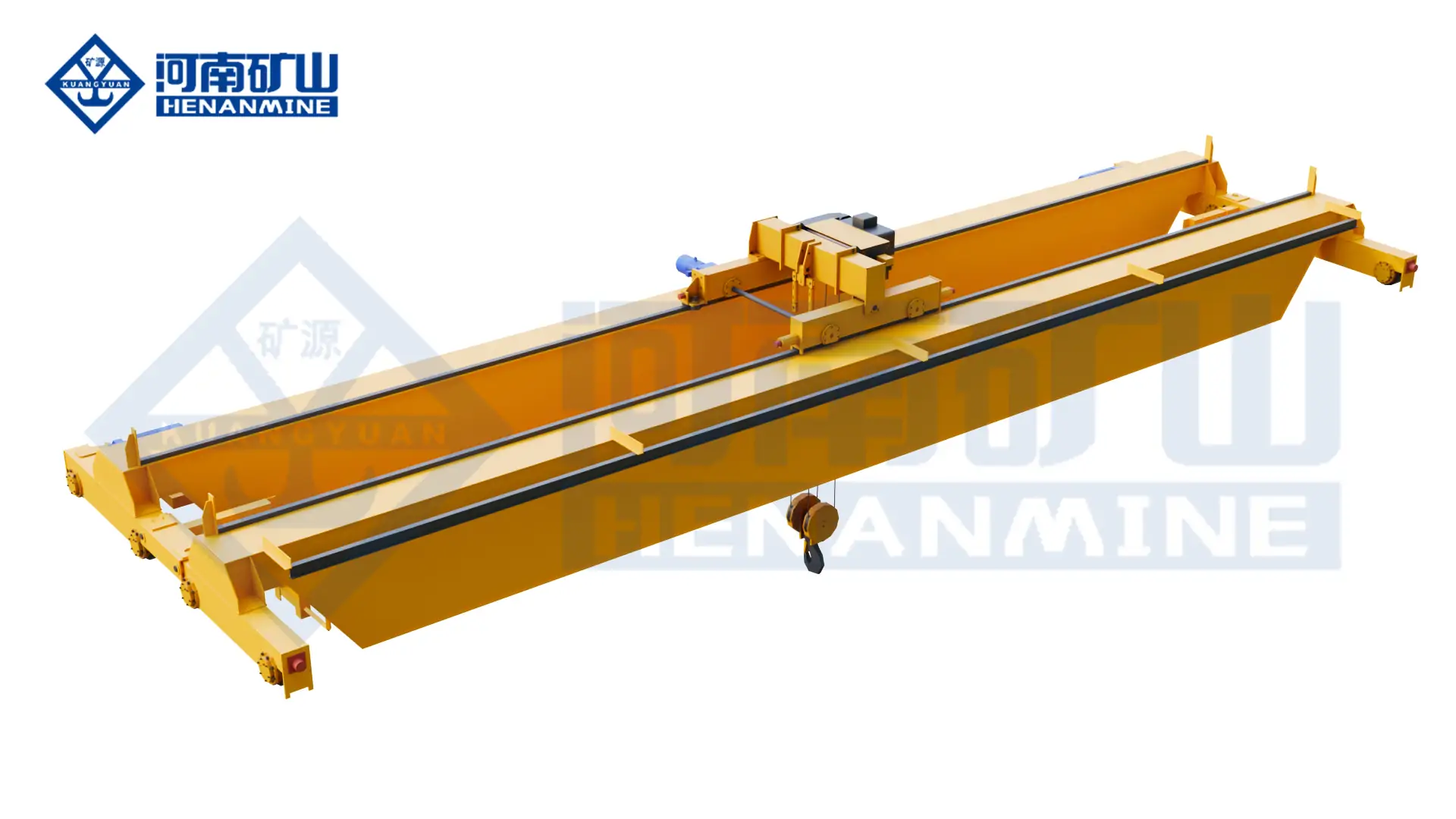
Vertical Hoisting Motion
A wire-rope electric hoist, electric chain hoist or open-winch trolley raises and lowers the load. Capacity, lifting height, reeving, motor duty, brake arrangement and required creep speed determine the hoisting mechanism.
Trolley Cross Travel
The hoist or trolley moves across the bridge to position the hook across the bay. Side approach, trolley wheelbase, rail arrangement and service access affect usable coverage.
Bridge Long Travel
End carriages move the complete bridge along parallel runway rails. Wheel loads, drive coordination, rail alignment, skew behavior, buffers and end limits require review as one travel system.
Smooth Motion and Positioning
Single-speed operation can suit simple maintenance tasks. Dual-speed or variable-frequency control improves acceleration, deceleration and final positioning. Anti-sway and automatic positioning are available where production flow justifies the additional control scope.
Overhead Travelling Crane Specifications
Overhead travelling cranes are project-configured rather than selected from capacity alone. The following schedule identifies the principal parameters that must appear in a technical proposal and purchase specification.
| Parameter | Available Engineering Direction | Required Project Definition |
|---|---|---|
| Rated capacity | Light, medium, heavy and project-specific lifting capacities | Payload, attachment mass, dynamic effects and required safety allowance |
| Bridge structure | Single girder, double girder, top-running or underhung | Span, headroom, hook approaches, building loads and maintenance access |
| Hoisting mechanism | Chain hoist, wire-rope hoist, open-winch trolley or special mechanism | Capacity, lift, reeving, duty, speed, redundancy and load type |
| Span and lifting height | Custom to runway gauge and operating envelope | Measured building section, rail elevation, floor level and highest load position |
| Working class | Selected under the specified ISO, FEM, CMAA or local classification basis | Operating time, starts, load spectrum, cycles and production criticality |
| Motion speeds | Single speed, dual speed or variable-frequency control | Required cycle time, load stability, approach speed and positioning tolerance |
| Operator control | Pendant, radio remote, cabin, remote station or automatic system | Visibility, travel distance, staffing, process interface and risk assessment |
| Power supply | Three-phase supply and control voltage matched to the destination site | Voltage, frequency, earthing system, feeder position and available fault level |
| Load attachment | Hook, lifting beam, grab, magnet, clamp or custom below-hook device | Load shape, temperature, pickup method, attachment mass and loss-of-power response |
| Environmental protection | Dust, corrosion, high-temperature, explosion-protected or clean configuration | Ambient data, hazardous-area classification, contaminants and enclosure requirements |
Frequently requested capacity groups include 1–5 t, 5–20 t, 20–50 t and 50 t+. These groups are procurement starting points rather than fixed model limits. Span, duty, building reactions and process risk can change the preferred crane structure within the same capacity.
Building, Runway and Electrical Interfaces
Runway Survey and Structural Review
Existing runway beams and supporting structures require verified dimensions, rail condition, alignment, elevation, support spacing and allowable reactions. New buildings require early coordination of crane wheel loads and horizontal forces with the structural designer.
Headroom and Hook Coverage
Rail elevation, roof bracing, lights, ducts, sprinklers and adjacent equipment can restrict crane depth and hook travel. End and side approaches should be shown on the approved general arrangement rather than assumed from nominal span.
Power Distribution
The supply scope can include runway conductor bars or festoon systems, bridge cross-travel electrification, isolation, control transformer, protective devices and earthing. Interface positions and incoming cable responsibilities belong in the commercial schedule.
Multiple-Crane Operation
Shared runways may require anti-collision devices, working-zone limits and coordinated maintenance isolation. Tandem lifting requires a separately engineered control and load-sharing arrangement.
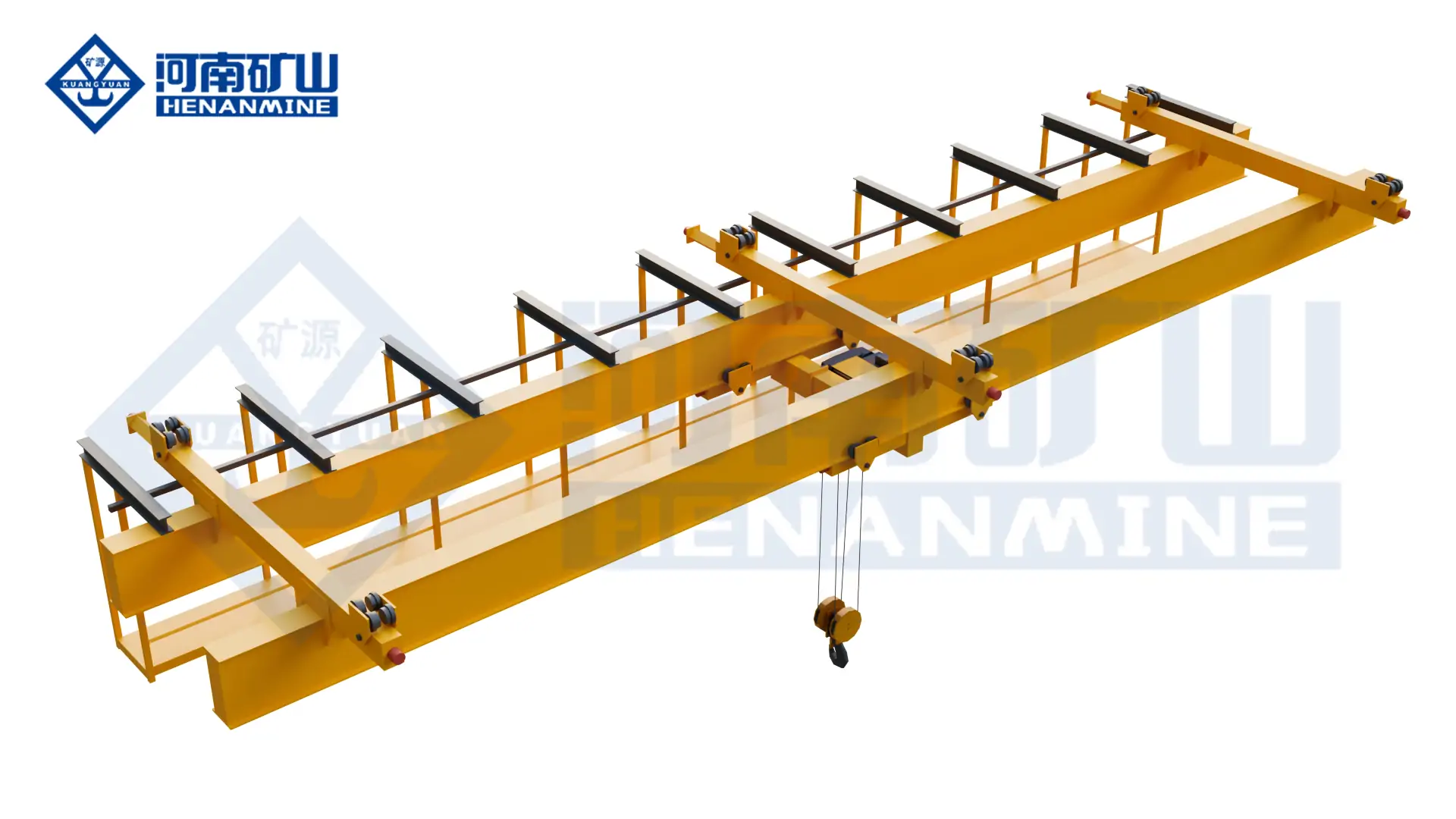
Controls, Safety Functions and Load Handling
Hoisting Protection
Overload limitation, upper and lower limits, brakes, rope guidance, hook latches and project-specific overspeed or redundancy functions protect the lifting motion.
Travel Protection
Bridge and trolley travel can include end limits, buffers, emergency stops, motor protection, braking supervision and anti-collision devices for shared runways.
Controlled Positioning
Variable-frequency drives, low-speed approach, anti-sway, encoders and selected positioning functions support stable load movement and repeatable process handling.
Special Attachments
Lifting beams, magnets, grabs, clamps and purpose-built attachments require defined load cases, interlocks, power-loss response and inspection provisions.
The final safety architecture follows the risk assessment, selected crane standard, destination regulations, working environment and handled material. Component names alone do not establish compliance; functions, setpoints, test methods and documentation must be defined in the technical agreement.
Representative Overhead Travelling Crane Projects
Project requirements range from one large-capacity crane for precision component installation to coordinated crane fleets serving several production lines. The following cases demonstrate both engineering conditions.
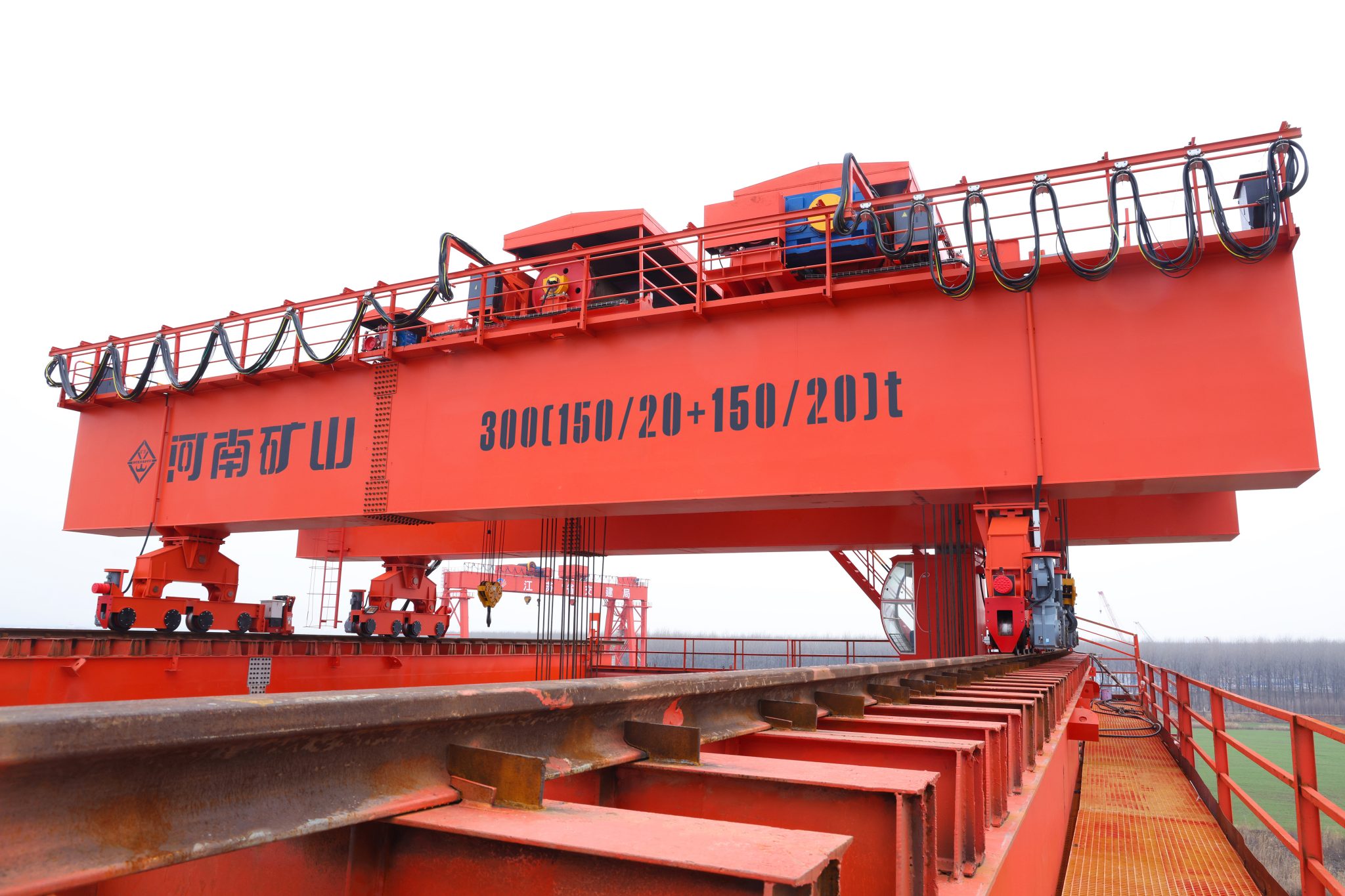
PROJECT CASE 01 · HEAVY ENGINEERING
300 t Double-Girder Overhead Travelling Crane
CAPACITY
300 t
STRUCTURE
Double Girder
APPLICATION
Bridge Construction
Henan Mine Crane developed the crane as core lifting equipment for the Zhangjinggao Yangtze River Bridge project. The modular double-girder arrangement addresses large component handling, installation access and transport segmentation.
The project configuration includes full variable-frequency motion control, hardened-gear drive components and integrated electrical design. This case demonstrates the engineering depth required when capacity, precision, long operating periods and project logistics must be resolved together.
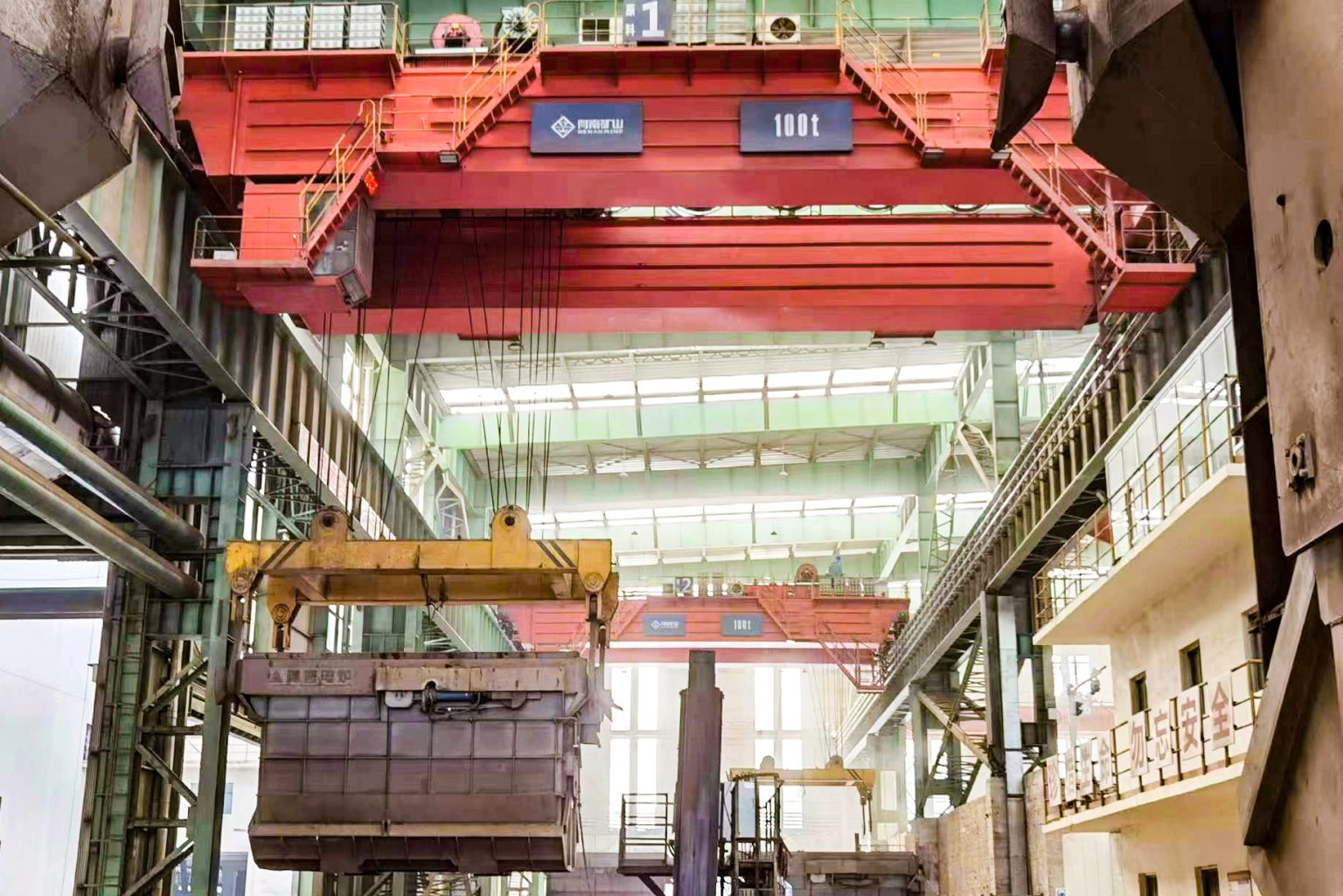
PROJECT CASE 02 · MULTI-CRANE PRODUCTION FACILITY
150-Crane Package for a 6-Million-Ton Industrial Plant
PACKAGE
Up to 150 Cranes
LISTED CAPACITIES
100 t and 125+125 t
PLANT CAPACITY
6 Million t/year
This industrial project required a batch crane package across material handling, equipment assembly and production processes. Individual crane specifications were assigned to different workstations instead of applying one standard configuration throughout the plant.
The disclosed equipment family includes 100 t intelligent cranes and 125+125 t cranes with variable-frequency control, position tracking, production-line interfaces, monitoring and redundant safety provisions. The case demonstrates multi-model engineering and coordinated delivery for a continuous-production facility.
Comparable Project Scope
A technically comparable crane case should identify capacity, span, lifting height, working class, load spectrum, mechanism arrangement, control philosophy, runway interface, environment and delivery boundary. Matching capacity without matching operating conditions does not establish an equivalent crane.
Engineering, Manufacturing and Project Documentation
A reliable purchase specification defines the design basis, manufacturing controls, inspection points and handover records before production begins. Henan Mine Crane can align the project document schedule with the destination requirements and agreed supply scope.
Engineering Package
- Design criteria and classification basis
- General arrangement and hook-coverage drawing
- Wheel loads and runway interface data
- Electrical architecture and control narrative
Manufacturing Controls
- Material identification and inspection scope
- Welding, dimensional and structural checks
- Wheel, end-carriage and mechanism alignment
- Surface preparation and coating inspection
Testing and Handover
- Factory functional and control checks
- Inspection records and component certificates
- Site commissioning and agreed load testing
- Operation, maintenance and spare-parts documents
Required standards, third-party inspection, witness points, certificate formats and document language should be listed in the inquiry. Certification must be confirmed for the selected crane and destination rather than inferred from a different product or project.
Delivery, Installation, Commissioning and Maintenance
Shipment and Site Readiness
Transport segmentation, packing, unloading access, erection equipment, runway completion, electrical supply and working permits should be confirmed before dispatch.
Erection and Alignment
Installation covers bridge assembly, end-carriage alignment, hoist or trolley installation, electrification, rail interface checks and verification of required clearances.
Commissioning and Acceptance
Commissioning verifies mechanisms, brakes, limits, controls, alarms, travel behavior and agreed load tests. Acceptance responsibilities follow the project contract and local regulations.
Lifecycle Maintenance
Routine inspection covers ropes or chains, hooks, brakes, wheels, rails, fasteners, lubrication, electrical devices and safety functions. Intervals follow duty, environment and applicable requirements.
Overhead Travelling Crane Price and Cost Scope
Current international equipment listings for basic new overhead travelling cranes commonly begin at approximately US$3,000–US$9,000. A practical early equipment budget for standard industrial single- or double-girder systems is approximately US$8,000–US$100,000+, depending on capacity, span, lifting height, working class, hoist or trolley design and control scope.
These figures are preliminary market-planning ranges, not fixed Henan Mine Crane selling prices. Heavy-duty, explosion-protected, metallurgical, automated or unusually wide-span cranes require an engineered quotation. A complete installed-system budget may be substantially higher when runway structures, building reinforcement, freight, erection, commissioning and local inspection are included.
| Cost Package | Typical Inclusions | Principal Cost Drivers |
|---|---|---|
| Crane Equipment | Bridge, end carriages, hoist or trolley, controls and specified safety functions | Capacity, span, lift, duty, speeds, environment and attachment |
| Runway and Power | Rails, runway beams, columns, conductor system, isolators and incoming feeder interfaces | Runway length, building capacity, foundation scope and local electrical design |
| Logistics | Packing, inland transport, ocean freight, insurance and destination handling as agreed | Shipment dimensions, delivery term, destination and route restrictions |
| Site Services | Survey, erection supervision, installation, commissioning, load test and training | Site access, labor, erection equipment, test loads and regulatory inspection |
A valid price comparison uses the same capacity, span, lifting height, working class, speeds, protection, control scope, runway boundary, documentation, delivery term and site-service responsibilities. A crane equipment price cannot be compared directly with a complete installed-system price.
Overhead Travelling Crane FAQ
Is an overhead travelling crane the same as an EOT or bridge crane?
The terms commonly describe the same crane family: a bridge travels along elevated runways and a hoist or trolley moves across the bridge. EOT emphasizes electric operation, while bridge crane emphasizes the supporting structure.
What is the difference between travelling and traveling crane?
Travelling is standard British spelling and traveling is standard American spelling. The equipment and operating principle are the same.
Should a single-girder or double-girder crane be selected?
Single-girder cranes suit many general industrial applications where lower bridge mass and compact electric-hoist construction satisfy the load and duty. Double-girder cranes provide additional rigidity and configuration space for heavier loads, wider spans, demanding duty or improved hook approaches.
Can an overhead travelling crane be installed in an existing building?
Installation may be possible after verifying runway beams, columns, brackets, roof clearances, rail alignment, electrical supply and erection access. A freestanding runway can be evaluated where the building cannot support crane reactions.
How is the required duty class determined?
Duty classification considers total operating time, starts per hour, load spectrum, travel distances, lifting cycles and production criticality under the specified standard. Rated capacity alone does not determine duty.
Which control method is suitable?
Pendant control supports local operation. Radio remote control provides flexible viewing positions. Cabin control suits long travel, intensive duty or visibility-critical work. Automatic control is evaluated for repetitive production and system integration.
How much does an overhead travelling crane cost?
Basic new equipment listings commonly begin around US$3,000–US$9,000. Standard industrial single- or double-girder equipment often requires an early budget of approximately US$8,000–US$100,000+. Runways, freight, installation and local inspection can add substantial cost.
Are runway beams and rails included in the crane quotation?
Only when expressly included. The commercial schedule should identify crane equipment, rails, runway beams, columns, conductor system, building work, freight, installation, commissioning and testing as separate scope items.
Can variable-frequency control and anti-sway be supplied?
Variable-frequency control can be configured for hoisting, trolley and bridge travel. Anti-sway, positioning and process interlocks can be integrated where the handling cycle, load behavior and required accuracy justify the control functions.
What information is required for a quotation?
The RFQ should include rated and normal loads, span, lifting height, runway length, building section, operating cycles, required speeds, control method, environment, power supply, project country, applicable standards and delivery and installation scope.
Request an Overhead Travelling Crane Quote
Henan Mine Crane prepares a project-specific configuration and commercial scope from the operating requirement and site data. The RFQ should include:
- Maximum and normal loads, load dimensions, attachment and lifting method.
- Runway span, lifting height, runway length, rail elevation and building section.
- Operating hours, lifts per hour, load spectrum and required motion speeds.
- Control method, positioning requirement and production-line interface.
- Temperature, dust, corrosion, hazardous media and indoor or outdoor conditions.
- Power supply, project country, required standards, inspection plan and installation boundary.