

Henan Mine Crane · Steel Mill Process Cranes
Slab Handling Crane for Steel Mill Storage and Transfer
A heavy-duty overhead crane engineered for lifting, transporting, turning, stacking and dispatching hot or ambient steel slabs across continuous-casting, cooling, conditioning, warehouse and rolling-mill interfaces.
Henan Mine Crane configures YB slab handling cranes with clamps, magnetic beams, synchronized lifting, slewing systems, PLC control and optional automation. Final design follows slab geometry, gross suspended mass, temperature exposure, handling route, duty and plant interfaces.
HANDLED MATERIAL
Hot & Ambient Steel Slabs
ATTACHMENT OPTIONS
Clamp, Magnet or Beam
SERVICE PROFILE
A7–A8 Published Range
CONTROL OPTIONS
Cabin, PLC & Automation
What Is a Slab Handling Crane?
A slab handling crane is a purpose-engineered metallurgical overhead crane that moves semi-finished steel slabs between production and storage stages. Typical duties include receiving slabs from a continuous caster, clearing a cooling bed, transferring material to inspection or scarfing stations, organizing stockyard stacks, feeding a reheating furnace and loading railcars, trucks or internal transfer equipment.
The equipment differs from a general hook crane because the slab itself defines the lifting system. Length, width, thickness, surface temperature, camber, scale condition, stack spacing and permitted contact zones determine whether a mechanical clamp, electromagnetic beam, hook beam or another approved attachment can establish secure load control. High cycle frequency and precise placement may also require synchronized lifting, anti-sway, low-speed positioning, coordinate control and production-system communication.
Rated capacity cannot be selected from slab net weight alone. The engineering basis must identify whether the contractual capacity represents slab payload or gross suspended load. A complete gross-load calculation includes the maximum slab or slab group, clamp or magnet beam, rotating structure, hook blocks, equalizing equipment and every component suspended below the trolley. Dynamic factors and the governing design basis are then applied.
Henan Mine Crane configures YB slab cranes for hot and ambient handling. Final project drawings define attachment geometry, control logic, safety functions and inspection requirements.
Slab Handling Crane Configurations
01 · Mechanical Slab Clamp Crane
Side-gripping mechanical or powered tongs engage approved slab faces. The arrangement avoids dependence on magnetic holding power and suits defined thickness and width ranges. Jaw geometry, closing force, locking status, surface scale and anti-release protection require project approval.
02 · Electromagnetic Slab Crane
A suspended magnet beam lifts magnetically responsive slabs without side access. Fast pickup and release support high-throughput yards, but magnetic duty, slab temperature, air gaps, power continuity, residual magnetism and emergency retention strategy govern suitability.
03 · Fixed-Orientation Transfer Crane
A non-slewing lifting system transfers slabs along a consistent storage or production axis. Reduced rotating mass and simpler control can support dependable repetitive handling when pickup and placement orientations remain aligned.
04 · Rotating Slab Handling Crane
A slewing trolley or rotating beam changes slab orientation between process bays, stacks, inspection lines and dispatch lanes. Rotation envelope, cable management, load inertia, collision zones and positioning accuracy form part of the crane design.
05 · Automated Slab Warehouse Crane
PLC control, encoders, ranging devices, anti-sway, stack coordinates and plant communication support unmanned or supervised automatic cycles. Manual recovery, safe-zone logic, inventory reconciliation and degraded-mode operation remain essential.
06 · Synchronized Dual-Lift System
Two lifting points or a 50+50 t arrangement distribute load along long slabs and specialized clamps. Load sharing, hoist synchronization, skew monitoring, rope reeving and independent protective functions limit twist and unequal loading.
Compare Slab Lifting and Motion Configurations
| Configuration | Load Interface | Principal Advantage | Engineering Constraint | Typical Application |
|---|---|---|---|---|
| Mechanical slab clamp | Side faces or defined gripping zones | No magnetic holding dependency; positive mechanical interface | Requires approved thickness, width, edge condition and jaw access; contact marks may require review | Hot or ambient slabs with stable geometry and controlled stack gaps |
| Electromagnetic beam | Upper slab surface through magnetic attraction | Fast pickup; no side access; adaptable magnet grouping | Ferromagnetic material only; air gap, temperature, scale, power loss and residual magnetism affect performance | Ambient or temperature-approved slabs in repetitive storage and dispatch |
| Hook or lifting beam | Engineered lifting points, chains or approved rigging | Flexible for unusual pieces and maintenance loads | Slower cycle; manual rigging exposure; lifting points and sling angles require control | Low-frequency handling or slabs with dedicated lifting interfaces |
| Non-slewing trolley | Clamp, magnet or beam kept on fixed axis | Simpler operating path and lower rotating complexity | Cannot correct orientation without another handling stage | Straight transfer between aligned production and storage points |
| Slewing trolley or beam | Attachment rotates around a controlled vertical axis | Places slabs across different bay and stack orientations | Higher dead load, headroom demand, inertia and collision-control complexity | Warehouses, conditioning lines and multi-direction dispatch layouts |
| Automatic coordinate handling | Attachment combined with sensors and stored positions | Repeatable stacking, traceable moves and reduced cycle variation | Requires reliable slab identity, clear zones, recovery logic and maintained calibration | High-throughput finished-slab warehouses and integrated production systems |
Attachment selection rule: slab temperature, magnetic properties, dimensional range, surface condition, stack access and failure consequence must be established before crane capacity, trolley layout and control functions are frozen.
Slab Handling Applications Across the Steel Process
| Process Area | Material Condition | Primary Handling Demand | Configuration Direction | Data Required for Engineering |
|---|---|---|---|---|
| Continuous-casting discharge | Newly cast hot slabs leaving the caster or transfer table | High radiant heat, production continuity and controlled pickup | Heat-shielded clamp crane with precise low-speed approach | Slab temperature, caster rhythm, transfer path and standby strategy |
| Cooling bed and slab yard | Hot slabs during staged cooling and buffer storage | Changing temperature, stack sequence and large coverage area | Clamp or approved magnetic system with coordinated yard travel | Cooling layout, dwell time, stack geometry and exclusion zones |
| Inspection and conditioning | Slabs routed to grinding, scarfing, marking or flaw detection | Accurate presentation and possible orientation change | Rotating clamp, magnet beam or engineered lifting beam | Required angle, placement tolerance and process-station interface |
| Finished-slab warehouse | Ambient slabs stored by grade, heat, order or destination | Inventory accuracy, dense stacking and repetitive cycles | Automated or semi-automated crane with coordinate control | Warehouse map, stack rules, identification method and throughput |
| Reheating-furnace feed | Selected slabs transferred from storage to rolling preparation | Production sequencing and furnace charging interface | High-duty crane with controlled placement and plant interlocks | Furnace schedule, buffer capacity, transfer equipment and cycle time |
| Rail, truck or internal dispatch | Slabs loaded to transport equipment or transfer cars | Vehicle position variation and personnel separation | Clamp, magnet or lifting beam with zone monitoring | Deck geometry, securing plan, loading sequence and access controls |
A hot-slab transfer crane may prioritize thermal protection, heavy duty and availability; an ambient warehouse crane may prioritize inventory control, positioning and dense storage. Materially different process conditions can require separate operating modes or separate cranes.
Slab Handling Crane Technical Selection Framework
The following range reflects the published Henan Mine Crane YB product envelope and a practical quotation framework. It is not a universal rating for every slab, building or destination. Final values appear on the approved project data sheet and general arrangement.
| Selection Item | Preliminary Engineering Envelope | Project Data Required | Procurement Control |
|---|---|---|---|
| Rated lifting capacity | 20–150 t published configurable range; 50+50 t documented project arrangement | Maximum slab mass, number of slabs, attachment mass and contractual capacity definition | Confirm net payload versus gross suspended load before mechanism sizing |
| Span | 10–39 m published configurable range | Runway rail-center distance, working coverage, end approaches and building reactions | Building clear width is not substituted for crane span |
| Lifting height | 5–23 m published configurable range | Lowest pickup, highest stack, attachment depth, rail elevation and service clearance | Available hook or clamp elevation is checked on a vertical section |
| Slab geometry | Project-specific; published clamp information identifies slabs from 150 mm thickness | Minimum and maximum length, width, thickness, camber, edge profile and weight distribution | Every attachment operating envelope is approved in writing |
| Temperature exposure | Published product information identifies operation around slabs up to 650°C | Slab surface temperature, ambient air, radiant exposure, distance, dwell time and heat cycles | Temperature terms are separated; a slab rating is not treated as ambient-air temperature |
| Duty classification | A7–A8 published range, subject to governing project classification | Lifts per hour, load spectrum, shifts, annual hours, travel distance and service-life target | Capacity and fatigue duty are evaluated independently |
| Motion performance | Hoist 1–8 m/min and crane travel 10–30 m/min published ranges; other values engineered | Cycle target, safe high-speed route, low-speed placement, rotation and positioning tolerance | Speed follows process flow, load stability and stopping distance |
| Control and power | PLC/HMI options; configurable voltage and frequency; cabin, supervised or automatic operation | Plant power, communication protocol, operating station, backup mode and cybersecurity boundary | I/O, interlocks, data ownership and recovery sequence are documented |
| Environment and protection | Metallurgical heat, dust and scale; IP55 listed as a published option | Temperature zones, dust, fumes, humidity, corrosion, vibration and maintenance access | Enclosures, cooling, cables, lubrication and materials match the actual zone |
| Runway and acceptance | Project-specific wheel loads, horizontal forces, rail and test requirements | Runway drawings, rail condition, destination rules, inspection authority and load-test plan | Crane, building and statutory responsibilities are contractually assigned |
Safety and Control Architecture for Slab Handling
The safety concept covers secure pickup, hoisting, travel, rotation, placement and release under the governing design basis and plant risk assessment.
Clamp Status and Release Interlocks
Open, closed and locked states are monitored where applicable. Hoisting permission, load presence and release conditions are interlocked so that a clamp cannot be opened during an unsafe suspended state.
Magnet Power-Loss Strategy
Magnetic systems require a documented response to supply interruption. Battery or alternate power, holding-time monitoring, alarms, controlled lowering and restricted personnel zones are selected from the load risk.
Hoist and Load Protection
Overload limitation, dual-point synchronization, upper and lower limits, brake monitoring, rope guidance and low-speed positioning protect the lifting path and prevent unequal loading.
Anti-Sway and Position Control
Mechanical reeving, VFD motion profiles, encoder feedback and optional electronic anti-sway reduce pendulation. Position tolerance is specified at the attachment and verified through commissioning.
Travel, Rotation and Collision Zones
End limits, buffers, anti-collision, slewing limits, clearance monitoring and protected storage coordinates prevent contact with structures, equipment, adjacent cranes and slab stacks.
High-Temperature Protection
Heat shields, protected electrical cabinets, temperature-rated cables, appropriate lubrication and component placement reduce radiant exposure. Inspection intervals reflect scale, heat and thermal cycling.
Automated-Mode Safeguards
Access control, zone scanning, permissive logic, fault diagnosis, safe stop, controlled restart and manual recovery govern unmanned or supervised cycles.
Operator and Maintenance Safety
High-visibility cabin design, cameras, warning devices, isolation points, platforms, access routes and component-removal space support controlled operation and maintainability.
Crane Structure, Headroom and Operating Logic
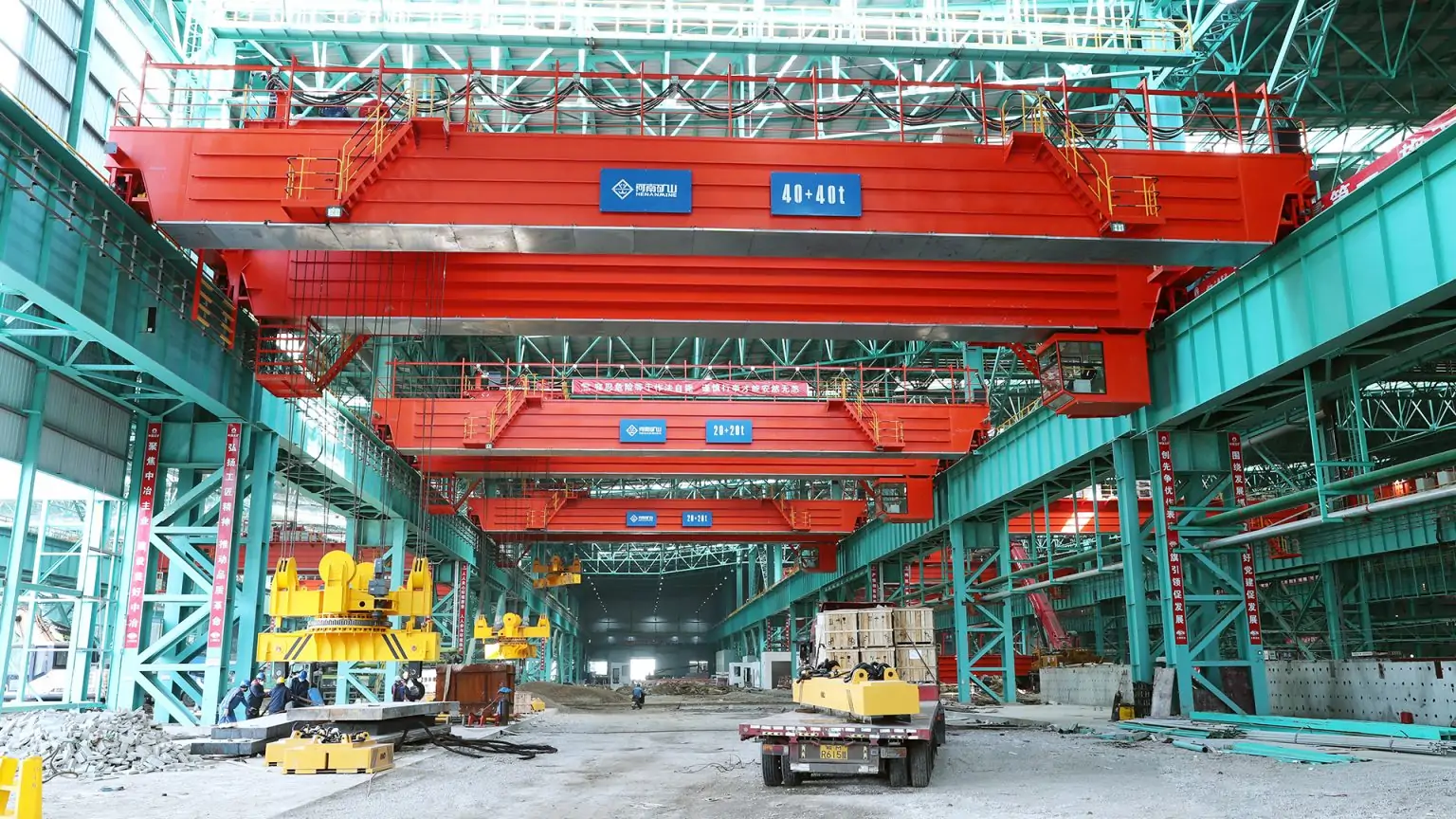
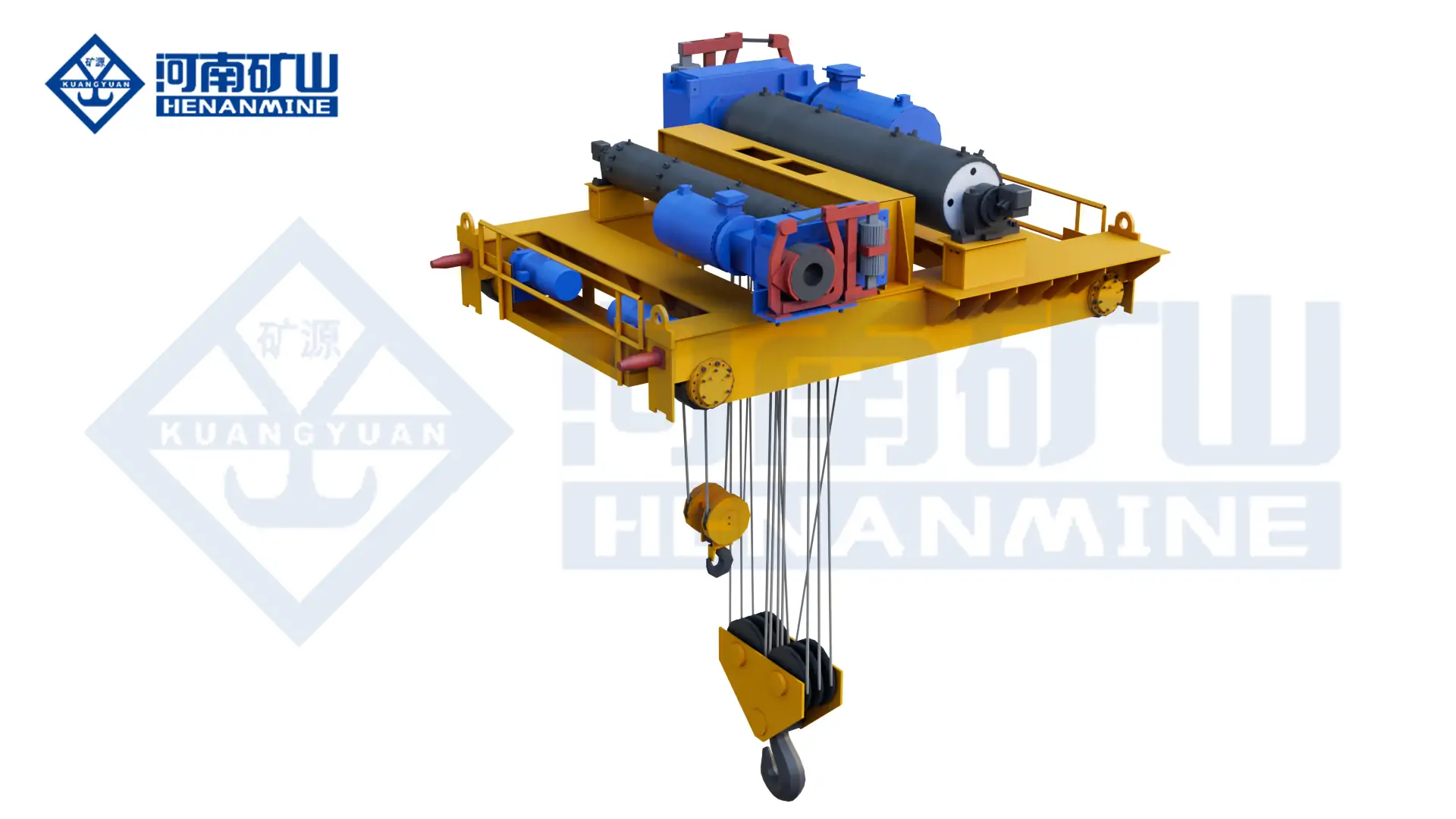
Heavy slab service commonly uses a top-running double-girder bridge with an engineered winch trolley. The arrangement provides structural stiffness, mechanism access and space for synchronized hoists, a rotating platform or a suspended clamp beam. Long slabs may require two lifting points so that load sharing and slab deflection remain controlled throughout acceleration, travel and placement.
Headroom is governed by more than hook height. Rail elevation, bridge depth, trolley structure, rope geometry, clamp opening height, slab thickness, required clearance above stacks and maintenance-removal paths must be shown on one dimensioned vertical section. A rotating attachment also requires a verified plan-view envelope at every operating elevation.
An automatic cycle normally includes destination validation, approach at controlled speed, attachment alignment, secure pickup confirmation, vertical clearance, bridge and trolley travel, optional rotation, stack-position verification, controlled lowering and release confirmation. Fault recovery must define retained load condition, safe manual access and the route back to a known coordinate.
Stack height, cooling separation, grade segregation, retrieval sequence and buffer locations determine travel distance and cycle time. Motion values should follow the process model rather than maximum speed alone.
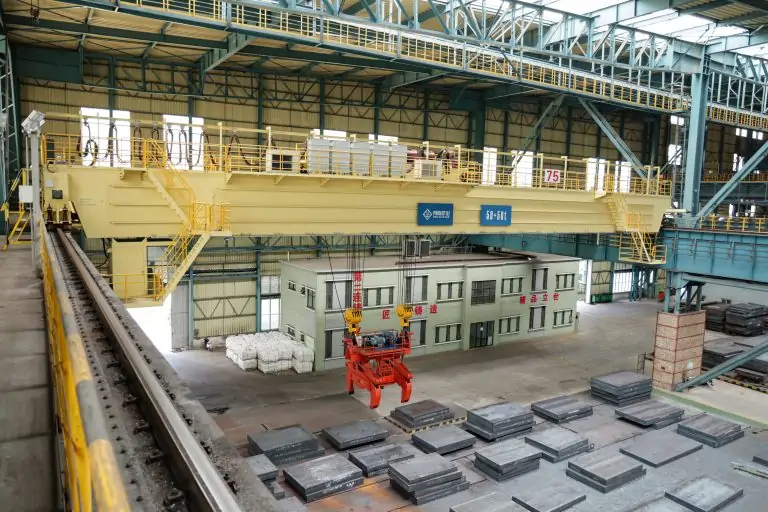
Project Case: 50+50 t Slab Clamping Crane
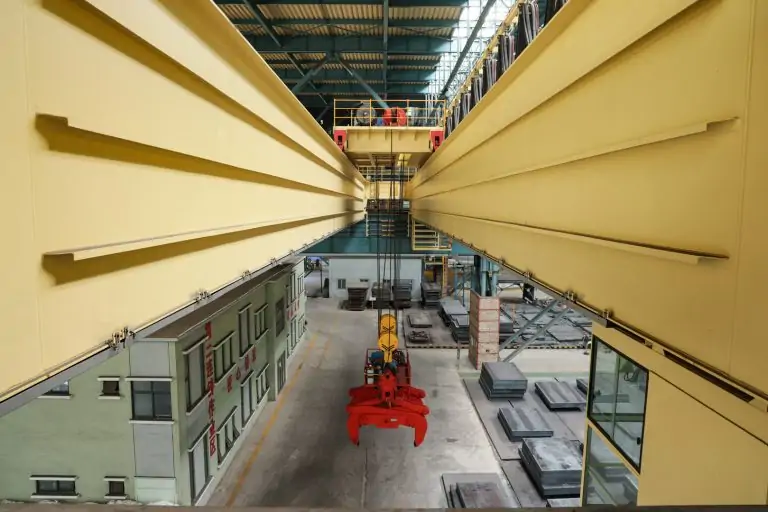
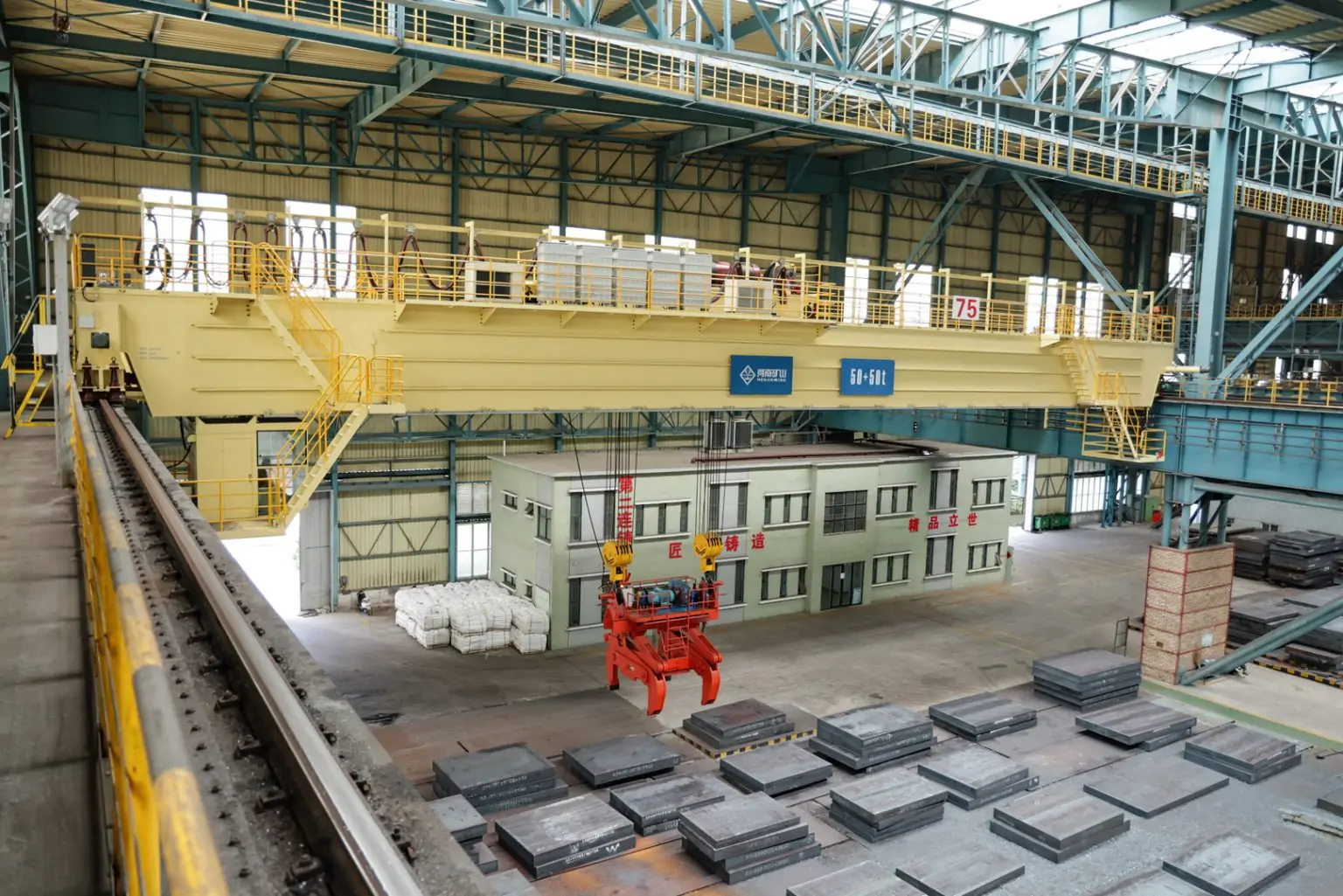
Henan Mine Crane manufactured a 50+50 t slab clamping crane for the Rizhao high-quality products base of Shanshan Iron & Steel. The project applies an electrically adjustable slab clamp with positioning control to large-tonnage steel-mill material handling.
The documented configuration addresses high-temperature radiation stated above 650°C through heat-resistant structural and protective measures. Digital speed control and a guiding arrangement support stable heavy-load motion and accurate placement. PLC control, weighing, fault alarms and operating-data functions provide a foundation for monitored production and later automation integration.
The case demonstrates that dual-point load control, clamp adjustment, thermal protection, positioning, monitoring and maintenance access must operate as one system. Temperature and performance values remain project-specific.
Engineering, Manufacturing and Quality Documentation
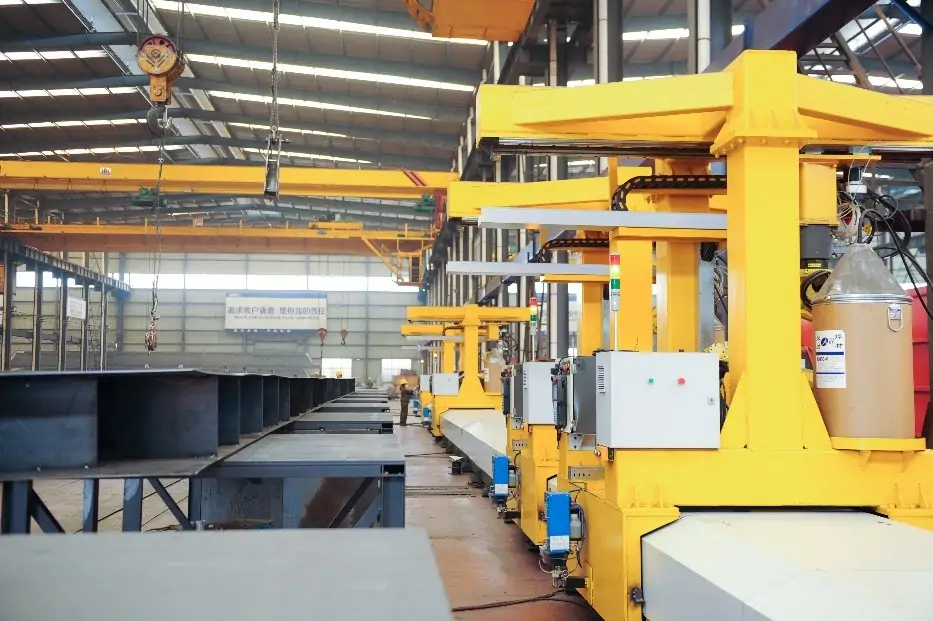
A slab handling crane should be released through an agreed document and inspection plan. Records connect the approved load case and control philosophy to the fabricated structure, assembled mechanisms and commissioned attachment.
Approved Design Package
General arrangement, wheel loads, attachment drawing, lifting-point geometry, mechanism data, electrical demand and control narrative.
Structural Quality
Material identification, approved welding procedures, welder qualification, dimensional checks and specified non-destructive examination.
Mechanism Verification
Hoist synchronization, brakes, drums, ropes, wheels, reducers, lubrication, rotation drives and maintenance-access checks.
Attachment Inspection
Clamp opening range, jaw contact, pins, locks, sensors, magnet circuits, beam geometry and safe-release interlocks.
Functional Testing
Motion tests, limits, alarms, overload functions, position feedback, automated sequences and contracted witness points.
Final Handover
Final drawings, manuals, configured parameters, inspection records, spare-parts schedule and commissioning documentation.
Installation, Commissioning and Lifecycle Planning
Site and Runway Verification
Confirm rail centers, elevation, alignment, supporting structure, maximum wheel loads, horizontal forces, conductor location, erection access and available assembly space before shipment.
Shipping and Erection Plan
Define transport divisions, lifting points, temporary supports, girder assembly, trolley placement, attachment installation, high-temperature protection and site responsibility matrix.
Cold Commissioning
Verify travel alignment, brakes, limits, encoders, clamp or magnet functions, rotation, alarms, interlocks, communication and manual recovery without a process load.
Load and Process Acceptance
Conduct contracted static, dynamic and functional tests, then validate pickup, transfer, positioning and release using approved trial slabs and controlled operating zones.
Attachment Maintenance
Inspect clamp jaws, pins, bushes, locks, guides and sensors; check magnet insulation, cables, power backup and beam condition. Wear limits and replacement criteria belong in the manual.
Thermal and Electrical Inspection
Monitor heat shields, cable protection, cabinet cooling, seals, lubrication condition, brakes, ropes and temperature-affected components at intervals derived from actual exposure.
Automation Support
Maintain coordinate calibration, sensor health, network interfaces, backups, fault logs and recovery procedures. Software changes require controlled authorization and documented validation.
Critical Spare Parts
Plan brakes, encoders, sensors, contactors, VFD-related components, limits, seals, clamp wear parts, cable assemblies and selected magnet-power components around production consequence.
Slab Handling Crane Price and Project Cost
Custom slab cranes require project quotation because capacity, attachment, temperature, duty and automation change the system materially. General bridge-crane figures provide only a lower-level market benchmark; they do not represent a fixed Henan Mine Crane slab-crane price.
| Budget Level | Indicative Market Position | Typical Scope | Main Cost Drivers | Commercial Control |
|---|---|---|---|---|
| General 5 t double-girder bridge benchmark | Around US$60,000 in a current North American installed example | Conventional bridge, trolley or hoist and installation under stated conditions | Span, lift, duty, runway, regional labor and controls | Not a slab-crane quotation; used only as a general-market floor comparison |
| General 10 t double-girder bridge benchmark | Around US$100,000 in a current North American installed example | Conventional double-girder system under stated conditions | Capacity, span, headroom, runway, installation and testing | Not comparable with 20–150 t metallurgical process equipment |
| Manual slab clamp process crane | Project quotation | Double-girder crane, open-winch trolley, engineered clamp and metallurgical protection | Gross load, slab range, clamp adjustment, heat, duty, span and documentation | Price schedule separates crane, attachment, electrification, freight and site services |
| 50+50 t or synchronized dual-lift crane | Project quotation | Dual lifting points, load sharing, high-capacity attachment and advanced monitoring | Synchronization, rope system, structure, brakes, clamp, thermal protection and testing | Approved load cases and supply boundary precede commercial comparison |
| Automated slab warehouse crane | Project quotation | Crane, attachment, sensors, anti-sway, positioning, PLC and plant interface | Coordinate accuracy, throughput, redundancy, system integration and recovery mode | Automation hardware, software, commissioning and production trials are itemized |
| Turnkey slab-handling installation | Project quotation | Equipment plus selected runway, delivery, erection, commissioning, load testing and training | Destination, civil and runway work, access, local labor, permits and shutdown plan | Equipment-only and installed-project totals remain clearly separated |
Price comparison basis: normalize capacity definition, attachment, duty, temperature protection, rotation, automation, runway, electrification, packing, freight, erection, commissioning, load testing, training and spare parts. A low equipment figure can exclude the highest-risk project interfaces.
Information Required for a Slab Handling Crane Quote
A complete request establishes attachment geometry, crane duty and project boundary. Slab schedules, building drawings and process-flow diagrams should accompany the following data.
Slab Size and Mass Range
Minimum and maximum length, width, thickness, unit mass, number lifted per cycle, camber, edge condition and center-of-gravity variation.
Temperature and Surface Condition
Maximum slab surface temperature, ambient temperature, radiant exposure, scale, moisture, contact restrictions and cooling pattern.
Handling Route and Stack Plan
Pickup and placement coordinates, transfer distance, stack orientation, maximum stack height, gaps, retrieval logic and vehicle interfaces.
Capacity and Attachment
Required payload, proposed clamp or magnet, attachment mass, opening range, rotation requirement, auxiliary hook and special handling modes.
Duty and Throughput
Moves per hour, load spectrum, shifts, annual hours, target cycle time, production criticality and standby or redundancy requirements.
Building and Runway
Rail centers, bridge travel, rail elevation, runway beam and rail data, column spacing, roof obstructions, wheel-load limits and maintenance access.
Control and Automation
Cabin or supervised control, automatic operating zones, positioning accuracy, anti-sway, cameras, plant PLC/MES interface and recovery philosophy.
Power, Destination and Scope
Voltage, frequency, destination country, governing requirements, delivery term, runway scope, installation, testing, training and required schedule.
Slab Handling Crane FAQ
How is slab crane capacity calculated?
Capacity begins with the maximum slab or slab group and the complete lifting attachment. The contract must state whether rated capacity means net slab payload or gross suspended load. Dynamic and design factors are then applied under the governing engineering basis.
Which attachment is suitable for hot slabs?
A temperature-rated mechanical clamp is a common direction where side access and slab geometry permit positive gripping. A magnetic system requires confirmed temperature capability, air-gap conditions and power-loss controls. Final attachment selection follows a documented risk and geometry review.
Can one clamp handle different slab widths and thicknesses?
An electrically or hydraulically adjustable clamp can cover an approved operating range. Minimum and maximum dimensions, jaw contact zones, opening clearance, clamping force and locking indication must be defined for every permitted slab family.
Can a slab handling crane rotate the load?
Yes. A slewing trolley or rotating lifting beam can change slab orientation. Rotation angle, envelope, inertia, cable routing, stopping accuracy and collision protection are incorporated into the crane and building layout.
Can the crane operate near 650°C slabs?
Henan Mine Crane publishes configurations for high-temperature slab exposure up to the stated product limit and documents a 50+50 t case for severe radiant heat. Final approval distinguishes slab surface temperature, ambient air, distance, exposure time and thermal cycling.
Is an electromagnetic system safe during a power failure?
Safety depends on the engineered retention and recovery concept. Backup power, monitored holding time, alarms, restricted access and controlled lowering may be required. A generic magnet without a documented power-loss strategy is not an acceptable basis.
Can the same crane handle billets?
Possible suitability depends on billet geometry, bundle condition, attachment contact and operating route. A slab clamp is not automatically suitable for billets. The complete billet range and proposed attachment require separate engineering approval.
What information determines crane duty?
Load spectrum, moves per hour, travel distance, full-load frequency, operating shifts, annual hours, motion speeds and production consequence determine structural and mechanism duty. Rated tonnage alone is insufficient.
Can slab warehouses be automated?
Yes. Automated handling can combine encoders, ranging devices, anti-sway, coordinate storage, slab identification and plant communication. Safe zones, manual recovery, calibration, inventory reconciliation and fault handling form part of the system.
What should a quotation include?
A complete quotation identifies capacity basis, attachment, span, lift, duty, speeds, controls, temperature design, safety functions, wheel loads, documentation, testing, delivery boundary, installation responsibility, schedule and exclusions.
Related Steel Mill Crane Products
Related configurations support adjacent steel-production tasks. Final product selection remains tied to load geometry, temperature, duty, attachment and process risk.
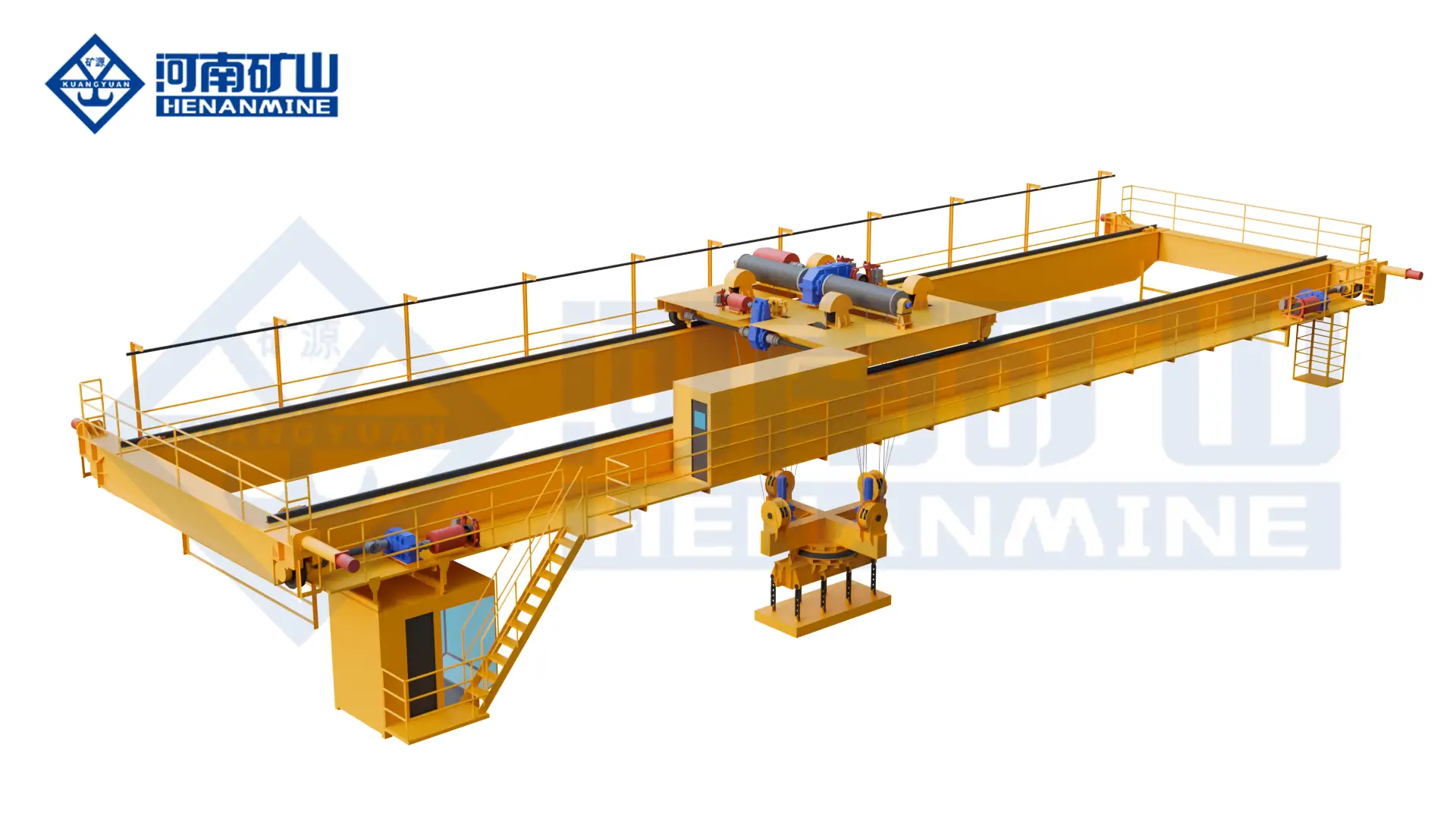
Electromagnetic Hanging Crane
Rotating magnetic-beam system for approved plates, profiles and other magnetically responsive steel loads.
Upper-Rotating Magnetic Crane
Slewing-trolley magnetic crane for multi-angle positioning in steel storage and production bays.
Double-Girder Bridge Crane
Customizable bridge platform for higher capacities, demanding duty and specialized below-the-hook equipment.
Metallurgical Bridge Crane
Heavy-duty overhead crane family developed for heat, dust and intensive metallurgical production service.
Quenching Crane
Fast controlled lifting system for transferring and immersing high-temperature workpieces during heat treatment.

Four-Girder Casting Crane
Ultra-heavy metallurgical crane for intensive ladle transfer and molten-metal production duties.
Configure a Slab Handling Crane for the Steel Process
Submit the slab dimensions and mass range, temperature, attachment preference, handling route, stack plan, throughput, span, lifting height, duty, runway information, power supply, automation scope, destination and delivery boundary. Henan Mine Crane will prepare a project-specific technical configuration and commercial quotation.