分类: Technical Resources

Crane selection, technology, operation and purchasing knowledge.

  • 150t Coastal Port Gantry Cranes for Marine Environments

    150t Coastal Port Gantry Cranes for Marine Environments

    150t Coastal Port Gantry Cranes for Marine Environments

    Coastal ports, shipyards and offshore engineering bases face harsh environments with high salt spray, strong winds and high humidity all year round, which puts forward strict requirements for the performance of heavy lifting equipment.The 150-ton coastal port gantry crane is specially built for this kind of scene. It has both large lifting weight, weather resistance and corrosion resistance, and continuous operation reliability. It is the core equipment for large-scale hoisting in marine scenes.

    What Are 150t Coastal Port Gantry Cranes?

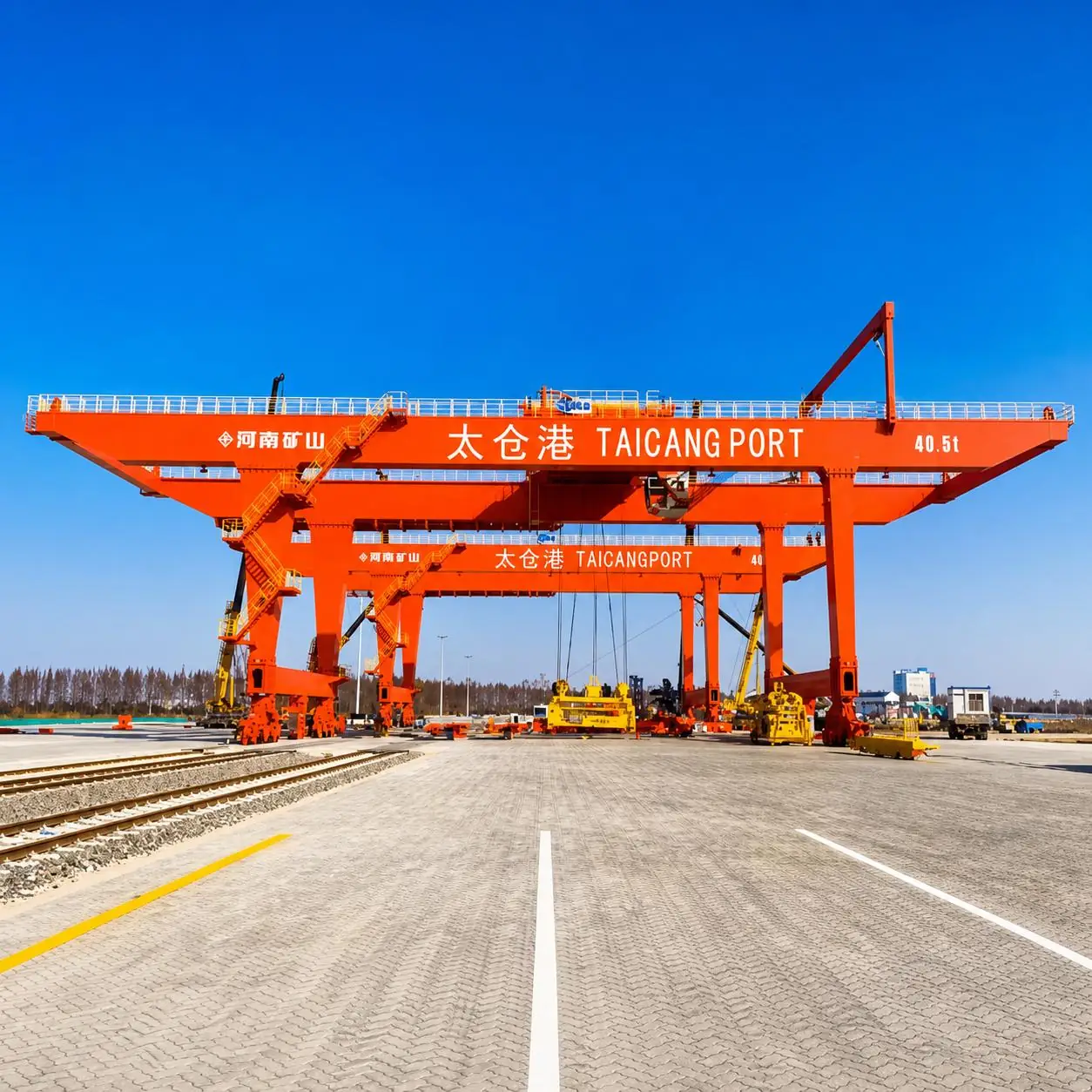
    The 150-ton coastal port gantry crane is a large-tonnage heavy-duty lifting equipment with a rated lifting weight of 150 tons.The whole machine uses door-shaped outriggers as the main support structure, and travels smoothly along the embedded track on the ground. The equipment as a whole has been specially strengthened for the marine environment, and it has the ability to operate in the open air around the clock.

    Facing the needs of large-scale hoisting in ports and docks, the crane can stably achieve vertical lifting, precise positioning and horizontal transfer of heavy objects. It is widely used in the loading, unloading and displacement of oversized materials such as hull segments, marine modules, and heavy steel structures.

    Core performance characteristics

    • The rated lifting weight can reach 150 tons, which can calmly undertake the lifting operations of various types of large-scale marine engineering cargo, and is suitable for the lifting conditions of heavy-duty components such as hull segments and marine modules.
    • The span and lifting height of the door machine can be customized on demand. The conventional span covers the range of 20-50 meters, and larger span specifications can be designed according to the needs of the site.
    • It has the ability to operate in the open air around the clock, and the whole machine is equipped with a special anti-corrosion and weather-resistant protection system for the ocean to resist coastal salt spray, heavy rains, temperature differences and other harsh environmental erosion.
    • It can adapt to high-frequency continuous operation cycles, the durability of the whole machine is strong, and the working level of the equipment generally reaches A6~A7 and above, ensuring long-term stable service.
    • The control scheme is flexible and diverse, supporting local manual operation and remote control in the cab, and can also be upgraded with semi-automatic or fully automatic control systems to adapt to the intelligent operation needs of different ports.

    Main Challenges of Operating Gantry Cranes in Marine Environments

    Salt spray corrosion protection challenge

    Salt spray and chlorine-containing air will greatly accelerate the corrosion of steel, and the corrosion rate is 5-10 times that of the inland environment.Chloride ions will penetrate the coating, causing pitting and crevice corrosion of the main beam, welds, fasteners, walking wheels, and electrical components, weakening the structural strength.

    Corresponding protection priorities: multi-layer anticorrosive coating system, high-quality structural steel, stainless steel or anticorrosive protection fasteners for key parts, fully sealed electrical cabinets, and high-protection electrical components.

    Weather and wind resistance

    Coastal areas encounter strong winds, heavy rains, high humidity, and temperature differences all year round, and some areas will also face typhoons.Crane design requirements: It can withstand wind speeds of about 14m/s under operating conditions, and can withstand high winds of 55m/s and above in non-working anchoring conditions.

    The equipment adopts truss-type main beam to reduce the wind load (which can reduce the wind load by 40%-60%), and is equipped with track clamps, storm anchors, and wind speed monitors, which automatically stop and lock and fix when there is a strong wind.

    Wear problems in continuous heavy-duty operations

    High-frequency lifting operations will accelerate the wear of lifting mechanisms, reducers, wheel tracks, brakes and electrical components.Reliable mechanical structure design, frequency conversion drive system, overload protection device, and structural design that is easy to overhaul and maintain are the key to reducing downtime and failures.

    Key Design Features of 150t Marine Gantry Cranes

    High-performance lifting mechanism

    The reinforced box beam or truss gantry structure is adopted to resist the stress caused by dynamic loads and wind loads.With the help of finite element analysis (FEA), the structural stress is optimized and calculated; the span, lifting height and operating range are customized as needed.Under the working conditions of coastal soft land foundation, the pile foundation foundation plan can also be matched to ensure the stability of the whole machine.

    Heavy-duty lifting system

    The high-performance motor and reducer are combined with a multi-magnification wire rope lifting system to disperse the load and improve safety redundancy.Equipped with load monitoring and overload protection devices, frequency conversion control realizes smooth acceleration and deceleration, and the positioning accuracy can reach ±10~50mm.

    Electrical anticorrosive protection

    The electrical control cabinet reaches IP54/IP65 and above waterproof and dustproof rating, the cabinet is equipped with an anti-condensation heater, the motor and bearing adopt a sealed structure, and it is equipped with a remote condition monitoring function to prevent salt spray and moisture from invading the electrical system.

    Corrosion Protection Solutions for Coastal Port Gantry Cranes

    • Multi-layer composite anticorrosive coating system: the steel is sandblasted to Sa2.5 near–white grade, using zinc-rich epoxy primer, thick-paste epoxy intermediate paint, polyurethane/fluorocarbon topcoat combination, dry film thickness 240-360µm; key components can be additionally hot-dip galvanized to strengthen anticorrosive.
    • ISO 12944 C5-M marine anticorrosive standard: The C5-M of ISO 12944 is a highly corrosive marine atmosphere grade, which is suitable for high-salt coastal environments.The anti-corrosion life of the C5-M coating system can reach 15-25 years. Compared with ordinary coating, it can effectively extend the service life of the door machine and reduce operation and maintenance expenses.
    • Detailed anti-corrosion structure design: the structure is equipped with drainage bevels and drain holes to avoid stagnant water; the bearings and motors are sealed; the bolts and connecting nodes are rust-proof; the welds are polished and smooth, and the box-shaped components are closed to reduce corrosion germination points.

    Smart Technologies Improving 150t Port Gantry Crane Efficiency

    • PLC intelligent control system: A programmable logic controller (PLC) realizes precise control of lifting, cart operation, and trolley movement, supports automated operation processes, and can be connected to the terminal operating system (TOS) to integrate into the overall operation scheduling of the port.
    • Anti-shake and precise positioning technology: an open-loop/closed-loop anti-shake system based on sensors and algorithms to suppress the swing of heavy objects.In a windy environment, it can not only improve the safety of operations, but also speed up the alignment of goods.
    • Remote monitoring and predictive maintenance: equipped with Internet of Things sensors, it collects operating data such as load, vibration, temperature, and wind speed in real time, and automatically pushes fault warnings.Formulate maintenance plans based on the actual operating status of the equipment, reduce unplanned downtime, and support remote fault diagnosis.

    Safety Features for Heavy Marine Lifting Operations

    • Load safety control: The whole machine is equipped with overload protection device, real-time load monitoring system and emergency stop system, which dynamically monitors the lifting weight throughout the process. In the event of overload, protection can be quickly triggered to eliminate the risk of structural deformation and failure caused by overload operations.
    • Anti-collision and walking protection device: equipped with limit switch, laser/radar positioning and door-machine interlocking anti-collision system to avoid equipment collision; equipped with anti-derailment device and end buffer to achieve multiple safety protection.
    • High wind and storm safety protection system: the anemometer monitors the wind in real time, automatically alarms and shuts down when the early warning threshold is reached; track clamps, storm anchors, and parking locking mechanisms can stabilize and lock the whole machine in extreme weather such as typhoons.

    How to Select the Right 150t Coastal Port Gantry Crane

    On-site operation condition assessment

    On-site survey of the project site and comprehensively evaluate the basic conditions for hoisting:

    • Maximum lifting load: When calculating the rated load, the dynamic load impact generated by hoisting needs to be fully included, and the weight of ancillary components such as spreaders and beams must be included. It cannot be calculated only according to the net weight of the workpiece, and sufficient safety redundancy should be reserved to avoid the risk of overload.
    • Cargo to be hoisted: evaluate the outline, overall length, width, and center of gravity of the cargo in detail, and predict in advance the problems of partial load, shaking, and space interference that may occur during the hoisting process.
    • Operation intensity: Count the frequency of daily operation cycles and the length of continuous work in a single day to match the adapted crane work level to ensure that the equipment can withstand continuous heavy-duty operations stably for a long time.
    • Environmental conditions: collect environmental parameters such as on-site salt spray concentration, annual average wind speed, extreme high and low temperature, and annual rainfall as the core basis for the design of the anticorrosive scheme and wind-resistant structure of the whole machine.
    • Site restrictions: on-site survey of available installation areas and spaces for carts to walk, and investigate surrounding obstacles such as buildings and pipelines to prevent collision and interference during operations.
    • Basic conditions: test the geological bearing capacity of the site, evaluate the track layout plan, and judge the construction difficulty and feasibility of civil engineering projects such as foundation pouring and burial of embedded parts.

    Verification of key technical parameters

    Check the core technical indicators of the equipment item by item to match the project requirements:

    • Lifting height and effective span of the door machine: combine the size of the cargo with the height of the obstacles on site to determine the parameters, and reserve sufficient safety margin to ensure the working space for heavy objects to lift and cross obstacles.
    • The working level of the whole machine: The high working level of A6~A8 is preferred for heavy-duty continuous operation scenarios in ports, which is suitable for long-term and high-frequency hoisting cycles.
    • The operating speed of the mechanism: it covers the lifting speed, the operating speed of the trolley, and the walking speed of the trolley, and strikes a balance between the operating efficiency and the stability of the hoisting.
    • Power supply form, voltage specifications, cable layout plan: match the on-site power distribution system of the port, plan a reasonable power supply method and cable retractable layout to ensure stable and reliable power supply.
    • Control mode: You can choose from a variety of modes of local operation, remote control, and automatic control in the cab to meet the operating needs of different automation levels.
    • The wind resistance design level of the whole machine and the protection level of the anticorrosive coating (recommended C5-M): Selected according to the coastal meteorological and salt spray environment, the C5-M anticorrosive system can resist the high salt spray erosion of the ocean.
    • Lifting mechanism safety factor and braking performance indicators: verify the safety redundancy of the lifting mechanism and the braking ability of the main and auxiliary brakes to build a strong safety bottom line for heavy lifting

    Structural scheme selection

    According to the hoisting object and site, determine the main structure form:

    • Main structure selection: combine the hoisting load characteristics, cargo specifications and on-site site conditions to determine the overall structure plan of the crane.
    • Main beam form: you can choose a single main beam gantry crane, or a double main beam gantry crane with stronger carrying capacity and better overall stability.
    • Door leg configuration: Select the door leg style as needed, and match the combination of rigid legs and flexible legs to offset the structural expansion and contraction effects caused by temperature changes.
    • Walking plan: The conventional rail-type cart walking mechanism is used, and other walking plans can also be evaluated according to the site conditions.

    Optional protection level

    Customized protection plan for marine corrosive environment:

    • Optional anticorrosive plan: Customize the protection plan of the whole machine for the marine corrosive environment with high salt spray in coastal ports. Conventional basic anticorrosive coating can be selected, and it can also be upgraded to ISO 12944 C5-M high-level marine anticorrosive package as needed, greatly improving the equipment’s ability to resist chloride ion erosion.
    • Electrical protection upgrade: Upgrade the protection level of electrical components, and choose control cabinets, motors and sensor components with high IP protection specifications to block salt spray, rain and humid air from invading the electrical interior to avoid circuit short circuits and metal parts corrosion.
    • Supporting protection design: improve the entire sealing structure and drainage channels of components, and at the same time equip the electrical cabinet with an anti-condensation heating system to eliminate corrosion incentives such as stagnant water and condensation from the structural details, and reduce the risk of equipment corrosion in all directions.

    Intelligent and automated configuration selection

    Choose intelligent systems on demand to adapt to the construction of smart ports:

    • Intelligent configuration planning: various types of intelligent systems are selected on demand to adapt to the long-term development plan of the digital construction of smart ports and improve the level of terminal operation automation.
    • PLC electronic control system upgrade: Upgrade and optimize the basic electronic control PLC system to improve the control accuracy of lifting action and ensure the stable and reliable operation of lifting, cart and trolley.
    • Intelligent monitoring module: add load monitoring, anti-shake control and remote online monitoring module to grasp the status of the equipment in real time, suppress the swing of heavy-duty cranes, and improve the safety of hoisting.
    • Automated docking capability: it supports the transformation of automated operations, can realize data docking and interoperation with the terminal operating system, open up the data stream of port operations, and realize collaborative scheduling.

    Optional for spreaders and special operations

    Combined with the type of hoisting cargo, supporting special accessories:

    • Customization of hoisting accessories: special spreaders, balanced beams and reinforced hook components can be customized according to the shape of large pieces, which are suitable for hoisting special-shaped components such as hull segments and marine modules.
    • Dual-machine synchronous lifting system: For large-scale joint lifting conditions, a dual-machine synchronous lifting control system is optional to realize the coordinated action of the two gantry cranes and the balanced distribution of loads to ensure the stability and safety of joint lifting operations.

    Full cycle operation and maintenance evaluation

    Evaluate the landing conditions of the whole cycle of the project in advance:

    • Modular design of the whole machine: evaluate whether the equipment adopts a modular structure, supports the separation and transportation of components, and facilitates the disassembly, relocation and reuse of off-site after the completion of the later project.
    • On-site installation and commissioning cycle: calculate the construction period required for on-site assembly, docking of the whole machine and electrical commissioning, and plan the construction window in advance to reduce the downtime of terminal operations.
    • Convenience of spare parts supply, maintenance and maintenance: verify the manufacturer’s spare parts supply capacity, consider the design of equipment maintenance platform and disassembly space, and reduce the difficulty of late maintenance and downtime costs.

    Conclusion

    The 150-ton coastal port gantry crane needs to take into account heavy-duty hoisting, adaptation to the marine environment, stable high-frequency operation and long-term reliable operation.Facing the problems of coastal salt spray, strong winds, and continuous operation, the equipment needs to be comprehensively designed in terms of anti-corrosion, structure, lifting system, intelligent control, and safety protection.

    Manufacturers with offshore lifting experience are more adaptable and have lower operation and maintenance costs.Henan Mine Crane can customize a 150-ton door machine with anti-corrosion, safety and intelligent solutions to serve heavy-duty port operations.
    Henan Mine CraneDiscuss your requirements ↗
  • 10t Single Girder Outdoor Gantry Cranes: Cost-Effective Stockyard Staging Solutions

    10t Single Girder Outdoor Gantry Cranes: Cost-Effective Stockyard Staging Solutions

    10t Single Girder Outdoor Gantry Cranes: Cost-Effective Stockyard Staging Solutions

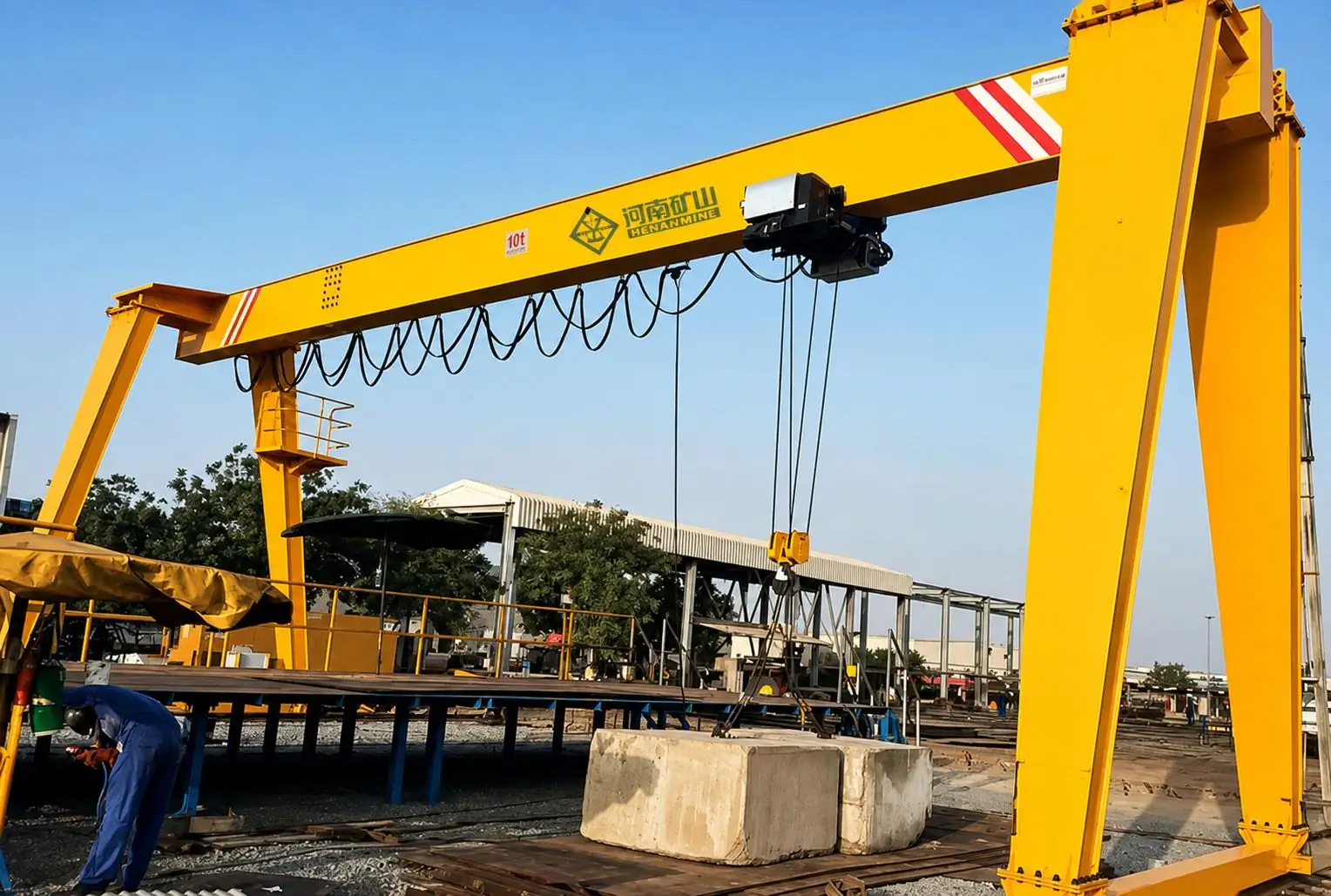
    In the daily lifting operations of open-air yards, storage yards, and building materials processing sites, most enterprises will face a problem. It is necessary not only to meet the needs of 10-ton normalized hoisting, stacking, and loading and unloading operations, but also to strictly control the comprehensive cost of equipment procurement, installation, and operation and maintenance, and at the same time adapt to complex working conditions such as outdoor wind and rain, exposure, and temperature differences.With its lightweight and stable structure, minimalist operation and maintenance system, high space utilization rate and outdoor adaptability, 10t single girder outdoor gantry cranes has become a standardized lifting solution with the highest neutral price ratio in small and medium-sized depots, steel storage, building materials transportation, and wood stacking scenarios.Unlike double-girder gantry cranes and large-scale bridge cranes, which have high input, high footprint, and high operation and maintenance costs, 10t single girder outdoor gantry cranes are specially tailored for the normalization staging scene of outdoor yard, taking into account the advantages of load stability, outdoor weather resistance and full life cycle cost. It is currently the mainstream choice for upgrading lifting equipment in industrial yards and supporting new sites.

    Why Single Girder Gantry Cranes Are Cost-Effective

    Cost control is the core consideration in the selection of industrial yard equipment. Enterprises not only pay attention to the initial purchase price of equipment, but also pay more attention to comprehensive investment in installation, operation and maintenance, energy consumption, and site adaptation.The reason why Henan Mine Crane manufactured 10t single girder outdoor gantry cranes has become the first choice for cost-effective yard is that it realizes all-round cost reduction from the four dimensions of structure, system, installation, and space utilization. Compared with the same tonnage double girder gantry crane and fixed lifting equipment, the comprehensive cost of use can be reduced by more than 30%, which is perfectly adapted to the needs of small and medium-tonnage, high-frequency, and outdoor open yard operations.

    Lower Structural Cost

    The lightweight design of the single-beam core structure is the core advantage of its structural cost reduction.The 10t single girder outdoor gantry cranes adopts an optimized Q235B national standard steel single main beam structure. Compared with double-beam gantry cranes of the same tonnage, the core structural materials such as main beams, end beams, and brackets are greatly streamlined, and the overall weight is lighter. , The structural design is more concise, and the manufacturing cost of equipment is reduced from the source.

    The streamlined structure does not sacrifice the carrying stability of the equipment. Through the mechanically optimized box beam structure, it accurately matches the operating requirements of the 10-ton rated load, and eliminates the cost waste caused by structural redundancy.At the same time, the lightweight structure effectively reduces the wheel pressure of the equipment itself, eliminates the need for a heavy high-strength load-bearing foundation, and greatly reduces the supporting cost of civil construction on the site.For yard companies with limited budgets and mainly conventional stacking and transshipment, the structural design can directly reduce the initial equipment procurement cost by 15%-25%, and the cost-effective advantage is extremely outstanding.

    Simple Crane System

    The 10t single girder outdoor gantry cranes is equipped with a minimalist modular lifting system, the mechanical structure, electrical control, and transmission mechanism of the whole machine are highly simplified, there are no complex redundant accessories, and the failure rate is much lower than that of traditional heavy lifting equipment.The core operating components of the equipment are concentrated in the three modules of electric hoist, walking mechanism, and control system. The accessories are highly versatile and the market penetration rate is high, which greatly reduces the cost of late maintenance and replacement.

    At the daily operation and maintenance level, the simple system architecture makes equipment overhaul, maintenance, and troubleshooting more convenient. Without the need for a professional high-end technical team, ordinary operation and maintenance personnel can complete daily inspection, lubrication, and commissioning work, greatly saving labor operation and maintenance costs.At the same time, the energy consumption of the equipment motor is lower, and the lightweight operating structure reduces the energy consumption and consumption of the operation. Under long-term high-frequency yard operations, the energy-saving and cost-reducing effect is significant.The system characteristics of low failure, easy operation and maintenance, and low energy consumption make the whole life cycle cost of the equipment much lower than that of similar double-beam lifting equipment.

    Lower Installation Cost

    Outdoor depots are mostly open sites with limited civil infrastructure conditions, while 10t single girder outdoor gantry cranes are adapted to simple installation solutions, eliminating the need for complex large-scale civil engineering, aerial work equipment and cumbersome installation processes. The installation cost and cycle have been greatly optimized.Thanks to the lightweight split structure of the equipment, the whole machine can be split into main beams, end beams, walking mechanisms, electrical systems and other modules, which are convenient for transportation and low for hoisting and assembly, without the need for large-scale hoisting equipment to assist in installation.

    The installation process is standardized and simplified. The professional construction team can complete the splicing, track calibration, electrical commissioning, and no-load load testing of the whole machine in a short period of time, greatly reducing the construction period and labor construction costs.At the same time, the equipment has extremely low requirements for the installation foundation. Conventional gravel ballast + sleeper foundation or simple concrete foundation can meet the operating needs without high investment in civil engineering transformation, which is perfectly adapted to the needs of rapid landing and rapid commissioning of old and new yards, and further reduces the overall landing cost of the project.

    Better Space Efficiency

    The site utilization rate of the industrial yard directly determines the storage and transshipment capacity of the enterprise. Henan Mine Crane manufactured 10t single girder outdoor gantry cranes adopts a narrow fuselage, low headroom, and long-span adaptation design, and the space utilization efficiency far exceeds that of traditional lifting equipment.The main beam of the equipment has a compact structure and no redundant footprint on the side. The walking track fits the edge of the site, does not occupy the core material stacking and vehicle passage space of the yard, and maximizes the use area of the site.

    At the same time, the effective operation coverage of the equipment is wide, and it can be adapted to the span of a conventional yard of 12-30 meters. A single equipment can cover a large area of the yard operation area, without the need for multiple equipment to be superimposed, which not only saves equipment procurement investment, but also avoids space conflicts in multi-equipment operations.For industrial depots with every inch of soil and every inch of gold, efficient space utilization can directly improve the stacking capacity and transportation efficiency of materials, and increase site production capacity and enterprise economic benefits in disguise, so as to realize the operating advantages of small space, large production capacity, and low investment.

    Key Features for Outdoor Stockyard Operation

    The operating environment of the outdoor yard is complex and changeable, and it faces harsh working conditions such as sun, rain, wind, frost, snow, dust, sand, and large temperature fluctuations for a long time. Ordinary indoor cranes are prone to electrical failures, corrosion of components, stuck operation, unstable load-bearing and other problems.The 10t single girder outdoor gantry cranes are specially customized for open-air working conditions and are equipped with a full set of outdoor special configurations, from electrical systems, lifting mechanisms, walking systems to orbital operation systems, which are fully adapted to harsh outdoor environments, ensuring stable and continuous operation of equipment for 24 hours, and reducing equipment failure rates and downtime losses under outdoor working conditions.

    Weather-Resistant Electricals

    The electrical system is the core vulnerable module of outdoor lifting equipment. In view of the environmental characteristics of outdoor humidity, rain, exposure, and dust accumulation, all 10t single girder outdoor gantry cranes are equipped with outdoor weather-resistant electrical accessories.All electrical control cabinets, junction boxes, and limit switches adopt IP54 and above dust-proof and waterproof protection levels, which can effectively block rainwater penetration, dust accumulation, and fog erosion, and eliminate common electrical faults such as short circuits, leakage, and poor contact.

    The supporting cables of 10t single girder outdoor gantry cranes are made of special outdoor cables that are resistant to aging and high and low temperature. They are not afraid of high temperature exposure in summer and freezing and cracking at low temperature in winter. They have excellent weathering and corrosion resistance, and are not easy to break and age for long-term outdoor use.At the same time, the electrical system is equipped with multiple safety protection functions such as overload protection, short circuit protection, voltage loss protection, and emergency stop protection. In severe weather and sudden working conditions, it can automatically power off and stop, avoid equipment damage, and the risk of safety accidents, and ensure the safety and stability of outdoor yard operations around the clock.

    outdoor gantry crane

    Outdoor-Rated Hoist

    The lifting hoist is the core operating component of the crane. The 10t single girder outdoor gantry cranes are standard with outdoor special electric hoists, which are different from ordinary indoor hoists and have been strengthened and upgraded under special outdoor working conditions.The whole hoist is sprayed with anti-rust and anti-corrosion treatment, and the metal parts are galvanized and anticorrosive, which can resist outdoor rainwater, acid-base dust corrosion, and eliminate corrosion, stagnation, and excessive wear of parts due to long-term open-air use. Problems such as rapid wear and tear of parts.

    Outdoor customized gourds have a stronger ability to adapt to temperature differences, can operate stably in a wide temperature range of -20℃ to 45℃, and are suitable for the four seasons of open-air depots in the north and south.At the same time, the hoist has stable lifting operation, controllable start-stop buffer, and is equipped with a precise limit device, which can accurately complete the lifting, landing, alignment, and stacking operations of 10 tons of materials without shaking or offset, greatly improving the accuracy and efficiency of outdoor material organization and loading and unloading operations, and adapting to the normalized hoisting needs of various materials such as steel, building materials, and wood.

    Heavy-Duty Travel System

    The outdoor stacking site is mostly gravel and hardened ground, with limited flatness, and long-term heavy-duty walking pressure, which requires extremely high load-bearing, wear-resistant and stability of the equipment walking system.The 10t single girder outdoor gantry cranes is equipped with a heavy-duty integrated walking mechanism and adopts a three-in-one geared motor direct drive design. It has high transmission efficiency, sufficient power and low operating noise, which can meet high-frequency and long-distance outdoor round-trip walking operations.

    The walking wheels of 10t single girder outdoor gantry cranes are made of high-strength wear-resistant cast steel with high hardness, rolling resistance and wear resistance. They are suitable for outdoor uneven roads and long-term heavy-duty walking conditions, and are not easy to deform and damage.The entire walking system has undergone intensive heavy-duty testing, with excellent impact resistance and fatigue resistance. It can adapt to the complex working conditions of frequent start and stop in the yard, heavy-duty walking, and open-air exposure to rain, so as to eliminate problems such as walking caton, deviation, and excessive wheel wear, and greatly extend the service life of equipment walking parts and reduce the frequency of late maintenance and replacement.

    Stable Rail Operation

    The stability of the track system is the basis for the safe operation of outdoor gantry cranes. In view of outdoor high winds, ground settlement, temperature difference deformation and other issues, 10t single girder outdoor gantry cranes are equipped with a standardized outdoor dedicated track operation system, which is suitable for 24-38kg/m industrial dedicated track. The load-bearing, flatness and deformation resistance of the track fully match the requirements of 10 tons of heavy-duty operations.

    The track installation adopts precise calibration technology, with special track pressure plates and fixed accessories, which can effectively resist the shaking of equipment and track offset caused by outdoor windy weather, and at the same time avoid the thermal expansion and contraction deformation of the track caused by changes in temperature difference.The whole machine has a high degree of fit between walking and track, and runs smoothly without shaking, deviation, and rail gnawing. Even in high winds and heavy-duty operations, it can still maintain the stable operation of the whole machine.A stable track operation system not only guarantees the safety of operations, but also reduces the wear and tear of wheels and tracks, reduces equipment loss and operation and maintenance costs, and improves the overall operating stability and service life of the equipment.

    10t Gantry Crane Applications in Stockyards

    Henan Mine Crane manufactured 10t single girder outdoor gantry cranes with moderate load, strong adaptability, good weather resistance, and outstanding cost performance. It is perfectly adapted to the material transfer, stacking, loading, unloading and shipping operations of various industrial open-air depots. It is widely used in mainstream scenarios such as steel storage, concrete building materials, wood depots, and truck loading and unloading. It is the core equipment for standardized operations in small and medium-tonnage depots, which can comprehensively improve the level of yard automation and efficient operation.

    Steel Storage

    Most of the materials in the steel yard are heavy-duty materials such as steel profiles, steel pipes, steel plates, and steel bars. The weight of a single batch is mostly concentrated at 5-10 tons, which just matches the rated load of this model.In the steel storage scenario, 10t single girder outdoor gantry cranes can efficiently complete steel warehousing stacking, regular palletizing, outbound hoisting, material shifting and other operations, replacing traditional manual forklifts and simple hoisting equipment, greatly improving the regularity of stacking and operating efficiency.

    The operation of the equipment is stable and the alignment is accurate, which can realize the layered and orderly stacking of steel, maximize the use of storage site space, and increase the storage capacity of the yard.At the same time, the outdoor weather-resistant configuration can be adapted to the needs of open-air storage and all-weather operation of steel depots, without fear of wind, rain and dust, and to ensure the continuity of steel storage and turnover. It is the standard lifting equipment for steel trading, steel processing, warehousing and logistics enterprise depots.

    Concrete Materials

    The concrete building materials yard contains materials such as cement prefabricated parts, concrete blocks, sand and gravel packages, roadside stones, and prefabricated components. Such materials have uniform weight, concentrated stacking, and high transportation frequency, which require high stability, continuity, and safety of lifting equipment.The 10t single girder outdoor gantry cranes can be perfectly adapted to the hoisting, stacking, and transshipment operations of such materials to meet the normalized production needs of construction sites, depots, and building materials factories.

    In view of the characteristics of high hardness and easy collision of concrete materials, Henan Mine Crane manufactured 10t single girder outdoor gantry cranes start-stop buffer design can effectively avoid shaking and collision during material hoisting and reduce material damage and loss.At the same time, the equipment can operate in the open air around the clock, does not rely on closed factories, adapts to the flexible operation needs of temporary depots on construction sites and open-air storage sites for building materials, and helps building materials enterprises and infrastructure construction sites to achieve efficient material turnover and ensure construction and production progress.

    Timber Staging

    The logs, plates, square wood and other materials in wood yards and wood processing sites are large in size, long in length, and moderate in weight. It is difficult for conventional heavy-duty equipment to adapt to long material hoisting, and the 10t single girder outdoor gantry cranes have the advantages of large span and wide operating field of view. It is perfectly adapted to wood stacking staging operations.The equipment can easily complete the work of incoming hoisting of logs, layered palletizing of plates, regular stacking of finished wood, and material shifting and transportation.

    The equipment is lightweight and has a wide operating range. It will not cause rolling damage to the ground of the wood pile. At the same time, the simple fuselage structure will not block the line of sight of the operation, and the operator can accurately control the hoisting position to avoid long wood bumps and scattered.The outdoor weather resistance can be adapted to the open-air operating environment of forest areas and timber factories, resist the erosion of wind, sand and rain, ensure the stable operation of the wood yard all year round, and greatly improve the turnover efficiency of wood storage and processing.

    Truck Loading

    Truck loading and unloading is the most core high-frequency operation scenario of various depots. The 10t single girder outdoor gantry cranes can cover the loading and unloading needs of various yard materials, and are suitable for the rapid loading and unloading of steel, building materials, wood, and heavy materials.Compared with forklifts and mobile hoisting equipment, this model has a larger operating radius, more stable load, and higher efficiency. It can realize a single batch of material loading and unloading, greatly shorten the truck residence time, and improve the efficiency of yard logistics turnover.

    Henan Mine Crane manufactured 10t single girder outdoor gantry cranes can walk along the track throughout the operation, covering the entire loading and unloading area of the yard, without frequent movement of equipment, and are suitable for continuous loading and unloading operations of multiple trucks.The precise lifting and alignment functions can realize smooth loading and orderly placement of materials, and avoid problems such as tilting, damage, and overload of materials.Whether it is the daily shipment of the yard, the unloading of incoming materials, or the temporary logistics transfer, it can be efficiently adapted, comprehensively reduce the cost of manual loading and unloading, and improve the overall operating efficiency of the yard.

    10t Single Girder Gantry Crane Cost Factors

    When an enterprise purchases 10t single girder outdoor gantry cranes, the equipment quotation is not fixed and unified. It is affected by the four core factors of structure span, core accessories, site matching, installation, operation and maintenance, and the price range varies greatly.A clear understanding of the various cost influencing factors can help companies accurately control their budgets, select models on demand, avoid premiums, and choose equipment solutions that are suitable for their own yard conditions and are cost-effective.

    Structure and Span

    The structure of the fuselage and the operating span are the core factors that determine the basic cost of the equipment.The conventional span of the standard 10t single girder gantry crane is 12-30 meters. The larger the span, the higher the length of the main beam, the amount of material used, and the cost of structural reinforcement technology, and the overall quotation of single girder outdoor gantry cranes will increase.Conventional 16-22 meter standard span equipment is the most cost-effective and is the mainstream choice for most small and medium-sized depots. The span exceeds the standard range and needs to be customized for production, and the cost will increase significantly.

    At the same time, the fuselage structure material and lifting height of the 10t single girder outdoor gantry cranes will also affect the cost. Ordinary Q235B carbon steel material is the standard configuration, and the cost is moderate.If the high-toughness and high-strength Q345B material is required to be adapted to heavy-duty and strong wind conditions, the cost will rise slightly.The higher the lifting height, the higher the demand for reinforcement of the main beam and outriggers, and the simultaneous increase in equipment cost.In addition, the differences in the selection of flower stand and box structures will also bring about fluctuations in basic costs. Enterprises can choose according to the site span and operating height on demand, and strictly control the procurement budget.

    Hoist and Electricals

    The lifting hoist and electrical system are the core value-added components of the equipment, which directly affect the performance, durability and procurement costs of the equipment.The basic standard is equipped with outdoor electric hoists and ordinary standard electrical accessories, which can meet conventional open-air yard operations with the lowest cost and adapt to basic working conditions with limited budgets.If an enterprise needs a frequency conversion hoist, a low-noise energy-saving hoist, and a high-precision limit hoist, the stability and accuracy of the operation can be improved, but the cost of purchasing accessories will increase accordingly.

    In terms of electrical systems, ordinary domestic standard electrical accessories are cost-effective, versatile, and convenient after-sales.If the brand frequency conversion electrical system, intelligent remote control system, automatic limit protection system, and remote monitoring operation and maintenance system are selected, the intelligent operation of the equipment, lower failure rate, and longer service life can be realized. It is suitable for high-frequency, high-load, and high-demand yard operations, but the overall equipment cost will be significantly increased.The brand, function, and protection level of accessories are one of the key factors that open the price gap between equipment.

    Foundation and Rails

    Site foundation and track matching are important hidden costs for equipment landing, which can easily be ignored by enterprises.In terms of track, the 24-30kg/m light track is adapted to standard conventional working conditions, and the procurement and laying costs are low.32-38kg/m heavy-duty track has stronger load-bearing and more durable, is suitable for high-frequency heavy-duty and windy conditions, and has higher laying costs.The length, material, and laying process of the track directly determine the level of supporting costs.

    The site foundation is divided into simple foundation and standard foundation. The conventional pile site has good surface conditions. The simple foundation of gravel ballasts and sleepers can meet the operating needs of the equipment, and the civil construction cost is extremely low.If the ground of the site is soft, the risk of sedimentation is high, or long-term high-load operations require reinforced concrete hardened foundation and load-bearing reinforcement treatment, the cost of civil construction will increase significantly.The adaptation plan of the track and the foundation needs to be combined with the site working conditions and operation frequency planning to avoid excessive investment or non-compliance with the foundation affecting the operation of the equipment.

    Installation and Operation

    The installation, commissioning, transportation and post-operation and maintenance operating costs of 10t single girder outdoor gantry cranes are an important part of the whole life cycle cost.The installation cost is affected by the site conditions, construction difficulty, and construction period requirements. The site is flat, the transportation is convenient, the installation and construction are simple, and the labor and machinery costs are low.The site is remote, the ground is complex, and the construction needs to be expedited at night, and the installation cost will rise accordingly.At the same time, long-distance equipment transportation, on-site commissioning, and acceptance services will also generate corresponding supporting costs.

    At the operational level, the equipment configuration directly determines the later operation and maintenance costs. The standard basic configuration equipment accessories are universal, the maintenance is simple, the energy consumption is moderate, and the long-term operating costs are low.The early investment in intelligent frequency conversion and high-configuration equipment is high, but the energy consumption is lower, the failure rate is lower, the downtime loss is small, and the long-term operation and maintenance are more cost-effective.In addition, the charging standards for manufacturers’ after-sales warranty services, on-site repairs, and parts replacement will also affect the long-term cost of equipment. The initial investment and long-term operating costs of equipment need to be considered comprehensively when selecting models.

    Henan Mine Crane Factory Custom

    With a full range of cost advantages, professional outdoor weather-resistant configuration, and extensive yard scene adaptability, 10t single girder outdoor gantry cranes has become a cost-effective benchmark equipment for industrial yard stacking, transshipment, and loading and unloading operations.Whether it is a small industrial yard or a medium-sized standardized storage site, this model can solve the pain points of outdoor lifting operations with the advantages of low investment, low operation and maintenance, high efficiency and high stability.Accurately controlling the influencing factors of equipment cost and matching the configuration of working conditions on demand can help enterprises maximize the value of equipment, help the yard reduce costs and increase efficiency, and normalize and stabilize production.

    As a professional crane manufacturer, Henan Mine Crane Factory supply 10t single girder outdoor gantry cranes are specially tailored for all kinds of open-air yard working conditions, taking into account durability and high cost performance, without high civil construction investment, easy installation, worry-free operation and maintenance.The equipment is suitable for steel, wood, building materials stacking and truck loading and unloading operations, and is weather-resistant and stable in operation.Direct sales from the source factory, no middleman premium, and the span and configuration can be customized on demand to help enterprises easily reduce costs and put into production efficiently.

    Henan Mine CraneDiscuss your requirements ↗
  • 10t Metallurgical Overhead Cranes Heat-Shielded Cabins and H-Class Motors for Foundry Bays

    10t Metallurgical Overhead Cranes Heat-Shielded Cabins and H-Class Motors for Foundry Bays

    10t Metallurgical Overhead Cranes Heat-Shielded Cabins and H-Class Motors for Foundry Bays

    In extreme high temperature conditions such as steel smelting, casting production, furnace feeding, and molten metal transportation, ordinary bridge cranes are prone to motor burning, shell deformation, high temperature and sultry heat in the operating cabin, and aging and failure of accessories, which not only affect production efficiency, but also bury major safety risks.The 10t metallurgical bridge crane is a heavy metallurgical bridge crane specially customized for high-temperature scenarios in foundry workshops. The core is equipped with a heat-insulating protective cab and an H-class high-temperature resistant motor, which takes into account the performance of heavy-duty operations, high-temperature tolerance and personnel operation safety. It is the core preferred metallurgical bridge crane for high-temperature lifting operations in small and medium-sized foundries and steel processing plants.

    Compared with ordinary general-purpose cranes, this 10t metallurgical crane is fully optimized for continuous thermal radiation, dense dust, and high-frequency start-stop operation scenarios in foundry workshops from 60℃ to 200℃. The whole machine meets the standard of metallurgical special heavy-duty working conditions and can be continuously adapted to high-intensity operations such as furnace peripherals, casting production lines, and billet transportation for 24 hours. With stable performance, long-term durability and extremely safe configuration, it has become a high-reputation and highly adaptable high-temperature lifting metallurgical bridge crane in the industry, and it is also a popular model purchased by overseas foundry companies.

    10t Metallurgical Overhead Crane Specifications for Foundry Bays

    10t lifting capacity

    The rated lifting weight of Henan Mine Crane Factory supply metallurgical bridge crane is accurately calibrated to 10 tons. It is specially designed for various medium-sized and heavy-duty lifting scenarios in foundry workshops. The rated load is stable and the lifting accuracy is high, which eliminates the problem of heavy-duty offset and lifting shaking.Metallurgical bridge cranes strictly follow the industry standards of metallurgical lifting metallurgical bridge cranes. There is no false standard for the rated lifting weight, and they can stably lift molten metal ladles of 10 tons and below, formed steel castings, smelting supporting metallurgical bridge cranes, furnace accessories and other materials.At the same time, the safe load margin is reserved to adapt to the high-frequency and intermittent heavy-duty operation mode of the foundry workshop, so as to eliminate the overload and fuselage deformation failure of the metallurgical bridge crane caused by insufficient rated load, and fully meet the core lifting needs of small and medium-sized casting production lines.

    Crane span and lift height

    In view of the installation and operation needs of foundry plants of different specifications, the span of metallurgical bridge cranes supports the dual configuration of standardization and customization. The conventional span covers 7.5m-28.5m, which can be adapted to the gauge of most standard foundry workshops.The lifting height can be flexibly customized according to the height of the furnace, the layout of the production line, and the needs of material transfer. The standard lifting height can reach 16m, which can meet the high-altitude operation scenarios such as high-altitude furnace feeding, high-altitude casting transfer, and large-scale mold hoisting.The span of the whole machine and the lifting height are extremely adaptable. Whether it is a small precision casting workshop or a large-scale smelting production plant, it can be accurately installed and operated without dead ends, maximizing the coverage of the lifting operation area of the workshop.

    Hoisting and travel speeds

    Combined with the core requirements of stable, accurate, slow and safe casting operations, metallurgical bridge cranes adopt a graded speed regulation design to avoid the risk of molten metal shaking and material offset caused by high-speed operations.The standard lifting speed is 10.4-15.5m/min, with smooth lifting at low speed and precise alignment, which is suitable for high-precision working conditions such as ladle pouring and precise placement of castings.The operating speed of carts and trolleys has been optimized under working conditions, the operation is stable without setbacks, and the start-stop cushioning effect is excellent, which effectively avoids the inertial shaking of the crane.At the same time, it supports personalized speed adjustment, and the speed parameters can be adjusted according to the rhythm of the production line operation and the type of material, taking into account the operation efficiency and lifting safety, and adapting to the two scenarios of continuous operation of the assembly line and single-point precision hoisting.

    Heavy-duty duty class

    As a special heavy-duty metallurgical bridge crane for metallurgy, the Henan Mine Crane Factory supply10t bridge crane has a working level of A6-A7 heavy-duty level, corresponding to the FEM 2M-3M industrial heavy-duty standard, which far exceeds the working level of ordinary general-purpose cranes.The foundry workshop has the characteristics of high temperature, high dust, high frequency of operation, and long continuous running time. Metallurgical bridge cranes comprehensively strengthen the fuselage structure for high-frequency start-stop, continuous heavy-duty, high-temperature aging and other working conditions. The main beam, end beam, and walking mechanism are all made of thickened wear-resistant steel. After annealing treatment to eliminate stress, it can achieve 24 hours of uninterrupted continuous operation, fatigue resistance, wear resistance, and deformation resistance. It is perfectly adapted to the high-strength and heavy-duty working conditions of metallurgical casting. The service life of metallurgical bridge cranes is more than 40% higher than that of ordinary cranes.

    Heat-Shielded Cabins for 10t Metallurgical Cranes

    Heat protection design

    High-temperature thermal radiation is the core loss factor of the crane cab in the foundry workshop. Long-term high-temperature exposure and heat source radiation can cause the temperature of the cab to soar, the interior to age, and the electrical components to fail. At the same time, it seriously affects the operating status of operators.The exclusive thermal insulation cab of the metallurgical bridge crane adopts a multi-layer composite thermal insulation protection design. The bottom, side walls and top of the cab are equipped with high-temperature thermal insulation reflective plates and flame-retardant thermal insulation cotton, which can effectively block the thermal radiation of the furnace and the high temperature conduction of the environment, and isolate more than 90% of the external thermal radiation.The bottom of the main beam of the fuselage is synchronously equipped with a special thermal insulation protection structure to avoid the upward conduction of high-temperature heat sources affecting the cab and core accessories, and a high-temperature protection system is constructed from all directions. Even in a short-term high-temperature radiation environment of 200℃, the internal temperature of the cab can still be maintained in a comfortable operating range.

    Operator cabin layout

    The cab adopts an ergonomic layout exclusive to metallurgical working conditions, which fits the long-term operation needs of the foundry workshop and maximizes operating comfort and convenience.The internal space is spacious and transparent, and the core control components such as the operation handle, control panel, and emergency brake button are reasonably arranged. The partition is clear and easy to operate, reducing the physical fatigue of long-term operation.The control table is made of high-temperature-resistant and non-slip material to prevent high-temperature deformation and slippage.The seat adopts shock absorption, high temperature resistance and wear-resistant design, which is suitable for slight vibration during crane start and stop and walking, and is suitable for workers to be on duty for a long time.At the same time, various auxiliary metallurgical bridge crane installation interfaces are reserved, and monitoring, communication, and temperature-controlled metallurgical bridge cranes can be installed on demand to adapt to intelligent casting operation scenarios.

    Visibility and ventilation

    The lifting operation of the foundry workshop has extremely high requirements for the accuracy of the field of vision, especially for the transfer of molten metal and the alignment of pouring. The field of vision without blind spots is the key to the safety of the operation.The cab is equipped with high-temperature and explosion-proof tempered glass in all directions, with high light transmittance, unobstructed field of vision, and high-temperature explosion-proof. It can realize 360° observation of the operating area without dead ends, and accurately control the lifting position, material status and surrounding working conditions to prevent safety accidents caused by visual blind spots.At the same time, it is equipped with a professional ventilation and heat dissipation system, equipped with high-temperature-resistant ventilation fans and diversion ducts, which can quickly replace indoor high-temperature air and discharge dust, ensure the air circulation of the cab, avoid high temperature and sultry heat, and dust accumulation affect the operator’s line of sight and operating status, and adapt to the operating environment of the high-temperature workshop throughout the year.

    High-temperature materials

    All structural accessories of the cab are made of industrial-grade special materials for high temperature resistance, abandoning ordinary civilian accessories and fully adapting to high temperature and harsh working conditions.The shell is made of thickened anticorrosive and high temperature resistant steel plate, which is resistant to high temperature oxidation, deformation and dust corrosion.Sealing strips, interior panels, and circuit sleeves are all made of flame-retardant and high-temperature-resistant materials, which can withstand conventional ambient temperatures from -20℃ to 60℃ for a long time, and can withstand high temperature radiation at 200℃ for a short time, and are not easy to age, crack, and fail.The supporting cables are made of metallurgical special high-temperature-resistant cables, and the wire ropes are made of high-temperature and wear-resistant special models to eliminate the problems of short circuit and aging and damage of accessories in high-temperature environments, greatly reducing the failure rate of metallurgical bridge cranes and reducing downtime and maintenance costs.

    10t metallurgical overhead crane

    H-Class Motors for Metallurgical Overhead Cranes

    H-class insulation

    High-temperature operation

    In view of the continuous high-temperature operation scenario of the foundry workshop, the H-class motor has been optimized for special high-temperature operating conditions, equipped with an efficient heat dissipation structure and high-temperature-resistant bearings, rotors, and stator components, with excellent high-temperature resistance and thermal attenuation resistance.Metallurgical bridge cranes can operate at full load and uninterrupted in a continuous high temperature environment with an ambient temperature of 60℃, and there will be no power attenuation, unstable speed, overheating and shutdown.When encountering high-temperature radiation at close range of the furnace and high-temperature air flow in a short period of time, the motor can still maintain normal working condition without stopping to cool down.It perfectly solves the industry pain points of high temperature overload, frequent tripping, and short service life of ordinary crane motors, and adapts to the high-intensity production rhythm of the foundry workshop all year round.

    Motor protection

    The H-class motor is equipped with multiple exclusive protection systems, which are suitable for harsh metallurgical working conditions, and can avoid damage to metallurgical bridge cranes caused by dust, high temperature, overload, and humidity in all directions.The motor shell adopts a closed dust-proof and waterproof design to prevent metal dust and oxide skin from entering the motor in the foundry workshop and wearing the coils and bearings.Built-in overheating protection, overload protection, and phase loss protection modules monitor the motor temperature, current, and load status in real time, and automatically power off protection in the event of abnormality.At the same time, it is equipped with a forced cooling fan to dynamically divert the operating heat of the motor to avoid heat accumulation, and multiple protection linkage, which greatly reduces the probability of motor failure, extends the service life of the motor, and reduces the operation and maintenance costs of metallurgical bridge cranes.

    Heavy-duty performance

    Relying on the hard-core performance of the H-class insulated motor, the crane’s heavy-duty operating capacity has been greatly upgraded, and the power output is strong, stable and uniform, with no caton and no power attenuation.Facing the high-intensity operating conditions of 10 tons of rated heavy loads, high-frequency start-stop, repeated lifting, and continuous walking, the motor can stably output power, has strong carrying capacity and excellent impact resistance, and can easily cope with heavy-duty scenarios such as molten metal transfer, heavy-duty casting hoisting, and metallurgical bridge crane maintenance.Compared with ordinary motor-driven cranes, H-class motor-driven metallurgical bridge cranes start and stop more smoothly and lift more stably, effectively avoiding the problems of sliding hooks, shaking, and insufficient power in heavy-duty operations, and greatly improving operating efficiency and operating safety, fully meeting the standards of heavy-duty operations in the metallurgical industry.

    10t Foundry Cranes for High-Temperature Lifting

    Molten metal handling

    Molten metal transfer is the lifting scene with the highest risk and the most demanding working conditions in the foundry workshop, and the crane has extremely high temperature resistance, stability and safety requirements.The 10t metallurgical crane is specially optimized for the lifting of molten metal, the structure of the whole machine is reinforced, with heat insulation protection and H-class high temperature motor, it can safely transport molten steel, molten iron, aluminum and other molten materials, and is suitable for the hoisting, transportation and pouring of small and medium-sized ladles.Metallurgical bridge cranes operate smoothly, have accurate alignment, and have excellent start-stop cushioning performance. They can minimize the risk of molten metal shaking and spilling, and prevent safety accidents caused by high-temperature material leakage. It is the core special metallurgical bridge crane for molten metal transportation in small and medium-sized foundry enterprises.

    Steel mill operations

    It is suitable for the full-process lifting operations of small and medium-sized steel processing plants, and can complete various working conditions such as billet hoisting, steel transfer, smelting and metallurgical bridge crane maintenance, raw material loading, and finished product unloading.In view of the characteristics of high temperature, dust, heavy load, and high frequency operations in steel mills, metallurgical bridge cranes are wear-resistant, high temperature resistant, and fatigue-resistant. They can be adapted to the continuous production rhythm of steel mill assembly lines, and effectively solve the problems of ordinary cranes that are easy to damage, high failure rate, and frequent downtime under steel mill working conditions.Metallurgical bridge cranes have stable operation and convenient operation and maintenance, which can greatly improve the production and circulation efficiency of steel mills and reduce the downtime loss and operation and maintenance costs of metallurgical bridge cranes.

    Foundry production lines

    It is perfectly adapted to the supporting operations of automated and semi-automatic casting production lines, and can connect the whole process of casting, forming, mold release, transportation, and warehousing.Metallurgical bridge cranes have accurate speed regulation and controllable operation, which can match the rhythm of production line operations, realize accurate hoisting and orderly transfer of materials, and help the production line operate efficiently and continuously.At the same time, the metallurgical bridge crane has strong anti-interference ability, is not affected by the high temperature, dust, and vibration of the metallurgical bridge crane in the workshop, has stable operating accuracy, and can be adapted to the high-intensity and high-frequency operation needs of the assembly line for a long time, effectively improving the overall production capacity of the casting production line and the degree of production standardization.

    Furnace area lifting

    The surrounding area of the furnace is the area with the highest temperature and harshest working conditions in the foundry, and conventional cranes cannot operate here for a long time.The 10t metallurgical crane has undergone a special high-temperature enhanced design, with excellent thermal insulation protection of the cab, high temperature resistance of the motor, and thermal deformation resistance of the fuselage. It can complete high-risk operations such as furnace feeding, furnace body parts maintenance, waste residue cleaning, and ladle docking at close range.Metallurgical bridge cranes can withstand the continuous thermal radiation of the furnace and the impact of high-temperature air currents, the fuselage structure is not easy to deform, and the accessories are not easy to age. It completely solves the pain points of lifting metallurgical bridge cranes in the furnace area that are prone to failure, unsafe, and short life, and comprehensively covers the needs of various lifting operations around the furnace.

    Safety Features of 10t Metallurgical Overhead Cranes

    Overload protection

    Henan Mine Crane Factory supply metallurgical bridge crane is equipped with a high-precision intelligent overload protection system to accurately monitor the lifting load in real time. Once the lifting load exceeds the rated load of 10 tons, the system will immediately trigger an automatic early warning, and lock the lifting mechanism at the same time. It is forbidden to continue ascending operations and can only be unloaded downwards.This function can eliminate safety accidents such as fuselage deformation, wire rope fracture, motor burning, and crane fall caused by overload operations from the root cause, adapt to the risks of overload that are prone to manual feeding and material mixing in the foundry workshop, and ensure the safety of metallurgical bridge cranes and operations in all directions.

    Emergency braking

    Equipped with a dual-circuit emergency braking system, the lifting, cart, and trolley operating mechanisms are all equipped with independent brakes, which have fast braking response speed and stable braking force.In the event of emergency situations such as sudden power failure, metallurgical bridge crane failure, personnel misoperation, material shaking, etc., emergency braking can be triggered with one key, and all operating mechanisms can be locked instantly to prevent dangerous working conditions such as hoisting hooks, metallurgical bridge cranes sliding, and materials falling.The brakes are made of high-temperature and wear-resistant materials, which are not affected by the high temperature of the workshop, the braking performance is stable and does not decrease, and there is no slippage or failure in long-term use, so as to build a strong safety line of defense for high-temperature and high-risk operations.

    Limit switches

    Metallurgical bridge cranes are equipped with high-precision stroke limit switches at all points, including multiple protections for lifting upper and lower limits, operating left and right limits, and track end limits to eliminate the risk of over-range operations.When the crane rises, descends, or the metallurgical bridge crane reaches the limit position, the limit switch will automatically cut off the corresponding power supply, forcing the metallurgical bridge crane to stop, avoiding mechanical failures and safety accidents such as hook rushing to the top, crane landing, and metallurgical bridge crane hitting the rail.The limit switch adopts a high-temperature and dust-proof design, which is suitable for the harsh working conditions of casting, has high sensitivity and strong stability, and has no caton or failure problems for long-term use, so as to achieve full-process operation limit protection.

    Heat-resistant components

    The core accessories of the whole machine are all specially configured for high temperature resistance, which can be adapted to high temperature conditions in all directions.Except for H-class motors and heat-insulated cabs, wire ropes, pulleys, bearings, seals, circuits, brakes and other wear-resistant accessories are all customized for high temperature resistance, which can withstand high temperature radiation and high temperature environments for a long time, and are not easy to age, deform, and fail.Eliminate the rapid wear, cracking, and failure of ordinary accessories in high temperature environments, greatly reduce the probability of failure of metallurgical bridge cranes, improve the operating stability and safety of the whole machine, and extend the overall service life of metallurgical bridge cranes.

    Custom Design Options for 10t Metallurgical Overhead Cranes

    Cabin customization

    Support all-round personalized customization of the cab, and the configuration can be adjusted according to workshop working conditions, operating requirements and operating habits.Optional closed, open, and intelligent upgrade styles can be installed, and air-conditioning, constant temperature system, high-definition monitoring, voice intercom, and lighting-assisted metallurgical bridge cranes can be installed as needed.It supports the customization of cab size, installation location, and control method, and adapts to the needs of different plant heights and operating viewing angles.At the same time, anti-corrosion, dust-proof, and enhanced thermal insulation versions can be customized to adapt to extreme casting conditions with high dust, strong high temperature, and high humidity to maximize operating comfort and ease of operation.

    Hoist configuration

    The hoist supports multi-specification customized configuration, and the hoist parameters can be adjusted according to the material type, operation accuracy, and operation rhythm.Optional special explosion-proof hoists for metallurgy and high-temperature-resistant heavy-duty hoists are available, which support personalized adjustment of lifting speed, braking accuracy, and cushioning performance.It can be adapted to different operating needs such as single-point hoisting, precise alignment, and high-frequency start and stop.At the same time, it supports the reinforcement of the hoist structure, the upgrade of wear resistance, and the upgrade of dust-proof sealing, which is suitable for the harsh working conditions of high temperature and dust in the foundry, to ensure the long-term stable operation of the lifting mechanism, and to adapt to diversified production scenarios.

    Control system

    The control system supports multi-mode customization, covering three mainstream modes of traditional handle control, wireless remote control, and linkage intelligent control. It can be configured separately or used in combination to adapt to different operating scenarios.Handle control can be selected for ordinary working conditions, which is accurate and stable.Wireless remote control can be used in high-risk furnace areas to realize man-machine separation operations and ensure the safety of personnel.Large-scale production lines can be upgraded with intelligent linkage control systems to realize intelligent functions such as precise speed regulation, automatic alignment, data monitoring, and fault alarm.The system is adapted to high temperature operating conditions, has strong anti-interference ability, sensitive and stable operation, and is not prone to caton and failure problems.

    Crane dimensions

    The overall size of Henan Mine Crane Factory supply metallurgical bridge crane supports non-standard customization and can be adapted to various special specifications of foundry plants.For special scenarios such as low-rise factories, narrow-gauge workshops, ultra-long working areas, and special-shaped factories, the core dimensional parameters such as crane span, track gauge, lifting height, fuselage width, and machine height can be individually adjusted.All customized sizes strictly follow the safety standards of metallurgical lifting metallurgical bridge cranes. While adapting to the installation conditions of the plant, the heavy-duty performance, safety performance and operating efficiency of metallurgical bridge cranes are guaranteed, and precise adaptation and on-demand customization are realized to solve the problem of adapting metallurgical bridge cranes to non-standard plants.

    Henan Mine Crane Factory Custom

    The 10t metallurgical bridge crane is specially tailored for high-temperature and heavy-duty working conditions in casting and steel mills. It is equipped with a heat-insulating protective cab and a high-performance H-class high-temperature resistant motor. Relying on A6-A7 heavy-duty grade and a full set of high-temperature safety protection design, it can calmly cope with harsh scenarios such as furnace peripheral operations, molten metal transportation, and heavy-duty casting hoisting.Compared with ordinary lifting metallurgical bridge cranes, it has high temperature resistance, stable operation and high safety factor, which greatly reduces operating conditions and operation and maintenance costs.Henan Mine Crane Factory supports multi-dimensional personalized customization, can be adapted to the needs of various non-standard factories and production lines, and is full of adaptability and practicality. It is a high-quality metallurgical bridge crane choice for high-temperature lifting and upgrading in the metallurgical foundry industry.

    Henan Mine CraneDiscuss your requirements ↗
  • 10t European Single Girder Overhead Crane for Low-Headroom Industrial Plants

    10t European Single Girder Overhead Crane for Low-Headroom Industrial Plants

    10t European Single Girder Overhead Crane for Low-Headroom Industrial Plants

    At present, small and medium-sized precision assembly and processing workshops generally face the space problems of insufficient floor height, compact site, and intensive production equipment. Traditional bridge cranes have a large headroom, limited effective lifting height, and low space utilization, making it difficult to adapt to refined production needs.Relying on a lightweight and compact structure and professionally optimized low-clearance design, this 10t European-style low-clearance single-beam bridge crane has stable operation and accurate positioning, and can be perfectly adapted to various compact workshop working conditions. It is currently the mainstream lifting equipment dedicated to compact workshops. It is widely used in many industrial scenarios such as mechanical assembly, hardware manufacturing, and parts processing. It effectively solves the pain points of hoisting operations in small workshops, helps factories revitalize limited production space, and greatly improves the overall operating efficiency of the workshop.

    Why 10t Single Girder Overhead Cranes Are Ideal for Compact Assembly Plants

    10t capacity for assembly handling

    The 10-ton rated load is the golden tonnage range for industrial assembly scenarios. This 10t single-beam bridge crane is accurately adapted to the heavy-duty hoisting needs of most small and medium-sized factories.Compared with 5-ton and 8-ton small-tonnage cranes, its carrying capacity is stronger, and it can easily handle the handling, assembly, alignment, and loading and unloading of heavy machinery parts, complete assembly modules, metal forming workpieces, and large molds.Compared with large-tonnage equipment of 16 tons and above, 10-ton models have lighter weight, lower energy consumption, more controllable procurement and operation and maintenance costs, and there is no problem of excess equipment performance.In high-frequency working conditions such as equipment assembly, finished product transfer, mold replacement, and station replenishment, the 10-ton load of European-style low-clearance cranes can not only cover most standard operating requirements, but also adapt to short-term heavy-duty hoisting tasks, taking into account practicality and economy, and perfectly match the diversified operating scenarios of compact assembly workshops.

    Space-saving single girder design

    The single-beam main structure is the core design advantage of adapting to a compact factory building, and it is also the core highlight of the 10t European-style low-clearance single-girder crane. It is different from the heavy and cumbersome structure of traditional double-girder cranes. The European-style 10-ton single-girder crane adopts an optimized lightweight main beam structure. The overall body is slender and compact, with strong structural stiffness and high load-bearing stability.The equipment abandons the redundant structural design, and under the premise of ensuring the rated lifting performance, structural strength, and operating safety of 10 tons, the horizontal and vertical space occupied by the fuselage is greatly reduced.At the same time, the weight of the whole machine is more than 30% lower than that of traditional cranes of the same level, which effectively reduces the load-bearing pressure on the steel beams and roofing of the plant. There is no need to carry out structural reinforcement and transformation of old factories and light steel structure factories, which greatly reduces the equipment installation cost of plant transformation and low-clearance bridge cranes.The simple single-beam structure also allows the equipment to run with fewer blind spots, and can be adapted to the narrow working space between narrow stations and dense production lines.

    Better use of limited factory space

    Compact assembly plants generally have pain points such as insufficient floor height, narrow passages, dense equipment arrangement, and limited reserved hoisting space. Traditional cranes are prone to problems such as installation, difficult operation, touching equipment, and height restrictions.The 10t European-style low-clearance single-beam bridge crane fully frees up workshop space from the horizontal, vertical and vertical three-dimensional dimensions through exclusive structural optimization.It is installed laterally on the column track of the plant and does not occupy the ground production channel.The longitudinal fuselage is compact, and there is no extra offset space for operation.With the core structure of a dedicated low-headroom hoist, the problem of vertical space waste of traditional equipment is completely solved.So that the originally unusable low-rise plant space and corner work space can be fully reused, without expanding the plant or adjusting the layout of the production line, the effective working area and hoisting coverage of the workshop can be directly increased, and enterprises can rely on special cranes for compact plants to achieve production capacity upgrades.

    What Makes European Low-Headroom Crane Design Different?

    Compact hoist structure

    The core differentiated advantages of Henan Mine Crane manufactured European-style low-clearance cranes are derived from the newly upgraded compact electric hoist structure, which is also the core technical highlight of the 10t European-style low-clearance bridge crane that distinguishes it from traditional equipment, completely subverting the design shortcomings of traditional hoists that are bulky and require high clearance.The equipment adopts a modular and integrated design, which highly integrates the core components such as the motor, reducer, reel, and walking wheel set, with a precise and compact structure, and abandons the redundant layout of the traditional equipment split type.With the optimized design of large-diameter reels, it not only reduces the overall volume of the hoist, but also effectively reduces the blind spots of the left and right operating limits, so that the hoist can be as close to the two ends of the main beam as possible and close to the wall of the plant.At the same time, the high-precision hard tooth surface reducer is equipped with a sealed integrated structure, which does not require frequent maintenance. The whole machine has low operating noise and low failure rate. It is suitable for long-term continuous operation conditions. It is a high-performance European-style single-girder crane suitable for industrial workshops.

    Reduced headroom requirements

    The headroom height is the core index to measure the adaptability of compact plant cranes. The 10t European-style low-headroom single-girder crane has greatly reduced the roof headroom height required for equipment installation through its exclusive structural design.Traditional 10-ton single-girder cranes need to reserve a large top clearance distance, while European-style low clearance models use the eccentric layout of the hoist and the optimized structure installed at the bottom of the main beam. Compared with traditional equipment of the same tonnage, the clearance height can be reduced by 20%-35%, which perfectly solves the installation problem of low-rise plant equipment.For many old assembly workshops, low steel structure factories, and customized factories with limited floor height, there is no need to remove the ceiling, raise the roof, and transform the plant structure. The equipment installation and commissioning of low-clearance single-girder cranes can be successfully completed, greatly reducing the threshold for equipment landing and transformation costs.

    Increased effective lifting height

    Under the premise that the roof height of the plant is fixed, lower equipment headroom loss means higher effective lifting height, which is also one of the core advantages of the 10t European-style low-headroom bridge crane.The measured data show that under the same plant floor height, the same span, and the same tonnage conditions, the effective hook lifting height of a 10-ton European-style low-clearance crane is 0.6-1.5 meters higher than that of a traditional ordinary crane.This part of the additional vertical working space is essential for compact assembly workshops. It can meet the needs of fine-grained operations such as vertical assembly of large workpieces, installation of high-level equipment, stacking of multi-layer shelves, and alignment of high-station parts, and completely solve the operation limitations of traditional cranes that are not high and out of reach, and greatly improve the vertical space utilization rate of low-rise factories.

    Smooth and precise operation

    How Low-Headroom Design Improves Compact Plant Layouts

    Working with limited roof height

    Most small and medium-sized assembly plants did not reserve space for the installation of large-scale lifting equipment in the early stages of the construction of the plant. The height of the roof is generally low, and the roof is covered with pipelines, bridges, and ventilation equipment. Traditional cranes cannot be adapted at all.The 10t European-style low-clearance single-girder crane is specially tailored for low-rise and high-compact factories. It has very small top installation space requirements, which can perfectly avoid interference from roof pipelines and ancillary equipment, and is directly suitable for mainstream compact factories with a height of 6-12 meters.Whether it is a newly built low-profile steel structure workshop or an old retrofit workshop, it can be directly installed and used without changing the top structure of the workshop. It is a special industrial lifting equipment with strong adaptability to low-profile workshops.

    Maximizing vertical lifting space

    The core of the space value of industrial plants lies in the vertical utilization rate. Traditional cranes consume a lot of top clearance, resulting in valuable vertical space occupied by the equipment itself and cannot be used for production operations.The core value of the low headroom design of Henan Mine Crane manufactured bridge crane is to maximize the idle space on the top of the plant into effective hoisting space.The equipment compresses its own height through precise structure optimization, leaving more layers of height for hoisting operations, so that 10-ton heavy-duty hoisting can cover all vertical working areas of the workshop, and is suitable for large-scale workpiece stacking, high-level assembly, vertical installation of equipment and other working conditions.Under the premise of not increasing the floor height of the plant and not expanding the floor area, the vertical operating capacity of the workshop can be directly doubled to maximize the space value of the compact plant.

    10t single girder overhead crane

    Reducing interference with production lines

    The core characteristics of a compact assembly workshop are dense production lines, small spacing between stations, and many auxiliary equipment. The traditional crane has a wide body and limited operating stroke, which can easily collide and interfere with production lines, tooling equipment, and station equipment.The 10t European-style low-clearance single-beam bridge crane has a compact body and very small blind spots in operation. The trolley can run close to both ends of the main beam, and the hook can be as close to the wall as possible and the edge of the production line.The trajectory of the equipment is accurate and controllable, and will not interfere with the flow of the ground production line, material transportation, and manual operation. It is perfectly adapted to the layout of the workshop with intensive multi-station arrangement, ensuring that the hoisting operation and the assembly line production are carried out simultaneously and efficiently, without conflict with each other, and effectively improve the overall production and circulation efficiency of the compact workshop.

    Key Specifications to Consider for a 10t Single Girder Overhead Crane

    Span and lifting height

    Span and lifting height are the basic core parameters of the 10t single-beam bridge crane adapted to the plant, which directly determine the coverage and operating capacity of the equipment.The conventional applicable span of a 10-ton European-style low-clearance crane is 7.5m-22.5m, which can cover the width of most small and medium-sized assembly workshops, and the span can be customized to widen under non-standard working conditions.The lifting height is generally standard with 6m, 9m, and 12m, and can be customized up to 30m, which can be accurately matched according to the actual floor height and operating height requirements of the plant.When selecting the type, it is necessary to accurately measure the center distance of the track of the plant, the effective clearance height of the roof, and the actual maximum hoisting height to avoid inconsistent parameters that cause the European-style low-clearance crane to be unable to install or insufficient working space, and ensure that the equipment is fully adapted to the layout of the workshop.

    Crane duty and working frequency

    The working level and frequency of use directly determine the service life and operating stability of Henan Mine Crane manufactured10t European-style low-clearance single-girder crane, which is also the key basis for equipment selection.The mainstream working levels of 10-ton European-style low-clearance cranes are A4 and A5, which are suitable for industrial normalization operation scenarios.Among them, the A4 level is suitable for intermittent operations of 4-6 hours a day, and is suitable for low-frequency assembly, mold hoisting, and occasional heavy-duty transfer conditions.The A5 level is suitable for continuous operation for 8-12 hours a day to meet the needs of high-frequency material transfer in assembly lines, batch workpiece assembly, and continuous heavy-duty operations.In view of the high-intensity working conditions of 24-hour uninterrupted operation and frequent full-load hoisting, high-level models can be upgraded and customized to avoid long-term overload operation of low-clearance bridge cranes, which leads to equipment aging, deformation, and frequent failures.

    Hoist and travelling speed

    Lifting speed and walking speed directly affect production efficiency and operating stability. The 10t European-style low-clearance bridge crane adopts frequency conversion and speed regulation design, and the speed can be accurately regulated.The lifting speed is divided into two modes: high-speed and low-speed. The low-speed adapts to precision alignment and fine assembly, and the high-speed adapts to the rapid transfer of materials, taking into account efficiency and accuracy.The walking speed of carts and trolleys is stable and adjustable, with infinite speed start and stop, and no inertial shaking, which effectively avoids the offset and collision of workpieces during heavy-duty hoisting.Compared with the disadvantages of fixed-speed operation of traditional cranes, the adjustable speed parameters of European-style single-girder cranes can be flexibly switched according to different operating scenarios, which is perfectly adapted to the dual needs of refined assembly and efficient transportation.

    Control and power options

    Henan Mine Crane manufactured low-clearance single-girder cranes are equipped with diversified intelligent control and power supply solutions to meet the needs of different workshop operations.The control method comes standard with a dual mode of wired control of the flashlight door + industrial wireless remote control. The remote control operation has a long distance and strong anti-interference ability, which can achieve precise control from a long distance and avoid the safety risks of close-range operations.It can be equipped with intelligent systems such as PLC intelligent control, frequency conversion, precise positioning, limit protection, and overload protection to improve the level of equipment automation and safety.The power supply method adopts safe sliding contact wire for power supply, stable conductivity, no caton, low loss, and is suitable for long-term continuous operation. The power supply scheme can be customized according to the circuit layout of the workshop and the operating environment to ensure the stable operation of low-clearance lifting equipment.

    Typical Applications of 10t Low-Headroom Overhead Cranes

    Machinery assembly plants

    The general machinery assembly workshop is the core application scenario of the 10t low-clearance European-style single-girder crane, which is suitable for the assembly of small and medium-sized machine tools, automation equipment, construction machinery parts, and transmission equipment, component hoisting, mold replacement, and offline transfer of finished products.With precise and stable control performance, it can complete high-precision workpiece alignment and precision parts assembly, effectively improve equipment assembly accuracy and production efficiency, and adapt to the high-frequency and refined operation needs of compact mechanical assembly workshops. It is a professional lifting equipment commonly used in the machining industry.

    Equipment manufacturing workshops

    In non-standard equipment, industrial supporting equipment, and mechanical and electrical equipment manufacturing workshops, the 10t European-style low-clearance bridge crane can easily handle the hoisting, splicing, installation and transfer of heavy equipment housings, racks, and core components.The equipment takes up little space and does not interfere with the layout of the production line. It can be adapted to the cross-hoisting operations of multiple stations and multiple processes in the equipment manufacturing process, greatly improving the flow efficiency of equipment manufacturing, and adapting to the normal production conditions of small and medium-sized equipment manufacturers. It is a highly adaptable special hoisting equipment for equipment manufacturing workshops.

    Metal fabrication facilities

    Metal processing, steel structure sheet metal, hardware forging and other processing workshops generally have the characteristics of large workpiece weight, large size, frequent transportation, and intensive workshop equipment.The 10-ton stable load capacity of the 10t European-style low-clearance single-girder crane can meet the hoisting, shifting, and stacking operations of steel plates, sections, steel structural parts, and forged finished products. The low-clearance structure is suitable for the low-floor, high-density and pipeline-intensive working conditions of the metal workshop. The smooth operation characteristics can avoid the collision and deformation of metal workpieces and ensure the processing quality of finished products. It is widely used in various metal fabrication industrial scenarios.

    Industrial component handling

    For the handling, stacking, loading and unloading, warehousing and outbound operations of large-scale industrial parts, molds, auto parts, heavy industry parts, and warehousing heavy materials, the 10t low-clearance European-style bridge crane has strong adaptability.Whether it is material transfer in the workshop, loading and unloading of finished products in the factory, or high-level stacking, the operation can be completed efficiently, and the precise positioning ability can meet the gentle hoisting needs of precision industrial accessories, and it is suitable for most industrial parts heavy-duty handling scenarios. It is an essential high-efficiency lifting equipment for industrial production.

    Henan Mine Crane Factory Custom

    Suitable for all kinds of low-profile and compact modern production workshops, the 10t European-style low-clearance single-beam bridge crane relies on mature European-style technology and optimized structure to completely solve the problems of waste of space, unstable operation, and poor adaptability of traditional equipment.Henan Mine Crane Factory bridge crane operates accurately and smoothly, has reliable load-bearing performance, can fully excavate the vertical space of the plant, does not interfere with the normal operation of the production line, and is fully adapted to mainstream working conditions such as mechanical assembly, metal processing, and equipment manufacturing.This high-performance European-style low-clearance single-girder crane has excellent quality, wide range of adaptations, and outstanding cost performance. It is a high-quality upgrade choice for factories to upgrade lifting equipment, optimize workshop layout, and achieve efficient and stable production.

    Henan Mine CraneDiscuss your requirements ↗
  • 100t Tandem Operating Bridge Cranes for Long Steel Tubes

    100t Tandem Operating Bridge Cranes for Long Steel Tubes

    100t Tandem Operating Bridge Cranes for Long Steel Tubes

    In the steel pipe manufacturing, pipeline processing and heavy equipment industries, hoisting of ultra-long heavy steel pipes has always been a difficult point for material handling.Single-point lifting can easily cause the steel pipe to bend and deform, and the load to tilt, which will not only cause the product to be scrapped, but also bring major safety risks.

    The 100-ton dual-machine linkage bridge crane uses a multi-hook PLC synchronization system to realize multi-point collaborative hoisting of ultra-long steel pipes. It is the core heavy-duty lifting equipment of the steel pipe workshop.This article introduces its working principle, PLC synchronization technology, safety configuration, selection points and application scenarios for reference by pipe companies and equipment buyers.

    What Is a 100t Tandem Operating Bridge Crane?

    The 100-ton dual-machine linkage bridge crane is suitable for multi-point collaborative lifting of heavy and ultra-long workpieces such as long steel pipes, pipelines, and large steel beams.The equipment consists of one or more double-beam bridge mechanisms, equipped with multiple sets of synchronous lifting mechanisms and hooks, and is uniformly controlled by PLC.100 tons is the total rated load of the system under linkage conditions, which can avoid the risks of pipe bending, load skew and single-point overload caused by single-point hoisting.

    This kind of equipment is widely used in industrial plants, and can transfer long steel between production stations, flaw detection and inspection areas, finished product warehouse areas, and delivery areas, reducing manual intervention throughout the process and reducing pipe deformation and damage.

    Principle of dual-machine linkage lifting operation

    • Definition of dual-machine linkage: Multiple sets of lifting mechanisms work together to lift workpieces under the same control system, and the operator uniformly controls the entire set of equipment, relying on PLC and position sensors for real-time monitoring to ensure that the position and operating speed of each lifting point are kept in sync.
    • The difference between a single bridge crane and a two-machine linkage system: a single machine is suitable for short workpieces, and it is easy to bend due to its own weight when hoisting long steel pipes; the linkage system adopts a multi-point support structure, and the electronic control can automatically correct the load attitude deviation, and the hoisting stability is stronger.
    • Why long and heavy-duty steel pipes are suitable for dual-machine linkage hoisting: single-point hoisting of long steel pipes is easy to flex and deform, and multi-point hoisting can disperse the force, and the ultra-long steel pipes and steel pipe bundles can be hoisted smoothly and safely.

    Core composition of the 100-ton dual-machine linkage crane system

    1. Bridge structure and end beam: high-rigidity double-beam box-shaped or truss main beam, the deformation of the main beam under heavy load is controlled in a very low range, and it is suitable for decentralized heavy loads.The end beam is equipped with a walking drive wheel set, which runs along the track of the plant, and is generally equipped with an anti-skew mechanism.
    2. Main and auxiliary lifting mechanism: wire rope hoist mechanism, the main lifting bears the rated load, and the auxiliary lifting is used for fine-tuning attitude and light load auxiliary operations.Multiple sets of independent reel hoists, providing multiple hook lifting points.
    3. Multi-hook and hanging point components: usually equipped with 2 to 4 hooks, the spacing is drawn in the direction of the long workpiece.It can be equipped with hanging beams, balance beams, special hanging pliers for steel pipes, permanent magnet suction cups and other tooling to achieve multi-point stable clamping.
    4. Electrical drive, encoder, sensor and PLC control cabinet: frequency conversion drive (VFD) to achieve smooth speed regulation; the motor or reel is equipped with absolute/incremental encoder to feedback the hook position in real time; load cell monitors the load; the central PLC uniformly coordinates all moving axes through the industrial bus (such as Profinet).
    5. Operation unit and safety monitoring system: wireless remote control or cab operation, supporting human-machine interface HMI, real-time display of hook height, load of each hanging point, synchronization status, fault alarm.With safety PLC and stroke limit switch, the status of the whole machine is monitored in real time throughout the process.

    Why Multi-Hook Lifting Matters for Long Steel Tubes

    Anti-bending and deformation of steel pipe

    Long steel pipes can be equivalent to long beam structures. The number of lifting points is insufficient or the spacing between the lifting points is unreasonable. Thin-walled and large-diameter pipes will flex significantly, and they will be directly and permanently deformed in severe cases.

    The spacing of hanging points needs to be calculated based on the length of the steel pipe, stiffness (elastic modulus, wall thickness, pipe diameter), material and load distribution, and the bending moment and deflection are controlled within the design allowable range.When necessary, it is equipped with balanced hanging beams to optimize the force form and make the force of multi-point hoisting more controllable.

    Maintain load stability

    Multi-point hanging points distribute the weight according to the geometry of the workpiece and the position of the center of gravity, reducing the tilt, rotation, and large swing of the steel pipe.Each hook rises and falls synchronously, maintaining the level of the steel pipe, and suppressing the swing during lifting and cart operation.This solution can be adapted to different pipe diameters, lengths, wall thicknesses, and weight differences between batches, and stably control the attitude of the pipe.

    Improve work efficiency

    Simultaneous hoisting of multiple hoisting points, loading and unloading, warehousing and shelves, and process transfer can be completed in one action, from molding, flaw detection to finished product delivery, reducing the operation of repeatedly adjusting the spreader and re-hooking, reducing the amount of manual operation for long-piece handling, shortening the operating cycle, and reducing personnel safety risks.

    How PLC Synchronization Works in Tandem Bridge Cranes

    PLC control system function

    The PLC receives the operator’s remote control/cab instructions, and uniformly coordinates multiple sets of lifting, trolley, and trolley drive units.Continuously collect operating data such as position, speed, and load through the encoder, and rely on master-slave or multi-axis closed-loop control logic to output motion curves to achieve synchronous action of multiple mechanisms.

    Multi-hook synchronous control

    The system controls the lifting height and lifting speed of each hook to ensure that the height difference of the hook is maintained within a very small tolerance range (high-end systems can reach within ±3~5mm).

    The encoder collects the height deviation in real time, and the PLC adjusts the output speed of the inverter in real time.The acceleration, deceleration and shutdown curves are uniformly matched to avoid sudden load movement, and low-latency industrial communication networks are relied on to ensure real-time data interaction.

    Load and deviation monitoring

    Load cells and overload protection devices monitor the load of each hook and the total load.Pre-set the synchronization error threshold and load imbalance threshold.Once the limit value is exceeded, the system will issue an alarm, automatically slow down, and trigger a shutdown if necessary.Important note: Position synchronization is not equal to automatic load sharing.The static load distribution is still determined by the mechanical structure, spreader, and the position of the center of gravity of the workpiece.

    Hook lag emergency response

    The system detects the difference in the position and speed of the hook in real time. Once the deviation exceeds the standard, the driven mechanism is first executed to follow the correction; when the deviation exceeds the safety threshold, all shafts perform a controlled shutdown interlock, and it is forbidden to continue dangerous operations.Before the fault is reset, the synchronization state and load state must be confirmed to be normal before restarting is allowed.

    Key Safety Features for 100t Tandem Crane Operations

    Overload and partial load protection

    Independently monitor the load of each set of lifting mechanism, and summarize the total load at the same time.Overload protection is set for a single hook and lifting mechanism, and hierarchical alarm thresholds can be configured (such as 90% to 100% load alarm, 105% to 110% trigger shutdown), which comply with EN 15011, ASME and other lifting specifications.The linkage mode downloads the load summary logic to protect the bridge structure from being overloaded.

    Anti-swing smooth control

    Relying on frequency converters to achieve segmented acceleration and deceleration curves, multi-axis linkage and coordinated movement, it can be equipped with open-loop/closed-loop anti-swing algorithms to reduce the swing amplitude of the pipe during the transfer and precise alignment stages.

    Emergency stop and fault interlocking

    An emergency stop loop that meets the safety level, and all mechanisms stop synchronously and safely in the linkage state.Encoder failure, drive failure, communication interruption, sensor abnormality, and synchronization deviation overrun will all trigger interlock protection.After the fault is cleared, the equipment must be checked and verified in accordance with the standardized process before it can be restarted.

    Control method and field of vision guarantee

    Wireless remote control is preferred, and the operator can operate on the ground away from the long pipe area; you can also choose the cab to operate.The HMI interface clearly displays the hook height, single hook/total load, synchronization status, and fault information.For long steel pipe operations, standardized communication signals and intercom processes are formulated between teams.

    How to Configure a Tandem Bridge Crane for Long Steel Tubes

    • Determine the size and load characteristics of the pipe: clarify the maximum length, outer diameter, wall thickness, weight of the steel pipe (considering batch weight fluctuations), material stiffness, allowable deflection, and center of gravity position, and include the weight of the spreader and the working system level.
    • Selection of the number of hooks and the spacing between the hanging points: determine the number of hanging points based on the geometry and stiffness analysis of the pipe, and calculate the load of each hanging point and the local stress of the support position.Evaluate whether accessories such as balance beams, special hanging pliers, slings, magnetic tooling, etc. are needed.
    • PLC control system matching accuracy requirements: select the encoder and frequency conversion closed-loop scheme as needed, define the synchronization error limit, load imbalance threshold, alarm and fault response logic.The prototype needs to be tested and verified under conditions close to the real load, and the load test is done.
    • Assessment of plant layout and environmental conditions: calculate crane span, lifting height, total track length, and plant clearance height; evaluate workshop environment: temperature, dust, humidity, and busy production; at the same time consider power supply, maintenance channels, and docking with existing conveyor lines, finished product shelves, and processing equipment.

    Typical Applications in Steel Manufacturing and Processing

    • Steel pipe production line: relying on the linkage multi-hanging point system to transport finished steel pipes, it can smoothly transfer pipes between various process stations such as forming, welding, flaw detection, and finishing, and the hoisting positioning is stable and reliable, effectively reducing the surface bumps and scratches of the pipes during the hoisting process, and ensuring product appearance and quality.
    • Steel pipe warehousing and logistics: complete the transfer of long pipes between storage shelves, waiting buffer areas, and finished product delivery areas; multi-hook collaborative lifting can stably and safely carry out the stacking and depalletizing of single or bundles of steel pipes, and improve the efficiency of warehouse material turnover.
    • Steel processing service center: used for hoisting large bundles of pipes and oversized single steel pipes to meet business needs such as subsequent cutting, secondary deep processing and external distribution. Multi-point synchronous hoisting greatly reduces the frequency of repeated alignment of workpieces and adjustment of spreaders, saving operating time.
    • Pipeline prefabrication workshop: accurately transport long steel pipes to cutting, beveling, welding, and machining stations, and sustainably maintain the straightness of the pipes with multi-point support, reduce the deformation caused by hoisting, and reduce the workload of manually correcting the attitude of the pipes on site.
    • Energy heavy industry: responsible for the lifting of large-caliber pipelines supporting oil and gas, power stations, and large-scale steel structure engineering projects. Such workpieces have strict standards for lifting positioning accuracy and pipe deformation control, and the linkage multi-lifting point lifting system can meet the needs of high-standard operations.

    In all of the above scenarios, simultaneous hoisting of multiple hoisting points can improve positioning consistency, shorten operating cycles, improve safety levels, and reduce manual operation and pipe damage.

    Common Problems and Solutions in Tandem Crane Operation

    Operational Problem Potential Cause Recommended Measure
    Uneven hook elevation Sensor drift or drive parameter mismatch Calibrate feedback sensors and review synchronization control logic
    Tube tilting during lifting Uneven load distribution Reassess hook spacing and verify load distribution at each lifting point
    Excessive tube deflection Unreasonable lifting-point support scheme Review tube mechanical properties and re-optimize lifting point layout
    Frequent synchronization alarms Incorrect parameter settings or mechanical jamming Inspect drive units, sensors, and mechanical alignment of bridge/trolley
    Excessive load swinging Abrupt acceleration and deceleration during start & stop Optimize motion profiles and standardize operating procedures
    Repeated positioning adjustments Insufficient positioning control precision Upgrade position feedback components and optimize control parameters

    Regular maintenance, sensor calibration, and operator training are the keys to avoiding most failures.

    Conclusion

    The 100-ton dual-machine linkage bridge crane relies on a dual-machine collaborative structure, multiple lifting points and PLC synchronous control system. It is a special engineering hoisting scheme for long and heavy steel pipes and large-scale components.Reasonable planning of load, lifting point spacing, synchronization accuracy and safety configuration can enhance the stability of hoisting and reduce the deformation of the workpiece and the risk of operation.

    When selecting models, focus on the supplier’s engineering design, electronic control synchronization, manufacturing strength and after-sales capabilities, and determine the lifting parameters and safety configuration based on working conditions.Henan Mine Crane can customize a 100-ton dual-machine linkage bridge crane for steel pipe processing and heavy industry logistics scenarios to ensure safe, efficient and accurate lifting of long and heavy parts.

    Henan Mine CraneDiscuss your requirements ↗
  • 100t Precast Railway Beam Gantry Cranes: Heavy Wheel Load Sizing for High-Speed Rail

    100t Precast Railway Beam Gantry Cranes: Heavy Wheel Load Sizing for High-Speed Rail

    100t Precast Railway Beam Gantry Cranes: Heavy Wheel Load Sizing for High-Speed Rail

    In the construction of high-speed rail bridges and viaducts, the hoisting, transportation and stacking of prefabricated box girders and T-beams is a key process, which is related to progress and safety.The 100-ton railway prefabricated beam gantry crane is the core heavy equipment of the high-speed rail beam yard. The selection and calculation of heavy-duty wheel pressure are the focus of site adaptation, stable foundation, and long-term safe operation.

    Many construction units only pay attention to the rated lifting weight of 100 tons in the selection of models, ignoring their own weight, dynamic wheel pressure and site conditions, which can easily cause hidden dangers such as track collapse, foundation settlement, and equipment instability.

    This article introduces the crane structure, wheel pressure calculation, high-speed rail selection points and design specifications, provides technical reference for equipment selection and construction design, and answers technical questions such as gantry crane wheel pressure calculation and 100-ton gantry crane maximum wheel pressure.

    What Is a 100t Precast Railway Beam Gantry Crane

    The 100-ton railway prefabricated beam gantry crane is a heavy-duty lifting equipment for railway infrastructure, which can complete the hoisting, transshipment, stacking and assembly of prefabricated beams within 100 tons.Most of the equipment is rail-walking double-beam and double-trolley structure, which has stable operation and accurate positioning, and is suitable for outdoor heavy-duty beam yard operations.

    The mainstream configuration is 50t+50t double hoist synchronous lifting, evenly sharing the load, and suitable for long prefabricated beams.However, 100 tons is only the rated reference, not the design limit. Engineering design requires comprehensive accounting of self-weight, dynamic load, wind load and orbital deviation.

    Core application scenarios

    The 100-ton railway prefabricated beam gantry crane is specifically adapted to the needs of railway infrastructure operations in all scenarios, and its core application scope covers:

    • Main beam and outrigger structure: Generally, box-shaped main beam or truss main beam are used, with a combination of rigid outriggers and flexible outriggers.This structure can effectively control the deflection of the main beam under heavy-duty operations, resist the deformation caused by alternating loads, and meet the strength requirements of long-term high-frequency hoisting.
    • Lifting mechanism: equipped with a single trolley or dual synchronous trolley system, often using a combination of double hoists for hoisting, with special prefabricated beam spreaders.The synchronous operation of the double lifting points can disperse the force of the beam body and prevent distortion and deformation of the long beam during hoisting.
    • Cart walking mechanism: it consists of a rail-type end trolley and multiple sets of wheel train, which is responsible for the longitudinal movement of the crane along the track.The multi-wheeled trolley design can disperse the wheel pressure and reduce the load on the track and foundation.
    • Trolley operating mechanism: the lifting trolley moves laterally along the main beam, flexibly adjusting the position of the lifting point, and adapting to the lifting of prefabricated beams of different lengths and different lifting point positions.
    • Electrical control system: equipped with frequency conversion drive system and synchronous control system, it supports two modes of cab operation and wireless remote control.Frequency conversion and speed regulation achieve smooth start and stop, avoid impact loads during hoisting, and ensure the safety of beam hoisting.
    • Track walking base: The standard crane track supporting structure is adopted, and the load is distributed through multiple rounds of combined management, and the maximum wheel pressure of a single wheel is controlled from the source of the structure to meet the requirements of outdoor heavy-duty continuous operation.

    The equipment can be adapted to the outdoor open-air, dusty, and complex construction environment, effectively reducing the cost of off-site transportation of prefabricated beams, and greatly improving the construction efficiency of high-speed rail projects.

    Equipment standard configuration structure

    The 100-ton railway prefabricated beam gantry crane adopts a heavy-duty reinforced structure, and the core configuration takes into account strength, stiffness and stability. The specific composition is as follows:

    • Main beam and outrigger structure: box-type or truss-type main beam is selected, with rigid and flexible reinforced outriggers, which can effectively resist structural deformation under heavy loads, and control the deflection of the main beam within the allowable range of the specification to meet the requirements of long-term cycle heavy-duty operations.
    • Lifting mechanism: equipped with a single trolley or a double synchronous trolley, with a double synchronous hoist system, a special spreader for prefabricated beams and a beam lifting device, the load is evenly distributed when hoisting the long-span beam body to avoid the local stress concentration of the beam body.
    • Cart walking mechanism: it adopts a rail-type end trolley and a multi-wheel structure to support the smooth movement of the whole machine along the longitudinal direction of the track, dispersing the total load to multiple wheels, and reducing the wheel pressure of a single wheel.
    • Trolley operating mechanism: the lifting trolley can be accurately displaced laterally along the main beam, and the position of the lifting point can be flexibly adjusted to adapt to the lifting conditions of prefabricated beams with different beam lengths and different lifting point arrangements.
    • Electrical control system: integrated frequency conversion speed control system (VFD) and synchronous control system, supporting two operating modes of cab operation and wireless remote control, to achieve precise speed regulation, smooth start and stop, and reduce hoisting impact.
    • Track walking base: adopts a standardized track adaptation structure and relies on the load-sharing design of multiple wheel sets to control the maximum single-wheel wheel pressure from the structural level to protect the track and the lower foundation.

    Understanding Heavy Wheel Loads in Gantry Crane Design

    Wheel pressure is the core parameter of 100-ton prefabricated beam gantry crane design, site foundation construction, and track selection, which directly determines the operating stability and engineering safety of equipment, and is the top priority of high-speed rail lifting engineering design.

    The core definition of wheel pressure

    Wheel pressure refers to the vertical pressure generated by the crane’s walking wheels (wheel sets/trolleys) on the track. It is the core basis for track selection and foundation bearing capacity accounting. It is mainly divided into two categories.:

    • Maximum wheel pressure: The maximum vertical pressure that a single wheel can withstand under the most unfavorable working conditions of the equipment (trolley partial load, full load hoisting, dynamic impact) is the control parameter of the engineering design.;
    • Static wheel pressure: the value of the wheel pressure when the equipment is stationary and there is no dynamic impact, which is only affected by the gravity load;
    • Dynamic wheel pressure: The actual wheel pressure after superimposed hoisting acceleration, equipment walking braking, vibration shock, and wind load is usually 1.1-1.3 times the static wheel pressure.

    During crane operation, the load will be redistributed according to the position of the trolley, the position of the lifting point, and the state of the track. The wheel pressure of each wheel is not evenly distributed, and the local partial load will greatly increase the pressure of a single wheel.

    Core factors affecting wheel pressure

    The wheel pressure value of a 100-ton gantry crane is not a fixed value and is affected by multiple parameters. The core factors are as follows:

    • Rated lifting weight: The rated lifting load of 100 tons is the most basic source of load for wheel pressure calculation.Under the extreme working conditions of prefabricated beam hoisting, the beam body load will be directly transmitted to the trolley, the main beam, and the outriggers, and ultimately act on the walking wheels, which is one of the core factors that determine the maximum wheel pressure level.
    • Equipment weight: The weight of the crane, plus the weight of the trolley, spreader, hanging beam device and other ancillary components, together constitute the main part of the static wheel pressure.It is easy for many engineering calculations to ignore self-weight, but the weight of heavy-duty gantry cranes often accounts for a high proportion of the total load, which has a significant impact on the wheel pressure results.
    • Span and outrigger structure: The larger the span of the crane, the longer the force transmission path between the outriggers; if the stiffness of the rigid outrigger and the flexible outrigger is inconsistent, the force transmission will deviate, and the uneven distribution of wheel pressure will be more prominent. The phenomenon is more prominent, and the one-sided wheels are more prone to load concentration.
    • Trolley and load position: When the lifting trolley moves with the prefabricated beam to one side of the outrigger and approaches the limit position, the load center is biased to this side, and the wheel pressure on that side will increase sharply.This is also the control condition that must be used when calculating the maximum wheel pressure in the project.
    • The number and arrangement of wheel sets: Under the premise that the total load remains the same, the number of wheels is rationally increased, and the wheel track and trolley arrangement are optimized at the same time, which can effectively distribute the total load, reduce the wheel pressure on a single wheel, and make the load distribution of the whole machine more uniform.
    • Start-stop acceleration and braking force: Acceleration and braking during the movement of the cart and the traverse of the cart will produce inertial forces, which are superimposed on the static load, directly increasing the instantaneous dynamic wheel pressure.The faster the start-stop speed, the more obvious the inertial impact, and the greater the wheel pressure fluctuation.
    • Environmental load: The wind load of open-air operations, the uneven foundation settlement caused by the long-term use of the site, and the deviation between the level and height of the track laying will all change the force state of each wheel, further exacerbating the uneven distribution of wheel pressure, and even causing individual wheels to overload.

    Maximum wheel pressure and average wheel pressure

    The average wheel pressure is the theoretical value of the total load evenly distributed to all wheels. It is only suitable for rough estimation and must not be used in engineering design.The maximum wheel pressure is the only control standard for the track and basic design of high-speed rail projects.

    During the hoisting of prefabricated beams and the walking of equipment, the partial load of the trolley, the offset of the beam weight, and the uneven track will all cause the load to be concentrated, and the wheel pressure of a single wheel will be much higher than the average value.If the track and foundation are designed according to the average wheel pressure, problems such as local track collapse, cracking of concrete foundation, and uneven foundation settlement will occur, which directly affect construction safety and equipment service life.

    Why High-Speed Rail Projects Require Careful Wheel Load Sizing

    Compared with ordinary highway and municipal projects, the construction of high-speed rail prefabricated beams has extremely high requirements for the wheel pressure control of gantry cranes. The core stems from the high standards, high precision and high safety requirements of high-speed rail projects.

    Characteristics of heavy-duty operation of prefabricated beams

    The prefabricated box girders and T-beams of high-speed rail are large in size and have concentrated self-weight. The weight of the single beam is close to the rated load of the equipment, and the construction process requires frequent hoisting, precise alignment, and fine-tuning.Under long-term high-frequency and heavy-duty operations, the stability of the wheel pressure value directly determines the hoisting accuracy of the equipment, and avoids construction quality problems such as beam offset and alignment deviation.

    Track and foundation bearing capacity requirements

    The track and concrete foundation of the high-speed rail beam yard are customized designs, and there are strict standards for the bearing capacity, flatness, and anchoring strength of the special track for P50/P60 cranes and the reinforced concrete foundation.If the wheel pressure exceeds the design limits of the track and foundation, track deformation, loose bolts, and foundation settlement will occur, which will directly damage the construction base of the beam field and affect long-term construction safety.

    Guarantee the walking stability of the equipment

    The 100-ton gantry crane needs to carry a long-span prefabricated beam to walk. The beam body itself is prone to shaking, superimposed on the outdoor wind load and the track is slightly uneven, which is prone to the risk of equipment instability.Accurate wheel pressure ratio and uniform load distribution can effectively reduce the walking offset of the equipment and the swing of the beam body, and ensure the overall stability of the heavy-duty walking process.

    Key Design Parameters for a 100t Precast Beam Gantry Crane

    The 100-ton gantry crane adapted to the high-speed rail project needs to optimize the core parameters around wheel pressure control, safety and stability, and working condition adaptation. The key design indicators are as follows:

    Lifting capacity and safety margin

    The rated lifting weight is 100 tons, and the equipment is designed to reserve not less than 1.25 times the safety margin, which can cover the deviation of the beam weight, the weight of the spreader, and various temporary additional loads.The whole machine is equipped with an overload protection system to eliminate overload operations from the hardware level and meet the requirements of Class A safety specifications for high-speed rail projects.

    Equipment span and lifting height

    The applicable span range of conventional beam yards is 18–50m, which can be customized in combination with the layout of the site; the lifting height is 10–20m, which can meet the requirements of the spatial net distance between the layered storage of prefabricated beams and the high-level erection, and avoid component interference during hoisting operations.

    Wheel and track matching design

    High-strength forged alloy wheels are used to harden the tread, wear-resistant and compression-resistant; the wheel pressure is dispersed by increasing the number of wheel sets and optimizing the spacing of wheel tracks; and the special track for QU series cranes is matched to achieve accurate wheel-rail matching and minimize the problem of local load concentration.

    Walking speed and drive system

    The heavy-duty walking speed is set to 5–20m/min to meet the needs of low-speed precise alignment; the whole machine is equipped with a frequency conversion synchronous multi-drive system to ensure the synchronous start, stop, acceleration and deceleration of the outriggers on both sides, effectively preventing the uneven distribution of wheel pressure caused by walking deviation.

    Main structure design

    The main beam adopts a high-stiffness box-shaped structure to strictly control the deflection of heavy loads; the legs are strengthened with compression and torsional design to adapt to long-term cyclic heavy loads; the overall structure is optimized for fatigue resistance and adapted to high-frequency operating conditions of high-speed rail projects to eliminate wheel pressure offset caused by structural deformation.

    Precast Railway Beam Conditions That Influence Crane Sizing

    The wheel pressure design and selection of the 100-ton gantry crane must match the actual working conditions of the prefabricated beam of the project. The core influencing conditions include:

    • Beam body parameters: the length of the prefabricated beam, the cross-section size, the weight distribution, the position of the lifting point and the height of the center of gravity directly affect the load transfer method during hoisting.The center of gravity and force points of different types of high-speed rail box girders and T-beams are obviously different, and improper design of the lifting points can easily cause the beam body to distort and tilt the hoisting.
    • On-site operating conditions: the layout of beam storage in the beam yard, the stacking form and the average daily hoisting frequency determine the working level and long-term heavy-duty cycle strength of the 100-ton gantry crane.High-frequency hoisting produces alternating loads, which affect the dynamic changes of wheel pressure and the fatigue life of equipment. It is an important reference for wheel pressure verification and structure optimization.
    • Site and track conditions: The bearing capacity and track flatness of the ground foundation of the beam site will change the state of the wheel force. Once there is a height difference or the foundation is weak, it is easy to produce partial loads, causing local wheel pressure to exceed the standard.

    Safety Systems for Heavy-Duty Railway Beam Gantry Cranes

    For high-speed rail outdoor heavy-duty operation scenarios, 100-ton prefabricated beam gantry cranes must be equipped with a complete set of safety systems to avoid abnormal wheel pressure and equipment instability risks.:

    • Overload protection system: collect and continuously monitor the load of hoisting operations in real time, automatically trigger the protection action when the load exceeds the rated limit, cut off the lifting power in time, and eliminate the phenomenon of overload from the source to avoid a sharp increase in wheel pressure due to excessive load, and prevent overload damage to the wheels, tracks and foundations.
    • Stroke limit switch: set the limit position protection for the traverse of the trolley, the lifting height, and the walking of the trolley respectively.Once it is run to the boundary position, it can automatically stop, prevent the equipment from running offside, avoid a large shift in the lifting center of gravity and cause the partial load to get out of control, and control the maximum wheel pressure not to exceed the design value.
    • Emergency braking system: In the event of emergency working conditions such as sudden failure and abnormal force, it supports one-key shutdown and locking, quickly fixing the position of the crane and the whole machine, limiting further changes in the load, and avoiding the risk of wheel pressure mutation and instability caused by sudden load impact.
    • Anti-collision system: scan the surrounding space in real time, monitor the distance between the equipment and the equipment and the beam field structure, give early warning and slow down and brake in advance, avoid hard collisions and produce instantaneous impact loads, and prevent the impact from causing the local wheel pressure to soar instantly.
    • Walking deviation monitoring: continuously collect data on the walking trajectory of the cart, cooperate with the drive system to correct the running direction in real time, suppress the deviation of the cart, prevent the force on one side of the outrigger from increasing, and avoid the uneven distribution of wheel pressure caused by track offset and rail gnawing.
    • Windproof anchoring device: For the open-air operating environment of the beam yard, the whole machine can be locked by the anchoring device in windy weather to resist the additional horizontal force and overturning torque generated by the lateral wind load, reduce the increase in unilateral wheel pressure caused by the wind load, and ensure the stability of the equipment in strong winds.
    • Synchronous lifting control system: accurately control the lifting action of the double trolley, maintain the same lifting speed and displacement height on both sides, ensure the balance of force during the lifting of the prefabricated beam, avoid the tilt of the beam body and partial load, and maintain the stability of the wheel pressure of the whole machine.
    • Regular inspection mechanism: Establish a normalized inspection plan, regularly detect the degree of wheel wear, track deformation, and fatigue damage of the main steel structure, investigate diseases in time, and ensure that the wheel pressure parameters are stable in the design allowable range for a long time.

    Common Mistakes When Selecting a 100t Railway Gantry Crane

    Combined with the construction experience of high-speed rail projects, high-frequency misunderstandings in the selection of equipment in the industry are also the core problem that leads to the failure of wheel pressure design.:

    • Only rated load selection: Only refer to the rated lifting weight of 100 tons when selecting the type, ignoring the crane’s own weight, dynamic load, wind load and other additional forces, resulting in distortion of the wheel pressure calculation results.
    • Ignore the influence of equipment weight: The weight of the gantry crane itself accounts for a high proportion of the total load, which is the core parameter of the wheel pressure calculation, but it is often missed by designers during the project planning stage.
    • Misuse of average wheel pressure instead of maximum wheel pressure: simply design the track and foundation according to the average wheel pressure evenly distributed by the load, without considering the extreme partial load conditions such as trolley bias, there are safety risks.
    • Underestimate the dynamic impact load: the wheel pressure calculation does not include the dynamic amplification coefficient caused by equipment start-stop, operating vibration, and wind load, resulting in the track and basic design values are too small.
    • Mismatch of wheel and rail parameters: The actual wheel pressure of the crane does not match the bearing capacity and track specifications of the existing track on the site, and long-term operation can easily cause track deformation and damage.
    • Ignore the deviation of the beam weight center of gravity: The center of gravity is offset when the prefabricated beam is hoisted, which will cause the wheel pressure on one side of the equipment to exceed the limit, causing safety risks such as partial load and abnormal structural force.
    • Unreserved expansion margin: The plan only adapts to the current beam type parameters, and there is no reserved design margin, making it difficult to cope with subsequent production capacity increase, beam type replacement and other construction adjustment needs.

    How to Specify a 100t Gantry Crane for a High-Speed Rail Project

    In order to facilitate the precise selection of projects and the customization of docking manufacturers, a verification list of special selection parameters for high-speed rail projects is organized to cover all core design indicators.:

    Key Parameters Required Project Information
    Rated Lifting Capacity Standard 100 t; dual-hoist synchronized configuration available per project requirements
    Girder Parameters Max. girder self-weight, length, cross-section dimensions, and center of gravity
    Crane Span Rail center-to-center distance, tailored to precast yard layout and working range
    Lifting Height Max. hook height to satisfy clearance for stacking and girder erection
    Working Duty Class Heavy-duty class A5–A7 selected according to operating frequency
    Travel Speed Empty/loaded travel speed matched to on-site positioning accuracy requirements
    Wheel Set Configuration Number of wheels, wheelbase, and wheel-set arrangement
    Maximum Wheel Load Project-specific engineered dynamic maximum wheel load value
    Rail Specification Existing rail model or custom rail design parameters
    Foundation Conditions Site bearing capacity and concrete foundation design parameters
    Power Supply Site voltage and frequency; compatible with diesel generator backup system
    Operating Environment Outdoor wind speed, temperature, dust, and other working conditions

    Conclusion

    The 100-ton railway prefabricated beam gantry crane is a heavy-duty special equipment suitable for high-speed rail construction.In addition to the rated lifting weight, the selection also needs to focus on self-weight, dynamic load, wind load, beam weight, wheel configuration and maximum wheel pressure, and match the track and basic plan based on the calculation results.

    In the actual design, the gantry structure, wheel set and safety control system should be configured in a targeted manner in accordance with the construction site, operation mode, operation frequency and safety requirements to ensure that the equipment and the track foundation are coordinated and matched.

    Henan Mine Crane can provide customized design and manufacturing solutions for 100-ton gantry cranes based on the load parameters, site conditions and construction requirements of railway prefabricated beam projects, and perform engineering calculations for key parameters such as maximum wheel pressure to provide matching lifting equipment support for high-speed rail prefabricated beam hoisting construction.

    Henan Mine CraneDiscuss your requirements ↗
  • 100t Bridge Cranes High-Tonnage Crane Solutions for Heavy Engineering Bays

    100t Bridge Cranes High-Tonnage Crane Solutions for Heavy Engineering Bays

    100t Bridge Cranes High-Tonnage Crane Solutions for Heavy Engineering Bays

    In heavy industry scenarios such as heavy engineering, metallurgical processing, and ship construction, there are widespread requirements for high-intensity operations such as 100-ton bulk transshipment, equipment assembly, and component hoisting. Traditional small and medium-tonnage cranes have insufficient carrying capacity and adaptability to working conditions, making it difficult to adapt to strict production standards.Relying on a high-strength double-main beam structure, a stable electronic control system and multiple safety protection design, the 100t bridge crane has strong carrying capacity and high operating stability. It can be adapted to large-span, high-frequency, and heavy-duty workshop operation scenarios. It is the core heavy-duty hoisting solution for modern heavy-duty engineering workshops.

    Where Are 100t Overhead Cranes Used?

    Heavy engineering plants

    The heavy-duty engineering workshop is the core application scenario of Henan Mine Crane manufactured100t bridge crane.Such workshops mainly undertake the processing, assembly, transportation and maintenance of large-scale construction machinery, heavy-industry equipment, and large-scale structural parts. The daily hoisting load generally reaches the level of tens of tons to hundreds of tons, and the load-bearing capacity, smooth operation and operating span of the crane are extremely demanding.The 100t bridge crane can cover the entire working space of the workshop, accurately complete the precise alignment, vertical lifting and horizontal transfer of large racks, heavy-duty bases, and complete tooling molds, and effectively solve the pain points of difficult lifting, low efficiency, and high safety risks in heavy industry workshops.At the same time, the equipment can be adapted to the normal continuous operation mode of the workshop, greatly improving the production coherence of the heavy engineering assembly line, and it is the standard equipment for the standardized production of heavy industry workshops.

    Steel and metal processing

    The steel and metal processing industry has harsh working conditions, concentrated loads, and high operating frequency. It is the core application field of large-tonnage cranes.In the processes of steel smelting, rolling, profile processing, and non-ferrous metal forging, heavy-duty materials such as steel ingots, thick steel plates, large steel coils, and smelting equipment components need to be hoisted frequently. The weight of a single group of materials is generally close to or reaches the level of 100 tons.With its super heavy-duty performance, the 100t bridge crane can stably complete heavy-duty hoisting operations under high temperature and dust conditions, and is suitable for the full-process operation needs of smelting workshops, hot-rolling workshops, and finished product storage workshops.The equipment adopts customized accessories with wear-resistant and high temperature resistance, which can withstand the harsh operating environment of the metallurgical industry, reduce equipment losses, and ensure the uninterrupted and stable operation of the steel processing production line for 24 hours.

    Shipbuilding facilities

    Shipbuilding belongs to the ultra-large component assembly industry. The core components such as hull segments, large marine engines, propellers, deck equipment, and cabin structural parts are heavy in weight, large in size, and high in hoisting accuracy. It relies on large-tonnage bridge cranes to complete the core process operations.In the ship’s workshop, the 100t bridge crane can realize the precise hoisting, alignment and splicing of the segments of the oversized hull, as well as the installation, maintenance and disassembly of large-scale marine equipment.Compared with mobile lifting equipment, the fixed track operation mode of bridge cranes has stronger operating stability and wider coverage, which can effectively avoid the shaking and offset problems of large-scale component hoisting, and greatly improve the accuracy of ship assembly and construction safety. It is the core lifting equipment of modern ship manufacturing buildings.

    Heavy equipment manufacturing

    In the manufacturing fields of heavy equipment such as construction machinery, power generation equipment, mining machinery, and rail transit equipment, the core components and the assembly links of the whole machine require the support of large-tonnage lifting equipment.Large excavator fuselage, wind power tower accessories, hydroelectric generator sets, mining heavy equipment and other products, a single piece can weigh up to 100 tons, the assembly process requires accurate and stable heavy-duty hoisting cooperation.The 100t bridge crane can be perfectly adapted to such scenarios, completing the whole process of heavy-duty parts transfer, assembly of the whole machine, equipment pressure test, and finished product out of the warehouse.The equipment can match the beat of the production line, adapt to the production needs of high frequency, high precision and large loads, effectively improve the production efficiency and assembly accuracy of heavy equipment, and help heavy equipment enterprises to mass produce on a large scale.

    Key Specifications of a 100t Overhead Crane

    Lifting height and span

    Lifting height and span are the core parameters that determine the adaptability of the 100t bridge crane site, and directly determine the operating coverage of the equipment.Under industry standard working conditions, the conventional lifting height of 100t bridge cranes covers mainstream specifications such as 12m, 16m, 18m, and 20m, which can meet the vertical hoisting needs of most heavy-duty workshops. At the same time, non-standard customization can be made according to the height of the plant floor, the height of the equipment stacking, and the limit height of the workpiece hoisting.The span of the equipment is extremely adaptable, with a standard span range of 10.5m to 31.5m, which can be adapted to heavy industry workshops, metallurgical workshops, and ship workshops of different widths.The combination of reasonable span and lifting height can maximize the use of workshop space and avoid blind spots in operations. At the same time, it ensures that heavy workpieces are lifted vertically and move horizontally without blocking, and it is suitable for all kinds of large-scale hoisting scenarios.

    Hoist and travel speeds

    The three speed parameters of the lifting speed of the lifting trolley, the operating speed of the cart, and the operating speed of the trolley directly affect the operating efficiency and hoisting stability of the equipment.The 100t large-tonnage crane is different from the small and medium-tonnage equipment. It adopts a low-speed stable crane and a speed design with adjustable speed, taking into account efficiency and safety.In the no-load state, the speed can be appropriately accelerated to improve the efficiency of material transfer.Automatic low-speed operation under heavy-duty 100-ton working conditions, effectively suppressing the shaking and offset of heavy objects, and ensuring the accuracy of hoisting.Under the standard configuration, the lifting speed is adapted to the requirements of heavy-duty and low-speed, and the walking speed of large and small vehicles is uniform and stable. With a frequency conversion speed control system, it can achieve no impact on start and stop and no shaking in operation. It is perfectly adapted to the operation requirements of precise alignment and precision assembly of heavy-duty components, and eliminates safety hazards caused by high-speed heavy loads.

    Working class

    The working level is the core index that measures the adaptability of Henan Mine Crane manufactured100t bridge crane to working conditions, which represents the load status of the equipment and the operating frequency adaptation level.The mainstream 100t bridge crane in the industry has working levels of A5 and A6, which are suitable for industrial operation scenarios of different intensities.Among them, the A5 level is suitable for medium-frequency and intermittent operation scenarios, and is suitable for conventional heavy industry workshops, equipment maintenance, and low-frequency material transfer conditions.The A6 level is a heavy-duty work level, which is suitable for harsh scenarios of steel metallurgy, batch heavy industry production, and high-frequency continuous operations. It can withstand heavy-duty and high-frequency start-stop operations for a long time, and has higher structural fatigue strength and stronger durability.Customers can choose the corresponding work level according to the frequency and load time of their own production line to avoid equipment overload loss or performance waste.

    Duty cycle

    The working cycle parameters determine the continuous operating capacity and service life of the 100t bridge crane, and the core reflects the load continuity rate and tolerance performance of the equipment.Large-tonnage lifting equipment has extremely high requirements for the working cycle. The 100t bridge crane adopts an optimized motor and electronic control system, and the standard load continuity rate can reach 25%~40%, which can meet the needs of normalized continuous operation in industrial workshops.In high-frequency operation scenarios such as steel processing and batch equipment manufacturing, the equipment can achieve long-term, uninterrupted heavy-duty operation without motor overheating, system overload, structural fatigue and other problems.Stable work cycle performance can be effectively adapted to the two-shift and three-shift production modes of heavy industry enterprises, greatly reducing the probability of equipment downtime and ensuring the continuous and stable operation of the production line.

    How to Choose the Right 100t Overhead Crane

    Girder configuration

    The main beam structure is the core load-bearing structure of a 100t bridge crane, which directly determines the bearing capacity, stability and service life of the equipment. When selecting the type, priority should be given to matching the requirements of the working conditions.Under heavy-duty conditions with a large tonnage of 100 tons, the double main beam structure is the preferred configuration. Compared with the single main beam, the double main beam has more uniform force, greater structural stiffness, and stronger deformation resistance. It can withstand heavy loads of 100 tons for a long time, effectively avoiding problems such as bending and structural fatigue of the main beam.The double-main beam structure is equipped with high-strength alloy steel, and the overall load-bearing performance and impact resistance are greatly improved, and it is suitable for high-frequency, heavy-duty and long-span operation scenarios.For some lightweight and intermittent operation scenarios, the cross-section specifications of the main beam can be optimized according to the actual load requirements, and the equipment cost can be controlled under the premise of ensuring safety, so as to achieve a balance between performance and cost performance.

    Top-running vs. under-running

    Overhead and suspended installation methods are the key points in the selection of 100t bridge cranes, and the core is adapted to different plant structures and space conditions.The overhead crane track is installed on the top of the column leg or roof beam of the plant. It has a strong load-bearing capacity and high operating stability. It is the mainstream choice for 100t large-tonnage equipment. It is suitable for standard heavy industry plants, large-span, and high-load operation scenarios. It is convenient for late maintenance and has a longer service life of the equipment.The suspended crane track is suspended under the roof of the plant, which takes up less space as a whole. It is suitable for low-rise, old factories, and space-restricted operation scenarios, but the upper load-bearing limit and operating stability are slightly lower than that of the overhead type.When selecting the type, it is necessary to combine the load-bearing structure, floor height conditions, and operating load of the plant, and give priority to the appropriate installation form to eliminate structural safety hazards.

    100t overhead crane

    Workshop space

    The spatial parameters of the plant are the basic prerequisites for crane selection, which directly determine the span, lifting height, overall size and installation plan of the equipment.Before selecting the type, it is necessary to accurately measure the core data such as the headroom height of the plant, the spacing of the track columns, the effective operating width of the plant, and the layout of the ground equipment.For the standard new heavy industry plant, it can directly match the standard span and standard lifting height of the 100t bridge crane, which has strong adaptability, low installation cost and fast delivery speed.For special scenarios where old factories, non-standard factories, and equipment are densely laid out, it is necessary to customize and optimize the dimensions of the equipment, track installation location, and end size in combination with on-site space constraints, so as to avoid interference between the equipment and the plant structure and on-site equipment, maximize the use of limited workshop space, and ensure that there are no blind spots in the operation.

    Load requirements

    Load requirements are the core basis for the selection of Henan Mine Crane manufactured cranes. It is strictly forbidden to blindly select the crane based on the maximum lifting weight.When selecting the type, it is necessary to comprehensively consider the four core elements of maximum rated load, conventional operating load, hoisting workpiece size, and hoisting working condition complexity.The conventional configuration of the 100t bridge crane is 100 tons of main hook, which can be used with 10 tons and 20 tons of auxiliary hooks to take into account the heavy-duty lifting of large pieces and the transfer of light-load small pieces to improve operational flexibility.At the same time, it is necessary to reserve 10%~20% of the safety load margin to avoid long-term full load and overload operation of the equipment, and effectively avoid safety issues such as deformation of the main beam, motor overload, and structural fatigue.For special working conditions such as high temperature, outdoor, and high dust, additional load loss needs to be considered, and the corresponding heavy-duty protection configuration needs to be adapted to ensure the long-term stable carrying of equipment.

    100t Overhead Crane Safety and Performance

    Overload protection

    Overload protection is the core safety line of defense of 100t bridge cranes, which prevents major safety accidents such as equipment damage, collapse, and heavy objects falling due to overload operations.All Henan Mine Crane manufactured100t bridge cranes come standard with an intelligent overload protection system and are equipped with high-precision weight sensors, which can accurately monitor the lifting load in real time.When the hoisting weight is close to the rated load threshold, the system automatically issues a sound and light warning to remind the operator to standardize the operation.When the load exceeds the rated load of 100 tons, the system immediately automatically cuts off the lifting power supply, locks the lifting action, and prohibits the equipment from continuing operation.At the same time, the system has a data recording function, which can retain load operation data throughout the process to facilitate later traceability and investigation, eliminate overloading and illegal operations from the root cause, and ensure the safety of equipment and on-site construction.

    Braking systems

    Large-tonnage heavy-duty hoisting requires extremely high braking performance, and a reliable braking system is the key to smooth start and stop of equipment, precise positioning, and anti-slip vehicles.The 100t bridge crane adopts a multi-brake protection design, and the lifting mechanism, cart operating mechanism, and trolley operating mechanism are all equipped with independent braking devices, and the dual protection modes of electromagnetic braking and mechanical braking are adopted.During normal operation, electromagnetic braking achieves smooth deceleration, start and stop, no impact and no shaking.In emergency working conditions or power failure, the mechanical brake locks instantly to prevent heavy objects from slipping, equipment from slipping, and position offset.The braking system has been strengthened and optimized for heavy loads, with strong wear resistance, fast response speed and low failure rate. It can be adapted to high-frequency and large-load start-stop operations to ensure the stability and safety of hoisting for a long time.

    Load control

    The ability of precise control of heavy loads directly determines the accuracy and construction efficiency of hoisting operations, and is the core guarantee for the assembly of heavy equipment and the hoisting of precision components.The 100t bridge crane is equipped with a frequency conversion intelligent load control system, which can realize stepless speed regulation and smooth start and stop, completely solving the pain points of heavy-duty start and stop shaking and offset of traditional cranes.The system can automatically match the operating speed according to the load weight, stable lifting of heavy loads at low speeds, and efficient transportation of light loads. It is suitable for complex scenarios such as precise alignment of large components, precise installation of equipment, and operation in small spaces.At the same time, it is equipped with anti-swing control function, which can effectively suppress the swing amplitude of heavy objects, greatly reduce the difficulty of hoisting and alignment, improve operating accuracy, reduce workpiece bumps, installation deviations and other problems, and adapt to the needs of high-end heavy industry precision operations.

    Inspection and maintenance

    Standardized inspection and maintenance are the core keys to extend the service life of Henan Mine Crane manufactured100t bridge crane, avoid the risk of failure, and ensure long-term stable operation.Standardized processes need to be established for daily operation and maintenance: daily inspection of the brake system, limit device, early warning equipment, and wire rope wear status, and timely troubleshooting of simple faults.Weekly inspection of the main beam structure, track flatness, motor operating status, and sensitivity of the electronic control system.Lubricate, overhaul and replace vulnerable parts such as reducers, bearings, brake pads, etc. every month.A comprehensive inspection of the whole machine is carried out every year, including special work such as structural flaw detection, load verification, and system debugging.Regular maintenance can effectively avoid structural fatigue, component aging, system failure and other problems, greatly reduce the equipment failure rate, extend the service life of the equipment, and ensure the long-term safe and efficient operation of the production line.

    Why Choose a Customized 100t Overhead Crane?

    Workshop-specific design

    It is difficult for standardized cranes to adapt to all non-standard factories and special working conditions, while customized 100t bridge cranes can achieve one-to-one workshop exclusive adaptation.There are obvious differences in the plant structure, column spacing, equipment layout, operating procedures, and types of hoisting workpieces of different enterprises. Standardized equipment is prone to problems such as poor space adaptation, many blind spots in operation, and redundant or insufficient functions.Customized services can optimize the span, dimensions, operating range, and functional configuration of the equipment in a targeted manner based on the measured data, production process flow, and operating habits of the customer’s workshop, so that the equipment can fully fit the working conditions of the workshop and can be perfectly adapted without retrofitting the workshop, maximizing the workshop space utilization rate and operating efficiency, and adapting to all kinds of new, old, and non-standard heavy industry workshops.

    Limited headroom solutions

    A large number of old heavy industry factories, low-rise workshops, and factories with dense top pipelines have problems such as insufficient floor height and limited headroom, and standardized large-tonnage cranes cannot be installed and used.Henan Mine Crane manufactured customized 100t bridge crane can provide exclusive low-headroom solutions. By optimizing the trolley structure, compressing the headspace of the equipment, and adjusting the layout of the lifting mechanism, the overall height of the equipment can be greatly reduced without reducing the rated load and losing operating performance, and it can be adapted to the installation conditions of low-rise factories.The solution does not need to change the main structure of the plant and does not need to dismantle the top pipeline equipment. It can realize 100-ton heavy-duty hoisting operations, perfectly solving the problem of large-tonnage hoisting in restricted-floor workshops, and providing low-cost and high-efficiency solutions for the upgrading and upgrading of old workshops and the improvement of production capacity.

    Customized lifting parameters

    The hoisting requirements of different industries and different workpieces vary greatly, and the customized parameter configuration can accurately match the individual operation requirements.Customers can flexibly customize core parameters such as lifting height, equipment span, operating speed, working level, and load ratio according to their own working conditions. At the same time, they can match exclusive functions such as double hook linkage, synchronous hoisting, intelligent remote control, and precise positioning as needed.According to the high-temperature working conditions of the steel industry, the high-temperature protection configuration can be customized.For precision hoisting of shipbuilding, the anti-swing and precise alignment system can be optimized.For high-frequency continuous operation, the heavy-duty working level and enhanced motor configuration can be upgraded.Personalized parameter customization, completely avoid the problem of waste of standardized equipment performance or insufficient adaptation of working conditions, and achieve accurate matching of equipment performance and production requirements.

    Long-term operating efficiency

    The core advantage of customized 100t bridge cranes is that they can maximize the long-term operating efficiency of enterprises and reduce comprehensive production costs.The exclusive customized equipment fully fits the operation beat of the production line and adapts to all hoisting scenarios in the workshop, effectively reducing the blind spots of the operation, reducing the time-consuming hoisting, and improving the efficiency of production flow.At the same time, targeted operating condition configuration can greatly reduce the probability of no-load operation, overload loss, failure and shutdown of equipment, and reduce late maintenance costs and equipment losses.With intelligent electronic control, energy-saving motors, and wear-resistant reinforced accessories, the equipment has lower energy consumption, stronger stability, and longer service life for long-term operation.From the perspective of long-term operation, customized equipment can greatly increase production capacity, reduce operation and maintenance costs, avoid downtime losses, and create higher long-term economic benefits for enterprises.

    Henan Mine Crane Factory Custom

    As the core lifting equipment in the field of heavy engineering, 100t bridge cranes cover the needs of heavy-duty operations in all scenarios such as iron and steel metallurgy, shipbuilding, heavy industry equipment, and large-scale engineering workshops.Scientific parameter selection, standardized safe operation and maintenance, and exclusive customized design are the keys to ensure the efficient, stable and safe operation of equipment.As a professional large-scale crane manufacturer, Henan Mine Crane Factory can provide a complete set of standardized and customized 100t bridge crane solutions, from site survey, program design, equipment production, installation and commissioning to after-sales maintenance, to provide one-stop full-process services, accurately adapt to various heavy-duty and heavy-duty working conditions, and help enterprises produce efficiently and safely.

    Henan Mine CraneDiscuss your requirements ↗
  • 100-Ton Outdoor Gantry Crane: Wind Load, Rail Gauge, and Anti-Derailment Requirements

    100-Ton Outdoor Gantry Crane: Wind Load, Rail Gauge, and Anti-Derailment Requirements

    100-Ton Outdoor Gantry Crane: Wind Load, Rail Gauge, and Anti-Derailment Requirements

    A single high-wind incident can overturn a fully assembled 100-ton outdoor gantry crane  crushing operator cabins, deforming runway rails, and triggering costly shutdown investigations. Yet this category of equipment continues to be specified, procured, and installed without adequate attention to three engineering requirements that are directly linked to outdoor catastrophic failure: wind load calculation, rail gauge tolerances, and anti-derailment device selection.

    This guide cuts through the complexity. Whether you are an engineer specifying a 100-ton rail-mounted gantry crane for a precast bridge yard, a port terminal, or a heavy-industrial storage facility, you will find a precise, standards-based breakdown of each requirement, how they interact, and what compliance looks like in practice.

    What Makes a 100-Ton Outdoor Gantry Crane Different From Lighter Configurations

    Before addressing wind and rail specifics, it is worth understanding why 100-ton outdoor machines occupy a distinct engineering category.

    At this capacity, the crane almost always features a double main girder structure. This provides the bending stiffness and torsional resistance needed when wind forces create asymmetric lateral loads across a span that can run from 15 m to 35 m or more. Double girder designs also allow trolley systems, lifting winches, and operator cabins to be mounted with adequate clearance for safe operation at height.

    The crane’s large surface area  main girders, end trucks, legs, and any operator house or electrical enclosures  creates a substantial wind-facing profile. For a 100-ton machine with a 25 m span and 15 m lift height, the total wind-exposed frontal area can exceed 200 m². At a working wind pressure of 250 Pa (corresponding to approximately 20 m/s), that translates to a lateral wind force on the order of 50 kN on the structure alone  before any suspended load is factored in.

    Common applications for 100-ton outdoor gantry cranes include:

    • Precast bridge and beam yards (lifting T-beams, box girders, railway precast sections)
    • Shipyard hull section assembly
    • Port bulk cargo and container handling
    • Wind turbine component staging and assembly
    • Heavy industrial raw materials storage yards

    Each application brings its own site wind exposure class, local building code obligations, and operational duty cycle  all of which feed directly into the wind load and rail requirements discussed below.

    Understanding Wind Load Requirements for 100-Ton Gantry Cranes

    The Two-State Wind Design Framework

    Gantry cranes do not experience wind in a single steady state. Engineering standards universally require design for two distinct conditions:

    1. Working state wind load: the maximum wind speed at which lifting operations are permitted to continue. For most outdoor gantry cranes, this threshold is20 m/s (approximately Beaufort Force 8). The structural calculation must confirm that the crane remains stable and controllable at this speed while carrying the rated 100-ton load.
    2. Non-working state (storm) wind load: the maximum wind speed the parked, secured crane must withstand without sliding, overturning, or structural failure. Depending on geographic location and the applicable standard, this figure ranges from 40 m/s to over 60 m/s. Port crane standards using a 50-year return period can push this threshold even higher in typhoon-prone coastal zones.

    How Wind Load Is Calculated

    The basic wind load acting on a crane structure is expressed as:

    F = C × A × q

    Where:

    • F= wind force (N or kN)
    • C= shape coefficient (drag factor; typically 1.2–2.0 depending on whether the structural section is solid plate, truss, or circular pipe)
    • A= windward projected area of the structural element (m²)
    • q= dynamic wind pressure (Pa), derived from the design wind speed for the site

    For a box-girder main beam on a 100-ton crane, the shape coefficient C is typically taken as 1.3–1.4. Truss girder configurations reduce the effective wind area substantially, which is why truss designs can offer superior wind resistance though at the cost of increased fabrication complexity.

    The total wind load on a complete 100-ton gantry crane must account separately for:

    • Main girder(s)
    • End trucks and traveling gear
    • Legs and lower crossbeams
    • Operator cabin and electrical enclosures
    • Suspended load and hook block (in working state calculations)

    North American Compliance Standards

    OSHA 29 CFR 1910.179 sets binding requirements for outdoor gantry crane wind protection in U.S. workplaces. The regulation explicitly requires that rail-mounted gantry cranes located outside enclosed buildings be fitted with windproof rail clamps capable of activating automatically at preset wind speeds to prevent track instability caused by high winds. It also mandates a wind velocity indicator mounted on the crane runway structure, providing both visible and audible alarms to the operator at a predetermined threshold.

    ASME B30.2-2022 the primary U.S. technical standard for overhead and gantry cranes specifies mandatory performance, inspection, and configuration requirements for wind protection devices, including interlocking rules between windproof equipment and the crane’s emergency stop system.

    Washington State’s WAC 296-155-54200 is illustrative of how OSHA and ASME requirements translate into enforceable state code: it requires a wind velocity indicator for every outdoor overhead and gantry crane, mounted on the runway structure, giving visible and audible alarm at a predetermined wind velocity.

    European and Chinese Standards

    Under European FEM and EN 13001 standards, wind load classification runs from W0 to W3 based on geographic exposure. Most open outdoor installations fall in class W2 or W3. The EN framework requires that structural calculations explicitly demonstrate resistance to characteristic wind pressure for the 50-year return wind event.

    China’s GB/T 3811 (crane design standard) and the port-specific JT/T 90-2020 define wind load calculation methodology for Chinese installations, with the latter requiring design based on the 50-year return maximum wind speed and prescribing typhoon preparedness measures including returning to anchored positions, engaging anti-slip brakes, tensioning windproof cables, and applying rail clamps and wedges.

    Rail Gauge Requirements: Sizing the Running System for 100-Ton Loads

    Defining Rail Gauge in Gantry Crane Context

    Rail gauge for a gantry crane refers to the center-to-center horizontal distance between the two runway rails on which the crane’s end trucks travel. This measurement is distinct from  but related to  the crane’s structural span (the distance between the centerlines of the supporting legs). For most designs, rail gauge equals span at the base rail level.

    Getting rail gauge right is not optional. An undersized gauge relative to the crane’s height, load, and operating wind exposure creates an inherently unstable machine that is prone to overturning and rocking under lateral loads. An oversized gauge wastes civil foundation resources and increases runway construction cost.

    Typical Rail Gauge Ranges for 100-Ton Outdoor Cranes

    For 100-ton rail-mounted gantry cranes, spans and corresponding rail gauges typically fall in the following ranges:

    Application Typical Span / Rail Gauge Notes
    Precast beam yard 15–25 m Lifting height 8–15 m
    Port bulk handling 18–35 m Often with cantilevered outreach
    Shipyard assembly 25–40 m Stiff-leg + flex-leg beyond 30 m
    Industrial storage 15–20 m Compact footprint preferred

    Design rule: For spans under 30 m, both legs are typically rigid (stiff legs). When span exceeds 30 m, one leg is designed as a flexible leg  allowing thermal expansion and deflection without introducing secondary stresses into the main frame.

    Rail Profile and Fastening Requirements

    The rail must be matched to the wheel load imposed by a 100-ton crane. At full rated load with trolley positioned at mid-span, the maximum wheel load on a double-girder 100-ton gantry can reach 250–400 kN per wheel depending on span and configuration. This typically dictates:

    • Rail section:QU70, QU80, or QU100 (Chinese standard) / CR100 or heavier (North American ASCE rail profiles)
    • Fastening:Spring clamp or bolted fishplate systems providing both vertical load transfer and lateral restraint
    • Gauge tolerance:Typically ±3 mm per 10 m of rail length under CMAA and FEM guidelines; tighter tolerances for high-speed or precision cranes

    Rail straightness and gauge consistency over the full runway length are critical to preventing wheel flange wear and  more importantly  to ensuring that anti-derailment guide rollers and rail clamp systems engage correctly when deployed.

    Foundation and Rail Beam Design

    A 100-ton outdoor gantry transmits very high concentrated loads into the runway rail beams and their supporting foundations. Civil engineers must account for:

    • Static wheel loadfrom dead weight plus rated load
    • Dynamic amplification factor(typically 1.1–1.3 for gantry bridge travel)
    • Lateral wind forcetransferred through the traveling gear into the rail and foundation
    • Braking forcesfrom traveling mechanism deceleration
    • Settlement differentialbetween the two runway foundations, which can create gauge variation over time

    Regular rail surveying  gauge measurement, rail head wear inspection, and fastener torque checks  is part of the required maintenance program under both ASME B30.2 and OSHA 1910.179.

    Anti-Derailment Requirements: Devices, Types, and Compliance

    Why Derailment Is the Primary Outdoor Wind Risk

    Every documented case of an outdoor gantry crane being overturned by wind involved a sliding phase before the structure tipped. Wind forces generate a lateral load on the crane’s traveling gear that, if it overcomes wheel-rail friction, causes the crane to drift along the rails. Once the crane reaches a buffer stop or encounters a misaligned rail section, derailment and potentially overturning follows.

    This is why anti-derailment and anti-sliding devices are not accessories. They are primary structural safety systems.

    The Three Device Categories

    Rail Clamps (Track Clamps)

    Rail clamps grip the sides of the rail head, preventing the crane from sliding longitudinally. They are the most widely used and most critically important wind protection device for outdoor gantry cranes. Three types are in common use:

    • Manual caliper rail clamp: Operator-actuated via screw mechanism. Low cost, suitable for small cranes or as a secondary device. Requires operator action and is inadequate as the sole protection for a 100-ton machine.
    • Electric rail clamp:Motor-actuated, typically integrated with the crane’s wind alarm system so that when wind speed exceeds the threshold, the clamp activates automatically. Suitable for medium-tonnage outdoor cranes.
    • Electro-hydraulic (spring-set) rail clamp:The preferred solution for 100-ton and larger outdoor gantry cranes. These clamps are spring-applied and hydraulically released: they engage automatically on power failure (fail-safe), and provide the highest clamping force. They are the standard specification for port cranes in typhoon-prone areas.

    Rail clamps should be mounted on the crane’s end truck chassis, positioned to engage the rail head with equal force from both sides. OSHA requires that windproof rail clamps on outdoor gantry cranes activate automatically at preset wind velocities  manual-only systems do not satisfy this requirement for large cranes.

    Anchor Devices

    Anchor devices secure the crane to fixed ground points along the runway, preventing movement under storm-level winds that exceed the capacity of rail clamps alone. A typical anchor system for a 100-ton outdoor gantry consists of:

    • Ground-embedded anchor bolts or sockets installed at fixed intervals (commonly every 10–20 m) along the runway
    • Mating latches or pin connectors on the crane’s lower cross-beam or leg base
    • A storm parking position where all four anchor points can be simultaneously engaged

    The non-working state design requirement  that anchor devices alone must be able to bear the full storm wind load  is a key engineering constraint. Where anchor devices are absent, the anti-wind braking system must be capable of independently resisting the full non-working wind load, which typically requires oversized hydraulic clamping systems.

    Iron Shoes and Wedge Devices

    Iron wedges (also called iron shoes) are inserted between the wheel flange and the rail to provide a mechanical block against rolling under storm conditions. They are typically used as a tertiary or backup device, deployed manually by ground personnel before an approaching storm, in conjunction with rail clamps and anchors.

    Some cranes incorporate track-pressing devices  positively engaging plates that press down onto the top of the rail rather than gripping the sides  which are less sensitive to rail lateral-surface condition and are common in environments where rail flanges may be contaminated by material buildup.

    Anti-Derailment Guide Rollers

    Separate from wind-protection clamps, all outdoor rail-mounted gantry cranes should be equipped with horizontal guide rollers that prevent the traveling wheels from climbing the rail head under lateral force. These rollers are mounted on the end truck and maintain a nominal clearance of 5–10 mm from the rail side face in normal operation. When a lateral force (from wind, off-center loading, or rail misalignment) pushes the crane sideways, the guide rollers engage the rail and prevent wheel climb.

    Crane end trucks with sweeps  devices that extend below the top of the rail in front of the truck wheels  are also required under ASME B30.2 to clear debris from the rail path that could cause derailment.

    Anemometer and Wind Speed Alarm Requirements

    No anti-derailment system functions correctly if the operator cannot be warned in time. Outdoor 100-ton gantry crane installations must include:

    • A calibrated anemometermounted on the crane runway structure at crane-top elevation (not ground level, where wind speed is systematically underestimated)
    • Bothvisible and audible alarm triggered at the pre-set working wind speed threshold
    • Alarm signals that are discernible from the operator’s cab under operating noise conditions
    • A defined operational protocol: at working wind alarm, suspend load handling; at storm wind threshold, engage all rail clamps, park at anchor position, engage anchor devices, and evacuate

    Common Failure Modes and How Requirements Address Them

    Inadequate Rail Clamp Clamping Force

    A frequently observed deficiency in accident investigations is that rail clamps were installed but generated insufficient gripping force  either because the clamp model was undersized for the crane weight, or because maintenance was inadequate and the clamping mechanism had corroded or worn. The engineering rule: the total combined clamping force of all rail clamps must exceed the calculated non-working wind force with an appropriate safety factor, typically 1.5 or higher.

    Gauge Drift Over Time

    Outdoor runways are subject to foundation settlement, frost heave, and thermal cycling. Gauge drift of even 10–15 mm can cause guide rollers to jam or fail to engage correctly. A formal rail inspection and gauge survey program,at minimum annually, more frequently in severe climates  is part of compliance under OSHA 1910.179 and ASME B30.2 maintenance provisions.

    Operator Failure to Engage Devices

    Multiple incidents have occurred where storm rail clamps and anchor devices were installed but not engaged before a high-wind event. This is a procedural failure, but one that engineering controls can mitigate: automatic activation of electro-hydraulic clamps on wind alarm removes dependence on operator action during a potentially chaotic weather emergency.

    What to Specify When Buying a 100-Ton Outdoor Gantry Crane

    Use this checklist to ensure wind load, rail gauge, and anti-derailment requirements are properly addressed in your crane specification and supplier technical documents:

    • Wind load design basis:Confirm working wind speed (m/s) and non-working storm wind speed (m/s) specified, with design standard cited (ASME, FEM, GB/T, or EN)
    • Wind load calculation report: Request supplier’s structural calculation showing working and non-working wind loads by component, with safety factors
    • Rail clamp type and clamping force: Specify electro-hydraulic spring-set clamps for 100-ton outdoor installations; require clamping force documentation
    • Automatic wind alarm interlock:Confirm rail clamp activation is interlocked with crane wind speed alarm (required by OSHA for outdoor cranes)
    • Anchor device quantity and capacity:Confirm four-point anchoring at storm parking position, with each anchor device rated for its share of non-working wind load
    • Rail gauge and tolerance:Confirm rail gauge matches site civil design; request gauge tolerance specification and acceptance criteria
    • Rail section specification:Confirm rail profile (QU80, QU100, CR100, or equivalent) matched to maximum wheel load at rated capacity
    • Anemometer specification:Confirm anemometer type, alarm setpoints, and alarm modalities (visible + audible)
    • Guide roller clearance:Confirm horizontal guide roller or anti-derailment roller clearance specification (5–10 mm from rail face)
    • Buffer and end stop design:Confirm travel limit switches, buffers, and rail end stops are rated to prevent derailment at maximum travel speed
    • Applicable standards compliance:Request written confirmation of compliance with OSHA 29 CFR 1910.179 and ASME B30.2-2022 (or applicable local equivalents)
    • Maintenance documentation:Confirm operation and maintenance manual includes rail gauge inspection intervals, clamp inspection procedure, and storm procedure

    Conclusion

    A 100-ton outdoor gantry crane is an asset that can deliver decades of reliable heavy-lift service  or become a liability in the first major storm if wind load engineering, rail gauge precision, and anti-derailment systems are not treated as core design elements rather than afterthoughts.

    The framework is clear: design structurally for both working and non-working wind states, match rail gauge and rail profile to the actual wheel loads your machine generates, specify electro-hydraulic spring-set rail clamps with automatic wind alarm interlock, install anchor devices at storm parking positions, and establish a maintenance program that keeps all of these systems in measurable, documented compliance with OSHA 1910.179 and ASME B30.2-2022.

    Procurement teams should demand wind load calculation reports, clamp force documentation, and standard compliance statements as part of the technical package  not as an optional supplement. A supplier that cannot produce these documents is not a supplier whose crane you want operating in an open yard at maximum capacity.

    Henan Mine Crane Crane boasts a professional team and extensive experience, with engineers well-versed in site-specific wind conditions and applicable standards. We dedicate ourselves to rigorous preliminary engineering design to precisely meet our customers’ needs.

    Henan Mine CraneDiscuss your requirements ↗
  • 100 Rubber-Tyred Mobile Gantry Cranes (RTG): Outdoor Heavy Load Transport

    100 Rubber-Tyred Mobile Gantry Cranes (RTG): Outdoor Heavy Load Transport

    100 Rubber-Tyred Mobile Gantry Cranes (RTG): Outdoor Heavy Load Transport

    The demand for outdoor heavy-duty handling in ports, shipyards and heavy industries is constantly growing. The 100-ton rubber-tryed gantry crane (RTG) gets rid of track restrictions and can move flexibly, adapting to the lifting of various large-scale components. The rated load of 100 tons is suitable for most outdoor heavy-duty working conditions. Compared with fixed gantry cranes, there is no need for infrastructure bases, and they can freely switch operating points, which significantly improves the material turnover efficiency of the yard.

    What Is a 100-Ton Rubber-Tyred Gantry Crane?

    The rubber-tyred gantry crane (RTG) uses rubber tires to walk without tracks, and is suitable for heavy-duty loading and unloading on outdoor hardened sites. The 100-ton RTG has a rated lifting capacity of 100 tons, which is the main lifting equipment for heavy-duty outdoor industrial operations.

    The rated lifting weight of 100 tons is the maximum total load that the spreader can withstand under standard working conditions, including the weight of the hanging beam and other accessories. During operation, the weight of the accessories should be deducted to calculate the net weight of the goods. Overloading is strictly prohibited to ensure the safe operation of the equipment.

    The overall structure of the 100-ton tire gantry crane is precise, and the various systems operate in concert. The core components and functions are as follows:

    • Gantry frame: welded and formed of high-strength alloy steel, it consists of the main beam, outriggers, and end beams. It has a stable structure and strong load-bearing capacity. It can withstand complex working conditions such as outdoor wind and rain, temperature differences, and slight bumps. It can effectively carry 100 tons of dynamic stress generated by heavy-duty operations, and the equipment is extremely durable and stable.
    • Lifting mechanism: The core lifting execution components, including winches, wire ropes, hooks, pulley blocks and other components, are responsible for the vertical lifting of goods, and are equipped with multiple cushioning and protective structures to ensure stable and accurate heavy-duty lifting.
    • Operating trolley: mounted on the top of the main beam of the gantry, it can walk back and forth laterally along the main beam, and cooperate with the lifting mechanism to complete the lateral displacement of the cargo, so as to achieve precise alignment and fine-tuning positioning of the cargo.
    • Rubber tire group: industrial solid rubber tires with wear-resistant and strong pressure-bearing capacity are used, which are suitable for outdoor hardened ground. They have the characteristics of shock absorption, non-slip and anti-rolling. They can adapt to slightly uneven ground to ensure stable equipment walking, no track wear and no ground damage problems.
    • Walking steering system: equipped with intelligent drive and global steering mechanism, it supports a variety of operating modes such as straight, in-situ steering, and oblique walking. The steering radius is reasonable, and it can be flexibly adapted to the spatial layout of various large and small depots to achieve multi-area free switching operations.
    • Electrical control system: adopts PLC intelligent integrated control system, equipped with frequency conversion speed control module, accurate operation and stable operation, with basic functions such as overload protection, limit early warning, and fault self-inspection. It is the core center for safe and efficient operation of equipment.
    • Operating terminal: equipped with a closed operating cab and a wireless remote control dual operating system, the cab has a wide field of view, sound insulation and heat insulation, and is suitable for outdoor all-weather operations; the remote control mode can realize long-distance precise control and avoid high-risk operations.

    Relying on the tire walking and intelligent steering system as a whole, the equipment can move freely in a wide range of outdoor operating areas such as ports, factories, and construction sites independently, without manual assistance in shifting, and quickly switch operating points to adapt to the operation needs of multi-point and multi-area alternating construction.

    Key Specifications to Consider When Selecting a 100t RTG Crane

    Rated lifting capacity

    The rated load of 100 tons is the core performance index of this model, which represents the ultimate safety lifting standard of the equipment.When selecting the type, it is necessary to strictly distinguish between the rated load and the actual operating load, and overloading operation is strictly prohibited.In actual operations, ancillary accessories such as hanging beams, spreaders, fixtures, etc. all have their own weight.

    The weight of the accessories needs to be deducted from the rated load of 100 tons to calculate the net weight that the goods can carry.At the same time, it is necessary to take into account the position of the center of gravity of the cargo, the spacing of the lifting points, and the eccentricity of the load in a comprehensive manner to avoid uneven force on the equipment due to the offset of the load, causing safety risks, and ensuring long-term stable operation.

    Span and lifting height

    The span of the gantry crane is the distance between the centers of the two legs, which determines the width of the operation coverage, and selects the type according to the layout of the yard and the traffic requirements. The lifting height defines the maximum lifting distance of the cargo to meet the height requirements of loading, unloading, stacking and hoisting of large components.

    The selection of models needs to take into account the current working conditions and reserve the parameter margin to match the long-term planning of the plant and reduce the cost of later transformation. The mainstream 100-ton RTG supports personalized customization with a span of 10-40 meters and a lifting height of 6-30 meters.。

    Movement and steering performance

    Mobility is the core advantage of the 100-ton tire gantry crane. The rubber tire walking structure is free of track restrictions and can move freely in all directions.The equipment supports straight, fixed-point steering, and multi-angle fine-tuning walking, and is suitable for the displacement needs of various small and medium-sized depots and narrow operating areas.

    When selecting the type, it is necessary to pay attention to the turning radius of the equipment, the minimum operating spacing, the walking speed and other parameters, combined with the space size of the work site, the width of the channel, and the distribution of the work site, to match the adapted steering and walking configuration, to ensure efficient equipment displacement, accurate positioning, and avoid site space restrictions.

    Power supply and drive system

    The 100-ton RTG is mainly divided into three power configurations: diesel-electric, pure electric, and oil-electric hybrid, which are adapted to different operating environments and energy consumption requirements.

    1. The pure electric motor type relies on the cable reel or the power grid of the plant for power supply, with low energy consumption, zero emissions and low noise, and is suitable for normalized and fixed plant operations.;
    2. The diesel-electric motor type is equipped with an on-board generator set, which does not require an external power supply and provides independent power supply. It is suitable for temporary construction scenarios without power grid coverage and in the field.;
    3. The oil-electric hybrid engine type takes into account energy saving and flexibility, and can automatically switch the power mode according to working conditions, which is suitable for high-frequency, all-weather outdoor operations.

    When selecting the type, it is necessary to combine the power supply conditions of the operation site, the frequency of operation, environmental protection requirements, and the comprehensive selection of operating costs, while considering the energy consumption efficiency and power stability of the equipment to ensure the reliability of long-term high-frequency operations.

    How a 100t RTG Crane Handles Heavy Loads Outdoors

    The 100-ton tire-type gantry crane cooperates with the three major systems of lifting, trolley walking, and machine walking to complete the whole process of handling outdoor heavy-duty cargo. The operation process is standardized, the operation is stable, and the positioning is accurate.

    Docking in place

    After the equipment is driven to the designated operating station, the operator controls the hook and spreader through the lifting hoist mechanism, accurately aligns with the lifting and completes reliable locking; then starts the lifting action to lift the cargo smoothly and lift it to a preset safe operating height, fully avoiding ground pipelines, components and other obstacles.

    Precise shift

    Flexibly switch the transfer mode according to the needs of on-site operations: the main beam trolley can be used to walk horizontally and accurately to complete the fine alignment and calibration of the goods to ensure the accuracy of hoisting; the tire walking system of the whole machine can also be activated to carry the load smoothly and efficiently complete the longitudinal transfer of large-span and long-distance sites.

    Blanking operation

    After the hoisting cargo is transferred to the target operating area as a whole, the electronic control system of the equipment finely regulates the unloading rate in real time, keeping the hoisting stable and impact-free throughout the process, so that the cargo can fall smoothly to the predetermined location, and efficiently complete various hoisting processes such as heavy material handling, cargo stacking, or installation of large prefabricated components.

    Stable load control

    The whole machine is equipped with a high-performance frequency conversion stepless speed regulation system, which can realize the smooth and smooth start-stop, acceleration, and deceleration process, and eliminate heavy-duty shocks.At the same time, it is equipped with a professional anti-sway device to effectively suppress the shaking and offset of the cargo during the hoisting process, and greatly improve the positioning accuracy, operating stability and overall operating safety level of 100-ton heavy-duty operations.

    Outdoor Applications for 100t Rubber-Tyred Mobile Gantry Cranes

    Port container operations

    In ports and container hub terminals, 100-ton RTG is the core loading and unloading equipment of the yard. It is mainly used for the stacking, transshipment, and loading and unloading of heavy containers and large freight boxes, and completes the cargo transfer between the yard and cargo trucks, the yard and the storage area.

    The equipment can flexibly shuttle between container depots, not limited by fixed tracks, adapt to the changeable cargo stacking layout of the terminal and the rhythm of ship loading and unloading, and greatly improve the efficiency of port cargo turnover. It is the core supporting equipment of modern port logistics.

    Shipbuilding and offshore manufacturing

    The operation area of shipbuilding and offshore engineering equipment is open, the operation points are scattered, and most of them are for the handling of super-heavy components.The 100-ton tire gantry crane can easily complete the transfer and hoisting of prefabricated hull sections, large steel structures, heavy machinery supporting ships, drive shafts, and marine platform components.

    The equipment can be moved in the whole area of a large open-air shipyard without the need for fixed infrastructure. It is adapted to the multi-station and multi-regional alternating construction mode of the shipyard, which perfectly matches the heavy-duty and large-scale operation needs of the shipbuilding industry.

    Material transfer in heavy industry plant area

    In heavy machinery, steel structure, electric power equipment, and heavy industry equipment manufacturing plants, 100 tons of RTG are widely used in material transfer in production lines and storage areas, and can be hoisted and transported large steel structure parts, transformers, industrial presses, heavy machinery and equipment and other bulk workpieces.

    One equipment can cover multiple production and storage areas in the factory area, without the need to configure fixed lifting equipment separately for each station, which greatly reduces the input cost of infrastructure and equipment in the factory area and improves the efficiency of production and circulation.

    Hoisting and construction of infrastructure projects

    In outdoor projects such as bridge construction, municipal infrastructure, wind power engineering, and large-scale venue construction, 100-ton tire-type gantry cranes play an important role in hoisting prefabricated bridge box girders, large steel structure components, wind power tower accessories, heavy infrastructure materials, etc.

    As the construction progress advances, the equipment can be shifted and adjusted at any time, without the need to build a temporary fixed lifting base, which adapts to the characteristics of strong mobility of infrastructure projects and changeable operating scenarios, and effectively shortens the construction cycle.

    Heavy-duty logistics warehouse yard

    Large-scale industrial logistics parks and heavy-duty storage depots mainly store oversized machinery, engineering equipment, large steel structures, and heavy-duty cargo for projects. Such cargo has a large tonnage, high handling frequency, and flexible stacking layout.

    The 100-ton RTG can efficiently complete the loading, unloading, storage, and transshipment of large cargo, get rid of the site restrictions of fixed lifting equipment, and adapt to the layout adjustment of the yard and the renewal of cargo categories without the need to transform the yard infrastructure, greatly reducing the yard’s dependence on fixed lifting infrastructure.

    Why Choose Rubber Tires for a 100t Mobile Gantry Crane?

    Compared with rail-type gantry cranes and fixed gantry cranes, the rubber tire walking structure is the core differentiated advantage of 100-ton RTG, and it is also the key to its adaptation to outdoor changeable working conditions. The core advantages are as follows:

    More maneuverable

    The equipment abandons the operating limitations of traditional orbital equipment, completely gets rid of the constraints of the track, supports free walking in the whole field and flexible steering from multiple angles, and can quickly switch operating areas and adjust operating positions according to on-site construction needs.

    Compared with traditional gantry cranes that can only run linearly along a fixed track, the equipment has a stronger dynamic operation ability, which effectively solves the problems of large blind spots and difficult transitions in fixed-point operations, and greatly improves the flexibility and adaptability of on-site hoisting operations.

    No infrastructure investment

    The whole machine adopts a tire-type walking structure, and there is no need to lay a special walking track in advance, and there is no need to pour a fixed equipment foundation base, which will not cause damage to the original ground structure of the factory and yard.

    Fundamentally, a series of infrastructure processes such as track laying, foundation construction, and site restoration are eliminated, and the infrastructure costs in the early stage of the project and the site renovation and maintenance costs in the later stage are greatly reduced, effectively saving the overall investment in the project.

    Multi-regional universal

    A single 100-ton tire gantry crane can cover multiple operating stations and yard areas in the factory in all directions, without the need to configure lifting equipment separately for different operating areas.According to changes in construction progress and hoisting tasks, it can flexibly transition and freely allocate work sites, adapt to the production mode of multi-station alternating construction and zoning rotation operations, and greatly improve the utilization rate of equipment and reduce the cost of idle equipment.

    High site adaptability

    The equipment has lower requirements for the work site. It is not only suitable for standard hardened and flat ground, but also for slightly undulating outdoor complex sites, and is compatible with all kinds of open-air depots, factory sites and other operating environments.It can cooperate with enterprises to adjust the layout of the yard and optimize the arrangement of stations at any time, and flexibly adapt to various changeable working conditions such as temporary expedited construction, phased project operations, and dynamic production scheduling.

    Wider application scenarios

    The comprehensive operation performance of the equipment is outstanding. It can not only meet the normalized and continuous production line material transfer and hoisting operations of the factory, but also adapt to the heavy-duty construction scenarios of various temporary engineering projects such as outdoor infrastructure, wind power, bridges, shipyards, etc., taking into account fixed plant operations and outdoor mobile construction, the scene adaptation range far exceeds that of traditional fixed lifting equipment, and the comprehensive practicality and versatility are stronger.

    Safety Considerations for 100t Outdoor RTG Crane Operations

    The operation risk of 100-ton heavy-duty equipment is higher, and the outdoor open-air environment has increased uncertainties such as wind, weather, and site. Standardizing safe operation and implementing protective measures are the core of the stable operation of equipment and avoiding accidents. The key safety points are as follows:

    • Overload protection and control: The equipment is equipped with an intelligent overload detection system, which monitors the weight of the load in real time, and automatically alarms and locks the machine when the rated load exceeds 100 tons to prevent overload operations.The total weight of the goods and spreader must be accurately calculated before operation, and lucky operation is strictly prohibited.
    • Load stability control: confirm the position of the center of gravity of the cargo before operation, ensure the symmetrical force of the lifting point, and eliminate eccentric hoisting and cable-stayed oblique hoisting; rely on the anti-swing system to control the shaking of the cargo, heavy-duty lifting and shifting at low speed and smoothly throughout the process.
    • Site and tire inspection: check the tire pressure, wear degree, and surface integrity before daily operation to avoid tire damage and air leakage causing the equipment to tilt; confirm that the operation ground is flat, the bearing capacity is sufficient, and there are no collapses or obstacles.
    • Meteorological environment monitoring: outdoor operations pay real-time attention to wind, rain and snow, high temperature and low temperature weather, and stop in time in severe weather such as high winds, heavy rains, and snowstorms to avoid equipment overturning and cargo falling; coastal high-salt spray environments need to do a good job of anti-corrosion protection of equipment.
    • Safety braking and limit protection: The equipment is equipped with an emergency braking system, a travel limit switch, and a safety interlock device. The effectiveness of the function is tested before operation. It can be stopped urgently under over-travel and sudden working conditions to avoid the risk of collision and over-limit.
    • Personnel operation specifications: operators need to hold a certificate to take the job and be familiar with the equipment operation process and emergency response plan; keep a clear vision during the operation, be on-site alert, and prevent personnel from approaching the operating radius.
    • Regular safety inspections: Normalize equipment safety inspections, conduct regular special inspections of lifting systems, braking systems, electrical systems, and safety protection devices, and promptly investigate hidden dangers.

    How to Design a 100t RTG Crane for a Specific Project

    The site conditions, operating conditions, and cargo types of different projects vary greatly, and it is difficult for standardized equipment to be fully adapted to individual needs. It needs to be customized in combination with the actual project design. The core design process is as follows:

    1. Clarify the load parameters: count the maximum heavy load and conventional operating load of the project, based on the peak load of 100 tons, and combine the average daily operating frequency and working level to match the structural strength of the equipment, motor power and working level.
    2. Matching site parameters: according to the yard size, channel width, and working radius, customize the equipment span, lifting height, and turning radius to adapt to the site space layout and eliminate blind spots in the operation.
    3. Evaluate the working conditions of the site: detect the flatness of the ground and the bearing capacity of the foundation, and combine the environmental characteristics of outdoor wind and rain, temperature difference, corrosion, etc. To optimize the anti-corrosion, shock absorption, and wear-resistant configuration of the equipment in a targeted manner.
    4. Determine the control and power plan: according to the site’s power supply conditions and environmental protection requirements, choose pure electric, diesel-electric or hybrid power modes; according to the requirements of operating accuracy, it is equipped with manual, semi-automatic, and fully automatic control systems.
    5. Add intelligent optional functions: anti-swing, automatic alignment, path planning, and obstacle recognition systems can be installed in high-precision operation scenarios; high-frequency operation scenarios can be equipped with remote monitoring and fault self-inspection functions.
    6. Optimize maintenance design: adopt a modular structure design, reserve maintenance operation space, and match standardized accessories to reduce the difficulty and cost of late maintenance, and ensure the long-term stable operation of the equipment.

    Improving Heavy Load Transport Efficiency with a 100t RTG Crane

    To maximize the operating value of the 100-ton tire gantry crane, in addition to the performance of the equipment itself, scientific operation control and optimization of working conditions are essential, which can improve operating efficiency from the following dimensions:

    • Optimize the overall hoisting operation process, streamline redundant processes, effectively avoid inefficient operations such as secondary cargo transfer and repeated alignment, and realize the operation effect of single hoisting and precise placement of goods, greatly shorten the duration of a single operation, efficiently compress the overall operation cycle, and significantly improve the efficiency of heavy-duty hoisting operations.
    • Scientifically plan the optimal driving path based on the overall layout of the on-site yard, standardize and fix the operation movement line, effectively avoid invalid equipment displacement, detour driving and redundant positioning actions, reduce redundant loss of operations, and significantly improve the efficiency of cargo transfer and the overall speed of operation.
    • Relying on a high-performance intelligent control system, the hoisting positioning accuracy can be significantly improved, and the time-consuming manual alignment and fine-tuning on-site can be greatly reduced. Even under heavy-duty conditions of 100 tons, fast, stable and accurate hoisting alignment can still be achieved, reducing errors caused by human operation.
    • It can realize collaborative linkage with various material handling equipment such as trucks, forklifts, and on-site transshipment vehicles, synchronously match the operating beats of various supporting equipment, eliminate waiting gaps between processes, avoid the problem of convergence faults in the material transfer link, and ensure the continuous and smooth operation of the entire material transfer link.
    • The equipment is equipped with frequency conversion stepless speed regulation technology, which deeply optimizes the operation logic of the whole machine to start, stop, accelerate and decelerate. Under the premise of ensuring the smooth and impact-free lifting process of 100-ton heavy-duty, the coherence of the action response is further improved, and the entire lifting operation is smoother and smoother.
    • The equipment is equipped with an integrated system of remote monitoring and intelligent operation and maintenance, which can collect and monitor the operating parameters of the whole machine in real time around the clock, identify and predict potential hidden faults in advance, implement preventive maintenance, minimize sudden downtime, and avoid on-site missed work losses caused by equipment failures.
    • The parameters of the equipment can be customized in combination with the actual operating frequency and conventional lifting load on the site, which can not only prevent the waste of costs caused by over-design of the equipment, but also avoid the performance shortcomings caused by insufficient parameter configuration, and fully adapt to long-term continuous, high-intensity and efficient heavy-duty operating conditions.

    Maintenance Requirements for a 100t Rubber-Tyred Gantry Crane

    Normalized preventive maintenance is the core of extending the service life of equipment, ensuring operation safety, and reducing operation and maintenance costs. For the characteristics of 100-ton RTG heavy-duty operations, the core maintenance items are as follows:

    • Maintenance of tire walking system: regularly check tire pressure, tread wear, and cracking, check the operating status of wheels and bearings, and replace severely worn tires in time to ensure that the equipment walks smoothly and has uniform load-bearing.
    • Maintenance of lifting system: daily inspection of wire rope wear, corrosion, and broken wire, regular lubrication and maintenance; inspection of hook deformation, cracks, and effectiveness of anti-release devices to prevent sick operations of lifting parts.
    • Brake and transmission system maintenance: regularly check the sensitivity of the brake and the degree of wear of the brake pads, check the oil level and oil quality of the lubricating oil of the gearbox and transmission mechanism, change the oil in time, and fasten the accessories to ensure reliable braking and smooth transmission.
    • Electrical system maintenance: clean up the control cabinet, circuit dust and stagnant water, check the aging of cables and loose wiring, test the functions of the control system, alarm system, and limit device to ensure the stable operation of the electrical system.
    • Maintenance of structural parts: regularly check the main beam, outriggers, and welds of the gantry for deformation, cracking, and corrosion. Outdoor equipment should be painted and anticorrosive in time to strengthen loose connectors.
    • Hydraulic and steering system maintenance: check whether the hydraulic pipeline is leaking and the status of the hydraulic oil, test the flexibility of the steering system, and regularly lubricate the steering accessories to ensure accurate and smooth shifting and steering.
    • Safety system testing: regularly carry out load tests and functional tests of safety devices to ensure the normal operation of overload protection, emergency braking, anti-swing, and limit systems.

    Conclusion

    The 100-ton tire-type mobile gantry crane (RTG) can be used in outdoor scenes such as ports, shipyards, heavy industries, infrastructure and heavy-duty depots.Compared with rail and fixed cranes, it does not need to lay tracks, has strong mobility, and can flexibly transition to complete the hoisting and stacking of large-tonnage materials.

    The selection of the project needs to configure the equipment according to the parameters of lifting weight, span, site, transition requirements, operation frequency, etc., taking into account the driving, safety protection and operation and maintenance requirements.Customized design can improve the adaptability of working conditions and control operation and maintenance costs.Henan Mine Crane can customize the production of 100 tons of RTG for ports, heavy industries, and infrastructure projects, and provide outdoor heavy-duty hoisting solutions.

    Henan Mine CraneDiscuss your requirements ↗
  • 10 Questions To Ask Before Ordering An Industrial Crane

    10 Questions To Ask Before Ordering An Industrial Crane

    10 Questions To Ask Before Ordering An Industrial Crane

    In the fields of industrial production, warehousing and logistics, heavy-duty manufacturing, etc., industrial cranes are the core equipment to improve operational efficiency and ensure the flow of materials.However, purchasing an industrial crane is by no means a simple order and payment. It is a systematic investment involving technology adaptation, cost control, safety assurance, and long-term operation and maintenance.Due to insufficient pre-planning and unclear key issues, many enterprises eventually face problems such as mismatch between equipment and working conditions, blocked installation, soaring operation and maintenance costs, and prominent safety risks, which not only cause a waste of funds, but also affect production progress.Sorting out the core issues in advance and making adequate planning can effectively avoid unexpected costs, installation problems and operational risks, and ensure that the crane is adapted to production needs.The following are the 10 key issues that must be clarified before ordering industrial cranes to help companies accurately select models and invest rationally.

    What Is The Required Lifting Capacity For Your Application?

    Lifting capacity is the core parameter of Henan Mine Crane manufactured industrial cranes and the primary basis for selection. Once the judgment is wrong, the light equipment cannot meet the operating requirements, and the heavy equipment will cause a safety accident.First of all, we must comprehensively evaluate the maximum load requirements in the actual working conditions. We must not only consider the weight of the materials for conventional hoisting, but also take into account the heavy-duty requirements under special working conditions to avoid equipment overload due to insufficient load estimation. Operation.When accurately calculating the load requirements, it is necessary to check the material specifications, weight and lifting frequency one by one in accordance with the actual operation scenarios on the site to ensure that the data is true and accurate, and provide reliable support for the selection.

    At the same time, attention must be paid to the setting of the safety factor. The safety factor of industrial cranes must meet industry standards, and a certain amount of redundancy is usually reserved to ensure the safety of operation under sudden working conditions.In addition, it is necessary to combine the future development plan of the enterprise to predict the capacity requirements that may be brought about by future production capacity increases and material weight gain, so as to avoid the replacement of equipment due to increased load in the short term, resulting in unnecessary waste of investment.Reasonable planning of lifting capacity can not only eliminate the risk of overload, but also realize the efficient use of funds.The setting of the safety factor must strictly follow the relevant national and industry norms, and the standards cannot be lowered at will. At the same time, it is necessary to take into account the long-term development plan of the enterprise to avoid the increase in the cost of subsequent equipment upgrades due to short-term demand constraints.

    Which Type Of Industrial Crane Is Best For Your Facility?

    There are many types of industrial cranes. The common ones are bridge cranes, gantry cranes, special lifting systems, etc. The scenarios, spaces and operating requirements for different types of cranes are significantly different, and improper selection will directly affect the operating efficiency.Henan Mine Crane manufactured Bridge cranes are suitable for fixed-span scenarios such as indoor factories and warehouses, which can realize vertical and horizontal movement of materials, and have strong adaptability.Gantry cranes are more suitable for outdoor operations and large-span sites, such as ports, depots, construction sites, etc., and are more adaptable to ground conditions.Before selecting the type, it is necessary to conduct an on-site survey of the operating site, clarify the space constraints, environmental characteristics and operating procedures of the site, and combine the advantages of different types of cranes to filter out the types of equipment with the highest adaptability.

    There are three core factors that need to be considered in the selection of models. One is the working space, including the length, width and height of the site, and the distribution of obstacles.The second is the operating environment, such as indoor and outdoor temperature difference, humidity, dust, corrosive gases, etc., special models such as anti-corrosion and explosion-proof need to be selected for special environments.Third, the operation process, combined with the lifting frequency, moving range, and accuracy requirements of the material, selects the type of crane that best fits the workflow to ensure the seamless connection between the equipment and the production link.For special operating environments, customized adaptation plans need to be communicated with the manufacturer in advance to ensure that the equipment can still operate stably in complex environments and avoid environmental factors affecting the service life and operation safety of the equipment.

    What Are The Required Span Length And Lifting Height?

    The span and lifting height are the key parameters that determine the crane design plan. They are directly affected by the structure of the plant and the conditions of the work site. Parameter deviations will cause the equipment to fail to be installed or used normally.First of all, it is necessary to clarify the actual span of the plant, that is, the distance between the crane’s operating tracks, and at the same time consider the installation accuracy and load-bearing capacity of the track to ensure the smooth operation of the Henan Mine Crane manufactured crane.When measuring the span and lifting height, professionals need to be invited to accurately survey the site, and at the same time combine the load-bearing limit of the plant structure to avoid hidden dangers in equipment installation due to unreasonable parameter design.

    The lifting height needs to be determined in combination with the stacking height of the material and the vertical movement range required by the operation. It is not only necessary to meet the height requirements of conventional lifting, but also to reserve a certain safety margin to avoid risks such as material collision and falling off.In addition, it is necessary to consider the operating range of the crane, including the moving distance of the cart and trolley, to ensure that the equipment can cover all operating points, avoid blind spots in the operation, and improve the overall operating efficiency.When reasonably planning the operating range, it is necessary to combine the distribution of operating points to optimize the movement path of equipment, reduce invalid running time, and further improve the overall efficiency of material lifting.

    What Is The Expected Working Duty Class?

    The working level is an important indicator to measure the intensity of crane operations, which is directly related to the service life, operating stability and operation and maintenance costs of the equipment. The selection must be determined in combination with the actual operating frequency and working conditions.Different work levels correspond to different job intensities. For example, the light-level work system is suitable for scenarios with occasional jobs and light loads, while the heavy-level work system is suitable for scenarios with continuous jobs and frequent heavy loads.When accurately evaluating the intensity of operations, it is necessary to count the length of daily operations, the frequency of loads, and the number of starts and brakes to avoid premature equipment wear or waste of resources due to improper selection of work levels.

    If the working level of the selected crane is lower than the actual demand, it will cause accelerated wear and tear of equipment components, frequent failures, and shorten the service life.Conversely, excessive selection of high-level equipment will increase procurement costs.Therefore, it is necessary to accurately evaluate the parameters such as operating frequency, load continuity rate, and number of starting and braking times, and select a matching working level to achieve a balance between equipment performance and investment costs.The selection of work level needs to take into account practicality and economy, and make reasonable choices based on the actual operating needs of the enterprise, which can not only ensure the stable operation of the equipment, but also effectively control the procurement cost.

    What Features And Customizations Does The Crane Need?

    There are differences in the functional requirements of cranes in different industries and working conditions. Standardized equipment often cannot fully meet individual needs, so it is necessary to clarify the required functional configuration and customized solutions.The core functions include control system, automation options, safety devices and supporting accessories. Among them, the control system can be divided into manual control, remote control, intelligent control, etc., which can be selected according to the needs of operation accuracy.Automation options such as automatic positioning, intelligent lifting, remote monitoring, etc. can greatly improve operational efficiency and safety.The functional configuration needs to be reasonably selected in combination with the characteristics of the industry and the needs of the operation, so as to avoid the blind pursuit of high-end configuration leading to increased costs, while ensuring that the core functions are complete and meet the needs of daily operations.

    Safety devices are essential configurations, such as overload protection, limit protection, emergency braking, anti-collision devices, etc., which can effectively avoid safety risks.In addition, for the special needs of different industries, such as high-temperature resistant cranes in the metallurgical industry, explosion-proof cranes in the chemical industry, intelligent stacking cranes in the warehousing industry, etc., customized solutions need to be provided to ensure that the equipment is adapted to the characteristics of the industry and maximizes its effectiveness.Safety devices need to be inspected and maintained regularly to ensure that they are always in normal working condition. At the same time, customized solutions need to be combined with special industry standards to ensure that the equipment complies with industry safety specifications.

    Does The Crane Manufacturer Have The Required Experience And Certifications?

    The quality and performance of the crane directly depend on the strength of the manufacturer. Choosing a professional and experienced manufacturer is the key to ensuring the reliable operation of the equipment.First of all, it is necessary to evaluate the comprehensive capabilities of the manufacturer, including the level of R&D and design, manufacturing technology, quality control system, etc., which can be understood by looking at corporate cases, customer evaluations, industry reputation, etc.When evaluating the strength of a manufacturer, it can visit its production base on the spot to check the production equipment, testing process and product quality to ensure that the manufacturer has a stable production capacity and a perfect quality control system.

    Secondly, it is necessary to verify the manufacturer’s relevant qualification certifications, such as ISO quality management system certification, CE certification, special equipment production licenses, etc., to ensure that the equipment meets national and industry standards.In addition, it is necessary to pay attention to the manufacturer’s production capacity, testing standards and export experience, especially for companies with export needs, the manufacturer’s export qualification and overseas service capabilities are essential, which can effectively avoid subsequent compliance issues and service problems.

    What Is Included In The Total Crane Cost?

    The procurement cost of industrial cranes is not a single equipment price, but a comprehensive cost that includes equipment body, installation, transportation, operation and maintenance, etc. The cost composition is clear in the early stage, which can effectively avoid additional subsequent expenditures.Equipment price is the core part. It is necessary to clarify the corresponding price standards for equipment configuration, material, technology, etc. to avoid inflated prices due to vague configuration.Clarify the cost composition with the manufacturer in the early stage, sign a detailed price agreement, and write the details of each expense into the contract to avoid subsequent invisible expenditures and ensure the controllability of the procurement budget.

    In addition, installation costs must be considered, including track installation, equipment commissioning, personnel construction and other costs.Transportation costs need to be determined in combination with factors such as equipment size, weight, and transportation distance.Operation and maintenance expenses include long-term expenses such as daily maintenance, parts replacement, and overhaul services.At the same time, it is necessary to understand the core factors that affect the price of the crane, such as equipment specifications, functional configuration, degree of customization, material grade, etc., and plan the budget rationally to maximize the cost performance.When planning the budget rationally, it is necessary to take into account short-term procurement costs and long-term operation and maintenance costs, and give priority to equipment with high price ratio and low operation and maintenance costs to achieve efficient use of funds.

    How Long Is The Manufacturing And Delivery Lead Time?

    The production and delivery cycle directly affect the production planning arrangement of the enterprise, especially for projects with clear construction period requirements, it is essential to clarify the delivery time in advance.The production process of Henan Mine Crane manufactured cranes usually includes design, raw material procurement, parts processing, machine assembly, quality inspection and other links. The progress of each link will affect the final delivery time.Before signing the contract, it is necessary to clarify the time nodes of each link with the manufacturer, formulate a detailed production and delivery plan, and reserve a certain buffer time to deal with possible emergencies.

    The factors that affect the delivery cycle mainly include the degree of customization of equipment, the supply of raw materials, the manufacturer’s production capacity, and the order volume.Therefore, before signing the contract, it is necessary to clarify the production cycle, delivery time, acceptance criteria, etc. with the manufacturer, and at the same time understand the factors that may lead to delivery delays and response plans to ensure that the equipment can be delivered on time without affecting the production progress of the enterprise.For equipment with a high degree of customization, it is necessary to communicate the production progress with the manufacturer in advance, follow up on the procurement of raw materials and production and processing in a timely manner, and ensure that the delivery cycle conforms to the enterprise’s production plan.

    What Installation, Training, And After-Sales Support Are Provided?

    The installation quality of the crane, the professional level of the operators and the subsequent after-sales service are directly related to the operation safety and service life of the equipment, so it is necessary to clarify the relevant service content provided by the manufacturer.Professional installation guidance is the basis for the normal operation of the equipment. The manufacturer should provide a professional installation team or technical guidance to ensure that the installation of the equipment meets the standards and the commissioning is in place.During the installation process, professional personnel need to be arranged for on-site supervision to ensure that the installation process complies with the specifications. After the commissioning of the equipment is completed, a trial operation test is required to confirm that the equipment is running normally before it is put into use.

    Operator training is also indispensable. It is necessary to ensure that operators master the operating specifications, safety precautions, and daily maintenance skills of the equipment to avoid failures or safety accidents caused by improper operation.In addition, the after-sales service system is essential, including parts supply, regular maintenance, fault repair, technical support, etc., perfect after-sales service can effectively reduce equipment downtime and ensure production continuity.Operators need to undergo professional training and pass the assessment before they can take the job. At the same time, a complete equipment operation and maintenance file is established, equipment maintenance is carried out regularly, and hidden faults are investigated in a timely manner to extend the service life of the equipment.

    How Can The Crane Improve Long-Term Operational Efficiency?

    The procurement of industrial cranes is not only to meet the current operational needs, but also to pay attention to its effect on the long-term operational efficiency of the enterprise. The core is to evaluate the return on investment (ROI) of the equipment.A high-quality industrial crane can create long-term value for enterprises by improving material lifting efficiency, reducing labor costs, and reducing downtime.When evaluating the return on investment, it is necessary to combine equipment procurement costs, operation and maintenance costs, operational efficiency improvement and labor cost savings to comprehensively calculate the long-term value of equipment to ensure the rationality of procurement decisions.

    At the same time, the energy-saving performance, durability and expandability of the equipment should be considered. Energy-saving equipment can reduce long-term operating costs, durable equipment can reduce the frequency of replacement, and the expandability can be adapted to the future production capacity upgrade needs of enterprises.Through reasonable selection and planning, cranes can be truly integrated into the production process of enterprises and become the core driving force for improving productivity and reducing operating costs.Priority is given to equipment with energy-saving, durable and scalable characteristics, which can not only reduce long-term operating costs, but also adapt to the future development needs of enterprises, and realize the long-term maximization of equipment value.

    Henan Mine Crane Factory Custom

    Choosing the right industrial crane is a systematic work that requires comprehensive consideration of technology, cost, service, and long-term value.The above 10 key issues cover the whole process from demand assessment, selection planning, cost control to after-sales guarantee, which can help enterprises comprehensively sort out their procurement needs and avoid various risks.Choosing a manufacturer with professional strength and a perfect service system is the key to ensuring the stable operation of equipment and realizing long-term value, and can provide strong support for the production and operation of enterprises.Henan Mine Crane Factory has always taken customer needs as the core, providing customized lifting solutions to help enterprises improve operational efficiency and achieve sustainable development.

    Henan Mine CraneDiscuss your requirements ↗