
Products & Technology
Automatic Feeding Crane for Carbon Plants: Integration and Acceptance
Henan Mine Crane reported an automatic material feeding and distribution crane for a carbon-industry production line. The published configuration uses variable-frequency motion control, absolute-encoder position feedback, a hydraulically operated discharge gate and an interface with the plant’s existing feeding equipment. A buyer should define the complete handling and discharge cycle before evaluating a similar machine.
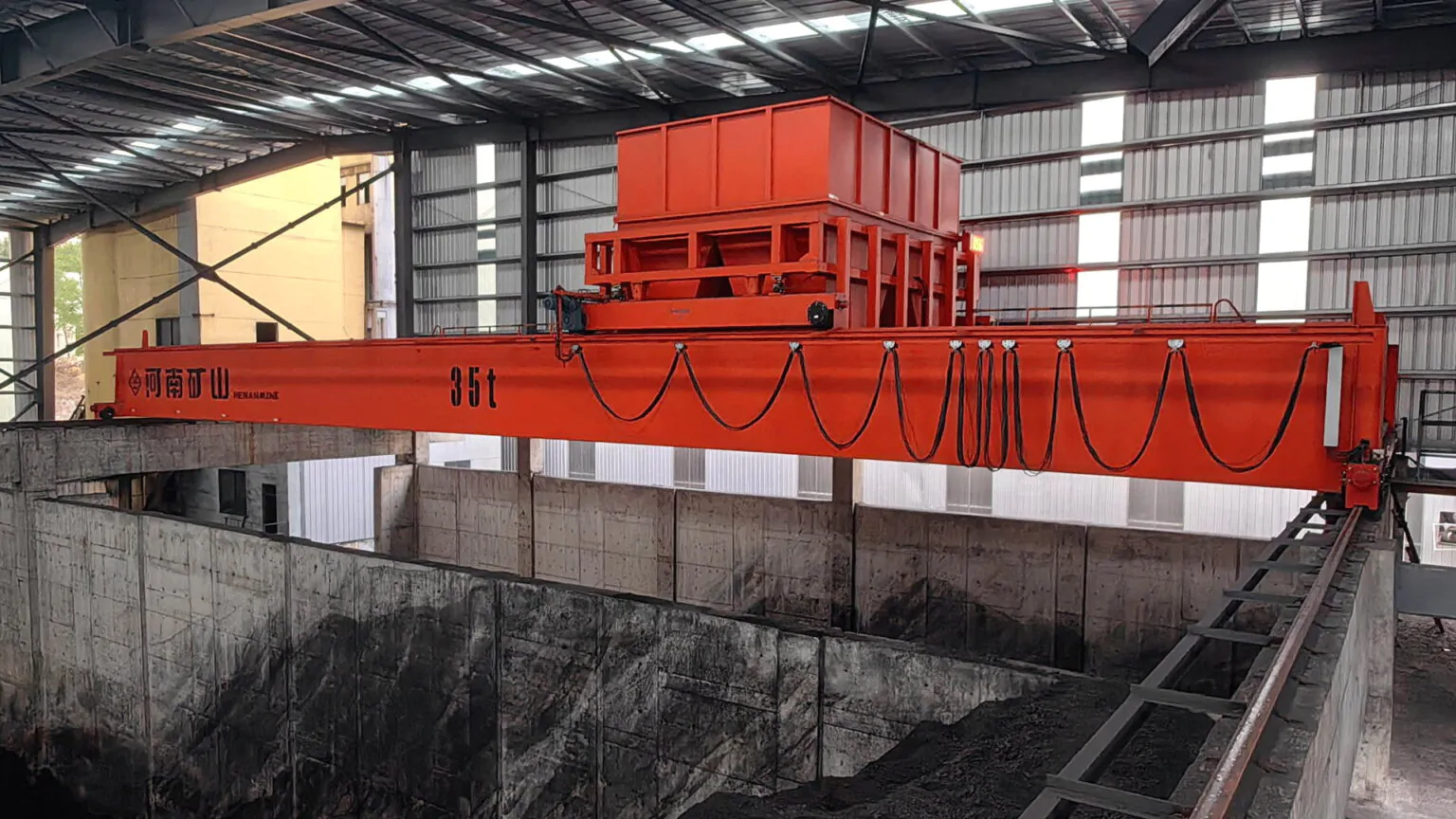
The process task behind the crane
A carbon production line needs material moved from a filling position to one or more receiving points, then discharged in the required sequence. The crane in the project photograph spans a process bay above a receiving area; a 35 t marking is visible on the bridge. That marking does not define the permissible payload in a new application, the container and material weight, or the required duty. Those values must be checked against the project drawings and rated-load documentation.
For a new enquiry, describe material type, bulk density, particle size, temperature, moisture, batch mass, discharge opening and the number and spacing of feed points. Include the building section, runway information, travel path and access for cleaning and maintenance. The equipment must fit the process and the facility, rather than being selected from a lifting-capacity label alone.
Controls, position feedback and the discharge gate
The source report identifies variable-frequency speed control and absolute encoders for positioning, together with a hydraulic gate for discharge. The crane also exchanges commands with the existing feeding equipment so an automatic loading and distribution sequence can be started through the integrated system. It does not publish a measured accuracy, throughput or availability result that can be applied to another site.
Define target positions, approach speed, permitted position error, repeatability, gate-open and gate-closed signals, and the conditions under which discharge is allowed. Agree which system owns each command, how the crane receives a station-ready signal, and what happens if communications, position feedback or the gate state becomes uncertain. Require manual recovery and safe maintenance modes in the control narrative.
The hydraulic arrangement should be specified against material flow and the local environment. Ask for the gate opening, force and cycle requirements, protection for hydraulic components, spill management, cleaning access and a procedure to clear a blocked gate safely.
High-temperature and dusty-site checks
The report places the machine in a hot, dusty production environment. Buyers should supply measured ambient and process temperatures, dust characteristics, cleaning methods and the intended operating hours. Electrical enclosures, cable routing, sensors, hydraulic seals, lubrication and maintainability can then be selected for the real exposure.
If the dust can form a hazardous atmosphere, provide the area classification and applicable local requirements before design. The original story does not identify an explosion-protection rating, so no such rating should be assumed for the pictured crane.
Acceptance scope for an integrated feeding cycle
Factory and site tests should cover the agreed machine and process interfaces. Agree the material loading condition, target stations, travel and approach modes, encoder reference procedure, gate interlocks, fault alarms, emergency stop, power-loss recovery and the response to a receiving-line interruption. Where performance targets matter, define the measurement method and acceptable cycle-time, positioning and discharge results in the project contract.
Ask for general arrangement drawings, electrical and control schematics, interface signal list, inspection plan, operating instructions, spare-parts list and commissioning records. Assign responsibilities for the existing feeding equipment, network, power supply, runway and site access before shipment. This gives the buyer a verifiable acceptance route for the entire feeding process.
Specify an Automatic Feeding Crane
Share the material properties, batch mass, receiving points, layout, temperatures, dust classification and existing equipment interface for a project-specific proposal.