
QB Explosion-Proof Crane Capacity for Chemical and Oil-Gas Sites
Capacity selection must sit alongside the site's hazardous-area requirements. Provide the complete suspended load, handling dimensions and area classification so the proposed QB arrangement addresses both the lifting task and installation conditions.
Key points for this crane project.
- What Is a QB Crane?
- How Duty Class (A3–A5) Affects Which Capacity You
- Matching Load Capacity to Oil & Gas / Chemical Plant
What Is a QB Crane?
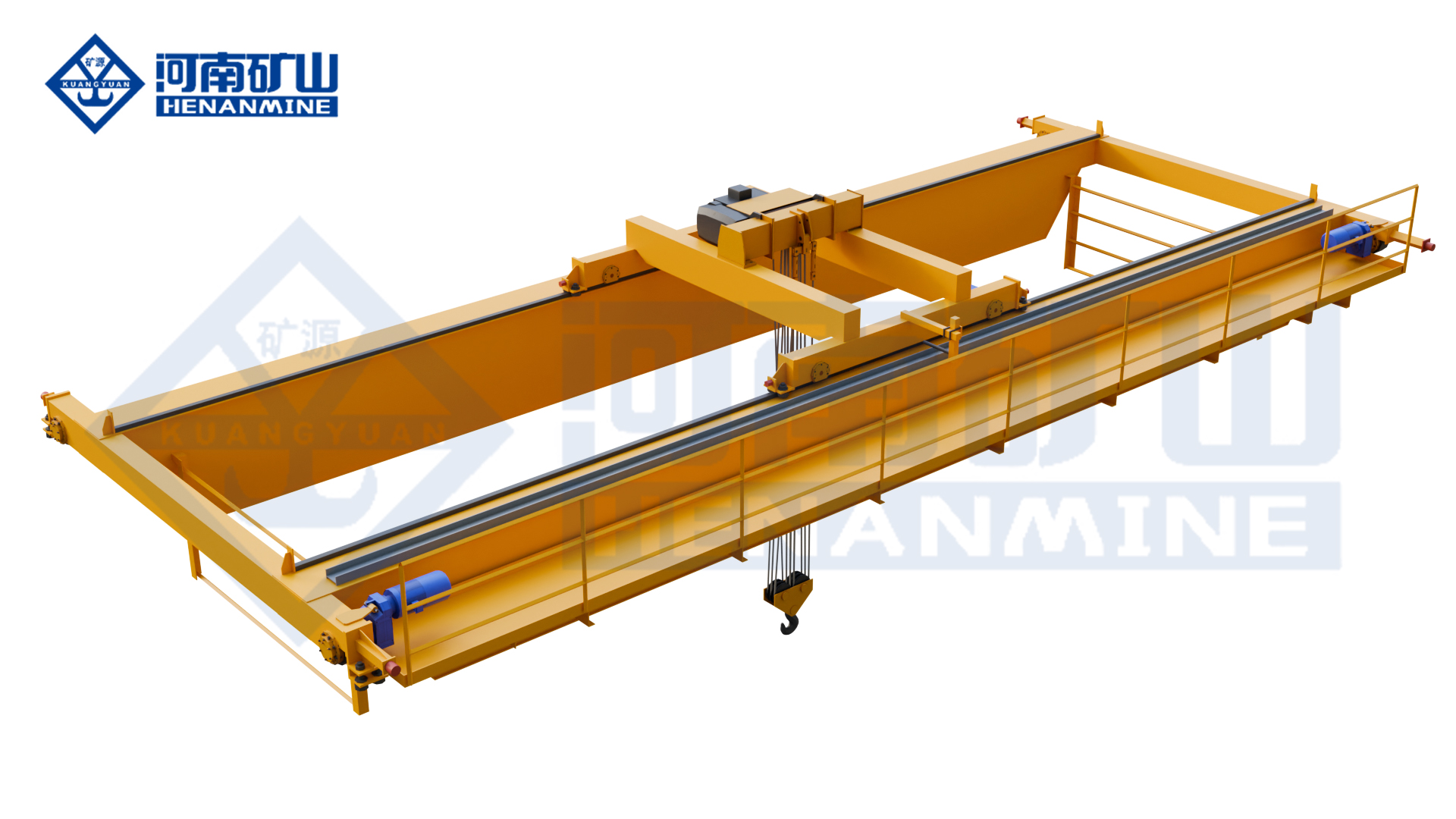
A QB crane is a double-girder, top-running overhead crane built with explosion-proof electrical components throughout motor, hoist, control panel, pendant, limit switches, and cable routing. The "QB" designation is standard across most Chinese and Asian crane manufacturers and denotes a flameproof (Ex d) double-girder bridge crane rated for use in classified hazardous areas.
The gas group IIB or IIC determines which specific gases the crane is rated to operate safely around, a distinction covered in more detail below.
Unlike a standard industrial overhead crane, every spark-capable component on a QB unit is either eliminated or enclosed to contain any internal ignition, preventing it from reaching the surrounding atmosphere. This is why QB cranes carry a meaningful cost premium over a standard double-girder crane of equivalent capacity and why getting the capacity specification right the first time matters so much.
How Duty Class (A3–A5) Affects Which Capacity You Actually Need
Tonnage alone doesn't tell you whether a QB crane is correctly specified. Duty class governed by ISO 4301 / FEM 1.001 determines how many lift cycles and what load spectrum the crane's structure and drivetrain are engineered to handle over their service life. For QB cranes, duty class typically runs from A3 to A5, with A5 as the practical ceiling for this series.
This matters because two plants needing the same 20-ton lift can require very different cranes:
- A3–A4 (light duty):Batch-process operations with real rest time between lifts maintenance turnarounds, occasional drum handling, infrequent equipment swaps. Roughly 10–30 cycles per shift is typical.
- A5 (the QB maximum):Regular, near-daily lifting without the extended idle periods of A3–A4, but still short of continuous production-line cycling.
If your actual usage pattern is closer to continuous multi-shift lifting for example, a reactor feed operation running 40+ cycles an hour across three shifts that workload exceeds what any QB-class crane is designed for. Running that duty cycle on an A5-rated crane pushes the gearbox, hoist motor, and structural welds beyond their fatigue design life, leading to premature failure and unplanned maintenance inside a Zone 1 classified area which is a safety event, not just a maintenance headache.
- Average load as a percentage of maximum rated capacity
Your crane supplier should calculate duty class from this data rather than defaulting to a conservative guess both under- and over-specifying carry real cost consequences.
Matching Load Capacity to Oil & Gas / Chemical Plant Tasks
Different areas of an oil and gas or chemical facility generate very different lift profiles. Mapping your task type to a realistic capacity band avoids both under-spec risk and unnecessary overspend:
Petrochemical reactor and pressure-vessel installation during turnarounds is consistently the heaviest recurring lift category, which is why plants with active turnaround programs often specify the upper end of the QB range even if day-to-day lifting rarely approaches that tonnage. It's common and reasonable for a single facility to run more than one QB crane at different capacities across different bays rather than oversizing one unit for the whole plant.
Step-by-Step: How to Calculate the Load Capacity You Need
Sizing a crane by "the heaviest thing we lift" alone is a common and costly shortcut. Use this sequence instead:
- Determine the maximum actual net weight of equipment/component itself: the data specified in the technical specification of equipment and freight list shall prevail. It is forbidden to adopt estimated value and calculate the heaviest single weight actually required to be hoisted on site.
- Weight of all lifting tools and accessories included: lifting rigging, balance lifting beam, shackle, lifting beam and crane hook group, etc., all supporting lifting equipment weight shall be included in the total load to be carried by the crane.
- Considering dynamic load additional coefficient: during hoisting process, component deviation, swing and start-stop impact will produce additional load exceeding static dead weight, especially when reactor special-shaped components and suspended pipelines are hoisted in sections, so dynamic load allowance must be reserved.
- The two calculation methods are essentially equivalent and are used to reserve safety buffer intervals.
- In addition to tonnage, synchronous check crane working level: even if the rated lifting capacity of the crane meets the load requirements, if the working cycle frequency does not match the field operation conditions, it is still a selection error.
QB vs. LB (Single Girder): When 75 Tons Isn’t the Right Question
Before finalizing the purchase order for QB crane, verify whether the double girder crane is actually required for the working condition.
QB double-beam crane shall be selected to meet any of the following working conditions:
- The field conditions require higher lifting height
- This advantage is especially critical when lifting operations are carried out in narrow areas such as close to plant walls and reactor nozzles.
Under this tonnage, the type selection cannot be based on the lifting weight alone, but needs to be comprehensively judged in combination with the operation span, lifting height and working level to select the model with better cost performance and adaptability.
Gas Group & Zone Classification's Effect on Capacity Selection
Load capacity and hazardous-area rating are specified independently, but both must be confirmed together before ordering. QB cranes are most commonly rated:
- ExdIIBT4:the standard default configuration, covering the majority of industrial hazardous atmospheres including hydrogen sulfide, ethylene, propylene, and most petroleum and solvent vapors. This is correct for the large majority of petrochemical transfer, refinery, and fuel storage applications.
- ExdIICT4:required only where hydrogen or acetylene are present, the two most ignition-sensitive gases found in chemical synthesis and some specialty processes.
Your facility's hazardous area classification document not a general assumption about "the oil and gas industry" should specify which gas group and zone (Zone 1, Zone 2, Zone 21/22 for dust) applies to the specific bay where the crane will operate.
Common Overspec/Underspec Mistakes in Oil & Gas Procurement
Three patterns show up repeatedly in QB crane procurement, and both directions of error are expensive:
- Sizing to the nameplate weight only. Teams frequently specify capacity from an equipment datasheet weight alone, without adding rigging, lifting devices, or a safety margin leaving no buffer for the real-world lift.
- Ignoring duty class in favor of tonnage. A crane rated for the correct maximum weight but installed in a higher-cycle-frequency application than its duty class supports will fail structurally years ahead of its design life inside a classified hazardous area, where unplanned maintenance carries outsized risk.
- Defaulting to IIC "to be safe."Specifying the higher gas group as a blanket precaution, rather than confirming actual area classification, adds unnecessary cost without a corresponding safety benefit if the facility's actual atmosphere only requires IIB.
The fix in all three cases is the same: pull actual cycle, shift, and area-classification data before the RFQ stage rather than after installation reveals the mismatch.
Cost Implications of Capacity & Duty Class
Capacity and duty class are the two largest cost drivers on a QB crane order, and they interact rather than stacking independently:
Specifying accurately upfront correct tonnage, correct duty class, correct gas group is consistently cheaper over the crane's service life than either an oversized "just in case" order or an undersized unit that fails early.
Frequently Asked Questions
What is the maximum load capacity of a QB explosion-proof crane?
Heavy-duty custom configurations for reactor and pressure-vessel installation can extend well beyond that on a project-engineered basis.
What duty class should a QB crane in an oil and gas plant use?
QB cranes are typically rated A3 to A5, with A5 as the practical maximum for this series. The correct class depends on your daily lift-cycle count and shift pattern, not on tonnage alone.
Is gas group IIB or IIC required for a QB crane?
Gas group IIB covers most petroleum and chemical vapors, including hydrogen sulfide and ethylene, and is the default rating for QB cranes. IIC is required only where hydrogen or acetylene are present in the classified area.
How much safety margin should I add when specifying crane capacity?
Should I choose a QB double-girder or LB single-girder crane?
Discuss the crane arrangement for your project.
Capacity selection must sit alongside the site's hazardous-area requirements. Provide the complete suspended load, handling dimensions and area classification so the proposed QB arrangement addresses both the lifting task and installation conditions. Share the load, available drawings, working cycle and site conditions with Henan Mine Crane so the required configuration and supply boundary can be discussed.
Related crane configurations
Clean Explosion Proof Bridge Crane
View product parametersCombine overhead lifting with the declared cleanliness and hazardous-area requirements. Specify particle-control expectations, process exposure and area classification for the complete lifting system.
Dual Trolley Explosion Proof Bridge Crane
View product parametersCombine two-trolley handling with the declared hazardous-area specification. Coordinate hook loads, lifting sequence, electrical protection and operator controls for the complete installation.
Updated 2026 · Henan Mine Crane