Engineering · Manufacturing · Project support
info@hnksglobal.comWhatsApp +86 18836207779 ↗

作者: YUWEI, YUWEI

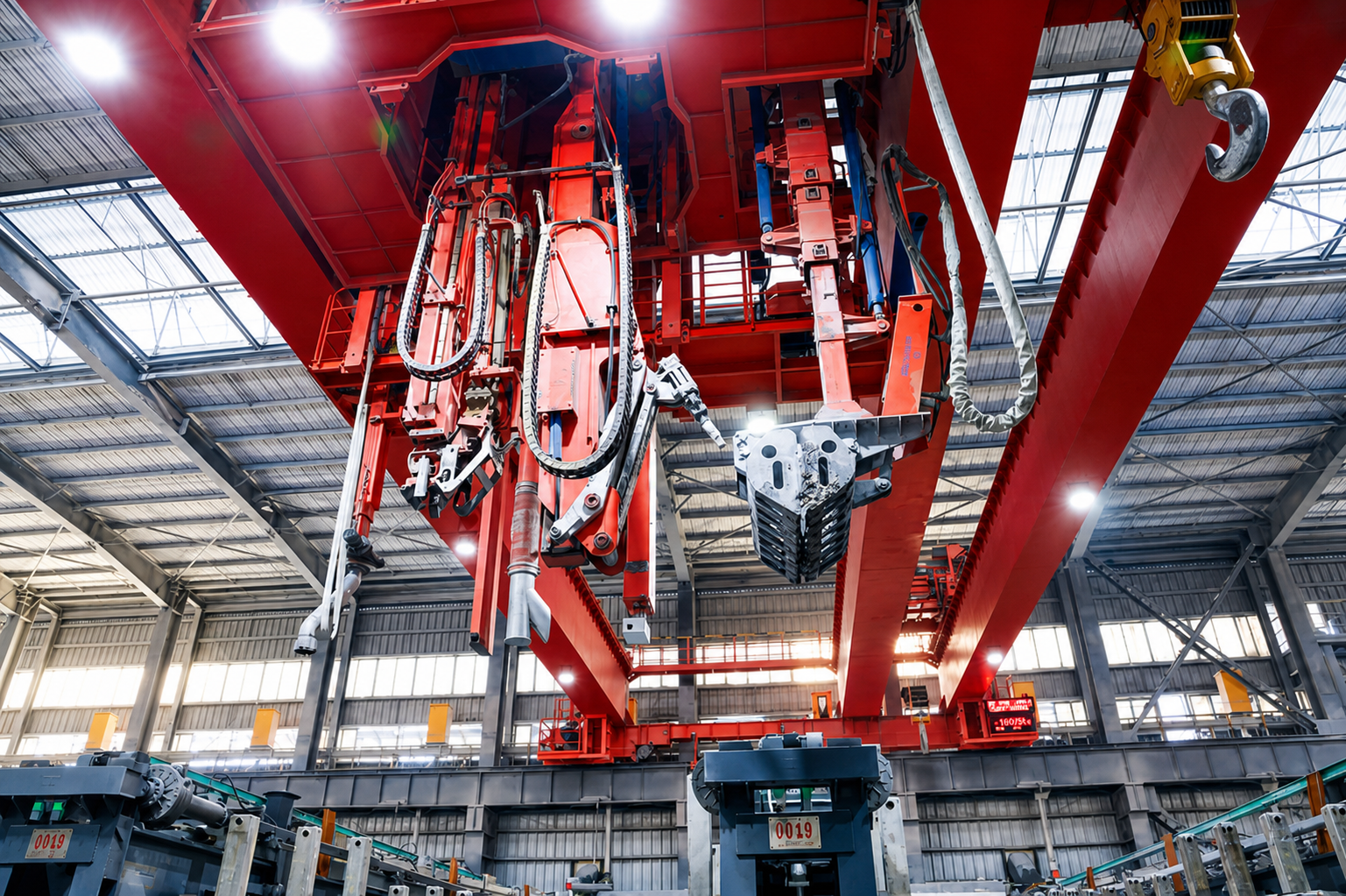
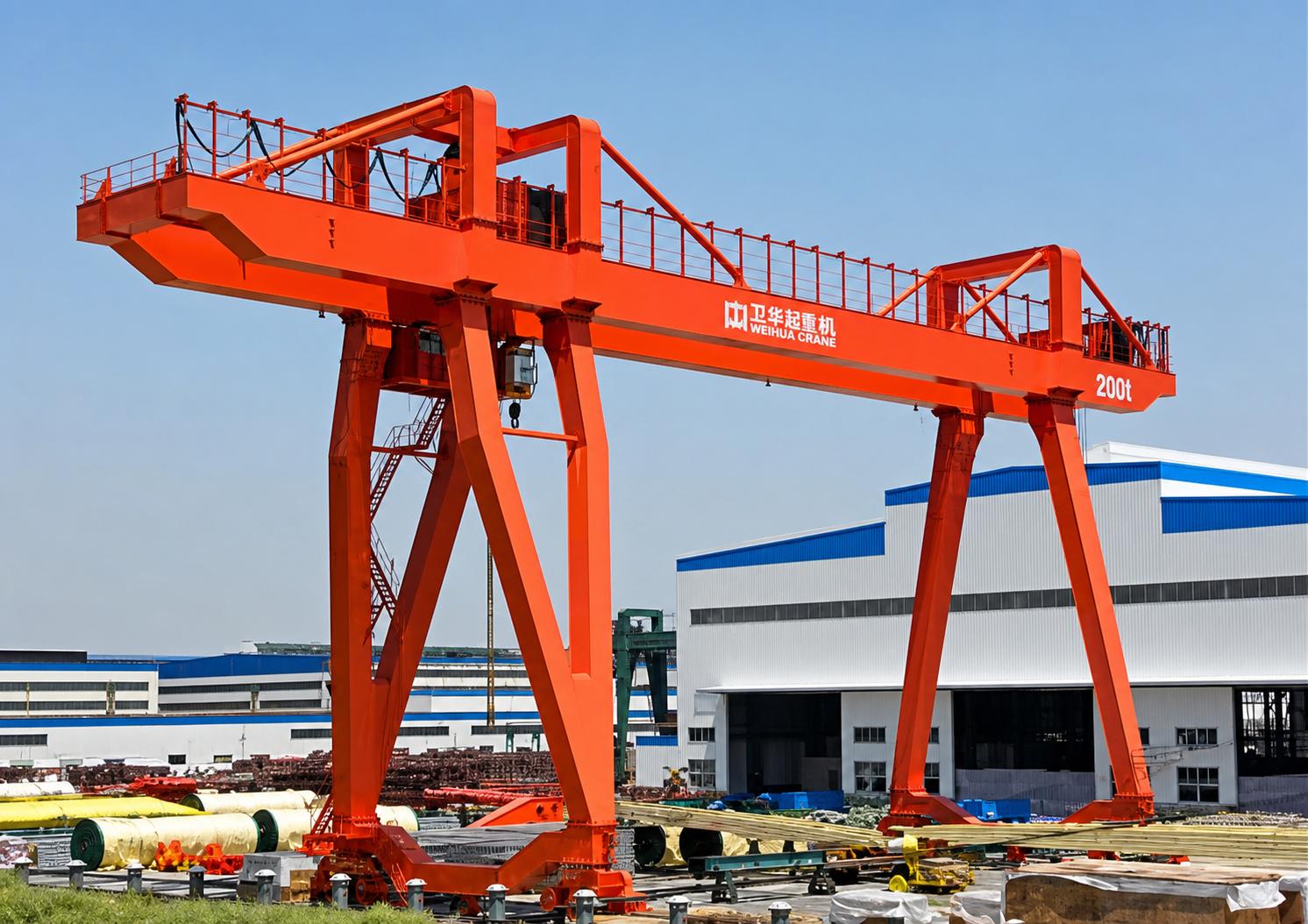
  • Henan Mine Crane 400t gantry crane landing

    Henan Mine Crane 400t gantry crane landing

    Henan Mine Crane 400t gantry crane landing

    In October 2024, Henan Mine Crane welcomed another technological breakthrough, more than 30 sets of various types of cranes manufactured for an enterprise in Shandong were successfully delivered.

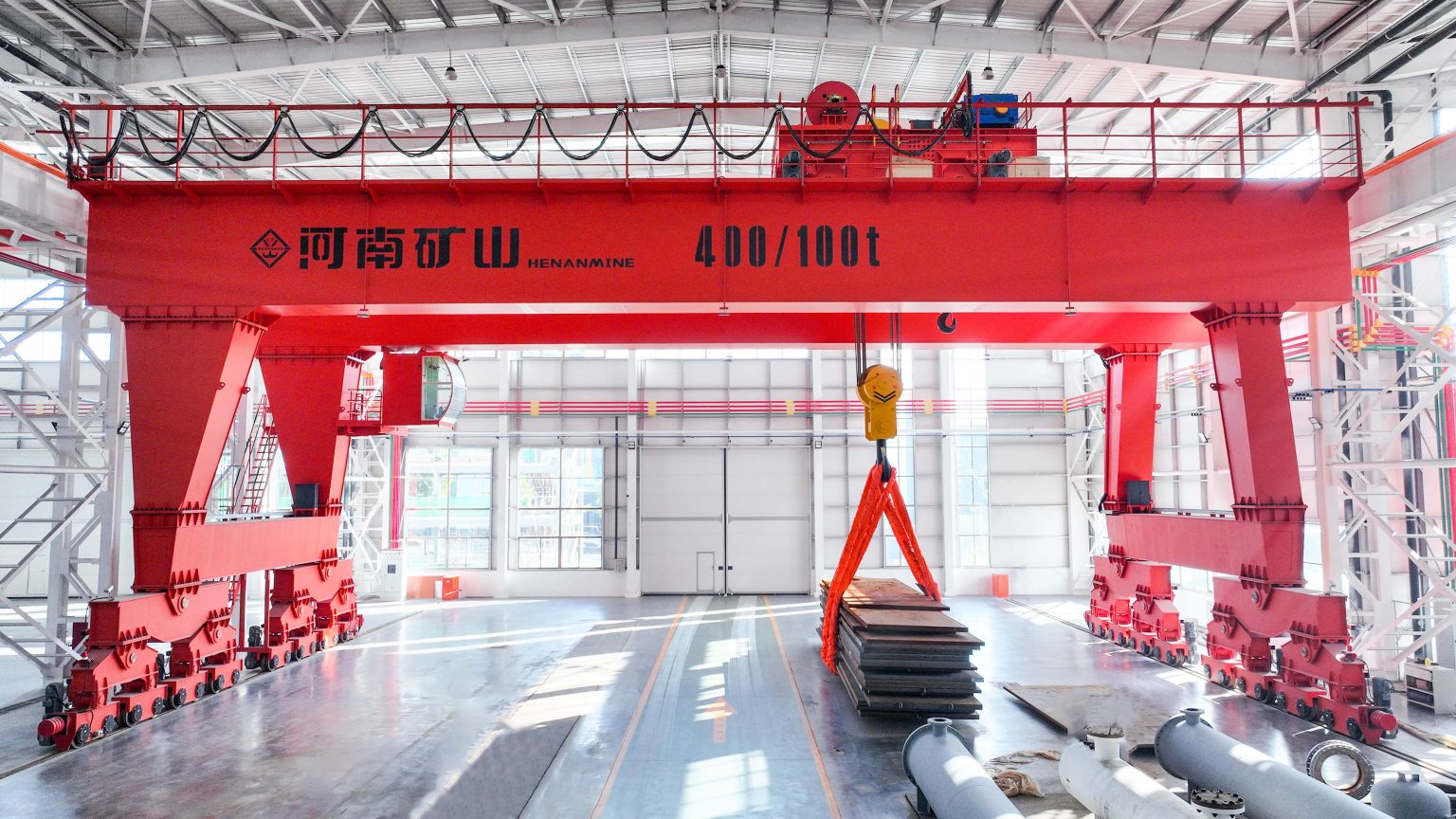
    The equipment is specifically applied to high-end chemical equipment manufacturing, of which 400 tons of double girder gantry cranes for the current chemical equipment manufacturing field put into use in the oversized tonnage cranes, highlighting the hard core strength of the mine source of intellectual manufacturing.
    Henan Mine Crane 400 tons gantry crane landing

    The lifting equipment delivered this time relies on innovative smart technology to realize precise operation.

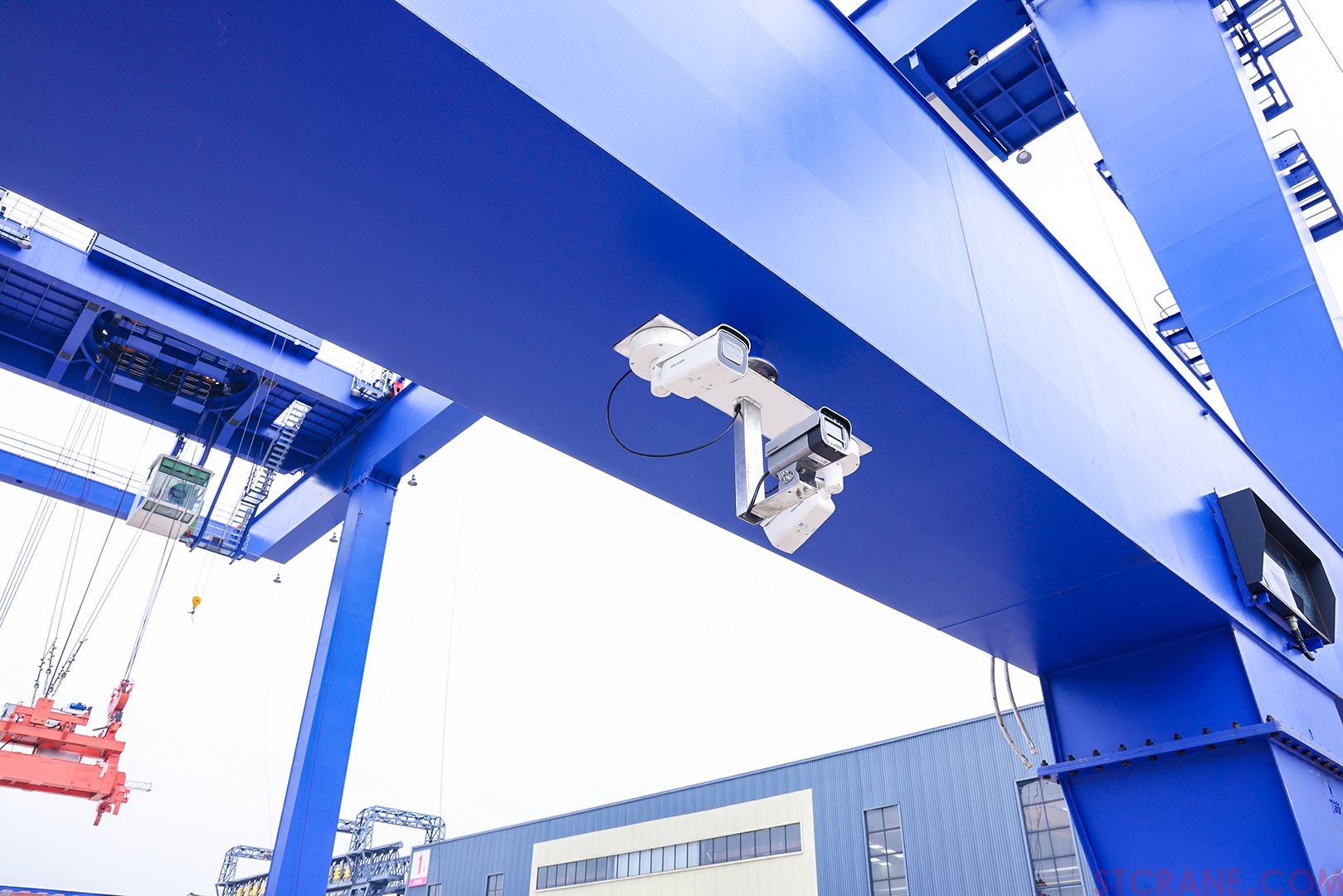
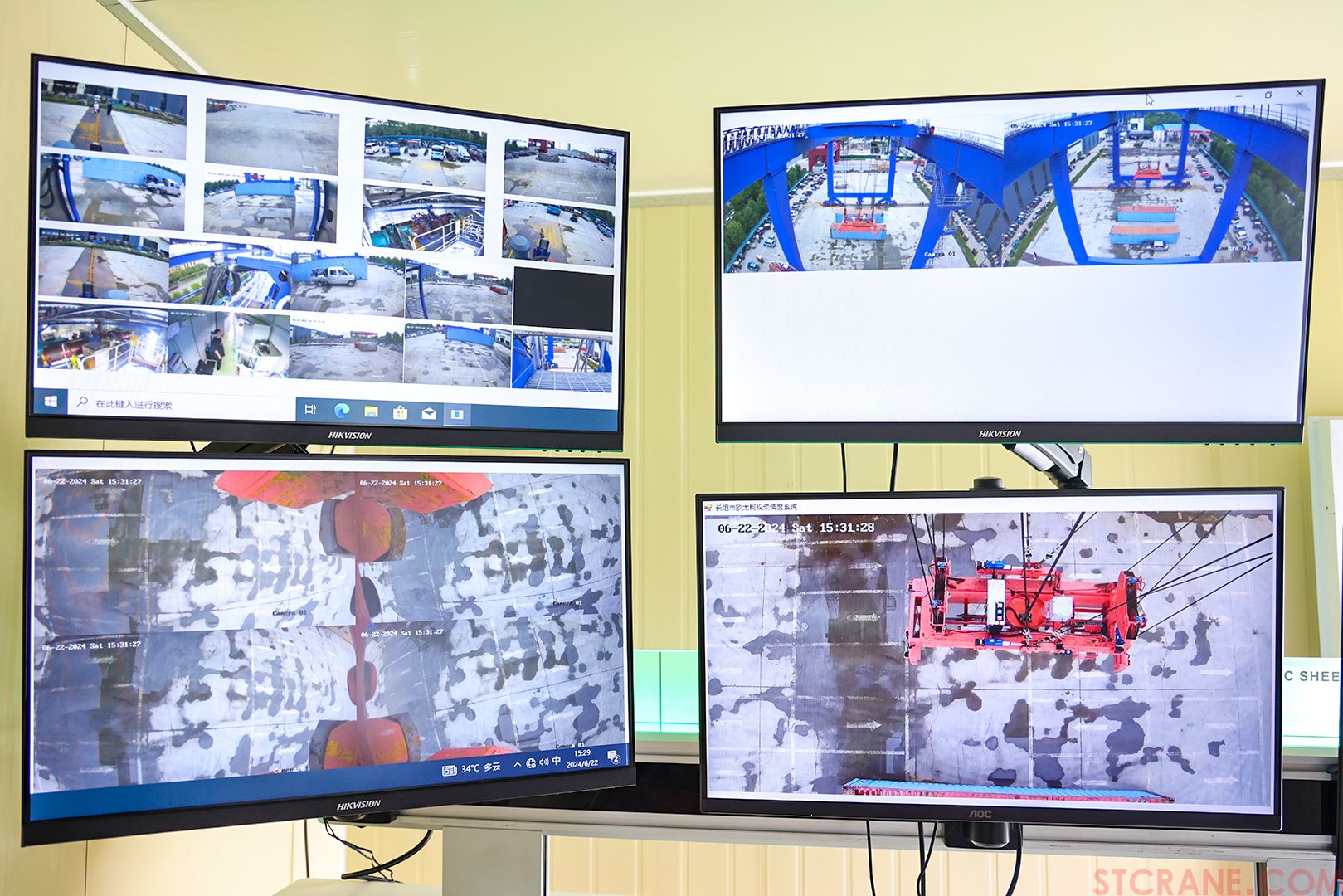
    The equipment adopts PLC + frequency converter communication control program, with the help of frequency converter digital filtering technology, greatly improving the operating accuracy of the crane, perfectly adapted to the needs of high-end chemical equipment manufacturing high-precision operations.The equipment incorporates intelligent monitoring design, which makes the operation more convenient. The driver’s room is equipped with a rotating integrated operation linkage table, with safety monitoring system, data monitoring system, the operator can clearly grasp the real-time working condition of the crane through the display screen, realizing the visualization and control of equipment operation.

    Henan Mine Crane has always adhered to the development concept of “intelligent and intelligent manufacturing, customer first”, and continues to plow into the field of chemical equipment manufacturing. For the global chemical industry customers to provide professional lifting equipment solutions.

    Henan Mine CraneDiscuss your requirements ↗
  • Henan Mine Crane Automation Containerized Gantry Crane Exports

    Henan Mine Crane Automation Containerized Gantry Crane Exports

    Henan Mine Crane Automation Containerized Gantry Crane Exports

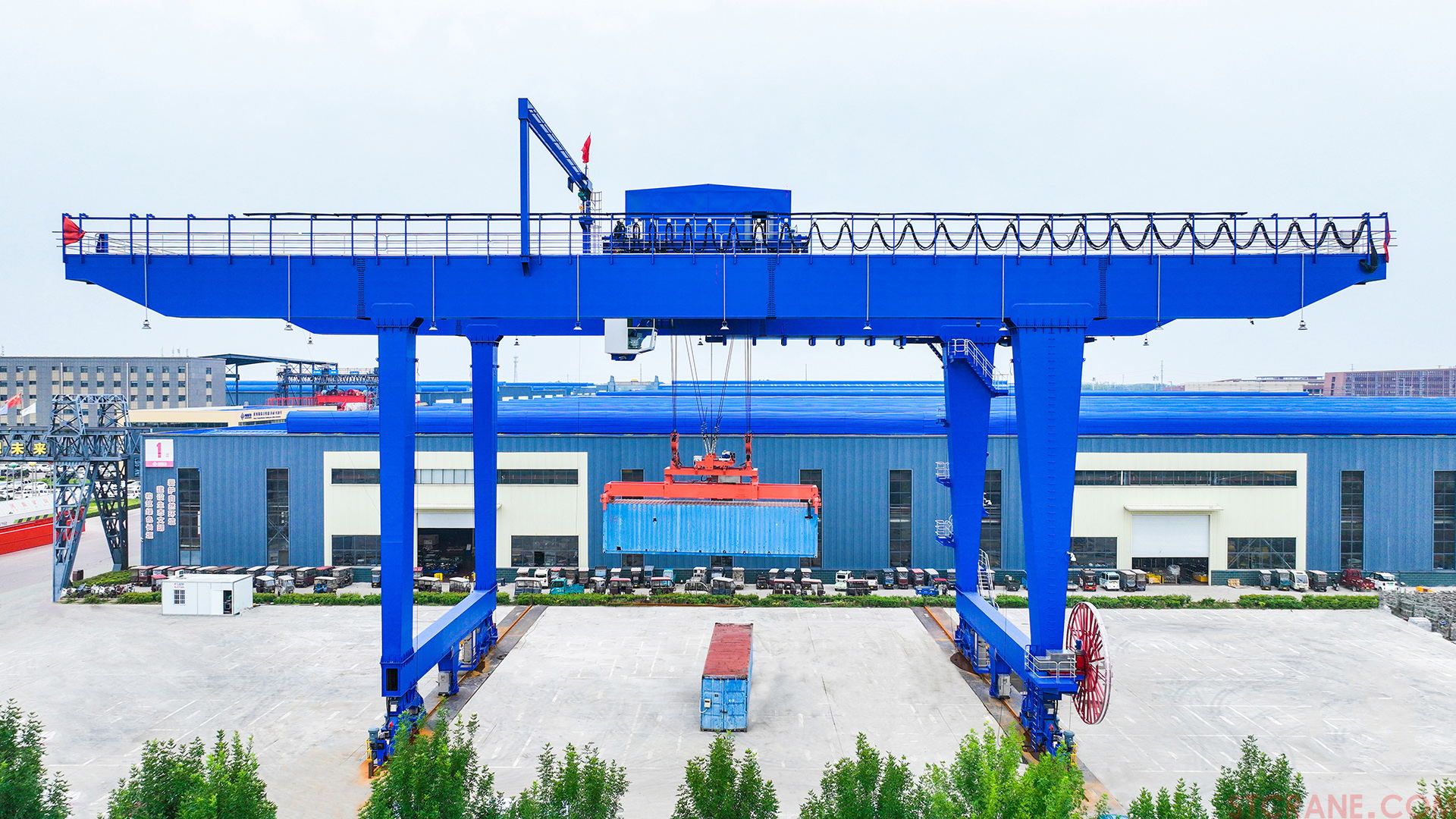
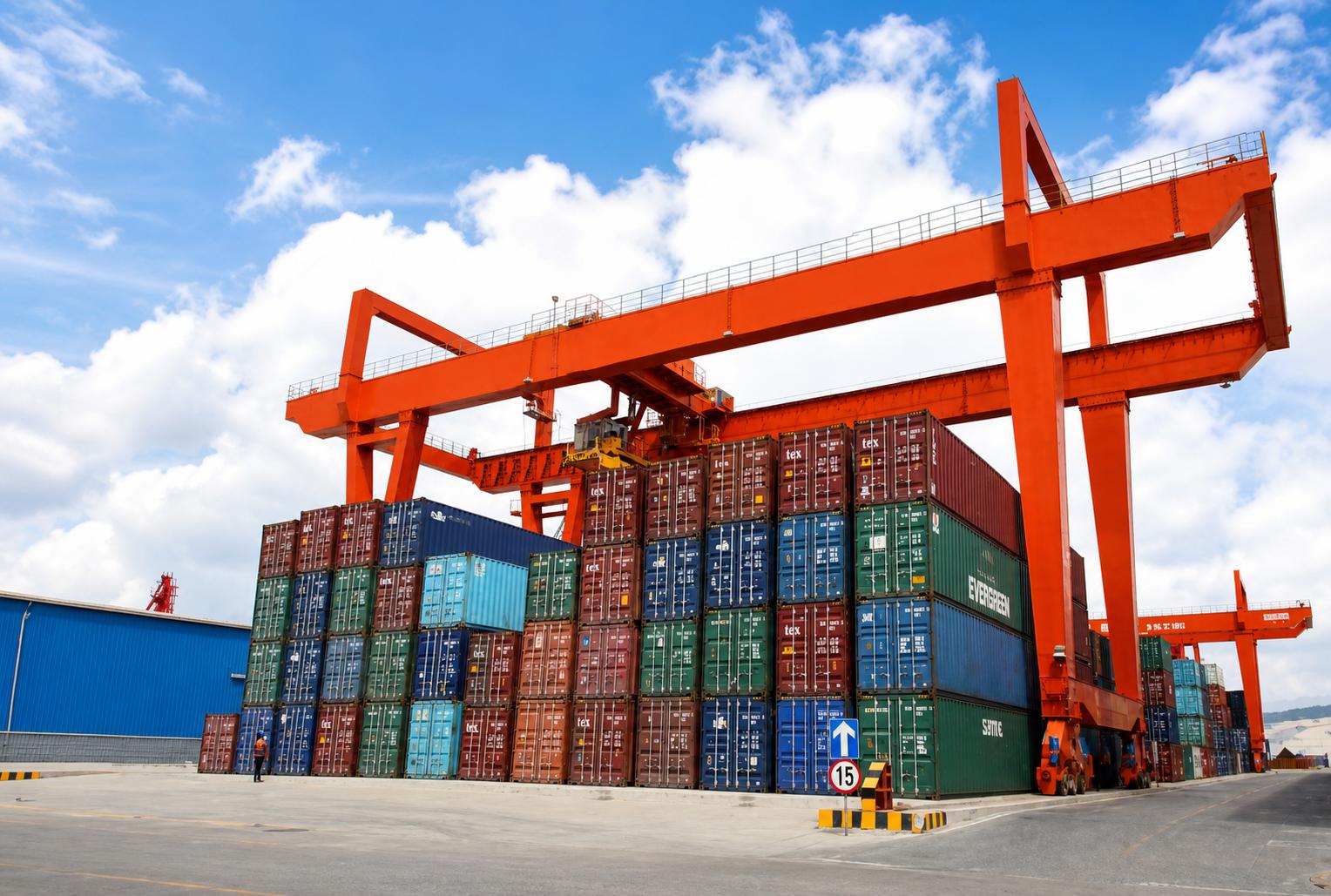
    In July 2024, Henan Mine Crane‘s automated containerized gantry cranes successfully completed the load test and were officially exported to supply an overseas national railroad project.

    The project is Henan Mine Crane service “One Belt, One Road” another international benchmark project, successive Pakistan waste heat power generation, Congo mining, Bangladesh power plant, Serbia copper and other key projects.

    The exported container gantry cranes are A8 extra heavy duty working system, made of special dedicated materials.

    The equipment can be adapted to high latitude, high cold extreme environment, in -40 ℃ low temperature can still be stable to complete the container loading and unloading operations.

    The equipment has high-frequency and high-speed operation capability, and the lifting efficiency is 3 times higher than that of the common container door machine.

    The whole machine is equipped with full frequency conversion drive and energy feedback system, ACCS automation control and GPS high-precision positioning system.

    It can realize container handling automation, equipment status visualization and logistics information integration, which is suitable for the intelligent demand of international logistics.

    In recent years, Henan Mine Crane has continued to promote the transformation and upgrading of products from strong to fine, and adhere to the strategy of high-quality products and scientific and technological innovation.

    With reliable quality and hard core technology, the enterprise will push the high-end lifting equipment to the world, and help China’s lifting machinery industry high-quality development.
    Container Crane for Railway Project by Henan Mine Crane Factory Container Crane for Railway Project by Henan Mine Crane Factory Container Crane for Railway Project by Henan Mine Crane Factory Container Crane for Railway Project by Henan Mine Crane Factory

    Henan Mine CraneDiscuss your requirements ↗
  • Automated Stacking Crane Solutions for Cold Chain Logistics Warehouses

    Automated Stacking Crane Solutions for Cold Chain Logistics Warehouses

    Automated Stacking Crane Solutions for Cold Chain Logistics Warehouses

    Cold chain cold storage recruitment is difficult, manual low temperature operation is limited, forklift energy consumption is high. The automatic stacker can independently complete the high-level pallet access of cold storage, adapt to low-temperature and high-intensity operation, effectively reduce the cost of manpower and energy consumption, and is the preferred scheme for cold chain storage upgrade.

    This paper explains in detail the working principle of the automatic stacker, the advantages of cold chain adaptation, low temperature working condition design, cost return scheme, and combs the common misunderstandings and landing points of the cold storage automation transformation, which can provide a complete reference system for enterprises to build new automatic cold storage, compare the selection decision of stacker and shuttle ASRS system.

    What Is an Automated Stacking Crane?

    Automated stacking crane — sometimes known as a stacker crane or an AS/RS crane — forms the heart of a crane-based automated storage and retrieval system (AS/RS). It moves along a floor mounted rail (usually also an overhead guide rail) through a single storage aisle and is capable of three simultaneous motions: moving horizontally along the aisle; lifting the mast vertically, and extending the forks in the depth direction into the rack.

    Single- and twin-mast cranes are the most common high speed pallet warehouse, especially for high throughput. These handle between 1 and 2 pallets per cycle. Trilateral stacker cranes are useful for upgrading an existing, conventional warehouse where the forklift racking is not modified when switching to an automated system.

    They feature a rotating fork head which has 3 possible positions (front, left, right). Miniload cranes, designed for cartons, totes and trays, are smaller than the pallet application and typically less than 30kW. They are often used in cold chains to pack pharmaceuticals or mixed case retail grocery orders. A warehouse execution system (WES) controls and sequences the movement of every pallet by instructing the crane which pallet to pick, which slot to place it in, and what order to accomplish the moves.

    How Stacking Cranes Are Engineered for Sub-Zero Operation

    Standard industrial automation equipment cannot adapt to repeated temperature difference conditions between normal temperature assembly and-25℃ low temperature operation.Cold chain special stacker needs to go through a number of exclusive optimization design, can adapt to extreme low temperature operation, the core transformation points are as follows:

    1. Configure low temperature resistant lubricating medium.Ordinary grease will suddenly rise in viscosity at low temperatures, increasing the friction load of the transmission mechanism, while cold-resistant special lubricating products will not solidify and delaminate at low temperatures to ensure smooth operation of the transmission system.
    2. Select low temperature resistant motor and supporting cable.Ordinary cable insulation layers and conductors are prone to embrittlement and cracking under repeated alternating hot and cold conditions. Cold-resistant electrical wires and motors can avoid such aging and damage problems.
    3. At the junction of different temperature zones, condensation and frost control shall be done.After the moisture carried by the normal temperature air enters the low temperature area, it is easy to freeze on the surface of the track, sensing element and electrical contact, causing equipment failure.
    4. Equipped with quick release connector and remote diagnosis system.Maintenance personnel do not need to stay in the cold storage for a long time, they can quickly complete the maintenance and replacement of parts, and reduce the operation and maintenance time in the cold storage.
    5. The control cabinet and sensor are equipped with sealing structure or supporting heating device to ensure that the electric control cabinet and detection device can work stably and continuously under low temperature conditions.
    6. Equipped with energy regenerative braking system.The kinetic energy generated in the deceleration and falling process of the stacker gantry can be recovered by this system and fed back to the power supply network of the plant. The actual measurement can reduce the overall energy consumption of the equipment by 15%~20%.

    Ordinary equipment can only withstand low temperature environment for a short time, while the stacker with the above-mentioned complete improved design can run continuously for a long time in the deep frozen warehouse from-20 ℃ to-30 ℃, greatly eliminating the problem of unplanned shutdown. The core difference between the two is reflected in these exclusive optimization designs.

    Key Benefits for Cold Chain Facilities

    l Higher storage density: Compared with manual forklifts, automated stackers are adapted to narrower roadways and can be adapted to higher shelf operations, greatly increasing the pallet storage utilization of expensive cold storage space.

    l Better energy efficiency: In addition to the energy-saving characteristics of regenerative braking, the three-dimensional high-level storage layout can reduce the roof and ground floor area of the warehouse. Effectively reduce the roof solar heat load, while reducing the heating demand of the antifreeze ground, significantly reducing the cold storage refrigeration energy consumption.

    l All-weather continuous operation: the equipment can operate 7 × 24 hours a year without interruption. without adding night shift personnel, the cold storage can complete operations such as night replenishment and off-peak receipt of goods, which is suitable for the continuous operation requirements of the cold chain.

    l Strong operation safety: the equipment replaces manual handling and lifting operations of cold storage at low temperature and high frequency, eliminating the risk of frostbite of personnel at low temperature, and avoiding forklift operation accidents under low visibility and low friction environment of cold storage.

    l Accurate and controllable inventory: All access operations are controlled by system records, which can stably realize first-in, first-out, batch traceability and full data trace, and solve the pain points of irregular manual operation inventory management and difficult data traceability.

    Cold Storage Challenge Automated Stacking Crane Impact
    Freezer labor is hard to recruit and retain Removes repetitive travel and cold exposure from most storage tasks
    Refrigerated space is expensive per square foot Increases storage density through taller, narrower-aisle design
    Energy costs rise with door openings and travel Regenerative braking and reduced footprint cut refrigeration load
    FEFO and lot rules are hard to enforce manually Software-directed retrieval enforces rotation rules automatically
    Forklift incidents in low-visibility freezer aisles Separates people from automated storage lanes

    Stacking Cranes vs. Shuttle ASRS vs. AMRs for Cold Storage

    Not every cold chain facility should default to a crane-based system. The right choice depends on load type, SKU velocity, and throughput requirements.

    System Type Best Fit Strengths Trade-offs
    Stacker Crane AS/RS High-density frozen or chilled pallet storage with predictable SKU movement Highest dense-pallet throughput per aisle, proven for deep-freeze operation, simpler mechanical footprint Higher upfront capex, one crane typically serves one aisle, less flexible for rapidly shifting order profiles
    Shuttle ASRS High SKU count, case or tote handling, fast order sequencing Multiple shuttles per aisle, scalable throughput, strong fit for e-grocery and mixed-case fulfillment More moving parts to maintain in cold conditions, generally lower per-pallet density than dedicated crane storage
    AMRs / Mobile Robots Facilities needing flexibility or phased automation rollout Lower upfront investment, easier to redeploy or scale incrementally Lower density and throughput ceiling than fixed crane or shuttle infrastructure

    The ideal candidate for a stacker-crane AS/RS is large pallet-centric frozen distributor, a relatively stable SKU assortment, a predictable inbound/ outbound flow. The more SKUs, mixed case picking, fast-changing order profile there is, the more benefit is derived from shuttle-based or hybrid solutions.

    Building Design Considerations

    A stacking crane project succeeds or fails on how well it’s integrated with the building itself. Retrofitting automation into a building designed for manual operations rarely captures the full benefit.

    l Before finalizing the warehouse construction plan, priority should be given to determining the technical parameters of automation equipment and stackers. With equipment requirements as the core, the overall optimization of building structure, shelf height, channel width and load-bearing layout, to avoid the limitations of subsequent equipment forced to adapt to the existing building structure, to ensure the overall adaptability of the storage system.

    l The storage planning follows the principle of “vertical expansion and strict control of horizontal land occupation. The traditional low-rise warehouse has a large roof area, high cooling heat load and serious energy consumption loss. Relying on the high-level three-dimensional storage design realized by the stacker, it can effectively reduce the area of the reservoir area, significantly reduce the cost of civil construction and long-term refrigeration operation and maintenance expenses.

    l Minimize the frequency of door opening and closing and cross-temperature transfer operations. Every time the cold storage opens and the circulation of goods between the cold chain, normal temperature and freezing temperature zones, heat load will be added, which will aggravate the frost risk of equipment and track. The cargo line needs to be scientifically planned to streamline the temperature zone switching process to the greatest extent and stabilize the low temperature environment in the reservoir area.

    l The design of equipment operation and maintenance channel shall take into account the convenience of maintenance and the integrity of warehouse insulation. The overall layout needs to reserve sufficient equipment inspection and maintenance work space, while avoiding the permanent thermal bridge generated by the building envelope, and eliminating the problems of insulation failure and cold loss.

    l The ground structure and special fire protection design shall be coordinated simultaneously. Deep-frozen cold storage needs to be equipped with ground anti-freezing and expansion heating system, and the fire protection standard of high-level automatic warehouse is different from that of traditional low-level warehouse, both of which need to be integrated with the automation system planning, and cannot be supplemented and modified later.

    Software Integration: WMS/WES and FEFO Compliance

    The hardware is responsible for cargo handling, the software determines the warehouse scheduling logic, and the compliance value of software control in the cold chain scenario is much higher than that of the room temperature warehouse.

    l WMS warehouse management system: unified management of inventory basic data, including goods batch, batch number, validity period and customer-specific storage specifications, the establishment of standardized inventory ledger.

    l WES warehouse execution system: to undertake real-time intelligent dispatching of the whole site, to coordinate the picking sequence of stackers, dock arrival docking and peak load balanced distribution, to replace manual operation deviation with system standardized control, and to ensure orderly operation compliance.

    l WCS warehouse control system: responsible for the precise control of the bottom equipment, direct linkage stacker, conveying equipment, transfer station and safety interlocking mechanism, to ensure the stable and safe operation of automation equipment.

    WES is the core of cold chain compliance, which can standardize the implementation of key rules such as first-out (FEFO), isolation and control of batches to be inspected, loading according to logistics appointments, and strict control of cargo overtemperature duration.

    Stacker hardware alone can achieve efficient handling, but can not automatically guarantee the integrity of the cold chain and inventory turnover compliance, software scheduling system is the key to the equipment to achieve compliance operations.

    ROI and Total Cost of Ownership for Cold Chain Automation

    Relying solely on laborcost savings to estimate the benefits of coldchain automation often underestimates the overall rate of return. A comprehensive, high-value return-on-investment model that encompasses multiple integrated benefits:

    l Comprehensive reduction of labor costs: Not only does it lower basic staffing expenses, but it also helps avoid a host of hidden labor-related costs—such as highsalary allowances for coldstorage positions, recruitment, preemployment training, and employee turnover—thereby achieving overall optimization of personnel expenditures.

    l Substantially reduces energyuse costs: By leveraging three key advantages—energy recovery through regenerative braking, compact and efficient warehouse space utilization, and minimized coldstorage dooropening frequency—the system effectively lowers the cooling load and comprehensively cuts coldstorage energy consumption.

    l Eliminates expansion and capacityincrease costs: Highdensity automated warehousing maximizes the utilization of existing coldstorage space and significantly boosts storagecapacity efficiency, obviating the need to build new facilities or lease external coldchain warehousing. This represents the most critical and largestshare component of the benefits in automationupgrade projects.

    l Effectively reduces product loss: The system enforces a FirstExpiry, FirstOut (FEFO) picking policy, mitigating temperature fluctuations caused by delayed manual operations and significantly lowering the risk of spoilage, shrinkage, and write-offs.

    l Optimizing long-term operational costs: Although low-temperaturespecific equipment components entail higher upfront procurement expenses, they offer greater operational reliability and lower downtime due to failures, resulting in a significantly better total cost of ownership over the long term compared to standard conventional equipment.

    l Stabilize peakseason operational capacity: By automating and intelligently scheduling putaway and retrieval processes, we effectively address pain points such as dock congestion and orderpicking delays during periods of surging demand, ensuring consistent and stable warehouse throughput.

    Automated Storage and Retrieval Systems (AS/RS) with stacker cranes entail higher initial capital expenditures than conventional manual cold storage facilities; however, over the equipment’s entire lifecycle, when factoring in savings on labor, energy consumption, and the avoidance of expansion costs, their overall return on investment significantly outperforms traditional warehousing models.

    Implementation Roadmap: Planning to Go-Live

    • l Clear operating data standards: before bidding and inquiry, it is necessary to completely sort out the cold storage temperature area and temperature control standards, goods type and size specifications, SKU quantity and turnover frequency, peak flux in and out of the port, as well as the existing first-in-first-out, batch traceability and other business rules, to provide accurate data basis for equipment selection.
    • l First set the system and then finalize the building plan: link the automation equipment manufacturer and the building design team in advance to optimize the shelf specifications, roadway width and warehouse structure according to the stacker equipment parameters to avoid conflicts between building design and automation equipment adaptation.
    • l Plan the software architecture system in advance: At the initial stage, clarify the rights and responsibilities and docking logic of WMS, WES, and WCS systems, and plan the core business processes such as FIFO, quality inspection freeze, and abnormal order scheduling in advance to ensure smooth system operation.
    • l Measure the total cost of the whole life cycle: abandon the calculation method of only accounting for the initial equipment input, comprehensively count the energy consumption, operation and maintenance, manpower and expansion-free comprehensive income and expenditure of the whole life cycle of the equipment, and accurately evaluate the real return on investment.
    • l Develop a switching plan and manual mechanism: automated cold storage needs to be equipped with a complete manual emergency operation process to deal with special scenarios such as equipment downtime and daily maintenance to ensure uninterrupted operation of storage business.
    • l Based on the peak condition acceptance verification system: the system debugging and acceptance can not only refer to the daily average flux, but also need to combine the real order peak and incoming and outgoing pressure test to verify the stability and carrying capacity of the equipment in the peak season burst single scene.

    Common Mistakes to Avoid

    l Only for storage storage automation design: if only automatic storage, and picking, staging, sorting and other links still rely on manual, storage automation can not play a complete effect, the overall cost reduction and efficiency will be greatly limited.

    l Ignore the opening and closing of the library door and cross-temperature zone flow control: unnecessary door opening operation and cross-temperature zone cargo transfer will continue to increase the energy consumption of cold storage, aggravate the hidden danger of equipment frosting, and continue to offset the expected energy-saving benefits of the project.

    l There are too many manual operation links in the cold storage: if the work of goods selection, quality inspection and abnormal problem handling is still concentrated in the low-temperature storage area, it will greatly weaken the value of manpower optimization and operation safety improvement brought about by automation transformation.

    l Configure system capacity according to daily average work volume: cold chain business generally has seasonal peaks, equipment and software systems need to be configured according to the maximum work load during peak hours, rather than according to the daily average work volume design, to avoid the peak period capacity shortage.

    l Confusing the design standards of cold storage area and freezing area: there are significant differences in equipment weather resistance grade, heat preservation specification and operation process rules between normal temperature cold storage area and deep freezing area, and unified design scheme cannot be applied.

    l Missing software rule layer automation configuration: only realize the automation of physical handling of goods, without supporting the construction of first-to-expire first-out (FEFO), batch freezing, full traceability and other software control rules, will create compliance loopholes, still need to rely on manual verification to cover the bottom, can not realize the whole process compliance automation.

    Conclusion

    Each cold chain warehouse has different requirements in terms of storage capacity, operation throughput, operating temperature and automation level.Therefore, the selection of stacker system can not only rely on standard parameters, but also need to combine the working conditions and operation processes of the reservoir area to provide customized engineering solutions.

    Henan Mine Crane crane can provide customized automatic stacker, overhead crane, portal crane and intelligent material handling system for cold chain warehouse, logistics center, production plant and automatic three-dimensional warehouse scenarios.The professional engineering team can accurately judge the core requirements of the project and tailor the complete solution with long-term efficiency, operation stability and operation safety for the customer.

    Henan Mine CraneDiscuss your requirements ↗
  • 10 Things to Consider When Selecting an Overhead Crane

    10 Things to Consider When Selecting an Overhead Crane

    10 Things to Consider When Selecting an Overhead Crane

    Sudden failure of plant material handling equipment can result in an average of thousands of dollars in economic losses per hour. The bridge crane specifications are too small, the selection does not match, is the most common cause of this kind of fault, but also the most easy to avoid one of the core reasons.

    The service life of the bridge crane can reach 15 to 25 years. As the core fixed asset, its selection directly determines the safety, production efficiency and maintenance expenses of the plant, so the purchase selection verification is a crucial decision.

    This guide summarizes the ten core points of selection, and helps enterprises to select cranes with suitable working conditions and long-term durability, which can be checked by factory engineers, operation and maintenance personnel before placing orders.

    Define Your Lifting Requirements

    Selection needs to be based on production conditions, not the equipment itself. The core basis for all crane parameters is only two: the maximum lifting load and the conventional lifting load. These two values are usually not the same, if only based on the rare peak load selection, it is very easy to cause equipment specifications redundancy, procurement and operation and maintenance costs.

    Before the inquiry, it is necessary to sort out the list of core hoisting working conditions and specify the hoisting weight, reclaim position, running track and operation frequency. This 1 simple operation, which can avoid most of the selection differences of engineering, safety, operation and maintenance departments in advance.

    At the same time, three key equipment parameters need to be defined:

    1. Hook height and lifting height: comprehensively consider the headroom height of the factory building, sandwich structure and various fixed obstacles, accurately determine the effective vertical lifting stroke of the electric hoist, and ensure that the lifting operation is free of interference.
    2. Operation span: According to the overall width of the workshop or the installation spacing of crane rails, the corresponding crane needs to cover the global horizontal operation range, which is the core basic parameter of equipment selection.
    3. Bridge and trolley running speed: combined with the workshop material transfer efficiency requirements, matching the appropriate equipment level running rate, taking into account the operation efficiency and operation stability.

    In addition, a sufficient safety margin shall be reserved based on the design of the maximum rated load of the equipment. Overload operation is the core cause of crane equipment damage and failure shutdown. At the same time, it will directly violate the industry safety operation standards and have great safety risks.

    Match the Duty Cycle to a Recognized Duty Class

    Duty cycle indicates how frequently, how rapidly and how severely a crane will be used – and it immediately influences the frame strength,  the motor sizes, brakes and gearbox the crane requires. The Crane Manufacturers Association of America (CMAA) and the Hoist Manufacturers Institute (HMI) list duty classifications standardized enough that most respected builders spec against:

    Duty Class Typical Use Example Application
    Class A/B (Standby–Light) Infrequent lifting, long idle periods Maintenance bays, small shops
    Class C (Moderate) Regular use, moderate speed Machine shops, light manufacturing
    Class D (Heavy) Frequent, intensive daily use General manufacturing, multi-shift plants
    Class E (Severe) Continuous, high-speed cycling Steel warehouses, high-volume production
    Class F (Continuous Severe) Round-the-clock, heavy service Steel mills, nuclear facilities

    Don‘t under design the duty class to reduce initial capital cost if your line involves several shifts, starts and stops, or constant material throughout the line. The savings are normally realized within the first year to year and a half by drive and brake motor premature failure.

    Choose the Right Crane Type for Your Facility

    Overhead crane is a category, not a single product. The right type depends on coverage area, building structure, and how materials move through your space.

    Crane Type Best For Typical Capacity Mobility
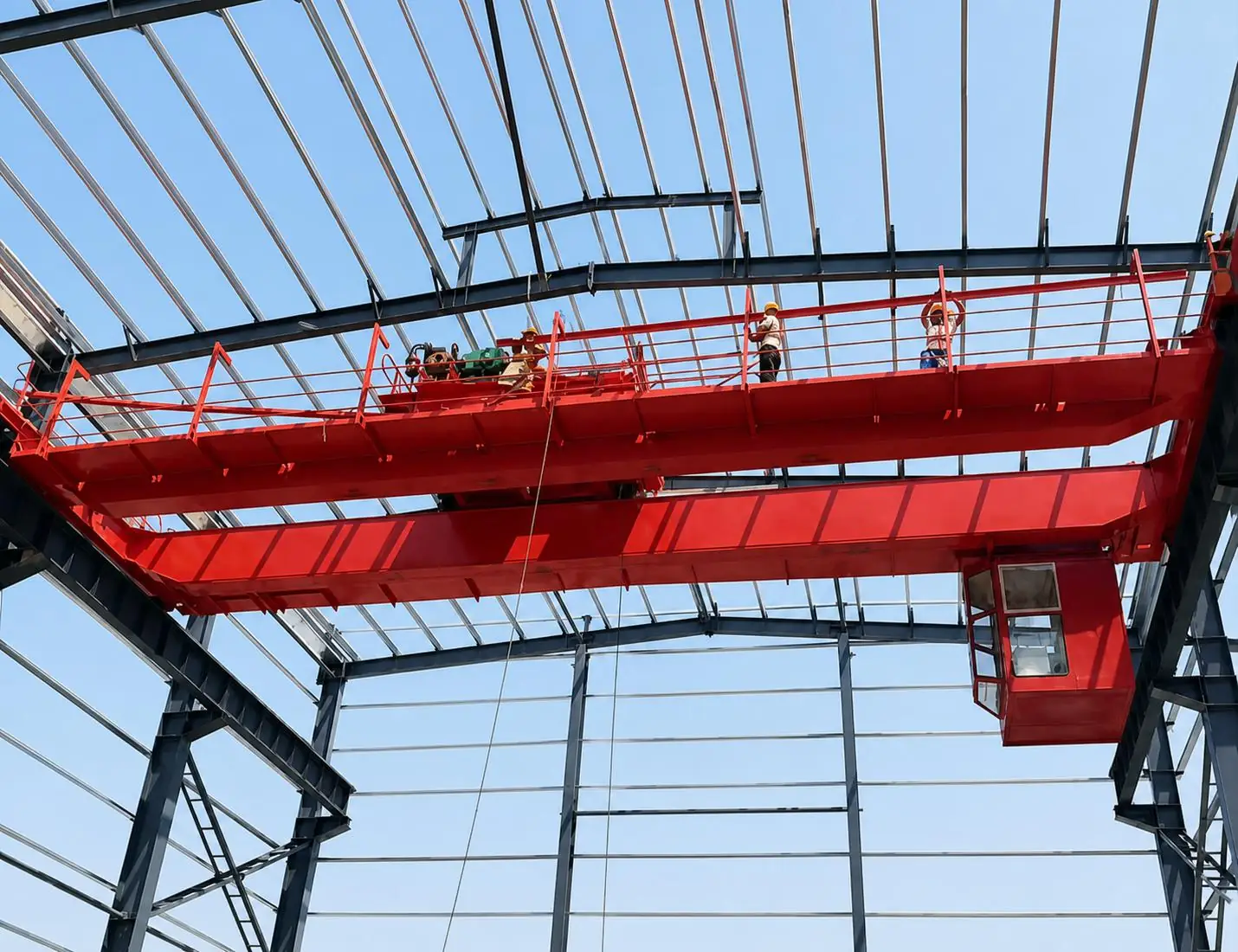
    Bridge crane (single/double girder) Full-bay coverage in permanent buildings Up to 250 tons (double girder) Fixed runway
    Gantry crane Facilities without adequate building support, outdoor use A few hundred pounds to industrial-scale Self-supporting, often portable
    Jib crane Localized, repetitive lifts at a single workstation Typically up to 1–2 tons Rotates around a fixed column
    Monorail crane Fixed, repeatable paths through tight or curved layouts Up to roughly 6 tons Follows a fixed curved or straight track

    Bridge cranes are still the default for permanent, full coverage handling because they use the building structure to support the load. Gantry cranes are logical when you can‘t support the runway loads in your building,  or when you need to move the crane. Jib and monorail cranes address narrower issues – just one workstation,  or a set production path – at a cost a small fraction of a full bridge system.

    Secide Between Single and Double Girder, Top-Running and Under-Running

    Once a bridge crane has been selected, two additional core structural options must be determined, as they directly influence the equipment’s overall configuration and operational performance: the choice between a single-girder and a double-girder design, and between top-running and suspendedtype configurations.

    Single girder vs. double girder

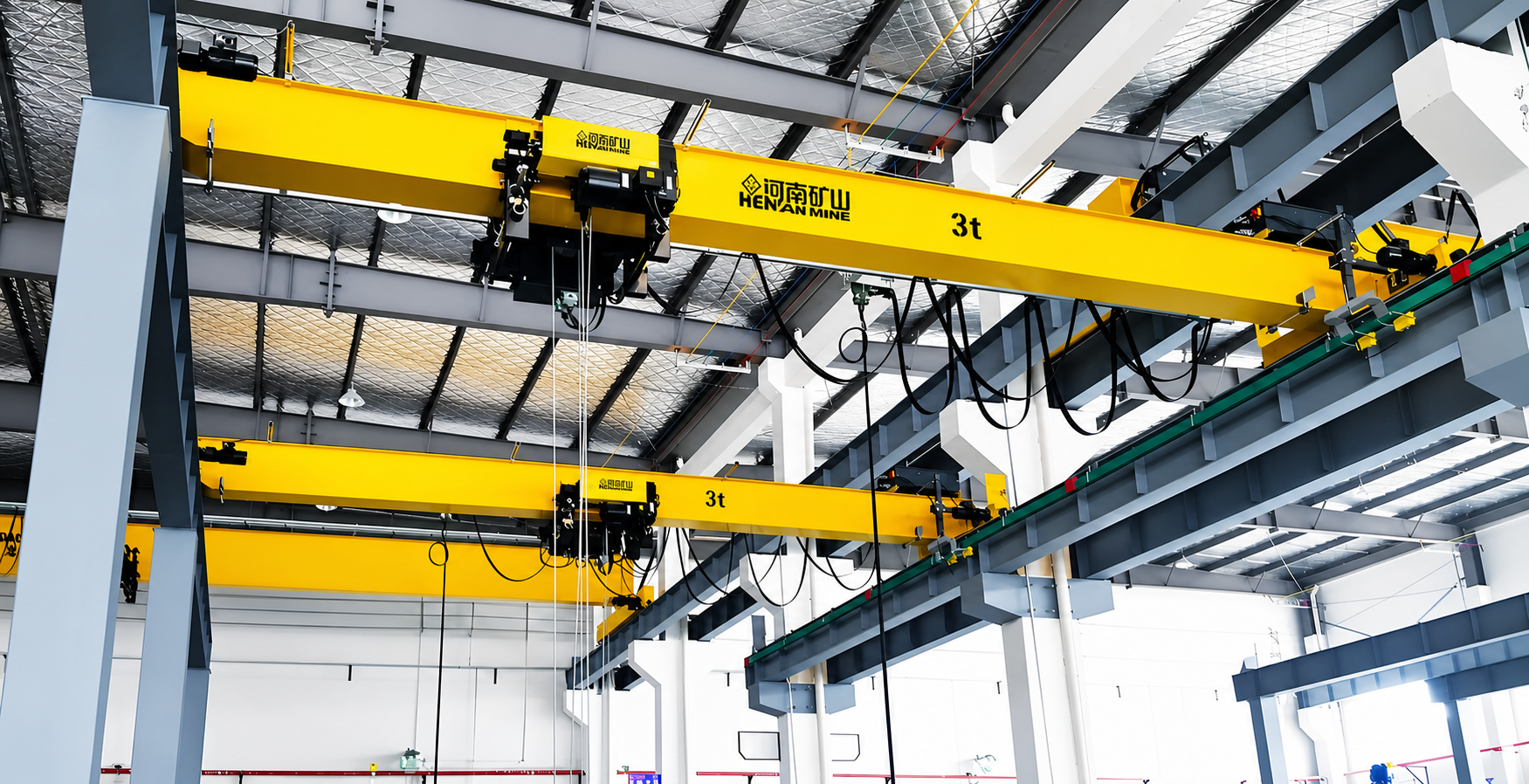
    The single-girder crane adopts a single I-beam main beam, the overall structure is light and compact, the installation space is small, the procurement and operation and maintenance costs are lower, and the adaptability is stronger. It is generally suitable for light and medium load conventional hoisting conditions within 15 tons. It is the mainstream choice for small and medium-sized factories to be economical and practical.

    The double-girder crane adopts a symmetrical structure of double main girders, with stronger overall rigidity and more stable bearing performance. It not only has a larger effective lifting height, but also has a rated load of hundreds of tons. Its bearing capacity and operation stability far exceed that of the single-girder crane. It is a special standard equipment for heavy-duty, high-frequency and high-standard hoisting operations in large factories.

    Top-running vs. under-running

    The top running crane runs along the top of the track, which can fully release the rated load of the equipment, while retaining the maximum effective lifting height, the overall bearing capacity and the utilization rate of the working space are higher, and it is suitable for large-scale, heavy-duty, and high-working conditions. Lifting system.

    The under running crane adopts the roof suspended ceiling installation method, does not occupy the ground and column space, the layout is more clean and flexible, the space adaptation advantage is outstanding, very suitable for light load conditions, plant floor height is limited, the site layout is compact production scene.

    The selection of the above two structures has no absolute advantages and disadvantages, and the optimal scheme depends entirely on the load-bearing capacity of the plant structure and the indoor headroom height, which is also a crucial consideration dimension in the selection of cranes.

    Select the Hoist and Control System

    Electric hoist is the core lifting mechanism of crane, the choice of hoist type directly determines the use cost and operating performance of the equipment, the two types of mainstream model adaptation scenarios are different.

    • The wire rope hoist has stronger carrying capacity and runs more smoothly under high frequency and high strength operating conditions. It is a general preferred model for heavy load and high frequency lifting scenarios and is suitable for most heavy industrial production conditions.
    • The chain hoist has outstanding cost performance and is more suitable for work stations with small tonnage and light load. However, long-term continuous heavy-duty operation is easy to aggravate body wear and tear, and its service life will be greatly reduced, which is not suitable for high-intensity work scenarios.

    On the control side, modern cranes typically offer:

    • The wired handle has simple control structure, low cost, wired connection, stable and reliable operation, and easy maintenance. It is the mainstream choice for conventional basic working conditions.
    • Wireless remote control can liberate the operator’s activity space, greatly improve the operation flexibility and vision safety, especially suitable for large-span and large-scale hoisting operation scenarios, and avoid the risk of operation blind area.

    The cab control is specially designed for large cranes or high-capacity, high-throughput heavy-duty systems, and is suitable for high-strength, high-precision, and all-weather industrial operations.

    The variable frequency drive system (VFD) is a valuable upgrade configuration for cranes. Although the initial purchase cost increases slightly, it can realize soft start and stop of equipment, precise positioning, reduce mechanical impact and wear, effectively extend the life of equipment and reduce long-term maintenance costs.

    Verify Facility and Runway Compatibility

    Even cranes with fully compliant drawing parameters may not be able to adapt due to plant conditions. Before finalizing the procurement proposal, the following site conditions must be verified:

    1. Structural bearing parameters: the joint civil engineer shall confirm the track beam specifications, column spacing and equipment wheel pressure load to ensure that the plant structure meets the equipment operation requirements.
    2. Clearance and obstacles: do not only refer to the height of the highest floor of the factory building, but also check the running path of the crane in the whole process, completely avoid all kinds of obstacles such as spray pipes, ventilation pipes, lighting equipment and supporting steel beams, and verify the effective operation clearance.
    3. Supporting conditions for power supply: confirm the power supply scheme in advance, including the selection of sliding contact line or drag chain cable, equipment grounding mode and installation position of electric control cabinet.
    4. Feasibility of on-site installation: The construction risks of retrofitting cranes in old factory buildings are completely different from those of supporting equipment in new factory buildings. Improper planning can easily lead to rework and delay of construction period, which is a common problem of project landing.

    For the old plant renovation project, this link can directly screen out a large number of unsuitable crane models. Therefore, the verification of plant conditions must be placed in the early stage of selection, rather than remedied after the completion of procurement, from the source to avoid adaptation failure, project rework and other problems.

    Prioritize Safety Features and Regulatory Compliance

    In the United States, the bridge crane to strictly follow the OSHA 1910.179 “bridge and gantry crane” specification, equipment construction and inspection process usually refer to ASME B30.2 and CMAA industry standards. The following security configurations are hard standard equipment and cannot be omitted:

    • Overload protection and load limit switch: real-time monitoring of hoisting load, once exceeding the rated tonnage immediately limit the operation, from the source to avoid overload caused by equipment damage and safety accidents;
    • Emergency stop device on the operation console: the operator can stop with one key at any time to deal with sudden abnormal working conditions, quickly cut off the operation of the equipment, and build a strong defense line for sudden risks;
    • Lifting upper and lower limit switches: accurately control the lifting stroke of the hook, effectively prevent dangerous working conditions such as over-range operation, topping, falling bottom, etc., and avoid damage to the mechanical structure;
    • Anti-sway and anti-collision system: it is mostly used in medium and high-end models, which can effectively inhibit hoisting shaking, avoid hidden dangers of equipment collision, and greatly improve equipment operation stability and operation safety factor;
    • Acousto-optic integrated early warning device: when the equipment is running, it will send out light and sound prompt synchronously to clearly warn the on-site personnel and avoid the potential safety hazard of man-machine cross operation.

    In addition to the equipment hardware configuration, the OSHA specification clearly requires the equipment daily power-on precheck and regular in-depth inspection. Enterprises need to consider compliance inspection, data filing and certification requirements in advance during the selection and procurement stage, and do not wait until the equipment installation is completed before making rectification.

    Suppliers shall be able to provide CE, EN 13157 and other corresponding national standard certification, engineering drawings and load test process documents. Suppliers who cannot provide complete compliance information shall be carefully selected.

    Account for Environmental and Operating Conditions

    The actual operating environment of the crane directly determines the material selection, anti-corrosion coating, motor parameters and electrical protection level of the equipment, and the following key working conditions should be considered in the selection:

    • Extreme temperature environment: whether it is cold storage low temperature conditions, or high temperature conditions in the foundry, all need to match the exclusive motor specifications and lubricating medium, to avoid the failure of conventional accessories due to temperature change.
    • High humidity and flushing conditions: For food processing and other scenes that require high-frequency water washing and killing, waterproof flushing grade accessories must be selected and matched with corrosion-resistant coatings to prevent problems such as moisture corrosion and water inflow failures.
    • Dust and explosion-proof environment: For flammable, explosive and high dust scenes such as grain processing, woodworking production and chemical workshops, special structures for fire prevention and explosion-proof shall be adopted. Pneumatic hoist is also a common adaptation model for such high-risk environments.
    • Outdoor open-air working conditions: outdoor operation scenarios without closed plant protection, cranes need to be equipped with anti-ultraviolet protective coatings and fully sealed electrical components to resist outdoor environmental erosion such as sunlight, wind and rain.

    According to the actual working environment, one-time accurate selection can effectively avoid premature corrosion and damage failure of the equipment, which is far lower and more stable than the renovation cost of later failure renovation and installation of anti-corrosion accessories.

    Plan for Maintenance, Serviceability, and Future Expansion

    A hard-to-service crane will hurt you in downtime long after the asking price is forgotten.  Choose models with easily reachable parts, walkways, and platforms so that inspection and maintenance take less time.  If you‘ll be operating a number of bays,  standardize your hoists and controls so that your spare parts inventory and personnel training is manageable.

    It‘s also helpful to be specific with future growth in mind:  has there been either available capacity in the electrical panel, a runway designed for a longer length than you presently require, or structural clearances for a second bridge further in the future. These types of “wants” are significantly less expensive to include in the design at purchase than to modify at a later date.

    Calculate Total Cost of Ownership, Not Just Purchase Price

    The purchase unit price is the most intuitive purchase cost, but it is often the lowest expenditure in the 15 to 25 year service cycle of the crane. The total cost of ownership (TCO) of the equipment consists of four core segments:

    1. Energy cost: Equipped with high-efficiency motor and variable frequency drive system (VFD) equipment, can effectively reduce power consumption, while reducing equipment running heat, long-term energy saving benefits.
    2. Maintenance and spare parts cost: priority should be given to the models with strong versatility of spare parts, short supply cycle and common standardized spare parts with existing equipment in the factory area, so as to reduce the difficulty of subsequent operation and maintenance and the cost of consumables.
    3. Cost of downtime loss: Crane failure downtime will directly cause production stagnation, and the capacity loss caused by the shutdown is usually much higher than the input cost of preventive maintenance.
    4. Training and testing costs: including professional training costs for operators, as well as regular equipment testing and compliance filing related costs mandated by OSHA regulations.

    Comprehensive long-term cost of use, the purchase of higher unit price of high-quality cranes, with lower frequency of parts replacement, fewer downtime failures, the total life cycle cost is much lower than the low-cost low-cost low-equipped models, is a more cost-effective long-term choice.

    Conclusion

    Bridge crane selection can not only refer to the rated load, but also need to consider the load conditions, operating frequency, plant conditions, operating environment, safety standards and future capacity requirements. Cranes customized for working conditions can effectively improve production efficiency, ensure operation safety, and reduce the cost of equipment life cycle.

    Enterprises need to comprehensively comb the lifting requirements, plant parameters, operating frequency and installation conditions before making inquiries. Accurate working condition information can help manufacturers provide customized solutions, abandon the short board of general-purpose models, and realize accurate matching of equipment and production scenarios.

    Henan Mine Crane specializes in providing all kinds of lifting equipment and intelligent lifting systems, adapting to multi-industry working conditions and supporting customized solutions. With one-stop service, for customers to create safe and efficient, high-durability lifting equipment, to ensure long-term production benefits.

    Henan Mine CraneDiscuss your requirements ↗
  • Why Port Cranes Fail Under Continuous Operations and How to Prevent It

    Why Port Cranes Fail Under Continuous Operations and How to Prevent It

    Why Port Cranes Fail Under Continuous Operations and How to Prevent It

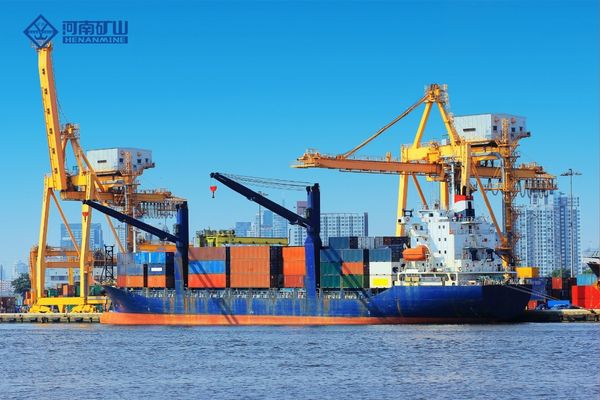
    With the continuous growth of global port cargo throughput, major terminals generally adopt a 24-hour uninterrupted operation mode, and port cranes have been in high-frequency and high-load operation for a long time.Continuous working conditions will significantly exacerbate the loss of port crane components and increase the probability of failure. It can easily cause problems such as port crane downtime, increased maintenance costs, and delays in cargo transfer, which directly affect the efficiency and revenue of terminal operations.This article analyzes in depth the causes and early warning signs of port crane failure under continuous operation, and provides practical failure prevention and port crane reliability optimization solutions.

    Why Continuous Port Crane Operations Accelerate Failure

    High cycles and cumulative mechanical stress

    Continuous operation of port cranes will repeat lifting, luffing, walking, rotating and other actions at high frequencies, and the number of daily operation cycles is extremely high.Each operation will cause stress loss to core components such as wire ropes, gearboxes, bearings, and brakes. Under continuous operation conditions, the stress of the components cannot be cushioned and released, and irreversible mechanical fatigue will be formed over a long period of time.This will continue to reduce the structural strength of the components, increase the gap and friction loss of the accessories, offset the standard operating parameters of the port crane, and ultimately cause various common faults such as abnormal noise, caton, and component failure of the port crane.

    24/7 operation impact on component life

    The design service life of port crane parts is adapted to conventional intermittent operating conditions, and 24-hour continuous operation will significantly exceed the design and operation benchmark of the parts, accelerating the overall aging and loss.Long-term heavy-duty friction of transmission components, rapid failure of lubricating media, and significant increase in wear rate.The electrical components continue to be energized and work, and the cooling buffer time is lacking, and the aging rate of the components is significantly accelerated.Due to the influence of marine corrosion conditions, the service life of various accessories has been greatly reduced, and the traditional maintenance mode cannot be adapted to the needs of high-intensity operations, which can easily cause early scrap of components and frequent failures of port cranes.

    Downturn impact on productivity and cost

    The port terminal is an assembly line operation mode, and the sudden shutdown of the crane will directly cause the entire operation line to stagnate, interrupt the transfer of goods, cause ships to be stuck in the port, and the backlog of vehicles will be greatly reduced. The throughput of the terminal.Unplanned crane downtime not only generates direct costs such as emergency repairs, parts replacement, and manual dispatching, but also shortens the overall service life of port cranes and increases labor costs.At the same time, freight delays will damage the port’s reputation for performance. Data show that a small increase in the length of unplanned downtime will significantly increase the port’s comprehensive operating costs and restrict the overall profitability.

    Common Causes of Port Crane Failures

    Mechanical wear issues

    Wear and tear of mechanical components is the most common and most common cause of failure of port cranes in continuous operation, and it is also the core cause of progressive failure of port cranes.In the continuous operation of high-frequency and heavy-duty loads, the core transmission and load-bearing components such as gearboxes, drive shafts, walking wheels, brake pads, wire ropes, and bearings continue to withstand multiple forces such as friction, impact, and extrusion.Long-term high-frequency operation will lead to surface wear of components, excessive mating clearance, deformation and loosening, and then transmission caton, braking failure, unstable lifting and other failures.In addition, minor operational problems such as slight overload, cargo center of gravity offset, and port crane alignment deviation during operation will be infinitely magnified during continuous operation, accelerating component wear and aging.If daily maintenance is not timely, minor wear and tear will quickly evolve into component damage, port crane downtime, and in severe cases, safety accidents such as derailment and falling objects will be caused.

    Electrical and control overheating

    The electrical and control system is the core control module of the port crane, and it is also a vulnerable module under continuous operation.Under 24-hour uninterrupted operation, electrical components such as motors, frequency converters, power distribution cabinets, sensors, cable harnesses, etc. continue to work, and heat continues to accumulate and cannot be fully dissipated, which can easily cause overheating of the system.High temperature can lead to attenuation of the performance of electrical components, aging of the insulation layer, abnormal line resistance, and then sensor failure, signal transmission delay, inverter error, insufficient motor power and other failures.Especially in the superimposed scenarios of high temperature in summer, closed port computer rooms, and high-load operations of port cranes, the probability of overheating of the electrical system is greatly increased, and safety tripping and abnormal start and stop of port cranes are frequently triggered.Repeated overheating and restarting will further damage electrical components, shorten the service life of the control system, continue to increase component loss, and form a cumulative superposition of hidden dangers in the operation of port cranes.

    Marine corrosion damage

    Port cranes have been deployed in coastal and riverside terminals for a long time, and they face harsh marine working conditions such as high humidity, high salt spray, sea breeze erosion, and rainwater erosion all year round. Corrosion is the key cause of permanent loss of port cranes.The chloride ions in the salt spray are highly permeable and will continue to corrode the crane’s steel structure, metal connectors, mechanical components and electrical interfaces.Continuous operation will further exacerbate corrosion hazards. The continuous vibration of port cranes will cause fine cracks in the anticorrosive coating on the metal surface, and salt spray and water vapor will invade the substrate through cracks, causing steel structure corrosion, component stagnation, and bolt corrosion and loosening.Corrosion of the electrical interface can lead to poor contact, signal failure, and hidden dangers of short circuit.Long-term corrosion will cause the structural strength of the port crane to decrease and the accuracy of the components to fail, greatly increasing the probability of failure, and in severe cases it will affect the overall structural safety of the port crane.

    Structural fatigue and dynamic load

    Henan Mine Crane manufactured the main steel structure of the main beam, end beam, gantry, etc. of the port crane, which needs to continuously withstand multiple forces such as the dynamic load of the cargo, the vibration of the port crane itself, and the impact of the sea breeze.Under continuous operation, dynamic loads repeatedly and alternately act on the same position of the steel structure, and long-term accumulation will cause fatigue of the metal structure and produce fine fatigue cracks.Unlike static port crane wear and tear, steel structure fatigue has a strong concealment, and the initial cracks are difficult to identify with the naked eye. As the frequency of operations increases and the load continues to act, the cracks will gradually expand, eventually leading to serious problems such as structural deformation, cracking, and excessive deflection.At the same time, the instantaneous impact load of cargo lifting, the dynamic thrust of the sea breeze, and the inertial load of the port crane will continue to intensify structural fatigue and reduce the structural stability and carrying capacity of the port crane.

    Maintenance and operator errors

    Human-made operation and maintenance and improper operation are important subjective reasons for frequent failures in the continuous operation of port cranes.At the maintenance level, some port operation and maintenance teams follow the maintenance cycle of conventional intermittent operations and are not adapted to the high-loss characteristics of 24-hour continuous operation. There are problems such as untimely lubrication, inadequate inspections, failure to replace lost parts in advance, and lag in anti-corrosion maintenance, resulting in the continuous accumulation of minor hidden dangers, which eventually evolved into major failures.At the operational level, operators are prone to fatigue operations and illegal operations during long-term high-intensity operations, including slightly overloaded lifting, emergency stopping and turning, cargo shaking operations, and irregular operations such as forced alignment of port cranes.Such operations will instantly increase the load and mechanical impact of port cranes, accelerate component wear and structural fatigue.At the same time, the operator’s failure to recognize the early warning signals of the port crane in time and the failure handling is not standardized will also lead to the expansion of minor failures and exacerbate the risk of failure of the port crane.

    Warning Signs of an Impending Port Crane Failure

    Abnormal noise, vibration and temperature

    Abnormal noise, vibration, and temperature rise are the most intuitive pre-warning signals for crane failure, and they are also the core manifestations of excessive loss of crane components in the port.When mechanical parts are worn, lubrication fails, and the mating gap is abnormal, abnormal noises will occur in the operation of the port crane, including gear bite noise, bearing friction sound, and wire rope shaking noise.Loose parts, structural fatigue, and uneven load will cause abnormal vibration of port cranes, and the vibration amplitude will gradually increase with the length of operation.At the same time, the temperature of motors, gearboxes, bearings and other components rises abnormally, far exceeding the conventional operating temperature. It is highly likely that it is a signal of component overload, increased friction, and heat dissipation failure.Once the above anomalies occur, it means that the port crane is already in a critical state of failure, and it needs to be stopped for inspection immediately to investigate hidden dangers and avoid sudden failure and shutdown.

    Rising motor and gearbox load

    During continuous operation, if the operating current of the crane motor continues to increase, the load rate exceeds the standard, the operating resistance of the gearbox increases, and the temperature rises too fast, it is an important early warning of the failure of the transmission system.Gear wear, lubrication failure, bearing stagnation, drive shaft alignment offset and other problems will all lead to increased transmission resistance, and the motor needs to output more power to complete the operation, which is directly manifested as an abnormal increase in load.Long-term high-load operation of the motor and gearbox will quickly exacerbate the aging of the components, causing serious failures such as motor burning, gear cracking, and transmission stuck.The operation and maintenance team can accurately identify abnormal load changes through real-time load monitoring data, and predict the risk of transmission system failure in advance.

    Slow and unstable crane movement

    The crane’s lifting, walking, and luffing movements slow down, the operation is stuck, the trajectory is unstable, and the shaking amplitude increases. These are typical signs of the failure of the hydraulic system, transmission system, and control system of the port crane.Aging of hydraulic oil, blockage of oil circuit, and wear of hydraulic pump can lead to insufficient power output and slow movement.Loose wear and tear of transmission parts and excessive clearance will cause unstable operation.The accuracy of the sensor decreases and the delay of the control signal will cause the action to stall and the start and stop will be unstable.Such problems only affect operational efficiency in the early stage, but if left unchecked, they will deteriorate rapidly, leading to uncontrolled movement of port cranes and brake failure, which will not only cause port crane failures, but also bring safety risks such as cargo falling and port crane collisions.

    Frequent electrical faults and trips

    Frequent errors in the electrical system, repeated tripping of safety protection devices, and automatic shutdown of port cranes are the core early warnings of electrical failures and system overload.Problems such as overheating of electrical components, aging of lines, sensor failure, voltage instability, and interface corrosion caused by continuous operation will trigger safety protection mechanisms, resulting in frequent tripping and shutdown.Repeated electrical failures and safety tripping are not simple system false positives, but an intuitive manifestation of the attenuation of the performance of the electrical system of the port crane and the accumulation of hidden dangers.Frequent start-stop shocks will further damage electrical components, forming a vicious circle, which will eventually lead to complete failure of the electrical system and cause long-term downtime for maintenance.

    Fast wear of core wearing parts

    Wire ropes, brakes, walking wheels, and bearings are the most quickly worn and vulnerable parts of cranes, and their wear speed can directly reflect the operating state of port cranes.If the wire rope is broken, corroded, and the diameter shrinks during daily inspections, the brake pads wear out too quickly, the braking distance becomes longer, the wheel tread wears unevenly, scratches and deformation occur, and the bearings are heated. , Abnormal clearance and other accelerated wear phenomena indicate that the port crane is in an overloaded and high-loss operating state.The accelerated aging of such vulnerable components is a pre-confidence signal of the overall failure of the port crane. If it is not replaced and maintained in time, it will directly cause major failures such as lifting failure, braking failure, and derailment, which seriously threaten the operation safety and operation continuity of the port crane.
    port crane failures

    How to Prevent Port Crane Failures Under Continuous Operations

    Preventive maintenance and lubrication

    Targeted preventive maintenance and refined lubrication are the basic means to prevent crane failures in continuous operation.In view of the 24-hour uninterrupted operating conditions, it is necessary to abandon the conventional maintenance cycle and formulate an exclusive maintenance plan for high-frequency refinement and normalization.Shorten the inspection, maintenance, and lubrication cycle of core components, focusing on vulnerable components such as gearboxes, bearings, wire ropes, and brakes, regularly clean up impurities, supplement and replace special lubricating media, and choose wear-resistant greases suitable for high temperature, high load, and marine working conditions to avoid friction losses caused by lubrication failure.At the same time, a standardized maintenance ledger is established to record the loss status, maintenance time, and operating parameters of components to achieve traceability of losses and predictability of hidden dangers.Investigate the hidden dangers of loosening, wear, and aging in advance, replace critical wear-out parts in time, reduce sudden failures from the source, and ensure the continuous and stable operation of port cranes.

    Condition monitoring and predictive inspection

    Relying on intelligent condition monitoring and predictive inspection technology to replace traditional manual passive maintenance, it is the core failure prevention solution suitable for continuous operation Henan Mine Crane manufactured port cranes.Through the installation of intelligent port cranes such as temperature sensors, vibration sensors, current monitoring modules, and load monitoring systems, the operation data of port cranes is collected in real time, and the operating status of mechanical transmission, electrical control, and structure is monitored around the clock.Based on big data analysis, the operating parameters of port cranes are changing trends, and the hidden dangers of component wear, aging, and overheating are accurately predicted, and targeted maintenance is completed in the budding stage of failure, so as to investigate hidden dangers and preventative maintenance in advance.Compared with the traditional post-failure maintenance and regular maintenance models, predictive inspections can greatly reduce the probability of unplanned downtime and maximize adaptation to the needs of continuous operating conditions.

    Corrosion protection and marine parts

    In view of the harsh marine working conditions of the port, strengthen the anti-corrosion protection of port cranes and adapt to marine-grade special components, which can effectively resist various failures caused by corrosion.In the manufacturing stage of port cranes, special marine anticorrosive technology is used to remove rust, spray anticorrosive, and passivate the steel structure to improve the corrosion resistance of the substrate.In daily operation and maintenance, regularly repair the damaged anticorrosive coating, clean up the accumulation of salt spray and water vapor on the surface of the port crane, and prevent the spread of corrosion.At the same time, ordinary vulnerable parts, electrical interfaces, and fasteners are replaced with marine-specific accessories, which have the characteristics of salt spray resistance, high moisture resistance, corrosion resistance, and high temperature resistance. They are adapted to the harsh working conditions of the port around the clock, greatly reducing the problems of component failure, circuit failure, and structural loss caused by corrosion, and improving the environmental adaptability of port cranes.

    Standardized operator training

    Standardizing operating procedures and strengthening personnel training are key measures to reduce human failures and reduce the loss of port cranes.In view of the high-intensity working conditions of continuous operation, standardized port crane operation specifications have been established, and illegal operations such as overload lifting, emergency stopping and turning, savage alignment, and cargo shaking operations are clearly prohibited, and the operation standards of the whole process of starting and stopping, lifting, walking, and luffing of port cranes are standardized to reduce the impact and loss of port cranes caused by human operation.Carry out regular special training for operators, covering the operating principle of port cranes, fault early warning signal identification, standardized operation procedures, emergency response methods, etc., to enhance the professional ability of operators and the ability to identify hidden dangers.At the same time, a rotating operation system is implemented to avoid port crane failures caused by personnel fatigue operations, and to strengthen the continuous operation safety line of port cranes from the human level.

    How to Improve Port Crane Reliability and Availability

    Critical component replacement schedule

    The service life of the core components of port cranes is obviously differentiated. If you want to continuously improve the reliability and operational availability of port cranes, you need to accurately sort out the list of key core components of port cranes, classify and define load-bearing components, transmission components, electrical core components, and vulnerable consumable components, and formulate a dedicated standardized replacement cycle based on the loss rate of continuous operating conditions.For high-frequency wear-resistant parts such as wire ropes, brake pads, bearings, seals, etc., the replacement cycle is shortened.Formulate special testing and iteration plans for core precision components such as gearboxes, motors, and sensors.For long-lasting components such as steel structures, regular non-destructive testing is carried out to clarify the loss threshold.Through a standardized component replacement mechanism, sudden failures caused by overdue service of core components are avoided, and the operating performance of port cranes is stabilized.

    Data-driven maintenance planning

    Fully integrate the full amount of data from daily inspection, intelligent monitoring, and port crane operation, build a port crane maintenance data system, and use data as the support to achieve accurate predictive maintenance.By analyzing the historical change curves of temperature, vibration, load, wear, and electrical parameters of port cranes, we can accurately locate the high-frequency loss points, the high-occurrence period of hidden dangers, and the cause of failure.Relying on the laws of data, plan maintenance plans in advance, use the off-season of port operations and the ship window period to carry out targeted maintenance, component replacement, and port crane commissioning, and completely transform the passive operation and maintenance mode of emergency repair after failure, so that maintenance work is accurate and efficient, minimize the impact of maintenance on normal operations, and continuously improve the effective operating time of port cranes.

    Spare parts preparation for less downtime

    The scientific reserve and planning of spare parts is an important guarantee to reduce the length of unplanned downtime and improve the availability of port cranes.Combining the model of port crane, the frequency of component loss, and the type of high failure, a complete spare parts inventory system is established, focusing on the reserve of vulnerable parts, core precision parts, electrical accessories, anticorrosive accessories and other key materials to ensure that replacement and repair can be completed quickly when hidden faults occur.At the same time, combined with the operation data of the port crane and the maintenance plan, the quantity and category of spare parts inventory are dynamically adjusted to avoid the delay in emergency repairs and the increase in downtime caused by the shortage of spare parts.Through standardized spare parts management, the time-consuming failure and maintenance is greatly shortened, the operating capacity of port cranes is quickly restored, and the operating losses caused by unplanned downtime are effectively reduced.

    Timely modernization of aging equipment

    For old port cranes with long service life, attenuation of core performance, frequent failures, and high maintenance costs, simple maintenance and component replacement cannot completely solve the reliability problem.At this time, it is necessary to scientifically evaluate the adaptability, operating stability, maintenance cost and operating efficiency of port cranes, and start the intelligent and modern upgrading of port cranes in a timely manner.Upgrade and iterate the electrical control system, transmission system, monitoring system, and anticorrosive structure of old port cranes, replace backward accessories, optimize the operating parameters of port cranes, and install intelligent monitoring modules to enhance the automation, intelligence, and anti-loss capabilities of port cranes.For old port cranes with low retrofit value, complete the iterative update of port cranes in a timely manner, ensure the reliability and stability of continuous operation of port cranes from the hardware level, and adapt to the needs of efficient port operations.

    Henan Mine Crane Factory Custom Custom

    The continuous operation failure of port cranes stems from multiple factors such as loss of working conditions, environmental corrosion, maintenance omissions, and irregular operation. Relying on passive emergency repairs cannot completely solve the problem of port crane downtime.Building a full-cycle active protection system, combined with scientific maintenance and port crane upgrades, can effectively improve the stability of port cranes.As a professional port crane manufacturer, Henan Mine Crane Factory is deeply engaged in the research and development and manufacturing of cranes in harsh working conditions, adapted to 24-hour high-frequency heavy-duty operation scenarios, and provides high-quality port cranes and a full set of operation and maintenance upgrade services to help the port continue to reduce costs and improve efficiency. Stable operation.

    Henan Mine CraneDiscuss your requirements ↗
  • Why Port Cranes Fail Under Continuous Operations and How to Prevent It

    Why Port Cranes Fail Under Continuous Operations and How to Prevent It

    Why Port Cranes Fail Under Continuous Operations and How to Prevent It

    As the ‘throat’ connecting land and sea transport, the stable operation of cranes has a direct impact on port throughput and supply chain efficiency, and the ‘all-weather operation’ mode significantly increases its operating load, resulting in mechanical and electrical systems in a long-term high stress state, and failures occur frequently.

    In this paper, it is clear that continuous operation triggered by mechanical wear and tear, environmental erosion and other issues can easily lead to crane failure, and proactive prevention, scientific maintenance and other strategies can effectively reduce the risk and ensure equipment stability.

    Potential Wear and Tear on Port Cranes in Continuous Operation

    Port cranes continuous operation (especially 24-hour uninterrupted operation) and intermittent operation there are essential differences:

    Intermittent operation can provide rest and buffer time for the equipment, while continuous operation will make the crane’s mechanical, electrical, hydraulic, structural four systems are in a long-term high load operating state, the cumulative stress is constantly superimposed, and ultimately accelerate the aging of the components and the occurrence of failures.

    The core stress point under continuous operation is mainly reflected in two aspects:

    • High cycle times, a shore container crane needs to complete hundreds or even thousands of lifting, panning, landing movements per shift, wire rope, gears, bearings and other components repeatedly subjected to bending, stretching, friction, there may be no obvious abnormality in the short term, but the long term accumulation will significantly shorten its service life;
    • Continuous load, motors, winches, brakes and other power components need to continue to output power for a long time, prone to overheating, insulation aging and other issues, while the hydraulic system is in a high-pressure state for a long time, which may also lead to damage to seals, oil leakage.

    Wire rope, for example, in continuous operation, it needs to be repeatedly wound on the drum, through the pulley block, each rise and fall will produce bending and tensile stress, long-term down will lead to wire rope fatigue, wire breakage, if not found in time, may eventually lead to rupture accidents;

    Again, such as the motor winding, continuous operation will make the winding temperature continues to rise, if the cooling system fails to dissipate heat in time, it will accelerate the aging of the insulation layer, which in turn triggers a short circuit, motor burnout and other faults, resulting in sudden crane shutdown.

    Common Causes of Port Crane Failures Under Continuous Operation

    Mechanical Wear and Aging

    Mechanical wear is the most common cause of failure under continuous operation of port cranes, but also one of the main reasons for equipment shutdown, mainly affecting the core force components such as winches, winches, motors, brakes, etc., which bear the action of lifting and panning for a long time, and are in a high load and high friction state.

    In the continuous operation of the working conditions, the wear and tear of these parts will be significantly accelerated:

    • The wire rope which can be used stably for 3-5 years under the condition of intermittent operation will be shortened significantly under the high-intensity load of 24-hour uninterrupted operation, and its service life can only be maintained for 1-2 years;
    • The gearbox internal gears are in the state of meshing and rotating for a long time, which will lead to wear of the tooth surface and cracking of the top of the teeth due to continuous friction, and if lubrication and maintenance are not carried out in time, it may also lead to serious faults such as stuck gears, which will directly lead to the shutdown of the equipment;
    • Brakes need to perform frequent braking operations for a long time, the brake pads will wear out quickly, which will lead to increased brake clearance and decreased braking efficiency, and in serious cases, brake failure will occur, leading to safety accidents.

    After 36 hours of continuous operation of an RTG crane in a coastal port, the brake pads were not inspected and replaced for a long time, and the wear and tear exceeded the standard, resulting in brake failure, and the spreader slid down slowly with the container, which didn’t cause a fall, but the equipment was shut down for 12 hours for maintenance, affecting the pace of port operations.

    Improper Maintenance

    Inadequate maintenance is another major core cause of port crane failure, of which ‘passive maintenance’ is the most prominent harm.

    Many ports for the pursuit of efficiency, such as equipment failure before maintenance, resulting in small defects, small wear and tear accumulated into a major failure, not only higher maintenance costs, but also extend the downtime.

    In practice, the maintenance work is often negligent, especially the following easily overlooked links, easy to accelerate equipment failure:

    • Insufficient lubrication of moving parts: no timely lubrication and maintenance of moving parts, will exacerbate the friction between the parts of the loss, accelerate the rate of wear and tear, and thus shorten the service life of the parts.
    • Wire rope inspection is not meticulous: daily inspection in the wire rope status is not carefully checked, can not be found in time broken wire, rust and other hidden dangers, easy to bury the safety risk of wire rope breakage.
    • Safety system debugging is not timely: limit switches, emergency stop devices and other safety components are not regularly debugged according to the regulations, which will lead to the failure of its safety protection function and significantly increase the safety risks of equipment operation.

    An STS crane in a port suffered from abnormal vibration and slight rattling of the gear box. The maintenance personnel did not conduct in-depth inspection, but only did surface inspection, which ultimately led to gear collapse, equipment downtime and maintenance for 3 days, and repair cost of more than 1 million yuan.

    Afterwards, it was confirmed that the noise was a signal of increased gear wear, and timely troubleshooting could have prevented the failure.

    Environmental Factors

    Most of the port cranes operate in the open air, exposed to the harsh natural environment for a long time, the erosion of environmental factors will further accelerate the aging of the equipment and increase the risk of failure. Among them, salt spray and high humidity in coastal ports, as well as strong winds and extreme temperature differences prevalent in all types of ports, are the main environmental factors affecting the life of the equipment.

    Salt spray and high humidity can cause serious corrosion to the metal parts of cranes:

    • The paint protective coating on the surface of the crane steel structure will gradually fall off after long-term erosion by salt spray, resulting in exposed steel and corrosion, which will weaken the overall strength of the steel structure and lay a hidden danger of structural safety.
    • If salt spray and moisture enter the interior of the electrical control cabinet, it will cause the line insulation to drop, short circuit, or even burn the electrical components; wire rope, bearings and other components subject to corrosion, surface corrosion, strength decline, increasing the risk of fracture, jamming.
    • Strong winds will generate additional lateral force during crane operation, increasing the structural load bearing, especially in the process of lifting heavy loads, strong winds are prone to cause heavy loads to swing and hit the main structure of the crane, resulting in structural damage;
    • Extreme high temperature will accelerate the aging rate of the motor, electrical components, extreme low temperature will lead to lubricant solidification, hydraulic system operation jam, directly affecting the normal start and stop of the crane and operational accuracy.
    • Extreme high temperatures will accelerate the aging rate of the motor, electrical components, extreme low temperatures will lead to lubricant solidification, hydraulic system jamming, affecting the normal operation of the equipment.

    More noteworthy is that many of the damage caused by the environment is hidden. For example, corrosion within the steel structure, electrical components of the insulation aging, through conventional visual inspection is difficult to find, often wait until the equipment failure, the damage has been very serious, the difficulty and cost of maintenance has increased significantly.

    Overload and Operational Stress

    Overloading is one of the major causes of catastrophic failures of port cranes, and under continuous operation, in order to catch up with progress and efficiency, some operators may violate the overloading, or push the crane to the limit of the rated load, which will cause irreversible damage to the equipment in the long run.

    Each crane has a clear rated load, once more than this load, the structure of the crane, wire rope, winches and other components will be subjected to far beyond the design range of stress, it is very easy to cause breakage, deformation and other failures.

    In addition to direct overloading, the additional stress brought about by improper operation will also accelerate equipment failure:

    1. Operators in the lifting and landing of heavy objects in a hurry, easy to produce shock loads, instantly increase the core components of the stress intensity, accelerate component fatigue wear;
    2. cargo placement is not standardised, the centre of gravity shift, will lead to uneven force on the crane as a whole, significantly increasing the load bearing burden of structural and mechanical components, laying a hidden trouble;
    3. Sudden acceleration and emergency braking during the panning operation will cause the heavy load to generate a large inertia force, which is easy to hit the main structure of the crane, resulting in damage to the components and loss of precision.

    These improper operation behaviours are more likely to occur under the high-intensity rhythm of continuous operation, further increasing the risk of failure.

    Electrical System Failure

    The electrical system is the ‘brain’ of the harbour crane, responsible for controlling the various actions of the equipment, and continuous operation will make the electrical system in a long-term high load state, very prone to failure. Common triggers of electrical failure include power surge, line aging, loose wiring, overheating equipment.

    The power supply system in the harbour may experience power surges due to large equipment starting and stopping, lightning weather, etc. The surge voltage will break through the electrical components and cause system failure;

    Line for a long time by vibration, friction, environmental erosion, there will be insulation aging, loose wiring, which in turn triggers a short circuit, poor contact and other issues; motors, inverters and other electrical equipment will produce a large amount of heat in continuous operation, if the heat dissipation is not timely, it will lead to overheating of the equipment, triggering the protection mechanism shutdown, or even burn the equipment.

    After the intelligent upgrade of port cranes, the complexity of the electrical system increases, although it improves operational efficiency and accuracy, but also increases the failure points; the addition of IoT sensors and other components of the power supply and line connection requirements are higher, any related failure may lead to control system paralysis, affecting the operation of the equipment.

    Consequences of Port Crane Failures

    Operational and Economic Losses

    Port crane failure is the most direct consequence of operational disruption and economic loss: on the one hand, it will lead to berth stoppage, ship stranding, resulting in high stranding charges, stranding fees; on the other hand, the repair of a large number of manpower and material resources need to be invested in the cost of tens of thousands of yuan of minor failures, major failures of more than a million dollars, and can not be repaired, then need to be replaced by a huge amount of money to replace the equipment.

    An RTG crane in a container port was down for 5 days due to gearbox failure, resulting in 3 ships being stranded in harbour, resulting in demurrage fees of 800,000 RMB, maintenance costs of 600,000 RMB, a total loss of 1.4 million RMB; the failure may also result in damage to the goods, triggering trade disputes and increasing additional losses.

    Personnel Safety Risk

    The most serious consequence of the failure of the harbour crane is the threat to the life safety of the operator and the site personnel, such accidents often lead to catastrophic injuries and even death. Cranes, as large and heavy equipment, can lift heavy loads weighing up to tens of tonnes, and in the event of a failure, accidents such as heavy loads falling and equipment collapsing can cause fatal injuries to personnel on site.

    Common catastrophic injuries include:

    • Crush injuries, personnel are crushed by crane parts, falling heavy objects or the gap between the equipment and the ground, resulting in damage to bones, muscles, internal organs, and in severe cases, can lead to extrusion syndrome, renal failure and other complications;
    • Traumatic amputation, where personnel are entangled in the operating parts of a crane, resulting in a broken limb that requires lifelong use of a prosthesis;
    • Traumatic brain injury, where personnel are struck by falling weights, fall from equipment, or become involved in equipment collisions, resulting in concussions and severe brain damage that may cause cognitive impairment, memory loss, and lifelong disability;
    • Spinal cord injuries, where accidents such as falls and equipment overturning may lead to cervical, thoracic and lumbar spine injuries, triggering serious consequences such as quadriplegia and paralysis of the lower limbs;
    • In addition, there may be multiple fractures, internal bleeding, electric shock injuries and other injuries, and some serious accidents can directly lead to death, bringing irreparable losses to families and enterprises.

    Best Practices to Prevent Crane Failures in Continuous Operations

    Establishment of a Perfect Preventive Maintenance System

    Preventive maintenance is the core measure to reduce the incidence of harbour crane failures, the need to abandon the ‘passive maintenance’ mode, the establishment of a scientific and systematic maintenance system. First of all, clear maintenance focus, focus on the core components of the crane:

    • Regular wire rope breakage, corrosion inspection, wear and tear over the standard, there are potential safety hazards of the wire rope to be replaced in a timely manner, to eliminate the risk of wire rope breakage;
    • Regularly lubricate and maintain the core transmission parts such as gear box, bearings, winches, etc., and scientifically adjust the lubrication cycle to reduce the friction loss of the parts in combination with the operating environment of the harbour and the operating load of the equipment;
    • Regularly check the brake, limit switches, emergency stop devices and other safety systems, to ensure that the safety components are fully functional and reliable; at the same time, regular inspection of the electrical system, focusing on checking the line insulation, wiring fastening, and timely investigation of short circuits, poor contact and other hidden dangers.

    Secondly, make a reasonable maintenance plan, combined with the crane’s operating load, service life and manufacturer’s recommendations, to develop routine maintenance, regular inspection, quarterly overhaul, annual overhaul of the hierarchical maintenance plan.

    • Daily maintenance is the responsibility of the operator, focusing on checking the integrity of the appearance of the equipment, operating noise, key parts of the lubrication status, etc., and timely investigation of intuitively visible basis of hidden danger;
    • Regular inspection is carried out by professional maintenance personnel, with the help of professional testing tools, focusing on the investigation of hidden equipment hidden problems, so as to achieve early detection and early disposal;
    • Quarterly maintenance and annual overhaul need to carry out comprehensive dismantling of equipment, accurate testing and system debugging, and timely replacement of aging, wear and tear over the standard components, to ensure that the equipment is always in the optimal operating state, to protect the needs of continuous operation.

    In addition, we make good maintenance records, recording in detail the time, content, problems found and treatment measures of each maintenance. By analysing the maintenance records, we can grasp the operating status and wear and tear pattern of the equipments, so that we can pre-judge the risk of failures in advance and optimise the maintenance plan.

    Upgrade Advanced Monitoring System

    Upgrading the monitoring system with the help of modern technology can realise real-time monitoring of the operating status of cranes and fault prediction, effectively reducing the incidence of failure.

    On the one hand, the introduction of the Internet of Things (IoT) monitoring technology, crane core components installed sensors, real-time collection of equipment operating parameters and uploaded to the cloud for data analysis.

    Once the monitoring of data anomalies, immediately triggered an early warning mechanism to remind the maintenance staff to investigate and dispose of hidden dangers in a timely manner, to achieve the hidden dangers of early discovery, early treatment.

    On the other hand, the application of predictive maintenance technology, combined with artificial intelligence (AI) and machine learning algorithms for in-depth analysis of operational data, the construction of component wear prediction model, accurate prediction of the remaining service life of the core components, to truly achieve the goal of active protection ‘before failure, first maintenance’.

    At the same time, the establishment of a layered inspection system, the integration of daily pre-inspection, periodic special inspections and comprehensive testing, relying on professional testing equipment to accurately investigate hidden dangers, comprehensive coverage of the equipment monitoring links, to achieve the crane without dead ends, the whole process of monitoring, and build a strong line of defence for the safe operation of equipment.

    Emphasis on Operator Training and Certification

    The professional level of the operator directly affects the operational safety of the crane and the risk of failure, so it is necessary to strengthen the training and certification of operators to enhance their operational skills and safety awareness.

    1. Conduct comprehensive training courses covering the basic structure of cranes, operating principles, load calculation, safe operating procedures, emergency response methods, etc., to ensure that operators are proficient in equipment operation skills, and understand the identification of common failures and emergency response measures.
    2. Strictly implement the operator certification system, the operator must pass the professional examination and obtain the corresponding operation certificate before going on duty, and operation without certificate is strictly prohibited;
    3. establish a regular retraining and re-certification system, with the technology upgrading and equipment updating, timely re-training of operators to ensure that they master the operation of new equipment and technology and adapt to the job requirements.
    4. strengthen day-to-day management, carry out regular safety training and case warning education, strengthen the safety awareness of operators, put an end to illegal operation, overloading and other behaviours, and guide operators to develop good habits of standardised operation and regular inspection.

    Implement Effective Load Management Measures

    Reasonable load management can effectively reduce the operating stress of the crane and reduce the risk of failure.

    • Strictly implement load limitation regulations, specify the rated load of each crane, post load signs in obvious locations of the equipment, and strictly prohibit overloading operations;
    • Operators must accurately calculate the weight of the goods before lifting the goods and confirm that the weight of the goods does not exceed the rated load of the crane before carrying out the operation.
    • Standardise cargo placement and rigging operation to ensure stable centre of gravity of the cargo and standardised placement to avoid uneven force on the crane due to shift of the centre of gravity;
    • Select appropriate rigging equipment, ensure that the rated load of the rigging equipment matches the weight of the goods, and ensure that the goods are firmly fixed during the rigging process, so as to prevent the goods from sliding and falling during the operation.
    • Enhance communication and coordination at the operation site. Operators should maintain close communication with ground commanders and terminal dispatchers, and adopt standardised hand signals or two-way radios for information transfer, so as to ensure a smooth operation process and avoid operational errors and increased equipment loads due to miscommunication.

    Quality Materials and System Upgrades

    High-quality equipment components and system upgrades are the basis for improving the anti-fatigue and anti-wear capabilities of cranes. When purchasing equipment and replacing parts, priority is given to high-quality parts that are high-strength, corrosion-resistant and wear-resistant.

    For example, choose galvanised or stainless steel wire ropes to enhance corrosion resistance; choose gears and bearings with good wear resistance to extend the service life of components; choose hydraulic components with excellent sealing performance to reduce the risk of oil leakage.

    At the same time, the old crane system upgrade, eliminating backward electrical systems, control systems and safety protection systems, the introduction of intelligent, automated technology to enhance the operational stability and safety of equipment.

    For example, the traditional electrical control system is upgraded to a PLC control system to improve operational precision and system reliability; intelligent load monitoring devices are installed to monitor the operational load in real time, and once the rated load is approached, an immediate warning is issued to prevent overloading operations.

    Take Protective Measures

    In view of the harsh environmental conditions in the harbour, targeted protective measures are taken to reduce the erosion of the environment on the equipment. For coastal ports, focus on good anti-corrosion prevention.

    • Professional anticorrosion coating treatment of crane steel structure, regular inspection of the coating intact state, found to fall off, damaged in time to make up for the coating, build a solid steel structure anticorrosion line of defence;
    • The implementation of sealing protection treatment of electrical control cabinets, retrofitting dehumidification, anti-salt spray special device, effectively blocking salt spray, moisture intrusion, to protect the normal operation of electrical components;
    • For steel wire rope, bearings and other metal parts, regularly carry out rust removal, lubrication and maintenance operations to effectively enhance the corrosion resistance of components and extend their service life.

    At the same time, adjust the operation plan according to the weather conditions, suspend the crane operation when encountering strong winds, heavy rain, high temperature, cold and other extreme weather, to avoid the equipment to withstand additional stress in bad weather;

    Before the arrival of strong winds, lower the crane’s spreader to the lowest position, and fix the equipment, to prevent the equipment from being damaged by wind blowing.

    Regular Load Test

    Regular load test is an important means to check the load capacity of cranes and investigate hidden structural problems, which should be combined with the service life of the equipment and the operational load, and regularly carry out the rated load test and the overload test with strict control ratio, check the structural strength, braking performance, etc., to confirm that the equipment meets the requirements of continuous operational loads.

    Tests need to use professional equipment to monitor real-time operating data, and abnormalities in structure, braking or components are found to immediately stop the test and repair and adjust to ensure that the equipment operates safely within the rated load, and to avoid failures caused by insufficient load.

    Cultivate Safety First Corporate Culture

    A good safety culture is an important guarantee for preventing crane failures and ensuring operational safety.

    The first to establish a sound safety management system and operating procedures, clarify the safety responsibilities of each position, standardise the crane’s operating procedures, maintenance procedures and emergency disposal procedures, to ensure that all work is regulated.

    • Regularly carry out safety training and emergency drills, organise operators and maintenance personnel to learn safety knowledge and emergency disposal methods, and enhance the safety awareness and emergency disposal ability of all staff;
    • For emergencies caused by crane failure, formulate detailed emergency plans and carry out regular drills to ensure that accidents can be quickly and effectively disposed of to reduce casualties and economic losses.
    • Establish an accountability mechanism and an accident reporting system to encourage employees to take the initiative to report equipment hazards and operational abnormalities, and reward employees who find hidden dangers and avoid accidents;
    • For equipment failures caused by irregular operation and improper maintenance, seriously investigate the responsibility of relevant personnel and strengthen the implementation of responsibility;
    • For equipment failures and attempted incidents (near-miss incidents) that have occurred, carry out in-depth investigation and analysis, identify the root cause, formulate targeted rectification measures, closed-loop management, and prevent the recurrence of similar accidents.

    Conclusion

    Failure of port cranes under continuous operation is caused by mechanical wear and tear, lack of maintenance and other factors, which can cause operation interruption, huge economic losses and personnel safety threats; at present, continuous operation has become the norm, and failure prevention is the core task of port enterprises.

    Call on all parties involved in the port to pay attention to failure prevention, combined with their own practical development of targeted programmes, to identify hidden problems, and pay attention to new technologies in the industry, optimize equipment management and maintenance mode, to help the port industry high-quality development.


    Henan Mine CraneDiscuss your requirements ↗
  • Why Custom Cranes Outperform Standard Solutions in Complex Facilities

    Why Custom Cranes Outperform Standard Solutions in Complex Facilities

    Why Custom Cranes Outperform Standard Solutions in Complex Facilities

    In the field of industrial production, cranes are the core equipment of material handling, and their adaptability directly affects production line efficiency, production safety and long-term operating costs.For industrial facilities with complex layout and special working conditions, standard cranes are often difficult to adapt to actual needs, while customized cranes have become the best choice under complex working conditions with targeted design, precise adaptation and full-scene adaptation capabilities.This article will analyze in depth the core reasons why customized cranes exceed standard solutions, and help companies make more scientific equipment selection decisions.

    Why Standard Cranes Cannot Meet Complex Facility Requirements

    Limitations of standard crane designs

    The design logic of the standard crane is based on general working conditions and adopts fixed span, load parameters and structure. The core advantages are mass production, controllable cost and short delivery cycle.However, this standardized design has obvious limitations, and its parameter settings cannot cover all industrial scenarios, especially when it is aimed at non-standardized requirements, it is often reluctantly adapted.For example, the span of a standard crane is mostly conventional specifications, which makes it difficult to adapt to the irregular layout of a special plant.The lifting height and operating range are fixed, which cannot meet the space requirements of special production processes.Spreaders and fixtures are universal models, which are inefficient for handling goods of special shapes and materials, and even have safety risks.This immobilized design model makes it difficult for standard cranes to maximize their value in complex facilities, and may even become a production bottleneck.

    Challenges in complex industrial facilities

    • The problem of space constraints is prominent. Some factories have low headroom, narrow passages, and cross-interference with multiple equipment. The volume and trajectory of the standard crane cannot be adapted, and the installation is difficult, or even the installation cannot be completed.
    • The load requirements are special, and the handling of overweight, large-size, and irregularly shaped goods is frequent. The carrying capacity and spreader design of standard cranes cannot be met, and they are prone to problems such as unstable load and difficult handling.
    • The production process is complex, with high requirements for multi-process collaboration and automation linkage. The operating path and control mode of the standard crane cannot be deeply integrated with the existing production process, which affects the overall production efficiency.
    • The harsh working environment, high temperature, dust, corrosion, explosion-proof and other special working conditions put forward higher requirements for the material, protection level, and component performance of the crane, and the general configuration of the standard crane is difficult to cope with, prone to equipment failure, shortened service life and other problems.

    How Custom Cranes Solve Complex Facility Challenges

    Customized design for limited installation spaces

    Customized cranes are based on on-site working conditions as the core design basis, completely breaking the space constraints of standard cranes.The design team will survey the parameters of the plant size, headroom height, equipment layout, etc. on the spot, and design the span, lifting height, operating range and structural form of the crane in a targeted manner.For low-plant height scenarios, a lightweight and compact structure can be used to maximize the use of vertical space.For irregular layout and narrow passages, the operating trajectory can be optimized and the size of the equipment can be adjusted to avoid interference with existing equipment and building structures.According to special installation conditions, a detachable and modular structure can be designed to reduce the difficulty of installation and ensure the smooth landing of the equipment.This design that fits the actual working conditions allows the crane to be perfectly adapted to the existing space without the need for large-scale renovation of the plant, which not only saves the cost of renovation, but also improves the space utilization rate.

    Engineered for specific load requirements

    For the special load requirements in complex facilities, Henan Mine Crane manufactured customized cranes can be accurately adapted.Whether it is overweight loads, large-size components, or irregular-shaped, fragile, and high-value goods, the design team will combine the characteristics of the goods to optimize the crane’s carrying structure, power system, and braking system to ensure the stability and safety of the handling process.At the same time, exclusive spreaders, fixtures and auxiliary devices, such as special grab buckets, suction cups, balance beams, etc., can be customized to improve the efficiency and accuracy of cargo grabbing and transportation, and avoid cargo damage.For the handling of large-scale steel structure parts, customized cranes with large spans and high loads can be designed with special spreaders to achieve one-time hoisting in place.For the handling of precision equipment, shock absorption devices can be installed to reduce the impact of vibration during the handling process and ensure the integrity of the equipment.

    Integration with existing production processes

    One of the core advantages of customized cranes is the ability to deeply integrate with existing production processes to achieve seamless material handling and production processes.The design team will comprehensively sort out the production process of the enterprise, analyze the material handling needs of each process, optimize the operating path, operating speed and operating rhythm of the crane, reduce invalid movement, and improve the logistics efficiency between production lines.At the same time, according to the needs of intelligent upgrading of enterprises, customized cranes can be linked with automated control systems, conveyor lines, intelligent manufacturing equipment, etc. to achieve automated and intelligent handling, reduce manual intervention and reduce labor costs.For example, in an automated production workshop, customized cranes can work together with robots and conveyor lines to realize automatic material grabbing, transportation, and loading, improve overall production efficiency, and promote the intelligent transformation of enterprises.

    Designed for special working environments

    For harsh working environments such as high temperature, dust, corrosion, and explosion-proof, Henan Mine Crane Manufactured customized cranes can meet the needs of special working conditions through material selection, component optimization, and protection design.In a high-temperature environment, high-temperature-resistant materials can be selected and a heat dissipation system can be installed to ensure the stable operation of the equipment under high-temperature conditions.In dust and corrosive environments, sealing and protection designs can be adopted, and corrosion-resistant and dust-proof components can be selected to extend the service life of the equipment.In explosion-proof scenarios, explosion-proof motors and explosion-proof electrical components can be used to meet explosion-proof standards and eliminate safety hazards.In addition, customized cranes can also optimize the convenience of equipment maintenance according to environmental characteristics, reduce late operation and maintenance costs, and ensure long-term stable operation of equipment in harsh environments.

    Why Custom Cranes Deliver Better Operational Performance

    Improved material handling efficiency

    Customized cranes greatly improve material handling efficiency by optimizing the lifting route and adapting to the production process.Compared with the fixed operating mode of standard cranes, customized cranes can adjust the operating trajectory and operating rhythm according to actual production needs, reduce invalid movement and waiting time, and realize rapid material transfer.At the same time, the design of exclusive spreaders and fixtures improves the efficiency of cargo grabbing and loading and unloading, and avoids delays in operations caused by unsuitable spreaders.In the collaborative operation of the production line, customized cranes can accurately match the material requirements of each process, ensure the timely supply of materials, avoid the delay in material handling affecting the production progress, and improve the operating efficiency of the production line as a whole, helping enterprises to achieve production capacity improvement.

    custom crane manufacturer

    Higher precision and control

    Customized cranes can be equipped with customized control systems to achieve high-precision positioning and stable control, and completely solve the problems of inaccurate positioning and large load swing of standard cranes.By optimizing the control algorithm and installing a precise positioning device, the positioning accuracy of the customized crane can reach the centimeter level, which can meet the handling needs of precision equipment and high-value goods.At the same time, it can be equipped with an anti-swing system and a shock absorption device to reduce the swing amplitude of the load during handling, improve operating stability, and avoid cargo damage and equipment collisions caused by load swing.Whether it is fine assembly, precise hoisting, or operations in high-risk environments, customized cranes can achieve precise control to ensure the safety and quality of operations.

    Reduced downtime and production interruptions

    Due to insufficient adaptability of standard cranes, they are prone to equipment failure, operation caton and other problems, resulting in production interruption and increased downtime losses.Henan Mine Crane manufactured customized crane is designed based on actual working conditions, and the equipment performance is highly matched with the production requirements, which can effectively avoid production bottlenecks caused by insufficient equipment capacity.At the same time, the selection of high-quality components and optimized structural design of customized cranes have improved the long-term operating reliability of the equipment, reduced the incidence of failures, and reduced downtime.In addition, the customized operation and maintenance plan can realize regular maintenance and timely maintenance of the equipment, further improve the stability of the equipment, ensure the continuous and smooth production process, and reduce economic losses caused by production interruptions.

    Custom Cranes vs Standard Cranes: Long-Term Value Comparison

    From the perspective of long-term operation, the core values of customized cranes and standard cranes are significantly different. The specific comparison is as follows:

    Comparison Dimension Custom Cranes Standard Cranes
    Equipment Adaptability 100% adapt to complex working conditions and special needs, no plant renovation required Only adapt to general working conditions; complex scenarios require forced adaptation or plant renovation
    Operational Efficiency


    Optimize handling processes, improve logistics efficiency, reduce unnecessary operations Fixed operation mode, prone to operation delays and low efficiency
    Long-term Reliability Targeted design, high-quality components, low failure rate, long service life General design, prone to failures due to unsuitable working conditions, short service life
    Maintenance Cost Customized maintenance plan, convenient maintenance, low long-term maintenance cost Frequent failures, difficult maintenance, high long-term maintenance cost
    Overall Cost-Performance High initial investment, low long-term operation cost, higher overall value Low initial investment, high long-term operation cost, low overall cost-performance

    Industries That Require Custom Crane Solutions

    Heavy manufacturing and steel industry

    Heavy-duty manufacturing and the steel industry have high-tonnage, high-frequency, and special environmental handling needs, such as the handling of large steel structure parts, steel coils, castings, etc., such materials are heavy in weight and large in volume, and production scenarios are often accompanied by harsh working conditions such as high temperature and dust.The carrying capacity, protection level and structural design of standard cranes cannot meet their long-term stable operation needs, and they are prone to frequent failures and low handling efficiency.Customized cranes can optimize the carrying structure according to the characteristics of the industry, choose suitable materials, and accurately match the handling needs of high loads and special working conditions, becoming an essential equipment for production operations in this industry.

    Shipbuilding and large equipment production

    In shipbuilding and large-scale equipment production, the hoisting of large components (such as hull segments and large mechanical components) is the core process. The large size and uneven weight of such components require extremely high crane span, carrying capacity and positioning accuracy.The fixed parameters of the standard crane cannot be adapted to the hoisting needs of large components, and it is prone to problems such as unstable hoisting and positioning deviation.The customized design can optimize the crane span, operating trajectory and spreader configuration according to the component size, hoisting path and on-site space, accurately match the hoisting requirements, ensure the safe and efficient hoisting of large components, and ensure production progress and operation safety.

    Energy and infrastructure projects

    In the manufacturing of electric power and energy equipment and infrastructure construction, the precise lifting of precision equipment and large-scale components is in prominent demand, such as transformers, generator sets, large steel structure brackets, etc., such materials have strict requirements for the stability and positioning accuracy of the handling process, and any deviation may cause equipment damage or construction delays.Henan Mine Crane manufactured customized cranes can be equipped with high-precision control systems to optimize braking and shock absorption design, achieve precise positioning and stable handling, and adapt to the complex installation environment on site to ensure the quality and progress of project construction, and meet the industry’s core requirements for equipment reliability and accuracy.

    How to Choose the Right Custom Crane Manufacturer

    When choosing a custom crane manufacturer, it is first necessary to evaluate its engineering design and customization capabilities.Focus on whether the enterprise has a professional design team and rich experience in program design, whether it can provide targeted solutions based on on-site working conditions, and whether it has the ability to optimize the structure and innovate technology to ensure that the equipment can be accurately adapted to its own needs.Secondly, we should pay attention to the manufacturing quality and project experience of the enterprise.Investigate the production capacity and quality control system of the enterprise, whether it has the delivery experience of large-scale customized crane projects, and whether it can guarantee the production quality and delivery cycle of the equipment.At the same time, it is necessary to evaluate the installation and commissioning capabilities and after-sales support capabilities of the enterprise to ensure the smooth installation of the equipment and the guarantee of later operation and maintenance.

    Henan Mine Crane Factory Custom

    In complex industrial facilities, the limitations of standard cranes are becoming more and more prominent, while customized cranes have completely solved the material handling problems under complex working conditions with the advantages of targeted design, precise adaptation, and efficient operation.Whether it is space adaptation, load carrying, process integration, or environmental adaptation, customized cranes can achieve better performance, improve production efficiency, reduce operating costs, and ensure operational safety.For companies that pursue long-term development and pay attention to production efficiency, choosing Henan Mine Crane Factory to customize cranes is not only the optimization of equipment selection, but also an important measure to enhance their core competitiveness.Only by choosing a professional custom crane manufacturer and creating exclusive equipment adapted to its own working conditions can material handling become a boost to enterprise production, not a bottleneck.

    Henan Mine CraneDiscuss your requirements ↗
  • Why Crane Wheels Wear Out Quickly and How to Prevent It

    Why Crane Wheels Wear Out Quickly and How to Prevent It

    Why Crane Wheels Wear Out Quickly and How to Prevent It

    In the operation and maintenance system of various types of lifting equipment such as bridge, gate, tower, etc., the wheels are the core vulnerable components that carry the load of the whole machine and ensure smooth walking, and they are also the key accessories that can easily be ignored.There is a common problem in many factories. The service life of crane wheels is much lower than the design standards, and problems such as tread wear, rim gnawing, and surface cracking frequently occur, and the average replacement cycle is greatly shortened.

    Rapid wheel wear and tear will not only increase the cost of parts procurement, downtime and maintenance, but also cause safety hazards such as crane walking jitter, deviation, and brake failure. In severe cases, it will lead to track deformation, stress damage to the main beam, and cause major equipment failures and even safety accidents.For heavy industry manufacturing, port warehousing, site construction and other enterprises, crane wheel wear is not a simple problem of parts loss, but directly affects production efficiency, operation and maintenance costs, and equipment safety.If you want to effectively avoid the problem of premature wheel aging, you need to deeply understand the core causes and development laws of wear and tear, and do a good job in targeted prevention, control and operation and maintenance.

    Why Crane Wheel Wear Should Not Be Ignored

    Many companies have a misunderstanding of the operation and maintenance of crane wheel wear, believing that it is a conventional wearing part, and there is no need to intervene in time for minor wear, and it can be replaced after the wear seriously affects walking.In fact, progressive wheel wear is an important early warning of equipment failure. Letting it go will cause multiple chain losses. The specific hazards are reflected in the following three aspects.

    • Operation and maintenance cost loss: Long-term abnormal wear and tear of wheels will continue to increase the operation and maintenance expenses of enterprise equipment.Frequent replacement of wheels and repair of damaged tracks are required in the short term, resulting in a large number of accessories and labor costs.Long-term problems such as track deformation, main beam offset, and transmission system loss will be induced, resulting in irreversible aging of equipment, greatly reducing the overall service life of the crane, and the cumulative loss cost is extremely high.
    • Equipment safety hazards: Wheels with excessive wear and tear will completely disrupt the walking balance and stability of the crane.Wear and tear of the rims can easily cause the equipment to run off and derail, and the risk of derailment increases sharply.Uneven wear and tear of the tread surface can cause equipment operation jitter, abnormal noise, and unbalanced force. Under heavy-duty and high-altitude operating conditions, it can easily cause major safety accidents such as equipment overturning and heavy objects falling, which seriously threaten the safety of on-site operations.
    • Loss of production efficiency: sudden wheel wear and failure will directly cause the crane to stop for maintenance, disrupt the original production schedule of the enterprise, and cause delays in construction and reduced production capacity.For 24-hour continuous operation scenarios such as ports and steel mills, the indirect economic losses caused by a single sudden shutdown far exceed the replacement cost of the wheels themselves, which directly affects the production efficiency of the enterprise.

    l Common Causes of Rapid Crane Wheel Wear

    • The rapid wear and tear of crane wheels is not caused by a single factor, but the result of the superposition of multi-dimensional problems such as installation, material, operation and maintenance, working conditions, and load.The premature aging and wear of most wheels is not a product quality problem, but is caused by irregular use and maintenance in the later stage.The following six core incentives cover more than 90% of the rapid wear and failure of wheels.

    Misaligned crane wheels

    Wheel dislocation is the primary cause of abnormal wear and tear of crane wheels. It mostly occurs after the equipment is newly installed, the wheels are replaced, or the force is deformed for a long time. It is mainly manifested as uneven wheel track, vertical tilt, and the wheels are not parallel to the track.Under normal working conditions, the tread of the lower wheel is evenly subjected to force and the wear is controllable. Once misalignment occurs, the rim will continue to rub hard and squeeze the side of the track, resulting in huge lateral friction, causing edge gnawing and unilateral wear.Slight misalignment accelerates loss, and severe misalignment will cause equipment to run off, walk stuck, and quickly damage the wheels and tracks.

    Uneven rail installation

    The installation accuracy and maintenance quality of the track directly determine the service life of the wheels of Henan Mine Crane manufactured crane. The uneven track, excessive straightness, uneven spacing, and loose joints are important causes of rapid wheel wear.Industry data show that every 10 meters of track has a straightness deviation of more than 3 mm, and the wear will be greatly aggravated.When the equipment travels to the defective part of the track, it will produce bumps and shocks, resulting in dot-like and wavy wear on the tread, coupled with the continuous friction of the track micro-displacement, it will form a vicious circle of track deformation and wheel wear that intensify each other.

    Excessive wheel loads

    Overloading operations and uneven load distribution are the core human causes of wheel wear.Many companies are overloaded for a long time in order to catch up with the construction period, and problems such as deformation of the main beam and unilateral overloading will cause the carrying pressure of a single wheel to far exceed the design threshold.According to the principle of mechanical wear, high-pressure loads will destroy the hardened layer on the surface of the wheel, accelerate metal fatigue, and cause tread creasing, peeling, and rapid wear.At the same time, the inertial impact force generated by frequent emergency start-stop and cable-stayed slanting will further increase wheel loss and significantly shorten the service life of equipment accessories.

    Poor wheel material selection

    The material and heat treatment process of the wheel directly determine its wear resistance and fatigue resistance. Improper material selection is a common cause of premature wheel aging.In order to control costs, some enterprises choose non-standard wheels with ordinary carbon steel, poor forging technology or substandard heat treatment. The hardened layer of such wheels is weak and the hardness and toughness are insufficient.Under the conditions of continuous friction and heavy-duty impact, problems such as plastic deformation of the tread and surface shedding can easily occur.In addition, light-duty standard wheels are optional for heavy-duty and high-frequency operation scenarios, and the material performance cannot be adapted to the working conditions, which will also cause the wheels to wear out quickly and be scrapped.

    Inadequate lubrication

    Standardized lubrication is the basic means to delay wheel wear, and insufficient lubrication and maintenance is an operation and maintenance loophole that can easily be ignored.The long-term lack of oil on the contact surface of the wheel track and the bearing, the wrong selection of grease, and the accumulation of impurities will put the equipment in a state of dry friction, greatly increasing the coefficient of friction and speeding up the wear rate.Impurities such as on-site sand, gravel, iron shavings, etc. entering the contact surface will form abrasive particles and wear, and scratches on the tread will produce pits and scratches.At the same time, lubrication failure will also cause the bearing to heat up and stagnate, resulting in poor wheel rotation, partial wear and other failures.

    Harsh operating conditions

    Harsh operating conditions will greatly speed up the wear rate of crane wheels, and various loss incentives are common in steel mills, mines, chemical industry, outdoor construction sites and other scenes.The high temperature environment will weaken the metal strength of the wheel and accelerate the aging of the surface.Wet, rainy and snowy weather can easily cause rust on the track and wheels, exacerbating friction loss.On-site dust and iron shavings will cause continuous abrasive wear, while acid-base corrosion will destroy the surface structure of the wheel.Compared with standard indoor working conditions, the wheel wear speed can be increased by 2 to 3 times in harsh environments such as corrosion, dust, and high temperature.

    How Different Types of Crane Wheel Wear Develop

    Crane wheel wear is not a single form, and different causes of failure will correspond to different types of wear.Only by accurately identifying wear patterns and figuring out the development patterns of various types of wear can we solve problems in a targeted manner and avoid blind maintenance and replacement.Wheel wear in the industry is mainly divided into four categories, and the development process and fault characteristics of various types of wear are as follows.

    Flange wear

    Rim wear is the most common wear failure of cranes. It is mostly caused by wheel misalignment, track offset, and equipment walking deviation. It is mainly manifested as rim thinning, burr, and severe wear on one side.The fault developed in a gradual manner, with only slight loss and no obvious abnormal noise in the initial stage.In the mid-term, the thickness of the rims decreased sharply, and there was friction noise and slight deviation when walking.Excessive wear and tear in the later stage will completely lose the ability to limit the position, which can easily cause derailment, caton and even rim fracture accidents, which is also the core reason for most wheels to be scrapped in advance.

    Tread wear

    Tread wear occurs on the bearing contact surface of the wheel and the track, and is often manifested as the tread is flattened, thinned, wavy lines or local grooves, mainly caused by long-term overload, insufficient lubrication, uneven track, and impurity abrasion.The law of its wear process is clear, and the initial size is only slightly reduced, which does not affect the operation of the equipment.Uneven wear and tear occurred in the mid-term, and the equipment shook slightly when walking.Excessive wear in the later stage will cause heavy-duty jitter, braking offset, and peeling off of the surface, which will greatly reduce operating stability and accelerate track damage.

    Uneven wheel wear

    Uneven wear is also called partial wear. It is manifested as a large difference in the wear of the left and right wheels and the same side of the wheels, and the local depression loss is serious. It is mostly caused by the tilt of the wheel installation, uneven force on the four wheels, deformation of the main beam, excessive track height difference and unilateral overload.The fault is extremely concealed, and it is difficult to identify with the naked eye at the beginning, but it continues to destroy the walking balance.After the wear difference expands, the problem of equipment jitter and deviation will intensify, which will not only accelerate the scrap of the wheels, but also pull the steel structure, causing irreversible damage such as equipment accuracy degradation and fuselage aging.

    Cracks and surface damage

    Cracks, peeling, peeling, and pits are severe surface damage to the wheels, which are mostly caused by long-term fatigue and wear, heavy-duty impact, substandard materials, and corrosion conditions.At the beginning of the failure, there are only fine surface scratches and microcracks, which are not easy to investigate. As the equipment continues to operate, the stress continues to accumulate, and the cracks will continue to expand in depth.In the later stage, the surface surface will fall off and penetrating cracks will occur, which will greatly reduce the strength of the wheel structure. There is a risk of fracture and collapse, and there is no repair value. Once found, it must be replaced immediately to prevent the equipment from operating with diseases.

    How to Identify Crane Wheel Wear Problems Early

    Crane wheel wear is a gradual process, and there is a sufficient window for intervention from mild loss to severe failure.The core reason for the frequent failures of most enterprises is the lack of awareness of early troubleshooting and the missed opportunity for rectification.Mastering the following three types of early identification methods can predict the hidden dangers of wear in advance and realize pre-failure control.

    Visual inspection signs

    Visual inspection is the simplest and most frequent way of troubleshooting. It is suitable for daily pre- and post-shift inspections. No professional equipment is required, and dominant wear problems can be quickly identified.Daily inspections need to focus on three core parts.First, check the rim to see if there are thinning, burrs, gaps, and severe wear on one side.The second is to tread the surface, check whether the surface is smooth, for scratches, pits, peeling, wave wear, partial shedding and other problems.Third, the wheel as a whole, compare the degree of wear of the same side and diagonal wheels to determine whether there is partial wear and dimensional deviation.At the same time, the wheel diameter, rim thickness, and tread wear can be measured with the help of simple measuring tools, and the standard parameters of the equipment can be compared. Once the wear exceeds 10% of the standard threshold value, it can be determined as early abnormal wear. The cause needs to be investigated and rectified in time to avoid the continuous intensification of wear.

    Abnormal noise and vibration

    Abnormal wear and tear of the wheels in the early stage will be accompanied by obvious abnormal operating noise and vibration changes, which is an important early warning signal.Under normal conditions, the crane walks smoothly, the noise is uniform, and there is no obvious vibration.If there is continuous metal friction noise, sharp rail gnawing sound, and caton noise when the equipment is walking, it is highly likely that it is caused by abnormal friction between the rim and the track, uneven tread wear, and lubrication failure.If periodic shaking, fuselage shaking, and local vibration intensify during walking, it means that the wheels have problems such as uneven wear, surface irregularities, and bearing wear and stagnation.In daily operation and maintenance, as long as there are irregular abnormal noises and vibration changes, there is no need to wait for wear marks visible to the naked eye, and it can be stopped for troubleshooting to avoid severe failures in advance.

    Changes in crane travel

    The subtle changes in the walking state of the crane are the core basis for judging wheel wear and abnormal alignment.Early wear and dislocation problems will directly change the walking trajectory and operating state of the equipment.Common abnormal manifestations include the crane’s walking deviation, inability to travel in a straight line, walking caton, obvious start-stop shaking, and inconsistent walking speed on both sides.Some equipment will also have problems such as continuous edge gnawing on one side of the track, increased wheel walking resistance, smooth no-load walking and heavy-duty caton. These are typical early symptoms of wheel wear, alignment deviation, and uneven load.Once it is found that the walking state is abnormal, it must be stopped immediately for testing, priority should be given to investigating wheel wear, track accuracy, and installation alignment problems, and the hidden dangers must be solved from the root cause.

    crane wheel wear

    How to Prevent Crane Wheels from Wearing Out Quickly

    The rapid wear and tear of crane wheels can be prevented and controlled, and there is no need for frequent replacement of accessories and passive maintenance.Combining the causes of wear and the law of failure, through standardized installation, standardized operation, refined operation and maintenance, and rationalized selection, the service life of the wheels can be greatly extended and the abnormal wear and failure can be reduced by more than 90%. A complete set of prevention plans with strong implementation are as follows.

    Maintain wheel and rail alignment

    Precise alignment is the core foundation to prevent abnormal wear and tear.After the equipment is newly installed, overhauled, and the wheels or tracks are replaced, professional measuring tools must be used to calibrate the level, verticality, wheel track, and diagonal dimensions of the wheels to ensure that all wheels are parallel, symmetrical, and fit perfectly with the track to eliminate offset, tilt, and misalignment problems.In daily operation and maintenance, the wheel alignment accuracy and track parallelism are regularly checked every quarter, and the deviation is fine-tuned in time.In view of the wheel skew caused by the deformation of the main beam and the offset of the end beam, the accuracy of the steel structure needs to be corrected synchronously to eliminate the problem of lateral friction and rail gnawing from the root cause.Maintaining precise alignment for a long time can directly reduce rim wear and uneven wear by 80%.

    Control operating loads

    Standardizing load operation is a key artificial control method to delay wheel wear.Strictly abide by the rated load standards of Henan Mine Crane manufactured cranes to prevent long-term overload and extreme load operations. It is strictly forbidden to cable-stayed and single-sided heavy loads to avoid overload of a single wheel.Optimize operating habits, eliminate frequent emergency start, emergency braking, and high-speed start and stop, and reduce the damage of inertial impact to the wheel tread.For equipment with uneven force on four wheels, the force balance is regularly checked, and the load is evenly distributed by fine-tuning the wheel height and alignment accuracy to avoid excessive local pressure and accelerated wear.Stable and standardized load operation can greatly slow down the metal fatigue of the wheels and extend the service life.

    Select suitable wheel materials

    On-demand selection is a prerequisite for eliminating premature aging and wear from the hardware level.Enterprises need to match high-quality wheels of corresponding specifications and materials according to crane tonnage, operating frequency, and working conditions, so as to eliminate low-cost and inferior non-standard products.For conventional heavy-duty cranes, high-strength alloy forged wheels are preferred. After overall heat treatment and high-frequency quenching of the tread, the hardness of the tread is guaranteed to be up to standard, the thickness of the hardened layer is sufficient, and the wear resistance and impact resistance are both high.24-hour continuous operation, high temperature, high dust and other harsh working conditions, customized wheels with thickened hardened layer, corrosion resistance and fatigue resistance need to be selected to meet the needs of high-intensity operations.Do not blindly choose low-cost wheels with ordinary carbon steel and substandard heat treatment. It will save procurement costs in the short term and increase operation and maintenance and downtime losses exponentially in the long term.

    Improve rail conditions

    The quality of the track directly determines the rate of wheel wear, and a normalized track maintenance mechanism needs to be established.Regularly check the straightness, level, and spacing accuracy of the track, and promptly correct the offset, deformation, and height gap of the track that exceeds the standard, to ensure that the straightness deviation of 10 meters is controlled within 3 mm.Deal with the gaps, steps, and damaged positions of the track joints in a timely manner, and polish the burrs and bumps of the joints.Tighten loose track pressure plates and bolts to prevent micro-displacement of track operation.Regularly clean up dust, iron shavings, sand and gravel and other impurities on the surface of the track to avoid abrasive wear.Under humid and corrosive conditions, the track is regularly treated with anti-rust and anti-corrosion treatment to reduce the loss of oxidized rust to the wheels.A flat, stable and clean track is the core guarantee for extending the life of the wheels.

    Follow a regular maintenance schedule

    Systematic maintenance is the core guarantee for long-term wear prevention and control and prolonging equipment life.Establish a special maintenance ledger for crane wheels, implement daily inspection, weekly inspection, monthly inspection, and annual inspection systems, and realize early detection and early rectification of hidden dangers.Do a good job in the daily lubrication and maintenance of wheel bearings and walking mechanisms, choose lubricating greases suitable for working conditions, and regularly replenish and change oil to eliminate dry friction operation.The frequency of lubrication should be appropriately encrypted under harsh working conditions.Regularly detect the amount of wheel wear, surface state, and crack defects, polish minor wear, scratches, and burrs in time, and replace the wheels with excessive wear and crack damage in time to avoid the expansion of minor faults.At the same time, the status of the transmission system, braking system, and steel structure is checked synchronously to ensure that the operation of the whole machine is matched and stable, and the wheels are protected from the whole system dimension to reduce abnormal losses.

    Extend Crane Wheel Life with Proper Maintenance and Design

    To maximize the life of crane wheels and completely solve the problem of frequent wear and tear, it is necessary to break the passive maintenance thinking, rely on the full-dimensional systematic control of product design, installation and construction, daily operation, and late maintenance, and build an active preventive operation and maintenance system to reduce the rate of wheel loss in all directions. The specific control points are as follows:

    • Optimize product design: Professional manufacturers will optimize the wheel structure in a targeted manner based on the tonnage of equipment, operating frequency and working conditions, adopt high-precision forging technology, and match reasonable tread and rim curvature to optimize the force distribution.In view of harsh scenarios such as high load, high corrosion, and dust, the material and structural strength are upgraded to effectively improve the wear resistance, impact resistance, and corrosion resistance of the wheels, and the problem of premature aging and wear is avoided from the design end.
    • Strict control of installation accuracy: strictly implement high-precision installation standards, accurately calibrate the matching accuracy of wheels, walking tracks, steel structures and transmission systems of the whole machine, and correct various offset, misalignment, and tilt problems.Eliminate alignment deviations, track and other basic defects from the installation link, avoid lateral friction and local overload when the equipment is running, and reduce the occurrence of abnormal wear and tear from the root cause.
    • Standardize operating operations: establish standardized lifting operating procedures, strictly control the rated load, and eliminate illegal operations such as overload, cable-stayed slanting, and unilateral heavy loads.At the same time, standardize the rhythm of equipment start and stop, avoid frequent emergency start and stop, high-speed operation, greatly reduce the damage of inertial impact force to the wheel tread, delay wheel metal fatigue through standardized operation, and extend the service life of accessories.
    • Implement fine maintenance: establish a normalized inspection, lubrication, correction, replacement and maintenance system, regularly detect wheel wear status, track accuracy, and bearing working conditions, and deal with minor faults and hidden dangers in a timely manner.Adjust the maintenance frequency according to the operating environment, do a good job of lubrication, maintenance and equipment calibration, and continuously maintain the best operating condition of the crane to avoid the accumulation of minor faults and cause severe wear and tear.

    A large number of on-site operation and maintenance data have confirmed that through the above full-dimensional systematic control, the service life of crane wheels can be effectively extended by 2-3 times, and the failure rate of equipment walking failures can be reduced by more than 90%.It can not only significantly reduce the operation and maintenance costs of parts replacement, shutdown and maintenance, equipment rectification, etc., but also ensure the long-term stable and safe operation of the crane, and provide a stable guarantee for the continuous production and operation of the enterprise.

    Henan Mine Crane Factory Custom Custom

    The premature aging and wear of crane wheels is the result of the comprehensive effects of equipment installation, track conditions, material matching, operating specifications and maintenance quality, and is not simply the natural loss of accessories.All kinds of wear problems have a clear evolution process and pre-signs. Through normalized condition monitoring and early troubleshooting, hidden faults can be identified in advance.Implement scientific and refined equipment management to ensure the long-term stable operation of lifting equipment.

    Industrial and mining enterprises that have long suffered from frequent wheel wear, repeated replacement, downtime and missed work can rely on professional crane manufacturing and supporting operation and maintenance solutions to completely improve.Henan Mine Crane Factory relies on mature structural design, accurate supporting technology and wheel material selection standards adapted to multiple conditions, combined with a strong maintenance guidance plan, to help enterprises significantly extend the service life of the wheels.Reduce operation and maintenance costs from the source, avoid safety risks such as derailment and jitter, so that every lifting equipment can maintain an efficient, safe and stable long-term operating state.

    Henan Mine CraneDiscuss your requirements ↗
  • Why Choose a Full-Service Crane Manufacturer for Your Lifting Project

    Why Choose a Full-Service Crane Manufacturer for Your Lifting Project

    Why Choose a Full-Service Crane Manufacturer for Your Lifting Project

    The safety, operating efficiency and long-term cost of industrial lifting projects depend on the whole process control of crane selection, design, installation, operation and maintenance.Most companies only value the low price of equipment and choose a single supplier for procurement, which is prone to problems such as mismatched working conditions, multiple installation failures, missing after-sales, and vulnerable equipment.

    Full-process service Crane manufacturers can provide one-stop full-life cycle services such as survey and design, manufacturing, installation and commissioning, operation training, maintenance and upgrade, etc., to effectively solve the various disadvantages of the traditional subcontracting model.This article will explain its core advantages, adaptation scenarios, selection criteria and cooperation points in detail, and provide a professional reference for the procurement of industrial lifting projects.

    What Is a Full-Service Crane Manufacturer?

    If you want to choose the right partner, you must first clearly distinguish the three types of mainstream cooperation subjects in the lifting industry, and accurately understand the core definitions and service advantages of the whole process service manufacturers.

    The full-process service crane manufacturer is a one-stop industrial lifting equipment service provider integrating working condition consulting, custom design, independent production, exclusive customization, quality inspection and testing, installation and commissioning, personnel training, lifetime maintenance, and technical upgrading.Enterprises do not need to connect multiple third-party teams, and one partner can handle all aspects of the whole life cycle of the crane project, and realize the seamless integration of design, production, construction, and after-sales.

    Core differences between the three types of lifting service providers

    The service capabilities of crane equipment suppliers, ordinary manufacturers, and full-process service manufacturers in the industry vary greatly, which is also the key to determining the success or failure of the project.:

    • Crane equipment supplier: essentially an equipment distributor, it has no independent design and production capacity, and is only responsible for the resale and supply of finished equipment.Only basic selection suggestions can be provided, and third-party teams need to be connected for installation, commissioning, and after-sales. The service is fragmented and there is no responsible entity.
    • Ordinary crane manufacturers: they have independent design and production capacity to ensure the quality of equipment, but the service chain is short. Most of them are only responsible for the shipment of equipment. They do not provide professional installation, commissioning, operator training and long-term maintenance services. Follow-up use problems need to be solved by the enterprise itself.
    • Full-process service crane manufacturers: integrate full-chain service capabilities, independently control all aspects of design, production, quality inspection, installation, operation and maintenance, and upgrade, and provide one-to-one exclusive docking throughout the process, with clear authority and responsibilities, and escort the whole process from project establishment to equipment scrap.

    The whole process manufacturer comes standard with core services

    Regular full-process crane manufacturers can provide one-stop standardized full-chain services, which are fully adapted to various industrial hoisting conditions, and the core services cover nine major sectors.:

    • Working condition survey and plan consultation: on-site survey of plant layout, operating environment and hoisting parameters, and tailor-made exclusive lifting solutions based on the production conditions of the enterprise;
    • Professional design and engineering research and development: relying on a senior engineering team, strictly following industry standards, complete the refined customized design of equipment structure, electrical system, and safety system;
    • Independent equipment manufacturing: own standardized plant and production line, independent processing and production of core components, strict control of production technology and product quality in the whole process;
    • Personalized equipment customization: customize exclusive equipment for special-shaped factories, high-risk working conditions, and special hoisting needs, and adapt to various unconventional operating scenarios;
    • Factory quality inspection and performance testing: complete multiple tests such as load testing, functional debugging, and safety verification before the equipment leaves the factory, and strictly prevent the delivery of unqualified equipment.;
    • On-site installation and equipment commissioning: the original professional engineers come to the site to complete the equipment assembly, line docking, and commissioning of the whole machine to ensure that the equipment is up to standard and put into operation.;
    • Professional training for operators: provide free systematic training on equipment operation, daily maintenance, and safety operation specifications for on-the-job personnel of the enterprise;
    • Lifetime maintenance and parts supply: provide normalized inspection, troubleshooting, and emergency repair services to ensure the rapid supply of original parts and reduce equipment downtime and loss;
    • Technical support and equipment upgrade: provide lifetime exclusive technical consulting services, support the transformation of old equipment, functional iteration, and system optimization, and adapt to the upgrading needs of enterprises.

    Key Reasons to Choose a Full-Service Crane Manufacturer

    Compared with the traditional fragmented cooperation model, the core values of full-process crane manufacturers are reflected in multiple dimensions such as project control, equipment quality, safety of use, and long-term cost. It is the best choice for efficient landing of industrial lifting projects.

    One-stop docking

    Traditional lifting projects need to be connected to the design team, equipment manufacturers, installation and construction teams, and after-sales maintenance providers separately. Multi-party communication is prone to information deviations, liability prevarication, delays in construction, etc., which greatly increases the cost of enterprise management.

    The full-process service manufacturer, as the only responsible body, connects one-to-one throughout the process and coordinates all aspects of the project.From early-stage plan communication, mid-term production and construction, to late-stage operation and maintenance upgrades, all issues only need to be connected to one team, the communication efficiency is greatly improved, the project authority and responsibilities are clear and clear, and the loopholes and risks of multi-party collaboration are completely avoided, so that the project landing is more worry-free and efficient.

    Accurate matching of working conditions

    Standardized crane equipment often has the problem of ”parameters are up to standard and working conditions are inconsistent”. It seems that the tonnage matches, but it cannot be adapted to the actual operating scenarios of the enterprise, and it is prone to problems such as low efficiency, rapid equipment loss, and safety hazards.

    The whole process manufacturers accurately customize equipment parameters through the six dimensions of load, span, lifting height, operating frequency, on-site environment, and plant space, and are perfectly adapted to 24-hour heavy loads, high and low temperatures, dust corrosion, site restrictions, and other complex working conditions. Equipment solutions, compared with general standard equipment, have a longer service life, higher operating efficiency, and stronger safety.

    Strong customization ability

    The layout of industrial plants is differentiated and the production conditions are diversified. In many old factories, special production lines, and high-risk operation scenarios, general cranes cannot meet the needs of use.The full-process service manufacturer has a full range of customization capabilities, and can personalize the whole structure and system of the equipment.:

    It can customize and transform the core modules of the main beam structure, operating mechanism, electronic control system, remote control device, track, safety protection, power supply, explosion-proof and anti-corrosion, etc., and adapt to special working conditions such as special-shaped factories, narrow spaces, high temperature and heavy loads, explosion-proof factories, ports and docks. There is no need to transform the factory building to efficiently adapt to the production needs of enterprises.

    Full chain quality control

    The separation of design and production is the main cause of equipment quality defects. Third-party OEM and subcontracted production are prone to problems such as substandard technology, poor component adaptability, and no traceability of quality.

    Manufacturers realize the integrated control of R&D, design, production, and quality inspection, and standardize the quality control of the whole process. They can provide complete testing qualification documents, traceability and compliance with industry specifications throughout the process, and control the quality of equipment from the source to ensure the stable operation of the equipment.

    Professional installation and commissioning

    Crane installation and commissioning is a key link in determining the operating effect of equipment. Non-professional construction can easily lead to equipment deviation, abnormal noise, substandard load, safety system failure and other problems, and even cause safety accidents, increasing later maintenance costs.

    The whole process manufacturer is equipped with original licensed engineers, who are familiar with the design and performance of the equipment, and can standardize the whole process of survey, assembly, wiring, load testing, functional debugging and safety verification, accurately eliminate installation hidden dangers, ensure that the equipment is qualified for one-time commissioning, quickly put into production, and effectively avoid rework and downtime.

    Compliance safety equipment

    Lifting operations are high-risk operations and must strictly follow industry safety regulations such as OSHA, ANSI/ASME, and CMAA.Many ordinary equipment can only meet the basic hoisting function, and the safety configuration is missing or later installed, which has great hidden dangers and operational risks.

    The whole process manufacturer integrates a full set of safety systems such as overload protection, emergency stop control, stroke limit, anti-collision, sound and light early warning in the equipment design stage, without the need for later installation.It not only complies with industry safety and compliance standards, but also comprehensively guarantees the safety of personnel and equipment, and avoids safety accidents and compliance risks from the source.

    Long-term after-sales maintenance

    Cranes are the core supporting equipment of industrial production. Once they fail and stop, they will directly cause the production line to stagnate and cause huge economic losses.Ordinary equipment suppliers only provide short-term warranty, and the after-sales response is slow, the supply of accessories is lagging, and there is no professional maintenance plan.

    Manufacturers provide after-sales protection throughout the life cycle, covering equipment inspection, preventive maintenance, emergency repair of faults, supply of original parts and lifetime technical consultation.Prevent hidden dangers and quickly deal with faults through pre-maintenance, effectively reduce the length of downtime and ensure the stable operation of the production line.

    Reduce full cycle costs

    Most companies only value the low price of equipment in their procurement, ignoring hidden costs such as energy consumption, maintenance, downtime, and transformation. From the full-cycle TCO accounting, the long-term investment in low-cost equipment is higher.

    The initial cost of high-quality customized equipment is slightly higher, but the working conditions are accurately adapted and the performance is stable. It can reduce energy consumption, reduce maintenance, and extend life. It also supports low-cost transformation, and the overall full-cycle price ratio is higher.

    Which Crane Projects Benefit Most From a Full-Service Manufacturer

    Not all simple hoisting projects require full-process services, but for the following high-frequency, heavy-duty, special working conditions, and large-scale systematic hoisting projects, priority is given to full-process manufacturers to maximize risk avoidance and efficiency.:

    • Supporting projects for cranes in newly built factories: adapt to the overall planning of the new factory area, equipment parameters and installation points fit the plant infrastructure and moving line design, and complete the design, production, installation and acceptance in an integrated manner, match the construction cycle, and avoid adaptation deviations and rework problems.
    • Integrated material conveying and lifting project: adapt to the material conveying needs of the whole plant on the automated assembly line, co-ordinate the integrated design and commissioning of multi-equipment, track, and electronic control systems, ensure the coordinated operation of equipment, and realize the integrated lifting and transportation of materials automation.
    • All-weather heavy-duty production workshop scenarios: adapt to 24-hour high-frequency heavy-duty operating conditions in metallurgy, heavy industry and other industries, customize heavy-duty equipment and support exclusive maintenance plans to reduce equipment failure rates and ensure continuous and stable operation of production lines.
    • High-temperature and heavy-duty metal processing projects: For high-temperature, heavy-duty, dust-corroded and harsh working conditions such as steel forging and metal smelting, high-temperature and anti-corrosion materials and reinforced structures are used to adapt to special operating environments and extend the service life of equipment.
    • High-frequency transportation scenarios for warehousing and logistics: adapt to high-frequency start-stop, frequent loading, unloading and transportation conditions of logistics and warehousing, optimize equipment operation speed and control accuracy, improve equipment stability, and efficiently ensure material transportation efficiency.
    • Large-scale hoisting projects in ports and shipyards: suitable for large-span and large-load open-air hoisting conditions in ports and shipyards, customized special lifting equipment, with anti-corrosion, windproof and other outdoor protection configurations to meet the hoisting needs of heavy-duty components.
    • Special lifting projects for new energy power plants: adapt to high-altitude, high-precision special hoisting and equipment maintenance conditions in the energy industry, and provide compliance special equipment and complete sets of solutions to ensure operation safety, compliance and accurate landing.
    • Special high-risk working conditions projects: adapt to explosion-proof, anticorrosive, and dust-free special working conditions such as chemical and pharmaceutical industries, customize special protection configurations, strictly comply with industry safety regulations, and meet the requirements of high-risk environmental operations.
    • Multi-machine linkage intelligent lifting project: According to the needs of synchronous linkage hoisting of multiple equipment, the electronic control and linkage system are uniformly designed, and the anti-collision protection mechanism is equipped to realize the coordinated and precise operation of equipment and create an intelligent lifting operation system.

    Screening criteria for high-quality full-process crane manufacturers

    The qualifications and strengths of lifting service providers in the market are uneven. When selecting companies, reliable partners can be selected from the seven core dimensions to avoid cooperation risks.:

    1. Professional engineering design and research capabilities: It has a senior professional engineering team, which can independently complete working condition calculation, structural design, electrical research and development, and program optimization. It has the ability to solve various complex lifting condition problems in a targeted manner, and can provide exclusive customized design solutions.
    2. Perfect independent production capacity: it has its own production plant, modern processing equipment, welding equipment, testing equipment, independent production of core components, no outsourcing OEM, and can control the production process and product quality throughout the process to ensure the stability of the equipment.
    3. Complete product system: products cover bridge cranes, gantry cranes, jib cranes, electric hoists and various customized lifting equipment, which can meet the diversified hoisting needs of different industries, different working conditions, and projects of different sizes.
    4. Formal qualification and quality control system: it holds ISO quality management system certification, CE certification and necessary qualifications for various industries, has a standardized testing process, a raw material traceability system, and a mechanism for handling substandard products. The products meet domestic and foreign industry safety standards.
    5. Professional on-site installation and commissioning capabilities: it has a licensed dedicated construction team, has a mature installation, commissioning, and acceptance process, and can undertake the construction of national and even overseas projects to ensure the standardized landing of projects and compliance with acceptance.
    6. Perfect after-sales guarantee system: Establish a perfect parts storage and maintenance service system, which can provide long-term services such as remote technical guidance, on-site maintenance, regular maintenance, and equipment upgrades. The after-sales response is timely and the service system is mature.
    7. Rich experience in industry projects: it has multi-industry landing cases, can provide reference cases for projects with similar working conditions and customer reputation certificates, and has landing service experience for large-scale projects, special working conditions projects, and overseas projects.

    What to Look for When Selecting a Full-Service Crane Manufacturer

    The whole-process crane manufacturer breaks the cumbersome model of traditional project fragmentation and multi-team docking, and creates a standardized, closed-loop eight-step one-stop service system, which is seamless throughout the process and has clear authority and responsibilities, greatly simplifying the project landing process, effectively saving enterprise time and management costs.:

    1. Survey and evaluation of working conditions: on-site investigation of plant structure, site space, operating environment, hoisting load and frequency, combined with industry specifications to comprehensively sort out project requirements, and investigate construction difficulties and safety hazards in advance.
    2. Customized plan planning: Based on site survey data and enterprise production needs, customize adaptable lifting solutions, and finalize precise equipment parameters, operation configuration and overall construction planning.
    3. Exclusive engineering design: A team of professional engineers will complete the structural mechanics design, electrical system configuration and a full set of safety protection plans, which will be refined and customized for special working conditions to ensure that the equipment fits the on-site use scenario.
    4. Production quality inspection and delivery: the whole process of independent production and processing, after multiple rounds of performance testing, load verification, safety testing and quality audit, strictly control the quality of the factory to ensure that the equipment is delivered up to standard.
    5. On-site installation and construction: The original factory’s licensed technical team is on-site construction, co-ordinating equipment transportation, on-site assembly, track calibration, electrical wiring and a complete set of standardized installation operations.
    6. Commissioning training and acceptance: complete the functional commissioning of the whole machine, safety system verification and load trial operation, and carry out standardized training of operators simultaneously to assist in project compliance acceptance and smooth commissioning.
    7. Long-term maintenance services: provide regular inspections, preventive maintenance, troubleshooting and emergency repairs, original parts supply and lifetime technical consultation to continuously ensure the stable operation of the equipment.
    8. Iterative upgrading of equipment: according to the expansion of enterprise production capacity, changes in working conditions and new industry regulations, provide services such as equipment transformation, control system optimization, and intelligent upgrading to extend the service life and adaptability of equipment.

    Conclusion

    The core values of industrial lifting projects focus on equipment adaptability, operational safety, manufacturing quality and comprehensive cost of the whole life cycle.Choosing a full-process service crane manufacturer can effectively avoid the risks of selection, communication, and operation and maintenance, reduce equipment downtime and loss, and ensure long-term stable and efficient operation of equipment.

    Henan Mine Crane is a professional one-stop crane manufacturer, which can provide bridge, gantry, cantilever cranes and various customized lifting solutions, covering the whole process of design, equipment manufacturing and technical after-sales support.If you have any lifting project planning, you can consult at any time and get exclusive working condition selection plans and accurate quotations for free.

    Henan Mine CraneDiscuss your requirements ↗
  • Which Port Crane Features Actually Improve Loading and Unloading Efficiency

    Which Port Crane Features Actually Improve Loading and Unloading Efficiency

    Which Port Crane Features Actually Improve Loading and Unloading Efficiency

    In the operation of ports and terminals, the efficiency of loading and unloading is directly related to terminal throughput, operating costs and market competitiveness.In the procurement and upgrading of port crane equipment, many ports only pay attention to the basic parameters of the crane, ignoring the core configuration that truly determines the operation accuracy, operating speed and continuous production capacity.Modern port cranes are intelligent operating systems that integrate multiple core technologies. The lifting performance of port cranes, the precise positioning of port cranes, the intelligent automation of port cranes, the adaptation design and equipment stability affect the container loading and unloading cycle speed and the overall operation beat in all directions. It is the key to the efficient operation, cost reduction and efficiency of the terminal.

    How Lifting Performance Affects Loading Speed

    Lifting performance is the basic core ability of Henan Mine Crane manufactured port cranes, and it is also the core factor that directly determines the basic speed of port crane loading and unloading operations.Different from ordinary lifting equipment, port shore bridges and field bridges need to be adapted to high-frequency, continuous, and large-load operation scenarios. The three parameters of lifting speed, rated load, and trolley operation cooperate with each other to directly determine the efficiency of the single-box cycle operation of the port crane, which is the core guarantee of the basic throughput of the terminal.

    Hoisting speed

    The lifting speed of port cranes is the core dynamic parameter that affects the beat of container loading and unloading, and directly determines the time-consuming lifting and unloading of goods.The lifting speed parameters of traditional ordinary cranes are conservative, with low-speed operation at full load and limited speed-up at no load. In high-frequency batch operations, a lot of time loss will occur, which greatly reduces the overall operating efficiency of port cranes.

    Lifting capacity

    The rated lifting weight of a port crane is not simply the upper limit of the load, but the key index that determines the upper limit of the adaptability and efficiency of the crane operation.Port operations cover 20-foot and 40-foot standard containers, overweight and heavy-duty containers and special cargo. Insufficient lifting capacity will not only limit the scope of operations, but also frequent load-limiting and diversion operations, which will seriously slow down the overall loading and unloading progress.

    Professional port cranes strictly follow international port operating standards. The rated lifting weight under the spreader covers the mainstream range of 35t-65t. Large and ultra-heavy models can achieve heavy-duty operations of 80t and above, and are fully adapted to high-frequency operation scenarios such as 40-foot ultra-heavy containers and double-box stacking cranes.It is worth noting that the lifting performance of the equipment has been optimized by the professional load curve, and the rated load can still be maintained at a stable load under the condition of large extension distance, and the load will not plummet due to the increase of the operating radius. There is no need to repeatedly adjust the operating position and split the cargo operation, which greatly reduces the loss of adaptation to working conditions and ensures efficient and stable operation throughout the process.

    Trolley movement

    Trolley operation is the core action of container horizontal alignment, translation and drop-off. The speed, stability and accuracy of trolley operation directly affect the efficiency of loading and unloading alignment.Traditional crane trolleys mostly run at uniform speed, with large start-stop impact and high alignment deviation. They require repeated manual fine-tuning and consume a lot of alignment time. It is an invisible pain point that restricts the speed of the operation.

    The new generation of Henan Mine Crane manufactured port cranes is equipped with an intelligent frequency conversion trolley operation system to achieve three-stage smooth operation of acceleration, uniform speed and deceleration. The operating speed is controllable and adjustable, taking into account the translation efficiency and operating stability.High-speed translation can quickly complete the horizontal transfer of container ships between the shore and the yard, precise deceleration and buffering can avoid the shaking and offset of the cargo, and greatly reduce the time cost of manual correction and secondary alignment.In batch container loading and unloading operations, stable and efficient trolley operation performance can effectively compress the alignment time of each round of operations and continuously improve the overall operation beat.

    How Positioning Systems Improve Handling Accuracy

    The core of loading and unloading efficiency lies not only in speed, but also in accuracy.Many terminal equipment has excellent speed parameters, but due to insufficient positioning accuracy, problems such as alignment deviation, box bumps, and misalignment of boxes frequently occur, which not only requires rework adjustment and slows down the pace of operation, but also increases the risk of cargo loss and equipment failure.Through intelligent technology, the precision positioning system completely solves the problem of alignment accuracy, realizes one-time precise alignment and drop-off, and accelerates efficiency from the details.

    port crane efficiency

    Anti-sway technology

    Cargo shaking is a common pain point in port lifting operations. During crane lifting, trolley translation, and cart travel, the box body can easily swing due to inertia. In traditional operations, you can only wait for the shaking to subside naturally. A single operation takes a few seconds or even tens of seconds to stabilize the box. The efficiency loss is great under high-frequency operations. At the same time, there are safety risks of the box colliding with the hull, yard, and adjacent cargo.

    Precision positioning

    Precise positioning technology relies on the integration of multiple technologies such as satellite positioning, laser ranging, and encoder real-time monitoring to achieve millimeter-level precise control of crane operating position and spreader landing point.In the traditional manual operation mode, the operator relies on experience to visually align, which is greatly affected by light, field of vision, weather, and operation proficiency. The alignment deviation is large, it takes a long time, and the accuracy of the operation is uneven.

    The modern intelligent positioning system can automatically calibrate the operation coordinates and correct the operating position of carts, trolleys, and spreaders in real time. The accuracy of the drop point can reach the millimeter level, which fully meets the high-precision requirements of high-density container stacking, precise loading and unloading of ships, and small space operations.Precise positioning does not require repeated manual fine-tuning, which greatly reduces the difficulty of operation, while avoiding box-dropping errors and stacking misalignment caused by alignment deviations, and reducing rework. In high-density depots and large-scale ship loading and unloading scenarios, the efficiency improvement effect is particularly significant.

    Automatic container alignment

    Automatic container alignment technology is the core configuration of efficient operation of intelligent ports, completely subverting the traditional manual visual alignment operation mode.The system can automatically identify container box corners, keyholes, ship space and yard positioning signs, match operating coordinates in real time, and independently complete the precise docking of spreaders and containers.The technology can be adapted to complex weather scenarios such as day and night operations, rain, snow and fog, and is not limited by light and field of vision, and maintains high-precision alignment around the clock.Compared with manual alignment, automatic alignment takes more than 60% less time, completely solves the efficiency fluctuations caused by manual operation fatigue and proficiency differences, and guarantees the stable output of terminal operation efficiency. It is the standard core function of large-scale automated unmanned terminals and high-throughput terminals.

    How Automation Improves Crane Productivity

    Rising labor costs, low upper limits on manual operation efficiency, and poor operation stability are the core bottlenecks restricting the increase in the production capacity of traditional port operations.The landing application of automation technology has completely broken the limitations of manual operations, realized the standardized, continuous and efficient operation of lifting operations, greatly improved the production capacity of stand-alone machines and the overall operating efficiency of the terminal, while reducing the risk of human operation failure.

    Automated handling

    The automated loading and unloading operating system can realize the fully automatic flow of containers from the ship, the collection card, and the yard, without manual control throughout the process, and independently complete the whole process of lifting, translation, unloading, locking, and unlocking.The system is equipped with standardized operating procedures, and all operating processes are unified, standardized, and accurate, completely avoiding the arbitrariness, lag, and error rate of manual operations.

    In batch operation scenarios, automation equipment can maintain uninterrupted and stable operation for 24 hours, without efficiency loss such as manual rest, shift changes, and fatigue operations.Taking the domestic automated benchmark terminal as an example, the shore bridge equipped with a fully automatic loading and unloading system can stably reach 35-40 boxes per hour of natural box operation by a single machine, which far exceeds the production capacity of traditional manual operation equipment, and greatly improves the overall daily and monthly throughput of the terminal.

    Intelligent path planning

    Traditional crane operations rely on manual planning of the operating path, and there are problems such as redundant paths, repetitive positions, and untimely avoidance. There are too many invalid trips, which is a serious waste of operating time.Relying on big data algorithms and real-time operation scenario modeling, the intelligent path planning system can independently plan the optimal operation path based on the ship’s docking location, container stacking location, peripheral equipment operation status, and traffic movement lines.

    The system can avoid operating obstacles in real time, actively avoid adjacent equipment, dynamically optimize the trajectory of carts, trolleys, and hoists, and minimize invalid position and waiting time.At the same time, it can realize the optimization of the collaborative operation path of multiple cranes, avoid mutual interference with equipment and operation congestion, greatly improve the overall operation efficiency of the terminal, and maximize the operational value of each equipment operation.

    Remote operation

    Remote control technology has completely changed the on-site high-altitude operation mode of the crane. The operator can remotely complete the equipment control in the central control room to get rid of the limitations of the on-site environment and high-altitude operation.This function not only improves the operating environment, reduces the intensity of manual labor, and improves the safety of operations, but also realizes a significant upgrade from the efficiency level.Remote control with high-definition video real-time return, multi-angle monitoring, and accurate sensor feedback, the operation field of view is more comprehensive and the response is more timely, and the operation lag and errors caused by the blind spot of the field of view are eliminated.At the same time, remote control can realize one-person and multiple-machine control, reduce labor configuration costs, and respond faster to equipment start-stop and working condition switching, smoother operation convergence, and effectively improve equipment utilization and overall operating efficiency. It is the core configuration of the smart port upgrade.

    How Crane Design Supports Different Port Operations

    The port operation scenarios are complex and diverse, covering standard containers, special heavy-duty cargo, boxes of different sizes, berths and yard operations under different working conditions.The structural design and adaptability design of the crane directly determine the adaptability of the equipment to working conditions. The universal, modular and flexible design can avoid the stagnation of operations and idle equipment caused by the limitations of the equipment’s working conditions, and ensure efficient operation in multiple scenarios.

    Spreader compatibility

    The spreader is the core component of the crane docking container, and the compatibility of the spreader directly determines the type of cargo and adaptation scenarios that the equipment can operate.Traditional fixed spreaders can only be adapted to single-size containers, and manual replacement of spreaders is required when operating boxes of different specifications, which is time-consuming and laborious, which seriously affects the continuity of operations.The modern port crane is equipped with a modular universal spreader system, which supports fast and adaptive switching of 20-foot, 40-foot, and 45-foot standard containers, and is compatible with a variety of box types such as ordinary containers, reefers, and open-top boxes. Some models support simultaneous operation of double-box spreaders, which can complete double-box loading and unloading in a single time, doubling the operating efficiency.The spreader is equipped with automatic locking and fault self-inspection functions. There is no need for manual assistance for switching, and the adaptation of working conditions is completed in seconds to ensure the fluency of alternating operations of multiple types of goods.

    Working range

    The operating range covers core parameters such as crane lifting height, trolley track gauge, and trolley extension distance. Insufficient operating range is an important reason for the low efficiency of many old terminal equipment.Limited operating radius will cause large ships to be unable to dock, high-rise containers cannot be stacked, and the corner areas of the yard cannot be covered. Frequent adjustment of ship berths and splitting of operating areas will greatly reduce operating efficiency.

    Henan Mine Crane manufactured professional port crane has been designed with optimized structure, and the outer extension distance can cover mainstream large-scale berth specifications such as 48m and 65m. The lifting height is adapted to the needs of multi-layer container stacking and large-scale ship loading and unloading, and the ability to cover a wide range of operations can complete the entire ship and the entire yard at once, without repeated shifting and adjustment.Sufficient operating range allows the equipment to be adapted to the operation scenarios of large-tonnage and large-size ships, greatly increasing the coverage of a single operation, and improving the overall throughput efficiency from the dimension of operation coverage.

    Container size flexibility

    At present, port cargo transportation is showing a diversified trend. In addition to conventional standard containers, the proportion of special-shaped size, ultra-heavy weight, and non-standard box cargo continues to increase. The flexibility of equipment size adaptation directly determines the adaptability of terminal operations and the efficiency of customs clearance.The new type of port crane adopts a flexible adaptation design, combined with adjustable spreaders and intelligent size recognition system, which can be independently adapted to container cargo of different lengths, heights and widths, without the need to retrofit equipment and replace accessories in advance.At the same time, the equipment supports the stable lifting of eccentric loads and irregular cargo, which is perfectly adapted to the needs of bulk collection, special boxes, and overrun boxes.The flexible size adaptation ability allows a single equipment to cover all types of container operations, avoiding idle equipment and short-term adaptation of working conditions, and ensuring efficient customs clearance of all kinds of goods at the terminal.

    How Reliability Affects Loading and Unloading Efficiency

    For continuous port operation scenarios, equipment reliability is the bottom line to ensure long-term efficient operation.No matter how excellent the speed, intelligence, and adaptability of the configuration, once the equipment fails frequently and stops for maintenance, it will lead to interruption of operations, ship stagnation, and yard congestion, resulting in economic losses that far exceed the benefits of operation speed-up.High-reliability design, long-term protection, and intelligent maintenance are the core guarantees for the continuous and efficient output of port equipment.

    Equipment durability

    The port terminal belongs to a harsh working environment with high dust, high humidity, high salt spray, and strong wind. The equipment runs continuously at high frequencies and large loads for a long time, and the structural strength and durability of the accessories are extremely demanding.Ordinary equipment with insufficient durability is prone to structural corrosion, component wear, hydraulic leakage and other problems, which frequently cause minor failures and interfere with the rhythm of operations.The port crane adopts a high-strength alloy steel structure and has undergone special treatment for anti-corrosion, anti-rust and anti-salt spray to adapt to the harsh working conditions of coastal ports.The core transmission, hydraulic, and electrical components are all equipped with high-end configurations in the industry. After millions of fatigue tests, they can withstand 24 hours of uninterrupted heavy-duty operation. The working level of the whole machine reaches the A7-A8 high-level standard, and there is no performance attenuation in long-term operation. Ensure the stability of the operation from the hardware level and avoid frequent minor failures that drag down the efficiency of the operation.

    Preventive maintenance

    Reduced downtime

    The length of downtime is the core index to measure the comprehensive operating efficiency of port equipment. The shorter the non-operating downtime of the equipment, the longer the effective operating time, and the higher the terminal’s production capacity.Relying on highly durable hardware configuration and intelligent preventive maintenance system, the equipment failure and shutdown rate is greatly reduced. At the same time, the equipment adopts a modular disassembly and assembly design, even if parts replacement and equipment overhaul are required, disassembly and assembly maintenance can be completed quickly, greatly shortening the maintenance time.

    The comprehensive utilization rate of high-quality port crane equipment can reach more than 95%, and the effective operation time throughout the year can exceed ordinary equipment to maximize the value of equipment production capacity.Reduce sudden downtime, shorten maintenance downtime, avoid chain problems such as ship stagnation, yard congestion, and operation delays, and continuously improve the overall loading and unloading efficiency and operating income of the terminal from the perspective of long-term operation.

    Henan Mine Crane Factory Custom

    The efficiency enhancement of loading and unloading of port cranes relies on the all-round collaborative optimization of the performance of the whole machine, positioning accuracy, intelligent automation, adaptation of working conditions and stable operation and maintenance. It is difficult to achieve substantial production capacity improvement with a single parameter upgrade.High-quality port lifting equipment can be adapted to various terminal operation scenarios, reduce operation deviations and equipment downtime losses, continuously optimize operation beats and reduce operating costs.As a professional crane manufacturer, Henan Mine Crane Factory can customize and adapt high-efficiency intelligent port equipment according to different terminal berths, freight specifications and operating capacity requirements to help major terminals achieve stable efficiency, improve quality and reduce costs.

    Henan Mine CraneDiscuss your requirements ↗