
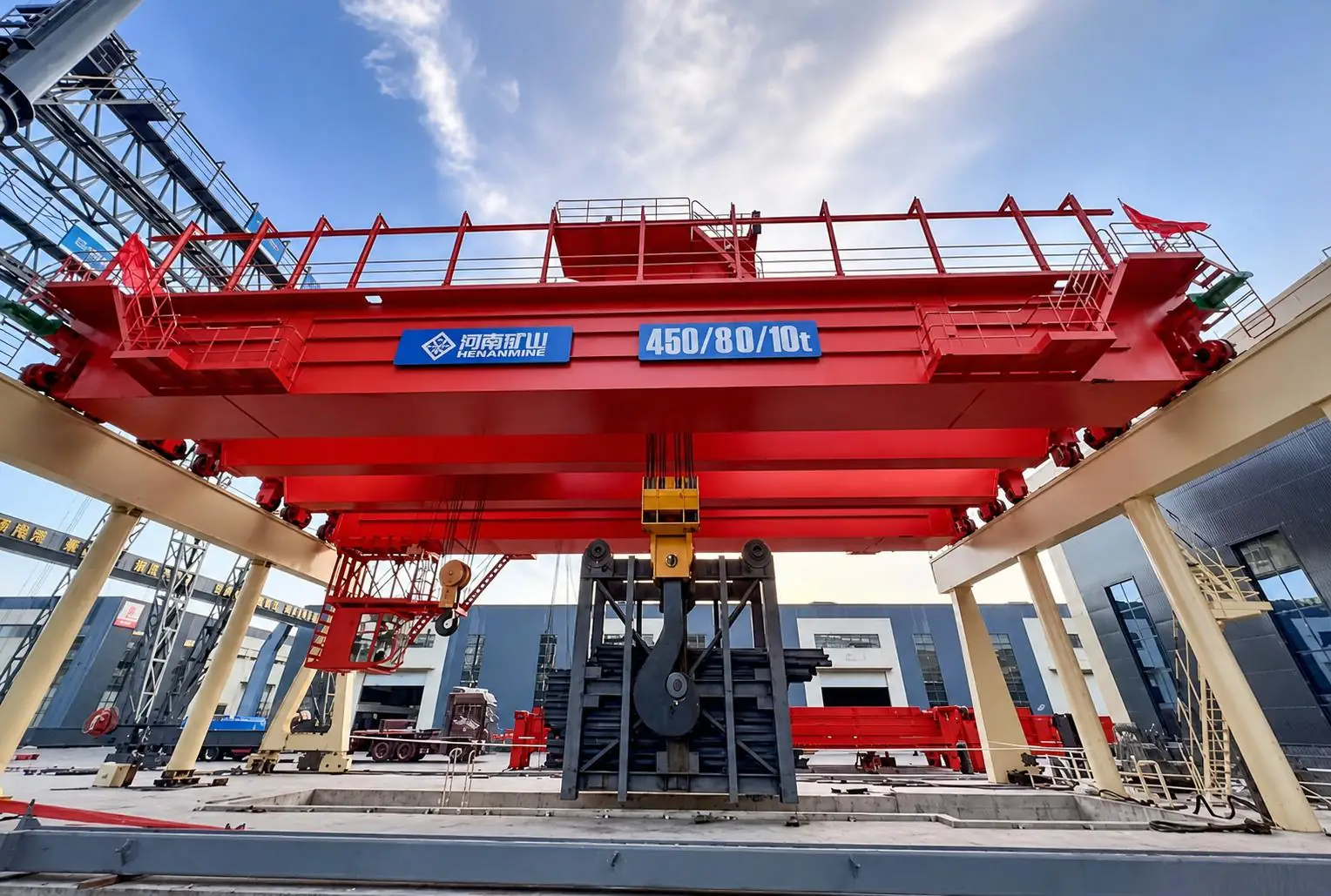
Factory workshops, steel structure processing plants, and transformer manufacturing plants often need to use bridge cranes to lift loads with offset center of gravity.If the position of the hook, the arrangement of the sling, or the load balance are not judged properly, problems such as tilt, swing, or uneven force may occur during the hoisting process, increasing the risk of equipment damage and personnel injury.Reasonably evaluate the center of gravity of the load, formulate a suitable hoisting plan, and select matching lifting equipment and spreaders, which will help improve the stability of hoisting, ensure the safety of operations, and reduce the additional wear and tear of key components of the bridge crane.
What Is an Eccentric Load in Overhead Crane Operations?
Understanding load eccentricity
Load eccentricity in bridge crane operation refers to the position of the center of gravity of a heavy object that does not coincide with the line of action of the lifting force of the hook, and the lifting force deviates from the center of gravity, resulting in additional overturning torque, which is different from concentric hoisting where the center of gravity falls on the vertical line of the hook.Even if the total load weight does not exceed the rated load of the crane, the bending moment and torsional force caused by eccentricity will still destroy the entire lifting system.The greater the eccentricity distance, the higher the additional torque, and the uneven force on the wire rope, spreader, main beam, and trolley wheel pressure will occur.Many on-site personnel mistakenly believe that it is safe as long as it is not overloaded, ignoring the hidden stress caused by eccentricity, which will accelerate component fatigue for a long time, and a single severe eccentricity will even cause load tilt and slippage at the moment of lifting.Identifying the load eccentricity is the first step in all non-standard workpiece hoisting operations.
Common eccentric load examples
Eccentric loads are very common in industrial sites, and a large number of non-standard workpieces naturally have a center of gravity offset.The cast thick-walled box, the transformer with a motor on one side, the long steel structure with heavy weight at one end, the material box with uneven internal material distribution, and the asymmetric welding frame are all typical eccentric loads.There are also temporary assembly equipment, molds for partial assembly parts, containers with internal fillers that can slide, and the center of gravity will shift twice after lifting.The design of the lug position in some scenes is unreasonable, and the hanging point and center of gravity are misplaced. Even if the shape is symmetrical, an eccentric load is still formed.This kind of workpiece is transferred very frequently in the workshop, and it is also a type of hoisting with a high incidence of bridge crane accidents. The position of the center of gravity must be evaluated separately before operation, and conventional symmetrical workpiece hoisting schemes cannot be applied.
Eccentric vs. uneven loads
Eccentric loads and uneven loads are often confused by on-site personnel, and there are obvious differences in the force mechanism and risk performance of the two.The core of the eccentric load is the offset of the center of gravity, and the line of action of the lifting force deviates from the center of gravity, resulting in a overturning bending moment, and the weight distribution of the load itself can be fixed.Uneven load refers to the uneven distribution of materials inside the load, and the center of gravity may move during the lifting process, such as bulk bins.Eccentric loads belong to the problem of geometric position offset, and uneven loads belong to the problem of dynamic center of gravity change.The same workpiece can have both eccentricity and uneven load characteristics at the same time.The eccentric load can be balanced by adjusting the hanging point and the position of the hook.In addition to adjusting the spreader for uneven loads, it is also necessary to fix the internal materials to prevent the center of gravity from sliding during lifting. The evaluation and control plans of the two cannot be equivalent.
What Risks Do Eccentric Loads Create During Lifting?
Load tilting and swinging
The moment the eccentric load is lifted off the ground, the most intuitive risk is the tilt and swing of the load.The offset of the center of gravity will cause the heavy object to automatically tilt to the heavier side, the length of the spreader force is inconsistent, and the load loses its horizontal attitude.Once the load is tilted, when the trolley or crane moves, a pendulum effect will form, and the load will continue to swing laterally, and the swing amplitude will increase with the operating speed.Swinging workpieces can easily hit workshop columns, shelves, and production line equipment, causing damage to workpieces and damage to plant structures.What is more dangerous is that the hanging point slides off by force after tilting, and heavy objects fall.It is difficult to rely on the operator to manually control the swing of the eccentric load. Simply slowing down the speed can only reduce the risk and cannot eliminate the root cause. The amount of eccentricity must be eliminated or suppressed before lifting.
Uneven forces on lifting gear
In the eccentric state, the force of lifting accessories such as slings, shackles, and lugs is no longer uniform, and the sling on one side close to the center of gravity will bear a load much higher than the other side, and a single sling will be overloaded.In many cases, the total load does not exceed the standard, but the stress of one-sided spreader breaks through the rated value, and the wire rope is extruded and deformed, the lug cracks, and the plastic deformation of the shackle occurs.Uneven force on the spreader can also cause the sling to twist and knot, further exacerbating the stress concentration.Most of these injuries are hidden injuries. A single hoisting will not break immediately, but fatigue cracks will be left. After multiple eccentric hoisting accumulates, the spreader will suddenly fail in subsequent conventional hoisting.For eccentric load operations, the selection of spreader cannot only refer to the total weight, but the actual force of each lifting point must be calculated separately.
Side pulling and component stress
Eccentric loads will naturally produce lateral tension, that is, cable-stayed side pull, which is a strictly restricted working condition for Henan Mine Crane Factory supply bridge cranes.After the hook is subjected to lateral force, the wire rope deviates from the vertical direction of the reel and squeezes the pulley groove, causing the wire rope to wear and change jobs, while introducing additional horizontal bending moments to the trolley, cart walking mechanism, and crane main beam.The main beam is subjected to bending+torsional composite stress, and the track and wheels are subjected to lateral thrust. Long-term eccentric hoisting will cause rim wear, track deformation, and trolley stagnation.Severe side pulling can even cause the car to derail.The factory rated load index of the crane is generally based on the vertical lifting conditions, and the eccentric side is pulled down, and the safety margin of the whole machine is greatly reduced, which can easily cause permanent structural damage.
How to Assess an Eccentric Load Before Lifting
Check load weight and center of gravity
The first step in eccentric load evaluation is to confirm the total weight of the workpiece and lock the center of gravity position.Regular workpieces can rely on drawings to calculate the center of gravity.Irregular castings and welded components need to be measured and estimated to have a center of gravity, and if necessary, they can be positioned by pre-test hoisting.After the center of gravity position is marked, the eccentric distance between the center of gravity and the preset hanging point is measured to calculate the overturning torque.The ancillary parts, pipelines, and counterweight blocks attached to the workpiece need to be included in the total weight and cannot be missed.If it is a box with movable filling, make sure that the material has been fixed to prevent the center of gravity from shifting during the lifting process.A complete record of weight, center of gravity coordinates, and eccentricity is used as the basic data for spreader selection and crane verification. It is strictly forbidden to judge the center of gravity position based on experience alone.
Identify unstable load points
After completing the center of gravity positioning, investigate the unstable hanging points and weak positions on the workpiece.Some workpiece lugs are temporary welding lugs, and the bearing capacity of the welds is insufficient.The workpiece shell is thin, and direct binding will cause local extrusion deformation.When the center of gravity is close to the edge of the workpiece, a small eccentricity will greatly amplify the risk of tilt, which is a highly unstable hanging point.It is also necessary to check whether the surface of the workpiece is smooth, the binding sling is at risk of slipping, and the sharp corners need to be protected by corner guards.At the same time, evaluate whether there are local protruding components of the workpiece, which can easily block the surrounding facilities when lifting and swinging.After identifying the unstable hanging point, the position of the hanging point should be replaced, the reinforcement tooling should be added, or the form of the spreader should be adjusted, and the eccentric load cannot be lifted directly at the weak point.
Calculate sling and lifting point forces
The eccentric load cannot simply estimate the sling force according to the equal weight, and the load of each sling point needs to be calculated separately by means of the torque formula.When the center of gravity is tilted to one side, the hanging point near the center of gravity bears most of the load, and the tension of the sling will increase synchronously with the angle between the slings.When calculating, the angle between the slings, the eccentricity distance, and the weight of the workpiece should all be included, and the rated load of each sling and shackle should be confirmed to be greater than the calculated maximum force.At the same time, reserve the safety factor to avoid the impact load of dynamic lifting.If the calculation results show that the load of a single lifting point exceeds the rated capacity of the spreader, it is necessary to increase the number of lifting points, replace the spreader with a higher bearing capacity or use a balance beam, and the original spreader cannot be forcibly used to lift the eccentric workpiece.
Verify crane capacity and hook position
After the force accounting of the lifting point is completed, check the capacity of the Henan Mine Crane Factory supply bridge crane and the position of the hook.The rated load of the crane is suitable for vertical concentric lifting. Under eccentric working conditions, the composite stress of the main beam, trolley, and wheels should be reviewed to confirm that the whole machine still meets the safety standards under the additional bending moment.The hook must be able to be adjusted directly above the center of gravity. If the travel of the trolley is limited and cannot be aligned, it cannot be hoisted directly.At the same time, check the status of the hoist and pulley block to confirm that there is no damage to the wire rope.It is also necessary to evaluate the working space and reserve a safety gap for the tilt and swing of the load.When the eccentric torque exceeds the allowable range of the crane design, a larger crane should be replaced, or special balancing tooling should be used to reduce the impact of eccentricity.
How to Handle Eccentric Loads with an Overhead Crane
Position the hook correctly
The core operation of handling eccentric loads is to precisely arrange the hooks vertically above the center of gravity of the load.The offset of the hook position is the most important cause of eccentric hoisting accidents.The operator moves the cart and trolley, and repeatedly fine-tunes the horizontal position of the hook until the vertical line of the hook passes through the center of gravity.After the adjustment is completed, gently lift until the wire rope is just tight, and observe the posture of the workpiece again to confirm that it is not tilted on one side.If the workpiece is tilted, it means that the hook still deviates from the center of gravity and needs to fall back to the ground to readjust the position of the hook, and it is forbidden to lift forcibly.For lifting eccentric workpieces, it is absolutely impossible to rely on cable-stayed workpieces to align the hooks. Cable-stayed workpieces will produce lateral forces, damage the crane structure, and bury major safety risks.
Select suitable lifting attachments
For eccentric loads, it is necessary to choose a special sling for adaptation, and ordinary slings cannot be used directly to bundle.The adjustable balance beam is preferred for eccentric hoisting. The balance beam can flexibly adjust the span of the lifting point, apportion the unbalanced torque, and limit the tilt of the load.For workpieces with a large center of gravity offset, multiple sets of shackles and sling combinations can be used to protect the edges of the workpiece with angle guards.The material and rated load of the spreader must match the hanging point to calculate the force, and the angle of the sling must be controlled within a reasonable range to avoid the surge of tension caused by small angles.Check the spreader for cracks, wear, and deformation before each use, and scrap it immediately if damage occurs.Customized spreaders need to be verified by lifting engineers to ensure that the spreaders can withstand the unbalanced tension caused by eccentricity.
Adjust lifting points for balance
After the position of the hook is fixed, the eccentricity effect is offset by adjusting the position of the hanging point.If the position of the lug of the workpiece is fixed, the length of the sling can be changed, and the hanging point on the side of the workpiece can be raised to keep the workpiece horizontal after lifting.When multiple hanging points are laid out, the spacing between the hanging points is redistributed to reduce the offset distance between the center of gravity and the center of the hanging point.Some non-standard workpieces do not have reserved lugs, and temporary lugs can be welded. The position of the lugs needs to be verified by strength.After adjusting the hanging point, check that all slings remain effectively tensioned and cannot relax the slings, otherwise the load will impact and flip at the moment of lifting.The adjustment of the lifting point belongs to the core link of the hoisting plan, and the layout of the lifting point needs to be recorded in writing for major eccentric hoisting.
Perform a trial lift
Test hoisting must be performed before the formal transfer. Test hoisting is a key step to verify the effectiveness of the complete eccentric hoisting scheme.Slowly lift the load, control the height from the ground to 100~200mm, hover for a period of time, and observe the attitude of the workpiece, the force of the spreader, and the crane for abnormal deformation.Focus on checking whether the workpiece is tilted, whether the sling is sliding, and whether the Henan Mine Crane Factory supply crane has signs of lateral force.During the test hoisting period, special personnel will be arranged to observe the status of each hoisting point, main beam, and trolley in the safe area.Once abnormalities such as tilt and slip are found, the load will fall smoothly immediately, and the hanging point and hook position will be re-optimized, or the spreader will be replaced.After the test crane confirms that it is stable and there is no abnormality, it can enter the subsequent horizontal transfer operation.
Control crane movements
During the whole process of eccentric load transfer, the crane must move at a low speed and smoothly, and emergency start, emergency stop, and rapid change of direction are prohibited.The acceleration and deceleration of carts and trolleys should be gentle, so as to reduce the inertial force and cause the load to swing.The operator maintains a visual observation of the load state. Once the swing occurs, do not yank the trolley in reverse to offset the swing, and wait for the load to stabilize naturally before continuing to move.The operating path cleans up obstacles in advance, delineates alert areas, and prohibits personnel from passing and staying under the load.The lifting action is also operated slowly to avoid the impact load amplifying the eccentric bending moment.The eccentric load is transported at a low altitude throughout the whole process to reduce the risk of falling. After reaching the target position, it will land smoothly, and then release the spreader after confirming that the load is stable.
How to Choose the Right Overhead Crane Configuration for Eccentric Loads
Choose a suitable crane type
Long-term frequent hoisting of eccentric loads requires targeted selection of bridge cranes.Single-beam bridge cranes are suitable for conditions with mild eccentricity and small load and weight.Double-girder bridge cranes are preferred for heavy-duty eccentric and large overturning torque conditions. The double-girder structure has stronger torsional resistance and can withstand the composite bending moment caused by eccentricity.If the eccentric working conditions of the workpiece in the workshop are changeable, you can also consider a double trolley bridge crane, which is lifted in concert with the double trolley, and the center of gravity offset is balanced synchronously through the double lifting points.When selecting the model, it is not only to look at the rated lifting weight, but also to evaluate the cross-section of the main beam, the track, and the anti-lateral load capacity of the wheel set.In long-term eccentric operation scenarios, the safety factor of the crane structure is higher than that of conventional concentric hoisting equipment.
Consider hoist and trolley positioning
The arrangement of the hoist and trolley directly affects the lifting capacity of the eccentric load.Conventional fixed trolley, the range of movement of the hook is limited.In workshops with more eccentric workpieces, a model with a larger trolley stroke can be selected to facilitate the movement of the hook directly above the center of gravity.The dual-trolley scheme can independently control the lifting of two hoists, dynamically adjust the height of the hanging points on both sides, and automatically compensate for the tilt caused by eccentricity.At the purchase stage, communicate with the manufacturer the daily eccentricity range, so that engineers can optimize the wheel pressure design of the trolley and strengthen the trolley’s anti-lateral force structure.At the same time, a synchronous control system is optional to maintain the synchronization of lifting and lowering when the double hoist is hoisted, so as to avoid the load flip caused by excessive lifting on one side, and to adapt to the normal hoisting of workpieces with offset center of gravity.
Use specialized lifting attachments
In addition to the crane body, the supporting special spreader system is an important component of the eccentric load scheme.Adjustable spreader beam (spreader beam) is the most commonly used tooling, which is suitable for workpieces with large length and asymmetric center of gravity, and can slide the lug to flexibly adjust the spacing of the hanging points.For heavy-duty workpieces with multiple hanging points, frame-type hanging beams can be used to disperse multi-point loads.It can also be used with tension monitoring sensors to view the force of each sling in real time and find the force imbalance in advance.The spreader needs to be designed in conjunction with the crane, and the weight of the crane beam must also be included in the total lifting load, and the crane capacity must be checked.The original supporting spreader can ensure that it matches the performance of the Henan Mine Crane Factory supply crane. Compared with the outsourcing of scattered spreaders, the overall safety is higher and the hoisting risks caused by mismatches are reduced.
Verify the complete lifting capacity
Under eccentric load conditions, the crane capacity verification cannot only look at the rated load of the nameplate, and the comprehensive bearing capacity of the whole machine needs to be verified.The verification includes the weight of the workpiece, the weight of the spreader, the weight of the balance beam, the additional bending moment and lateral force generated by the superposition of eccentricity, and the strength and stability of the main beam, end beam, trolley, track, wire rope, and reel are checked.It is also necessary to consider the lifting impact coefficient and operating inertial load, and reserve sufficient safety margin.If the verification finds that the local structural stress exceeds the standard, it is necessary to upgrade the crane specifications, strengthen the main beam structure, or limit the maximum allowable eccentricity distance.Provide a complete calculation book before delivery, clarify the eccentricity range of the crane allowed to be hoisted, and give the on-site operation boundary.
How Can a Crane Manufacturer Help with Eccentric Load Handling?
Review load and lifting requirements
Professional crane manufacturers can deeply sort out the eccentric hoisting conditions of the factory, and collect parameters such as workpiece size, weight, center of gravity position, common eccentric distance, workshop space restrictions, and daily hoisting frequency.The engineer will understand the type of workpiece, determine whether the eccentricity is a fixed center of gravity offset or a dynamic variable center of gravity, and record the layout of the workshop operation track and the height of the workshop.Identify hoisting pain points based on on-site working conditions, judge the safety vulnerabilities in the current operation process, and distinguish between mild eccentric and high-risk eccentric operation scenarios.Through the review of working conditions, clarify the lifting constraints, and provide complete input for crane selection, structure customization, and spreader matching, so as to avoid the purchase of equipment that cannot be adapted to the lifting needs of eccentric workpieces.
Recommend suitable lifting equipment
Based on the results of the working condition review, the crane manufacturer recommends a matching host and spreader combination plan.For mild eccentricity, it is recommended that standard double-girder cranes be equipped with adjustable balance beams.For large eccentric and heavy workpieces, a double trolley bridge crane + multi-point hanging beam system is recommended.At the same time, recommendations for sling and shackle specifications are given, and the safety factor of the sling and the angle control requirements of the sling are clarified.The manufacturer will also provide guidance and suggestions for hoisting operations, mark the allowable eccentricity limit value, and the main points of the test hoisting process.The complete set of solutions takes into account the cost of equipment procurement and the safety of long-term operations, so as to avoid the waste of budget caused by customers blindly purchasing large-tonnage cranes, or insufficient equipment selection, and long-term risky operations under over-limit eccentric working conditions.
Customize crane configurations
When standard models cannot meet the needs of high-frequency eccentric hoisting, manufacturers can provide customized bridge cranes.Engineers optimized the cross-section of the main beam, improved the torsional and bending resistance, strengthened the anti-lateral force structure of the trolley wheels and tracks, and upgraded the hoist system.The dual-trolley model can be customized with a synchronous lifting control system to realize synchronous fine-tuning of the lifting points on both sides.Load monitoring and tilt alarm modules can also be added to provide real-time warning of load imbalance during hoisting.The customization stage synchronously optimizes the hook stroke and the moving range of the trolley to facilitate the alignment of the center of gravity of the eccentric load.All customized changes will be mechanically calculated to ensure that the structure of the whole machine is stable and reliable within the design eccentricity range, and to meet the long-term lifting of non-standard workpieces in the workshop.
Confirm specifications before production
Before the official production, the manufacturer outputs a full set of technical documents, including the crane general drawing, the mechanical verification report, the eccentric working condition bearing description, the spreader drawing, and the customer’s technical team to confirm the parameters one by one.Check the rated load, the maximum allowable eccentricity, the parameters of the spreader, the control function, and the size of the plant interface, and confirm that all parameters match the requirements of on-site hoisting.Conduct technical reports on key risk items, clarify the boundaries of equipment use, and inform which eccentric working conditions exceed the scope of equipment design, and prohibit operations.After the parameters are confirmed to be correct, manufacturing will start.This process can avoid early communication deviations, prevent the equipment from being found to be unable to adapt to eccentric load hoisting after completion, and reduce rework and construction period losses.
Henan Mine Crane Factory Custom
Eccentric load hoisting must not only consider the rated lifting weight of the bridge crane, but also comprehensively evaluate the center of gravity of the workpiece, the position of the lifting point, the configuration of the spreader and the actual operating conditions.For industrial scenarios such as steel structure processing and transformer manufacturing, reasonable crane configuration and matching hoisting accessories can help reduce load tilt, uneven force, and additional stress on equipment components, and improve the stability and safety of the hoisting process.
Henan Mine Crane Factory can provide single-beam and double-beam bridge cranes and customized lifting solutions according to different hoisting needs.Whether it is a workpiece with an offset center of gravity, an irregularly shaped load, or a production condition that requires repeated precise hoisting, the appropriate equipment configuration should be determined based on the actual load characteristics and workshop conditions.If you are planning an eccentric load hoisting project, you can provide workpiece weight, size, center of gravity position, hoisting requirements and workshop drawings to obtain targeted crane configuration recommendations and project plans to help the equipment better adapt to actual production needs.